

Loading...

Top
Help
×

By creating an account you can:

Logo TaxTMI
Call Us / Help / Feedback

Contact Us At :

E-mail: [email protected]

Call / WhatsApp at: +91 99117 96707

For more information, Check Contact Us

FAQs :

To know Frequently Asked Questions, Check FAQs

Most Asked Video Tutorials :

For more tutorials, Check Video Tutorials

Submit Feedback/Suggestion :

Email :
Please provide your email address so we can follow up on your feedback.
Category :
Description :
Min 15 characters 0/2000
Make Most of Text Search
  1. Checkout this video tutorial: How to search effectively on TaxTMI.
  2. Put words in double quotes for exact word search, eg: "income tax"
  3. Avoid noise words such as : 'and, of, the, a'
  4. Sort by Relevance to get the most relevant document.
  5. Press Enter to add multiple terms/multiple phrases, and then click on Search to Search.
  6. Text Search
  7. The system will try to fetch results that contains ALL your words.
  8. Once you add keywords, you'll see a new 'Search In' filter that makes your results even more precise.
  9. Text Search
Add to...
You have not created any category. Kindly create one to bookmark this item!
Create New Category
Hide
Title :
Description :
❮❮ Hide
Default View
Expand ❯❯
Close ✕
🔎 News - Adv. Search
TEXT SEARCH:

Press 'Enter' to add multiple search terms. Rules for Better Search

Search In:
Main Text + AI Text
  • Main Text
  • Main Text + AI Text
  • AI Text
Category: ?
Categorized by AI
---- All Categories ----
  • ---- All Categories ----
  • Income Tax
  • GST
  • Customs, DGFT & SEZ
  • FEMA & RBI
  • Corp. Laws, SEBI & IBC
  • PMLA, Black Money & ED
  • Budget
  • News and Press Release
  • PTI News
Month:
---- All Months ----
  • ---- All Months ----
  • January
  • February
  • March
  • April
  • May
  • June
  • July
  • August
  • September
  • October
  • November
  • December
Year:
---- All Years ----
  • ---- All Years ----
  • 2026
  • 2025
  • 2024
  • 2023
  • 2022
  • 2021
  • 2020
  • 2019
  • 2018
  • 2017
  • 2016
  • 2015
  • 2014
  • 2013
  • 2012
  • 2011
Sort By: ?
In Sort By 'Default', exact matches for text search are shown at the top, followed by the remaining results in their regular order.
Relevance Default Date
    Why Most People Choose the Wrong Savings Account And How Not to Be One of Them
    RBI has proactively helped UCBs; cooperatives should look at regulator differently: Shah
    Ministry of Agriculture, Food and Rural Affairs and aT Host '2026 K-Food Fair in New Delhi, India'
    No compromise on tackling illegal immigrants' issue: Minister Priyank Kharge
    Technology, transparency key for urban cooperative banks to stay competitive: Shah
    Paul Merchants Gets RBI Approval for Perpetual AD Category-II Licence Under Revised FEMA Framework
    IEPFA Organises Stakeholder Engagement with Nodal Officers of Companies on Integrated IEPFA Portal 2.0
    Rupee settles with 5 paise gain at 95.17 against US dollar
    India weathered Hormuz disruption without fuel shortages: Puri
    RBI invites public comments on the draft Directions on ‘Credit Valuation Adjustment (CVA) Framework’
    RBI invites comments on the draft “Reserve Bank of India (Commercial Banks – Prudential Norms on Capital Adequacy) Eleventh Amendment Directions, ...
    87 Proposals Received under BHAVYA Scheme during First Round of Phase-I
    India successfully concludes the 16th BRICS Trade Ministers' Meeting in Jaipur under its BRICS Chairship 2026
    GeM Completes a Decade of Transforming Public Procurement with Cumulative GMV Exceeding ₹20 Lakh Crore
    NEWS HIGHLIGHTS
    India's forex kitty swells by USD 10.5 bn to USD 692.87 bn
    Rs 5,000 cr credited to 6.22 lakh Maharashtra farmers so far under loan waiver scheme: Fadnavis
    SBI Life and J&K Bank partner to bring comprehensive life insurance solutions closer to families across India
    DRI intensifies vigil along India's North-Eastern Frontier
    Vijayan slams Kerala govt's move to end doorstep pension delivery through cooperative banks
❯❯
Maximize Maximize Maximize
0 / 200
Expand Note
Add to Folder

No Folders have been created

+

Are you sure you want to delete "My most important" ?

NOTE:

News
Showing Results for :
Reset Filters
Results Found:
Show All Summaries Hide All Summaries
August 8, 2026
Show AI Summary
Savings account selection requires comparison of effective interest, fees, digital service, access, and individual banking needs.
Savings-account selection should compare effective interest returns under slab-based rates, recurring operating charges and the customer's actual banking needs. Net value depends not only on advertised rates but also on relevant minimum-balance, card, ATM, alert and transfer fees. Digital reliability, customer support, branch availability and ATM access should be assessed according to the customer's average balance, cash use, transfer frequency, travel patterns and need for in-person assistance. The suitable account is one that matches real banking behaviour.
August 8, 2026
Show AI Summary
Urban cooperative bank regulation promotes licensing, governance, compliance support and cybersecurity measures to strengthen stability and depositor confidence.
Urban cooperative banks are encouraged to recognise regulatory support through liberalised branch opening, doorstep banking, demand drafts, life certificates, dedicated regulatory coordination, enhanced gold-loan limits, one-time settlements and progress towards on-tap licensing. Sound governance is material to sectoral stability, while small-borrower lending is presented as a comparatively safe lending segment. The umbrella body can support member banks through technical expertise, compliance assistance, cybersecurity solutions and participation in a security operations centre to strengthen depositor confidence.
August 8, 2026
Show AI Summary
Korean food export promotion combines buyer consultations, regulatory guidance and consumer experiences to support entry into Indian and South Asian markets.
Korean food export promotion in India and South Asia combined business consultations with consumer-facing activities. Individual meetings connected Korean exporters with regional buyers and generated memoranda of understanding for products including frozen gimbap, ginseng wine and kombucha. Exporters received on-site guidance concerning non-tariff barriers, including food import customs clearance and certification requirements. Preparatory online sessions addressed import procedures, regulatory matters and consumer trends, while consumer events promoted Korean food through tasting, retail and experiential activities.
August 8, 2026
Show AI Summary
Illegal immigration enforcement prioritises dismantling entry, documentation and employment networks while requiring citizens to report information through police channels.
Illegal immigration enforcement involves continuous identification and verification operations, coordination with relevant officials, and confidential investigation of networks facilitating entry, identity documentation, accommodation and employment. Enquiries extend to intermediaries, contractors, Aadhaar procurement and verification practices, rather than focusing only on apprehended individuals. Citizen vigilantism, moral policing and social-media targeting of suspected migrants are discouraged because they may compromise investigations; information should instead be given through proper police channels.
August 8, 2026
Show AI Summary
Technology, transparency and governance strengthen urban cooperative banks through modern customer services, depositor protection and cooperative-sector support.
Technology adoption, transparency, sound governance and modern customer services are identified as necessary for urban cooperative banks to remain competitive. Banks are encouraged to join the sector's umbrella organisation and self-regulatory body, which provides capital, information-technology infrastructure and liquidity support. Protection of depositors' money remains a regulatory responsibility, while banks are expected to improve governance, train staff, adopt technology and enhance customer-centric services. Customer prosperity and reduced perception gaps between the central bank and urban cooperative banks are emphasised as measures to strengthen the sector.
August 8, 2026
Show AI Summary
Authorised Dealer Category-II licensing expands permissible FEMA current account and foreign trade transaction services for cross-border payment customers.
An Authorised Dealer Category-II approval under the Foreign Exchange Management (Authorised Persons) Regulations, 2026 enables Paul Merchants to undertake additional permissible non-trade current account transactions under FEMA, excluding gifts and donations, and foreign trade transactions within the applicable per-transaction limit. The approval supports foreign exchange and cross-border payment services, including overseas remittances for education, medical treatment, travel, and conference or event participation.
August 8, 2026
Show AI Summary
Integrated investor claim portal modernisation advances digital KYC, streamlined verification, stakeholder-informed safeguards, and efficient investor claim settlement services.
Integrated IEPFA Portal 2.0 is proposed to modernise investor claim processing through digital KYC, pre-filled Form IEPF-5, entitlement search, and a simplified e-Verification Report filing workflow. Stakeholder feedback included Aadhaar eKYC address validation, KYC for authorised representatives, entitlement-letter validation checks, bulk DSC and eSign functionality, integration of approved IEPF Form-4 data, lower-value share valuation using NSE and BSE data, and alerts for frequent address changes to prevent fraud.
August 7, 2026
Show AI Summary
Foreign capital inflows supported the rupee despite geopolitical uncertainty, oil-price pressures, and volatile global market sentiment.
Foreign capital inflows supported a marginal strengthening of the rupee against the US dollar despite global risk aversion arising from uncertainty surrounding negotiations affecting the Strait of Hormuz. Higher crude oil prices and weak domestic equity sentiment remained relevant pressures. Near-term currency movement was expected to depend on developments in the negotiations, weekend decisions, US employment data, the dollar index, crude oil prices, and the reported increase in foreign exchange reserves.
August 7, 2026
Show AI Summary
Energy security through diversified sourcing protected fuel supplies during Hormuz disruption and supports domestic exploration and alternative fuels.
Energy security measures based on diversified crude oil and LPG sourcing, expanded infrastructure, increased domestic LPG production and alternative fuels were presented as maintaining fuel availability during disruption of shipping through the Strait of Hormuz. Domestic resilience is also linked to support for private deep-water oil and gas exploration, opening offshore acreage, and expansion of compressed biogas and ethanol blending. Ethanol-blended petrol testing identified limited contamination instances rather than a systemic issue, while excise duty reductions were described as cushioning consumers against global fuel-price volatility.
August 7, 2026
Show AI Summary
Credit valuation adjustment framework revises derivative capital requirements through flexible basic approaches, hedge recognition, and risk-sensitive counterparty treatment.
Credit Valuation Adjustment framework revisions align CVA capital treatment with final Basel III standards. Eligible banks may use the full or reduced basic approach, while banks with an insignificant volume of non-centrally cleared derivatives may calculate their CVA capital charge at 100 per cent of the counterparty credit risk capital charge. The draft also clarifies CVA hedge recognition, introduces risk weights sensitive to sector and credit quality, and separates systematic and idiosyncratic CVA risk in the full basic approach.
August 7, 2026
Show AI Summary
Leverage ratio framework amendments propose Basel-aligned capital adequacy standards, with public feedback invited on the draft directions.
Proposed amendments to the leverage ratio framework would revise Chapter VII of the 2025 Commercial Banks Prudential Norms on Capital Adequacy Directions to implement the Basel Committee's Leverage Ratio 2017 Standard. Public comments and feedback on the draft Eleventh Amendment Directions, 2026, are invited until August 28, 2026, through the designated online platform, postal submission, or email.
August 7, 2026
Show AI Summary
BHAVYA Scheme project selection uses challenge-based evaluation of infrastructure, industrial ecosystems, and policy enablers under prescribed eligibility criteria.
BHAVYA Scheme Phase-I proposals submitted by State and Union Territory governments will be evaluated and scored under prescribed eligibility and evaluation criteria. Challenge-based project selection considers connectivity and site suitability, quality of core, value-added and social infrastructure in the detailed project report, and the industrial ecosystem and policy enablers. The Scheme guidelines provide for completion of the first-phase selection process within one year from notification.
August 7, 2026
Show AI Summary
Multilateral trade cooperation preserves developing economies' policy space while advancing MSME finance, diversified value chains and digital services.
BRICS ministers adopted measures supporting a development-centred multilateral trading system with the World Trade Organization at its core, preservation of Special and Differential Treatment, binding two-tier dispute settlement, and developing economies' policy space for food security and public stockholding. MSME measures include study of an invoice discounting mechanism and credit-assessment principles focused on cash flow rather than collateral. Value-chain measures provide for a GVC Action Plan, technical cooperation, Special Economic Zone cooperation and digitised trade documents, alongside principles for trusted cross-border digitally delivered services.
August 7, 2026
Show AI Summary
Digital public procurement promotes transparent sourcing, reduced seller charges, competition monitoring and evidence-based spending oversight through an integrated marketplace.
Government e-Marketplace digitises public procurement through a unified platform promoting transparency, efficiency, good governance and wider supplier participation. Seller-facing measures include reduced transaction charges, exemption of smaller orders, a cap on maximum transaction fees and reduced vendor assessment fees. The platform uses Artificial Intelligence and Machine Learning tools to identify suspected cartelisation, collusion and order splitting, while its digital transactional trail supports expenditure monitoring, identification of inefficiencies and evidence-based policy interventions.
August 7, 2026
Show AI Summary
Criminal justice, extremist-material regulation and administrative schemes feature in reports on prosecutions, demolition practices, loan waivers and fuel policy.
Criminal justice reports cover bail and an expedited trial in an assault prosecution, arrest for allegedly sheltering an accused, allegations of rape and murder of a minor, and claimed irregularities in a police recruitment examination. Regulatory developments include a ban on extremist literature associated with proscribed organisations and judicial disapproval of coercive demolition. Administrative coverage includes farmer loan-waiver transfers following Aadhaar authentication and debate over the E20 fuel-blending programme.
August 7, 2026
Show AI Summary
Foreign exchange reserves rose as foreign currency assets, gold holdings, Special Drawing Rights and IMF reserve position increased.
India's foreign exchange reserves increased during the week ended July 31, principally because of higher foreign currency assets and gold reserves. Foreign currency assets include US dollar valuation effects arising from movements in currencies such as the euro, pound and yen. Special Drawing Rights and India's reserve position with the International Monetary Fund also increased. The movement followed measures to attract foreign exchange inflows, including an FCNR(B) measure, after earlier reserve declines associated with rupee pressure and dollar sales for foreign exchange market intervention.
August 7, 2026
Show AI Summary
Farm loan waiver eligibility depends on verified beneficiary status and Aadhaar authentication for direct credit of eligible crop-loan relief.
The farm loan waiver scheme covers eligible short-term crop loans within the prescribed ceiling and eligibility period. Waiver amounts are credited to verified bank accounts after field verification and completion of Aadhaar authentication. Aadhaar authentication is the operative condition for automatic processing of benefits, while eligibility rules and technical conditions have raised concerns about exclusion of distressed farmers.
August 7, 2026
Show AI Summary
Corporate agency distribution expands access to life insurance products, supporting insurance awareness, financial inclusion and long-term household financial protection.
A corporate agency arrangement enables J&K Bank to distribute SBI Life Insurance protection, savings, retirement and child-oriented life insurance plans through its branch network. The partnership aims to improve insurance access, awareness, financial literacy and long-term financial planning for households, particularly in Jammu & Kashmir and Ladakh. It is intended to expand insurance penetration, strengthen household financial protection and support financial inclusion in line with the IRDAI vision of "Insurance for All by 2047".
August 7, 2026
Show AI Summary
Cross-border smuggling controls target narcotics, poppy seeds and areca nuts entering through the Indo-Myanmar border region.
Cross-border smuggling enforcement targeted methamphetamine, foreign-origin poppy seeds and areca nuts allegedly brought from Myanmar. Methamphetamine concealed in an ambulance was seized under the NDPS Act, 1985. Poppy seeds and areca nuts recovered in separate operations were seized under the Customs Act, 1962. Poppy-seed imports are restricted to designated countries and require registration to ensure traceability and prevent illicit produce entering legitimate supply chains. The enforcement action addresses circumvention of customs controls and regulated import requirements.
August 7, 2026
Show AI Summary
Direct benefit transfer for welfare pensions replaces cooperative-bank doorstep delivery, while retaining limited home service for excluded beneficiaries.
Direct Benefit Transfer for social security and welfare pensions is to be made through Aadhaar-linked bank accounts, replacing cooperative-bank doorstep delivery. Home delivery remains available for bedridden persons and others who cannot be excluded. The change is associated with delays in remitting undistributed amounts, record-update failures, reconciliation issues, duplicate payments, and incomplete Aadhaar-based payment implementation. Concerns have been raised that mandatory bank-account credit may disadvantage beneficiaries dependent on doorstep delivery.

News

Back

All News

Showing Results for :
Reset Filters
No Records Found

News

Back

All News

Showing Results for : Reset Filters
Customs, DGFT & SEZ

Make in India and the Capital Goods Revolution

April 3, 2025

Contents
Summary
Note

Note

-

Bookmark

Print

Print

Catalyzing Domestic Production and Technological Innovation

Introduction

According to the Ministry of Heavy Industries, heavy engineering and machine tools sector comprises of capital goods industry. India's capital goods sector is experiencing significant attention due to its critical role in driving industrial growth and economic development. This sector encompasses industries such as electrical equipment, machinery, and construction, which are essential for the country's infrastructure development. According to the Indian Electrical and Electronics Manufacturers’ Association (IEEMA), the electrical equipment industry witnessed consistent double-digit growth in power equipment, particularly transmission equipment and transformers, driven by domestic demand and international market expansion.

India is the third-largest market for construction equipment. Government initiatives have been instrumental in bolstering the capital goods sector. The Ministry of Heavy Industries has launched several policies to boost domestic production and reduce reliance on imports. These initiatives are part of the broader Make in India campaign (launched in 2014), which seeks to increase the manufacturing sector's contribution to GDP, generate employment, and improve technological capabilities. The capital goods sector is crucial to India's economic strategy, supporting large-scale manufacturing and infrastructure projects. With rapid urbanization, extensive infrastructure development, and strong government support, the sector is poised to drive sustainable industrial growth and elevate India's position in the global market.

Overview of the Heavy Industries and Engineering Sector
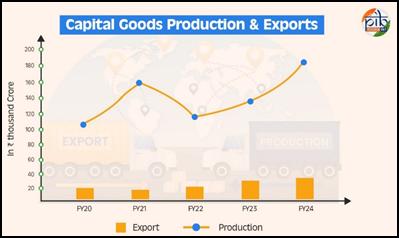
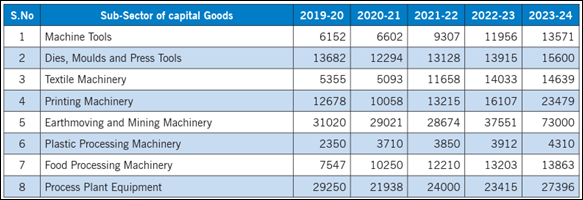
As per the present estimates, the Capital Goods industry contributes about 1.9% of GDP.  The Heavy Engineering and Machine Tool sector (capital goods industry) consists of the following major sub-sectors: Dies, Moulds and Press Tools; Plastic Machinery; Earthmoving and Mining Machinery; Metallurgical Machinery; Textile Machinery; Process Plant Equipment; Printing Machinery; and Food Processing Machinery. Due to catalytic effect of Ministry of Heavy Industries intervention, the production of capital goods sector has increased from Rs 2,29,533 crore in 2014-15 to Rs.4,29,001 crore in 2023-24. Production (in crores) by the sub-sectors of capital goods industry since 2019-20 are presented in the table below:
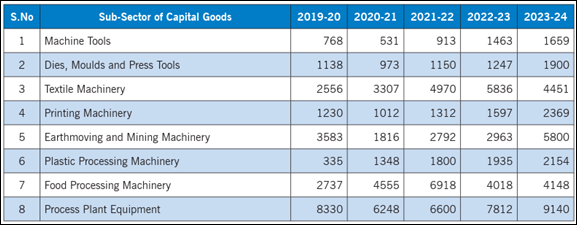
Exports (in crores) by the sub-sectors of capital goods industry since 2019-20 are presented in the table below:
The policy environment for the capital goods sector includes:

  • No industrial license is required for the sector.
  • FDI up to 100% permitted on automatic route (through RBI) except from the countries having land borders with India.
  • Quantum of payment for technology transfer, design and drawing, royalty, etc. to the foreign collaborator is not restricted.
  • There is no restriction on imports and exports.

The Union Budget 2025-26 proposes to add 35 additional capital goods for EV battery manufacturing, and 28 additional capital goods for mobile phone battery manufacturing to the list of exempted capital goods. This will boost domestic manufacture of lithium-ion battery, both for mobile phones and electric vehicles.

National Capital Goods Policy (2016)

The National Capital Goods Policy, formulated by the Ministry of Heavy Industries & Public Enterprises, is a comprehensive framework aims at boosting the capital goods sector in India. policy envisions increasing the sector's contribution to manufacturing activity from 12% (2016) to 20% by 2025. It seeks to make India one of the top capital goods producing nations, aiming to more than double production and increase exports to at least 40% of the total production. Furthermore, the policy aims to enhance the technology depth within the sector, moving from basic and intermediate levels to advanced levels.
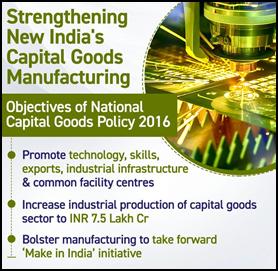
The major salient features of the policy are:

  1. To increase budgetary allocation and scope of the Scheme on Enhancement of Competitiveness in the Capital Goods Sector adding components i.e. skills, capacity building, advanced manufacturing and cluster development.
  2. To launch a Technology Development Fund under PPP model to fund technology acquisition/ transfer, purchase of IPRs/ designs and drawings/ commercialization.
  3. To set up regional State-of-the-Art Greenfield Centre of Excellence for skill development.
  4. To modernize existing CG manufacturing units, especially SMEs by replacing with the modern, computer controlled and energy efficient machineries across capital goods sub-sectors.
  5. To upgrade/ develop, testing and certification infrastructure.

The National Capital Goods Policy, 2016, inter alia, recommended increasing the budgetary allocation and scope of the Scheme on Enhancement of Competitiveness of Capital Goods which included setting up of Centers of Excellence, Common Engineering Facility Centers, Integrated Industrial Infrastructure Park and Technology Acquisition Fund Programme. These recommendations were incorporated in the Phase II of the scheme.

Scheme for Enhancement of Competitiveness in the Indian Capital Goods Sector Phase I

In order to address the skill gaps, infrastructure development and technology needs for the capital goods sector, Phase I of the capital goods scheme was rolled out in November 2014 which had the total outlay of Rs 995.96 crores. Phase I of the scheme fostered partnerships between academia and industry for engendering technology development with government support. The outcome of the Scheme has proved the efficacy of the strategies deployed for technology and industrial infrastructure development.

  • Centre of Excellence (CoE): 8 CoEs have been established wherein 30 niche indigenous technologies have been successfully developed in the fields of machine tools, additive manufacturing, textile machinery, welding robots and alloys design, earth moving machinery, and sensor technologies at national research institutes of eminence such as Indian Institute of Technology (IITs), Indian Institute of Sciences (IISc), Central Manufacturing Technology Institute (CMTI) etc.
  • Common Engineering Facility Centres (CEFC) - 15 CEFCs including four Industry 4.0 SAMARTH centres and six Web-Based Technology Innovation Platforms (TIPs) have been setup. Industry 4.0 SAMARTH centres are at Indian Institute of Sciences at Bengaluru, Centre for Industry 4.0 (C4i4) lab at Pune, Central Manufacturing Technology Institute (CMTI) at Bengaluru and Indian Institute of Technology (IIT) Delhi.
  • The six web-based open manufacturing technology innovation platforms are helping in bringing all India’s technical resources and the concerned Industry on to one platform to kick start and facilitate identification of technology problems faced by Indian Industry and crowd source solutions for the same in a systematic manner so as to facilitate start-ups and angel funding of India innovations.
  • Over 76,000 students, experts, institutes, industries and labs have already registered on these platforms so far.
  • Technology Acquisition Fund Programme (TAFP) – Following 5 technologies have been acquired from abroad under TAFP:
  1. Development & Commercialization of Titanium Casting with Ceramic Shelling Technology;
  2. Manufacturing of Heavy-Duty High Reliability Electrical Specialized Power Cables;
  3. Development of Turn Mill Centre;
  4. Development of Four Guideway CNC Lathe;
  5. Cutting Edge Robotic Laser Cladding Technology.
  • Integrated Machine Tools Park, Tumakuru: An exclusive industrial park for machine tool industry has been developed across 530 acres at Tumkuru, Karnataka. So far, out of 336 acres of allottable land, 145 acres of land has been allotted to the machine tool manufacturers.

Under Phase- I of the Scheme for Enhancement of Competitiveness in the Indian Capital Goods Sector, 33 projects with budgetary support of Rs. 583.312 crore were sanctioned. After launching of the Capital Goods Scheme Phase II, The Phase I of the Capital Goods Scheme has been merged with Phase II of the Scheme.

Scheme for Enhancement of Competitiveness in the Indian Capital Goods Sector Phase II

Ministry of Heavy Industries notified the Phase 2 of the Scheme on January 25, 2022, with an objective to expand and enlarge the impact created by Phase I of the capital goods scheme, thereby providing greater impetus through creation of a strong and globally competitive capital goods sector. The scheme has a financial outlay of Rs. 1207 crores with budgetary support of Rs. 975 crore and industry contribution of Rs. 232 crores. Under the Phase II, a total of 33 projects with project cost of Rs 1366.94 crores (due to higher contribution by Industry) and government contribution of Rs 963.19 crore have been sanctioned by August 2024. There are six components under the Phase II and the details of the projects sanctioned so far are:

  • Setting up of New Advanced Centres of Excellence and augmentation of Existing Centres of Excellence: To expedite R&D by utilizing academia of repute and private industry which is involved in research and development activities. A total of 9 projects with the budget of Rs. 478.87 have been sanctioned so far.
  • Setting up of Common Engineering Facility Centres (CEFCs) and augmentation of existing CEFCs: For creating demonstration & training, consultancy, hand holding and R & D services and awareness programmes to industrial units. A total of 5 projects with the budget of Rs. 357.07 have been sanctioned so far.
  • Promotion of skilling in Capital Goods Sector: Creation of Qualification packages for skill levels 6 and above- in association with Skill Councils for skills level 6 and above. A total of 3 projects with the budget of Rs. 7.59 have been sanctioned so far.
  • Augmentation of Existing Testing and Certification Centres: To address the needs of Capital Goods Sector & Auto sector for testing of machinery in terms of various properties relating to mechanical, electrical, chemical, structural, metallurgical, electronics aspects etc. A total of 7 projects with the budget of Rs. 195.99 have been sanctioned so far.
  • Setting up of Industry Accelerators for Technology Development: Aimed at development of targeted indigenous technologies, scaled to meet the requirements of selected industry segment, which till now has been dependent on imports. Selected Academic Institute/ Industry Body will act as an Accelerator for fostering the development of such technologies. A total of 8 projects with the budget of Rs. 325.32 have been sanctioned so far.
  • Identification of Technologies through Technology Innovation Portals: Six Web-based open manufacturing technology innovation platforms have been developed under CG Scheme Phase-I. These are being supported under CG Scheme Phase-II.

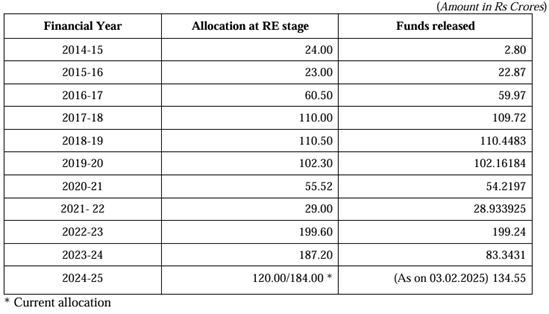
The details of the funds allocated and its utilization under the Scheme for Enhancement of Competitiveness in the Indian Capital Goods Sector Phase- I and II is as given in the table below:
Recent Achievements of the Capital Goods Scheme

  1. Sitarc, Coimbatore has indigenously developed a 6-inch BLDC submersible pump with a motor efficiency of 88% and a pump efficiency of 78% under the Capital Goods Scheme. This initiative promotes "Aatmanirbharta" by reducing the import of such pumps by 80%. This innovation was recognized as the best product in the pumps category by United Nations Industrial Development Organization (UNIDO).
  2. CMTI has developed a high-speed rapier loom machine capable of weaving yarns upto 450 RPM. This machine was launched at ITMA 2023 in Milan, Italy.
  3. Under the SAMARTH centre at CMTI, Industrial Internet of Things (IIOT) technology has been implemented in Toyota Engine Manufacturing line controlling 64 machines for preventive maintenance.
  4. A testing facilities for battery and Battery Management System (BMS) has been established at ARAI, Pune for the first time in India under the aegis of Ministry of Heavy Industries.
  5. 6 Smart Technologies, 5 Smart Tools, 14 solutions have been developed in digital twin, virtual reality, robotics, inspection, sustainability, additive manufacturing etc. by I-4.0 India @ IISc, Bengaluru;
  6. Under Industry Accelerator at ARAI-Advanced Mobility Transformation & Innovation Foundation (AMTIF) a high-voltage motor controller developed, which enabled the industry partner Raptee Energy Private Limited to launch a high-voltage motorcycle with electric car DNA.
  7. Under Industry Accelerator at ARAI-Advanced Mobility Transformation & Innovation Foundation (AMTIF) thermally stable sodium-ion batteries developed.

Bharat Heavy Electricals Limited (BHEL)

BHEL is a major contributor towards engineering and manufacturing capacity building for the Country. The company is carrying out following initiatives with support from Ministry of Heavy industries under the Capital Goods Scheme Phase II:

• BHEL has established a “Common Engineering Facility Centre (CEFC)” for skill development in Welding Technology at WRI Trichy along with its extension centers at Varanasi, Ranipet, Bhopal, Jhansi and Haridwar units of BHEL.

•  BHEL is establishing a testing facility comprising both Hardware in the Loop (HIL) and Software in the Loop (SIL) functionalities in the area of Industrial, Naval and Aircraft related processes at its Corporate R&D Unit at Hyderabad with support from Ministry of Heavy Industries.

Conclusion

The ‘Make in India’ initiative has had a transformative impact on the heavy industries and engineering sector. By fostering technological advancements, increasing domestic production, enhancing competitiveness, and generating employment, the initiative has played a pivotal role in strengthening India’s industrial base. With sustained policy support and continued investment, the sector is poised for further growth in the coming years.

References

https://www.investindia.gov.in/sector/capital-goods

https://pib.gov.in/PressReleseDetail.aspx?PRID=2098364

https://pib.gov.in/PressReleasePage.aspx?PRID=2085938

https://www.pib.gov.in/PressReleasePage.aspx?PRID=2042179

https://pib.gov.in/PressReleaseIframePage.aspx?PRID=2039020

https://www.indiabudget.gov.in/economicsurvey/doc/echapter.pdf

https://heavyindustries.gov.in/heavy-engineering-and-machine-tool

https://x.com/investindia/status/1302798627337723904?lang=ar-x-fm

https://heavyindustries.gov.in/sites/default/files/2023-07/Capital-Goods-Policy-Final.pdf

https://sansad.in/getFile/loksabhaquestions/annex/184/AU1227_CBVr5x.pdf?source=pqals

https://sansad.in/getFile/loksabhaquestions/annex/182/AU1375_e9YzYN.pdf?source=pqals

https://heavyindustries.gov.in/scheme-enhancement-competitiveness-indian-capital-goods-sector-phase-i

https://heavyindustries.gov.in/scheme-enhancement-competitiveness-indian-capital-goods-sector-phase-ii

https://heavyindustries.gov.in/sites/default/files/2025-02/heavy_annual_report_2024-25_final_27.02.2025_compressed.pdf

Topics

Acts Income Tax