

Loading...

Top
Help
×

By creating an account you can:

Logo TaxTMI
Call Us / Help / Feedback

Contact Us At :

E-mail: [email protected]

Call / WhatsApp at: +91 99117 96707

For more information, Check Contact Us

FAQs :

To know Frequently Asked Questions, Check FAQs

Most Asked Video Tutorials :

For more tutorials, Check Video Tutorials

Submit Feedback/Suggestion :

Email :
Please provide your email address so we can follow up on your feedback.
Category :
Description :
Min 15 characters 0/2000
Make Most of Text Search
  1. Checkout this video tutorial: How to search effectively on TaxTMI.
  2. Put words in double quotes for exact word search, eg: "income tax"
  3. Avoid noise words such as : 'and, of, the, a'
  4. Sort by Relevance to get the most relevant document.
  5. Press Enter to add multiple terms/multiple phrases, and then click on Search to Search.
  6. Text Search
  7. The system will try to fetch results that contains ALL your words.
  8. Once you add keywords, you'll see a new 'Search In' filter that makes your results even more precise.
  9. Text Search
Add to...
You have not created any category. Kindly create one to bookmark this item!
Create New Category
Hide
Title :
Description :
❮❮ Hide
Default View
Expand ❯❯
Close ✕
🔎 News - Adv. Search
TEXT SEARCH:

Press 'Enter' to add multiple search terms. Rules for Better Search

Search In:
Main Text + AI Text
  • Main Text
  • Main Text + AI Text
  • AI Text
Category: ?
Categorized by AI
---- All Categories ----
  • ---- All Categories ----
  • Income Tax
  • GST
  • Customs, DGFT & SEZ
  • FEMA & RBI
  • Corp. Laws, SEBI & IBC
  • PMLA, Black Money & ED
  • Budget
  • News and Press Release
  • PTI News
Month:
---- All Months ----
  • ---- All Months ----
  • January
  • February
  • March
  • April
  • May
  • June
  • July
  • August
  • September
  • October
  • November
  • December
Year:
---- All Years ----
  • ---- All Years ----
  • 2026
  • 2025
  • 2024
  • 2023
  • 2022
  • 2021
  • 2020
  • 2019
  • 2018
  • 2017
  • 2016
  • 2015
  • 2014
  • 2013
  • 2012
  • 2011
Sort By: ?
In Sort By 'Default', exact matches for text search are shown at the top, followed by the remaining results in their regular order.
Relevance Default Date
    SIDBI organizes a conclave of the Heads of Regional Rural Banks (RRBs) on expanding SIDBI-RRB MSME Co-Lending arrangement
    SC sets aside show cause notice to Tata Steel over input tax credit availed during FY19-23
    HC flags fraudulent use of Aadhaar by infiltrators to get Indian citizenship; calls for action
    IVCA Welcomes Consultative Approach on Draft FEMA NDI Rules
    India to be among top 5 Nestle markets in coming years, a major export hub : Global CEO
    Build Credit Awareness with a Free Credit Score Check from Bajaj Finance
    CARD91 Introduces Five-Point Credit Lifecycle Consistency Framework for Credit Line on UPI
    RBI's Proposed Shift from Revolving Credit to Term Loans: SwiffyLabs Lending Platform Already Supports the New Construct
    The US and Canada could pull back from an all-out trade war. It's not clear that they will
    Indian Community in Japan Playing Key Role in Strengthening India-Japan Ties: Commerce and Industry Minister Shri Piyush Goyal
    Union Minister of Commerce and Industry Shri Piyush Goyal Chairs India-Japan Industry Roundtable on Semiconductors and Artificial Intelligence in Toky...
    National Traders’ Welfare Board Holds 100th VC Meeting to Strengthen Engagement with Traders Across the Country
    CCI approves acquisition of 100% share capital of Tao Digital Solutions by Cyient Ltd
    CCI approves acquisition of 100% stake in Kestrel Coal Group Pty Ltd. by Yancoal Australia from certain sellers
    HC bench releases Skoda Volkswagen USD 1.4 billion tax case sans verdict; matter to be heard afresh
    Canada strikes back at US with retaliatory tariffs as trade war escalates
    Rupee rises 26 paise to close at 95.44 against US dollar
    Economy shows resilience to global headwinds with buoyant domestic demand: RBI bulletin
    Goyal promises BIS certification relief for high-tech sector firms
    IICA Conducts inaugural session of 11th Batch of its Certified CSR Professional Programme
❯❯
Maximize Maximize Maximize
0 / 200
Expand Note
Add to Folder

No Folders have been created

+

Are you sure you want to delete "My most important" ?

NOTE:

News
Showing Results for :
Reset Filters
Results Found:
Show All Summaries Hide All Summaries
August 26, 2026
Show AI Summary
MSME co-lending supports digital paperless credit delivery through rural banks for underserved rural and semi-urban enterprises.
SIDBI-RRB MSME co-lending arrangement is proposed for expansion to increase credit access for micro, small and medium enterprises in rural and semi-urban areas. The arrangement combines SIDBI's understanding of MSME credit requirements with Regional Rural Banks' local reach. SIDBI's Co-Lending Origination Platform provides an end-to-end digital credit process intended to enable faster, paperless loan processing, in-principle sanction communication, documentation and direct account disbursement without branch visits.
August 26, 2026
Show AI Summary
Input tax credit mismatch alone cannot support fraud-based GST demand without an assessing officer's recorded satisfaction of fraud or suppression.
Section 74 GST demand proceedings require the assessing officer's independent satisfaction of fraud, wilful misstatement or suppression of facts. An input tax credit mismatch or alleged short payment alone cannot establish these conditions. Unsupported assertions of suppression for invoking extended limitation are insufficient, and audit objections cannot replace the assessing officer's satisfaction. A show cause-cum-demand notice lacking factual allegations of a deliberate device to evade tax or avail excess input tax credit is vulnerable.
August 26, 2026
Show AI Summary
Fraudulent Aadhaar procurement exposes identity-verification gaps and prompts disclosure, expedited investigation, deportation, and statutory review measures.
Fraudulent procurement of Aadhaar and other identity documents by foreign nationals who infiltrate borders may undermine identity verification, immigration control and national security. Coordinated action is required to trace and deport such persons, prevent re-entry, strengthen document verification, and complete investigations without delay. Amendments to the Aadhaar Act are to be considered to assist investigating agencies, while a dedicated procedure is required to address border infiltration and human trafficking. Aadhaar enrolment records are to be supplied to police, followed by timely deportation proceedings.
August 26, 2026
Show AI Summary
Foreign investment liberalisation proposals receive industry support, subject to preserving AIF treatment, grandfathering, and prospective application.
Proposed foreign-investment liberalisation, including treatment of stakes below 10 per cent and a greater role for market forces in valuation, is welcomed. Preservation of the existing treatment of Alternative Investment Funds under the IOCC framework is emphasised, together with grandfathering of transactions and funds undertaken under the current regulatory position. Newly introduced requirements should operate prospectively to support a simpler, predictable and investment-friendly foreign-investment framework.
August 26, 2026
Show AI Summary
India market expansion guides Nestle 's volume-led growth, export-hub development and long-term investment without compromising product quality.
Nestle 's India strategy focuses on volume-led growth, wider consumer reach, portfolio development, efficiency improvements and sustained long-term investment. Growth is intended to combine increased household penetration with pricing, premiumisation, affordability and value offerings. India is also intended to develop further as a production and export hub for global markets, supported by manufacturing capacity and expanding overseas supplies. Product quality and consumer interests remain constraints on the pace of expansion.
August 26, 2026
Show AI Summary
Credit awareness through regular score and report review supports responsible borrowing, error detection, and informed credit management.
Free online access to the Credit Pulse Report is available through the Bajaj Finance website. Users verify their registered mobile number through OTP authentication, provide identifying particulars including PAN and date of birth, and then view the available credit score. The report may be reviewed and downloaded to examine repayment history, active credit accounts, recent enquiries and other recorded credit information. Periodic review can help identify unfamiliar accounts, inaccurate repayment records, overdue amounts, unupdated information and changes in credit utilisation.
August 26, 2026
Show AI Summary
Credit lifecycle consistency requires facility-specific treatment so UPI-linked credit records, repayments and customer obligations remain aligned.
CARD91's Credit Lifecycle Consistency Framework calls for facility-specific treatment of Credit Line on UPI transactions and continuing credit events. Credit limits, outstanding balances, repayments, refunds, reversals and EMI conversions should be accurately connected to the relevant customer account and applied according to the underlying facility's terms. Bank policy, customer consent, transaction controls and portfolio actions should remain aligned. Customer-facing applications, statements and alerts should consistently reflect available credit, outstanding obligations and repayment schedules, while disputes and manual corrections follow documented, reviewable processes.
August 26, 2026
Show AI Summary
Non-revolving credit lines require term-loan structures supporting multiple drawdowns without replenishing sanctioned limits for NBFC lending products.
Proposed restrictions on revolving credit facilities for most NBFCs would generally require credit products to operate as term loans, rather than facilities in which principal repayment automatically restores the available borrowing limit. Compliance may require technology capable of managing multiple drawdowns within an approved sanction, separate repayment schedules, amortisation and servicing workflows, while preventing repaid principal from replenishing the sanctioned limit.
August 26, 2026
Show AI Summary
Reciprocal trade tariffs intensify as negotiations confront market access, cultural protections, industrial safeguards, and sovereignty concerns.
US-Canada tariff escalation involves reciprocal import duties following failed negotiations over market access and trade in dairy, alcoholic beverages, automobiles, steel, aluminium and softwood lumber. United States tariff action relies on a rarely used trade-law power permitting duties against countries considered to discriminate against American businesses, without a prior investigation or stated time limit. Negotiations also raised concerns about protection of major industries, cultural protections and Canada's freedom to conclude trade agreements with other countries.
August 26, 2026
Show AI Summary
Diaspora engagement supports skilled mobility, investment links, remittances, and citizen welfare while encouraging compliance with local laws.
Indian diaspora engagement in Japan supports bilateral goodwill, business links, investment opportunities and people-to-people ties. Skilled Indian professionals are encouraged to understand local requirements, learn Japanese language and culture, and pursue opportunities in healthcare, trades, engineering, artificial intelligence, accountancy and maritime work. Diaspora members are also encouraged to maintain connections with India, contribute through digital education and knowledge-sharing, and comply with local laws and regulations. Remittances and government support for citizens' welfare, safety and crisis assistance abroad are recognised as important aspects of diaspora engagement.
August 26, 2026
Show AI Summary
Semiconductor and AI cooperation advances through industry engagement, investment facilitation, and accelerated economic partnership review.
India-Japan cooperation in semiconductors and artificial intelligence is being strengthened through industry engagement, investment facilitation, technology partnerships and an economic-security-oriented framework. India's semiconductor strategy covers chip design, machinery and materials, fabrication, ATMP/OSAT, research, and talent development, supported by Semicon India initiatives. Bilateral engagement also seeks to address industry concerns, expand manufacturing and innovation partnerships, and accelerate review of the Comprehensive Economic Partnership Agreement to reflect emerging economic opportunities.
August 26, 2026
Show AI Summary
Virtual trader engagement platform strengthens weekly grievance feedback, policy information sharing, and institutional dialogue between government and trading communities.
The Virtual Conference Interaction Meetings provide a weekly, accessible forum for retail traders to engage with the Government, receive information on relevant schemes, policies and reforms, and submit grievances and suggestions. The platform enables recurring concerns to be identified and communicated to concerned Ministries and Departments for consideration and redressal. It seeks to strengthen institutionalised dialogue, feedback, transparency, trust and cooperation between the Government and the trader community.
August 26, 2026
Show AI Summary
Competition clearance for full acquisition permits Cyient to acquire Tao Digital Solutions, a global digital transformation and technology services provider.
Competition Commission of India approved Cyient Limited's acquisition of 100% of Tao Digital Solutions Inc.'s share capital from its existing shareholders. The full share capital acquisition transfers complete ownership of Tao Digital Solutions to Cyient. Tao Digital Solutions provides global digital transformation and technology services, including product engineering, managed services, cybersecurity, payments, digitization and AI, cloud services, and data services, and operates in India through its wholly owned subsidiary, Tao Digital India Private Limited.
August 26, 2026
Show AI Summary
Competition clearance for full coal-sector acquisition addresses limited Indian market links through metallurgical and thermal coal sales.
Competition approval covers Yancoal Australia Limited's acquisition of 100% equity interest and warrants in Kestrel Coal Group Pty Ltd. The target holds an 80% interest in the Kestrel Joint Venture, which operates a Queensland coal mine producing principally metallurgical coal and a smaller volume of thermal coal. Neither the acquirer nor the target has a physical presence in India. Their Indian nexus is limited to coal exports and the joint venture's sales of metallurgical coal into India.
August 25, 2026
Show AI Summary
Customs classification of unassembled vehicle imports requires fresh hearing after reserved tax challenge was released without verdict.
The dispute concerns customs classification of imported unassembled vehicle parts. Customs authorities allege that parts imported in separate shipments should have been declared as completely knocked down (CKD) units, attracting the higher duty applicable to CKD imports, rather than as individual components subject to lower duty. The manufacturer contests the resulting customs demand. Proceedings have been released for fresh hearing before the regular indirect-tax writ bench, with status quo maintained for four weeks.
August 25, 2026
Show AI Summary
Retaliatory tariffs on imported goods escalate trade measures, targeting key sectors while maintaining support for affected domestic businesses.
Canada has imposed retaliatory tariffs on United States-origin industrial and consumer goods following increased United States tariffs on Canadian goods. Effective 8 September, the measures apply at rates of 15%, 25% and 50% across more than 700 products, including steel, aluminium, appliances, dairy products, seafood, furniture, clothing, pulp and paper, and electronics. Existing countertariffs on automobiles remain in force. The measures seek to protect domestic businesses and reduce imports, supported by assistance for affected workers and businesses amid risks to integrated cross-border supply chains.
August 25, 2026
Show AI Summary
Foreign-exchange market intervention and lower crude prices supported rupee appreciation, while USD/INR remained range-bound amid shifting dollar conditions.
Foreign-exchange market conditions supported rupee appreciation against the US dollar, driven by stronger domestic equity markets, a weaker US dollar and lower crude oil prices. The USD/INR pair remained broadly range-bound, with oil-price movements and Reserve Bank intervention identified as key near-term influences. The special USD-INR foreign-exchange swap facility for FCNR(B) deposits, overseas foreign-currency borrowings and external commercial borrowings mobilised substantial foreign-exchange inflows.
August 25, 2026
Show AI Summary
Section 301 tariffs may have lower impact where major exports remain outside their scope amid resilient domestic demand.
Economic resilience is attributed to buoyant domestic demand, increased manufacturing and services activity, improving liquidity conditions, credit growth, investment activity and rebounding foreign capital inflows. Recovery in the southwest monsoon improved kharif sowing and reservoir storage, partly mitigating agricultural-sector risks. US Section 301 tariffs are expected to have a comparatively lower effect because major Indian exports to the United States, including smartphones, petroleum products and pharmaceuticals, remain outside their scope. Foreign direct investment improved with higher gross inflows, while outward foreign direct investment continued to decline.
August 25, 2026
Show AI Summary
BIS certification exemptions may be structured for high-tech manufacturers to ensure timely equipment imports and support domestic manufacturing operations.
Mandatory Bureau of Indian Standards (BIS) certification requirements for equipment and components used by high-technology manufacturers may be addressed through a proposed exemption framework. Possible exemptions may be structured at the company, industry, product, project or bulk level to support timely availability of imported equipment, goods and services for manufacturing operations. The approach is directed at high-technology industries generally, particularly semiconductor and artificial intelligence sectors, while addressing delays associated with mandatory certification and complex procedures for specialised imported parts and equipment.
August 25, 2026
Show AI Summary
Corporate social responsibility should prioritise measurable community outcomes, transparency, capable implementing agencies, and strategic integration with sustainability objectives.
Corporate social responsibility should prioritise measurable community outcomes rather than expenditure alone. Effective CSR depends on community-responsive design, capable implementing agencies, rigorous monitoring, social audits, and transparent use of technology and data. Public sector enterprises may use thematic priorities, convergence with government programmes, and institutional collaboration to replace isolated interventions with strategic CSR. CSR capacity building encompasses legal and regulatory frameworks, governance, project planning, impact assessment, reporting, ESG and the Social Stock Exchange.

News

Back

All News

Showing Results for :
Reset Filters
No Records Found

News

Showing Results for : Reset Filters
Customs, DGFT & SEZ

Make in India and the Capital Goods Revolution

April 3, 2025

Contents
Summary
Note

Note

-

Bookmark

Print

Print

Catalyzing Domestic Production and Technological Innovation

Introduction

According to the Ministry of Heavy Industries, heavy engineering and machine tools sector comprises of capital goods industry. India's capital goods sector is experiencing significant attention due to its critical role in driving industrial growth and economic development. This sector encompasses industries such as electrical equipment, machinery, and construction, which are essential for the country's infrastructure development. According to the Indian Electrical and Electronics Manufacturers’ Association (IEEMA), the electrical equipment industry witnessed consistent double-digit growth in power equipment, particularly transmission equipment and transformers, driven by domestic demand and international market expansion.

India is the third-largest market for construction equipment. Government initiatives have been instrumental in bolstering the capital goods sector. The Ministry of Heavy Industries has launched several policies to boost domestic production and reduce reliance on imports. These initiatives are part of the broader Make in India campaign (launched in 2014), which seeks to increase the manufacturing sector's contribution to GDP, generate employment, and improve technological capabilities. The capital goods sector is crucial to India's economic strategy, supporting large-scale manufacturing and infrastructure projects. With rapid urbanization, extensive infrastructure development, and strong government support, the sector is poised to drive sustainable industrial growth and elevate India's position in the global market.

Overview of the Heavy Industries and Engineering Sector
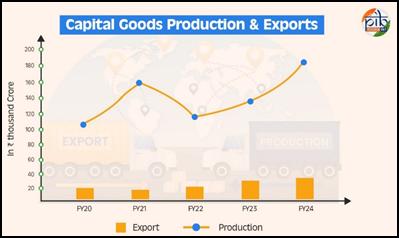
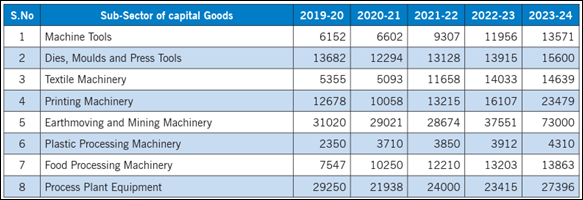
As per the present estimates, the Capital Goods industry contributes about 1.9% of GDP.  The Heavy Engineering and Machine Tool sector (capital goods industry) consists of the following major sub-sectors: Dies, Moulds and Press Tools; Plastic Machinery; Earthmoving and Mining Machinery; Metallurgical Machinery; Textile Machinery; Process Plant Equipment; Printing Machinery; and Food Processing Machinery. Due to catalytic effect of Ministry of Heavy Industries intervention, the production of capital goods sector has increased from Rs 2,29,533 crore in 2014-15 to Rs.4,29,001 crore in 2023-24. Production (in crores) by the sub-sectors of capital goods industry since 2019-20 are presented in the table below:
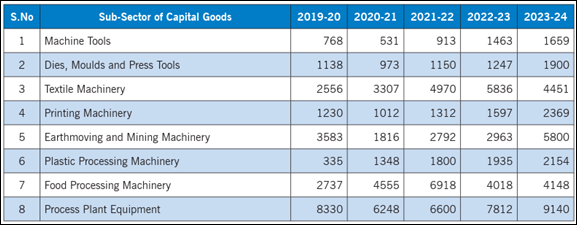
Exports (in crores) by the sub-sectors of capital goods industry since 2019-20 are presented in the table below:
The policy environment for the capital goods sector includes:

  • No industrial license is required for the sector.
  • FDI up to 100% permitted on automatic route (through RBI) except from the countries having land borders with India.
  • Quantum of payment for technology transfer, design and drawing, royalty, etc. to the foreign collaborator is not restricted.
  • There is no restriction on imports and exports.

The Union Budget 2025-26 proposes to add 35 additional capital goods for EV battery manufacturing, and 28 additional capital goods for mobile phone battery manufacturing to the list of exempted capital goods. This will boost domestic manufacture of lithium-ion battery, both for mobile phones and electric vehicles.

National Capital Goods Policy (2016)

The National Capital Goods Policy, formulated by the Ministry of Heavy Industries & Public Enterprises, is a comprehensive framework aims at boosting the capital goods sector in India. policy envisions increasing the sector's contribution to manufacturing activity from 12% (2016) to 20% by 2025. It seeks to make India one of the top capital goods producing nations, aiming to more than double production and increase exports to at least 40% of the total production. Furthermore, the policy aims to enhance the technology depth within the sector, moving from basic and intermediate levels to advanced levels.
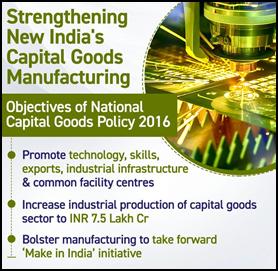
The major salient features of the policy are:

  1. To increase budgetary allocation and scope of the Scheme on Enhancement of Competitiveness in the Capital Goods Sector adding components i.e. skills, capacity building, advanced manufacturing and cluster development.
  2. To launch a Technology Development Fund under PPP model to fund technology acquisition/ transfer, purchase of IPRs/ designs and drawings/ commercialization.
  3. To set up regional State-of-the-Art Greenfield Centre of Excellence for skill development.
  4. To modernize existing CG manufacturing units, especially SMEs by replacing with the modern, computer controlled and energy efficient machineries across capital goods sub-sectors.
  5. To upgrade/ develop, testing and certification infrastructure.

The National Capital Goods Policy, 2016, inter alia, recommended increasing the budgetary allocation and scope of the Scheme on Enhancement of Competitiveness of Capital Goods which included setting up of Centers of Excellence, Common Engineering Facility Centers, Integrated Industrial Infrastructure Park and Technology Acquisition Fund Programme. These recommendations were incorporated in the Phase II of the scheme.

Scheme for Enhancement of Competitiveness in the Indian Capital Goods Sector Phase I

In order to address the skill gaps, infrastructure development and technology needs for the capital goods sector, Phase I of the capital goods scheme was rolled out in November 2014 which had the total outlay of Rs 995.96 crores. Phase I of the scheme fostered partnerships between academia and industry for engendering technology development with government support. The outcome of the Scheme has proved the efficacy of the strategies deployed for technology and industrial infrastructure development.

  • Centre of Excellence (CoE): 8 CoEs have been established wherein 30 niche indigenous technologies have been successfully developed in the fields of machine tools, additive manufacturing, textile machinery, welding robots and alloys design, earth moving machinery, and sensor technologies at national research institutes of eminence such as Indian Institute of Technology (IITs), Indian Institute of Sciences (IISc), Central Manufacturing Technology Institute (CMTI) etc.
  • Common Engineering Facility Centres (CEFC) - 15 CEFCs including four Industry 4.0 SAMARTH centres and six Web-Based Technology Innovation Platforms (TIPs) have been setup. Industry 4.0 SAMARTH centres are at Indian Institute of Sciences at Bengaluru, Centre for Industry 4.0 (C4i4) lab at Pune, Central Manufacturing Technology Institute (CMTI) at Bengaluru and Indian Institute of Technology (IIT) Delhi.
  • The six web-based open manufacturing technology innovation platforms are helping in bringing all India’s technical resources and the concerned Industry on to one platform to kick start and facilitate identification of technology problems faced by Indian Industry and crowd source solutions for the same in a systematic manner so as to facilitate start-ups and angel funding of India innovations.
  • Over 76,000 students, experts, institutes, industries and labs have already registered on these platforms so far.
  • Technology Acquisition Fund Programme (TAFP) – Following 5 technologies have been acquired from abroad under TAFP:
  1. Development & Commercialization of Titanium Casting with Ceramic Shelling Technology;
  2. Manufacturing of Heavy-Duty High Reliability Electrical Specialized Power Cables;
  3. Development of Turn Mill Centre;
  4. Development of Four Guideway CNC Lathe;
  5. Cutting Edge Robotic Laser Cladding Technology.
  • Integrated Machine Tools Park, Tumakuru: An exclusive industrial park for machine tool industry has been developed across 530 acres at Tumkuru, Karnataka. So far, out of 336 acres of allottable land, 145 acres of land has been allotted to the machine tool manufacturers.

Under Phase- I of the Scheme for Enhancement of Competitiveness in the Indian Capital Goods Sector, 33 projects with budgetary support of Rs. 583.312 crore were sanctioned. After launching of the Capital Goods Scheme Phase II, The Phase I of the Capital Goods Scheme has been merged with Phase II of the Scheme.

Scheme for Enhancement of Competitiveness in the Indian Capital Goods Sector Phase II

Ministry of Heavy Industries notified the Phase 2 of the Scheme on January 25, 2022, with an objective to expand and enlarge the impact created by Phase I of the capital goods scheme, thereby providing greater impetus through creation of a strong and globally competitive capital goods sector. The scheme has a financial outlay of Rs. 1207 crores with budgetary support of Rs. 975 crore and industry contribution of Rs. 232 crores. Under the Phase II, a total of 33 projects with project cost of Rs 1366.94 crores (due to higher contribution by Industry) and government contribution of Rs 963.19 crore have been sanctioned by August 2024. There are six components under the Phase II and the details of the projects sanctioned so far are:

  • Setting up of New Advanced Centres of Excellence and augmentation of Existing Centres of Excellence: To expedite R&D by utilizing academia of repute and private industry which is involved in research and development activities. A total of 9 projects with the budget of Rs. 478.87 have been sanctioned so far.
  • Setting up of Common Engineering Facility Centres (CEFCs) and augmentation of existing CEFCs: For creating demonstration & training, consultancy, hand holding and R & D services and awareness programmes to industrial units. A total of 5 projects with the budget of Rs. 357.07 have been sanctioned so far.
  • Promotion of skilling in Capital Goods Sector: Creation of Qualification packages for skill levels 6 and above- in association with Skill Councils for skills level 6 and above. A total of 3 projects with the budget of Rs. 7.59 have been sanctioned so far.
  • Augmentation of Existing Testing and Certification Centres: To address the needs of Capital Goods Sector & Auto sector for testing of machinery in terms of various properties relating to mechanical, electrical, chemical, structural, metallurgical, electronics aspects etc. A total of 7 projects with the budget of Rs. 195.99 have been sanctioned so far.
  • Setting up of Industry Accelerators for Technology Development: Aimed at development of targeted indigenous technologies, scaled to meet the requirements of selected industry segment, which till now has been dependent on imports. Selected Academic Institute/ Industry Body will act as an Accelerator for fostering the development of such technologies. A total of 8 projects with the budget of Rs. 325.32 have been sanctioned so far.
  • Identification of Technologies through Technology Innovation Portals: Six Web-based open manufacturing technology innovation platforms have been developed under CG Scheme Phase-I. These are being supported under CG Scheme Phase-II.

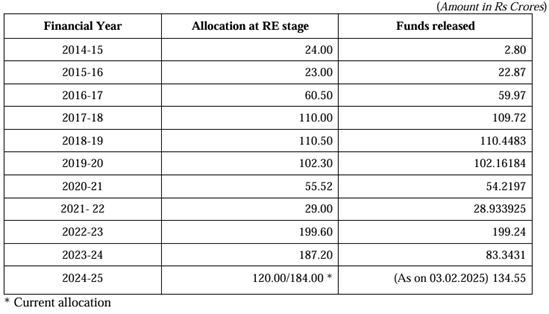
The details of the funds allocated and its utilization under the Scheme for Enhancement of Competitiveness in the Indian Capital Goods Sector Phase- I and II is as given in the table below:
Recent Achievements of the Capital Goods Scheme

  1. Sitarc, Coimbatore has indigenously developed a 6-inch BLDC submersible pump with a motor efficiency of 88% and a pump efficiency of 78% under the Capital Goods Scheme. This initiative promotes "Aatmanirbharta" by reducing the import of such pumps by 80%. This innovation was recognized as the best product in the pumps category by United Nations Industrial Development Organization (UNIDO).
  2. CMTI has developed a high-speed rapier loom machine capable of weaving yarns upto 450 RPM. This machine was launched at ITMA 2023 in Milan, Italy.
  3. Under the SAMARTH centre at CMTI, Industrial Internet of Things (IIOT) technology has been implemented in Toyota Engine Manufacturing line controlling 64 machines for preventive maintenance.
  4. A testing facilities for battery and Battery Management System (BMS) has been established at ARAI, Pune for the first time in India under the aegis of Ministry of Heavy Industries.
  5. 6 Smart Technologies, 5 Smart Tools, 14 solutions have been developed in digital twin, virtual reality, robotics, inspection, sustainability, additive manufacturing etc. by I-4.0 India @ IISc, Bengaluru;
  6. Under Industry Accelerator at ARAI-Advanced Mobility Transformation & Innovation Foundation (AMTIF) a high-voltage motor controller developed, which enabled the industry partner Raptee Energy Private Limited to launch a high-voltage motorcycle with electric car DNA.
  7. Under Industry Accelerator at ARAI-Advanced Mobility Transformation & Innovation Foundation (AMTIF) thermally stable sodium-ion batteries developed.

Bharat Heavy Electricals Limited (BHEL)

BHEL is a major contributor towards engineering and manufacturing capacity building for the Country. The company is carrying out following initiatives with support from Ministry of Heavy industries under the Capital Goods Scheme Phase II:

• BHEL has established a “Common Engineering Facility Centre (CEFC)” for skill development in Welding Technology at WRI Trichy along with its extension centers at Varanasi, Ranipet, Bhopal, Jhansi and Haridwar units of BHEL.

•  BHEL is establishing a testing facility comprising both Hardware in the Loop (HIL) and Software in the Loop (SIL) functionalities in the area of Industrial, Naval and Aircraft related processes at its Corporate R&D Unit at Hyderabad with support from Ministry of Heavy Industries.

Conclusion

The ‘Make in India’ initiative has had a transformative impact on the heavy industries and engineering sector. By fostering technological advancements, increasing domestic production, enhancing competitiveness, and generating employment, the initiative has played a pivotal role in strengthening India’s industrial base. With sustained policy support and continued investment, the sector is poised for further growth in the coming years.

References

https://www.investindia.gov.in/sector/capital-goods

https://pib.gov.in/PressReleseDetail.aspx?PRID=2098364

https://pib.gov.in/PressReleasePage.aspx?PRID=2085938

https://www.pib.gov.in/PressReleasePage.aspx?PRID=2042179

https://pib.gov.in/PressReleaseIframePage.aspx?PRID=2039020

https://www.indiabudget.gov.in/economicsurvey/doc/echapter.pdf

https://heavyindustries.gov.in/heavy-engineering-and-machine-tool

https://x.com/investindia/status/1302798627337723904?lang=ar-x-fm

https://heavyindustries.gov.in/sites/default/files/2023-07/Capital-Goods-Policy-Final.pdf

https://sansad.in/getFile/loksabhaquestions/annex/184/AU1227_CBVr5x.pdf?source=pqals

https://sansad.in/getFile/loksabhaquestions/annex/182/AU1375_e9YzYN.pdf?source=pqals

https://heavyindustries.gov.in/scheme-enhancement-competitiveness-indian-capital-goods-sector-phase-i

https://heavyindustries.gov.in/scheme-enhancement-competitiveness-indian-capital-goods-sector-phase-ii

https://heavyindustries.gov.in/sites/default/files/2025-02/heavy_annual_report_2024-25_final_27.02.2025_compressed.pdf

Topics

Acts Income Tax
