Loading...

Top
Help
×

By creating an account you can:

Logo TaxTMI
Call Us / Help / Feedback

Contact Us At :

E-mail: [email protected]

Call / WhatsApp at: +91 99117 96707

For more information, Check Contact Us

FAQs :

To know Frequently Asked Questions, Check FAQs

Most Asked Video Tutorials :

For more tutorials, Check Video Tutorials

Submit Feedback/Suggestion :

Email :
Please provide your email address so we can follow up on your feedback.
Category :
Description :
Min 15 characters 0/2000
Make Most of Text Search
  1. Checkout this video tutorial: How to search effectively on TaxTMI.
  2. Put words in double quotes for exact word search, eg: "income tax"
  3. Avoid noise words such as : 'and, of, the, a'
  4. Sort by Relevance to get the most relevant document.
  5. Press Enter to add multiple terms/multiple phrases, and then click on Search to Search.
  6. Text Search
  7. The system will try to fetch results that contains ALL your words.
  8. Once you add keywords, you'll see a new 'Search In' filter that makes your results even more precise.
  9. Text Search
Add to...
You have not created any category. Kindly create one to bookmark this item!
Create New Category
Hide
Title :
Description :
❮❮ Hide
Default View
Expand ❯❯
Close ✕
🔎 News - Adv. Search
TEXT SEARCH:

Press 'Enter' to add multiple search terms. Rules for Better Search

Search In:
Main Text + AI Text
  • Main Text
  • Main Text + AI Text
  • AI Text
Category: ?
Categorized by AI
---- All Categories ----
  • ---- All Categories ----
  • Income Tax
  • GST
  • Customs, DGFT & SEZ
  • FEMA & RBI
  • Corp. Laws, SEBI & IBC
  • PMLA, Black Money & ED
  • Budget
  • News and Press Release
  • PTI News
Month:
---- All Months ----
  • ---- All Months ----
  • January
  • February
  • March
  • April
  • May
  • June
  • July
  • August
  • September
  • October
  • November
  • December
Year:
---- All Years ----
  • ---- All Years ----
  • 2026
  • 2025
  • 2024
  • 2023
  • 2022
  • 2021
  • 2020
  • 2019
  • 2018
  • 2017
  • 2016
  • 2015
  • 2014
  • 2013
  • 2012
  • 2011
Sort By: ?
In Sort By 'Default', exact matches for text search are shown at the top, followed by the remaining results in their regular order.
Relevance Default Date
    NEWS HIGHLIGHTS
    India's forex kitty swells by USD 10.5 bn to USD 692.87 bn
    Rs 5,000 cr credited to 6.22 lakh Maharashtra farmers so far under loan waiver scheme: Fadnavis
    SBI Life and J&K Bank partner to bring comprehensive life insurance solutions closer to families across India
    DRI intensifies vigil along India's North-Eastern Frontier
    Vijayan slams Kerala govt's move to end doorstep pension delivery through cooperative banks
    Kerala to stop welfare pension delivery through cooperative banks, shifts to DBT
    China's exports slow slightly in July despite robust demand for high-tech products
    India successfully concludes the Tenth BRICS Industry Ministers' Meeting in Jaipur under its BRICS Chairship 2026
    APEDA Organises BIOFACH INDIA 2026 to Promote India's Certified Organic Products and Expand Global Market Access
    RBI bars banks from disabling mobile devices of defaulting borrowers
    Par panel for early conclusion of India-US trade pact, tariff exemptions on key goods
    No commitments relating to ethanol import from US for fuel blending under FTA talks: Govt
    No concession or commitment on import of Ethanol for fuel blending from the United States
    Office of the Controller General of Patents, Designs and Trade Marks Announces Tentative Schedule for Patent and Trade Marks Agent Examinations 2027 a...
    RBI invites comments on the draft “Reserve Bank of India (Non-Banking Financial Companies – Credit Facilities) Amendment Directions, 2026”
    West Bengal seeks 100pc foodgrain, 40pc sugar jute packaging quota at SAC meeting
    RBI clasifies Tata Sons, 16 others as large NBFCs
    Sensex climbs 374 points on buying in Reliance, ICICI Bank; Nifty ends flat
    Insurance Division, DFS Secures 3rd Rank in Group A Category of Grievance Redressal Assessment & Index (GRAI) for June 2026
❯❯
Maximize Maximize Maximize
0 / 200
Expand Note
Add to Folder

No Folders have been created

+

Are you sure you want to delete "My most important" ?

NOTE:

News
Showing Results for :
Reset Filters
Results Found:
Show All Summaries Hide All Summaries
August 7, 2026
Show AI Summary
Criminal justice, extremist-material regulation and administrative schemes feature in reports on prosecutions, demolition practices, loan waivers and fuel policy.
Criminal justice reports cover bail and an expedited trial in an assault prosecution, arrest for allegedly sheltering an accused, allegations of rape and murder of a minor, and claimed irregularities in a police recruitment examination. Regulatory developments include a ban on extremist literature associated with proscribed organisations and judicial disapproval of coercive demolition. Administrative coverage includes farmer loan-waiver transfers following Aadhaar authentication and debate over the E20 fuel-blending programme.
August 7, 2026
Show AI Summary
Foreign exchange reserves rose as foreign currency assets, gold holdings, Special Drawing Rights and IMF reserve position increased.
India's foreign exchange reserves increased during the week ended July 31, principally because of higher foreign currency assets and gold reserves. Foreign currency assets include US dollar valuation effects arising from movements in currencies such as the euro, pound and yen. Special Drawing Rights and India's reserve position with the International Monetary Fund also increased. The movement followed measures to attract foreign exchange inflows, including an FCNR(B) measure, after earlier reserve declines associated with rupee pressure and dollar sales for foreign exchange market intervention.
August 7, 2026
Show AI Summary
Farm loan waiver eligibility depends on verified beneficiary status and Aadhaar authentication for direct credit of eligible crop-loan relief.
The farm loan waiver scheme covers eligible short-term crop loans within the prescribed ceiling and eligibility period. Waiver amounts are credited to verified bank accounts after field verification and completion of Aadhaar authentication. Aadhaar authentication is the operative condition for automatic processing of benefits, while eligibility rules and technical conditions have raised concerns about exclusion of distressed farmers.
August 7, 2026
Show AI Summary
Corporate agency distribution expands access to life insurance products, supporting insurance awareness, financial inclusion and long-term household financial protection.
A corporate agency arrangement enables J&K Bank to distribute SBI Life Insurance protection, savings, retirement and child-oriented life insurance plans through its branch network. The partnership aims to improve insurance access, awareness, financial literacy and long-term financial planning for households, particularly in Jammu & Kashmir and Ladakh. It is intended to expand insurance penetration, strengthen household financial protection and support financial inclusion in line with the IRDAI vision of "Insurance for All by 2047".
August 7, 2026
Show AI Summary
Cross-border smuggling controls target narcotics, poppy seeds and areca nuts entering through the Indo-Myanmar border region.
Cross-border smuggling enforcement targeted methamphetamine, foreign-origin poppy seeds and areca nuts allegedly brought from Myanmar. Methamphetamine concealed in an ambulance was seized under the NDPS Act, 1985. Poppy seeds and areca nuts recovered in separate operations were seized under the Customs Act, 1962. Poppy-seed imports are restricted to designated countries and require registration to ensure traceability and prevent illicit produce entering legitimate supply chains. The enforcement action addresses circumvention of customs controls and regulated import requirements.
August 7, 2026
Show AI Summary
Direct benefit transfer for welfare pensions replaces cooperative-bank doorstep delivery, while retaining limited home service for excluded beneficiaries.
Direct Benefit Transfer for social security and welfare pensions is to be made through Aadhaar-linked bank accounts, replacing cooperative-bank doorstep delivery. Home delivery remains available for bedridden persons and others who cannot be excluded. The change is associated with delays in remitting undistributed amounts, record-update failures, reconciliation issues, duplicate payments, and incomplete Aadhaar-based payment implementation. Concerns have been raised that mandatory bank-account credit may disadvantage beneficiaries dependent on doorstep delivery.
August 7, 2026
Show AI Summary
Direct Benefit Transfer for welfare pensions replaces doorstep cooperative-bank delivery, while home delivery remains for bedridden beneficiaries.
Direct Benefit Transfer of social security and welfare pensions is to be made mandatory through Aadhaar-linked bank accounts, replacing cooperative-bank doorstep distribution. Home delivery continues for completely bedridden beneficiaries and others who cannot be excluded. The change addresses delays in remitting undistributed amounts, record-update and reconciliation deficiencies, duplicate payments linked to incomplete Aadhaar-based payments, delivery incentive costs, and the need to comply with Direct Benefit Transfer norms to avoid loss of central financial assistance.
August 7, 2026
Show AI Summary
Customs trade data show moderating July growth while high-technology exports, vehicles and advanced manufacturing supplies remain strongly supported.
Customs and trade data showed that China's July export and import growth moderated and its trade surplus narrowed from the preceding month. Typhoon-related port disruptions affected trade flows, but demand for electronics and green technology products supported elevated values. High-technology items, vehicles, electronics and machinery recorded strong January-July export growth, while trade performance varied among the United States, the European Union and Southeast Asia.
August 7, 2026
Show AI Summary
BRICS industrial cooperation advances MSME, photovoltaic, startup and logistics frameworks alongside resilient trade and digital services collaboration.
BRICS industrial cooperation under PartNIR was strengthened through a Joint Declaration and institutional measures addressing MSMEs, photovoltaics, startup-led innovation, and resilient transport and logistics. The measures include an SME cooperation framework, Terms of Reference and an Action Plan for photovoltaic industry cooperation, and a startup innovation action plan. Trade discussions focused on the multilateral trading system, MSME participation in international trade, resilient global value chains, and cross-border digitally delivered services within a rules-based trading framework.
August 7, 2026
Show AI Summary
Certified organic export promotion: BIOFACH INDIA facilitates buyer-seller engagement, certification awareness, traceability discussions and international market access.
BIOFACH INDIA 2026 promotes certified organic exports by providing a platform for Indian organic enterprises to showcase diverse certified products and engage with overseas buyers through structured Buyer-Seller Meets. Technical sessions address organic certification, traceability, sustainability, quality standards, international regulatory requirements and export-market expectations. The initiative supports quality assurance, international market access, export linkages and sustainable agricultural practices across the organic value chain.
August 6, 2026
Show AI Summary
Device-based loan recovery restrictions protect essential mobile functions while permitting gradual locking only for lender-financed devices.
Technology-based recovery mechanisms cannot restrict or disable a borrower's mobile device unless the bank financed acquisition of that device. Where permitted, banks must adopt a gradual approach and preserve essential functions, including incoming calls, SMS access, and emergency SOS features. Regulated entities and service providers must obtain manufacturer or operating-system certification for device-locking technology. Disclosure of borrower or guarantor information to recovery personnel must be limited to what is necessary for loan-recovery duties.
August 6, 2026
Show AI Summary
Bilateral trade agreement negotiations should secure tariff certainty, protect key exports, strengthen supply chains, and support vulnerable small industries.
An early Bilateral Trade Agreement is proposed to protect Indian interests, secure tariff exemptions for key exports, reduce barriers affecting industrial products, and create predictable trade conditions. Recommended measures include financial and export-credit support for small industries, real-time monitoring of customs requirements, documentation assistance, and timely policy support against tariff and non-tariff barriers. Export strategy should develop knowledge services and critical supply-chain integration, while a National Fund should assist suppliers with redesign, tooling, certification and entry into new global supply chains.
August 6, 2026
Show AI Summary
Ethanol imports for fuel blending remain excluded from trade commitments, with domestic producers continuing to supply the blending programme.
Ethanol imports for fuel blending remain outside concessions or commitments in India-US trade discussions. Under the Ethanol Blended with Petrol Programme, ethanol procurement is governed solely by domestic policy requirements and is sourced entirely from domestic producers. Claims of existing or intended large-scale ethanol imports from the United States for fuel blending, or of a policy change permitting them, are stated to be baseless.
August 6, 2026
Show AI Summary
Domestic ethanol sourcing for fuel blending continues unchanged, with no import commitments or concessions involving United States ethanol.
Ethanol used for fuel blending under the Ethanol Blended with Petrol Programme is sourced entirely from domestic producers, with no imports from the United States for that purpose. No concessions or commitments on importing United States ethanol for fuel blending have been made in trade discussions. Fuel blending and ethanol procurement continue to be governed solely by domestic policy requirements, and claims of a policy change allowing large-scale imports are incorrect.
August 6, 2026
Show AI Summary
Patent and trade marks agent qualification examinations require written-paper minimums, aggregate passing scores, and viva voce assessment for registration.
Patent and trade marks agent examinations comprise an objective Paper I, a descriptive Paper II and a viva voce assessing suitability to practise before the Intellectual Property Office. Candidates must secure the stipulated minimum marks in each written paper and the required aggregate score to pass. Registration in the relevant Register of Patent Agents or Register of Trade Marks Agents is available only to candidates who satisfy all prescribed eligibility conditions and qualify the examination.
August 6, 2026
Show AI Summary
Draft NBFC credit-facilities amendments open for stakeholder consultation through designated online and email feedback channels.
Draft amendments to the Non-Banking Financial Companies credit-facilities framework have been released for public consultation. Regulated entities and other interested stakeholders may submit comments or feedback through the 'Connect 2 Regulate' platform or by email using the specified subject line.
August 6, 2026
Show AI Summary
Mandatory jute packaging reservations were urged to protect cultivators, mill workers, crop absorption, and environmentally sustainable packaging.
Mandatory jute packaging reservations were sought to be retained at full coverage for foodgrains and increased for sugar packaging for the forthcoming Jute Year. The submission before the Standing Advisory Committee emphasised absorption of bumper jute output, remunerative prices for cultivators, uninterrupted mill operations, and protection of farm and worker livelihoods. It also stressed that biodegradable jute bags offer an environmentally friendly alternative to HDPE and polypropylene woven sacks, and that dilution of compulsory packaging could undermine plastic-pollution reduction efforts.
August 6, 2026
Show AI Summary
NBFC Upper Layer classification imposes enhanced regulation and listing obligations, while de-registration applications remain under examination.
NBFC Upper Layer classification subjects identified large non-banking financial companies to enhanced regulatory requirements for at least five years and requires stock-exchange listing within three years of identification. The framework divides NBFCs into Base, Middle, Upper and Top Layers. Seventeen large NBFCs were included in the Upper Layer list, while Tata Sons' classification remains subject to the pending examination of its de-registration application.
August 6, 2026
Show AI Summary
Closing auction price discovery may affect benchmark levels differently based on constituent liquidity and concentrated institutional order flow.
The Closing Auction Session in the equity cash segment uses an auction-based method to determine closing prices of eligible shares with futures and options contracts, aiming to strengthen transparent and robust price discovery. Its effect on benchmark closing levels may differ according to constituent liquidity and institutional order flow. The Reserve Bank of India retained the policy repo rate and neutral stance, indicating that future policy decisions will be data-dependent and influenced by assessment of energy-cost effects on inflation.
August 6, 2026
Show AI Summary
Public grievance redressal strengthens through monitoring, senior review, workshops, stakeholder coordination, and customer-centric service delivery improvements.
Public grievance redressal is assessed through the Grievance Redressal Assessment and Index, which analyses grievance categories and disposal. The Department of Financial Services' Insurance and Banking Divisions received third and sixth ranks respectively in the June 2026 assessment. Its framework includes disposal of grievances, random reviews by senior officials, and workshops on effective grievance redressal, supporting best practices, stakeholder coordination, technology use, customer-centric service, and accountable public service delivery.

News

Back

All News

Showing Results for :
Reset Filters
No Records Found

News

Back

All News

Showing Results for : Reset Filters
Customs, DGFT & SEZ

Threads of Progress

April 2, 2025

Contents
Summary
Note

Note

-

Bookmark

Print

Print

How Make in India is Shaping the Future of Textiles and Apparel Industry

Introduction

The Make in India initiative, launched in 2014, has played a crucial role in positioning India as a global textile manufacturing and export hub. The textile and apparel industry is one of the largest contributors to India’s economy, providing employment to millions and generating substantial foreign exchange earnings. With strong policy support, infrastructure development, and a skilled workforce, India has emerged as a preferred investment destination in the global textile sector.

Overview of India's Textile Industry

The textile and apparel industry contributes 2.3% to our GDP13% to industrial production, and 12% to exports. India exported textile items worth US$ 34.4 billion in 2023-24, with apparel constituting 42% of the export basket, followed by raw materials/semi-finished materials at 34% and finished non-apparel goods at 30%. It is also the second largest employment generators, after agriculture, with over 45 million people employed directly, including many women and the rural population. As further evidence of the inclusive nature of this industry, nearly 80% of its capacity is spread across Micro, Small and Medium Enterprises (MSMEclusters in the country.

The sector also has perfect alignment with the Government’s overall objectives of Make in India, Skill India, Women’s Empowerment, Rural Youth Employment and inclusive growth. The industry produces about 22,000 million pieces of garments per year, with the market size projected to reach US$ 350 billion by 2030, from the current $174 billion.

Recently, the Ministry of Textiles reported a 7% increase in textile and apparel exports, including handicrafts, from April to December 2024, compared to the same period the previous year. In line with the growth roadmap, the Indian textile market currently ranks fifth globally, and the government is actively working to accelerate this growth to a rate of 15-20% over the next five years.

Impact of 'Make in India' on the Textile Industry

The Make in India initiative has catalyzed textile manufacturing and exports through key policy interventions, enhanced infrastructure, and incentives. In the Union Budget 2024-25, to promote domestic textile production, two more types of shuttle-less looms are added to fully exempted textile machinery by the government. The government has introduced multiple schemes to enhance textile production, boost investments, and promote exports, including:
  1. Production Linked Incentive (PLI) Scheme for Textiles
  • Objective: To increase manufacturing in man-made fibre (MMF) and technical textiles.
  • Budget₹10,683 crore.
  • IncentivesFinancial incentives for large-scale textile manufacturers.
  1. PM MITRA (Mega Integrated Textile Region and Apparel) Parks

  • Objective: To develop world-class industrial infrastructure for textile manufacturing.
  • Focus: On developing integrated large scale and modern industrial infrastructure facility for total value-chain of the textile industry like spinning, weaving, processing, garmenting, textile manufacturing, processing & textile machinery industry.
  • Budget₹4,445 crore for a period 2021-22 to 2027-28.
  • Key Benefits: Reduced logistics costs, increased FDI, and better competitiveness in global markets.
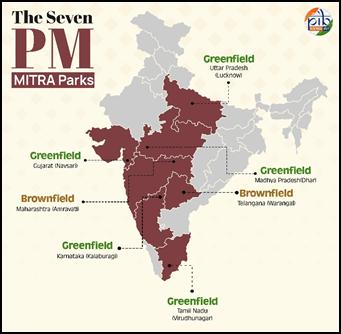
  • Current Status: A total of 7 Parks established in states of Gujarat, Maharashtra, Madhya Pradesh, Tamil Nadu, Karnataka, Uttar Pradesh, and Telangana.
  1. Amended Technology Upgradation Fund Scheme (ATUFS)
  • Objective: To incentivise credit flow for benchmark credit linked technology upgradation in this MSME driven Textile Industry for supporting capital investment.
  • Budget₹17,822 crore.
  • Incentives: Capital subsidies for technology upgradation.
  1. Samarth (Scheme for Capacity Building in Textile Sector)
  • Objective: To provide skill training to workers in the textile industry, in partnership with the Ministry of Skill Development & Entrepreneurship.
  • Budget Allocation: An amount of ₹115 crores was sanctioned during the FY 2023-24, out of which ₹114.99 crores (99.9%) were disbursed.
  • Current Status: As of March 27, 2025, more than 4.78 lakh users have been registered on the Samarth portal. As on March 19, 2025, a total of 3.82 lakh beneficiaries have been trained (passed) and 2.97 lakh beneficiaries (77.74%) have been placed.
  1. Textile Cluster Development Scheme (TCDS)
  • Objective: To create an integrated workspace and linkages-based ecosystem for existing as well as potential textile units/clusters to make them operationally and financially viable.
  • Benefits: Cluster development model of TCDS will bring benefits of critical mass for customization of interventions, economies of scale in operation, competitiveness in manufacturing, cost efficient, better access to technology and information, etc.
  • Budget₹853 crore.
  • Current Status: As of March 18, 2025, about 1.22 lakh employment opportunities have been generated under the scheme. During 2024-25₹34.48 crore have been released.
  1. National Technical Textiles Mission (NTTM)
  • Objective: To boost Technical Textiles in the country.
  • Target Years: 2020-21 to 2025-26
  • Budget₹1480 crore
  • Focus: The Mission focuses on (i) research, innovation and development, (ii) promotion and market development (iii) education and skilling and (iv) export promotion in technical textiles to position country as global leader in technical textiles.
  • Current Status: As on January 1, 2025168 projects of value ₹509 crores (approx.) have been approved in the category of Specialty fibres and Technical Textiles.

Union Budget Allocations for Ministry of Textiles

The Union Budget announced an outlay of ₹5272 crores for the Ministry of Textiles for 2025-26. This is an increase of 19% over budget estimates of 2024-25 (Rs. 4417.03 crore).

Key Highlights

  • Cotton Mission: A five-year plan to improve cotton productivity, especially extra-long staple varieties, with science and technology support.
  • Tax Exemptions on Looms: Duty removed on select shuttle-less looms to reduce costs and modernize weaving.
  • Customs Duty on Knitted Fabrics: Increased from “10% or 20%” to “20% or ₹115 per kg, whichever is higher” to curb cheap imports.
  • Handicraft Exports: Time for export extended from six months to one year, with more items eligible for duty-free input imports.
  • MSME Boost: Focus on exports, credit enhancement, and policies like the National Manufacturing Mission, Export Promotion Mission, Bharat Trade Net, and Fund of Funds to promote employment and entrepreneurship.

These measures aim to boost domestic manufacturing, support MSMEs, modernize the textile sector, and enhance India's global competitiveness.

Export Growth and Market Expansion
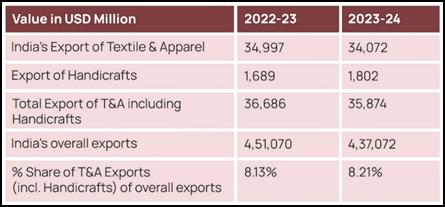
India is the 6th largest exporter of Textiles & Apparel in the world. The share of textile and apparel (T&A) including handicrafts in India’s total exports stands at a significant 8.21% in 2023-24. India has a share of 3.91% of the global trade in textiles and apparel. Major textile and apparel export destinations for India are USA and EU and with around 47% share in total textile and apparel exports.  The textile and apparel sector has witnessed significant export growth due to government incentives and trade agreements.

The government has taken several steps to enhance exports in textiles and apparels, including:

  • Rebate of State and Central Taxes and Levies (RoSCTL): On 7th March 2019, Government approved Rebate of State and Central Taxes and Levies (RoSCTL) Scheme to rebate all embedded State and Central taxes/levies on export of Apparel/Garments and Made-ups to provide support and enhance competitiveness of these sectors.
  • Production Linked Incentive (PLI) Scheme for Textiles: Under this scheme, as per the Quarterly Review Reports (QRRs) released on 31.03.2024, the turnover achieved was Rs. 1,355 crore including export of Rs.166 crore.
  • Free Trade Agreements: India has so far signed 14 Free Trade Agreements (FTAs) including recently concluded agreement with United Arab Emirates (UAE), Australia and TEPA (Trade and Economic Partnership Agreement) with EFTA (European Free Trade Association) countries comprising Switzerland, Iceland, Norway & Liechtenstein. India has 6 Preferential Trade Agreements (PTAs) with various trading partners. India is presently engaged in FTA negotiations with some of its trading partners notable among these FTAs are India-UK Free Trade Agreement, India- EU Free Trade Agreement, and India-Oman FTA.
  • Quality Control Orders: The Ministry has actively taken up notification of standards for textile products in co-ordination with Bureau of Indian Standards and Quality Control Orders (QCOs) are issued to regulate quality and curb sub-standard imports.
  • Textile Advisory Group on Man-Made Fibre (MMF): The Ministry has constituted a “Textile Advisory Group on Man-made Fibre (MMF)” comprising stakeholders of the country’s entire Man-Made Fibre (MMF) including viscose to deliberate and make recommendations on the issues and concerns of the sector.
  • Exports Promotion Councils (EPCs): There are eleven Exports Promotion Councils (EPCs) representing various segments of the textiles & apparel value chain from Fibre to finished goods as well as traditional sectors like handloom, handicrafts and carpets.  These Councils work in close cooperation with the Ministry of Textiles and other Ministries to promote the growth and export of their respective sectors in global markets. 

FDI in Textile and Apparel Industry

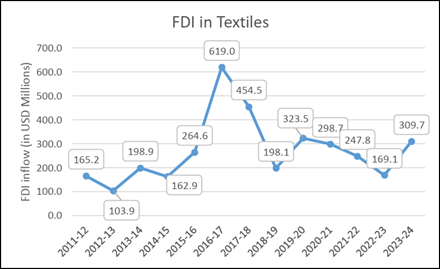
Foreign Direct Investment (FDI) plays a role in the Indian textile and apparel sector. From January 2000 to March 2024, the textile sector received US$ 4,472.79 million (₹28,304.10 crore) in FDI equity. FDI in textile sector over the years can be traced in the graph below:

BHARAT TEX 2024

Bharat Tex 2024, a global textile expo was successfully organized during February 26 to February 29, 2024 by the consortium of 11 Textiles Export Promotion Councils with the support of Ministry of Textiles. Built on the twin pillars of trade and investment and with an overarching focus on sustainability, the 4-day event attracted besides policymakers and global CEOs3,500 Exhibitors3,000 Buyers from 111 Countries and over one lakh trade visitors. An exhibition spread across nearly 2 million sq ft of area and encompassing the entire textile value chain, including an artistically curated story of textiles- Vastra Katha were the highlights of the event. The event was hosted simultaneously at two state of the art venues in Delhi - Bharat Mandapam and Yashobhoomi with both venues fully subscribed.

This global scale conference with 70 sessions and 112 international speakers saw engaging discussions on key textile issues of the day including Textile Mega TrendsSustainability, resilient global supply chains and Manufacturing 4.0.

BHARAT TEX 2025

Bharat Tex 2025, India's largest global textile event, was successfully organized from February 14 to 17, 2025, at Bharat Mandapam, New Delhi. The event spanned 2.2 million square feet and featured over 5,000 exhibitors, providing a comprehensive showcase of India's textile ecosystem. More than 1,20,000 trade visitors, from 120+ countries including global CEOs, policymakers, and industry leaders, attended the event.

Bharat Tex 2025 served as a platform to accelerate the government's "Farm to Fibre, Fabric, Fashion, and Foreign Markets" vision. India’s textile exports have already reached ₹3 lakh crore, and the goal is to triple this to ₹9 lakh crore by 2030 by strengthening domestic manufacturing and expanding global reach. The event demonstrated India's leadership in the textile sector and its commitment to innovation, sustainability, and global collaboration.

Innovation in Textile Sector

As far as innovation in textiles sector is concerned, Ministry of Textiles has conducted an Innovation Challenges in collaboration with Startup India & DPIIT. In this challenge, 9 winners were recognised and awarded, while incubation opportunities were presented to 6 awardees under the Atal Innovation Mission (AIM). Apart from this, 3 separate innovations challenges were conducted by nature fibre boards on their respective problem statements i.e. 

  • NJB Technological Innovation Grand Challenge in which 3 winners were recognised and awarded out of 125 applicants.
  • CSB Start-up Grand Challenge in which 4 winners were recognised and awarded out of             58 applicants.
  • CWDB Wool Innovation Challenge in which 3 winners were recognised and awarded out of     24 applicants.
  • 17 of the total above-mentioned winners are directly engaging in activities such as textile waste recycling, biobased fibres or sustainable garment production

Cotton Industry in India

Cotton is a vital commercial crop in India, contributing about 24% to global cotton production and sustaining the livelihoods of millions of farmers and workers. It plays a crucial role in India's foreign exchange earnings through exports of raw cotton, intermediate products, and finished goods. India holds the largest cotton acreage in the world.

  • Acreage and Yield: India has the largest cotton acreage globally; ranks 36th in productivity.
  • Production and Consumption: India is the 2nd largest producer and consumer of cotton in the world.
  • Cotton Species: India grows all four species of cotton: G. Arboreum, G. Herbaceum (Asian cotton), G. Barbadense (Egyptian cotton) and G. Hirsutum (American Upland cotton).
  • Major Growing Zones: Cotton is primarily grown in the NorthernCentral, and Southern zones of India.

Production and Consumption of Cotton (in lakh bales)

Cotton Year

Production

Consumption

2021-22

311.17

322.41

2022-23

336.60

313.63

2023-24 (P)

325.22

323.00

Import and Export of Cotton (in lakh bales)

Cotton Season

Import (in lakh bales)

Export (in lakh bales)

2021-22

21.13

42.25

2022-23

14.60

15.89

2023-24*

6.73

26.24

* Position up to 30.06.2024

Government Schemes and Initiatives:

  • Minimum Support Price (MSP) Operations to ensure remunerative prices to cotton farmers.
  • "Cott-Ally" mobile app for cotton farmers.
  • Aadhar-based farmer registration for MSP benefits.
  • E-auction for transparent sale of cotton stock.
  • QR code using Block Chain Technology for traceability of cotton.
  • Kasturi Cotton Bharat programme for branding Indian Cotton.

Silk Industry in India

Silk is an insect fibre known for its lustredrape, and strength. It is called the "Queen of Textiles" worldwide. India has a long history with silk and is the second largest producer and the largest consumer of silk in the world. India is unique in producing all four commercial varieties of silk: Mulberry, Tropical & Oak Tasar, Muga, and Eri. The Indian sericulture industry is important because it provides a lot of employment, requires low capital, and gives good income to silk growers. India produced 38,913 MT of silk, making it the second largest producer globally, after China.

Years

Mulberry

Tasar

Eri

Muga

Total

2004-05

14,620

322

1,448

110

16,500

2014-15

21,390

2,434

4,726

158

28,708

2020-21

23,896

2,689

6,946

239

33,770

2021-22

25,818

1,466

7,364

255

34,903

2022-23

27,654

1,318

7,349

261

36,582

2023-24

29,892

1,586

7,183

252

38,913

2024-25 (April-September)

14,233

106

3,924

92

18,355

Source: Central Silk Board, Bengaluru

The Indian government supports the silk industry through various initiatives and schemes:

  • The Central Silk Board (CSB) is a statutory body under the Ministry of Textiles that was established in 1948 to develop the silk industry.
  • The Ministry of Textiles is implementing the Scheduled Caste Sub Plan (SCSP) and Tribal Sub Plan (TSP) under the Silk Samagra Scheme.
  • In 2023-24, the Ministry of Textiles, Government of India, allocated ₹25 crore for the implementation of the SCSP for sericulture. The entire funds allocated under SCSP were fully utilized/released for implementation of beneficiary-oriented components.
  • The government is also working on research and development in the silk sector to improve productivity and quality. This includes promoting soil testing, organic farming, and the use of silkworm by-products. They are also upgrading reeling technology and promoting indigenous automatic reeling machines to boost the Make in India program.
  • The industry also focuses on product design development and diversification to promote Indian silks and help manufacturers and exporters create innovative designs and fabrics.

Jute Industry in India

The jute industry is a major player in India's economy, particularly in the eastern regions like West Bengal. It's a vital source of employment, providing livelihoods for workers in organized mills and diversified units, and supporting numerous farm families. The Indian government actively supports the jute sector through various initiatives aimed at improving productivity, ensuring fair prices for farmers, and promoting the use of jute products.

  • The jute industry provides direct employment to 4 lakh workers in organized mills and diversified units, including the tertiary sector and allied activities.
  • It supports the livelihood of 40 lakh farm families.
  • As per the Office of Jute Commissioner, there are 116 composite jute mills.
  • West Bengal has the highest number of jute mills (86).
  • Government of India provides support to the jute growers through MSP operations by the Jute Corporation of India and also through direct purchase of jute sacking.
  • Average land area under raw jute & mesta cultivation is 799 thousand hectares (average of last four years).
  • Average production of raw jute & mesta is 10,990 thousand bales (average of last four years).
  • Average export of jute goods is 133 thousand MT per annum with a value of Rs. 21,150 million per annum (average of last four years).
  • Jute - ICARE has been launched for improving fibre quality and productivity, reducing the cost of jute production, and increasing the income of jute farmers.
  • The schemes for the promotion of the jute sector are primarily implemented by the National Jute Board.

Conclusion

The Make in India initiative has significantly enhanced India’s position in global textile manufacturing and exports through targeted policies, infrastructure development, and investment promotion. With sustained efforts, India is poised to become a global textile leader, driving economic growth and employment generation.

References

https://www.texmin.nic.in/textile-data

https://jutecomm.gov.in/FAQ.html

https://www.investindia.gov.in/sector/textiles-apparel

https://pib.gov.in/PressReleasePage.aspx?PRID=2089306

https://pib.gov.in/PressReleasePage.aspx?PRID=2098352

https://pib.gov.in/PressReleasePage.aspx?PRID=2099411

https://pib.gov.in/PressReleasePage.aspx?PRID=2114277

https://pib.gov.in/PressReleaseIframePage.aspx?PRID=2104423

https://www.indiabudget.gov.in/economicsurvey/doc/echapter.pdf

https://www.texmin.nic.in/sites/default/files/Indian%20Jute%20At%20a%20Glance.pdf

https://www.texmin.nic.in/sites/default/files/Note%20on%20Cotton%20Sector_0.pdf

https://sansad.in/getFile/loksabhaquestions/annex/184/AU4118_0othg1.pdf?source=pqals

https://sansad.in/getFile/loksabhaquestions/annex/184/AS245_n0CCI6.pdf?source=pqals

https://sansad.in/getFile/loksabhaquestions/annex/184/AU2877_YZdL4e.pdf?source=pqals

https://sansad.in/getFile/loksabhaquestions/annex/184/AU2873_sOQ5IE.pdf?source=pqals

https://sansad.in/getFile/loksabhaquestions/annex/184/AS110_T8V4VD.pdf?source=pqals

https://www.texmin.nic.in/sites/default/files/FDI%20inflow%20at%20a%20glance.pdf

https://www.texmin.nic.in/sites/default/files/Table-2%20Raw%20Silk%20Production%20Statistics.pdf

https://texmin.nic.in/sites/default/files/MOT%20Annual%20Report%20English%20%2807.11.2024%29.pdf

https://www.texmin.nic.in/sites/default/files/FDI%20inflow%20%28Finacial%20year%20wise%29.pdf

https://ddnews.gov.in/en/india-sets-new-record-with-7-rise-in-textile-exports-government-implements-multiple-schemes-to-boost-sector/

Topics

Acts Income Tax