Loading...

Top
Help
×

By creating an account you can:

Logo TaxTMI
Call Us / Help / Feedback

Contact Us At :

E-mail: [email protected]

Call / WhatsApp at: +91 99117 96707

For more information, Check Contact Us

FAQs :

To know Frequently Asked Questions, Check FAQs

Most Asked Video Tutorials :

For more tutorials, Check Video Tutorials

Submit Feedback/Suggestion :

Email :
Please provide your email address so we can follow up on your feedback.
Category :
Description :
Min 15 characters 0/2000
Make Most of Text Search
  1. Checkout this video tutorial: How to search effectively on TaxTMI.
  2. Put words in double quotes for exact word search, eg: "income tax"
  3. Avoid noise words such as : 'and, of, the, a'
  4. Sort by Relevance to get the most relevant document.
  5. Press Enter to add multiple terms/multiple phrases, and then click on Search to Search.
  6. Text Search
  7. The system will try to fetch results that contains ALL your words.
  8. Once you add keywords, you'll see a new 'Search In' filter that makes your results even more precise.
  9. Text Search
Add to...
You have not created any category. Kindly create one to bookmark this item!
Create New Category
Hide
Title :
Description :
❮❮ Hide
Default View
Expand ❯❯
Close ✕
🔎 News - Adv. Search
TEXT SEARCH:

Press 'Enter' to add multiple search terms. Rules for Better Search

Search In:
Main Text + AI Text
  • Main Text
  • Main Text + AI Text
  • AI Text
Category: ?
Categorized by AI
---- All Categories ----
  • ---- All Categories ----
  • Income Tax
  • GST
  • Customs, DGFT & SEZ
  • FEMA & RBI
  • Corp. Laws, SEBI & IBC
  • PMLA, Black Money & ED
  • Budget
  • News and Press Release
  • PTI News
Month:
---- All Months ----
  • ---- All Months ----
  • January
  • February
  • March
  • April
  • May
  • June
  • July
  • August
  • September
  • October
  • November
  • December
Year:
---- All Years ----
  • ---- All Years ----
  • 2026
  • 2025
  • 2024
  • 2023
  • 2022
  • 2021
  • 2020
  • 2019
  • 2018
  • 2017
  • 2016
  • 2015
  • 2014
  • 2013
  • 2012
  • 2011
Sort By: ?
In Sort By 'Default', exact matches for text search are shown at the top, followed by the remaining results in their regular order.
Relevance Default Date
    APEDA Facilitates First-Ever Export of Mustard Honey by Dergang FPO from Tripura to Dubai
    Parliament passes The Bankers' Books Evidence Bill, 2026
    DRI uncovers another clandestine drug manufacturing unit in Maharashtra
    Delhi HC gives Kejriwal 4 weeks to respond to ED pleas against acquittal in two cases
    Pesticide residues found in 58 food samples tested in Kerala, says Minister Siddique
    DGFT Removes Physical Duty Payment Challans for Export Obligation Discharge Certificate Applications under Advance Authorisation and Export Promotion ...
    TRAI directs use of 1601-series for service, transactional calls by utilities, logistics cos
    Nagaland tax revenue rises to Rs 1,597 crore in FY'26
    India's Russian crude imports hit record for second straight month
    Stolen phone of 88-year-old leads Delhi Police to bust interstate cyber-fraud syndicate; 9 held
    Rupee falls 11 paise to close at 95.28 against US dollar on firm crude oil prices
    Loan Utsav 2026: Bajaj Finance Personal Loan Now Comes with an Exclusive Reward Bundle for Eligible Customers
    Freedom to Spend Smarter: AU Small Finance Bank Credit Cards Bring Rewards, EMI Flexibility and Lounge Access to India''s Biggest Shopping Month
    Rupee falls 8 paise to 95.25 against US dollar in early trade
    APEDA Facilitates First-Ever Export of GI-tagged Mithila Makhana by Sea Route from Bihar to Australia
    Government signs strategic MoUs with key industry leaders and ecosystems to strengthen support to StartUps
    No Charges for UPI Users
    Competition Commission of India (CCI) hosts BRICS Heads of Competition Authorities 2026 meeting
    ICoAS fraternity reaffirms commitment to cost optimisation for Atmanirbhar Bharat on ICoAS day 2026
    Govt to introduce bill in Lok Sabha to broaden NCDC's mandate for co-operative sector growth
❯❯
Maximize Maximize Maximize
0 / 200
Expand Note
Add to Folder

No Folders have been created

+

Are you sure you want to delete "My most important" ?

NOTE:

News
Showing Results for :
Reset Filters
Results Found:
Show All Summaries Hide All Summaries
August 10, 2026
Show AI Summary
Mustard honey export demonstrates FPO-led aggregation, quality-focused production and industry collaboration for international agricultural market access.
Mustard honey export from Tripura to Dubai marks the first international shipment by Dergang Farmer Producer Organisation, supported through export-oriented aggregation and market linkage initiatives. The export creates overseas market access for local beekeepers and farmers, diversifies the honey value chain, and encourages quality-focused production. Industry collaboration supported bee production and an export-oriented supply chain, while capacity building, quality assurance, value addition and market linkages can strengthen agricultural exports and farmer participation in international markets.
August 10, 2026
Show AI Summary
Digital banking evidence gains recognition through a modernised framework for physical and electronic records, with privacy and security safeguards.
The Bankers' Books Evidence Bill, 2026, modernises the evidentiary framework for bankers' books by permitting banking records to be produced in physical or electronic form in legal proceedings. It recognises electronic, digital and virtual records and enables the Central Government to extend the regime to other regulated financial entities, supporting a uniform financial-sector evidentiary framework. The framework seeks secure and transparent use of banking records while safeguarding customer privacy, confidentiality and data security.
August 10, 2026
Show AI Summary
Illicit opioid medicine exports exposed through concealed cargo, clandestine manufacturing, repacking, and attempted transnational trafficking to Nigeria.
Illicit manufacture and attempted export of controlled opioid medicines were detected in a network producing, concealing, storing and exporting Tramadol Hydrochloride tablets to Nigeria. A consignment declared as Pregabalin capsules contained concealed Tramadol Hydrochloride and Tapentadol tablets. Investigation identified clandestine manufacture, repacking and preparation for export, with searches yielding tablet-compression machinery and raw materials. Tramadol is a psychotropic substance under the Narcotic Drugs and Psychotropic Substances Act, while Tapentadol is regulated under the Drugs and Cosmetics Act and its rules.
August 10, 2026
Show AI Summary
Summons compliance under anti-money-laundering law faces appellate scrutiny after acquittal over unproven email service allegations.
Delhi High Court required Arvind Kejriwal to reply to Enforcement Directorate petitions challenging his acquittal in proceedings concerning alleged non-compliance with summonses. The trial court found that the agency had not proved intentional disobedience, service of summons through email, or lawful issuance of electronic summons under the Prevention of Money Laundering Act. The appellate challenge concerns proof of service, validity of electronic summons, and intentional non-compliance.
August 10, 2026
Show AI Summary
Pesticide residue concerns drive organic farming, school agriculture initiatives, infrastructure financing and climate-resilience support for farmers.
Food-safety concerns arising from pesticide residues and toxic substances are to be addressed through organic vegetable farming, household cultivation and the Kathir school-farming initiative. Kathir provides for institutional farming, teacher and committee support, markets, student training and clubs, with possible academic weightage for agricultural participation. Agricultural infrastructure financing supports post-harvest management, value addition, processing, packing, marketing and exports. Additional measures include banking support, agricultural technology adoption, women-farmer support and schemes addressing climate-related floods and drought.
August 10, 2026
Show AI Summary
Digital EODC processing removes physical duty challans through authenticated payment verification for export authorisation closure.
Export Obligation Discharge Certificate processing under the Advance Authorisation and Export Promotion Capital Goods schemes no longer requires physical duty-payment challans for voluntary customs-duty payments made on or after 1 August 2026. Authenticated licence-wise payment information is electronically transmitted from Customs/ICEGATE to DGFT systems and mapped to the relevant authorisation. Exporters can verify payment details on the customer portal, while Regional Authorities use corresponding back-office records, replacing manual submission and verification for authorisation closure.
August 10, 2026
Show AI Summary
Trusted service-call numbering requires verified utilities and logistics entities to use dedicated numbers exclusively for transactional and service communications.
The 1601-series is introduced for verified utilities, courier and logistics entities making service and transactional voice calls. Numbers must be allocated directly to eligible entities, not intermediaries or aggregators, following verification by telecom service providers and an undertaking of exclusive use. Promotional voice calls are prohibited on this series and remain associated with the 140-series. The framework separates these calls from the 1600-series reserved for regulated financial-sector and government-to-citizen communications, supporting consumer recognition of legitimate calls and reducing impersonation risks.
August 10, 2026
Show AI Summary
GST revenue collection drives tax growth while data scrutiny, taxpayer verification, and compliance capacity remain key administrative priorities.
GST constituted the principal component of tax revenue for the 2025-26 fiscal year. Tax administration faces staff shortages, information-technology upgrade needs, and increased workloads from taxpayer registrations and return filings. Compliance oversight requires GST data scrutiny, risk assessment, identification of unregistered taxpayers, tax-evasion detection, and field verification of high-risk taxpayers. Long-term revenue planning sets progressively higher collection targets through 2063.
August 10, 2026
Show AI Summary
Russian crude imports reshape India's refining trade as processed petroleum products reach sanctioning jurisdictions despite import restrictions.
Indian imports of Russian crude oil reached a second consecutive monthly record in July 2026, with Russian crude forming the dominant share of India's Russian fossil-fuel purchases and more than half of total crude imports. Higher receipts through smaller terminals offset reduced volumes at Paradip. Indian refineries processing Russian crude also exported refined petroleum products to sanctioning jurisdictions, including the European Union, Australia and the United States, despite the European Union prohibition on imports of oil products made from Russian crude.
August 10, 2026
Show AI Summary
Cyber-fraud through stolen phones allegedly used mule accounts, banking credentials and coordinated technical operations to divert victims' funds.
Investigation into unauthorised withdrawals after theft of a mobile phone uncovered an alleged interstate cyber-fraud network using stolen devices, linked banking credentials and mule bank accounts. The scheme allegedly involved phone theft, supply of accounts and banking instruments, and a technical operation that accessed victims' accounts and routed funds for withdrawal or transfer. Digital surveillance, transaction mapping, seized devices, victim data and transaction records are being examined to identify linked complaints and the extent of funds allegedly diverted.
August 10, 2026
Show AI Summary
Rupee depreciation reflected stronger dollar, elevated crude prices and geopolitical uncertainty, while portfolio inflows and equity gains provided support.
The rupee depreciated against the US dollar amid a stronger dollar, higher global crude oil prices and uncertainty surrounding West Asia-related negotiations. Concerns over crude oil's potential impact on the trade deficit weighed on the currency, while positive domestic equity markets and foreign portfolio investment inflows provided support. Market caution remained focused on forthcoming US inflation data, dollar-index movements and Brent crude prices. Foreign-exchange reserves increased during the reported period.
August 10, 2026
Show AI Summary
Collateral-free personal loans offer extended repayment flexibility, conditional reward benefits, and online application subject to eligibility and disbursal requirements.
Loan Utsav 2026 provides eligible Bajaj Finance Personal Loan applicants an exclusive reward bundle where the loan is successfully disbursed during the campaign period. The collateral-free facility supports personal expenses, offers repayment tenures from 12 to 108 months, and may enable lower monthly EMI obligations through a longer selected tenure. Interest rates depend on eligibility, credit assessment, financial profile and lending criteria. Online applications require personal and financial details and required documents, with disbursal for eligible applicants possible after verification and approval.
August 10, 2026
Show AI Summary
Credit card payment flexibility supports seasonal shopping and travel through eligible EMIs, rewards, tracking tools and conditional merchant benefits.
Credit-card spending features include conversion of eligible purchases into EMIs, selected no-cost EMI options, reward points, cashback, merchant discounts and payment flexibility. Travel-related benefits may include domestic airport lounge access, travel-booking discounts, fuel-surcharge waiver and anniversary-linked rewards. The AU 0101 application enables transaction tracking, balance and interest-rate monitoring, EMI conversion and bill-payment management. Features and offers are subject to change, customer eligibility, internal policies and partner-merchant terms.
August 10, 2026
Show AI Summary
Foreign-exchange market conditions weakened the rupee as stronger dollar and crude prices offset support from reserve growth and inflows.
Foreign-exchange market conditions saw the rupee weaken against the US dollar in early trading, influenced by a stronger dollar and higher global crude oil prices. Foreign institutional equity inflows and increased foreign-exchange reserves moderated pressure on the rupee. Market attention remained focused on developments in West Asia and the Reserve Bank of India, alongside movements in the dollar index, crude oil prices and domestic equity markets.
August 10, 2026
Show AI Summary
GI-tagged Mithila Makhana export facilitation expands sea-route market access while supporting quality compliance and farmer-linked value chains.
Export facilitation for GI-tagged Mithila Makhana enabled the first commercial sea-route shipment from Bihar to Australia. APEDA, in association with the Bihar agriculture department, supported market access, coordination, capacity building and stakeholder engagement. The export model is intended to improve farmer price realisation, require adherence to global quality standards, and strengthen growers, processors and exporters. A separate HS Code for Makhana has taken effect under the Finance Bill, 2025, supporting product-specific trade classification.
August 10, 2026
Show AI Summary
Startup ecosystem support expands through digital payments, cloud access, AI innovation, investment readiness, governance support and global market programmes.
DPIIT has entered into strategic MoUs to support DPIIT-recognised startups through payment infrastructure, entrepreneurship development, cloud technology, mobility innovation, investment readiness and global-market access. Eligible startups may receive payment and cloud support, technical training, mentorship, startup formalisation assistance, market and investor connections, AI and mobility enablement, and programmes addressing governance, financial readiness, compliance and international expansion. The collaborations promote innovation across digital payments, clean energy, artificial intelligence, climate technology, advanced manufacturing, mobility and automotive technology.
August 10, 2026
Show AI Summary
UPI transaction charges remain unavailable for consumers and person-to-person payments, while limited threshold-based merchant MDR may be considered.
Proposed amendment of section 10A of the Payment and Settlement Systems Act, 2007 is intended to support UPI sustainability, technological advancement and resilience. Consumer payments and person-to-person transactions are to remain free. Any future merchant discount rate would apply only to limited merchant transactions above a threshold, at a nominal rate, while most merchant transactions remain free. The framework supports investment in cybersecurity, fraud prevention and infrastructure, alongside a self-sustaining and inclusive digital-payment ecosystem.
August 10, 2026
Show AI Summary
Fair competition cooperation in renewable energy markets advances knowledge-sharing and evidence-based enforcement across interconnected digital and energy markets.
BRICS competition authorities adopted a Joint Statement strengthening cooperation to promote fair competition, including in renewable energy markets. Cooperation focuses on dialogue, knowledge-sharing and consideration of cross-border competition challenges in digital markets, emerging technologies and the energy transition. Competition enforcement is to remain principled and evidence-based, supporting efficiency, consumer welfare, innovation and merit-based competition. A collaborative renewable-energy competition study identified evolving market dynamics and areas for future cooperation.
August 10, 2026
Show AI Summary
Cost optimisation in public finance strengthens investment decisions, risk allocation, indigenous manufacturing and value-driven government expenditure through specialised financial expertise.
ICoAS cost optimisation supports public financial management through prudent resource utilisation, financial oversight and improved cost management across government. Its role includes supporting indigenous manufacturing, better investment decisions, efficient public expenditure and maximum value for public spending. With greater private-sector participation and Public-Private Partnerships, ICoAS officers are expected to promote cost efficiency, appropriate risk allocation and sound project structuring. Capacity building emphasises integrity, financial modelling, data visualisation, analytical frameworks and artificial intelligence for improved public-finance management.
August 9, 2026
Show AI Summary
Co-operative development financing would expand through direct assistance, share-capital participation and wider operational powers for sectoral support.
National Cooperative Development Corporation (Amendment) Bill, 2026 proposes to broaden the Corporation's mandate to promote co-operative development. It would permit direct loans and grants to co-operative societies and other entities engaged in co-operative development, where funds are used for co-operative purposes. With Central Government approval, the Corporation could participate in the share capital of such entities. The proposals also expand the meaning of foodstuffs, remove geographical restrictions for industrial-goods assistance, and provide additional functional powers.

News

Back

All News

Showing Results for :
Reset Filters
No Records Found

News

Back

All News

Showing Results for : Reset Filters
Customs, DGFT & SEZ

Threads of Progress

April 2, 2025

Contents
Summary
Note

Note

-

Bookmark

Print

Print

How Make in India is Shaping the Future of Textiles and Apparel Industry

Introduction

The Make in India initiative, launched in 2014, has played a crucial role in positioning India as a global textile manufacturing and export hub. The textile and apparel industry is one of the largest contributors to India’s economy, providing employment to millions and generating substantial foreign exchange earnings. With strong policy support, infrastructure development, and a skilled workforce, India has emerged as a preferred investment destination in the global textile sector.

Overview of India's Textile Industry

The textile and apparel industry contributes 2.3% to our GDP13% to industrial production, and 12% to exports. India exported textile items worth US$ 34.4 billion in 2023-24, with apparel constituting 42% of the export basket, followed by raw materials/semi-finished materials at 34% and finished non-apparel goods at 30%. It is also the second largest employment generators, after agriculture, with over 45 million people employed directly, including many women and the rural population. As further evidence of the inclusive nature of this industry, nearly 80% of its capacity is spread across Micro, Small and Medium Enterprises (MSMEclusters in the country.

The sector also has perfect alignment with the Government’s overall objectives of Make in India, Skill India, Women’s Empowerment, Rural Youth Employment and inclusive growth. The industry produces about 22,000 million pieces of garments per year, with the market size projected to reach US$ 350 billion by 2030, from the current $174 billion.

Recently, the Ministry of Textiles reported a 7% increase in textile and apparel exports, including handicrafts, from April to December 2024, compared to the same period the previous year. In line with the growth roadmap, the Indian textile market currently ranks fifth globally, and the government is actively working to accelerate this growth to a rate of 15-20% over the next five years.

Impact of 'Make in India' on the Textile Industry

The Make in India initiative has catalyzed textile manufacturing and exports through key policy interventions, enhanced infrastructure, and incentives. In the Union Budget 2024-25, to promote domestic textile production, two more types of shuttle-less looms are added to fully exempted textile machinery by the government. The government has introduced multiple schemes to enhance textile production, boost investments, and promote exports, including:
  1. Production Linked Incentive (PLI) Scheme for Textiles
  • Objective: To increase manufacturing in man-made fibre (MMF) and technical textiles.
  • Budget₹10,683 crore.
  • IncentivesFinancial incentives for large-scale textile manufacturers.
  1. PM MITRA (Mega Integrated Textile Region and Apparel) Parks

  • Objective: To develop world-class industrial infrastructure for textile manufacturing.
  • Focus: On developing integrated large scale and modern industrial infrastructure facility for total value-chain of the textile industry like spinning, weaving, processing, garmenting, textile manufacturing, processing & textile machinery industry.
  • Budget₹4,445 crore for a period 2021-22 to 2027-28.
  • Key Benefits: Reduced logistics costs, increased FDI, and better competitiveness in global markets.
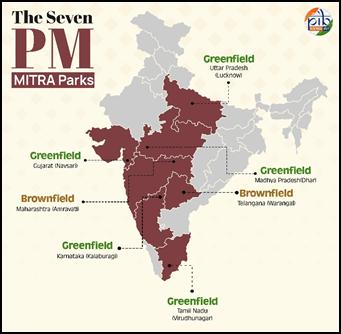
  • Current Status: A total of 7 Parks established in states of Gujarat, Maharashtra, Madhya Pradesh, Tamil Nadu, Karnataka, Uttar Pradesh, and Telangana.
  1. Amended Technology Upgradation Fund Scheme (ATUFS)
  • Objective: To incentivise credit flow for benchmark credit linked technology upgradation in this MSME driven Textile Industry for supporting capital investment.
  • Budget₹17,822 crore.
  • Incentives: Capital subsidies for technology upgradation.
  1. Samarth (Scheme for Capacity Building in Textile Sector)
  • Objective: To provide skill training to workers in the textile industry, in partnership with the Ministry of Skill Development & Entrepreneurship.
  • Budget Allocation: An amount of ₹115 crores was sanctioned during the FY 2023-24, out of which ₹114.99 crores (99.9%) were disbursed.
  • Current Status: As of March 27, 2025, more than 4.78 lakh users have been registered on the Samarth portal. As on March 19, 2025, a total of 3.82 lakh beneficiaries have been trained (passed) and 2.97 lakh beneficiaries (77.74%) have been placed.
  1. Textile Cluster Development Scheme (TCDS)
  • Objective: To create an integrated workspace and linkages-based ecosystem for existing as well as potential textile units/clusters to make them operationally and financially viable.
  • Benefits: Cluster development model of TCDS will bring benefits of critical mass for customization of interventions, economies of scale in operation, competitiveness in manufacturing, cost efficient, better access to technology and information, etc.
  • Budget₹853 crore.
  • Current Status: As of March 18, 2025, about 1.22 lakh employment opportunities have been generated under the scheme. During 2024-25₹34.48 crore have been released.
  1. National Technical Textiles Mission (NTTM)
  • Objective: To boost Technical Textiles in the country.
  • Target Years: 2020-21 to 2025-26
  • Budget₹1480 crore
  • Focus: The Mission focuses on (i) research, innovation and development, (ii) promotion and market development (iii) education and skilling and (iv) export promotion in technical textiles to position country as global leader in technical textiles.
  • Current Status: As on January 1, 2025168 projects of value ₹509 crores (approx.) have been approved in the category of Specialty fibres and Technical Textiles.

Union Budget Allocations for Ministry of Textiles

The Union Budget announced an outlay of ₹5272 crores for the Ministry of Textiles for 2025-26. This is an increase of 19% over budget estimates of 2024-25 (Rs. 4417.03 crore).

Key Highlights

  • Cotton Mission: A five-year plan to improve cotton productivity, especially extra-long staple varieties, with science and technology support.
  • Tax Exemptions on Looms: Duty removed on select shuttle-less looms to reduce costs and modernize weaving.
  • Customs Duty on Knitted Fabrics: Increased from “10% or 20%” to “20% or ₹115 per kg, whichever is higher” to curb cheap imports.
  • Handicraft Exports: Time for export extended from six months to one year, with more items eligible for duty-free input imports.
  • MSME Boost: Focus on exports, credit enhancement, and policies like the National Manufacturing Mission, Export Promotion Mission, Bharat Trade Net, and Fund of Funds to promote employment and entrepreneurship.

These measures aim to boost domestic manufacturing, support MSMEs, modernize the textile sector, and enhance India's global competitiveness.

Export Growth and Market Expansion
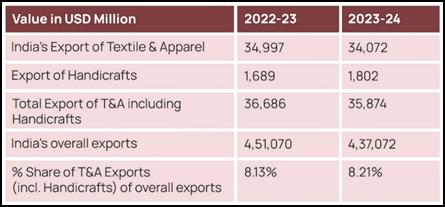
India is the 6th largest exporter of Textiles & Apparel in the world. The share of textile and apparel (T&A) including handicrafts in India’s total exports stands at a significant 8.21% in 2023-24. India has a share of 3.91% of the global trade in textiles and apparel. Major textile and apparel export destinations for India are USA and EU and with around 47% share in total textile and apparel exports.  The textile and apparel sector has witnessed significant export growth due to government incentives and trade agreements.

The government has taken several steps to enhance exports in textiles and apparels, including:

  • Rebate of State and Central Taxes and Levies (RoSCTL): On 7th March 2019, Government approved Rebate of State and Central Taxes and Levies (RoSCTL) Scheme to rebate all embedded State and Central taxes/levies on export of Apparel/Garments and Made-ups to provide support and enhance competitiveness of these sectors.
  • Production Linked Incentive (PLI) Scheme for Textiles: Under this scheme, as per the Quarterly Review Reports (QRRs) released on 31.03.2024, the turnover achieved was Rs. 1,355 crore including export of Rs.166 crore.
  • Free Trade Agreements: India has so far signed 14 Free Trade Agreements (FTAs) including recently concluded agreement with United Arab Emirates (UAE), Australia and TEPA (Trade and Economic Partnership Agreement) with EFTA (European Free Trade Association) countries comprising Switzerland, Iceland, Norway & Liechtenstein. India has 6 Preferential Trade Agreements (PTAs) with various trading partners. India is presently engaged in FTA negotiations with some of its trading partners notable among these FTAs are India-UK Free Trade Agreement, India- EU Free Trade Agreement, and India-Oman FTA.
  • Quality Control Orders: The Ministry has actively taken up notification of standards for textile products in co-ordination with Bureau of Indian Standards and Quality Control Orders (QCOs) are issued to regulate quality and curb sub-standard imports.
  • Textile Advisory Group on Man-Made Fibre (MMF): The Ministry has constituted a “Textile Advisory Group on Man-made Fibre (MMF)” comprising stakeholders of the country’s entire Man-Made Fibre (MMF) including viscose to deliberate and make recommendations on the issues and concerns of the sector.
  • Exports Promotion Councils (EPCs): There are eleven Exports Promotion Councils (EPCs) representing various segments of the textiles & apparel value chain from Fibre to finished goods as well as traditional sectors like handloom, handicrafts and carpets.  These Councils work in close cooperation with the Ministry of Textiles and other Ministries to promote the growth and export of their respective sectors in global markets. 

FDI in Textile and Apparel Industry

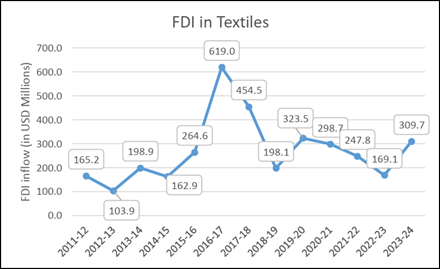
Foreign Direct Investment (FDI) plays a role in the Indian textile and apparel sector. From January 2000 to March 2024, the textile sector received US$ 4,472.79 million (₹28,304.10 crore) in FDI equity. FDI in textile sector over the years can be traced in the graph below:

BHARAT TEX 2024

Bharat Tex 2024, a global textile expo was successfully organized during February 26 to February 29, 2024 by the consortium of 11 Textiles Export Promotion Councils with the support of Ministry of Textiles. Built on the twin pillars of trade and investment and with an overarching focus on sustainability, the 4-day event attracted besides policymakers and global CEOs3,500 Exhibitors3,000 Buyers from 111 Countries and over one lakh trade visitors. An exhibition spread across nearly 2 million sq ft of area and encompassing the entire textile value chain, including an artistically curated story of textiles- Vastra Katha were the highlights of the event. The event was hosted simultaneously at two state of the art venues in Delhi - Bharat Mandapam and Yashobhoomi with both venues fully subscribed.

This global scale conference with 70 sessions and 112 international speakers saw engaging discussions on key textile issues of the day including Textile Mega TrendsSustainability, resilient global supply chains and Manufacturing 4.0.

BHARAT TEX 2025

Bharat Tex 2025, India's largest global textile event, was successfully organized from February 14 to 17, 2025, at Bharat Mandapam, New Delhi. The event spanned 2.2 million square feet and featured over 5,000 exhibitors, providing a comprehensive showcase of India's textile ecosystem. More than 1,20,000 trade visitors, from 120+ countries including global CEOs, policymakers, and industry leaders, attended the event.

Bharat Tex 2025 served as a platform to accelerate the government's "Farm to Fibre, Fabric, Fashion, and Foreign Markets" vision. India’s textile exports have already reached ₹3 lakh crore, and the goal is to triple this to ₹9 lakh crore by 2030 by strengthening domestic manufacturing and expanding global reach. The event demonstrated India's leadership in the textile sector and its commitment to innovation, sustainability, and global collaboration.

Innovation in Textile Sector

As far as innovation in textiles sector is concerned, Ministry of Textiles has conducted an Innovation Challenges in collaboration with Startup India & DPIIT. In this challenge, 9 winners were recognised and awarded, while incubation opportunities were presented to 6 awardees under the Atal Innovation Mission (AIM). Apart from this, 3 separate innovations challenges were conducted by nature fibre boards on their respective problem statements i.e. 

  • NJB Technological Innovation Grand Challenge in which 3 winners were recognised and awarded out of 125 applicants.
  • CSB Start-up Grand Challenge in which 4 winners were recognised and awarded out of             58 applicants.
  • CWDB Wool Innovation Challenge in which 3 winners were recognised and awarded out of     24 applicants.
  • 17 of the total above-mentioned winners are directly engaging in activities such as textile waste recycling, biobased fibres or sustainable garment production

Cotton Industry in India

Cotton is a vital commercial crop in India, contributing about 24% to global cotton production and sustaining the livelihoods of millions of farmers and workers. It plays a crucial role in India's foreign exchange earnings through exports of raw cotton, intermediate products, and finished goods. India holds the largest cotton acreage in the world.

  • Acreage and Yield: India has the largest cotton acreage globally; ranks 36th in productivity.
  • Production and Consumption: India is the 2nd largest producer and consumer of cotton in the world.
  • Cotton Species: India grows all four species of cotton: G. Arboreum, G. Herbaceum (Asian cotton), G. Barbadense (Egyptian cotton) and G. Hirsutum (American Upland cotton).
  • Major Growing Zones: Cotton is primarily grown in the NorthernCentral, and Southern zones of India.

Production and Consumption of Cotton (in lakh bales)

Cotton Year

Production

Consumption

2021-22

311.17

322.41

2022-23

336.60

313.63

2023-24 (P)

325.22

323.00

Import and Export of Cotton (in lakh bales)

Cotton Season

Import (in lakh bales)

Export (in lakh bales)

2021-22

21.13

42.25

2022-23

14.60

15.89

2023-24*

6.73

26.24

* Position up to 30.06.2024

Government Schemes and Initiatives:

  • Minimum Support Price (MSP) Operations to ensure remunerative prices to cotton farmers.
  • "Cott-Ally" mobile app for cotton farmers.
  • Aadhar-based farmer registration for MSP benefits.
  • E-auction for transparent sale of cotton stock.
  • QR code using Block Chain Technology for traceability of cotton.
  • Kasturi Cotton Bharat programme for branding Indian Cotton.

Silk Industry in India

Silk is an insect fibre known for its lustredrape, and strength. It is called the "Queen of Textiles" worldwide. India has a long history with silk and is the second largest producer and the largest consumer of silk in the world. India is unique in producing all four commercial varieties of silk: Mulberry, Tropical & Oak Tasar, Muga, and Eri. The Indian sericulture industry is important because it provides a lot of employment, requires low capital, and gives good income to silk growers. India produced 38,913 MT of silk, making it the second largest producer globally, after China.

Years

Mulberry

Tasar

Eri

Muga

Total

2004-05

14,620

322

1,448

110

16,500

2014-15

21,390

2,434

4,726

158

28,708

2020-21

23,896

2,689

6,946

239

33,770

2021-22

25,818

1,466

7,364

255

34,903

2022-23

27,654

1,318

7,349

261

36,582

2023-24

29,892

1,586

7,183

252

38,913

2024-25 (April-September)

14,233

106

3,924

92

18,355

Source: Central Silk Board, Bengaluru

The Indian government supports the silk industry through various initiatives and schemes:

  • The Central Silk Board (CSB) is a statutory body under the Ministry of Textiles that was established in 1948 to develop the silk industry.
  • The Ministry of Textiles is implementing the Scheduled Caste Sub Plan (SCSP) and Tribal Sub Plan (TSP) under the Silk Samagra Scheme.
  • In 2023-24, the Ministry of Textiles, Government of India, allocated ₹25 crore for the implementation of the SCSP for sericulture. The entire funds allocated under SCSP were fully utilized/released for implementation of beneficiary-oriented components.
  • The government is also working on research and development in the silk sector to improve productivity and quality. This includes promoting soil testing, organic farming, and the use of silkworm by-products. They are also upgrading reeling technology and promoting indigenous automatic reeling machines to boost the Make in India program.
  • The industry also focuses on product design development and diversification to promote Indian silks and help manufacturers and exporters create innovative designs and fabrics.

Jute Industry in India

The jute industry is a major player in India's economy, particularly in the eastern regions like West Bengal. It's a vital source of employment, providing livelihoods for workers in organized mills and diversified units, and supporting numerous farm families. The Indian government actively supports the jute sector through various initiatives aimed at improving productivity, ensuring fair prices for farmers, and promoting the use of jute products.

  • The jute industry provides direct employment to 4 lakh workers in organized mills and diversified units, including the tertiary sector and allied activities.
  • It supports the livelihood of 40 lakh farm families.
  • As per the Office of Jute Commissioner, there are 116 composite jute mills.
  • West Bengal has the highest number of jute mills (86).
  • Government of India provides support to the jute growers through MSP operations by the Jute Corporation of India and also through direct purchase of jute sacking.
  • Average land area under raw jute & mesta cultivation is 799 thousand hectares (average of last four years).
  • Average production of raw jute & mesta is 10,990 thousand bales (average of last four years).
  • Average export of jute goods is 133 thousand MT per annum with a value of Rs. 21,150 million per annum (average of last four years).
  • Jute - ICARE has been launched for improving fibre quality and productivity, reducing the cost of jute production, and increasing the income of jute farmers.
  • The schemes for the promotion of the jute sector are primarily implemented by the National Jute Board.

Conclusion

The Make in India initiative has significantly enhanced India’s position in global textile manufacturing and exports through targeted policies, infrastructure development, and investment promotion. With sustained efforts, India is poised to become a global textile leader, driving economic growth and employment generation.

References

https://www.texmin.nic.in/textile-data

https://jutecomm.gov.in/FAQ.html

https://www.investindia.gov.in/sector/textiles-apparel

https://pib.gov.in/PressReleasePage.aspx?PRID=2089306

https://pib.gov.in/PressReleasePage.aspx?PRID=2098352

https://pib.gov.in/PressReleasePage.aspx?PRID=2099411

https://pib.gov.in/PressReleasePage.aspx?PRID=2114277

https://pib.gov.in/PressReleaseIframePage.aspx?PRID=2104423

https://www.indiabudget.gov.in/economicsurvey/doc/echapter.pdf

https://www.texmin.nic.in/sites/default/files/Indian%20Jute%20At%20a%20Glance.pdf

https://www.texmin.nic.in/sites/default/files/Note%20on%20Cotton%20Sector_0.pdf

https://sansad.in/getFile/loksabhaquestions/annex/184/AU4118_0othg1.pdf?source=pqals

https://sansad.in/getFile/loksabhaquestions/annex/184/AS245_n0CCI6.pdf?source=pqals

https://sansad.in/getFile/loksabhaquestions/annex/184/AU2877_YZdL4e.pdf?source=pqals

https://sansad.in/getFile/loksabhaquestions/annex/184/AU2873_sOQ5IE.pdf?source=pqals

https://sansad.in/getFile/loksabhaquestions/annex/184/AS110_T8V4VD.pdf?source=pqals

https://www.texmin.nic.in/sites/default/files/FDI%20inflow%20at%20a%20glance.pdf

https://www.texmin.nic.in/sites/default/files/Table-2%20Raw%20Silk%20Production%20Statistics.pdf

https://texmin.nic.in/sites/default/files/MOT%20Annual%20Report%20English%20%2807.11.2024%29.pdf

https://www.texmin.nic.in/sites/default/files/FDI%20inflow%20%28Finacial%20year%20wise%29.pdf

https://ddnews.gov.in/en/india-sets-new-record-with-7-rise-in-textile-exports-government-implements-multiple-schemes-to-boost-sector/

Topics

Acts Income Tax