Loading...

Top
Help
×

By creating an account you can:

Logo TaxTMI
Call Us / Help / Feedback

Contact Us At :

E-mail: [email protected]

Call / WhatsApp at: +91 99117 96707

For more information, Check Contact Us

FAQs :

To know Frequently Asked Questions, Check FAQs

Most Asked Video Tutorials :

For more tutorials, Check Video Tutorials

Submit Feedback/Suggestion :

Email :
Please provide your email address so we can follow up on your feedback.
Category :
Description :
Min 15 characters 0/2000
Make Most of Text Search
  1. Checkout this video tutorial: How to search effectively on TaxTMI.
  2. Put words in double quotes for exact word search, eg: "income tax"
  3. Avoid noise words such as : 'and, of, the, a'
  4. Sort by Relevance to get the most relevant document.
  5. Press Enter to add multiple terms/multiple phrases, and then click on Search to Search.
  6. Text Search
  7. The system will try to fetch results that contains ALL your words.
  8. Once you add keywords, you'll see a new 'Search In' filter that makes your results even more precise.
  9. Text Search
Add to...
You have not created any category. Kindly create one to bookmark this item!
Create New Category
Hide
Title :
Description :
❮❮ Hide
Default View
Expand ❯❯
Close ✕
🔎 News - Adv. Search
TEXT SEARCH:

Press 'Enter' to add multiple search terms. Rules for Better Search

Search In:
Main Text + AI Text
  • Main Text
  • Main Text + AI Text
  • AI Text
Category: ?
Categorized by AI
---- All Categories ----
  • ---- All Categories ----
  • Income Tax
  • GST
  • Customs, DGFT & SEZ
  • FEMA & RBI
  • Corp. Laws, SEBI & IBC
  • PMLA, Black Money & ED
  • Budget
  • News and Press Release
  • PTI News
Month:
---- All Months ----
  • ---- All Months ----
  • January
  • February
  • March
  • April
  • May
  • June
  • July
  • August
  • September
  • October
  • November
  • December
Year:
---- All Years ----
  • ---- All Years ----
  • 2026
  • 2025
  • 2024
  • 2023
  • 2022
  • 2021
  • 2020
  • 2019
  • 2018
  • 2017
  • 2016
  • 2015
  • 2014
  • 2013
  • 2012
  • 2011
Sort By: ?
In Sort By 'Default', exact matches for text search are shown at the top, followed by the remaining results in their regular order.
Relevance Default Date
    Europe emerges top destination for India's electric car shipments in Q1
    Govt sets LPG production targets for refiners; Reliance gets largest quota
    PM urges MSMEs to tap opportunities from FTAs
    PM urges farmers to adopt 'chemical-free farming' to tap rising global demand for such food items
    Govt rolls out foreign asset disclosure scheme for small taxpayers
    Need one or two Indian pharma firms to be among global top 5: PM Modi
    Small taxpayers with€™ foreign assets to face 30 pc tax plus penalty; disclosure scheme opens till Dec 31
    PM urges MSMEs to tap opportunities from FTAs
    Govt cuts windfall gains tax on petrol, diesel, ATF exports
    Modi warns of weaponisation of resources, sea routes; urges energy self-reliance
    Current account deficit widens to USD 6.2 bn in Jun: RBI data
    Concessional swap facility attracts USD 56.85 bn forex inflows: RBI
    DFS Highlights Mechanism for Timely Redressal of Insurance Policyholders’ Grievances
    Forex kitty jumps USD 14.14 bn to USD 707 bn in one of the biggest weekly expansions
    PROVISIONAL ESTIMATES OF WHOLESALE PRICE INDEX, OUTPUT PRODUCER PRICE INDEX, AND TRIAL INPUT PRODUCER PRICE INDEX FOR THE MONTH OF JULY 2026, AND FINA...
    Logistics Data Bank Tracks 10 Crore EXIM Containers, Provides Visibility across Logistics Chain
    APEDA and Government of Tripura Organise International Organic Buyer-Seller Meet to Expand Global Market Linkages
    WPI inflation eases to 9.78 pc in July on softening in fuel prices
    IDFC FIRST Bank secures its first international rating with Investment Grade from S&P Global Ratings
    DRI busts illegal drug manufacturing facility in Jewar, UP; 30 kg drugs seized and two persons arrested
❯❯
Maximize Maximize Maximize
0 / 200
Expand Note
Add to Folder

No Folders have been created

+

Are you sure you want to delete "My most important" ?

NOTE:

News
Showing Results for :
Reset Filters
Results Found:
Show All Summaries Hide All Summaries
August 16, 2026
Show AI Summary
Electric vehicle export diversification strengthens India's presence across European, Asia-Pacific and Latin American markets through expanding overseas demand.
India's electric motor car exports expanded sharply in the first quarter of 2026-27, reflecting increased international acceptance and competitiveness of India-manufactured electric vehicles. Europe became the principal export destination, led by Spain and the United Kingdom, with further demand across several European markets. Exports also reached Asia-Pacific markets, Nepal and emerging Latin American destinations. This wider market presence reflects improving quality and safety standards, stronger integration into global electric-vehicle supply chains, and diversification of India's electric-vehicle export profile.
August 16, 2026
Show AI Summary
LPG production preparedness requires refiners and upstream producers to maintain capacity and increase output during supply constraints.
Government has established a standing LPG production preparedness framework under which refining companies, oil marketing companies and upstream producers may be directed to increase production during supply constraints. Companies must maintain adequate LPG storage, evacuation and transportation infrastructure and pursue technically and economically feasible production-enhancing measures. Written directions may prescribe production quantities and periods, including restrictions on alternative uses of input streams required for LPG. The production schedule is updated twice yearly to reflect new facilities and added capacity from infrastructure, technology and distribution improvements.
August 16, 2026
Show AI Summary
Free trade agreement market access requires MSMEs, farmers and exporters to meet global quality standards.
Free trade agreements expand market-access opportunities for Indian MSMEs, exporters and producers through reduced or eliminated import duties on traded goods. Textiles, machinery, medicines, seafood and agricultural products can access international markets where they meet global standards and remain competitively priced. Farmers and producers are encouraged to develop export-oriented products, including chemical-free agricultural produce, while MSMEs may use preferential trade access to support manufacturing, exports, employment and growth.
August 15, 2026
Show AI Summary
Chemical-free farming can strengthen agricultural exports by meeting global standards and responding to rising international demand.
Chemical-free farming is urged to meet growing global demand and expand agricultural exports. Agricultural products must meet global parameters to facilitate access to international markets, including markets opened through free trade agreements. Food processing, export-oriented farm production, and global branding of traditional cuisine, millets, spices, fruits and flowers are identified as important elements of agriculture and food production policy.
August 15, 2026
Show AI Summary
Voluntary foreign asset disclosure allows eligible taxpayers to regularise overseas holdings with immunity from further tax, penalties and prosecution.
FAST-DS permits eligible taxpayers to disclose specified undisclosed foreign assets, foreign income, and foreign assets omitted from return schedules. Undisclosed assets or income not previously offered to tax may be declared up to Rs 1 crore on payment of an effective 60 per cent levy, based on fair market value as of 31 March 2026. Assets already offered to tax, or acquired during non-resident status but omitted from the return schedule, may be declared up to Rs 5 crore on payment of a fee. Valid declarations provide immunity from further tax, penalty and prosecution, while declared amounts are excluded from total income.
August 15, 2026
Show AI Summary
Global pharmaceutical leadership is urged through Indian firms achieving top-five status, supported by generic manufacturing and export capacity.
Indian pharmaceutical companies are urged to attain representation among the world's five leading pharmaceutical firms, despite India's established position as a major producer of generic medicines. India has a broad manufacturing base, supplies generic medicines across numerous therapeutic categories, and exports to worldwide markets including highly regulated jurisdictions. Although pharmaceutical exports and the domestic market have expanded, Indian firms have not yet secured positions among the largest global companies. Greater international scale may be supported through acquisitions and expanded established-brand and branded-generic operations.
August 15, 2026
Show AI Summary
Foreign asset voluntary disclosure permits eligible small taxpayers to regularise qualifying assets through tax, additional levy, and statutory immunity.
FAST-DS permits eligible small taxpayers to voluntarily disclose specified foreign assets or foreign income. It covers undisclosed foreign assets or income not offered to tax, subject to an aggregate value threshold of Rs 1 crore, and certain foreign assets omitted from the relevant return schedule, subject to a Rs 5 crore threshold and prescribed fee. Payment comprises 30 per cent tax and an additional equal amount. Disclosed income or investment is excluded from total income, with immunity from further tax, penalty and prosecution under the Black Money Act for the disclosed asset or income.
August 15, 2026
Show AI Summary
Free trade agreement opportunities require MSMEs to meet global standards and expand exports across textiles, machinery, medicines and seafood.
Free trade agreements are presented as export-market opportunities for Indian MSMEs because they reduce or eliminate import duties on a substantial range of traded goods. MSMEs are urged to expand exports of textiles, machinery, medicines and seafood, including shrimp, by meeting global quality standards and offering products competitively. Their export role is linked to self-reliance and their significant contribution to manufacturing, exports, GDP and employment.
August 15, 2026
Show AI Summary
Windfall gains tax on petroleum exports was reduced to support domestic fuel availability and limit export price advantages.
Special additional excise duty (windfall gains tax) on exports of petrol, diesel and aviation turbine fuel was reduced from 15 August 2026. Petrol export duty was reduced to nil, and export-duty rates on diesel and ATF were lowered. Duty rates for petrol and diesel cleared for domestic consumption remained unchanged. The export-duty framework seeks to maintain domestic petroleum-product availability and limit export advantages arising from higher global crude oil prices amid West Asia tensions.
August 15, 2026
Show AI Summary
Energy self-reliance drives diversified fuel sourcing, expanded offshore exploration, and domestic capacity to reduce geopolitical supply vulnerability.
Energy security policy seeks to reduce exposure to geopolitical pressure and supply disruption caused by dependence on overseas fuel and strategic maritime routes. India is diversifying crude oil and LNG sourcing while strengthening domestic hydrocarbon production through offshore exploration, seismic surveys, exploratory drilling and shared infrastructure. Expanded access to sedimentary basins is intended to unlock domestic oil and gas resources. Wider piped natural gas coverage, solar generation, critical-mineral exploration, and nuclear and other non-fossil energy sources support the broader objective of energy self-reliance.
August 14, 2026
Show AI Summary
Current account deficit widened as merchandise trade imbalance expanded, despite stronger services surplus, transfers, and positive capital inflows.
India's current account deficit widened in June 2026, principally because merchandise imports increased faster than exports and expanded the merchandise trade deficit. A higher services surplus, increased net transfers and a narrower net income deficit provided partial offsets. Net capital inflows, including foreign direct investment and foreign portfolio investment, supported a positive overall monthly balance. During the April-June quarter, despite increased services surplus and net transfers, the overall balance shifted to a deficit as the merchandise trade deficit widened.
August 14, 2026
Show AI Summary
Concessional foreign-currency swap facility closes early for new FCNR(B) deposits while ECB and OFCB access remains available.
The concessional swap facility for FCNR(B) deposits encourages foreign-currency inflows and supports foreign-exchange liquidity. New FCNR(B) deposits eligible for the facility must be mobilised by 31 August 2026, while swaps for eligible deposits may be availed until 11 September 2026. The swap arrangement for External Commercial Borrowings and Overseas Foreign Currency Borrowings remains available until 31 December 2026.
August 14, 2026
Show AI Summary
Insurance grievance redressal requires initial insurer complaint, prompt acknowledgement, and escalation through integrated monitoring channels when resolution remains unsatisfactory.
Insurance policyholder grievances must first be raised with the concerned insurer, whose Grievance Redressal Officer and Board-level monitoring committee oversee redressal. Complaints received through digital channels, correspondence or call centres are recorded in the insurer's Complaints Management System, integrated with Bima Bharosa. Insurers must acknowledge complaints immediately and resolve them within 14 days. Where no response is received within a reasonable period or the response is unsatisfactory, policyholders may escalate through Bima Bharosa or designated helplines, email or physical correspondence.
August 14, 2026
Show AI Summary
Foreign exchange reserve growth reflects increases in foreign currency assets, gold holdings, special drawing rights, and IMF reserve position.
India's foreign exchange reserves rose to USD 707.002 billion for the week ended 7 August 2026. The increase comprised higher foreign currency assets, gold reserves, special drawing rights and the reserve position with the IMF. Foreign currency asset valuation incorporates appreciation or depreciation of non-US currencies held in reserve assets. Measures including the FCNR(B) scheme were introduced to attract additional foreign exchange inflows.
August 14, 2026
Show AI Summary
Wholesale and producer price indices show July inflation movements, provisional estimates, final revisions, and manufacturing input-price trends.
Wholesale Price Index, Output Producer Price Index, and trial Input Producer Price Index estimates under the 2022-23 base-year series set out provisional July 2026 measures and final May 2026 revisions. All-commodities WPI stood at 110.0 in July 2026, with year-on-year inflation of 9.78 per cent. The all-commodities Output PPI was unchanged at 109.9, while the trial Input PPI for manufacturing was provisionally estimated at 105.9. Final May WPI, Output PPI and trial Input PPI measures were revised from their respective provisional estimates.
August 14, 2026
Show AI Summary
Logistics data visibility enables EXIM container tracking, operational analytics and multimodal shipment monitoring across India's logistics chain.
Logistics Data Bank provides near real-time visibility of India's EXIM container movement through technology-based tracking and stakeholder monitoring tools. RFID-based coverage extends across ports, terminals, inland logistics facilities, rail networks, industrial zones, borders and highways. The platform uses RFID, Internet of Things, Big Data and Cloud technologies, with analytics on dwell time, transit time, and port and terminal performance to identify logistics bottlenecks. LDB 2.0 adds high-seas tracking of export containers and multimodal shipment visibility.
August 14, 2026
Show AI Summary
International organic buyer-seller linkages support Tripura producers through direct sourcing engagement, market access and sustainable export opportunities.
International Organic Buyer-Seller Meet in Tripura created a direct platform for organic producers, Farmer Producer Organisations, exporters and international buyers to explore sourcing opportunities, market requirements and long-term commercial linkages. Organic and naturally produced goods, including Queen Pineapple, GI-tagged Kalikhasa Rice, organic ginger and turmeric, black sesame, jackfruit and scented lemon, were showcased through product displays and producer interactions. The initiative seeks to strengthen global market access, sourcing partnerships and income opportunities for organic farmers.
August 14, 2026
Show AI Summary
Wholesale price inflation moderation was driven by softer fuel prices, while manufactured goods and primary articles recorded higher inflation.
Wholesale price inflation moderated in July, led by a decline in fuel and power inflation and a marginal easing in food-article inflation. Inflation in manufactured products and primary articles increased, making the moderation uneven across groups. Mineral oils, food articles, basic metals, non-food articles, food products, and chemical products remained significant inflation drivers. The output Producer Price Index remained unchanged year-on-year, with lower manufacturing and mining inflation offset by higher agriculture and electricity producer-price inflation.
August 14, 2026
Show AI Summary
International investment-grade issuer ratings support expanded foreign-currency funding, trade finance, correspondent banking and cross-border financial market access.
IDFC FIRST Bank's inaugural international investment-grade issuer credit ratings, with a stable outlook, are expected to improve access to international funding markets and global financial counterparties. The rating is intended to support standby letter of credit lines, foreign-currency funding through its GIFT City International Banking Unit, mobilisation of FCNR(B) deposits, correspondent banking relationships and cross-border trade finance. Strong capitalisation, improving profitability, stable asset quality and a granular retail funding profile underpin the outlook.
August 14, 2026
Show AI Summary
Clandestine psychotropic drug manufacturing faces enforcement targeting precursor chemicals, concealed laboratories, illicit production networks and trafficking operations.
Enforcement action against clandestine manufacture of psychotropic substances led to the detection of a residential drug-production facility. Searches recovered amphetamine and intermediary forms, precursor chemicals, reagents, raw materials, and manufacturing equipment. Field testing indicated the presence of amphetamine, a psychotropic substance regulated under the Narcotic Drugs and Psychotropic Substances Act, 1985. The recovered apparatus and materials indicated illicit manufacture, while preliminary investigation pointed to short-term, intermittently operated facilities intended to conceal production activities.

News

Back

All News

Showing Results for :
Reset Filters
No Records Found

News

Back

All News

Showing Results for : Reset Filters
Customs, DGFT & SEZ

Threads of Progress

April 2, 2025

Contents
Summary
Note

Note

-

Bookmark

Print

Print

How Make in India is Shaping the Future of Textiles and Apparel Industry

Introduction

The Make in India initiative, launched in 2014, has played a crucial role in positioning India as a global textile manufacturing and export hub. The textile and apparel industry is one of the largest contributors to India’s economy, providing employment to millions and generating substantial foreign exchange earnings. With strong policy support, infrastructure development, and a skilled workforce, India has emerged as a preferred investment destination in the global textile sector.

Overview of India's Textile Industry

The textile and apparel industry contributes 2.3% to our GDP13% to industrial production, and 12% to exports. India exported textile items worth US$ 34.4 billion in 2023-24, with apparel constituting 42% of the export basket, followed by raw materials/semi-finished materials at 34% and finished non-apparel goods at 30%. It is also the second largest employment generators, after agriculture, with over 45 million people employed directly, including many women and the rural population. As further evidence of the inclusive nature of this industry, nearly 80% of its capacity is spread across Micro, Small and Medium Enterprises (MSMEclusters in the country.

The sector also has perfect alignment with the Government’s overall objectives of Make in India, Skill India, Women’s Empowerment, Rural Youth Employment and inclusive growth. The industry produces about 22,000 million pieces of garments per year, with the market size projected to reach US$ 350 billion by 2030, from the current $174 billion.

Recently, the Ministry of Textiles reported a 7% increase in textile and apparel exports, including handicrafts, from April to December 2024, compared to the same period the previous year. In line with the growth roadmap, the Indian textile market currently ranks fifth globally, and the government is actively working to accelerate this growth to a rate of 15-20% over the next five years.

Impact of 'Make in India' on the Textile Industry

The Make in India initiative has catalyzed textile manufacturing and exports through key policy interventions, enhanced infrastructure, and incentives. In the Union Budget 2024-25, to promote domestic textile production, two more types of shuttle-less looms are added to fully exempted textile machinery by the government. The government has introduced multiple schemes to enhance textile production, boost investments, and promote exports, including:
  1. Production Linked Incentive (PLI) Scheme for Textiles
  • Objective: To increase manufacturing in man-made fibre (MMF) and technical textiles.
  • Budget₹10,683 crore.
  • IncentivesFinancial incentives for large-scale textile manufacturers.
  1. PM MITRA (Mega Integrated Textile Region and Apparel) Parks

  • Objective: To develop world-class industrial infrastructure for textile manufacturing.
  • Focus: On developing integrated large scale and modern industrial infrastructure facility for total value-chain of the textile industry like spinning, weaving, processing, garmenting, textile manufacturing, processing & textile machinery industry.
  • Budget₹4,445 crore for a period 2021-22 to 2027-28.
  • Key Benefits: Reduced logistics costs, increased FDI, and better competitiveness in global markets.
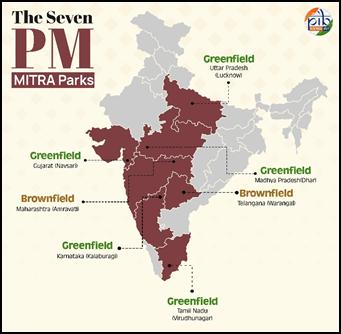
  • Current Status: A total of 7 Parks established in states of Gujarat, Maharashtra, Madhya Pradesh, Tamil Nadu, Karnataka, Uttar Pradesh, and Telangana.
  1. Amended Technology Upgradation Fund Scheme (ATUFS)
  • Objective: To incentivise credit flow for benchmark credit linked technology upgradation in this MSME driven Textile Industry for supporting capital investment.
  • Budget₹17,822 crore.
  • Incentives: Capital subsidies for technology upgradation.
  1. Samarth (Scheme for Capacity Building in Textile Sector)
  • Objective: To provide skill training to workers in the textile industry, in partnership with the Ministry of Skill Development & Entrepreneurship.
  • Budget Allocation: An amount of ₹115 crores was sanctioned during the FY 2023-24, out of which ₹114.99 crores (99.9%) were disbursed.
  • Current Status: As of March 27, 2025, more than 4.78 lakh users have been registered on the Samarth portal. As on March 19, 2025, a total of 3.82 lakh beneficiaries have been trained (passed) and 2.97 lakh beneficiaries (77.74%) have been placed.
  1. Textile Cluster Development Scheme (TCDS)
  • Objective: To create an integrated workspace and linkages-based ecosystem for existing as well as potential textile units/clusters to make them operationally and financially viable.
  • Benefits: Cluster development model of TCDS will bring benefits of critical mass for customization of interventions, economies of scale in operation, competitiveness in manufacturing, cost efficient, better access to technology and information, etc.
  • Budget₹853 crore.
  • Current Status: As of March 18, 2025, about 1.22 lakh employment opportunities have been generated under the scheme. During 2024-25₹34.48 crore have been released.
  1. National Technical Textiles Mission (NTTM)
  • Objective: To boost Technical Textiles in the country.
  • Target Years: 2020-21 to 2025-26
  • Budget₹1480 crore
  • Focus: The Mission focuses on (i) research, innovation and development, (ii) promotion and market development (iii) education and skilling and (iv) export promotion in technical textiles to position country as global leader in technical textiles.
  • Current Status: As on January 1, 2025168 projects of value ₹509 crores (approx.) have been approved in the category of Specialty fibres and Technical Textiles.

Union Budget Allocations for Ministry of Textiles

The Union Budget announced an outlay of ₹5272 crores for the Ministry of Textiles for 2025-26. This is an increase of 19% over budget estimates of 2024-25 (Rs. 4417.03 crore).

Key Highlights

  • Cotton Mission: A five-year plan to improve cotton productivity, especially extra-long staple varieties, with science and technology support.
  • Tax Exemptions on Looms: Duty removed on select shuttle-less looms to reduce costs and modernize weaving.
  • Customs Duty on Knitted Fabrics: Increased from “10% or 20%” to “20% or ₹115 per kg, whichever is higher” to curb cheap imports.
  • Handicraft Exports: Time for export extended from six months to one year, with more items eligible for duty-free input imports.
  • MSME Boost: Focus on exports, credit enhancement, and policies like the National Manufacturing Mission, Export Promotion Mission, Bharat Trade Net, and Fund of Funds to promote employment and entrepreneurship.

These measures aim to boost domestic manufacturing, support MSMEs, modernize the textile sector, and enhance India's global competitiveness.

Export Growth and Market Expansion
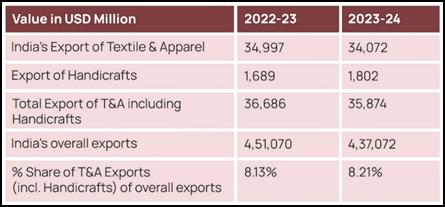
India is the 6th largest exporter of Textiles & Apparel in the world. The share of textile and apparel (T&A) including handicrafts in India’s total exports stands at a significant 8.21% in 2023-24. India has a share of 3.91% of the global trade in textiles and apparel. Major textile and apparel export destinations for India are USA and EU and with around 47% share in total textile and apparel exports.  The textile and apparel sector has witnessed significant export growth due to government incentives and trade agreements.

The government has taken several steps to enhance exports in textiles and apparels, including:

  • Rebate of State and Central Taxes and Levies (RoSCTL): On 7th March 2019, Government approved Rebate of State and Central Taxes and Levies (RoSCTL) Scheme to rebate all embedded State and Central taxes/levies on export of Apparel/Garments and Made-ups to provide support and enhance competitiveness of these sectors.
  • Production Linked Incentive (PLI) Scheme for Textiles: Under this scheme, as per the Quarterly Review Reports (QRRs) released on 31.03.2024, the turnover achieved was Rs. 1,355 crore including export of Rs.166 crore.
  • Free Trade Agreements: India has so far signed 14 Free Trade Agreements (FTAs) including recently concluded agreement with United Arab Emirates (UAE), Australia and TEPA (Trade and Economic Partnership Agreement) with EFTA (European Free Trade Association) countries comprising Switzerland, Iceland, Norway & Liechtenstein. India has 6 Preferential Trade Agreements (PTAs) with various trading partners. India is presently engaged in FTA negotiations with some of its trading partners notable among these FTAs are India-UK Free Trade Agreement, India- EU Free Trade Agreement, and India-Oman FTA.
  • Quality Control Orders: The Ministry has actively taken up notification of standards for textile products in co-ordination with Bureau of Indian Standards and Quality Control Orders (QCOs) are issued to regulate quality and curb sub-standard imports.
  • Textile Advisory Group on Man-Made Fibre (MMF): The Ministry has constituted a “Textile Advisory Group on Man-made Fibre (MMF)” comprising stakeholders of the country’s entire Man-Made Fibre (MMF) including viscose to deliberate and make recommendations on the issues and concerns of the sector.
  • Exports Promotion Councils (EPCs): There are eleven Exports Promotion Councils (EPCs) representing various segments of the textiles & apparel value chain from Fibre to finished goods as well as traditional sectors like handloom, handicrafts and carpets.  These Councils work in close cooperation with the Ministry of Textiles and other Ministries to promote the growth and export of their respective sectors in global markets. 

FDI in Textile and Apparel Industry

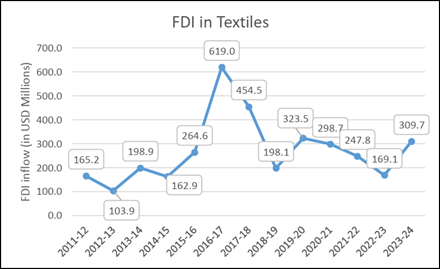
Foreign Direct Investment (FDI) plays a role in the Indian textile and apparel sector. From January 2000 to March 2024, the textile sector received US$ 4,472.79 million (₹28,304.10 crore) in FDI equity. FDI in textile sector over the years can be traced in the graph below:

BHARAT TEX 2024

Bharat Tex 2024, a global textile expo was successfully organized during February 26 to February 29, 2024 by the consortium of 11 Textiles Export Promotion Councils with the support of Ministry of Textiles. Built on the twin pillars of trade and investment and with an overarching focus on sustainability, the 4-day event attracted besides policymakers and global CEOs3,500 Exhibitors3,000 Buyers from 111 Countries and over one lakh trade visitors. An exhibition spread across nearly 2 million sq ft of area and encompassing the entire textile value chain, including an artistically curated story of textiles- Vastra Katha were the highlights of the event. The event was hosted simultaneously at two state of the art venues in Delhi - Bharat Mandapam and Yashobhoomi with both venues fully subscribed.

This global scale conference with 70 sessions and 112 international speakers saw engaging discussions on key textile issues of the day including Textile Mega TrendsSustainability, resilient global supply chains and Manufacturing 4.0.

BHARAT TEX 2025

Bharat Tex 2025, India's largest global textile event, was successfully organized from February 14 to 17, 2025, at Bharat Mandapam, New Delhi. The event spanned 2.2 million square feet and featured over 5,000 exhibitors, providing a comprehensive showcase of India's textile ecosystem. More than 1,20,000 trade visitors, from 120+ countries including global CEOs, policymakers, and industry leaders, attended the event.

Bharat Tex 2025 served as a platform to accelerate the government's "Farm to Fibre, Fabric, Fashion, and Foreign Markets" vision. India’s textile exports have already reached ₹3 lakh crore, and the goal is to triple this to ₹9 lakh crore by 2030 by strengthening domestic manufacturing and expanding global reach. The event demonstrated India's leadership in the textile sector and its commitment to innovation, sustainability, and global collaboration.

Innovation in Textile Sector

As far as innovation in textiles sector is concerned, Ministry of Textiles has conducted an Innovation Challenges in collaboration with Startup India & DPIIT. In this challenge, 9 winners were recognised and awarded, while incubation opportunities were presented to 6 awardees under the Atal Innovation Mission (AIM). Apart from this, 3 separate innovations challenges were conducted by nature fibre boards on their respective problem statements i.e. 

  • NJB Technological Innovation Grand Challenge in which 3 winners were recognised and awarded out of 125 applicants.
  • CSB Start-up Grand Challenge in which 4 winners were recognised and awarded out of             58 applicants.
  • CWDB Wool Innovation Challenge in which 3 winners were recognised and awarded out of     24 applicants.
  • 17 of the total above-mentioned winners are directly engaging in activities such as textile waste recycling, biobased fibres or sustainable garment production

Cotton Industry in India

Cotton is a vital commercial crop in India, contributing about 24% to global cotton production and sustaining the livelihoods of millions of farmers and workers. It plays a crucial role in India's foreign exchange earnings through exports of raw cotton, intermediate products, and finished goods. India holds the largest cotton acreage in the world.

  • Acreage and Yield: India has the largest cotton acreage globally; ranks 36th in productivity.
  • Production and Consumption: India is the 2nd largest producer and consumer of cotton in the world.
  • Cotton Species: India grows all four species of cotton: G. Arboreum, G. Herbaceum (Asian cotton), G. Barbadense (Egyptian cotton) and G. Hirsutum (American Upland cotton).
  • Major Growing Zones: Cotton is primarily grown in the NorthernCentral, and Southern zones of India.

Production and Consumption of Cotton (in lakh bales)

Cotton Year

Production

Consumption

2021-22

311.17

322.41

2022-23

336.60

313.63

2023-24 (P)

325.22

323.00

Import and Export of Cotton (in lakh bales)

Cotton Season

Import (in lakh bales)

Export (in lakh bales)

2021-22

21.13

42.25

2022-23

14.60

15.89

2023-24*

6.73

26.24

* Position up to 30.06.2024

Government Schemes and Initiatives:

  • Minimum Support Price (MSP) Operations to ensure remunerative prices to cotton farmers.
  • "Cott-Ally" mobile app for cotton farmers.
  • Aadhar-based farmer registration for MSP benefits.
  • E-auction for transparent sale of cotton stock.
  • QR code using Block Chain Technology for traceability of cotton.
  • Kasturi Cotton Bharat programme for branding Indian Cotton.

Silk Industry in India

Silk is an insect fibre known for its lustredrape, and strength. It is called the "Queen of Textiles" worldwide. India has a long history with silk and is the second largest producer and the largest consumer of silk in the world. India is unique in producing all four commercial varieties of silk: Mulberry, Tropical & Oak Tasar, Muga, and Eri. The Indian sericulture industry is important because it provides a lot of employment, requires low capital, and gives good income to silk growers. India produced 38,913 MT of silk, making it the second largest producer globally, after China.

Years

Mulberry

Tasar

Eri

Muga

Total

2004-05

14,620

322

1,448

110

16,500

2014-15

21,390

2,434

4,726

158

28,708

2020-21

23,896

2,689

6,946

239

33,770

2021-22

25,818

1,466

7,364

255

34,903

2022-23

27,654

1,318

7,349

261

36,582

2023-24

29,892

1,586

7,183

252

38,913

2024-25 (April-September)

14,233

106

3,924

92

18,355

Source: Central Silk Board, Bengaluru

The Indian government supports the silk industry through various initiatives and schemes:

  • The Central Silk Board (CSB) is a statutory body under the Ministry of Textiles that was established in 1948 to develop the silk industry.
  • The Ministry of Textiles is implementing the Scheduled Caste Sub Plan (SCSP) and Tribal Sub Plan (TSP) under the Silk Samagra Scheme.
  • In 2023-24, the Ministry of Textiles, Government of India, allocated ₹25 crore for the implementation of the SCSP for sericulture. The entire funds allocated under SCSP were fully utilized/released for implementation of beneficiary-oriented components.
  • The government is also working on research and development in the silk sector to improve productivity and quality. This includes promoting soil testing, organic farming, and the use of silkworm by-products. They are also upgrading reeling technology and promoting indigenous automatic reeling machines to boost the Make in India program.
  • The industry also focuses on product design development and diversification to promote Indian silks and help manufacturers and exporters create innovative designs and fabrics.

Jute Industry in India

The jute industry is a major player in India's economy, particularly in the eastern regions like West Bengal. It's a vital source of employment, providing livelihoods for workers in organized mills and diversified units, and supporting numerous farm families. The Indian government actively supports the jute sector through various initiatives aimed at improving productivity, ensuring fair prices for farmers, and promoting the use of jute products.

  • The jute industry provides direct employment to 4 lakh workers in organized mills and diversified units, including the tertiary sector and allied activities.
  • It supports the livelihood of 40 lakh farm families.
  • As per the Office of Jute Commissioner, there are 116 composite jute mills.
  • West Bengal has the highest number of jute mills (86).
  • Government of India provides support to the jute growers through MSP operations by the Jute Corporation of India and also through direct purchase of jute sacking.
  • Average land area under raw jute & mesta cultivation is 799 thousand hectares (average of last four years).
  • Average production of raw jute & mesta is 10,990 thousand bales (average of last four years).
  • Average export of jute goods is 133 thousand MT per annum with a value of Rs. 21,150 million per annum (average of last four years).
  • Jute - ICARE has been launched for improving fibre quality and productivity, reducing the cost of jute production, and increasing the income of jute farmers.
  • The schemes for the promotion of the jute sector are primarily implemented by the National Jute Board.

Conclusion

The Make in India initiative has significantly enhanced India’s position in global textile manufacturing and exports through targeted policies, infrastructure development, and investment promotion. With sustained efforts, India is poised to become a global textile leader, driving economic growth and employment generation.

References

https://www.texmin.nic.in/textile-data

https://jutecomm.gov.in/FAQ.html

https://www.investindia.gov.in/sector/textiles-apparel

https://pib.gov.in/PressReleasePage.aspx?PRID=2089306

https://pib.gov.in/PressReleasePage.aspx?PRID=2098352

https://pib.gov.in/PressReleasePage.aspx?PRID=2099411

https://pib.gov.in/PressReleasePage.aspx?PRID=2114277

https://pib.gov.in/PressReleaseIframePage.aspx?PRID=2104423

https://www.indiabudget.gov.in/economicsurvey/doc/echapter.pdf

https://www.texmin.nic.in/sites/default/files/Indian%20Jute%20At%20a%20Glance.pdf

https://www.texmin.nic.in/sites/default/files/Note%20on%20Cotton%20Sector_0.pdf

https://sansad.in/getFile/loksabhaquestions/annex/184/AU4118_0othg1.pdf?source=pqals

https://sansad.in/getFile/loksabhaquestions/annex/184/AS245_n0CCI6.pdf?source=pqals

https://sansad.in/getFile/loksabhaquestions/annex/184/AU2877_YZdL4e.pdf?source=pqals

https://sansad.in/getFile/loksabhaquestions/annex/184/AU2873_sOQ5IE.pdf?source=pqals

https://sansad.in/getFile/loksabhaquestions/annex/184/AS110_T8V4VD.pdf?source=pqals

https://www.texmin.nic.in/sites/default/files/FDI%20inflow%20at%20a%20glance.pdf

https://www.texmin.nic.in/sites/default/files/Table-2%20Raw%20Silk%20Production%20Statistics.pdf

https://texmin.nic.in/sites/default/files/MOT%20Annual%20Report%20English%20%2807.11.2024%29.pdf

https://www.texmin.nic.in/sites/default/files/FDI%20inflow%20%28Finacial%20year%20wise%29.pdf

https://ddnews.gov.in/en/india-sets-new-record-with-7-rise-in-textile-exports-government-implements-multiple-schemes-to-boost-sector/

Topics

Acts Income Tax