Loading...

Top
Help
×

By creating an account you can:

Logo TaxTMI
Call Us / Help / Feedback

Contact Us At :

E-mail: [email protected]

Call / WhatsApp at: +91 99117 96707

For more information, Check Contact Us

FAQs :

To know Frequently Asked Questions, Check FAQs

Most Asked Video Tutorials :

For more tutorials, Check Video Tutorials

Submit Feedback/Suggestion :

Email :
Please provide your email address so we can follow up on your feedback.
Category :
Description :
Min 15 characters 0/2000
Make Most of Text Search
  1. Checkout this video tutorial: How to search effectively on TaxTMI.
  2. Put words in double quotes for exact word search, eg: "income tax"
  3. Avoid noise words such as : 'and, of, the, a'
  4. Sort by Relevance to get the most relevant document.
  5. Press Enter to add multiple terms/multiple phrases, and then click on Search to Search.
  6. Text Search
  7. The system will try to fetch results that contains ALL your words.
  8. Once you add keywords, you'll see a new 'Search In' filter that makes your results even more precise.
  9. Text Search
Add to...
You have not created any category. Kindly create one to bookmark this item!
Create New Category
Hide
Title :
Description :
❮❮ Hide
Default View
Expand ❯❯
Close ✕
🔎 News - Adv. Search
TEXT SEARCH:

Press 'Enter' to add multiple search terms. Rules for Better Search

Search In:
Main Text + AI Text
  • Main Text
  • Main Text + AI Text
  • AI Text
Category: ?
Categorized by AI
---- All Categories ----
  • ---- All Categories ----
  • Income Tax
  • GST
  • Customs, DGFT & SEZ
  • FEMA & RBI
  • Corp. Laws, SEBI & IBC
  • PMLA, Black Money & ED
  • Budget
  • News and Press Release
  • PTI News
Month:
---- All Months ----
  • ---- All Months ----
  • January
  • February
  • March
  • April
  • May
  • June
  • July
  • August
  • September
  • October
  • November
  • December
Year:
---- All Years ----
  • ---- All Years ----
  • 2026
  • 2025
  • 2024
  • 2023
  • 2022
  • 2021
  • 2020
  • 2019
  • 2018
  • 2017
  • 2016
  • 2015
  • 2014
  • 2013
  • 2012
  • 2011
Sort By: ?
In Sort By 'Default', exact matches for text search are shown at the top, followed by the remaining results in their regular order.
Relevance Default Date
    Union Minister of Commerce and Industry Shri Piyush Goyal Strengthens India-Singapore Economic Partnership through High-Level Bilateral and Business E...
    A Vision for Responsible AI, Resilient Banking - Keynote Address [Contributions by RBI colleagues Ms. Chandni Trehan Saluja and Ms. Kavita Gangwal, De...
    Razorpay Launches Multi-Currency Account, Helping Exporters Retain International Earnings in Foreign Currencies
    DB HiTek to Make Debut at electronica India 2026, Targeting Growth in Indian Market
    BJP demands Vijayan’s resignation from Keralam LoP post over ED findings in CMRL case
    Pakistan seeks USD 10 bn US facility to bolster forex stability
    DRI busts a wildlife trafficking syndicate involved in illicit trade of ivory artefacts
    Japan reports record exports, imports for July as energy costs climb
    Five held in UP's Bareilly for alleged fake Ayushman cards racket
    MSMEs are the true builders of India’s economic resilience: LG Sinha
    RBI MPC preferred wait-and-watch stance amid food and fuel inflation risks: Minutes
    Bihar Police arrests man over alleged exam irregularities
    United Arab Emirates suspends trade with Iran after coming under renewed missile fire
    RBI minutes: Governor Malhotra awaits more clarity on inflation, opts for rate hold
    Instant Credit Card Application With JioFinance: Step-by-Step Guide
    Union Minister of Commerce & Industry Shri Piyush Goyal leaves for Singapore for 4th India-Singapore Ministerial Roundtable and 4th India-Singapore Bu...
    IDFC FIRST Bank successfully accesses international debt capital markets with maiden US$500 million bond issuance
    Any attempt to defame CAS by manipulation will be dealt with sternly, warns Sebi's Pandey
    Rupee falls 2 paise to settle at 95.76 against US dollar
    QualityKiosk Establishes Hyderabad Engineering Hub to Advance AI Reliability, Agentic Engineering and AI Assurance for Global Enterprises
❯❯
Maximize Maximize Maximize
0 / 200
Expand Note
Add to Folder

No Folders have been created

+

Are you sure you want to delete "My most important" ?

NOTE:

News
Showing Results for :
Reset Filters
Results Found:
Show All Summaries Hide All Summaries
August 20, 2026
Show AI Summary
India-Singapore economic cooperation advances through trade, investment, technology and business linkages, including agriculture, fintech and sustainable infrastructure collaboration.
India-Singapore economic cooperation was advanced through ministerial, business and government-to-business engagements focused on deepening bilateral trade, investment, technology and commercial linkages. Discussions addressed agri-exports, GCC-based commercial parks, fintech and sustainable infrastructure, alongside expanding agricultural market linkages. The engagements reinforced commitment to strengthening trade, investment, technology and business-to-business cooperation.
August 20, 2026
Show AI Summary
Responsible AI banking requires human oversight, explainable customer decisions, fair conduct, resilient systems and inclusive credit access.
Responsible AI in banking must promote inclusion, resilience and customer trust while preserving human judgement, governance accountability and clear responsibility. AI and alternative data may widen access to credit where data is obtained with consent, tested for reliability and bias, and used prudently. Banks must maintain capacity to challenge models, oversee providers, test systems under adverse conditions and intervene when automation fails. Material customer decisions must be explainable, clearly communicated and subject to review by an authorised person. Fair conduct, meaningful disclosure, impartial complaint review and transparent communication remain essential throughout the customer relationship.
August 20, 2026
Show AI Summary
Multi-Currency EEFC settlements let exporters retain foreign earnings and choose conversion timing for overseas payment obligations.
Multi-Currency EEFC Account settlements enable exporters and international businesses to receive payment settlements directly into Exchange Earners' Foreign Currency accounts in the original transaction currency without immediate conversion into Indian rupees. Retention of foreign currency earnings permits businesses to choose when conversion is required, reducing repeated foreign-exchange conversion cycles and supporting management of foreign-currency cash flows and overseas obligations.
August 20, 2026
Show AI Summary
Power semiconductor foundry expansion targets Indian fabless customers through technology showcasing, process development, and collaboration in the growing semiconductor market.
DB HiTek seeks to expand foundry business with Indian fabless semiconductor companies by showcasing power semiconductor and specialised process technologies. Its commercial focus includes BCD processes for automotive and industrial applications, together with silicon-carbide and gallium-nitride process development and planned volume production. Product-performance evaluations are underway with strategic customers. Customer expansion also covers X-ray, global-shutter, single-photon avalanche diode, specialty CIS, and mixed-signal/RF processes, supported by collaboration with local fabless firms.
August 20, 2026
Show AI Summary
Money-laundering allegations over payments without services raise concerns about overseas transfers, identity-linked communications, and mineral smuggling.
Money-laundering allegations concern claimed payments by Cochin Minerals and Rutile Ltd. to Exalogic Solutions Pvt. Ltd., a company promoted by Veena T., without corresponding services. Searches reportedly yielded handwritten material referring to fund transfers to Dubai and digital material relating to a SIM card obtained in another person's name. Further allegations included overseas fund movement, hawala transfers, and possible thorium or monazite smuggling, all presented as allegations requiring examination.
August 20, 2026
Show AI Summary
Exchange stabilisation support aims to strengthen foreign-exchange resilience, reduce rollover dependence and restore access to longer-term market financing.
Pakistan has sought a proposed Exchange Stabilisation Support Facility to reinforce foreign-exchange stability and signal currency resilience to international capital markets. The strategy seeks to reduce reliance on short-term bilateral loans, deposits and rollovers by moving towards market-based financing with longer repayment periods. Improving sovereign creditworthiness through engagement with credit-rating agencies is intended to facilitate international market access, lower borrowing costs and enable longer-maturity debt raising.
August 20, 2026
Show AI Summary
Elephant ivory trade prohibition supports enforcement against wildlife trafficking, seizure of carved ivory articles, and further investigation.
Illicit trade in elephant ivory and articles manufactured from it is prohibited under the Wildlife (Protection) Act, 1972, supporting India's CITES obligations. Enforcement action against a wildlife-trafficking syndicate resulted in the interception of four persons and seizure of 54 carved ivory artefacts. The seized articles and apprehended persons were transferred to the State Forest Department for further investigation. The action forms part of continuing measures against unlawful trade in wildlife derivatives and biodiversity threats.
August 20, 2026
Show AI Summary
Trade deficit pressures persist as energy-import costs and currency weakness offset record automobile and electronics export growth.
Japan recorded its highest July import and export values since comparable statistics began, but continued to experience a trade deficit as rising energy costs increased import expenditure. Higher crude oil prices and disruption to Middle East supply routes affected an economy reliant on imported oil, while a weak yen raised the cost of fuel, food and raw materials. Strong automobile, semiconductor and electronics exports benefited from currency weakness, which also increased the yen value of overseas earnings.
August 19, 2026
Show AI Summary
Forged health-scheme cards allegedly enabled ineligible treatment and misuse of public healthcare funds through false beneficiary details.
Alleged misuse of Ayushman health-scheme cards involved collecting identity and ration-card details by promising free treatment, then creating forged beneficiary cards with false particulars. The alleged scheme enabled treatment for ineligible persons and purported claims of government health-scheme funds. Police arrested five persons, recovered purported forged identity and beneficiary cards, and are investigating possible involvement of hospital and medical-office personnel, the scale of card forgery, and alleged diversion of public funds.
August 19, 2026
Show AI Summary
MSME competitiveness requires affordable credit, technology adoption, formalisation, sustainable trade and stronger export-market access for inclusive growth.
MSME development is identified as central to employment generation, exports, entrepreneurship, economic resilience and self-reliance. Key priorities include affordable credit, technology upgradation, supply-chain integration, market access, brand-building and reduced red tape. Formalisation of micro industries is emphasised to expand institutional credit access, while sustainable trade is promoted through green technologies and renewable energy. Export competitiveness is to be strengthened through regional production capabilities and the "One District, One Export Hub" initiative.
August 19, 2026
Show AI Summary
Supply-side inflation risks support a policy pause pending evidence of broad-based, persistent price pressures and de-anchored expectations.
Monetary policy calibration remained on hold because food and fuel inflation had not yet produced broad-based or persistent price pressures. The policy pause was supported by limited pass-through of supply-side shocks, contained core inflation and no clear demand-driven overheating. Recalibration depends on incoming evidence of persistent inflation, entrenched supply-side pressures, de-anchored expectations and the evolving growth-inflation dynamic. Geopolitical disruption, volatile oil prices, monsoon conditions and El Nin o-related agricultural risks remain material inflation risks.
August 19, 2026
Show AI Summary
Examination irregularities investigation examines alleged answer-sheet cheating, managed centres and suspected solver-gang involvement by a biometric operator.
Alleged examination irregularities involved suspected cheating through the receipt of an answer sheet by an examinee from personnel of a private firm conducting the examination. Police arrested a biometric operator following an investigation into his alleged involvement. His prior work with biometric firms and manpower supply agencies was examined in connection with clues concerning allegedly managed examination centres and a suspected solver gang.
August 19, 2026
Show AI Summary
Trade restrictions on Iran halt commercial and financial exchanges as regional security threats disrupt maritime commerce and re-export access.
UAE trade restrictions on Iran halted all trade, commercial exchanges and financial transactions until further notice following reported ballistic-missile incidents and regional security escalation. The UAE assessed the missiles as directed at maritime traffic, while Iran denied launching them. The suspension disrupts the UAE's role as a major trade and re-export gateway for Iran and may increase Iran's economic isolation. Continuing threats to shipping through the Strait of Hormuz also create economic risk for the UAE's regional business, finance and tourism position.
August 19, 2026
Show AI Summary
Inflation persistence and expectations guide continued rate hold amid supply shocks and uncertainty over broader price pressures.
Monetary policy calibration remains contingent on clearer evidence that supply-side price shocks are becoming persistent, broad-based inflationary pressures. The policy rate was maintained unchanged amid uncertainty from higher energy costs, supply-chain disruption, an erratic monsoon and food, fuel and input-price risks. Policy tightening may be required if inflation becomes generalised, expectations become de-anchored, or inflation persists. A wait-and-watch approach was preferred pending clearer realised inflation, forecasts, weather effects and global conditions.
August 19, 2026
Show AI Summary
Online credit card applications streamline comparison, eligibility screening and e-KYC, while approval remains subject to issuing-bank criteria.
Online credit card applications through the JioFinance app combine card comparison, eligibility checks, electronic verification, application submission and status tracking. Eligibility screening may occur without affecting the applicant's credit score, but approval remains subject to the issuing bank's criteria and internal policies. Aadhaar-based e-KYC or other accepted electronic verification may be used where applicable. Applicants should provide accurate Aadhaar, PAN and mobile details. Eligible approved applicants may receive a virtual card before physical-card delivery, subject to applicable terms and conditions.
August 19, 2026
Show AI Summary
Comprehensive strategic partnership drives ministerial and business engagements on investment, market access, technology collaboration, skills and agri-food trade.
India-Singapore economic engagement is being advanced through ministerial and business roundtables under the Comprehensive Strategic Partnership. A multidisciplinary business delegation is undertaking business-to-business, government-to-business and institutional engagements focused on partnerships, investment, market access, technology collaboration and talent development. Agricultural trade cooperation includes promotion of Indian agri-food exports through a retail initiative. The engagement seeks to strengthen trade, investment, digitalisation, advanced manufacturing, skills development, green-economy cooperation and people-to-people ties.
August 19, 2026
Show AI Summary
International senior notes issuance diversifies the bank's funding sources and expands access to global debt capital markets.
IDFC FIRST Bank accessed international debt capital markets through its IFSC Banking Unit at GIFT City by issuing inaugural fixed-rate senior notes with a three-year tenor, due in 2029. The notes were offered to investors outside the United States under the Regulation S format. The issuance followed an investment-grade long-term issuer credit rating with a stable outlook, diversifies the bank's funding sources, and creates an avenue for access to global capital markets in support of long-term growth.
August 19, 2026
Show AI Summary
Closing auction session safeguards market transparency through pooled order matching, backed by immediate action against manipulation and stronger monitoring.
Closing auction session (CAS) improves transparency and reduces manipulation in end-of-trading price formation by pooling buy and sell orders during a designated closing window for auction-style matching. Manipulation intended to undermine CAS is subject to prompt and stringent action, supported by enhanced monitoring. Responsible use of artificial intelligence and machine learning requires tiered accountability and governance, including kill-switch, human-in-the-loop and data controls. Regulated entities remain responsible for privacy, security and integrity of investor data used by every AI tool they deploy.
August 19, 2026
Show AI Summary
Foreign exchange market movement shows rupee pressure from elevated crude prices, moderated by reserves, intervention and FCNR(B) inflows.
Foreign exchange market movement saw the rupee depreciate marginally against the US dollar amid higher global crude oil prices, heightened West Asia tensions, a stronger dollar environment and weaker domestic equity markets. Central-bank intervention and foreign fund inflows provided support. Adequate foreign-exchange reserves and stronger-than-expected FCNR(B) scheme inflows were identified as factors limiting the scope for sharp depreciation.
August 19, 2026
Show AI Summary
AI reliability engineering expands through an enterprise hub supporting AI assurance, agentic engineering, observability and trusted AI deployment.
QualityKiosk Technologies has established a Hyderabad engineering hub to expand AI reliability engineering, AI assurance and agentic engineering capabilities. The centre supports engineering, marketing, branding, analyst-relations and advisory functions, while serving enterprise demand for AI reliability, product engineering, CloudOps and automation. It advances an AI reliability operating framework covering AI for reliability, reliability of AI, agentic engineering, shift-right engineering, frontier-system reliability, observability and platform-based delivery to promote governance, resilience, operational trust and assurance in AI-powered systems.

News

Back

All News

Showing Results for :
Reset Filters
No Records Found

News

Showing Results for : Reset Filters
Customs, DGFT & SEZ

Threads of Progress

April 2, 2025

Contents
Summary
Note

Note

-

Bookmark

Print

Print

How Make in India is Shaping the Future of Textiles and Apparel Industry

Introduction

The Make in India initiative, launched in 2014, has played a crucial role in positioning India as a global textile manufacturing and export hub. The textile and apparel industry is one of the largest contributors to India’s economy, providing employment to millions and generating substantial foreign exchange earnings. With strong policy support, infrastructure development, and a skilled workforce, India has emerged as a preferred investment destination in the global textile sector.

Overview of India's Textile Industry

The textile and apparel industry contributes 2.3% to our GDP13% to industrial production, and 12% to exports. India exported textile items worth US$ 34.4 billion in 2023-24, with apparel constituting 42% of the export basket, followed by raw materials/semi-finished materials at 34% and finished non-apparel goods at 30%. It is also the second largest employment generators, after agriculture, with over 45 million people employed directly, including many women and the rural population. As further evidence of the inclusive nature of this industry, nearly 80% of its capacity is spread across Micro, Small and Medium Enterprises (MSMEclusters in the country.

The sector also has perfect alignment with the Government’s overall objectives of Make in India, Skill India, Women’s Empowerment, Rural Youth Employment and inclusive growth. The industry produces about 22,000 million pieces of garments per year, with the market size projected to reach US$ 350 billion by 2030, from the current $174 billion.

Recently, the Ministry of Textiles reported a 7% increase in textile and apparel exports, including handicrafts, from April to December 2024, compared to the same period the previous year. In line with the growth roadmap, the Indian textile market currently ranks fifth globally, and the government is actively working to accelerate this growth to a rate of 15-20% over the next five years.

Impact of 'Make in India' on the Textile Industry

The Make in India initiative has catalyzed textile manufacturing and exports through key policy interventions, enhanced infrastructure, and incentives. In the Union Budget 2024-25, to promote domestic textile production, two more types of shuttle-less looms are added to fully exempted textile machinery by the government. The government has introduced multiple schemes to enhance textile production, boost investments, and promote exports, including:
  1. Production Linked Incentive (PLI) Scheme for Textiles
  • Objective: To increase manufacturing in man-made fibre (MMF) and technical textiles.
  • Budget₹10,683 crore.
  • IncentivesFinancial incentives for large-scale textile manufacturers.
  1. PM MITRA (Mega Integrated Textile Region and Apparel) Parks

  • Objective: To develop world-class industrial infrastructure for textile manufacturing.
  • Focus: On developing integrated large scale and modern industrial infrastructure facility for total value-chain of the textile industry like spinning, weaving, processing, garmenting, textile manufacturing, processing & textile machinery industry.
  • Budget₹4,445 crore for a period 2021-22 to 2027-28.
  • Key Benefits: Reduced logistics costs, increased FDI, and better competitiveness in global markets.
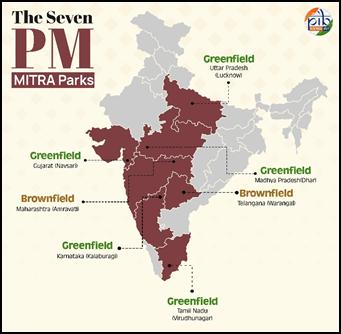
  • Current Status: A total of 7 Parks established in states of Gujarat, Maharashtra, Madhya Pradesh, Tamil Nadu, Karnataka, Uttar Pradesh, and Telangana.
  1. Amended Technology Upgradation Fund Scheme (ATUFS)
  • Objective: To incentivise credit flow for benchmark credit linked technology upgradation in this MSME driven Textile Industry for supporting capital investment.
  • Budget₹17,822 crore.
  • Incentives: Capital subsidies for technology upgradation.
  1. Samarth (Scheme for Capacity Building in Textile Sector)
  • Objective: To provide skill training to workers in the textile industry, in partnership with the Ministry of Skill Development & Entrepreneurship.
  • Budget Allocation: An amount of ₹115 crores was sanctioned during the FY 2023-24, out of which ₹114.99 crores (99.9%) were disbursed.
  • Current Status: As of March 27, 2025, more than 4.78 lakh users have been registered on the Samarth portal. As on March 19, 2025, a total of 3.82 lakh beneficiaries have been trained (passed) and 2.97 lakh beneficiaries (77.74%) have been placed.
  1. Textile Cluster Development Scheme (TCDS)
  • Objective: To create an integrated workspace and linkages-based ecosystem for existing as well as potential textile units/clusters to make them operationally and financially viable.
  • Benefits: Cluster development model of TCDS will bring benefits of critical mass for customization of interventions, economies of scale in operation, competitiveness in manufacturing, cost efficient, better access to technology and information, etc.
  • Budget₹853 crore.
  • Current Status: As of March 18, 2025, about 1.22 lakh employment opportunities have been generated under the scheme. During 2024-25₹34.48 crore have been released.
  1. National Technical Textiles Mission (NTTM)
  • Objective: To boost Technical Textiles in the country.
  • Target Years: 2020-21 to 2025-26
  • Budget₹1480 crore
  • Focus: The Mission focuses on (i) research, innovation and development, (ii) promotion and market development (iii) education and skilling and (iv) export promotion in technical textiles to position country as global leader in technical textiles.
  • Current Status: As on January 1, 2025168 projects of value ₹509 crores (approx.) have been approved in the category of Specialty fibres and Technical Textiles.

Union Budget Allocations for Ministry of Textiles

The Union Budget announced an outlay of ₹5272 crores for the Ministry of Textiles for 2025-26. This is an increase of 19% over budget estimates of 2024-25 (Rs. 4417.03 crore).

Key Highlights

  • Cotton Mission: A five-year plan to improve cotton productivity, especially extra-long staple varieties, with science and technology support.
  • Tax Exemptions on Looms: Duty removed on select shuttle-less looms to reduce costs and modernize weaving.
  • Customs Duty on Knitted Fabrics: Increased from “10% or 20%” to “20% or ₹115 per kg, whichever is higher” to curb cheap imports.
  • Handicraft Exports: Time for export extended from six months to one year, with more items eligible for duty-free input imports.
  • MSME Boost: Focus on exports, credit enhancement, and policies like the National Manufacturing Mission, Export Promotion Mission, Bharat Trade Net, and Fund of Funds to promote employment and entrepreneurship.

These measures aim to boost domestic manufacturing, support MSMEs, modernize the textile sector, and enhance India's global competitiveness.

Export Growth and Market Expansion
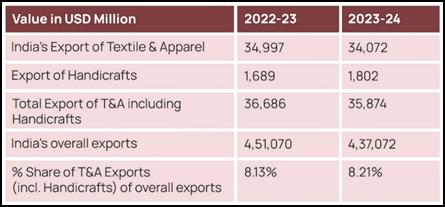
India is the 6th largest exporter of Textiles & Apparel in the world. The share of textile and apparel (T&A) including handicrafts in India’s total exports stands at a significant 8.21% in 2023-24. India has a share of 3.91% of the global trade in textiles and apparel. Major textile and apparel export destinations for India are USA and EU and with around 47% share in total textile and apparel exports.  The textile and apparel sector has witnessed significant export growth due to government incentives and trade agreements.

The government has taken several steps to enhance exports in textiles and apparels, including:

  • Rebate of State and Central Taxes and Levies (RoSCTL): On 7th March 2019, Government approved Rebate of State and Central Taxes and Levies (RoSCTL) Scheme to rebate all embedded State and Central taxes/levies on export of Apparel/Garments and Made-ups to provide support and enhance competitiveness of these sectors.
  • Production Linked Incentive (PLI) Scheme for Textiles: Under this scheme, as per the Quarterly Review Reports (QRRs) released on 31.03.2024, the turnover achieved was Rs. 1,355 crore including export of Rs.166 crore.
  • Free Trade Agreements: India has so far signed 14 Free Trade Agreements (FTAs) including recently concluded agreement with United Arab Emirates (UAE), Australia and TEPA (Trade and Economic Partnership Agreement) with EFTA (European Free Trade Association) countries comprising Switzerland, Iceland, Norway & Liechtenstein. India has 6 Preferential Trade Agreements (PTAs) with various trading partners. India is presently engaged in FTA negotiations with some of its trading partners notable among these FTAs are India-UK Free Trade Agreement, India- EU Free Trade Agreement, and India-Oman FTA.
  • Quality Control Orders: The Ministry has actively taken up notification of standards for textile products in co-ordination with Bureau of Indian Standards and Quality Control Orders (QCOs) are issued to regulate quality and curb sub-standard imports.
  • Textile Advisory Group on Man-Made Fibre (MMF): The Ministry has constituted a “Textile Advisory Group on Man-made Fibre (MMF)” comprising stakeholders of the country’s entire Man-Made Fibre (MMF) including viscose to deliberate and make recommendations on the issues and concerns of the sector.
  • Exports Promotion Councils (EPCs): There are eleven Exports Promotion Councils (EPCs) representing various segments of the textiles & apparel value chain from Fibre to finished goods as well as traditional sectors like handloom, handicrafts and carpets.  These Councils work in close cooperation with the Ministry of Textiles and other Ministries to promote the growth and export of their respective sectors in global markets. 

FDI in Textile and Apparel Industry

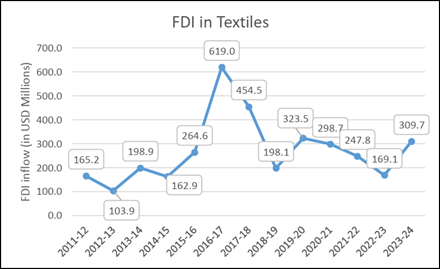
Foreign Direct Investment (FDI) plays a role in the Indian textile and apparel sector. From January 2000 to March 2024, the textile sector received US$ 4,472.79 million (₹28,304.10 crore) in FDI equity. FDI in textile sector over the years can be traced in the graph below:

BHARAT TEX 2024

Bharat Tex 2024, a global textile expo was successfully organized during February 26 to February 29, 2024 by the consortium of 11 Textiles Export Promotion Councils with the support of Ministry of Textiles. Built on the twin pillars of trade and investment and with an overarching focus on sustainability, the 4-day event attracted besides policymakers and global CEOs3,500 Exhibitors3,000 Buyers from 111 Countries and over one lakh trade visitors. An exhibition spread across nearly 2 million sq ft of area and encompassing the entire textile value chain, including an artistically curated story of textiles- Vastra Katha were the highlights of the event. The event was hosted simultaneously at two state of the art venues in Delhi - Bharat Mandapam and Yashobhoomi with both venues fully subscribed.

This global scale conference with 70 sessions and 112 international speakers saw engaging discussions on key textile issues of the day including Textile Mega TrendsSustainability, resilient global supply chains and Manufacturing 4.0.

BHARAT TEX 2025

Bharat Tex 2025, India's largest global textile event, was successfully organized from February 14 to 17, 2025, at Bharat Mandapam, New Delhi. The event spanned 2.2 million square feet and featured over 5,000 exhibitors, providing a comprehensive showcase of India's textile ecosystem. More than 1,20,000 trade visitors, from 120+ countries including global CEOs, policymakers, and industry leaders, attended the event.

Bharat Tex 2025 served as a platform to accelerate the government's "Farm to Fibre, Fabric, Fashion, and Foreign Markets" vision. India’s textile exports have already reached ₹3 lakh crore, and the goal is to triple this to ₹9 lakh crore by 2030 by strengthening domestic manufacturing and expanding global reach. The event demonstrated India's leadership in the textile sector and its commitment to innovation, sustainability, and global collaboration.

Innovation in Textile Sector

As far as innovation in textiles sector is concerned, Ministry of Textiles has conducted an Innovation Challenges in collaboration with Startup India & DPIIT. In this challenge, 9 winners were recognised and awarded, while incubation opportunities were presented to 6 awardees under the Atal Innovation Mission (AIM). Apart from this, 3 separate innovations challenges were conducted by nature fibre boards on their respective problem statements i.e. 

  • NJB Technological Innovation Grand Challenge in which 3 winners were recognised and awarded out of 125 applicants.
  • CSB Start-up Grand Challenge in which 4 winners were recognised and awarded out of             58 applicants.
  • CWDB Wool Innovation Challenge in which 3 winners were recognised and awarded out of     24 applicants.
  • 17 of the total above-mentioned winners are directly engaging in activities such as textile waste recycling, biobased fibres or sustainable garment production

Cotton Industry in India

Cotton is a vital commercial crop in India, contributing about 24% to global cotton production and sustaining the livelihoods of millions of farmers and workers. It plays a crucial role in India's foreign exchange earnings through exports of raw cotton, intermediate products, and finished goods. India holds the largest cotton acreage in the world.

  • Acreage and Yield: India has the largest cotton acreage globally; ranks 36th in productivity.
  • Production and Consumption: India is the 2nd largest producer and consumer of cotton in the world.
  • Cotton Species: India grows all four species of cotton: G. Arboreum, G. Herbaceum (Asian cotton), G. Barbadense (Egyptian cotton) and G. Hirsutum (American Upland cotton).
  • Major Growing Zones: Cotton is primarily grown in the NorthernCentral, and Southern zones of India.

Production and Consumption of Cotton (in lakh bales)

Cotton Year

Production

Consumption

2021-22

311.17

322.41

2022-23

336.60

313.63

2023-24 (P)

325.22

323.00

Import and Export of Cotton (in lakh bales)

Cotton Season

Import (in lakh bales)

Export (in lakh bales)

2021-22

21.13

42.25

2022-23

14.60

15.89

2023-24*

6.73

26.24

* Position up to 30.06.2024

Government Schemes and Initiatives:

  • Minimum Support Price (MSP) Operations to ensure remunerative prices to cotton farmers.
  • "Cott-Ally" mobile app for cotton farmers.
  • Aadhar-based farmer registration for MSP benefits.
  • E-auction for transparent sale of cotton stock.
  • QR code using Block Chain Technology for traceability of cotton.
  • Kasturi Cotton Bharat programme for branding Indian Cotton.

Silk Industry in India

Silk is an insect fibre known for its lustredrape, and strength. It is called the "Queen of Textiles" worldwide. India has a long history with silk and is the second largest producer and the largest consumer of silk in the world. India is unique in producing all four commercial varieties of silk: Mulberry, Tropical & Oak Tasar, Muga, and Eri. The Indian sericulture industry is important because it provides a lot of employment, requires low capital, and gives good income to silk growers. India produced 38,913 MT of silk, making it the second largest producer globally, after China.

Years

Mulberry

Tasar

Eri

Muga

Total

2004-05

14,620

322

1,448

110

16,500

2014-15

21,390

2,434

4,726

158

28,708

2020-21

23,896

2,689

6,946

239

33,770

2021-22

25,818

1,466

7,364

255

34,903

2022-23

27,654

1,318

7,349

261

36,582

2023-24

29,892

1,586

7,183

252

38,913

2024-25 (April-September)

14,233

106

3,924

92

18,355

Source: Central Silk Board, Bengaluru

The Indian government supports the silk industry through various initiatives and schemes:

  • The Central Silk Board (CSB) is a statutory body under the Ministry of Textiles that was established in 1948 to develop the silk industry.
  • The Ministry of Textiles is implementing the Scheduled Caste Sub Plan (SCSP) and Tribal Sub Plan (TSP) under the Silk Samagra Scheme.
  • In 2023-24, the Ministry of Textiles, Government of India, allocated ₹25 crore for the implementation of the SCSP for sericulture. The entire funds allocated under SCSP were fully utilized/released for implementation of beneficiary-oriented components.
  • The government is also working on research and development in the silk sector to improve productivity and quality. This includes promoting soil testing, organic farming, and the use of silkworm by-products. They are also upgrading reeling technology and promoting indigenous automatic reeling machines to boost the Make in India program.
  • The industry also focuses on product design development and diversification to promote Indian silks and help manufacturers and exporters create innovative designs and fabrics.

Jute Industry in India

The jute industry is a major player in India's economy, particularly in the eastern regions like West Bengal. It's a vital source of employment, providing livelihoods for workers in organized mills and diversified units, and supporting numerous farm families. The Indian government actively supports the jute sector through various initiatives aimed at improving productivity, ensuring fair prices for farmers, and promoting the use of jute products.

  • The jute industry provides direct employment to 4 lakh workers in organized mills and diversified units, including the tertiary sector and allied activities.
  • It supports the livelihood of 40 lakh farm families.
  • As per the Office of Jute Commissioner, there are 116 composite jute mills.
  • West Bengal has the highest number of jute mills (86).
  • Government of India provides support to the jute growers through MSP operations by the Jute Corporation of India and also through direct purchase of jute sacking.
  • Average land area under raw jute & mesta cultivation is 799 thousand hectares (average of last four years).
  • Average production of raw jute & mesta is 10,990 thousand bales (average of last four years).
  • Average export of jute goods is 133 thousand MT per annum with a value of Rs. 21,150 million per annum (average of last four years).
  • Jute - ICARE has been launched for improving fibre quality and productivity, reducing the cost of jute production, and increasing the income of jute farmers.
  • The schemes for the promotion of the jute sector are primarily implemented by the National Jute Board.

Conclusion

The Make in India initiative has significantly enhanced India’s position in global textile manufacturing and exports through targeted policies, infrastructure development, and investment promotion. With sustained efforts, India is poised to become a global textile leader, driving economic growth and employment generation.

References

https://www.texmin.nic.in/textile-data

https://jutecomm.gov.in/FAQ.html

https://www.investindia.gov.in/sector/textiles-apparel

https://pib.gov.in/PressReleasePage.aspx?PRID=2089306

https://pib.gov.in/PressReleasePage.aspx?PRID=2098352

https://pib.gov.in/PressReleasePage.aspx?PRID=2099411

https://pib.gov.in/PressReleasePage.aspx?PRID=2114277

https://pib.gov.in/PressReleaseIframePage.aspx?PRID=2104423

https://www.indiabudget.gov.in/economicsurvey/doc/echapter.pdf

https://www.texmin.nic.in/sites/default/files/Indian%20Jute%20At%20a%20Glance.pdf

https://www.texmin.nic.in/sites/default/files/Note%20on%20Cotton%20Sector_0.pdf

https://sansad.in/getFile/loksabhaquestions/annex/184/AU4118_0othg1.pdf?source=pqals

https://sansad.in/getFile/loksabhaquestions/annex/184/AS245_n0CCI6.pdf?source=pqals

https://sansad.in/getFile/loksabhaquestions/annex/184/AU2877_YZdL4e.pdf?source=pqals

https://sansad.in/getFile/loksabhaquestions/annex/184/AU2873_sOQ5IE.pdf?source=pqals

https://sansad.in/getFile/loksabhaquestions/annex/184/AS110_T8V4VD.pdf?source=pqals

https://www.texmin.nic.in/sites/default/files/FDI%20inflow%20at%20a%20glance.pdf

https://www.texmin.nic.in/sites/default/files/Table-2%20Raw%20Silk%20Production%20Statistics.pdf

https://texmin.nic.in/sites/default/files/MOT%20Annual%20Report%20English%20%2807.11.2024%29.pdf

https://www.texmin.nic.in/sites/default/files/FDI%20inflow%20%28Finacial%20year%20wise%29.pdf

https://ddnews.gov.in/en/india-sets-new-record-with-7-rise-in-textile-exports-government-implements-multiple-schemes-to-boost-sector/

Topics

Acts Income Tax