

Loading...

Top
Help
×

By creating an account you can:

Logo TaxTMI
Call Us / Help / Feedback

Contact Us At :

E-mail: [email protected]

Call / WhatsApp at: +91 99117 96707

For more information, Check Contact Us

FAQs :

To know Frequently Asked Questions, Check FAQs

Most Asked Video Tutorials :

For more tutorials, Check Video Tutorials

Submit Feedback/Suggestion :

Email :
Please provide your email address so we can follow up on your feedback.
Category :
Description :
Min 15 characters 0/2000
Make Most of Text Search
  1. Checkout this video tutorial: How to search effectively on TaxTMI.
  2. Put words in double quotes for exact word search, eg: "income tax"
  3. Avoid noise words such as : 'and, of, the, a'
  4. Sort by Relevance to get the most relevant document.
  5. Press Enter to add multiple terms/multiple phrases, and then click on Search to Search.
  6. Text Search
  7. The system will try to fetch results that contains ALL your words.
  8. Once you add keywords, you'll see a new 'Search In' filter that makes your results even more precise.
  9. Text Search
Add to...
You have not created any category. Kindly create one to bookmark this item!
Create New Category
Hide
Title :
Description :
❮❮ Hide
Default View
Expand ❯❯
Close ✕
🔎 News - Adv. Search
TEXT SEARCH:

Press 'Enter' to add multiple search terms. Rules for Better Search

Search In:
Main Text + AI Text
  • Main Text
  • Main Text + AI Text
  • AI Text
Category: ?
Categorized by AI
---- All Categories ----
  • ---- All Categories ----
  • Income Tax
  • GST
  • Customs, DGFT & SEZ
  • FEMA & RBI
  • Corp. Laws, SEBI & IBC
  • PMLA, Black Money & ED
  • Budget
  • News and Press Release
  • PTI News
Month:
---- All Months ----
  • ---- All Months ----
  • January
  • February
  • March
  • April
  • May
  • June
  • July
  • August
  • September
  • October
  • November
  • December
Year:
---- All Years ----
  • ---- All Years ----
  • 2026
  • 2025
  • 2024
  • 2023
  • 2022
  • 2021
  • 2020
  • 2019
  • 2018
  • 2017
  • 2016
  • 2015
  • 2014
  • 2013
  • 2012
  • 2011
Sort By: ?
In Sort By 'Default', exact matches for text search are shown at the top, followed by the remaining results in their regular order.
Relevance Default Date
    IFSCA Grants Nexent Capital GIFT City Investment Banking License
    India's exports rise 19.63 pc to USD 44.24 bn in Jul; trade deficit widens to $31.98 bn
    Vizhinjam port to commence EXIM operations from Aug 18: Kerala CM Satheesan
    Ratul Puri: Beyond Low-Cost Power to Clean Energy Reliability
    PMS Bazaar Collaborates with NSDL Database Management Limited (NDML Accreditation Agency) to Expand Access to SEBI Accredited Investor Certification
    Compounded annual growth rate of Manufacturing GVA at constant prices (2022-23 base) as per revised series during 2022-23 to 2025-26 is 10.88%
    National Company Law Tribunal (NCLT) Launches e-Inspection and e-Certified Copy Services
    The Government of India to launch the Central Bank Digital Currency (CBDC)-based Direct Benefit Transfer (DBT) in the Union Territories of Chandigarh ...
    India and the Southern African Customs Union (SACU) sign Terms of Reference (ToR) for negotiations towards a Preferential Trade Agreement
    Airtel ends all prepaid mobile plans offering 1.5 GB data per day with unlimited calls
    ED arrests IBC resolution professional
    Mumbai cops bust fake documents racket; four arrested
    After nine years at helm, N Chandra to exit Tata Sons amid expansion, governance standoff
    RBI invites comments on the Draft “Reserve Bank of India (Interest Rates on Loans and Advances) Directions, 2026”
    Sensex falls 188 pts amid elevated crude oil prices; Tata Group stocks decline after N Chandra's exit
    SJM urges govt to stand firm against US tariff pressure, calls for boycott of American products
    Union Minister of Commerce and Industry Shri Piyush Goyal Calls for Fair Trading Practices and Taking ‘Make in India’ from Local to Global
    Union Minister for Finance & Corporate Affairs Smt. Nirmala Sitharaman delivers keynote address at Seminar on “Role of the New Development Bank in M...
    Delhi HC halts processing of IT-returns of Supreme Court, high court judges
    Over 36,000 firms shut operations in Maharashtra in 5 yrs; Oppn claims graft, govt interference
❯❯
Maximize Maximize Maximize
0 / 200
Expand Note
Add to Folder

No Folders have been created

+

Are you sure you want to delete "My most important" ?

NOTE:

News
Showing Results for :
Reset Filters
Results Found:
Show All Summaries Hide All Summaries
August 13, 2026
Show AI Summary
Investment banking registration enables regulated cross-border offerings, listings, debt transactions and capital-market advisory through GIFT City.
IFSCA registration under the IFSCA (Capital Market Intermediaries) Regulations, 2025 authorises Nexent Capital IFSC Private Limited to operate as an investment banker from GIFT City. Permitted activities include management of initial and follow-on public offerings, SPAC and secondary listings, depository receipt issuances, debt capital-market transactions, and other capital-market advisory mandates. The firm proposes to provide transaction structuring, listing-readiness, execution and post-listing capital-markets support for companies seeking capital raising and listing opportunities through GIFT City's exchanges.
August 13, 2026
Show AI Summary
Merchandise export growth was driven by petroleum, electronics, engineering and marine goods, while rising imports widened the trade deficit.
India's merchandise exports increased in July, while imports also rose and widened the trade deficit. Export growth was attributed to higher overseas shipments of petroleum products, electronics, engineering goods and marine goods. Exports and imports both recorded growth during the April-July fiscal period, and exports to West Asian countries increased in July.
August 13, 2026
Show AI Summary
EXIM operations at international seaport to commence after customs clearance, bonded-area establishment, and temporary highway connectivity.
Vizhinjam International Seaport is scheduled to commence EXIM operations after Customs clearance, issuance of Customs notifications, establishment of a Customs-bonded area, and temporary connectivity to NH-66. The port had previously handled transshipment operations. A proposed transfer of a stake in the port concessionaire to a foreign shipping company remains under committee examination and requires Central Government consideration of strategic and security aspects.
August 13, 2026
Show AI Summary
Renewable energy reliability requires storage, grid readiness and ancillary service markets alongside competitive clean-power procurement.
Renewable energy procurement is shifting beyond lowest tariffs towards dependable, dispatchable and affordable clean power, assessed through capacity value, balancing capability and system economics. Storage-backed renewable and hybrid projects can improve renewable utilisation, reduce variability and curtailment, and support peak demand. Higher renewable penetration also requires supportive storage policies, timely approvals, aligned intrastate transmission planning, stronger distribution infrastructure, and market mechanisms for ramping reserves, frequency response and fast-response balancing services.
August 13, 2026
Show AI Summary
Accredited Investor certification facilitates eligible investors' access to alternative investment products, lower thresholds and applicable regulatory flexibilities.
SEBI's Accredited Investor framework enables eligible investors and entities to obtain certification that may allow lower minimum investment thresholds for Portfolio Management Services, Alternative Investment Funds and other alternative investment products, along with applicable regulatory flexibilities. PMS Bazaar and NSDL Database Management Limited's Accreditation Agency facilitate end-to-end applications, subject to required documentation and prescribed payment. Assistance is available to individual investors and eligible clients of investment providers without additional platform, service or processing charges, while prescribed certification fees remain payable.
August 13, 2026
Show AI Summary
Manufacturing GVA growth under the revised national accounts series highlights stable sectoral contribution and resilience-focused industrial measures.
Manufacturing performance is assessed under the revised National Accounts Statistics series using 2022-23 as the base year. Manufacturing's share of total Gross Value Added at current prices remained broadly stable through 2025-26, and Manufacturing GVA at constant prices achieved a compounded annual growth rate of 10.88% from 2022-23 to 2025-26. Production Linked Incentive schemes, logistics and industrial-corridor measures, semiconductor initiatives, and MSME support seek to strengthen domestic manufacturing, diversify supply chains, reduce import dependence, and improve resilience.
August 13, 2026
Show AI Summary
Electronic inspection and certified copies expand digital access to judicial records while supporting efficient case management and reduced delays.
NCLT has launched e-Inspection and e-Certified Copy Services for faster and more convenient access to judicial records and certified copies by advocates, litigants and other stakeholders. The services support a technology-enabled Registry framework and transparent, efficient justice delivery. Pendency monitoring, workload redistribution, Special Benches, maximisation of court time, and registration and listing guidelines are intended to improve case management, optimise limited judicial resources and reduce avoidable delays.
August 13, 2026
Show AI Summary
CBDC-based food subsidy transfers enable eligible beneficiaries to use Digital Rupee wallet credits for traceable foodgrain purchases.
CBDC-based Direct Benefit Transfer under the Pradhan Mantri Garib Kalyan Anna Yojana will credit eligible beneficiaries' food subsidies as programmable Digital Rupee tokens directly into CBDC wallets. Beneficiaries may use these credits to purchase foodgrains from empanelled merchants through secure, real-time and traceable payments, replacing conventional bank-account transfers. The model is intended to improve traceability, reduce leakages and cash handling, enable real-time monitoring of subsidy use, and provide a scalable framework for CBDC integration with welfare schemes.
August 13, 2026
Show AI Summary
Preferential trade agreement negotiations begin under agreed terms covering market access, origin rules, trade remedies and dispute settlement.
India and the Southern African Customs Union have signed Terms of Reference to commence negotiations for a Preferential Trade Agreement. Negotiations are envisaged on trade in goods and market access, rules of origin, customs procedures and trade facilitation, trade remedies including bilateral safeguards, sanitary and phytosanitary measures, technical barriers to trade, dispute settlement, and legal and horizontal provisions. The Terms of Reference establish the negotiating framework only; preferential tariff treatment and other operative commitments depend on conclusion of a final agreement.
August 12, 2026
Show AI Summary
Prepaid plan restructuring eliminates mid-tier daily-data options and channels subscribers toward higher-priced plans with expanded data access.
Bharti Airtel has discontinued prepaid plans combining 1.5 GB daily data allowances with unlimited calling, directing subscribers towards higher-priced plans with expanded data access, including unlimited 5G data. The restructuring reduces low-priced unlimited-data offerings and changes the pricing architecture for customers using discontinued mid-tier plans. Management links tariff repair to differentiated mobile-plan categories and sustained average revenue per user growth.
August 12, 2026
Show AI Summary
Insolvency professional conduct faces money-laundering allegations over re-admitted claims, creditor committee changes, and a connected resolution applicant.
Enforcement action under the Prevention of Money Laundering Act concerns allegations that an insolvency professional re-admitted claims earlier rejected as spurious and fraudulent during the Corporate Insolvency Resolution Process. The alleged re-admission altered the Committee of Creditors' composition and facilitated consideration of a resolution plan allegedly submitted for, and funded through an entity controlled by, a company promoter under investigation for diversion of bank-loan funds. Adverse findings reportedly included acting beyond authority by relying on fabricated and improperly submitted material.
August 12, 2026
Show AI Summary
Identity document forgery allegations prompt investigation into fraudulent Aadhaar updates and falsified government and educational certificates.
Alleged forgery and misuse of identity-related records are under investigation following operations at Aadhaar centres. Seized materials reportedly include forged birth, educational, residence, caste and citizenship certificates, records bearing forged signatures and seals, and equipment used for Aadhaar updates. Four persons were arrested in two operations for allegedly preparing forged records and using them to update Aadhaar cards. Cases have been registered under relevant provisions of the Bharatiya Nyay Sanhita, with investigation continuing into the extent of the alleged network.
August 12, 2026
Show AI Summary
Holding-company governance succession follows leadership departure, requiring transition planning amid unresolved strategy, capital allocation, board representation and listing questions.
Tata Sons' leadership succession and governance framework have become central following the chairman's decision not to seek reappointment when his term ends in February 2027. The board has been asked to decide on a successor promptly. Unresolved matters include the strategic roadmap, losses and capital requirements in newer businesses, board representation, capital allocation, an exit route for the Shapoorji Pallonji Group, and the possible listing of Tata Sons. Future leadership must manage these issues while improving returns from investment-intensive businesses and maintaining established operations.
August 12, 2026
Show AI Summary
Interest-rate regulation for loans and advances proposes harmonised fixed and floating loan-pricing principles across regulated entities.
Interest-rate regulation for loans and advances is proposed to be harmonised across all regulated entities through a principles-based framework for fixed-rate and floating-rate loans. The framework would be calibrated to each entity's nature, complexity and scale, while supporting monetary policy transmission, credit-risk-based pricing, and fair, non-discriminatory borrower treatment. It addresses divergent commercial-bank practices in determining the marginal cost of funds-based lending rate and its components, alongside limited regulatory coverage of fixed-rate loans. Separate final directions are intended for each category of regulated entity after consideration of feedback.
August 12, 2026
Show AI Summary
Elevated crude oil prices and Tata leadership transition drove broad equity market selling amid inflation concerns.
Indian equity markets declined amid elevated crude oil prices, inflation concerns and broad risk-off selling. Tata Group shares, particularly TCS, came under pressure after N. Chandrasekaran announced that he would not seek reappointment as Tata Sons Chairman when his current term ends. Crude oil prices approaching the USD 90-per-barrel level affected investor confidence because of potential inflationary effects, while uncertainty over United States-Iran negotiations and Strait of Hormuz shipping disruptions added to global energy market concerns.
August 12, 2026
Show AI Summary
Trade sovereignty and energy security underpin calls to resist tariff pressure and protect sensitive sectors in bilateral negotiations.
Trade sovereignty and energy security are advanced as grounds for resisting tariff pressure linked to Indian purchases of Russian crude. Bilateral trade negotiations should proceed through equality, reciprocity and mutual respect without compromising agriculture, dairy, energy security or strategic autonomy. Concerns are also raised over removal of e-commerce inventory restrictions for foreign direct investment and over proposed Merchant Discount Rate charges on UPI transactions. Withdrawal of the inventory measure and opposition to payment-provider charges are urged, alongside possible restrictions on United States technology and social-media companies and consumer boycotts of American goods and services.
August 12, 2026
Show AI Summary
Fair trading practices and circular production are promoted to strengthen Make in India and expand global market participation.
Trade and industrial policy messaging encourages businesses to digitise operations, adopt good manufacturing practices, follow fair trading practices, and promote recycling, reuse and a circular economy. Nine free trade agreements are identified as creating preferential market-access opportunities for Indian industry and businesses. MSMEs, entrepreneurs, farmers, fishermen, workers and the services sector are encouraged to expand Indian products and services globally, improve competitiveness through scale, and strengthen the quality, design and brand value associated with Make in India.
August 12, 2026
Show AI Summary
Private capital mobilisation requires credible long-term frameworks, risk-sharing mechanisms, and multilateral partnerships to strengthen infrastructure investment.
Private capital mobilisation in infrastructure and development finance depends on credible long-term frameworks, investor confidence, project bankability, and balanced risk allocation. Public capital is intended to catalyse rather than replace private investment. Key financing mechanisms include Viability Gap Funding, the Hybrid Annuity Model, credit enhancement, and Infrastructure Investment Trusts. Long-term investment visibility and coordinated connectivity are supported through the National Infrastructure Pipeline and PM Gati Shakti framework, alongside investment measures for freight, rail, waterways, and coastal cargo.
August 12, 2026
Show AI Summary
Judicial allowance exemptions under the new tax regime remain disputed, with return processing and resulting demands kept in abeyance.
Tax treatment of specified judicial allowances under the new income-tax regime is disputed. Statutory service-condition provisions are asserted to exclude allowances, including official residence, conveyance, sumptuary allowance and leave travel concession, from income computation and to override the Income-tax Act. Pending consideration, affected judges may show these amounts as receipts not in the nature of income, and their returns are not to be processed further. Any resulting demand remains in abeyance, while refundable amounts are withheld subject to the pending proceedings.
August 12, 2026
Show AI Summary
Corporate closure data highlights worker-claim treatment through insolvency adjudication and liquidation priority, while affected-worker information remains unmaintained.
Corporate closure data recorded 36,211 private companies in Maharashtra as liquidated, dissolved or struck off during the preceding five financial years. Central information is not maintained on workers affected by closures or special rehabilitation packages. In corporate insolvency resolution, employee and worker claims are adjudicated under orders of the adjudicating authority. In winding-up or liquidation, the liquidator deals with pending wages and other admissible statutory dues, subject to available funds and the statutory order of priority.

News

Back

All News

Showing Results for :
Reset Filters
No Records Found

News

Back

All News

Showing Results for : Reset Filters

SUMMARY OF UNION BUDGET 2025-26

February 1, 2025

Contents
Summary
Note

Note

-

Bookmark

Print

Print

NO INCOME TAX ON AVERAGE MONTHLY INCOME OF UPTO RS 1 LAKH; TO BOOST MIDDLE CLASS HOUSEHOLD SAVINGS & CONSUMPTION

SALARIED CLASS TO PAY NIL INCOME TAX UPTO ₹ 12.75 LAKH PER ANNUM IN NEW TAX REGIME

UNION BUDGET RECOGNISES 4 ENGINES OF DEVELOPMENT – AGRICULTURE, MSME, INVESTMENT AND EXPORTS

BENEFITTING 1.7 CRORE FARMERS, ‘PRIME MINISTER DHAN-DHAANYA KRISHI YOJANA’ TO COVER 100 LOW AGRICULTURAL PRODUCTIVITY DISTRICTS

“MISSION FOR AATMANIRBHARTA IN PULSES” WITH A SPECIAL FOCUS ON TUR, URAD AND MASOOR TO BE LAUNCHED

LOANS UPTO Rs. 5 LAKHS THROUGH KCC UNDER MODIFIED INTEREST SUBVENTION SCHEME

FY-25 ESTIMATED TO END WITH FISCAL DEFICIT OF 4.8%, TARGET TO BRING IT DOWN TO 4.4% IN FY-26

SIGNIFICANT ENHANCEMENT OF CREDIT WITH GUARANTEE COVER TO MSMEs FROM ₹ 5 CR TO ₹ 10 CR

A NATIONAL MANUFACTURING MISSION COVERING SMALL, MEDIUM AND LARGE INDUSTRIES FOR FURTHERING “MAKE IN INDIA”

50,000 ATAL TINKERING LABS IN GOVERNMENT SCHOOLS IN NEXT 5 YEARS

CENTRE OF EXCELLENCE IN ARTIFICIAL INTELLIGENCE FOR EDUCATION, WITH A TOTAL OUTLAY OF ₹ 500 CRORE

PM SVANIDHI WITH ENHANCED LOANS FROM BANKS, AND UPI LINKED CREDIT CARDS WITH ₹ 30,000 LIMIT

GIG WORKERS TO GET IDENTITY CARDS, REGISTRATION ON E-SHRAM PORTAL &  HEALTHCARE UNDER PM JAN AROGYA YOJANA

₹ 1 LAKH CRORE URBAN CHALLENGE FUND FOR ‘CITIES AS GROWTH HUBS’

NUCLEAR ENERGY MISSION FOR R&D OF SMALL MODULAR REACTORS WITH AN OUTLAY OF ₹ 20,000 CRORE

MODIFIED UDAN SCHEME TO ENHANCE REGIONAL CONNECTIVITY TO 120 NEW DESTINATIONS

₹ 15,000 CRORE SWAMIH FUND TO BE ESTABLISHED FOR EXPEDITIOUS COMPLETION OF ANOTHER 1 LAKH STRESSED HOUSING UNITS

₹ 20,000 CRORE ALLOCATED FOR PRIVATE SECTOR DRIVEN RESEARCH DEVELOPMENT AND INNOVATION INITIATIVES

GYAN BHARATAM MISSION FOR SURVEYAND CONSERVATION OF MANUSCRIPTS TO COVER MORE THAN ONE CRORE MANUSCRIPTS

FDI LIMIT ENHANCED FOR INSURANCE FROM 74 TO 100 PER CENT

JAN VISHWAS BILL 2.0 TO BE INTRODUCED FOR DECRIMINALISING MORE THAN 100 PROVISIONS IN VARIOUS LAWS

UPDATED INCOME TAX RETURNS TIME LIMIT INCREASED FROM TWO TO FOUR YEARS

DELAY IN TCS PAYMENT DECRIMINALISED

TDS ON RENT INCREASED FROM ₹ 2.4 LAKH TO ₹ 6 LAKH

BCD EXEMPTED ON 36 LIFESAVING DRUGS AND MEDICINES FOR TREATING CANCER, RARE AND CHRONIC DISEASES

BCD ON IFPD INCREASED TO 20% AND ON OPEN CELLS REDUCED TO 5%

BCD ON PARTS OF OPEN CELLS EXEMPTED TO PROMOTE DOMESTIC MANUFACTURING

TO BOOST BATTERY PRODUCTION, ADDITIONAL CAPITAL GOODS FOR EV AND MOBILE BATTERY MANUFACTURING EXEMPTED

BCD EXEMPTED FOR 10 YEARS ON RAW MATERIALS & COMPONENTS USED FOR SHIP BUILDING

BCD REDUCED FROM 30% TO 5% ON FROZEN FISH PASTE AND 15% TO 5% ON FISH HYDROLYSATE

Union Minister of Finance and Corporate Affairs Smt. Nirmala Sitharaman presented the Union Budget 2025-26 in Parliament today. Here is the summary of her budget speech;

PART A

 Quoting Telugu poet and playwright Shri Gurajada Appa Rao’s famous saying, ‘A country is not just its soil; a country is its people.’ – the Finance Minister presented the Union Budget 2025-26 with the theme “Sabka Vikas” stimulating balanced growth of all regions.

In line with this theme, the Finance Minister outlined the broad Principles of Viksit Bharat to encompass the following:

a) Zero-poverty;

b) Hundred per cent good quality school education;

c) Access to high-quality, affordable, and comprehensive healthcare;

d) Hundred per cent skilled labour with meaningful employment;

e) Seventy per cent women in economic activities; and

f) Farmers making our country the ‘food basket of the world’.

The Union Budget 2025-2026 promises to continue Government’s efforts to accelerate growth, secure inclusive development, invigorate private sector investments, uplift household sentiments, and enhance spending power of India’s rising middle class. The Budget proposes development measures focusing on poor (Garib), Youth, farmer (Annadata) and women (Nari).

The Budget aims to initiate transformative reforms in Taxation, Power Sector, Urban Development, Mining, Financial Sector, and Regulatory Reforms to augment India’s growth potential and global competitiveness.

Union Budget highlights that Agriculture, MSME, Investment, and Exports are engines in the journey to Viksit Bharat using reforms as fuel, guided by the spirit of inclusivity.

 1st Engine: Agriculture

Budget announced ‘Prime Minister Dhan-Dhaanya Krishi Yojana’ in partnership with states covering 100 districts to increase productivity, adopt crop diversification, augment post-harvest storage, improve irrigation facilities, and facilitate availability of long-term and short-term credit.

A comprehensive multi-sectoral ‘Rural Prosperity and Resilience’ programme will be launched in partnership with states to address underemployment in agriculture through skilling, investment, technology, and invigorating the rural economy. The goal is to generate ample opportunities in rural areas, with focus on rural women, young farmers, rural youth, marginal and small farmers, and landless families.

Union Finance Minister announced that Government will launch a 6-year “Mission for Aatmanirbharta in Pulses” with special focus on Tur, Urad and Masoor. Central agencies (NAFED and NCCF) will be ready to procure these 3 pulses, as much as offered during the next 4 years from farmers.

The Budget has outlined measures to Comprehensive Programme for Vegetables & Fruits, National Mission on High Yielding Seeds, and a five year Mission for Cotton Productivity amongst other measures to promote agriculture and allied activities in a major way.

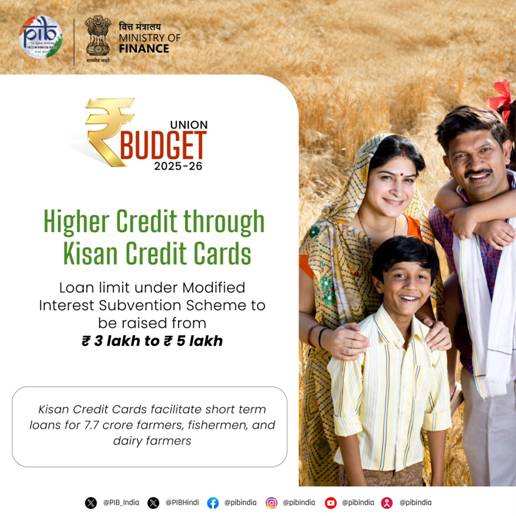
Smt. Sitharaman announced the increase in loan limits from Rs. 3 lakh to Rs. 5 lakh for loans taken through Kisan Credit Cards under modified interest subvention scheme.
 2nd Engine: MSMEs

Finance Minister described MSMEs as the second power engine for development as they constitute for 45% of our exports. To help MSMEs achieve higher efficiencies of scale, technological upgradation and better access to capital, the investment and turnover limits for classification of all MSMEs enhanced to 2.5 and 2 times, respectively. Further, steps to enhance credit availability with guarantee cover have also been announced.

The Finance Minister also announced the launch of a new scheme for 5 lakh women, Scheduled Castes and Scheduled Tribes first-time entrepreneurs. This will provide term loans up to Rs. 2 crore during the next 5 years.

Smt. Sitharaman announced that the Government will also implement a scheme to make India a global hub for toys representing the 'Made in India' brand. She added that the Government will set up a National Manufacturing Mission covering small, medium and large industries for furthering “Make in India”.

3rd Engine: Investment

Defining Investment as the third engine of growth, the Union Minister prioritized investment in people, economy and innovation. 

Under the investment in people, she announced that 50,000 Atal Tinkering Labs will be set up in Government schools in next 5 years.

Smt. Nirmala Sitharaman announced that broadband connectivity will be provided to all Government secondary schools and primary health centres in rural areas under the Bharatnet project.

She said Bharatiya Bhasha Pustak Scheme will be implemented to provide digital-form Indian language books for school and higher education.

Five National Centres of Excellence for skilling will be set up with global expertise and partnerships to equip our youth with the skills required for “Make for India, Make for the World” manufacturing.

A Centre of Excellence in Artificial Intelligence for education will be set up with a total outlay of 500 crore.

Budget announced that Government will arrange for Gig workers’ identity cards, their registration on the e-Shram portal and healthcare under PM Jan Arogya Yojana.

Under the investment in Economy, Smt Sitharaman said Infrastructure-related ministries will come up with a 3-year pipeline of projects in PPP mode.

She added that an outlay of Rs 1.5 lakh crore was proposed for the 50-year interest free loans to states for capital expenditure and incentives for reforms.

She also announced the second Asset Monetization Plan 2025-30 to plough back capital of Rs 10 lakh crore in new projects.

The Jal Jeevan Mission was extended till 2028 with focus on the quality of infrastructure and Operation & Maintenance of rural piped water supply schemes through “Jan Bhagidhari”.

Government will set up an Urban Challenge Fund of Rs.1 lakh crore to implement the proposals for ‘Cities as Growth Hubs’, ‘Creative Redevelopment of Cities’ and ‘Water and Sanitation’.

Under the investment in Innovation, an allocation of ₹20,000 crore is announced to implement private sector driven Research, Development and Innovation initiative.

Finance Minister proposed National Geospatial Mission to develop foundational geospatial infrastructure and data which will benefit urban planning.

Budget proposes Gyan Bharatam Mission, for survey, documentation and conservation of  more than 1 crore manuscripts with academic institutions, museums, libraries and private collectors. A National Digital Repository of Indian knowledge systems for knowledge sharing is also proposed.

4th Engine: Exports

Smt. Sitharaman defined Exports as the fourth engine of growth and said that jointly driven by the Ministries of Commerce, MSME, and Finance; Export Promotion Mission will help MSMEs tap into the export market. She added that a digital public infrastructure, ‘BharatTradeNet’ (BTN) for international trade was proposed as a unified platform for trade documentation and financing solutions.

The Finance Minister mentioned that support will be provided to develop domestic manufacturing capacities for our economy’s integration with global supply chains. She also announced that government will support the domestic electronic equipment industry for leveraging the opportunities related to Industry 4.0. A National Framework has also been proposed for promoting Global Capability Centres in emerging tier 2 cities.

The government will facilitate upgradation of infrastructure and warehousing for air cargo including high value perishable horticulture produce.

Reforms as the Fuel

Defining Reforms as the fuel to the engine, Smt. Sitharaman said that over the past 10 years, the Government had implemented several reforms for convenience of tax payers, such as faceless assessment, tax payers charter, faster returns, almost 99 per cent returns being on self-assessment, and Vivad se Vishwas scheme. Continuing with these efforts, she reaffirmed the commitment of the tax department to “trust first, scrutinize later”.

Financial Sector Reforms and Development

In a demonstrated steadfast commitment of the Government towards ‘Ease of Doing Business’, the Union Finance Minister proposed changes across the length and breadth of the financial landscape in India to ease compliance, expand services, build strong regulatory environment, promote international and domestic investment, and decriminalisation of archaic legal provisions.

The Union Finance Minister proposed to raise the Foreign Direct Investment (FDI) limit for the insurance from 74 to 100 per cent, to be available for those companies that invest the entire premium in India.

Smt. Sitharaman proposed a light-touch regulatory framework based on principles and trust to unleash productivity and employment. She proposed four specific measures to develop this modern, flexible, people-friendly, and trust-based regulatory framework for the 21st first century, viz.:

  1. High Level Committee for Regulatory Reforms
  • To review all non-financial sector regulations, certifications, licenses, and permissions.
  • To strengthen trust-based economic governance and take transformational measures to enhance ‘ease of doing business’, especially in matters of inspections and compliances
  • To make recommendations within a year
  • States will be encouraged to be onboarded 
  1. Investment Friendliness Index of States
  • An Investment Friendliness Index of States will be launched in 2025 to further the spirit of competitive cooperative federalism. 
  1. Mechanism under the Financial Stability and Development Council (FSDC)
  • Mechanism to evaluate impact of the current financial regulations and subsidiary instructions.
  • Formulate a framework to enhance their responsiveness and development of the financial sector. 
  1. Jan Vishwas Bill 2.0
  • To decriminalise more than 100 provisions in various laws.

Fiscal Consolidation

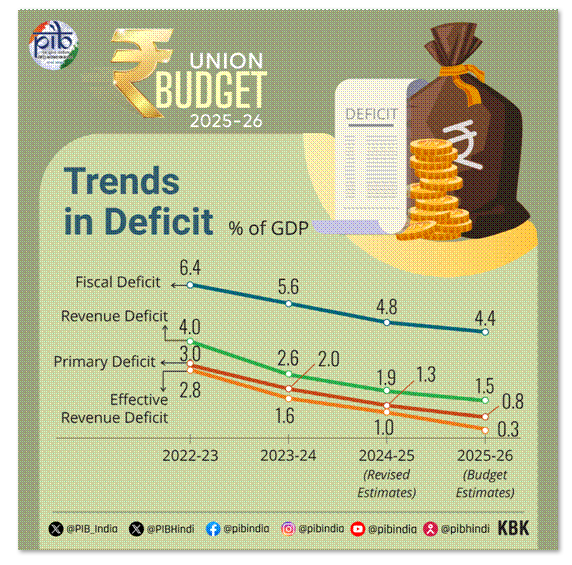
Reiterating the commitment to stay the course for fiscal consolidation, the Union Finance Minister stated that the Government endeavours to keep the fiscal deficit each year such that the Central Government debt remains on a declining path as a percentage of the GDP and the detailed roadmap for the next 6 years has been detailed in the FRBM statement. Smt. Sitharaman stated that the Revised Estimate 2024-25 of fiscal deficit is 4.8 per cent of GDP, while the Budget Estimates 2025-26 is estimated to be 4.4 per cent of GDP.
Revised Estimates 2024-25

The Minister said that the Revised Estimate of the total receipts other than borrowings is ₹31.47 lakh crore, of which the net tax receipts are ₹25.57 lakh crore. She added that the Revised Estimate of the total expenditure is ₹47.16 lakh crore, of which the capital expenditure is about ₹10.18 lakh crore.

Budget Estimates 2025-26

For FY 2025-26, the Union Finance Minister stated that the total receipts other than borrowings and the total expenditure are estimated at ₹34.96 lakh crore and ₹50.65 lakh crore respectively. The net tax receipts are estimated at ₹28.37 lakh crore.

PART B

Reposing faith on middle class in nation building, the Union Budget 2025-26 proposes new direct tax slabs and rates under the new income tax regime so that no income tax is needed to be paid for total income upto ₹ 12 Lakh per annum, i.e. average income of Rs 1 Lakh per month, other than special rate income such as Capital Gain. Salaried individuals earning upto ₹ 12.75 Lakh per annum will pay NIL tax, due to standard deduction of ₹ 75,000. Towards the new tax structure and other direct tax proposals, Government is set to lose revenue of about ₹ 1 lakh crore.

Under the guidance of Prime Minister Shri Narendra Modi, the Government has taken steps to understand the needs voiced by the people. The direct tax proposals include personal income tax reform with special focus on middle class, TDS/TCS rationalization, encouragement to voluntary compliances along with reduction of compliance burden, ease of doing business and incentivizing employment and investment.

The Budget proposes revised tax rate structure under the new tax regime as follows;

Total Income per annum

Rate of Tax

₹ 0 – 4 Lakh

NIL

 ₹ 4 – 8 Lakh

5%

₹ 8 – 12 Lakh

10%

₹ 12 – 16 Lakh

15%

₹ 16 – 20 Lakh

20%

₹ 20 – 24 Lakh

25%

Above ₹ 24 Lakh

30%

 To rationalize TDS/TCS, Budget doubles limit for tax deduction on interest earned by senior citizens from the present ₹ 50,000 to ₹ 1 Lakh. Further, TDS threshold on rent has been increased to ₹ 6 Lakh from ₹ 2.4 Lakh per annum. Other measures include, increasing of threshold to collect TCS to ₹ 10 Lakh and continuing with higher TDS deductions only in non-PAN cases. After the decriminalization of delay in payment of TDS, delay in TCS payments has now been decriminalized.

Encouraging voluntary compliance, Budget extends time-limit to file updated returns for any assessment year, from the current limit of two years, to four years. Over 90 Lakh taxpayers paid additional tax to update their income. Small charitable trusts/institutions have been given the benefit by increasing their period of registration from 5 to 10 years, reducing compliance burden. Further, tax payers can now claim annual value of two self-occupied properties as NIL, without any condition. Last budget’s Vivad Se Vishwas Scheme has received a great response, with nearly 33,000 tax payers having availed the scheme to settle their disputes. Giving benefits to senior and very senior citizens, withdrawals made from National Savings Scheme Accounts on or after 29th of August, 2024 have been exempted. NPS Vatsalya accounts also to get similar benefits.

For ease of doing business, Budget introduces a scheme for determining arm's length price of international transaction for a block period of three years. This is in line with global best practices. Further, self harbor rules are being expanded to provide certainty in international taxation.

To promote employment and investment, a presumptive taxation regime is envisaged for non-residents who provide services to a resident company that is establishing or operating an electronics manufacturing facility. Further, benefits of existing tonnage tax scheme are proposed to be extended to inland vessels. To promote start-up ecosystem, period of incorporation has been extended for a period of 5 years. To promote investment in the infrastructure sector, Budget extends the date of making investment in Sovereign Wealth Funds and Pension Funds by five more years, to 31st March, 2030.

As part of rationalization of Customs tariffs of industrial goods, Budget proposes to; (i) Remove seven tariffs, (ii) apply appropriate cess to maintain effective duty incidence, and (iii) levy not more than one cess or surcharge.

As relief on import of Drugs/Medicines, 36 lifesaving drugs and medicines for treating cancer, rare diseases and chronic diseases have been fully exempted from Basic Customs Duty (BCD). Further, 37 medicines along with 13 new drugs and medicines under Patient Assistance Programmes have been exempted from Basic Customs Duty (BCD), if supplied free to patients.

To support Domestic Manufacturing and Value Addition, BCD on 25 critical minerals, that were not domestically available, were exempted in July 2024. The Budget 2025-26 fully exempts cobalt powder and waste, scrap of lithium-ion battery, Lead, Zinc and 12 more critical minerals. To promote domestic textile production, two more types of shuttle-less looms added to fully exempted textile machinery. Further, BCD on knitted fabrics covering nine tariff lines from “10% to 20%” revised to “20% or ₹ 115 kg, whichever is higher”.

To rectify inverted duty structure and promote “Make in India”, BCD on Interactive Flat Panel Display (IFPD) increased to 20% and on Open cells reduced to 5%. Further to promote manufacture of Open cells, BCD on parts of Open Cells stands exempted.

To boost manufacturing of Lithion-ion battery in the country, 35 additional capital goods for EV battery manufacturing, and 28 additional capital goods for mobile phone battery manufacturing added to the list of exempted capital goods. Union Budget 2025-26 also continues exemption on BCD on raw materials, components, consumables or parts for ship building for another ten years. Budget also reduced BCD from 20% to 10% on Carrier Grade ethernet switches to make it at par with Non-Carrier Grade ethernet switches.

For export promotion, Budget 2025-26 facilitates exports of handicrafts, fully exempts BCD on Wet Blue leather for value addition and employment, reduce BCD from 30% to 5% on Frozen Fish Paste and reduce BCD from 15% to 5% on fish hydrolysate for manufacture of fish and shrimp feeds.

Union Minister of Finance and Corporate Affairs Smt. Nirmala Sitharaman said that Democracy, Demography and Demand are key pillars of Viksit Bharat journey. She said that the middle class gives strength of India’s growth and the Government has periodically hiked the ‘Nil tax’ slab in recognition to their contribution. She said the proposed new tax structure will substantially boost consumption, savings and investment, by putting more money in the hands of the middle class.

Topics

Acts Income Tax