

Loading...

Top
Help
×

By creating an account you can:

Logo TaxTMI
Call Us / Help / Feedback

Contact Us At :

E-mail: [email protected]

Call / WhatsApp at: +91 99117 96707

For more information, Check Contact Us

FAQs :

To know Frequently Asked Questions, Check FAQs

Most Asked Video Tutorials :

For more tutorials, Check Video Tutorials

Submit Feedback/Suggestion :

Email :
Please provide your email address so we can follow up on your feedback.
Category :
Description :
Min 15 characters 0/2000
Make Most of Text Search
  1. Checkout this video tutorial: How to search effectively on TaxTMI.
  2. Put words in double quotes for exact word search, eg: "income tax"
  3. Avoid noise words such as : 'and, of, the, a'
  4. Sort by Relevance to get the most relevant document.
  5. Press Enter to add multiple terms/multiple phrases, and then click on Search to Search.
  6. Text Search
  7. The system will try to fetch results that contains ALL your words.
  8. Once you add keywords, you'll see a new 'Search In' filter that makes your results even more precise.
  9. Text Search
Add to...
You have not created any category. Kindly create one to bookmark this item!
Create New Category
Hide
Title :
Description :
❮❮ Hide
Default View
Expand ❯❯
Close ✕
🔎 News - Adv. Search
TEXT SEARCH:

Press 'Enter' to add multiple search terms. Rules for Better Search

Search In:
Main Text + AI Text
  • Main Text
  • Main Text + AI Text
  • AI Text
Category: ?
Categorized by AI
---- All Categories ----
  • ---- All Categories ----
  • Income Tax
  • GST
  • Customs, DGFT & SEZ
  • FEMA & RBI
  • Corp. Laws, SEBI & IBC
  • PMLA, Black Money & ED
  • Budget
  • News and Press Release
  • PTI News
Month:
---- All Months ----
  • ---- All Months ----
  • January
  • February
  • March
  • April
  • May
  • June
  • July
  • August
  • September
  • October
  • November
  • December
Year:
---- All Years ----
  • ---- All Years ----
  • 2026
  • 2025
  • 2024
  • 2023
  • 2022
  • 2021
  • 2020
  • 2019
  • 2018
  • 2017
  • 2016
  • 2015
  • 2014
  • 2013
  • 2012
  • 2011
Sort By: ?
In Sort By 'Default', exact matches for text search are shown at the top, followed by the remaining results in their regular order.
Relevance Default Date
    Current account deficit widens to USD 6.2 bn in Jun: RBI data
    Concessional swap facility attracts USD 56.85 bn forex inflows: RBI
    DFS Highlights Mechanism for Timely Redressal of Insurance Policyholders’ Grievances
    Forex kitty jumps USD 14.14 bn to USD 707 bn in one of the biggest weekly expansions
    PROVISIONAL ESTIMATES OF WHOLESALE PRICE INDEX, OUTPUT PRODUCER PRICE INDEX, AND TRIAL INPUT PRODUCER PRICE INDEX FOR THE MONTH OF JULY 2026, AND FINA...
    Logistics Data Bank Tracks 10 Crore EXIM Containers, Provides Visibility across Logistics Chain
    APEDA and Government of Tripura Organise International Organic Buyer-Seller Meet to Expand Global Market Linkages
    WPI inflation eases to 9.78 pc in July on softening in fuel prices
    IDFC FIRST Bank secures its first international rating with Investment Grade from S&P Global Ratings
    DRI busts illegal drug manufacturing facility in Jewar, UP; 30 kg drugs seized and two persons arrested
    UCO Bank launches IFSC Banking Unit at GIFT City
    Banking sector has key role to play as India on way to become 3rd largest economy: Gujarat CM
    India's exports to US rise 12.85 pc in Jul; shipments to China jump 64.57 pc: Govt data
    50 tonnes of copper without e-way bills seized by Delhi GST, Railways joint team
    India's exports surge 19.6 pc in Jul; trade deficit widens to six-month high
    CBI ARRESTS CGST SUPERINTENDENT IN BRIBERY CASE
    The cumulative exports (merchandise & services) during April-July 2026-27 is estimated at US$ 316.42 Billion, as compared to US$ 279.63 Billion in Apr...
    Unlimit Mobile Ties Up with ICICI Bank Canada, RBC Royal Bank to Add Mobile Connectivity Benefits to Student GIC Journey
    Standard Chartered Accelerates India's GCC Growth with its Global Banking Expertise and 25 Years of GCC Experience
    IFSCA Grants Nexent Capital GIFT City Investment Banking License
❯❯
Maximize Maximize Maximize
0 / 200
Expand Note
Add to Folder

No Folders have been created

+

Are you sure you want to delete "My most important" ?

NOTE:

News
Showing Results for :
Reset Filters
Results Found:
Show All Summaries Hide All Summaries
August 14, 2026
Show AI Summary
Current account deficit widened as merchandise trade imbalance expanded, despite stronger services surplus, transfers, and positive capital inflows.
India's current account deficit widened in June 2026, principally because merchandise imports increased faster than exports and expanded the merchandise trade deficit. A higher services surplus, increased net transfers and a narrower net income deficit provided partial offsets. Net capital inflows, including foreign direct investment and foreign portfolio investment, supported a positive overall monthly balance. During the April-June quarter, despite increased services surplus and net transfers, the overall balance shifted to a deficit as the merchandise trade deficit widened.
August 14, 2026
Show AI Summary
Concessional foreign-currency swap facility closes early for new FCNR(B) deposits while ECB and OFCB access remains available.
The concessional swap facility for FCNR(B) deposits encourages foreign-currency inflows and supports foreign-exchange liquidity. New FCNR(B) deposits eligible for the facility must be mobilised by 31 August 2026, while swaps for eligible deposits may be availed until 11 September 2026. The swap arrangement for External Commercial Borrowings and Overseas Foreign Currency Borrowings remains available until 31 December 2026.
August 14, 2026
Show AI Summary
Insurance grievance redressal requires initial insurer complaint, prompt acknowledgement, and escalation through integrated monitoring channels when resolution remains unsatisfactory.
Insurance policyholder grievances must first be raised with the concerned insurer, whose Grievance Redressal Officer and Board-level monitoring committee oversee redressal. Complaints received through digital channels, correspondence or call centres are recorded in the insurer's Complaints Management System, integrated with Bima Bharosa. Insurers must acknowledge complaints immediately and resolve them within 14 days. Where no response is received within a reasonable period or the response is unsatisfactory, policyholders may escalate through Bima Bharosa or designated helplines, email or physical correspondence.
August 14, 2026
Show AI Summary
Foreign exchange reserve growth reflects increases in foreign currency assets, gold holdings, special drawing rights, and IMF reserve position.
India's foreign exchange reserves rose to USD 707.002 billion for the week ended 7 August 2026. The increase comprised higher foreign currency assets, gold reserves, special drawing rights and the reserve position with the IMF. Foreign currency asset valuation incorporates appreciation or depreciation of non-US currencies held in reserve assets. Measures including the FCNR(B) scheme were introduced to attract additional foreign exchange inflows.
August 14, 2026
Show AI Summary
Wholesale and producer price indices show July inflation movements, provisional estimates, final revisions, and manufacturing input-price trends.
Wholesale Price Index, Output Producer Price Index, and trial Input Producer Price Index estimates under the 2022-23 base-year series set out provisional July 2026 measures and final May 2026 revisions. All-commodities WPI stood at 110.0 in July 2026, with year-on-year inflation of 9.78 per cent. The all-commodities Output PPI was unchanged at 109.9, while the trial Input PPI for manufacturing was provisionally estimated at 105.9. Final May WPI, Output PPI and trial Input PPI measures were revised from their respective provisional estimates.
August 14, 2026
Show AI Summary
Logistics data visibility enables EXIM container tracking, operational analytics and multimodal shipment monitoring across India's logistics chain.
Logistics Data Bank provides near real-time visibility of India's EXIM container movement through technology-based tracking and stakeholder monitoring tools. RFID-based coverage extends across ports, terminals, inland logistics facilities, rail networks, industrial zones, borders and highways. The platform uses RFID, Internet of Things, Big Data and Cloud technologies, with analytics on dwell time, transit time, and port and terminal performance to identify logistics bottlenecks. LDB 2.0 adds high-seas tracking of export containers and multimodal shipment visibility.
August 14, 2026
Show AI Summary
International organic buyer-seller linkages support Tripura producers through direct sourcing engagement, market access and sustainable export opportunities.
International Organic Buyer-Seller Meet in Tripura created a direct platform for organic producers, Farmer Producer Organisations, exporters and international buyers to explore sourcing opportunities, market requirements and long-term commercial linkages. Organic and naturally produced goods, including Queen Pineapple, GI-tagged Kalikhasa Rice, organic ginger and turmeric, black sesame, jackfruit and scented lemon, were showcased through product displays and producer interactions. The initiative seeks to strengthen global market access, sourcing partnerships and income opportunities for organic farmers.
August 14, 2026
Show AI Summary
Wholesale price inflation moderation was driven by softer fuel prices, while manufactured goods and primary articles recorded higher inflation.
Wholesale price inflation moderated in July, led by a decline in fuel and power inflation and a marginal easing in food-article inflation. Inflation in manufactured products and primary articles increased, making the moderation uneven across groups. Mineral oils, food articles, basic metals, non-food articles, food products, and chemical products remained significant inflation drivers. The output Producer Price Index remained unchanged year-on-year, with lower manufacturing and mining inflation offset by higher agriculture and electricity producer-price inflation.
August 14, 2026
Show AI Summary
International investment-grade issuer ratings support expanded foreign-currency funding, trade finance, correspondent banking and cross-border financial market access.
IDFC FIRST Bank's inaugural international investment-grade issuer credit ratings, with a stable outlook, are expected to improve access to international funding markets and global financial counterparties. The rating is intended to support standby letter of credit lines, foreign-currency funding through its GIFT City International Banking Unit, mobilisation of FCNR(B) deposits, correspondent banking relationships and cross-border trade finance. Strong capitalisation, improving profitability, stable asset quality and a granular retail funding profile underpin the outlook.
August 14, 2026
Show AI Summary
Clandestine psychotropic drug manufacturing faces enforcement targeting precursor chemicals, concealed laboratories, illicit production networks and trafficking operations.
Enforcement action against clandestine manufacture of psychotropic substances led to the detection of a residential drug-production facility. Searches recovered amphetamine and intermediary forms, precursor chemicals, reagents, raw materials, and manufacturing equipment. Field testing indicated the presence of amphetamine, a psychotropic substance regulated under the Narcotic Drugs and Psychotropic Substances Act, 1985. The recovered apparatus and materials indicated illicit manufacture, while preliminary investigation pointed to short-term, intermittently operated facilities intended to conceal production activities.
August 13, 2026
Show AI Summary
International banking unit expands cross-border financing, trade finance and foreign-currency service access through GIFT City operations.
UCO Bank has launched an International Financial Services Centre Banking Unit at GIFT City to provide permitted international banking services. The unit offers trade finance, external commercial borrowings, foreign-currency loans, loan syndication, treasury services and other permitted financial services. It serves Indian corporates, exporters, importers, financial institutions, overseas businesses and other eligible customers requiring cross-border financing and access to global financial markets. FCNR(B) deposits are also offered through the unit.
August 13, 2026
Show AI Summary
Last-mile credit access is prioritised through timely lending, wider beneficiary coverage, digital support and stronger fraud vigilance.
Banking-sector participation is emphasised through last-mile credit access for MSMEs, women entrepreneurs, rural artisans, small farmers and other underserved beneficiaries. Banks are urged to expedite government-scheme applications, maximise coverage and use technology for timely financial support. Industrial-policy assistance and incentives cover startups, SC/ST entrepreneurs, persons with disabilities and first-generation entrepreneurs. Greater coordination, expanded village banking access, and vigilance against cyber fraud and mule accounts are also prioritised.
August 13, 2026
Show AI Summary
Merchandise trade growth saw rising exports to major markets alongside increased imports and continuing United States trade-pact negotiations.
India's merchandise trade data records increased July exports to the United States and China, alongside growth in imports from both markets. Exports to Singapore, the United Arab Emirates, the Netherlands, Germany, South Africa, Tanzania, Australia, Malaysia, Sri Lanka, Italy and Vietnam showed positive growth, while July exports declined for the United Kingdom, Bangladesh, Saudi Arabia and Nepal. Imports also increased from Russia, Korea, Singapore, Germany, Oman, Malaysia, Taiwan and Brazil. India and the United States are negotiating a trade pact amid an additional United States tariff on India.
August 13, 2026
Show AI Summary
GST transport documentation enforcement addresses freight movement of metals without valid e-way bills and invoices under applicable rules.
GST enforcement action led to the seizure of copper and aluminium ingots transported by freight train without valid e-way bills and invoices. The metals were found in three train wagons during inspection of parcel cargo. Further proceedings are to be undertaken under applicable GST rules concerning movement of goods without prescribed transport documentation.
August 13, 2026
Show AI Summary
Merchandise trade deficit widens as import growth outpaces exports despite strong petroleum, electronics and engineering shipments.
Merchandise trade in July 2026 saw exports rise 19.63 per cent and imports increase 17.52 per cent, widening the trade deficit to a six-month high. Petroleum products, electronics, engineering goods and marine goods supported export growth, while crude oil and several commodity and capital-goods categories increased imports. During April-July 2026-27, faster import growth widened the cumulative merchandise trade deficit compared with the corresponding prior-year period.
August 13, 2026
Show AI Summary
Bribery allegations in GST enforcement prompted arrest after alleged payment demand to avoid a tax-liability notice.
Bribery allegations involving GST enforcement led to the arrest of a CGST Superintendent after a complaint alleged that payment was demanded from a private company to avoid issuance of a tax-liability demand notice and to close the matter. A trap operation resulted in the public servant being apprehended while allegedly accepting part of the demanded bribe, and the amount accepted was recovered. Searches were undertaken, and investigation remained ongoing.
August 13, 2026
Show AI Summary
Trade performance shows rising merchandise and services exports, but faster import growth expands the overall trade deficit.
India's combined merchandise and services exports and imports increased in July 2026 and April-July 2026-27, while the overall trade deficit widened. Cumulative exports were estimated at US$ 316.42 billion and imports at US$ 365.85 billion, resulting in a trade deficit of US$ 49.43 billion. Merchandise exports, non-petroleum exports, and exports excluding petroleum and gems and jewellery grew, led by petroleum products, electronic goods, engineering goods and chemicals. Services trade recorded a cumulative surplus of US$ 69.17 billion.
August 13, 2026
Show AI Summary
Student GIC referral programmes integrate connectivity credits with funding verification and post-arrival banking arrangements for eligible international students.
Referral arrangements connect mobile connectivity benefits with the Student Guaranteed Investment Certificate application journey. Applicants may access an online portal through a referral link, submit documents, complete know-your-customer verification, and fund the GIC from permitted Indian bank accounts in no more than two transactions. After arrival, students may activate the GIC account and open a linked bank account for receipt of GIC transfers. Eligible verified applicants receive non-cash mobile credits usable only against mobile bills, subject to a cap on the bill portion payable through credits.
August 13, 2026
Show AI Summary
Global Capability Centre banking support connects offshore and onshore operations to simplify financial management and enable cross-border expansion.
Global Capability Centre banking support is positioned around connected offshore and onshore banking, international network access, digital banking platforms, and expertise in treasury centres, cross-border corporates, and evolving GCC operating models. The approach seeks to simplify financial operations and support GCC expansion across global markets. India's GCC ecosystem is characterised as a leading global capability hub, with capability centres evolving into strategic enterprise hubs requiring support for operational and financial complexities across markets.
August 13, 2026
Show AI Summary
Investment banking registration enables regulated cross-border offerings, listings, debt transactions and capital-market advisory through GIFT City.
IFSCA registration under the IFSCA (Capital Market Intermediaries) Regulations, 2025 authorises Nexent Capital IFSC Private Limited to operate as an investment banker from GIFT City. Permitted activities include management of initial and follow-on public offerings, SPAC and secondary listings, depository receipt issuances, debt capital-market transactions, and other capital-market advisory mandates. The firm proposes to provide transaction structuring, listing-readiness, execution and post-listing capital-markets support for companies seeking capital raising and listing opportunities through GIFT City's exchanges.

News

Back

All News

Showing Results for :
Reset Filters
No Records Found

News

Back

All News

Showing Results for : Reset Filters

SUMMARY OF UNION BUDGET 2025-26

February 1, 2025

Contents
Summary
Note

Note

-

Bookmark

Print

Print

NO INCOME TAX ON AVERAGE MONTHLY INCOME OF UPTO RS 1 LAKH; TO BOOST MIDDLE CLASS HOUSEHOLD SAVINGS & CONSUMPTION

SALARIED CLASS TO PAY NIL INCOME TAX UPTO ₹ 12.75 LAKH PER ANNUM IN NEW TAX REGIME

UNION BUDGET RECOGNISES 4 ENGINES OF DEVELOPMENT – AGRICULTURE, MSME, INVESTMENT AND EXPORTS

BENEFITTING 1.7 CRORE FARMERS, ‘PRIME MINISTER DHAN-DHAANYA KRISHI YOJANA’ TO COVER 100 LOW AGRICULTURAL PRODUCTIVITY DISTRICTS

“MISSION FOR AATMANIRBHARTA IN PULSES” WITH A SPECIAL FOCUS ON TUR, URAD AND MASOOR TO BE LAUNCHED

LOANS UPTO Rs. 5 LAKHS THROUGH KCC UNDER MODIFIED INTEREST SUBVENTION SCHEME

FY-25 ESTIMATED TO END WITH FISCAL DEFICIT OF 4.8%, TARGET TO BRING IT DOWN TO 4.4% IN FY-26

SIGNIFICANT ENHANCEMENT OF CREDIT WITH GUARANTEE COVER TO MSMEs FROM ₹ 5 CR TO ₹ 10 CR

A NATIONAL MANUFACTURING MISSION COVERING SMALL, MEDIUM AND LARGE INDUSTRIES FOR FURTHERING “MAKE IN INDIA”

50,000 ATAL TINKERING LABS IN GOVERNMENT SCHOOLS IN NEXT 5 YEARS

CENTRE OF EXCELLENCE IN ARTIFICIAL INTELLIGENCE FOR EDUCATION, WITH A TOTAL OUTLAY OF ₹ 500 CRORE

PM SVANIDHI WITH ENHANCED LOANS FROM BANKS, AND UPI LINKED CREDIT CARDS WITH ₹ 30,000 LIMIT

GIG WORKERS TO GET IDENTITY CARDS, REGISTRATION ON E-SHRAM PORTAL &  HEALTHCARE UNDER PM JAN AROGYA YOJANA

₹ 1 LAKH CRORE URBAN CHALLENGE FUND FOR ‘CITIES AS GROWTH HUBS’

NUCLEAR ENERGY MISSION FOR R&D OF SMALL MODULAR REACTORS WITH AN OUTLAY OF ₹ 20,000 CRORE

MODIFIED UDAN SCHEME TO ENHANCE REGIONAL CONNECTIVITY TO 120 NEW DESTINATIONS

₹ 15,000 CRORE SWAMIH FUND TO BE ESTABLISHED FOR EXPEDITIOUS COMPLETION OF ANOTHER 1 LAKH STRESSED HOUSING UNITS

₹ 20,000 CRORE ALLOCATED FOR PRIVATE SECTOR DRIVEN RESEARCH DEVELOPMENT AND INNOVATION INITIATIVES

GYAN BHARATAM MISSION FOR SURVEYAND CONSERVATION OF MANUSCRIPTS TO COVER MORE THAN ONE CRORE MANUSCRIPTS

FDI LIMIT ENHANCED FOR INSURANCE FROM 74 TO 100 PER CENT

JAN VISHWAS BILL 2.0 TO BE INTRODUCED FOR DECRIMINALISING MORE THAN 100 PROVISIONS IN VARIOUS LAWS

UPDATED INCOME TAX RETURNS TIME LIMIT INCREASED FROM TWO TO FOUR YEARS

DELAY IN TCS PAYMENT DECRIMINALISED

TDS ON RENT INCREASED FROM ₹ 2.4 LAKH TO ₹ 6 LAKH

BCD EXEMPTED ON 36 LIFESAVING DRUGS AND MEDICINES FOR TREATING CANCER, RARE AND CHRONIC DISEASES

BCD ON IFPD INCREASED TO 20% AND ON OPEN CELLS REDUCED TO 5%

BCD ON PARTS OF OPEN CELLS EXEMPTED TO PROMOTE DOMESTIC MANUFACTURING

TO BOOST BATTERY PRODUCTION, ADDITIONAL CAPITAL GOODS FOR EV AND MOBILE BATTERY MANUFACTURING EXEMPTED

BCD EXEMPTED FOR 10 YEARS ON RAW MATERIALS & COMPONENTS USED FOR SHIP BUILDING

BCD REDUCED FROM 30% TO 5% ON FROZEN FISH PASTE AND 15% TO 5% ON FISH HYDROLYSATE

Union Minister of Finance and Corporate Affairs Smt. Nirmala Sitharaman presented the Union Budget 2025-26 in Parliament today. Here is the summary of her budget speech;

PART A

 Quoting Telugu poet and playwright Shri Gurajada Appa Rao’s famous saying, ‘A country is not just its soil; a country is its people.’ – the Finance Minister presented the Union Budget 2025-26 with the theme “Sabka Vikas” stimulating balanced growth of all regions.

In line with this theme, the Finance Minister outlined the broad Principles of Viksit Bharat to encompass the following:

a) Zero-poverty;

b) Hundred per cent good quality school education;

c) Access to high-quality, affordable, and comprehensive healthcare;

d) Hundred per cent skilled labour with meaningful employment;

e) Seventy per cent women in economic activities; and

f) Farmers making our country the ‘food basket of the world’.

The Union Budget 2025-2026 promises to continue Government’s efforts to accelerate growth, secure inclusive development, invigorate private sector investments, uplift household sentiments, and enhance spending power of India’s rising middle class. The Budget proposes development measures focusing on poor (Garib), Youth, farmer (Annadata) and women (Nari).

The Budget aims to initiate transformative reforms in Taxation, Power Sector, Urban Development, Mining, Financial Sector, and Regulatory Reforms to augment India’s growth potential and global competitiveness.

Union Budget highlights that Agriculture, MSME, Investment, and Exports are engines in the journey to Viksit Bharat using reforms as fuel, guided by the spirit of inclusivity.

 1st Engine: Agriculture

Budget announced ‘Prime Minister Dhan-Dhaanya Krishi Yojana’ in partnership with states covering 100 districts to increase productivity, adopt crop diversification, augment post-harvest storage, improve irrigation facilities, and facilitate availability of long-term and short-term credit.

A comprehensive multi-sectoral ‘Rural Prosperity and Resilience’ programme will be launched in partnership with states to address underemployment in agriculture through skilling, investment, technology, and invigorating the rural economy. The goal is to generate ample opportunities in rural areas, with focus on rural women, young farmers, rural youth, marginal and small farmers, and landless families.

Union Finance Minister announced that Government will launch a 6-year “Mission for Aatmanirbharta in Pulses” with special focus on Tur, Urad and Masoor. Central agencies (NAFED and NCCF) will be ready to procure these 3 pulses, as much as offered during the next 4 years from farmers.

The Budget has outlined measures to Comprehensive Programme for Vegetables & Fruits, National Mission on High Yielding Seeds, and a five year Mission for Cotton Productivity amongst other measures to promote agriculture and allied activities in a major way.

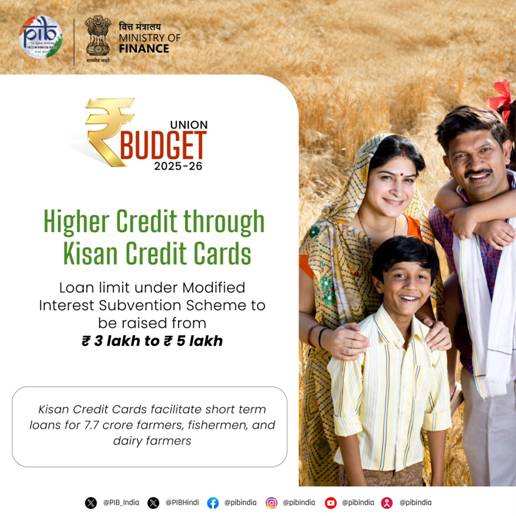
Smt. Sitharaman announced the increase in loan limits from Rs. 3 lakh to Rs. 5 lakh for loans taken through Kisan Credit Cards under modified interest subvention scheme.
 2nd Engine: MSMEs

Finance Minister described MSMEs as the second power engine for development as they constitute for 45% of our exports. To help MSMEs achieve higher efficiencies of scale, technological upgradation and better access to capital, the investment and turnover limits for classification of all MSMEs enhanced to 2.5 and 2 times, respectively. Further, steps to enhance credit availability with guarantee cover have also been announced.

The Finance Minister also announced the launch of a new scheme for 5 lakh women, Scheduled Castes and Scheduled Tribes first-time entrepreneurs. This will provide term loans up to Rs. 2 crore during the next 5 years.

Smt. Sitharaman announced that the Government will also implement a scheme to make India a global hub for toys representing the 'Made in India' brand. She added that the Government will set up a National Manufacturing Mission covering small, medium and large industries for furthering “Make in India”.

3rd Engine: Investment

Defining Investment as the third engine of growth, the Union Minister prioritized investment in people, economy and innovation. 

Under the investment in people, she announced that 50,000 Atal Tinkering Labs will be set up in Government schools in next 5 years.

Smt. Nirmala Sitharaman announced that broadband connectivity will be provided to all Government secondary schools and primary health centres in rural areas under the Bharatnet project.

She said Bharatiya Bhasha Pustak Scheme will be implemented to provide digital-form Indian language books for school and higher education.

Five National Centres of Excellence for skilling will be set up with global expertise and partnerships to equip our youth with the skills required for “Make for India, Make for the World” manufacturing.

A Centre of Excellence in Artificial Intelligence for education will be set up with a total outlay of 500 crore.

Budget announced that Government will arrange for Gig workers’ identity cards, their registration on the e-Shram portal and healthcare under PM Jan Arogya Yojana.

Under the investment in Economy, Smt Sitharaman said Infrastructure-related ministries will come up with a 3-year pipeline of projects in PPP mode.

She added that an outlay of Rs 1.5 lakh crore was proposed for the 50-year interest free loans to states for capital expenditure and incentives for reforms.

She also announced the second Asset Monetization Plan 2025-30 to plough back capital of Rs 10 lakh crore in new projects.

The Jal Jeevan Mission was extended till 2028 with focus on the quality of infrastructure and Operation & Maintenance of rural piped water supply schemes through “Jan Bhagidhari”.

Government will set up an Urban Challenge Fund of Rs.1 lakh crore to implement the proposals for ‘Cities as Growth Hubs’, ‘Creative Redevelopment of Cities’ and ‘Water and Sanitation’.

Under the investment in Innovation, an allocation of ₹20,000 crore is announced to implement private sector driven Research, Development and Innovation initiative.

Finance Minister proposed National Geospatial Mission to develop foundational geospatial infrastructure and data which will benefit urban planning.

Budget proposes Gyan Bharatam Mission, for survey, documentation and conservation of  more than 1 crore manuscripts with academic institutions, museums, libraries and private collectors. A National Digital Repository of Indian knowledge systems for knowledge sharing is also proposed.

4th Engine: Exports

Smt. Sitharaman defined Exports as the fourth engine of growth and said that jointly driven by the Ministries of Commerce, MSME, and Finance; Export Promotion Mission will help MSMEs tap into the export market. She added that a digital public infrastructure, ‘BharatTradeNet’ (BTN) for international trade was proposed as a unified platform for trade documentation and financing solutions.

The Finance Minister mentioned that support will be provided to develop domestic manufacturing capacities for our economy’s integration with global supply chains. She also announced that government will support the domestic electronic equipment industry for leveraging the opportunities related to Industry 4.0. A National Framework has also been proposed for promoting Global Capability Centres in emerging tier 2 cities.

The government will facilitate upgradation of infrastructure and warehousing for air cargo including high value perishable horticulture produce.

Reforms as the Fuel

Defining Reforms as the fuel to the engine, Smt. Sitharaman said that over the past 10 years, the Government had implemented several reforms for convenience of tax payers, such as faceless assessment, tax payers charter, faster returns, almost 99 per cent returns being on self-assessment, and Vivad se Vishwas scheme. Continuing with these efforts, she reaffirmed the commitment of the tax department to “trust first, scrutinize later”.

Financial Sector Reforms and Development

In a demonstrated steadfast commitment of the Government towards ‘Ease of Doing Business’, the Union Finance Minister proposed changes across the length and breadth of the financial landscape in India to ease compliance, expand services, build strong regulatory environment, promote international and domestic investment, and decriminalisation of archaic legal provisions.

The Union Finance Minister proposed to raise the Foreign Direct Investment (FDI) limit for the insurance from 74 to 100 per cent, to be available for those companies that invest the entire premium in India.

Smt. Sitharaman proposed a light-touch regulatory framework based on principles and trust to unleash productivity and employment. She proposed four specific measures to develop this modern, flexible, people-friendly, and trust-based regulatory framework for the 21st first century, viz.:

  1. High Level Committee for Regulatory Reforms
  • To review all non-financial sector regulations, certifications, licenses, and permissions.
  • To strengthen trust-based economic governance and take transformational measures to enhance ‘ease of doing business’, especially in matters of inspections and compliances
  • To make recommendations within a year
  • States will be encouraged to be onboarded 
  1. Investment Friendliness Index of States
  • An Investment Friendliness Index of States will be launched in 2025 to further the spirit of competitive cooperative federalism. 
  1. Mechanism under the Financial Stability and Development Council (FSDC)
  • Mechanism to evaluate impact of the current financial regulations and subsidiary instructions.
  • Formulate a framework to enhance their responsiveness and development of the financial sector. 
  1. Jan Vishwas Bill 2.0
  • To decriminalise more than 100 provisions in various laws.

Fiscal Consolidation

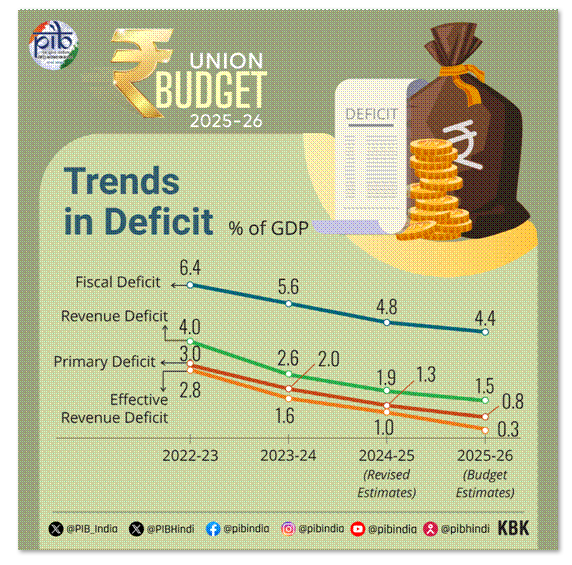
Reiterating the commitment to stay the course for fiscal consolidation, the Union Finance Minister stated that the Government endeavours to keep the fiscal deficit each year such that the Central Government debt remains on a declining path as a percentage of the GDP and the detailed roadmap for the next 6 years has been detailed in the FRBM statement. Smt. Sitharaman stated that the Revised Estimate 2024-25 of fiscal deficit is 4.8 per cent of GDP, while the Budget Estimates 2025-26 is estimated to be 4.4 per cent of GDP.
Revised Estimates 2024-25

The Minister said that the Revised Estimate of the total receipts other than borrowings is ₹31.47 lakh crore, of which the net tax receipts are ₹25.57 lakh crore. She added that the Revised Estimate of the total expenditure is ₹47.16 lakh crore, of which the capital expenditure is about ₹10.18 lakh crore.

Budget Estimates 2025-26

For FY 2025-26, the Union Finance Minister stated that the total receipts other than borrowings and the total expenditure are estimated at ₹34.96 lakh crore and ₹50.65 lakh crore respectively. The net tax receipts are estimated at ₹28.37 lakh crore.

PART B

Reposing faith on middle class in nation building, the Union Budget 2025-26 proposes new direct tax slabs and rates under the new income tax regime so that no income tax is needed to be paid for total income upto ₹ 12 Lakh per annum, i.e. average income of Rs 1 Lakh per month, other than special rate income such as Capital Gain. Salaried individuals earning upto ₹ 12.75 Lakh per annum will pay NIL tax, due to standard deduction of ₹ 75,000. Towards the new tax structure and other direct tax proposals, Government is set to lose revenue of about ₹ 1 lakh crore.

Under the guidance of Prime Minister Shri Narendra Modi, the Government has taken steps to understand the needs voiced by the people. The direct tax proposals include personal income tax reform with special focus on middle class, TDS/TCS rationalization, encouragement to voluntary compliances along with reduction of compliance burden, ease of doing business and incentivizing employment and investment.

The Budget proposes revised tax rate structure under the new tax regime as follows;

Total Income per annum

Rate of Tax

₹ 0 – 4 Lakh

NIL

 ₹ 4 – 8 Lakh

5%

₹ 8 – 12 Lakh

10%

₹ 12 – 16 Lakh

15%

₹ 16 – 20 Lakh

20%

₹ 20 – 24 Lakh

25%

Above ₹ 24 Lakh

30%

 To rationalize TDS/TCS, Budget doubles limit for tax deduction on interest earned by senior citizens from the present ₹ 50,000 to ₹ 1 Lakh. Further, TDS threshold on rent has been increased to ₹ 6 Lakh from ₹ 2.4 Lakh per annum. Other measures include, increasing of threshold to collect TCS to ₹ 10 Lakh and continuing with higher TDS deductions only in non-PAN cases. After the decriminalization of delay in payment of TDS, delay in TCS payments has now been decriminalized.

Encouraging voluntary compliance, Budget extends time-limit to file updated returns for any assessment year, from the current limit of two years, to four years. Over 90 Lakh taxpayers paid additional tax to update their income. Small charitable trusts/institutions have been given the benefit by increasing their period of registration from 5 to 10 years, reducing compliance burden. Further, tax payers can now claim annual value of two self-occupied properties as NIL, without any condition. Last budget’s Vivad Se Vishwas Scheme has received a great response, with nearly 33,000 tax payers having availed the scheme to settle their disputes. Giving benefits to senior and very senior citizens, withdrawals made from National Savings Scheme Accounts on or after 29th of August, 2024 have been exempted. NPS Vatsalya accounts also to get similar benefits.

For ease of doing business, Budget introduces a scheme for determining arm's length price of international transaction for a block period of three years. This is in line with global best practices. Further, self harbor rules are being expanded to provide certainty in international taxation.

To promote employment and investment, a presumptive taxation regime is envisaged for non-residents who provide services to a resident company that is establishing or operating an electronics manufacturing facility. Further, benefits of existing tonnage tax scheme are proposed to be extended to inland vessels. To promote start-up ecosystem, period of incorporation has been extended for a period of 5 years. To promote investment in the infrastructure sector, Budget extends the date of making investment in Sovereign Wealth Funds and Pension Funds by five more years, to 31st March, 2030.

As part of rationalization of Customs tariffs of industrial goods, Budget proposes to; (i) Remove seven tariffs, (ii) apply appropriate cess to maintain effective duty incidence, and (iii) levy not more than one cess or surcharge.

As relief on import of Drugs/Medicines, 36 lifesaving drugs and medicines for treating cancer, rare diseases and chronic diseases have been fully exempted from Basic Customs Duty (BCD). Further, 37 medicines along with 13 new drugs and medicines under Patient Assistance Programmes have been exempted from Basic Customs Duty (BCD), if supplied free to patients.

To support Domestic Manufacturing and Value Addition, BCD on 25 critical minerals, that were not domestically available, were exempted in July 2024. The Budget 2025-26 fully exempts cobalt powder and waste, scrap of lithium-ion battery, Lead, Zinc and 12 more critical minerals. To promote domestic textile production, two more types of shuttle-less looms added to fully exempted textile machinery. Further, BCD on knitted fabrics covering nine tariff lines from “10% to 20%” revised to “20% or ₹ 115 kg, whichever is higher”.

To rectify inverted duty structure and promote “Make in India”, BCD on Interactive Flat Panel Display (IFPD) increased to 20% and on Open cells reduced to 5%. Further to promote manufacture of Open cells, BCD on parts of Open Cells stands exempted.

To boost manufacturing of Lithion-ion battery in the country, 35 additional capital goods for EV battery manufacturing, and 28 additional capital goods for mobile phone battery manufacturing added to the list of exempted capital goods. Union Budget 2025-26 also continues exemption on BCD on raw materials, components, consumables or parts for ship building for another ten years. Budget also reduced BCD from 20% to 10% on Carrier Grade ethernet switches to make it at par with Non-Carrier Grade ethernet switches.

For export promotion, Budget 2025-26 facilitates exports of handicrafts, fully exempts BCD on Wet Blue leather for value addition and employment, reduce BCD from 30% to 5% on Frozen Fish Paste and reduce BCD from 15% to 5% on fish hydrolysate for manufacture of fish and shrimp feeds.

Union Minister of Finance and Corporate Affairs Smt. Nirmala Sitharaman said that Democracy, Demography and Demand are key pillars of Viksit Bharat journey. She said that the middle class gives strength of India’s growth and the Government has periodically hiked the ‘Nil tax’ slab in recognition to their contribution. She said the proposed new tax structure will substantially boost consumption, savings and investment, by putting more money in the hands of the middle class.

Topics

Acts Income Tax