

Loading...

Top
Help
×

By creating an account you can:

Logo TaxTMI
Call Us / Help / Feedback

Contact Us At :

E-mail: [email protected]

Call / WhatsApp at: +91 99117 96707

For more information, Check Contact Us

FAQs :

To know Frequently Asked Questions, Check FAQs

Most Asked Video Tutorials :

For more tutorials, Check Video Tutorials

Submit Feedback/Suggestion :

Email :
Please provide your email address so we can follow up on your feedback.
Category :
Description :
Min 15 characters 0/2000
Make Most of Text Search
  1. Checkout this video tutorial: How to search effectively on TaxTMI.
  2. Put words in double quotes for exact word search, eg: "income tax"
  3. Avoid noise words such as : 'and, of, the, a'
  4. Sort by Relevance to get the most relevant document.
  5. Press Enter to add multiple terms/multiple phrases, and then click on Search to Search.
  6. Text Search
  7. The system will try to fetch results that contains ALL your words.
  8. Once you add keywords, you'll see a new 'Search In' filter that makes your results even more precise.
  9. Text Search
Add to...
You have not created any category. Kindly create one to bookmark this item!
Create New Category
Hide
Title :
Description :
❮❮ Hide
Default View
Expand ❯❯
Close ✕
🔎 News - Adv. Search
TEXT SEARCH:

Press 'Enter' to add multiple search terms. Rules for Better Search

Search In:
Main Text + AI Text
  • Main Text
  • Main Text + AI Text
  • AI Text
Category: ?
Categorized by AI
---- All Categories ----
  • ---- All Categories ----
  • Income Tax
  • GST
  • Customs, DGFT & SEZ
  • FEMA & RBI
  • Corp. Laws, SEBI & IBC
  • PMLA, Black Money & ED
  • Budget
  • News and Press Release
  • PTI News
Month:
---- All Months ----
  • ---- All Months ----
  • January
  • February
  • March
  • April
  • May
  • June
  • July
  • August
  • September
  • October
  • November
  • December
Year:
---- All Years ----
  • ---- All Years ----
  • 2026
  • 2025
  • 2024
  • 2023
  • 2022
  • 2021
  • 2020
  • 2019
  • 2018
  • 2017
  • 2016
  • 2015
  • 2014
  • 2013
  • 2012
  • 2011
Sort By: ?
In Sort By 'Default', exact matches for text search are shown at the top, followed by the remaining results in their regular order.
Relevance Default Date
    SVC Bank's Nationwide Cyber Safety Drive Reaches Over 19,061 Citizens Across 213 Housing Societies
    'Not haircut but mundan': Cong on NCLT clearing Subhash Chandra's Rs 6.5 crore payout
    Keralam: Escaped Assam prisoner reaches police station for Aadhaar card, flees again
    Women's Savings Account: Features that make opening one worth it
    Best Pension Plans and Annuity Plans in India 2026: A Full Comparison
    Rupee rises 4 paise to 95.40 against US dollar in early trade
    Minister of State for Commerce and Industry and Electronics & Information Technology Shri Jitin Prasada Concludes Official Visit to Morocco; Co-Chairs...
    Hyderabad police caution citizens against ''Hybrid Cyber Fraud''
    Hoping to work towards further expanding scope of India-Japan trade pact: Goyal
    Bajaj Finance Personal Loan Offers Limited-Time Rewards During Loan Utsav 2026
    Commerce and Industry Minister Shri Piyush Goyal Highlights India’s Growing Startup Ecosystem at India–Japan Startup Roundtable in Tokyo
    Sugar prices rise again by Re 1 per kg to Rs 65 in retail market
    SIDBI organizes a conclave of the Heads of Regional Rural Banks (RRBs) on expanding SIDBI-RRB MSME Co-Lending arrangement
    SC sets aside show cause notice to Tata Steel over input tax credit availed during FY19-23
    HC flags fraudulent use of Aadhaar by infiltrators to get Indian citizenship; calls for action
    IVCA Welcomes Consultative Approach on Draft FEMA NDI Rules
    India to be among top 5 Nestle markets in coming years, a major export hub : Global CEO
    Build Credit Awareness with a Free Credit Score Check from Bajaj Finance
    CARD91 Introduces Five-Point Credit Lifecycle Consistency Framework for Credit Line on UPI
❯❯
Maximize Maximize Maximize
0 / 200
Expand Note
Add to Folder

No Folders have been created

+

Are you sure you want to delete "My most important" ?

NOTE:

News
Showing Results for :
Reset Filters
Results Found:
Show All Summaries Hide All Summaries
August 27, 2026
Show AI Summary
Cyber fraud awareness promotes safe digital banking by teaching customers to verify communications, protect credentials, and report suspicious transactions.
Cyber-fraud awareness and digital banking safety were promoted through community sessions addressing phishing, impersonation, OTP and UPI fraud, QR-code scams, digital-arrest fraud, and fraudulent customer-care calls. Participants were guided to identify authentic banking communications, avoid sharing confidential credentials, verify callers and links before acting, and promptly report suspected unauthorised transactions. Customer vigilance, financial literacy, and institutional security measures were emphasised as complementary safeguards against digital financial fraud.
August 27, 2026
Show AI Summary
Personal insolvency repayment plans may be approved despite minimal creditor recovery when requisite voting support and comparative valuation support them.
Personal insolvency repayment plan approval was granted under the Insolvency and Bankruptcy Code, 2016, despite objections that creditor recoveries were negligible and the proposed payment uncertain. The plan received 80.81 per cent voting support, while dissenting creditors held less than 20 per cent voting share. Valuation showed that the debtor's personal estate was materially below the offered amount, and rejection could result in bankruptcy and lower recovery. Assessment of settlement adequacy was treated as a matter of creditor commercial wisdom.
August 27, 2026
Show AI Summary
Prison escape security lapses prompt coordinated tracing measures, transport monitoring, inter-state alerts, and a detailed custodial-security inquiry.
Prison escape and custodial-security lapses arose after a detainee escaped from Aluva Sub Jail, allegedly by using an under-construction structure within the premises to cross the compound wall. Following his later appearance at a police station seeking return of his Aadhaar card, search measures included a lookout circular, information sharing with police stations, railway-security coordination, and alerting police in Assam. A detailed inquiry has been initiated into the prison-security deficiencies enabling the escape.
August 27, 2026
Show AI Summary
Women's savings account selection depends on practical benefits, charges, eligibility, and banking needs rather than the account label.
Women's Savings Accounts may provide standard banking facilities together with additional services or benefits for eligible women. Their suitability depends on practical use of digital banking, transfers, payments, alerts, debit-card facilities, accessibility, security features, charges, and minimum-balance conditions. Since regular Savings Accounts may offer comparable facilities, the additional benefits should be assessed against associated costs and conditions. Selection should be based on comparison of eligibility, facilities, balance requirements, benefits, customer support, and authentication safeguards rather than the account's women-focused label alone.
August 27, 2026
Show AI Summary
Retirement annuity selection prioritises payout structure, taxation, insurer strength and flexibility over brand comparison for informed retirement decisions.
Retirement planning may combine market-linked accumulation during working years, deferred annuities that lock future guaranteed income, and immediate annuities that convert retirement savings into regular payments. Annuity choice depends on whether the priority is higher income, continuation for a surviving spouse, or return of capital on death. Product comparison should consider market-linked growth versus income certainty, taxation of annuity income at applicable slab rates, insurer strength, and flexibility in deferment, payout frequency and policy loans.
August 27, 2026
Show AI Summary
Foreign exchange inflows through deposit and borrowing measures provided near-term rupee support amid lower crude prices.
Reserve Bank special measures relating to FCNR(B) deposits, Overseas Foreign Currency Borrowings and External Commercial Borrowings were identified as attracting foreign-exchange inflows and providing near-term support to the rupee. The Reserve Bank became a net dollar buyer in June after two months of sales to support the rupee. The FCNR(B) window remained open until August 31, while the market outlook anticipated broader rupee depreciation over subsequent weeks.
August 27, 2026
Show AI Summary
Preferential trade agreement exploration advances bilateral market access, pharmaceutical cooperation, investment partnerships, and diversified trade.
India-Morocco economic cooperation is expanded through the seventh Joint Commission framework, targeting deeper and more diversified trade, investment, industrial collaboration and market access across goods and services. An India-Morocco Joint Working Group is to examine bilateral trade opportunities and the feasibility of a preferential trade agreement, including tariff and non-tariff barriers, improved market access and trade facilitation. Cooperation also addresses pharmaceutical market authorisation and approval timelines, food safety, sustainable agriculture, renewable energy, artificial intelligence, healthcare, and phosphates and fertilisers.
August 26, 2026
Show AI Summary
Hybrid cyber fraud exploits stolen smartphones and intercepted verification codes to compromise digital banking and payment accounts.
Hybrid cyber fraud combines physical smartphone theft with digital financial exploitation. Offenders obtain screen-lock credentials, steal devices and use control of the active SIM card to intercept verification codes and reset UPI and digital banking credentials. Preventive measures include withholding PINs, passwords and OTPs; avoiding storage of financial and identity records on phones; and immediately blocking the SIM card and freezing digital banking and UPI services after a theft.
August 26, 2026
Show AI Summary
CEPA review aims to expand bilateral trade engagement, address export barriers, and support regulatory registrations for exporters.
India and Japan are considering a review of the Comprehensive Economic Partnership Agreement to make the bilateral trade framework more contemporary and expand its scope, scale and commercial opportunities. The review is linked to balanced trade and to identifying export barriers arising from procedural requirements, language issues and time involved in market access. Regulatory compliance assistance may support product registrations required for overseas markets, including costly chemical registrations and pharmaceutical registrations.
August 26, 2026
Show AI Summary
Personal loan reward eligibility depends on successful campaign-period disbursal, alongside review of borrowing costs and repayment capacity.
Loan Utsav 2026 provides a limited-period reward bundle to eligible customers whose personal loan is successfully disbursed during the campaign period, subject to applicable terms and conditions. Personal loans are collateral-free and available subject to eligibility, customer profile, documentation and applicable loan terms. Applicants may choose a loan amount and repayment tenure based on their requirements. Extended tenures can reduce monthly EMI obligations but may increase total interest payable. Customers should review interest rates, EMI, processing charges, other loan costs and repayment capacity before accepting a loan offer.
August 26, 2026
Show AI Summary
Deep-tech investment cooperation advances through capital corridors, innovation bridges, manufacturing integration and startup pitching platforms for cross-border growth.
India-Japan startup cooperation is proposed to advance through a deep-tech capital corridor, a two-way innovation bridge, manufacturing and technology integration, and joint startup pitching platforms. Collaboration is directed towards patient capital, early-stage research, deep-tech commercialisation, technology validation, precision manufacturing, investment and market access. The partnership also emphasises MSME integration with startups and global supply chains, co-investment mechanisms, plug-and-play infrastructure, and institutional links among universities, research institutions, incubators and industry.
August 26, 2026
Show AI Summary
Sugar price-control measures combine raw-sugar imports, stockholding limits and export restrictions to curb retail price pressures.
Sugar price-control measures combine authorised raw-sugar imports, stockholding limits for dealers and bulk consumers, and an existing export prohibition to address elevated domestic prices. Imports are permitted within the specified period, while stockholding restrictions seek to curb speculation and hoarding. Retail prices continued to rise despite lower ex-mill prices, and the regulatory approach focuses on augmenting supply, limiting stock accumulation, and preventing export-related pressure on domestic availability.
August 26, 2026
Show AI Summary
Alternative dispute resolution enabled settlement of long-pending disputes, alongside reporting on court administration and regulatory compliance concerns.
Legal developments include resolution of long-pending tenancy, commercial and property disputes through a special Lok Adalat mechanism, including a digitally signed international settlement. Other matters concern a challenge to a riot-related murder conviction, allegations of administrative irregularities and selective case listing, fast-track court pendency, cancellation of a recruitment process following suspected examination malpractice, fraudulent identity documents used to claim citizenship, medical-qualification standards, and opposition to uranium exploration and mining.
August 26, 2026
Show AI Summary
MSME co-lending supports digital paperless credit delivery through rural banks for underserved rural and semi-urban enterprises.
SIDBI-RRB MSME co-lending arrangement is proposed for expansion to increase credit access for micro, small and medium enterprises in rural and semi-urban areas. The arrangement combines SIDBI's understanding of MSME credit requirements with Regional Rural Banks' local reach. SIDBI's Co-Lending Origination Platform provides an end-to-end digital credit process intended to enable faster, paperless loan processing, in-principle sanction communication, documentation and direct account disbursement without branch visits.
August 26, 2026
Show AI Summary
Input tax credit mismatch alone cannot support fraud-based GST demand without an assessing officer's recorded satisfaction of fraud or suppression.
Section 74 GST demand proceedings require the assessing officer's independent satisfaction of fraud, wilful misstatement or suppression of facts. An input tax credit mismatch or alleged short payment alone cannot establish these conditions. Unsupported assertions of suppression for invoking extended limitation are insufficient, and audit objections cannot replace the assessing officer's satisfaction. A show cause-cum-demand notice lacking factual allegations of a deliberate device to evade tax or avail excess input tax credit is vulnerable.
August 26, 2026
Show AI Summary
Fraudulent Aadhaar procurement exposes identity-verification gaps and prompts disclosure, expedited investigation, deportation, and statutory review measures.
Fraudulent procurement of Aadhaar and other identity documents by foreign nationals who infiltrate borders may undermine identity verification, immigration control and national security. Coordinated action is required to trace and deport such persons, prevent re-entry, strengthen document verification, and complete investigations without delay. Amendments to the Aadhaar Act are to be considered to assist investigating agencies, while a dedicated procedure is required to address border infiltration and human trafficking. Aadhaar enrolment records are to be supplied to police, followed by timely deportation proceedings.
August 26, 2026
Show AI Summary
Foreign investment liberalisation proposals receive industry support, subject to preserving AIF treatment, grandfathering, and prospective application.
Proposed foreign-investment liberalisation, including treatment of stakes below 10 per cent and a greater role for market forces in valuation, is welcomed. Preservation of the existing treatment of Alternative Investment Funds under the IOCC framework is emphasised, together with grandfathering of transactions and funds undertaken under the current regulatory position. Newly introduced requirements should operate prospectively to support a simpler, predictable and investment-friendly foreign-investment framework.
August 26, 2026
Show AI Summary
India market expansion guides Nestle 's volume-led growth, export-hub development and long-term investment without compromising product quality.
Nestle 's India strategy focuses on volume-led growth, wider consumer reach, portfolio development, efficiency improvements and sustained long-term investment. Growth is intended to combine increased household penetration with pricing, premiumisation, affordability and value offerings. India is also intended to develop further as a production and export hub for global markets, supported by manufacturing capacity and expanding overseas supplies. Product quality and consumer interests remain constraints on the pace of expansion.
August 26, 2026
Show AI Summary
Credit awareness through regular score and report review supports responsible borrowing, error detection, and informed credit management.
Free online access to the Credit Pulse Report is available through the Bajaj Finance website. Users verify their registered mobile number through OTP authentication, provide identifying particulars including PAN and date of birth, and then view the available credit score. The report may be reviewed and downloaded to examine repayment history, active credit accounts, recent enquiries and other recorded credit information. Periodic review can help identify unfamiliar accounts, inaccurate repayment records, overdue amounts, unupdated information and changes in credit utilisation.
August 26, 2026
Show AI Summary
Credit lifecycle consistency requires facility-specific treatment so UPI-linked credit records, repayments and customer obligations remain aligned.
CARD91's Credit Lifecycle Consistency Framework calls for facility-specific treatment of Credit Line on UPI transactions and continuing credit events. Credit limits, outstanding balances, repayments, refunds, reversals and EMI conversions should be accurately connected to the relevant customer account and applied according to the underlying facility's terms. Bank policy, customer consent, transaction controls and portfolio actions should remain aligned. Customer-facing applications, statements and alerts should consistently reflect available credit, outstanding obligations and repayment schedules, while disputes and manual corrections follow documented, reviewable processes.

News

Back

All News

Showing Results for :
Reset Filters
No Records Found

News

Showing Results for : Reset Filters

SUMMARY OF UNION BUDGET 2025-26

February 1, 2025

Contents
Summary
Note

Note

-

Bookmark

Print

Print

NO INCOME TAX ON AVERAGE MONTHLY INCOME OF UPTO RS 1 LAKH; TO BOOST MIDDLE CLASS HOUSEHOLD SAVINGS & CONSUMPTION

SALARIED CLASS TO PAY NIL INCOME TAX UPTO ₹ 12.75 LAKH PER ANNUM IN NEW TAX REGIME

UNION BUDGET RECOGNISES 4 ENGINES OF DEVELOPMENT – AGRICULTURE, MSME, INVESTMENT AND EXPORTS

BENEFITTING 1.7 CRORE FARMERS, ‘PRIME MINISTER DHAN-DHAANYA KRISHI YOJANA’ TO COVER 100 LOW AGRICULTURAL PRODUCTIVITY DISTRICTS

“MISSION FOR AATMANIRBHARTA IN PULSES” WITH A SPECIAL FOCUS ON TUR, URAD AND MASOOR TO BE LAUNCHED

LOANS UPTO Rs. 5 LAKHS THROUGH KCC UNDER MODIFIED INTEREST SUBVENTION SCHEME

FY-25 ESTIMATED TO END WITH FISCAL DEFICIT OF 4.8%, TARGET TO BRING IT DOWN TO 4.4% IN FY-26

SIGNIFICANT ENHANCEMENT OF CREDIT WITH GUARANTEE COVER TO MSMEs FROM ₹ 5 CR TO ₹ 10 CR

A NATIONAL MANUFACTURING MISSION COVERING SMALL, MEDIUM AND LARGE INDUSTRIES FOR FURTHERING “MAKE IN INDIA”

50,000 ATAL TINKERING LABS IN GOVERNMENT SCHOOLS IN NEXT 5 YEARS

CENTRE OF EXCELLENCE IN ARTIFICIAL INTELLIGENCE FOR EDUCATION, WITH A TOTAL OUTLAY OF ₹ 500 CRORE

PM SVANIDHI WITH ENHANCED LOANS FROM BANKS, AND UPI LINKED CREDIT CARDS WITH ₹ 30,000 LIMIT

GIG WORKERS TO GET IDENTITY CARDS, REGISTRATION ON E-SHRAM PORTAL &  HEALTHCARE UNDER PM JAN AROGYA YOJANA

₹ 1 LAKH CRORE URBAN CHALLENGE FUND FOR ‘CITIES AS GROWTH HUBS’

NUCLEAR ENERGY MISSION FOR R&D OF SMALL MODULAR REACTORS WITH AN OUTLAY OF ₹ 20,000 CRORE

MODIFIED UDAN SCHEME TO ENHANCE REGIONAL CONNECTIVITY TO 120 NEW DESTINATIONS

₹ 15,000 CRORE SWAMIH FUND TO BE ESTABLISHED FOR EXPEDITIOUS COMPLETION OF ANOTHER 1 LAKH STRESSED HOUSING UNITS

₹ 20,000 CRORE ALLOCATED FOR PRIVATE SECTOR DRIVEN RESEARCH DEVELOPMENT AND INNOVATION INITIATIVES

GYAN BHARATAM MISSION FOR SURVEYAND CONSERVATION OF MANUSCRIPTS TO COVER MORE THAN ONE CRORE MANUSCRIPTS

FDI LIMIT ENHANCED FOR INSURANCE FROM 74 TO 100 PER CENT

JAN VISHWAS BILL 2.0 TO BE INTRODUCED FOR DECRIMINALISING MORE THAN 100 PROVISIONS IN VARIOUS LAWS

UPDATED INCOME TAX RETURNS TIME LIMIT INCREASED FROM TWO TO FOUR YEARS

DELAY IN TCS PAYMENT DECRIMINALISED

TDS ON RENT INCREASED FROM ₹ 2.4 LAKH TO ₹ 6 LAKH

BCD EXEMPTED ON 36 LIFESAVING DRUGS AND MEDICINES FOR TREATING CANCER, RARE AND CHRONIC DISEASES

BCD ON IFPD INCREASED TO 20% AND ON OPEN CELLS REDUCED TO 5%

BCD ON PARTS OF OPEN CELLS EXEMPTED TO PROMOTE DOMESTIC MANUFACTURING

TO BOOST BATTERY PRODUCTION, ADDITIONAL CAPITAL GOODS FOR EV AND MOBILE BATTERY MANUFACTURING EXEMPTED

BCD EXEMPTED FOR 10 YEARS ON RAW MATERIALS & COMPONENTS USED FOR SHIP BUILDING

BCD REDUCED FROM 30% TO 5% ON FROZEN FISH PASTE AND 15% TO 5% ON FISH HYDROLYSATE

Union Minister of Finance and Corporate Affairs Smt. Nirmala Sitharaman presented the Union Budget 2025-26 in Parliament today. Here is the summary of her budget speech;

PART A

 Quoting Telugu poet and playwright Shri Gurajada Appa Rao’s famous saying, ‘A country is not just its soil; a country is its people.’ – the Finance Minister presented the Union Budget 2025-26 with the theme “Sabka Vikas” stimulating balanced growth of all regions.

In line with this theme, the Finance Minister outlined the broad Principles of Viksit Bharat to encompass the following:

a) Zero-poverty;

b) Hundred per cent good quality school education;

c) Access to high-quality, affordable, and comprehensive healthcare;

d) Hundred per cent skilled labour with meaningful employment;

e) Seventy per cent women in economic activities; and

f) Farmers making our country the ‘food basket of the world’.

The Union Budget 2025-2026 promises to continue Government’s efforts to accelerate growth, secure inclusive development, invigorate private sector investments, uplift household sentiments, and enhance spending power of India’s rising middle class. The Budget proposes development measures focusing on poor (Garib), Youth, farmer (Annadata) and women (Nari).

The Budget aims to initiate transformative reforms in Taxation, Power Sector, Urban Development, Mining, Financial Sector, and Regulatory Reforms to augment India’s growth potential and global competitiveness.

Union Budget highlights that Agriculture, MSME, Investment, and Exports are engines in the journey to Viksit Bharat using reforms as fuel, guided by the spirit of inclusivity.

 1st Engine: Agriculture

Budget announced ‘Prime Minister Dhan-Dhaanya Krishi Yojana’ in partnership with states covering 100 districts to increase productivity, adopt crop diversification, augment post-harvest storage, improve irrigation facilities, and facilitate availability of long-term and short-term credit.

A comprehensive multi-sectoral ‘Rural Prosperity and Resilience’ programme will be launched in partnership with states to address underemployment in agriculture through skilling, investment, technology, and invigorating the rural economy. The goal is to generate ample opportunities in rural areas, with focus on rural women, young farmers, rural youth, marginal and small farmers, and landless families.

Union Finance Minister announced that Government will launch a 6-year “Mission for Aatmanirbharta in Pulses” with special focus on Tur, Urad and Masoor. Central agencies (NAFED and NCCF) will be ready to procure these 3 pulses, as much as offered during the next 4 years from farmers.

The Budget has outlined measures to Comprehensive Programme for Vegetables & Fruits, National Mission on High Yielding Seeds, and a five year Mission for Cotton Productivity amongst other measures to promote agriculture and allied activities in a major way.

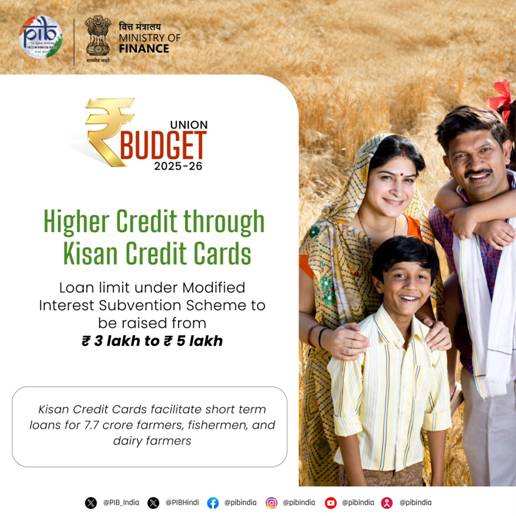
Smt. Sitharaman announced the increase in loan limits from Rs. 3 lakh to Rs. 5 lakh for loans taken through Kisan Credit Cards under modified interest subvention scheme.
 2nd Engine: MSMEs

Finance Minister described MSMEs as the second power engine for development as they constitute for 45% of our exports. To help MSMEs achieve higher efficiencies of scale, technological upgradation and better access to capital, the investment and turnover limits for classification of all MSMEs enhanced to 2.5 and 2 times, respectively. Further, steps to enhance credit availability with guarantee cover have also been announced.

The Finance Minister also announced the launch of a new scheme for 5 lakh women, Scheduled Castes and Scheduled Tribes first-time entrepreneurs. This will provide term loans up to Rs. 2 crore during the next 5 years.

Smt. Sitharaman announced that the Government will also implement a scheme to make India a global hub for toys representing the 'Made in India' brand. She added that the Government will set up a National Manufacturing Mission covering small, medium and large industries for furthering “Make in India”.

3rd Engine: Investment

Defining Investment as the third engine of growth, the Union Minister prioritized investment in people, economy and innovation. 

Under the investment in people, she announced that 50,000 Atal Tinkering Labs will be set up in Government schools in next 5 years.

Smt. Nirmala Sitharaman announced that broadband connectivity will be provided to all Government secondary schools and primary health centres in rural areas under the Bharatnet project.

She said Bharatiya Bhasha Pustak Scheme will be implemented to provide digital-form Indian language books for school and higher education.

Five National Centres of Excellence for skilling will be set up with global expertise and partnerships to equip our youth with the skills required for “Make for India, Make for the World” manufacturing.

A Centre of Excellence in Artificial Intelligence for education will be set up with a total outlay of 500 crore.

Budget announced that Government will arrange for Gig workers’ identity cards, their registration on the e-Shram portal and healthcare under PM Jan Arogya Yojana.

Under the investment in Economy, Smt Sitharaman said Infrastructure-related ministries will come up with a 3-year pipeline of projects in PPP mode.

She added that an outlay of Rs 1.5 lakh crore was proposed for the 50-year interest free loans to states for capital expenditure and incentives for reforms.

She also announced the second Asset Monetization Plan 2025-30 to plough back capital of Rs 10 lakh crore in new projects.

The Jal Jeevan Mission was extended till 2028 with focus on the quality of infrastructure and Operation & Maintenance of rural piped water supply schemes through “Jan Bhagidhari”.

Government will set up an Urban Challenge Fund of Rs.1 lakh crore to implement the proposals for ‘Cities as Growth Hubs’, ‘Creative Redevelopment of Cities’ and ‘Water and Sanitation’.

Under the investment in Innovation, an allocation of ₹20,000 crore is announced to implement private sector driven Research, Development and Innovation initiative.

Finance Minister proposed National Geospatial Mission to develop foundational geospatial infrastructure and data which will benefit urban planning.

Budget proposes Gyan Bharatam Mission, for survey, documentation and conservation of  more than 1 crore manuscripts with academic institutions, museums, libraries and private collectors. A National Digital Repository of Indian knowledge systems for knowledge sharing is also proposed.

4th Engine: Exports

Smt. Sitharaman defined Exports as the fourth engine of growth and said that jointly driven by the Ministries of Commerce, MSME, and Finance; Export Promotion Mission will help MSMEs tap into the export market. She added that a digital public infrastructure, ‘BharatTradeNet’ (BTN) for international trade was proposed as a unified platform for trade documentation and financing solutions.

The Finance Minister mentioned that support will be provided to develop domestic manufacturing capacities for our economy’s integration with global supply chains. She also announced that government will support the domestic electronic equipment industry for leveraging the opportunities related to Industry 4.0. A National Framework has also been proposed for promoting Global Capability Centres in emerging tier 2 cities.

The government will facilitate upgradation of infrastructure and warehousing for air cargo including high value perishable horticulture produce.

Reforms as the Fuel

Defining Reforms as the fuel to the engine, Smt. Sitharaman said that over the past 10 years, the Government had implemented several reforms for convenience of tax payers, such as faceless assessment, tax payers charter, faster returns, almost 99 per cent returns being on self-assessment, and Vivad se Vishwas scheme. Continuing with these efforts, she reaffirmed the commitment of the tax department to “trust first, scrutinize later”.

Financial Sector Reforms and Development

In a demonstrated steadfast commitment of the Government towards ‘Ease of Doing Business’, the Union Finance Minister proposed changes across the length and breadth of the financial landscape in India to ease compliance, expand services, build strong regulatory environment, promote international and domestic investment, and decriminalisation of archaic legal provisions.

The Union Finance Minister proposed to raise the Foreign Direct Investment (FDI) limit for the insurance from 74 to 100 per cent, to be available for those companies that invest the entire premium in India.

Smt. Sitharaman proposed a light-touch regulatory framework based on principles and trust to unleash productivity and employment. She proposed four specific measures to develop this modern, flexible, people-friendly, and trust-based regulatory framework for the 21st first century, viz.:

  1. High Level Committee for Regulatory Reforms
  • To review all non-financial sector regulations, certifications, licenses, and permissions.
  • To strengthen trust-based economic governance and take transformational measures to enhance ‘ease of doing business’, especially in matters of inspections and compliances
  • To make recommendations within a year
  • States will be encouraged to be onboarded 
  1. Investment Friendliness Index of States
  • An Investment Friendliness Index of States will be launched in 2025 to further the spirit of competitive cooperative federalism. 
  1. Mechanism under the Financial Stability and Development Council (FSDC)
  • Mechanism to evaluate impact of the current financial regulations and subsidiary instructions.
  • Formulate a framework to enhance their responsiveness and development of the financial sector. 
  1. Jan Vishwas Bill 2.0
  • To decriminalise more than 100 provisions in various laws.

Fiscal Consolidation

Reiterating the commitment to stay the course for fiscal consolidation, the Union Finance Minister stated that the Government endeavours to keep the fiscal deficit each year such that the Central Government debt remains on a declining path as a percentage of the GDP and the detailed roadmap for the next 6 years has been detailed in the FRBM statement. Smt. Sitharaman stated that the Revised Estimate 2024-25 of fiscal deficit is 4.8 per cent of GDP, while the Budget Estimates 2025-26 is estimated to be 4.4 per cent of GDP.
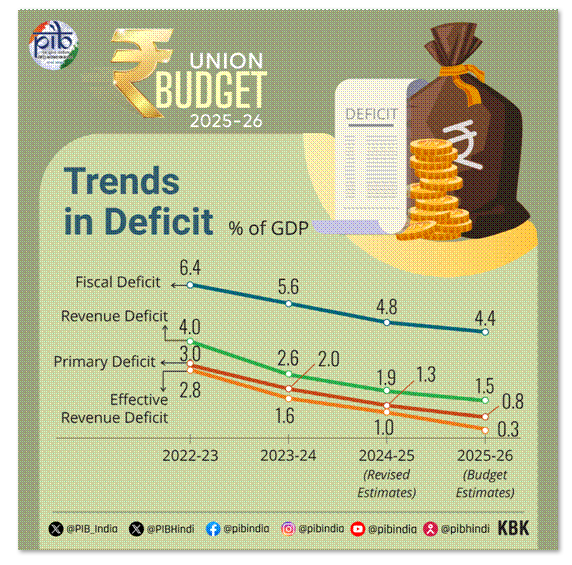
Revised Estimates 2024-25

The Minister said that the Revised Estimate of the total receipts other than borrowings is ₹31.47 lakh crore, of which the net tax receipts are ₹25.57 lakh crore. She added that the Revised Estimate of the total expenditure is ₹47.16 lakh crore, of which the capital expenditure is about ₹10.18 lakh crore.

Budget Estimates 2025-26

For FY 2025-26, the Union Finance Minister stated that the total receipts other than borrowings and the total expenditure are estimated at ₹34.96 lakh crore and ₹50.65 lakh crore respectively. The net tax receipts are estimated at ₹28.37 lakh crore.

PART B

Reposing faith on middle class in nation building, the Union Budget 2025-26 proposes new direct tax slabs and rates under the new income tax regime so that no income tax is needed to be paid for total income upto ₹ 12 Lakh per annum, i.e. average income of Rs 1 Lakh per month, other than special rate income such as Capital Gain. Salaried individuals earning upto ₹ 12.75 Lakh per annum will pay NIL tax, due to standard deduction of ₹ 75,000. Towards the new tax structure and other direct tax proposals, Government is set to lose revenue of about ₹ 1 lakh crore.

Under the guidance of Prime Minister Shri Narendra Modi, the Government has taken steps to understand the needs voiced by the people. The direct tax proposals include personal income tax reform with special focus on middle class, TDS/TCS rationalization, encouragement to voluntary compliances along with reduction of compliance burden, ease of doing business and incentivizing employment and investment.

The Budget proposes revised tax rate structure under the new tax regime as follows;

Total Income per annum

Rate of Tax

₹ 0 – 4 Lakh

NIL

 ₹ 4 – 8 Lakh

5%

₹ 8 – 12 Lakh

10%

₹ 12 – 16 Lakh

15%

₹ 16 – 20 Lakh

20%

₹ 20 – 24 Lakh

25%

Above ₹ 24 Lakh

30%

 To rationalize TDS/TCS, Budget doubles limit for tax deduction on interest earned by senior citizens from the present ₹ 50,000 to ₹ 1 Lakh. Further, TDS threshold on rent has been increased to ₹ 6 Lakh from ₹ 2.4 Lakh per annum. Other measures include, increasing of threshold to collect TCS to ₹ 10 Lakh and continuing with higher TDS deductions only in non-PAN cases. After the decriminalization of delay in payment of TDS, delay in TCS payments has now been decriminalized.

Encouraging voluntary compliance, Budget extends time-limit to file updated returns for any assessment year, from the current limit of two years, to four years. Over 90 Lakh taxpayers paid additional tax to update their income. Small charitable trusts/institutions have been given the benefit by increasing their period of registration from 5 to 10 years, reducing compliance burden. Further, tax payers can now claim annual value of two self-occupied properties as NIL, without any condition. Last budget’s Vivad Se Vishwas Scheme has received a great response, with nearly 33,000 tax payers having availed the scheme to settle their disputes. Giving benefits to senior and very senior citizens, withdrawals made from National Savings Scheme Accounts on or after 29th of August, 2024 have been exempted. NPS Vatsalya accounts also to get similar benefits.

For ease of doing business, Budget introduces a scheme for determining arm's length price of international transaction for a block period of three years. This is in line with global best practices. Further, self harbor rules are being expanded to provide certainty in international taxation.

To promote employment and investment, a presumptive taxation regime is envisaged for non-residents who provide services to a resident company that is establishing or operating an electronics manufacturing facility. Further, benefits of existing tonnage tax scheme are proposed to be extended to inland vessels. To promote start-up ecosystem, period of incorporation has been extended for a period of 5 years. To promote investment in the infrastructure sector, Budget extends the date of making investment in Sovereign Wealth Funds and Pension Funds by five more years, to 31st March, 2030.

As part of rationalization of Customs tariffs of industrial goods, Budget proposes to; (i) Remove seven tariffs, (ii) apply appropriate cess to maintain effective duty incidence, and (iii) levy not more than one cess or surcharge.

As relief on import of Drugs/Medicines, 36 lifesaving drugs and medicines for treating cancer, rare diseases and chronic diseases have been fully exempted from Basic Customs Duty (BCD). Further, 37 medicines along with 13 new drugs and medicines under Patient Assistance Programmes have been exempted from Basic Customs Duty (BCD), if supplied free to patients.

To support Domestic Manufacturing and Value Addition, BCD on 25 critical minerals, that were not domestically available, were exempted in July 2024. The Budget 2025-26 fully exempts cobalt powder and waste, scrap of lithium-ion battery, Lead, Zinc and 12 more critical minerals. To promote domestic textile production, two more types of shuttle-less looms added to fully exempted textile machinery. Further, BCD on knitted fabrics covering nine tariff lines from “10% to 20%” revised to “20% or ₹ 115 kg, whichever is higher”.

To rectify inverted duty structure and promote “Make in India”, BCD on Interactive Flat Panel Display (IFPD) increased to 20% and on Open cells reduced to 5%. Further to promote manufacture of Open cells, BCD on parts of Open Cells stands exempted.

To boost manufacturing of Lithion-ion battery in the country, 35 additional capital goods for EV battery manufacturing, and 28 additional capital goods for mobile phone battery manufacturing added to the list of exempted capital goods. Union Budget 2025-26 also continues exemption on BCD on raw materials, components, consumables or parts for ship building for another ten years. Budget also reduced BCD from 20% to 10% on Carrier Grade ethernet switches to make it at par with Non-Carrier Grade ethernet switches.

For export promotion, Budget 2025-26 facilitates exports of handicrafts, fully exempts BCD on Wet Blue leather for value addition and employment, reduce BCD from 30% to 5% on Frozen Fish Paste and reduce BCD from 15% to 5% on fish hydrolysate for manufacture of fish and shrimp feeds.

Union Minister of Finance and Corporate Affairs Smt. Nirmala Sitharaman said that Democracy, Demography and Demand are key pillars of Viksit Bharat journey. She said that the middle class gives strength of India’s growth and the Government has periodically hiked the ‘Nil tax’ slab in recognition to their contribution. She said the proposed new tax structure will substantially boost consumption, savings and investment, by putting more money in the hands of the middle class.

Topics

Acts Income Tax
