

Loading...

⚠ ✕
❮ Top
☎ Help
☰
×

By creating an account you can:

Logo TaxTMI
Call Us / Help / Feedback✕

Contact Us At :

✉ E-mail: [email protected]

✆ Call / WhatsApp at: +91 99117 96707

For more information, Check Contact Us

FAQs :

To know Frequently Asked Questions, Check FAQs

Most Asked Video Tutorials :

For more tutorials, Check Video Tutorials

Submit Feedback/Suggestion :

Email :
Please provide your email address so we can follow up on your feedback.
Category :
Description :
Min 15 characters 0/2000
Make Most of Text Search ✕
  1. Checkout this video tutorial: How to search effectively on TaxTMI.
  2. Put words in double quotes for exact word search, eg: "income tax"
  3. Avoid noise words such as : 'and, of, the, a'
  4. Sort by Relevance to get the most relevant document.
  5. Press Enter to add multiple terms/multiple phrases, and then click on Search to Search.
  6. Text Search
  7. The system will try to fetch results that contains ALL your words.
  8. Once you add keywords, you'll see a new 'Search In' filter that makes your results even more precise.
  9. Text Search
╳
Add to...
You have not created any category. Kindly create one to bookmark this item!
✕
Create New Category
Hide
Title :
Description :
❮❮ Hide
❮ Default View
Expand ❯❯
Close ✕
🔎 Filters / Advanced Search ❯
TEXT

Press 'Enter' to add multiple search terms. Rules for Better Search

Search In
Main Text + AI Text ❯
  • Main Text
  • Main Text + AI Text
  • AI Text
Category: ?
Categorized by AI
---- All Categories ---- ❯
  • ---- All Categories ----
  • Income Tax
  • GST
  • Customs, DGFT & SEZ
  • FEMA & RBI
  • Corp. Laws, SEBI & IBC
  • PMLA, Black Money & ED
  • Budget
  • News and Press Release
  • PTI News
Month:
---- All Months ---- ❯
  • ---- All Months ----
  • January
  • February
  • March
  • April
  • May
  • June
  • July
  • August
  • September
  • October
  • November
  • December
Year:
---- All Years ---- ❯
  • ---- All Years ----
  • 2026
  • 2025
  • 2024
  • 2023
  • 2022
  • 2021
  • 2020
  • 2019
  • 2018
  • 2017
  • 2016
  • 2015
  • 2014
  • 2013
  • 2012
  • 2011
Sort By: ?
In Sort By 'Default', exact matches for text search are shown at the top, followed by the remaining results in their regular order.
Relevance Default Date
    No commitment given to bank unions on 5-day work week by Finance Ministry, say sources
    Ethanol can help raise farmers' income and reduce fuel imports: Gadkari
    Rupee rises 19 paise to close at 95.80 against US dollar
    Check Credit Score and Understand Credit Health with the Bajaj Finance Credit Pulse Report
    Europe uses subsidies, taxes and policy pauses to offset pain of high fuel prices
    Loyalty Juggernaut Advances Responsible AI with ISO/IEC 42001 Certification
    Draft Warehousing Operations Regulations, 2026 - uploading on the CBIC website for inviting comments/views/suggestions from stakeholders
    From Digital Banking to Resilient Banking – Technology, Cyber Security and AI as Pillars of Trust - Address by Shri Rohit Jain, Deputy Governor at t...
    Union Minister of Commerce and Industry Shri Piyush Goyal Highlights India’s Expanding Global Economic Engagement and Growing Integration with Globa...
    India Participates in 14th East Asia Summit Economic Ministers’ Meeting and 23rd ASEAN-India Economic Ministers Consultation
    Sebi board approves slew of reforms; widens investment avenues, FPI access
    GST Council to take a view on GST on UPI MDR: Sources
    K'taka Deputy CM Parameshwara rejects Opposition's allegation of 'bankruptcy'
    EOW registers case against businessman, 4 others for ''forgery, unauthorised transactions''
    India's Russian oil imports hold near 1.8 million bpd as Middle East fills gaps
    IDFC FIRST Bank enables Direct Tax payments through UPI, cards, net banking and branches
    Sensex slumps 1,248 pts as IRDAI proposal hits financial shares; rising crude, US yields weigh
    Bajaj Finance Personal Loan Offers Rs. 40,000 to Rs. 55 Lakh with Tenures up to 108 Months
    MCA issues advisory - cautions public against high-return promises by non-compliant Nidhi Companies
    Banks likely to deploy excess liquidity over next few months amid strong credit demand: RBI Deputy Guv
❮
❯
❯❯
Maximize Maximize Maximize
0 / 200
Expand Note
Add to Folder

No Folders have been created

+

Are you sure you want to delete "My most important" ?

NOTE:

News
Showing Results for :
Reset Filters
Results Found:
Show All Summaries Hide All Summaries
September 25, 2026
Show AI Summary
Five-day banking proposal remains under consideration amid strike plans and measures for uninterrupted banking and advance disbursements.
Five-day banking remains under governmental consideration, with no Finance Ministry commitment to implementation. Unions linked the proposal to the 12th Bipartite Settlement/9th Joint Note, which contemplated extended Monday-to-Friday working hours. Family pension revision and a pension option for resignees were identified as addressed, while withdrawal of the Performance Linked Incentive scheme remains in abeyance. Public sector banks were instructed to remain open on the preceding Sunday, and central government salaries, wages and pensions were directed to be disbursed in advance.
September 25, 2026
Show AI Summary
Alternative fuel transition promotes ethanol, electric and hydrogen mobility to reduce imports, pollution, and strengthen farm income.
Alternative-fuel and public-transport measures seek to reduce dependence on imported petroleum, curb air pollution, and support farmer income and employment. Ethanol is positioned as a farm-income source through increased demand and returns for maize growers, alongside electricity, hydrogen and waste-derived CNG. Development and introduction of flex-fuel vehicles, using engines capable of operating on ethanol, electric tractors, hydrogen-powered vehicles and hydrogen buses form part of a cleaner-mobility strategy.
September 25, 2026
Show AI Summary
Foreign-exchange market intervention expectations supported rupee appreciation amid improved risk sentiment, while importer demand and crude prices constrained gains.
Foreign-exchange market conditions supported a 19-paise appreciation of the rupee to 95.80 against the US dollar, aided by improved global risk sentiment and expectations of Reserve Bank intervention. Dollar demand from importers, high crude prices and US dollar strength constrained gains. Lower crude prices and dollar weakness could support the rupee, while geopolitical escalation may create pressure. Market participants expected intervention if the currency weakened toward 96.
September 25, 2026
Show AI Summary
Credit health assessment combines score, repayment history, utilisation, accounts and enquiries to support informed borrowing and profile monitoring.
Credit health is broader than a numerical credit score and encompasses the way credit has been managed over time. Credit analysis requires a combined review of the score, repayment history, credit accounts, credit utilisation, credit history and credit enquiries. A credit report may identify management of EMIs and credit-card dues, existing borrowing obligations, use of revolving credit relative to available limits, and recent lender checks associated with credit applications. Incorrect or unfamiliar entries may be reviewed and, where necessary, raised with the relevant lender or credit bureau.
September 25, 2026
Show AI Summary
Fuel-price mitigation measures use tax reductions, targeted subsidies and energy-security policies to ease pressure on households and energy-intensive industries.
European fuel-price intervention combines targeted subsidies, fuel-tax reductions, temporary regulatory flexibilities and energy-security investment to moderate the economic effects of sharply higher gasoline and diesel prices caused by disrupted supplies. Member States have temporary discretion to grant state aid to households and energy-intensive sectors, including agriculture, transport and fishing, and limited flexibility under EU spending rules for investments that improve energy security and reduce dependence on imported fossil fuels.
September 25, 2026
Show AI Summary
AI management certification anchors responsible lifecycle governance, transparency, accountability, security, and human oversight for agentic loyalty systems.
ISO/IEC 42001:2023 certification applies to an Artificial Intelligence Management System governing AI development, deployment, oversight and continual improvement within the GRAVTY platform. The framework supports AI-related risk management, responsible governance, transparency, accountability, security and human oversight throughout the AI lifecycle. Its scope includes supervised and unsupervised learning models and large language models supporting personalised engagement, fraud management, loyalty intelligence, autonomous decision-making, operational automation and workflow support.
September 25, 2026
Show AI Summary
Digital warehousing controls propose electronic tracking, secure transport, monthly returns, and risk-based compliance verification for warehoused goods.
Draft Warehousing Operations Regulations, 2026 would require public and private warehouse licensees to use the electronic portal and a digital warehouse management system for receipt, storage, transfers, removals and accounting of warehoused goods. Transport would generally require a one-time-lock and transit-risk insurance, subject to specified exemptions. Licensees would verify locks and goods, report discrepancies, maintain auditable electronic records, submit monthly returns, and permit removals for home consumption or export only upon electronic clearance orders. Non-confirmation, discrepancies and contraventions would trigger information demands, risk-based verification and action under the Customs Act.
September 25, 2026
Show AI Summary
Technology risk governance requires banks to retain accountability, test resilience, and govern artificial intelligence before scaling financial services.
Technology risk governance must treat technology architecture as a first-order enterprise risk, alongside conventional financial risks, because the availability and integrity of core banking, payments, onboarding, credit, fraud-monitoring and reporting systems determine whether customers can access essential financial services. Banks may outsource technology functions but retain accountability for access controls, concentration, recoverability, data protection and exit options. Effective resilience requires secure architecture, asset visibility, timely remediation of vulnerabilities and legacy systems, identity and access management, effective controls, third-party oversight, post-incident learning, and regular recovery testing.
September 25, 2026
Show AI Summary
Global value chain integration advances trade partnerships, semiconductor capacity, and deep-tech innovation within broader economic engagement.
India's global economic engagement prioritises trade and economic partnerships to strengthen participation in global value chains and supply chains, facilitating cross-border movement of goods and services. The approach is linked to projected semiconductor demand and development of artificial-intelligence capabilities, alongside innovation, deep-tech startup support and private-sector space activity. The startup ecosystem is described as having expanded substantially, with current policy emphasis on deep-tech innovation and participation in global markets.
September 25, 2026
Show AI Summary
Trade agreement review targets balanced, user-friendly, trade-facilitative rules to address asymmetries and strengthen regional commerce.
The ongoing review of the ASEAN-India Trade in Goods Agreement seeks to enhance trade flows, address trade asymmetries, and deliver a balanced, effective, user-friendly, and trade-facilitative arrangement for businesses. It forms part of India's commitment to mutually beneficial trade partnerships and regional trade arrangements.
September 24, 2026
Show AI Summary
Portfolio management reforms broaden permitted investments, establish independent fund managers, and retain registered managers' responsibility for client portfolios.
Portfolio-management reforms replace the 2020 framework and expand investments into IPOs, primary-market debt, listed overseas equity and debt, and direct plans of Indian mutual fund schemes. Investment-grade unlisted non-convertible debt may comprise up to 10 per cent of client assets under management with client consent. Independent Fund Managers may operate with registered portfolio managers, which retain responsibility and liability. Accredited-investor eligibility is broadened, while specified compliance requirements are relaxed where adequate audit trails and internal controls exist.
September 24, 2026
Show AI Summary
Merchant discount rate on UPI merchant payments may be treated as a taxable payment settlement service with input credit availability.
GST treatment of MDR charged on UPI merchant payments above Rs 2,000 is to be considered by the GST Council. The MDR framework imposes a merchant-borne charge for payment processing and settlement. As these activities are services, MDR may attract GST at 18 per cent, subject to the Council's view. Merchants paying GST on MDR may claim input tax credit, potentially reducing their net tax burden.
September 24, 2026
Show AI Summary
Fiscal responsibility limits frame cautions on new projects as budgetary discipline rather than financial crisis.
Finance-department advice treats fiscal indicators as grounds for restraint in approving additional expenditure rather than as evidence that funds are unavailable. Funding new projects may be difficult until additional resources are mobilised or allocations already approved are reallocated. Project proposals lacking budgetary provision or earmarked funding may create cash-flow pressures and fiscal-management challenges, requiring deferment until resources are finalised.
September 24, 2026
Show AI Summary
Corporate document forgery allegations trigger investigation into unauthorised insolvency consortium participation and disputed share transfers.
An FIR concerns alleged cheating, forgery, criminal conspiracy, corporate-document misuse, and unauthorised financial liabilities arising from participation in a corporate insolvency resolution process. Allegations include entering a consortium arrangement without the Parekh Group's knowledge or authorisation, reliance on a fabricated and unapproved board resolution, and unauthorised transfer of shares to a group-controlled entity. Investigation covers disputed-record authenticity, alleged digital-signature misuse, and financial transaction trails.
September 24, 2026
Show AI Summary
Energy security shapes continued Russian crude sourcing as alternative suppliers replace shortfalls amid potential sanctions-related restrictions.
Russian crude imports are operating near 1.8 million barrels daily in September, with refinery maintenance, stronger Chinese buying, and disruptions to Russian export infrastructure constraining availability. Middle Eastern supply, especially from Iraq and Saudi Arabia, has offset reduced Russian volumes. Potential tougher restrictions on countries purchasing Russian oil could complicate procurement, but energy security and tight physical oil markets make a significant near-term reduction in Russian crude purchases unlikely. Replacement remains technically possible but may raise procurement costs and competition for medium-grade crude.
September 24, 2026
Show AI Summary
Direct tax payment gateway integration enables nationwide payments through digital options, branch channels, and customers' respective internet-banking services.
IDFC FIRST Bank's payment-gateway integration for Central Board of Direct Taxes collections enables Direct Tax payments through UPI, credit cards, debit cards, Retail and Corporate Internet Banking, and branch-based cheque, demand draft, or cash payments. Customers of other banks may use their own internet-banking facilities through the gateway. Taxpayers create a challan on the Income Tax e-Filing Portal, select Payment Gateway and IDFC FIRST Bank, choose a payment mode, complete payment, and download or print the paid challan. Payment confirmations are also accessible.
September 24, 2026
Show AI Summary
Insurance distribution controls target commissions, expenses and loan-linked sales, reshaping bancassurance arrangements and intermediary remuneration structures.
IRDAI's consultation proposals for insurance distribution contemplate lower Expenses of Management limits, tighter commission controls, and greater control over loan-linked insurance practices. The prospective framework concerns insurer and intermediary remuneration, distribution expenses, and bancassurance fee structures. Reported concerns centre on potential effects on insurer earnings, intermediary economics, and lending-linked distribution arrangements; the measures are not described as final operative obligations or enforcement action.
September 24, 2026
Show AI Summary
Personal loan eligibility and repayment planning: loan variants and digital applications remain subject to assessment, verification, and applicable terms.
Eligible customers may seek collateral-free personal loans within stated amount, tenure and interest-rate ranges. Loan amount, interest rate and tenure determine the EMI and total interest payable, while calculator results are estimates rather than final repayment obligations. Eligibility includes nationality, age, employment and credit-score conditions, but approval, final pricing and loan amount remain subject to lender assessment, document verification and applicable terms. Online applications require personal, financial and employment details and KYC verification.
September 24, 2026
Show AI Summary
Nidhi company deposits lack insurance protection, requiring verification of government declaration before relying on high-return promises.
Each company seeking to function as a Nidhi must file Form NDH-4 for declaration or updated Nidhi status and comply with the Companies Act, 2013 and applicable Nidhi Rules. Nidhi companies may accept deposits and grant loans only to members. Public investors should verify declared Nidhi status rather than rely on unusually high-return promises, agent representations, or informal assurances. Deposits with Nidhi companies are not insured by the Deposit Insurance and Credit Guarantee Corporation, and recovery may be difficult where a company fails or fraud occurs.
September 24, 2026
Show AI Summary
FCNR(B) liquidity deployment remains within banks' discretion, guided by credit pipelines, asset-liability positions, and prudent underwriting standards.
Banks retain full discretion to deploy liquidity mobilised through FCNR(B) deposits, based on their credit pipeline, lending proposals, liquidity outlook and asset-liability position. No sector-specific direction applies to use of these funds. FCNR(B) deposits are fixed-term foreign-currency deposits in which principal and interest are repayable in the same foreign currency, protecting non-resident depositors from direct rupee exchange-rate risk. Continued prudent credit appraisal and underwriting standards are expected.

News

Back

All News

Showing Results for :
Reset Filters
No Records Found

News

Back

All News

News and Press Release

India attends Indo-Pacific Economic Framework for Prosperity (IPEF) Ministerial meeting in Singapore

June 6, 2024

Contents
Summary
Note

Note

-

Bookmark

Print

Print

Indian delegation led by Secretary, Department of Commerce, Shri Sunil Barthwal participated in the Indo-Pacific Economic Framework for Prosperity (IPEF) Ministerial meeting held in Singapore on 6 June 2024.

The IPEF Ministerial Statement of 14 November 2023 declared substantial conclusion of negotiations for Clean Economy, Fair Economy, and the overarching Agreement on the Indo-Pacific Economic Framework for Prosperity. Pursuant to this, the IPEF partners completed legal review of the text for these agreements and domestic approval processes.
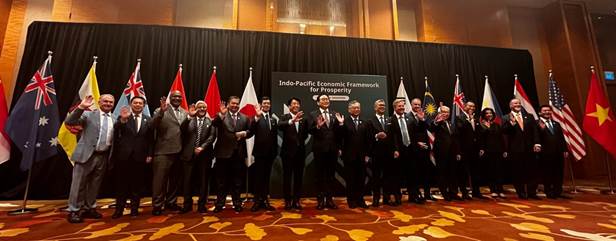
A group of men in suits standing in front of a black curtainDescription automatically generated

Today, IPEF members signed these agreements which are first-of-their-kind approaches to addressing 21st century challenges and strengthening economic engagement across a critical region. India actively participated in the signing proceedings and the ministerial deliberations. However, India did not formally sign these agreements as domestic approval processes are still underway and will be completed after formation of the new government. These agreements will enter into force after at least five IPEF partners complete their internal legal procedures for ratification, acceptance or approval.

A group of people in a roomDescription automatically generated

In his intervention, Shri Barthwal reflected on substantial progress made on the establishment of the three cooperative bodies under the Supply Chain Agreement, the Cooperative Work Programmes under the Clean Economy Agreement, and the cooperative activities under the Fair Economy Agreement.  He also reiterated that India, with its skilled manpower, natural resources, and policy support, aims to become a major player in the global supply chain. Government initiatives are proactive in finding solutions and ensuring India’s participation in diverse and predictable supply chains.

IPEF Clean Economy Agreement

Agreement on Clean Economy intends to accelerate efforts of IPEF partners towards energy security and transition, climate resilience and adaptation, GHG emissions mitigation; find/develop innovative ways of reducing dependence on fossil fuel energy; promote technical cooperation, workforce development, capacity building, and research collaborations; and collaborate to facilitate development, access, and deployment of clean energy and climate-friendly technologies. This agreement will facilitate investments, concessional financing, joint collaborative projects, workforce development and Technical Assistance and Capacity Building for industries, in particular MSMEs, to further integrate the Indian companies in the value chains, particularly in the Indo-Pacific region. These cooperative activities will be undertaken through joint collaborative actions such as Cooperative Work Programmes and the IPEF Catalytic Capital Fund.

Cooperative Work Programme (CWP)

The IPEF partners welcomed the continued efforts to build and sustain longer-term cooperation among various groupings of interested partners on a range of climate solutions through the CWP mechanism, in furtherance of the overarching goals of the IPEF Clean Economy Agreement. Since the announcement of the CWPs on hydrogen supply chains (in May 2023), and carbon markets, clean electricity, sustainable aviation fuel, and just transition (in March 2024), participating IPEF partners have developed detailed roadmaps for cooperation and highlighted significant progress on a number of CWPs under discussion. Shri Barthwal, in his remarks welcomed CWPs under the Clean Economy Agreement “designed to facilitate objectives of energy transition which will help create a more sustainable and prosperous Indo-Pacific region”.

A new CWP led by India on “e-waste urban mining” was announced by the group today. This CWP will facilitate a more sustainable e-waste management system for IPEF partners, including through the exchange of information on current and emerging technologies, techniques, and activities, as well as the development of solutions for efficient recovery and recycling of materials, particularly critical metals and minerals.

Shri Barthwal noted that “India’s focus on transitioning to a circular economy is evident in CWPs addressing e-waste management, aiming for resource efficiency and pollution prevention.” Commerce Secretary thanked IPEF partners for their support to India’s proposed CWP and conveyed India’s intention to work with IPEF partners on other CWPs to facilitate immense gains from such CWPs not only for developmental purposes but also towards their contribution to society.

IPEF Catalytic Capital Fund

The IPEF partners applauded the operational launch of the IPEF Catalytic Capital Fund, which supports the expansion of the pipeline of quality clean economy infrastructure projects in the IPEF emerging and upper-middle income economies under the IPEF Clean Economy Agreement. The Fund’s founding supporters – Australia, Japan, Korea, and the United States – have made significant progress in their respective domestic processes to provide US $33 million of initial grant funding to catalyze up to US $3.3 billion in private investment. The Private Infrastructure Development Group (PIDG), which administers the Fund, provided an update to IPEF partners about several initial projects in the pipeline, and discussed additional opportunities to deploy concessional financing, technical assistance, and capacity-building to catalyze private investment.

Investor Forum

A business delegation led by Invest India also participated in the Forum.

More than 30 Indian companies would be presenting opportunities of investment in renewable energy sector in the presence of top global investors like Blackrock, KKR & Co., JP Morgan etc.

Under Sustainable Infrastructure track, 4 Indian projects pitched their concepts before the global investor community. Similarly, 10 Indian ClimateTech startups also presented their business case before the interested investor community from across the globe at the Forum. The investor Forum provided a unique opportunity for project proponents and startup community to interact and network with more than 100 top global investors.

6 Indian investors including venture capital funds, private equity firms and strategic investors attended the Forum to explore investment opportunities and potential collaboration with the global investors as well as multilateral development banks.

IPEF Fair Economy Agreement

Agreement on Fair Economy intends to create a more transparent and predictable business environment which can spur greater trade and investment in the markets of member countries; promote level playing field for businesses and workers in the economies of the IPEF partners; enhance efforts to prevent and combat corruption by strengthening anti-corruption frameworks, establishing confidential systems, and promote participation of groups outside public sector; support efforts to improve tax transparency and exchange of information for tax purposes between competent authorities, domestic resource mobilization, and tax administration; and support capacity building and to provide technical assistance to the IPEF partners, through sharing of expertise and best practices, development and application of technological innovations, and need-based collaboration with the private sector and other stakeholders.

Shri Barthwal during his remarks welcomed IPEF’s focus on Technical Assistance and contribution to Capacity Building for the Fair Economy Agreement, and highlighted training programme in Digital Forensics & System-Driven Risk Analysis under Pillar IV Technical Assistance and Capacity Building catalogue that will be offered by India to other IPEF partners.

The IPEF Upskilling Initiative

The IPEF partners welcomed the substantial progress on the IPEF Upskilling Initiative, which was launched in September 2022 to support sustainable and inclusive economic growth and development by providing primarily women and girls in IPEF emerging and middle-income partner countries with access to digital skills training. Under the initiative, 14 participating U.S. companies and the Asia Foundation provided 10.9 million upskilling opportunities in IPEF partners, primarily for women and girls, in the last 2 years of which India received 4 million of these opportunities.

Next Steps

Ministerial meeting also decided to encourage holding of first meeting of the three Supply Chain institutional committees virtually in July 2024 and in-person in Washington DC in later half of 2024. It was also decided to hold next ministerial meeting virtually in September 2024 and work towards holding the first meeting of IPEF Council and the Joint Commission in 2025.

About IPEF

IPEF was launched on 23 May 2022 at Tokyo, Japan, comprising of 14 countries – Australia, Brunei, Fiji, India, Indonesia, Japan, Republic of Korea, Malaysia, New Zealand, Philippines, Singapore, Thailand, Vietnam and USA. The IPEF seeks to strengthen economic engagement and cooperation among partner countries with the goal of advancing growth, economic stability and prosperity in the region.

The framework is structured around four pillars relating to Trade (Pillar I); Supply Chain Resilience (Pillar II); Clean Economy (Pillar III); and Fair Economy (Pillar IV). India had joined Pillars II to IV of IPEF while it has maintained an observer status in Pillar-I.

Topics

Acts Income Tax