

Loading...

Top
Help
×

By creating an account you can:

Logo TaxTMI
Call Us / Help / Feedback

Contact Us At :

E-mail: [email protected]

Call / WhatsApp at: +91 99117 96707

For more information, Check Contact Us

FAQs :

To know Frequently Asked Questions, Check FAQs

Most Asked Video Tutorials :

For more tutorials, Check Video Tutorials

Submit Feedback/Suggestion :

Email :
Please provide your email address so we can follow up on your feedback.
Category :
Description :
Min 15 characters 0/2000
Make Most of Text Search
  1. Checkout this video tutorial: How to search effectively on TaxTMI.
  2. Put words in double quotes for exact word search, eg: "income tax"
  3. Avoid noise words such as : 'and, of, the, a'
  4. Sort by Relevance to get the most relevant document.
  5. Press Enter to add multiple terms/multiple phrases, and then click on Search to Search.
  6. Text Search
  7. The system will try to fetch results that contains ALL your words.
  8. Once you add keywords, you'll see a new 'Search In' filter that makes your results even more precise.
  9. Text Search
Add to...
You have not created any category. Kindly create one to bookmark this item!
Create New Category
Hide
Title :
Description :
❮❮ Hide
Default View
Expand ❯❯
Close ✕
🔎 News - Adv. Search
TEXT SEARCH:

Press 'Enter' to add multiple search terms. Rules for Better Search

Search In:
Main Text + AI Text
  • Main Text
  • Main Text + AI Text
  • AI Text
Category: ?
Categorized by AI
---- All Categories ----
  • ---- All Categories ----
  • Income Tax
  • GST
  • Customs, DGFT & SEZ
  • FEMA & RBI
  • Corp. Laws, SEBI & IBC
  • PMLA, Black Money & ED
  • Budget
  • News and Press Release
  • PTI News
Month:
---- All Months ----
  • ---- All Months ----
  • January
  • February
  • March
  • April
  • May
  • June
  • July
  • August
  • September
  • October
  • November
  • December
Year:
---- All Years ----
  • ---- All Years ----
  • 2026
  • 2025
  • 2024
  • 2023
  • 2022
  • 2021
  • 2020
  • 2019
  • 2018
  • 2017
  • 2016
  • 2015
  • 2014
  • 2013
  • 2012
  • 2011
Sort By: ?
In Sort By 'Default', exact matches for text search are shown at the top, followed by the remaining results in their regular order.
Relevance Default Date
    Govt to soon announce high-level panel on 'Banking for Viksit Bharat'
    Union Minister of Finance and Corporate Affairs interacts with interns from PM Internship Scheme in New Delhi
    DRI uncovers large-scale illegal use of SAFTA agreement in areca imports
    Rupee falls 17 paise to 95.59 against US dollar in early trade
    Colombian president asks Trump to suspend tariffs to help earthquake recovery
    Mission Samudra to be launched alongside Vizhinjam’s EXIM operations
    Europe emerges top destination for India's electric car shipments in Q1
    Govt sets LPG production targets for refiners; Reliance gets largest quota
    PM urges MSMEs to tap opportunities from FTAs
    PM urges farmers to adopt 'chemical-free farming' to tap rising global demand for such food items
    Govt rolls out foreign asset disclosure scheme for small taxpayers
    Need one or two Indian pharma firms to be among global top 5: PM Modi
    Small taxpayers with€™ foreign assets to face 30 pc tax plus penalty; disclosure scheme opens till Dec 31
    PM urges MSMEs to tap opportunities from FTAs
    Govt cuts windfall gains tax on petrol, diesel, ATF exports
    Modi warns of weaponisation of resources, sea routes; urges energy self-reliance
    Current account deficit widens to USD 6.2 bn in Jun: RBI data
    Concessional swap facility attracts USD 56.85 bn forex inflows: RBI
    DFS Highlights Mechanism for Timely Redressal of Insurance Policyholders’ Grievances
    Forex kitty jumps USD 14.14 bn to USD 707 bn in one of the biggest weekly expansions
❯❯
Maximize Maximize Maximize
0 / 200
Expand Note
Add to Folder

No Folders have been created

+

Are you sure you want to delete "My most important" ?

NOTE:

News
Showing Results for :
Reset Filters
Results Found:
Show All Summaries Hide All Summaries
August 17, 2026
Show AI Summary
Banking sector review panel will align future growth with financial stability, inclusion and consumer protection through government recommendations.
High Level Committee on Banking for Viksit Bharat is proposed to comprehensively review the banking sector and align it with India's next phase of growth. It is intended to safeguard financial stability, financial inclusion and consumer protection, while providing views and recommendations to the Government on banking-sector development and reform.
August 17, 2026
Show AI Summary
Prime Minister Internship Scheme enhances youth employability through paid industry exposure, cross-field learning, workplace readiness and potential full-time employment.
The Prime Minister Internship Scheme provides paid internships with leading companies across India to improve youth employability through practical workplace exposure, industry experience and skills development. It addresses the gap between classroom learning and employers' expectations of workplace readiness. Participation is not confined to academic qualifications, allowing youth to pursue fields of interest and gain hands-on professional learning. Strong internship performance may lead to full-time roles, while the scheme stresses responsible work where errors may affect quality, consumer safety and organisational reputation.
August 17, 2026
Show AI Summary
SAFTA origin fraud in areca imports allegedly enabled improper duty exemption through false Bangladeshi-origin declarations.
SAFTA preferential duty treatment for areca-nut imports was allegedly misused by falsely declaring goods originating in South-East Asian countries as Bangladeshi origin. Since areca nuts normally attract 100% basic customs duty, the scheme sought to obtain the full SAFTA exemption reserved for qualifying Bangladeshi goods meeting Rules of Origin requirements. The alleged mechanism included routing goods through Bangladesh, changing containers and bags, using improperly obtained Certificates of Origin, and facilitating clearance through importers, Customs Brokers and IEC holders. Investigative findings also indicated cash proceeds, hawala channels and dummy entities.
August 17, 2026
Show AI Summary
FCNR(B) concessional swap facility closure may reduce temporary foreign-currency inflow support and heighten rupee weakness concerns.
The Reserve Bank of India restricted its concessional swap facility for FCNR(B) deposits to deposits mobilised by August 31, advancing the earlier cut-off date. The facility was intended to encourage foreign-currency inflows, while banks mobilise such deposits through attractive interest rates. Market commentary indicated that existing inflows may support the rupee in the near term, but the curtailed availability of the facility could reduce this temporary cushion and increase depreciation risk.
August 16, 2026
Show AI Summary
Temporary tariff suspension for earthquake recovery is sought to ease pressure on affected Colombian businesses.
Temporary suspension of high tariffs on Colombian products has been sought to support business recovery following a severe earthquake declared a natural disaster. The request links tariff relief to economic disruption affecting businesses amid extensive destruction, injuries and missing persons. United States emergency assistance has been provided through food, shelter and health supplies, while no response to the tariff-suspension request had been reported.
August 16, 2026
Show AI Summary
Port-led industrial development and direct export operations aim to expand logistics infrastructure, market access and trade connectivity.
Mission Samudra is proposed as a port-led industrial and logistics development programme linked to the commencement of export-import operations at Vizhinjam seaport. It covers industrial clusters, new cities, port connectivity, logistics, development initiatives, programme management and capacity building. Direct export shipments are intended to improve overseas-market access and reduce transit time and logistics costs, particularly for small and medium enterprises. The framework also anticipates growth in warehousing, cold storage, container freight stations and logistics parks, supported by private participation and road and rail connectivity.
August 16, 2026
Show AI Summary
Electric vehicle export diversification strengthens India's presence across European, Asia-Pacific and Latin American markets through expanding overseas demand.
India's electric motor car exports expanded sharply in the first quarter of 2026-27, reflecting increased international acceptance and competitiveness of India-manufactured electric vehicles. Europe became the principal export destination, led by Spain and the United Kingdom, with further demand across several European markets. Exports also reached Asia-Pacific markets, Nepal and emerging Latin American destinations. This wider market presence reflects improving quality and safety standards, stronger integration into global electric-vehicle supply chains, and diversification of India's electric-vehicle export profile.
August 16, 2026
Show AI Summary
LPG production preparedness requires refiners and upstream producers to maintain capacity and increase output during supply constraints.
Government has established a standing LPG production preparedness framework under which refining companies, oil marketing companies and upstream producers may be directed to increase production during supply constraints. Companies must maintain adequate LPG storage, evacuation and transportation infrastructure and pursue technically and economically feasible production-enhancing measures. Written directions may prescribe production quantities and periods, including restrictions on alternative uses of input streams required for LPG. The production schedule is updated twice yearly to reflect new facilities and added capacity from infrastructure, technology and distribution improvements.
August 16, 2026
Show AI Summary
Free trade agreement market access requires MSMEs, farmers and exporters to meet global quality standards.
Free trade agreements expand market-access opportunities for Indian MSMEs, exporters and producers through reduced or eliminated import duties on traded goods. Textiles, machinery, medicines, seafood and agricultural products can access international markets where they meet global standards and remain competitively priced. Farmers and producers are encouraged to develop export-oriented products, including chemical-free agricultural produce, while MSMEs may use preferential trade access to support manufacturing, exports, employment and growth.
August 15, 2026
Show AI Summary
Chemical-free farming can strengthen agricultural exports by meeting global standards and responding to rising international demand.
Chemical-free farming is urged to meet growing global demand and expand agricultural exports. Agricultural products must meet global parameters to facilitate access to international markets, including markets opened through free trade agreements. Food processing, export-oriented farm production, and global branding of traditional cuisine, millets, spices, fruits and flowers are identified as important elements of agriculture and food production policy.
August 15, 2026
Show AI Summary
Voluntary foreign asset disclosure allows eligible taxpayers to regularise overseas holdings with immunity from further tax, penalties and prosecution.
FAST-DS permits eligible taxpayers to disclose specified undisclosed foreign assets, foreign income, and foreign assets omitted from return schedules. Undisclosed assets or income not previously offered to tax may be declared up to Rs 1 crore on payment of an effective 60 per cent levy, based on fair market value as of 31 March 2026. Assets already offered to tax, or acquired during non-resident status but omitted from the return schedule, may be declared up to Rs 5 crore on payment of a fee. Valid declarations provide immunity from further tax, penalty and prosecution, while declared amounts are excluded from total income.
August 15, 2026
Show AI Summary
Global pharmaceutical leadership is urged through Indian firms achieving top-five status, supported by generic manufacturing and export capacity.
Indian pharmaceutical companies are urged to attain representation among the world's five leading pharmaceutical firms, despite India's established position as a major producer of generic medicines. India has a broad manufacturing base, supplies generic medicines across numerous therapeutic categories, and exports to worldwide markets including highly regulated jurisdictions. Although pharmaceutical exports and the domestic market have expanded, Indian firms have not yet secured positions among the largest global companies. Greater international scale may be supported through acquisitions and expanded established-brand and branded-generic operations.
August 15, 2026
Show AI Summary
Foreign asset voluntary disclosure permits eligible small taxpayers to regularise qualifying assets through tax, additional levy, and statutory immunity.
FAST-DS permits eligible small taxpayers to voluntarily disclose specified foreign assets or foreign income. It covers undisclosed foreign assets or income not offered to tax, subject to an aggregate value threshold of Rs 1 crore, and certain foreign assets omitted from the relevant return schedule, subject to a Rs 5 crore threshold and prescribed fee. Payment comprises 30 per cent tax and an additional equal amount. Disclosed income or investment is excluded from total income, with immunity from further tax, penalty and prosecution under the Black Money Act for the disclosed asset or income.
August 15, 2026
Show AI Summary
Free trade agreement opportunities require MSMEs to meet global standards and expand exports across textiles, machinery, medicines and seafood.
Free trade agreements are presented as export-market opportunities for Indian MSMEs because they reduce or eliminate import duties on a substantial range of traded goods. MSMEs are urged to expand exports of textiles, machinery, medicines and seafood, including shrimp, by meeting global quality standards and offering products competitively. Their export role is linked to self-reliance and their significant contribution to manufacturing, exports, GDP and employment.
August 15, 2026
Show AI Summary
Windfall gains tax on petroleum exports was reduced to support domestic fuel availability and limit export price advantages.
Special additional excise duty (windfall gains tax) on exports of petrol, diesel and aviation turbine fuel was reduced from 15 August 2026. Petrol export duty was reduced to nil, and export-duty rates on diesel and ATF were lowered. Duty rates for petrol and diesel cleared for domestic consumption remained unchanged. The export-duty framework seeks to maintain domestic petroleum-product availability and limit export advantages arising from higher global crude oil prices amid West Asia tensions.
August 15, 2026
Show AI Summary
Energy self-reliance drives diversified fuel sourcing, expanded offshore exploration, and domestic capacity to reduce geopolitical supply vulnerability.
Energy security policy seeks to reduce exposure to geopolitical pressure and supply disruption caused by dependence on overseas fuel and strategic maritime routes. India is diversifying crude oil and LNG sourcing while strengthening domestic hydrocarbon production through offshore exploration, seismic surveys, exploratory drilling and shared infrastructure. Expanded access to sedimentary basins is intended to unlock domestic oil and gas resources. Wider piped natural gas coverage, solar generation, critical-mineral exploration, and nuclear and other non-fossil energy sources support the broader objective of energy self-reliance.
August 14, 2026
Show AI Summary
Current account deficit widened as merchandise trade imbalance expanded, despite stronger services surplus, transfers, and positive capital inflows.
India's current account deficit widened in June 2026, principally because merchandise imports increased faster than exports and expanded the merchandise trade deficit. A higher services surplus, increased net transfers and a narrower net income deficit provided partial offsets. Net capital inflows, including foreign direct investment and foreign portfolio investment, supported a positive overall monthly balance. During the April-June quarter, despite increased services surplus and net transfers, the overall balance shifted to a deficit as the merchandise trade deficit widened.
August 14, 2026
Show AI Summary
Concessional foreign-currency swap facility closes early for new FCNR(B) deposits while ECB and OFCB access remains available.
The concessional swap facility for FCNR(B) deposits encourages foreign-currency inflows and supports foreign-exchange liquidity. New FCNR(B) deposits eligible for the facility must be mobilised by 31 August 2026, while swaps for eligible deposits may be availed until 11 September 2026. The swap arrangement for External Commercial Borrowings and Overseas Foreign Currency Borrowings remains available until 31 December 2026.
August 14, 2026
Show AI Summary
Insurance grievance redressal requires initial insurer complaint, prompt acknowledgement, and escalation through integrated monitoring channels when resolution remains unsatisfactory.
Insurance policyholder grievances must first be raised with the concerned insurer, whose Grievance Redressal Officer and Board-level monitoring committee oversee redressal. Complaints received through digital channels, correspondence or call centres are recorded in the insurer's Complaints Management System, integrated with Bima Bharosa. Insurers must acknowledge complaints immediately and resolve them within 14 days. Where no response is received within a reasonable period or the response is unsatisfactory, policyholders may escalate through Bima Bharosa or designated helplines, email or physical correspondence.
August 14, 2026
Show AI Summary
Foreign exchange reserve growth reflects increases in foreign currency assets, gold holdings, special drawing rights, and IMF reserve position.
India's foreign exchange reserves rose to USD 707.002 billion for the week ended 7 August 2026. The increase comprised higher foreign currency assets, gold reserves, special drawing rights and the reserve position with the IMF. Foreign currency asset valuation incorporates appreciation or depreciation of non-US currencies held in reserve assets. Measures including the FCNR(B) scheme were introduced to attract additional foreign exchange inflows.

News

Back

All News

Showing Results for :
Reset Filters
No Records Found

News

Back

All News

Showing Results for : Reset Filters
Customs, DGFT & SEZ

Department of Commerce holds Chintan Shivir on FTA Strategy and SOP for Trade Negotiations

May 28, 2024

Contents
Summary
Note

Note

-

Bookmark

Print

Print

Economic Assessment and Modelling of FTAs, Services and Digital Trade in FTAs, and Leveraging India’s FTAs to address emerging areas like AI, critical minerals discussed

Department of Commerce, Ministry of Commerce and Industry in collaboration with Centre for Trade and Investment Law (CTIL), Indian Institute of Foreign Trade, New Delhi organised a Chintan Shivir on Free Trade Agreement Strategy and SOP for Trade Negotiations from 16 to 17 May 2024 at Neemrana, Rajasthan.

The Two-Day Chintan Shivir facilitated discussions on various issues related to negotiations of Free Trade Agreements (FTAs) by India, its position and strategy that should be adopted for such negotiations. The attendees also deliberated on standard operating procedures (SoP) for FTA negotiations, capacity building and resource management for trade negotiations as well as certain contemporary issues under modern FTAs such as labour, environment, gender etc.

Commerce Secretary, Shri Sunil Barthwal spearheaded the Chintan Shivir, seeking to chart a strategic course for India's future engagement in FTA negotiations. The program drew active participation of senior government officials involved in India’s FTA negotiations from various Ministries, Departments, and Agencies of Government of India. Eminent speakers at the event included former senior officials of the Government of India, esteemed national and international experts in FTA negotiations, venerable academicians, and seasoned legal professionals. Their presentations were embellished with invaluable insights, enriching the discourse with profound expertise and depth of knowledge.
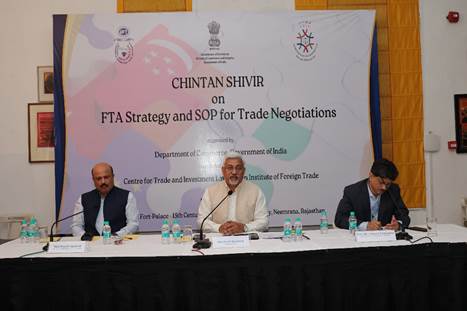
The Chintan Shivir unfolded across six dynamic sessions and one roundtable, each delving into critical themes: (1) Economic Assessment and Modelling of FTAs; (2) Addressing New Disciplines into FTAs such as Labour, Environment, Gender, Indigenous Peoples, etc.; (3) Services and Digital Trade in FTAs; (4) Standard Operating Procedures for FTA Negotiations including Stakeholder Consultations; (5) Capacity Building and FTA resource management; and (6) Leveraging India’s FTAs to address emerging areas such as CBAM, Supply Chain disruptions, Critical Minerals, Artificial Intelligence, etc.

The ‘Roundtable with Former Secretaries and Ambassadors on FTA Strategy’, comprising of Shri Rajeev Kher (Chair), Former Commerce Secretary, Govt. of India; Amb. Ujal Singh Bhatia, Former Appellate Body Member and Chair, WTO; Dr. Anup Wadhawan, Former Commerce Secretary, Govt. of India; Amb. (Dr.) Jayant Das Gupta, Former Ambassador/PR to the WTO; and Shri Sudhanshu Pandey, Former Secretary, Department of Food & Public Distribution, Govt. of India and Election Commissioner for UTs, discussed how Indian FTAs must be driven by balancing geopolitics and geoeconomics, and focused on how regionalism (regional trade agreements) should complement multilateralism (global trade agreements), with regional aspirations stemming from multilateral efforts. The roundtable also identified that FTAs should foster value chain development, and the importance of integrating non-trade issues (e.g., Trade and Sustainable Development - TSD) crucial for market access, as seen in chapters negotiated with, for example EFTA. Lastly, the roundtable highlighted that effective stakeholder consultations ensure realistic and attainable goals and a balanced approach to trade and industrial policies can optimise trade negotiations and outcomes.

Session 1 on ‘India’s FTA Strategy and Economic Assessment and Modelling’, highlighted that detailed economic studies, including models like Computable General Equilibrium (CGE), are necessary to guide FTA negotiations; and how economic models help build negotiation narratives but must be used with an understanding of their assumptions and limitations thereof. The participants also discussed how negotiating investment and trade together can create synergies, and the need for careful consideration of trade policy and the industrial policy together.

Session 2 on ‘Inclusion of New Disciplines into FTAs’ provided an opportunity for participants to explore and understand the implications of new areas such as TSD (including Environment, Labour, Gender, Indigenous Peoples) in trade agreements, the issues involved in enforcing domestic laws and ratifying international treaties; different approaches followed by developed countries for these areas (US and EU models); and the challenges involved in defining policy space, law enforcement, civil society involvement. Among others, some of the solutions suggested by participants included constructive engagement with stakeholders, supporting identification of measures and possible way out, and exploring pilot projects for implementation of those commitments.

Session 3 on ‘Services and Digital Trade in FTAs’ highlighted the significance of services trade, especially cross-border supply (Mode 1), the challenges of data sovereignty, consumer protection and cybersecurity, and the choice between positive and negative listing approaches in services commitments having impact on transparency and negotiation outcomes. The session also explored India’s data adequacy issues under EU GDPR and significant challenges posed by the evolving landscape of e-commerce and digital trade. The speakers also emphasised on how leveraging critical and emerging technologies through initiatives like India-EU TTC and US-India iCET can boost trade prospects for India.

In Session 4 on ‘Standard Operating Procedures for FTA Negotiations including Stakeholder Consultations’, speakers and participants discussed evolution and drafting of SOP and its benefits in enhancing the objectives of trade agreements and creating documentational or institutional memory for future negotiations. Participants discussed the challenge of on-the-spot drafting requiring mechanisms to draft agreements in real-time during negotiations to ensure clarity and immediate consensus, and how the negotiators can ensure that commitments undertaken are pre-approved. The discussions highlighted that relevant stakeholder consultations are essential for inclusive and supportive outcomes, how the stakeholders provide critical insights and hence continuous outreach to stakeholders is necessary to keep them informed and engaged. The participants also explored robust resource management strategies and its implementation, to prevent overstraining, and ensuring proactive problem-solving thereby providing useful and constructive attributions.

Session 5 on ‘Capacity Building and FTA resource management’ identified that FTAs play a critical role in enhancing national security by establishing strong economic ties and creating frameworks for regulatory cooperation. It also acknowledged that modern FTAs address complex issues beyond traditional trade, including digital trade, data protection, and environmental standards. Speakers highlighted the importance of interdisciplinary support noting that successful negotiations require expertise in law, economics, data analytics, and industry specific knowledge and how gathering expert opinions and insights from various sectors enhances the negotiation process. Participants explored ways to utilise the resources of India’s embassies/missions abroad, towards leveraging on-ground insights from embassies which would help understand the regulatory regimes of partner countries.

Discussions in Session 6 on ‘Leveraging India’s FTAs to address emerging areas’ focused on supply chain disruptions, critical minerals, capacity building, de-globalisation and geopolitical influence. Session discussions identified that FTAs can be used as tools to enhance supply chain resilience, ensuring stability and sustainability in trade relationships. It also emerged during discussions that India should negotiate a dedicated chapter on Critical Minerals or Critical Minerals-based agreements specially with such mineral-rich countries to protect India from abrupt disruption in supply chain. The session also noted that the global trend towards partial de-globalisation and the use of industrial policy as a cover for protectionism, and geopolitics now play equally an influential role that of geoeconomics in shaping trade policies. The session suggested that India should use FTAs to build resilient supply chains, focus on capacity building and interdisciplinary expertise, and adapt to the current trend of partial de-globalisation and geopolitical influences.

The Chintan Shivir ended with wrap-up session and report of the event and special remarks by Shri Sunil Barthwal and Additional Secretary, Department of Commerce, Shri Rajesh Agrawal. The event brainstormed various suggestions on formulating India’s FTA strategies and for adopting the standard operating procedures for enhancing India’s FTA preparedness.

Topics

Acts Income Tax