In the dynamic landscape of fiscal management, the Department of Expenditure (DoE) oversees the public financial management system in the Central Government and matters connected with State finances.
Implementing the recommendations of the 15th Finance Commission, DoE approved grants-in-aid totalling Rs. 1,79,140 crore to State Governments for the fiscal year 2023-24. These grants encompass various crucial sectors such as post-devolution revenue deficit, health, disaster management, and local bodies, demonstrating a comprehensive approach to regional development.
Through, the Data Gap Initiative, initiated in response to the 2007-08 global financial crisis, the Controller General of Accounts transitioned India's statistical system from ‘RED’ to ‘AMBER’, aligning with international standards. This commitment to transparent and comparable government finance statistics reflects the nation's resilience in anticipating and addressing vulnerabilities.
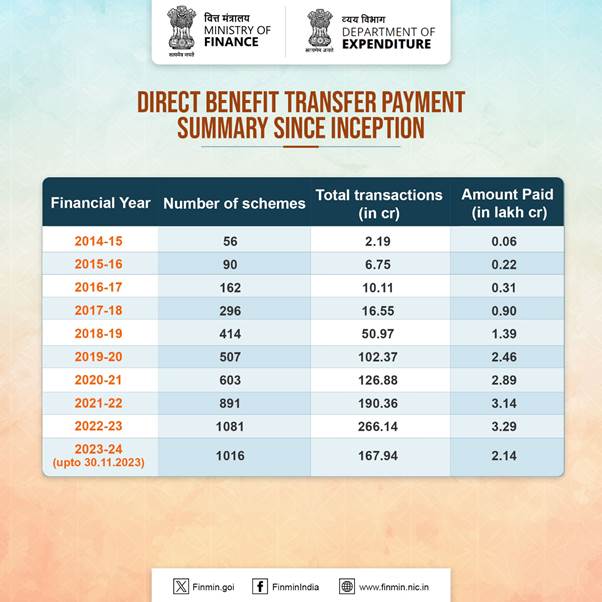
The Public Financial Management System (PFMS) has been a cornerstone in the implementation of Direct Benefit Transfer (DBT), a crucial aspect of the Digital India Initiative. With over 104.02 crore beneficiaries registered under various schemes, PFMS has facilitated the efficient transfer of funds, with an emphasis on real-time tracking and accessibility. The DBT Payment Summary since its inception showcases a substantial increase in both the number of schemes and the amount disbursed, underlining the system's impact.
Furthermore, the integration of treasury systems across States and Union Territories through the Single Nodal Account (SNA) framework has streamlined fund flow and expenditure tracking. The GIFMIS Vertical, eGramSwaraj Interface, and initiatives like SNA-SPARSH and the Central Nodal Account (CNA) Implementation exemplify the commitment to e-Governance and digital transformation.
The Special Assistance to States for Capital Expenditure, with its multi-faceted approach, stands out as a strategic move to boost state economies. This includes untied funds, incentives for scrapping old vehicles, urban planning reforms, financing reforms in urban local bodies, and housing initiatives.
In the pension domain, the Central Pension Accounting Office's (CPAO) innovative initiatives, including the DIRGHAYU Mobile Application and Virtual Pension Adalat, demonstrate a commitment to addressing the needs of pensioners efficiently.
Lastly, the Vivad Se Vishwas Scheme, introduced in the Union Budget 2023-24, has provided relief to MSMEs and sought to settle pending contractual disputes, further fostering economic stability. These achievements collectively underscore the Department of Expenditure's unwavering commitment to fiscal prudence, transparency, and inclusive development in the year 2023.
Following are some of the major achievements of the Department of Expenditure, Ministry of Finance, in 2023:
Data Gap Initiative
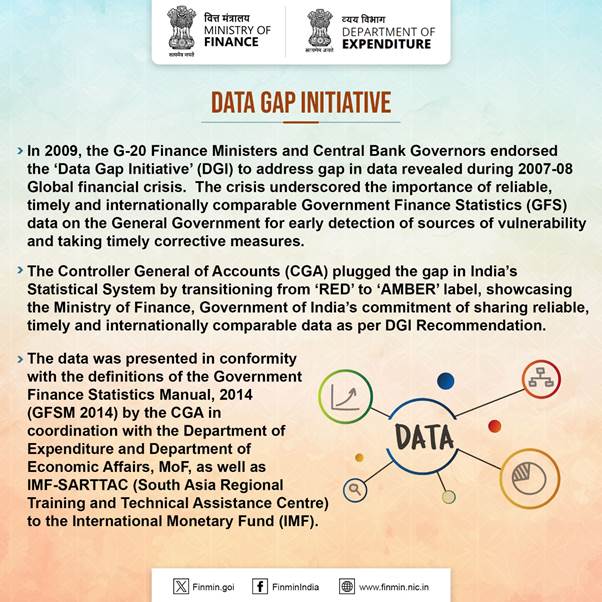
In 2009, the G-20 Finance Ministers and Central Bank Governors endorsed the ‘Data Gap Initiative’ (DGI) to address gap in data revealed by 2007-08 Global financial crisis. The crisis underscored the importance of reliable, timely and internationally comparable Government Finance Statistics (GFS) data on the general government for early detection of sources of vulnerability and taking timely corrective measures.
The Controller General of Accounts (CGA) plugged the gap in India's Statistical System by transitioning from 'RED' to ‘AMBER' label, showcasing the Ministry of Finance, Government of India's commitment of sharing reliable, timely and internationally comparable data as per DGI Recommendation.
The data was presented in conformity with the definitions of the Government Finance Statistics Manual, 2014 (GFSM 2014) by the CGA in coordination with the Department of Expenditure and Department of Economic Affairs, MoF, as well as IMF-SARTTAC (South Asia Regional Training and Technical Assistance Centre) to the International Monetary Fund (IMF).
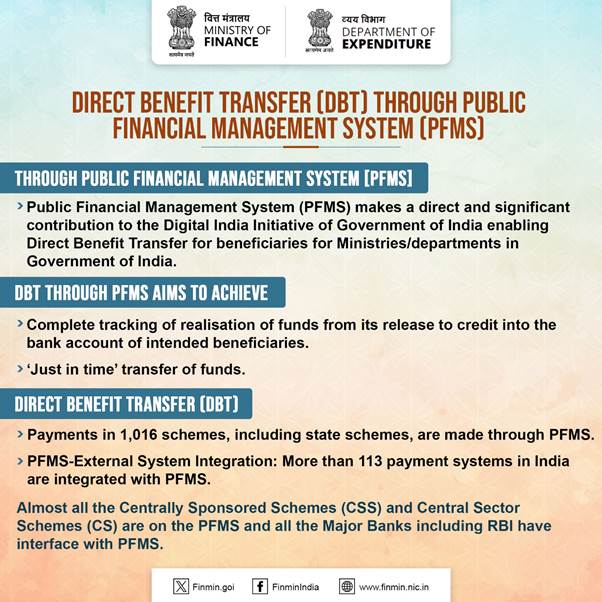
Direct Benefit Transfer (DBT) Through Public Financial Management System (PFMS)
Through Public Financial Management System [PFMS]
- Public Financial Management System (PFMS) makes a direct and significant contribution to the Digital India Initiative of Government of India enabling Direct Benefit Transfer for beneficiaries for Ministries/departments in Government of India.
DBT Through PFMS Aims to Achieve
- Complete tracking of realisation of funds from its release to credit into the bank account of intended beneficiaries.
- 'Just in time' transfer of funds.
Direct Benefit Transfer (DBT)
- Payments in 1,016 schemes, including state schemes, are made through PFMS.
- PFMS-External System Integration: More than 113 payment systems in India are integrated with PFMS.
Almost all the Centrally Sponsored Schemes (CSS) and Central Sector Schemes (CS) are on the PFMS and all the Major Banks including RBI have interface with PFMS.
Direct Benefit Transfer Payment Summary Since Inception
| Financial Year | Number of schemes | Total transactions (in cr) | Amount Paid (in lakh cr) |
| 2014-15 | 56 | 2.19 | 0.06 |
| 2015-16 | 90 | 6.75 | 0.22 |
| 2016-17 | 162 | 10.11 | 0.31 |
| 2017-18 | 296 | 16.55 | 0.90 |
| 2018-19 | 414 | 50.97 | 1.39 |
| 2019-20 | 507 | 102.37 | 2.46 |
| 2020-21 | 603 | 126.88 | 2.89 |
| 2021-22 | 891 | 190.36 | 3.14 |
| 2022-23 | 1081 | 266.14 | 3.29 |
| 2023-24
(upto 30.11.2023) | 1016 | 167.94 | 2.14 |
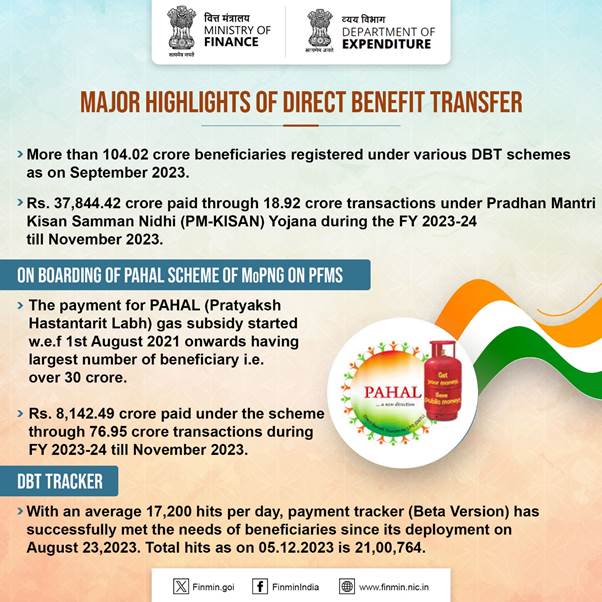
Major Highlights of Direct Benefit Transfer
- More than 104.02 crore beneficiaries registered under various DBT schemes as of September 2023.
- Rs. 37,844.42 crore paid through 18.92 crore transactions under Pradhan Mantri Kisan Samman Nidhi (PM-KISAN) Yojana during the FY 2023-24 till November 2023.
- On boarding of PAHAL scheme of MoPNG on PFMS:
- The payment for PAHAL (Pratyaksh Hastantarit Labh) gas subsidy started w.e.f 1st August 2021 onwards having largest number of beneficiary i.e. over 30 crore.
- Rs. 8,142.49 crore paid under the scheme through 76.95 crore transactions during FY 2023-24 till November 2023.
- DBT Tracker:
- With an average 17,200 hits per day, payment tracker (Beta Version) has successfully met the needs of beneficiaries since its deployment on August 23,2023. Total hits as on 05.12.2023 is 21,00,764.
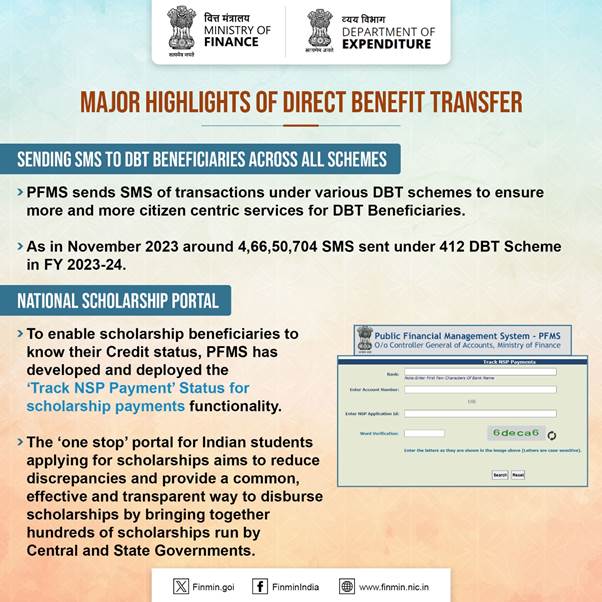
- Sending Sms To DBT Beneficiaries Across All Schemes
- PFMS sends SMS of transactions under various DBT schemes to ensure more and more citizen centric services for DBT Beneficiaries.
- As in November 2023 around 4,66,50,704 SMS sent under 412 DBT Scheme in FY 2023-24.
National Scholarship Portal
- To enable scholarship beneficiaries to know their Credit status, PFMS has developed and deployed the 'Track NSP Payment' Status for scholarship payments functionality.
- The 'one stop' portal for Indian students applying for scholarships aims to reduce discrepancies and provide a common, effective and transparent way to disburse scholarships by bringing together hundreds of scholarships run by Central and State Governments.
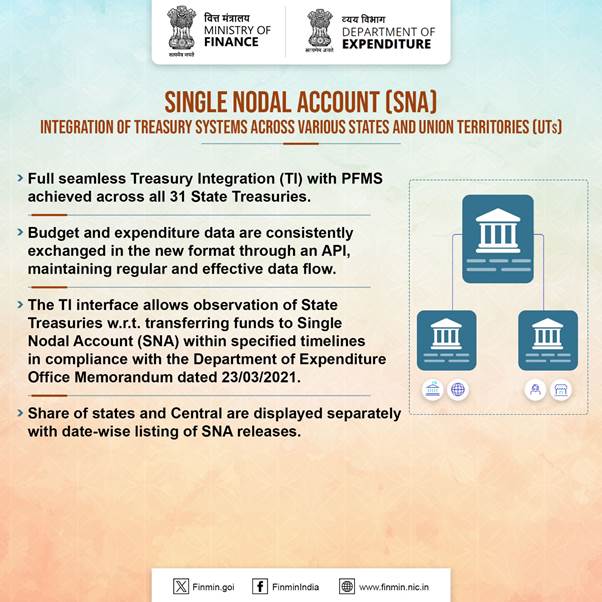
SINGLE NODAL ACCOUNT (SNA)
- Integration of treasury systems across various States and Union Territories (UTs)
- Full seamless Treasury Integration (TI) achieved across all 31 State Treasuries
- Budget and expenditure data are consistently exchanged in the new format through an API, maintaining regular and effective data flow.
- The TI interface allows observation of State Treasuries w.r.t. transferring funds to Single Nodal Account (SNA) within specified timelines in compliance with the Department of Expenditure Office Memorandum dated 23/03/2021
- Share of states and Central are displayed separately with date-wise listing of SNA releases.
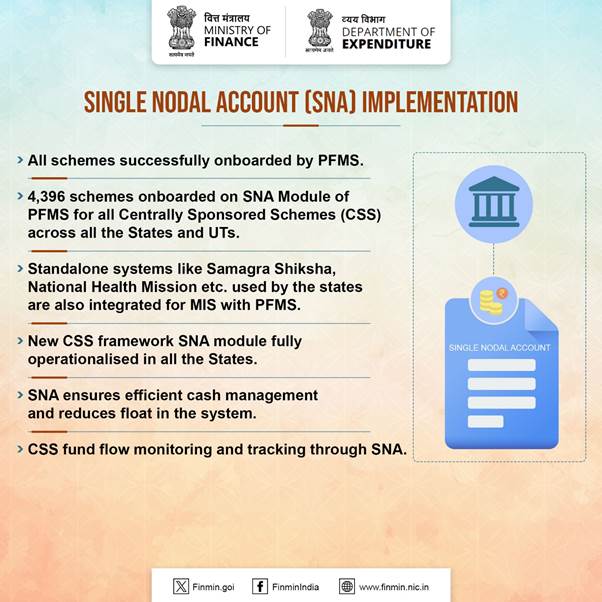
- SINGLE NODAL ACCOUNT (SNA) IMPLEMENTATION
- All schemes successfully onboarded by PFMS.
- 4,396 schemes onboarded on SNA Module of PFMS for all Centrally Sponsored Schemes (CSS) across all the States and UTs.
- Standalone systems like Samagra Shiksha, National Health Mission etc. used by the states are also integrated for MIS with PFMS.
- New CSS framework SNA module fully operationalised in all the States.
- SNA ensures efficient cash management and reduces float in the system.
- CSS fund flow monitoring and tracking through SNA.
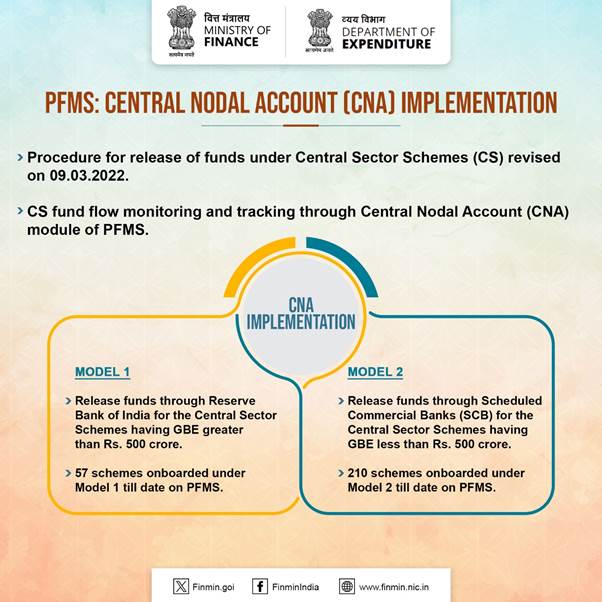
Central Nodal Account (CNA) Implementation
- Procedure of release of funds under Central Sector Schemes (CS) revised on 09.03.2022.
- CS fund flow monitoring and tracking through Central Nodal Account (CNA) module of PFMS.
CNA Implementation MODEL 1
- Release funds through Reserve Bank of India for the Central Sector Schemes having GBE greater than Rs. 500 crore
- 57 schemes onboarded under Model 1 till date on PFMS.
CNA Implementation MODEL 2
- Release funds through Scheduled Commercial Banks (SCB) for the Central Sector Schemes having GBE less than Rs. 500 crore.
- 210 schemes onboarded under Model 2 till date on PFMS.
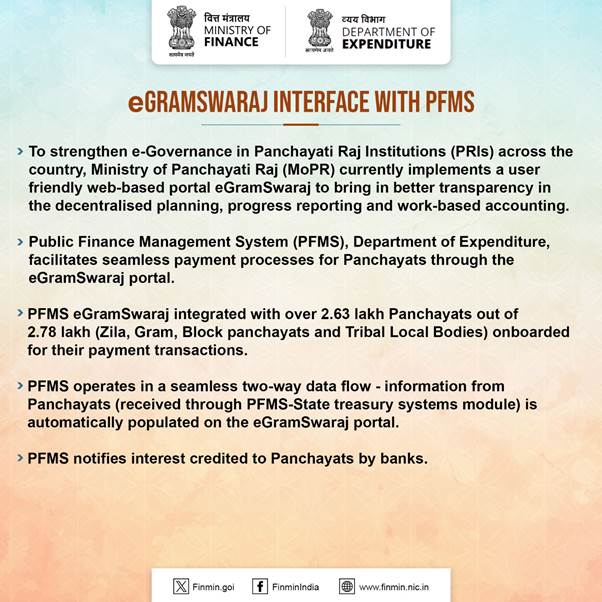
eGramSwaraj Interface with PFMS
- To strengthen e-Governance in Panchayati Raj Institutions (PRIs) across the country, Ministry of Panchayati Raj (MoPR) currently implements a user friendly web-based portal eGramSwaraj to bring in better transparency in the decentralised planning, progress reporting and work-based accounting.
- Public Finance Management System (PFMS), Department of Expenditure, facilitates seamless payment processes for Panchayats through the eGramSwaraj portal.
- PFMS eGramSwaraj integrated with over 2.63 lakh Panchayats out of 2.78 lakh (Zila, Gram, Block panchayats and Tribal Local Bodies) onboarded for their payment transactions.
- PFMS operates in a seamless two-way data flow - information from Panchayats (received through PFMS-State treasury systems module) is automatically populated on the eGramSwaraj portal.
- PFMS notifies interest credited to Panchayats by banks.
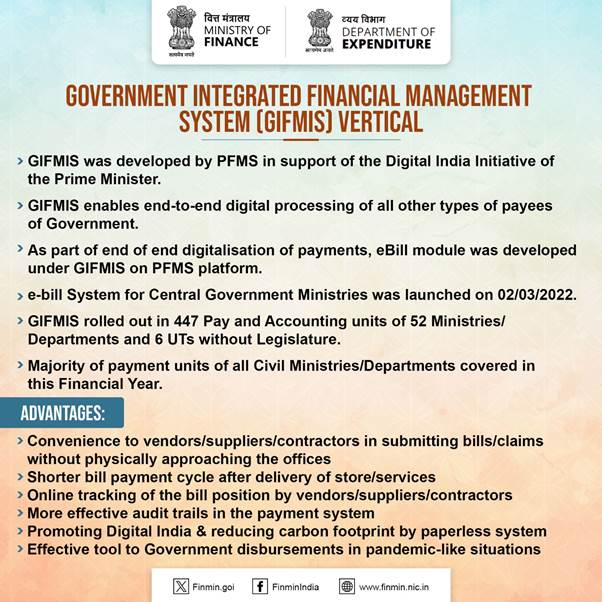
Government Integrated Financial Management System (GIFMIS) Vertical
- GIFMIS was developed by PFMS in support of the Digital India Initiative of the Prime Minister.
- GIFMIS enables end-to-end digital processing of all other types of payees of Government.
- As part of end of end digitalisation of payments, eBill module was developed under GIFMIS on PFMS platform.
- e-bill System for Central Government Ministries was launched on 02/03/2022.
- GIFMIS rolled out in 447 Pay and Accounting units of 52 Ministries/ Departments and 6 UTs without Legislature.
- Majority of payment units of all Civil Ministries/Departments covered in this Financial Year.
Advantages of Government Integrated Financial Management System (GIFMIS) Vertical:
- Convenience to vendors/suppliers/contractors in submitting bills/claims without physically approaching the offices
- Shorter bill payment cycle after delivery of store/services
- Online tracking of the bill position by vendors/suppliers/contractors
- More effective audit trails in the payment system
- Promoting Digital India & reducing carbon footprint by paperless system
- Effective tool to Government disbursements in pandemic-like situations
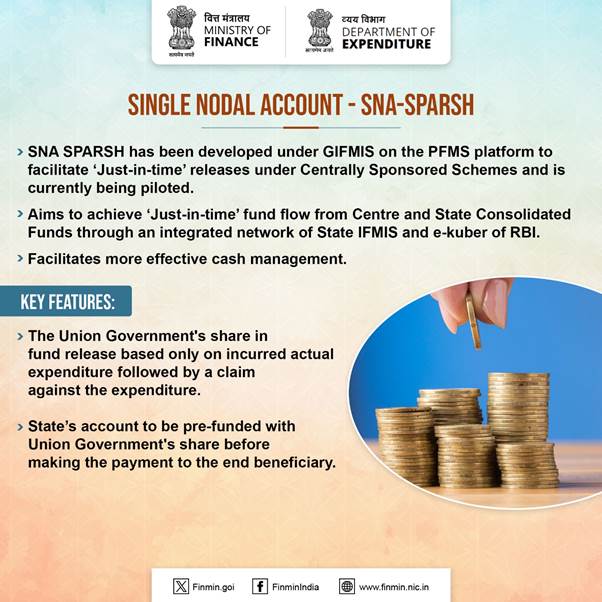
SINGLE NODAL ACCOUNT - SNA-SPARSH
- SNA SPARSH has been developed under GIFMIS on the PFMS platform to facilitate 'Just-in-time' releases under Centrally Sponsored Schemes and is currently being piloted.
- Aims to achieve 'Just-in-time' fund flow from Centre and State Consolidated Funds through an integrated network of State IFMIS and e-kuber of RBI.
- Facilitates more effective cash management.
Key features:
- The Union Government's share in fund release based only on incurred actual expenditure followed by a claim against the expenditure.
- State's account to be pre-funded with Union Government's share before making the payment to the end beneficiary.
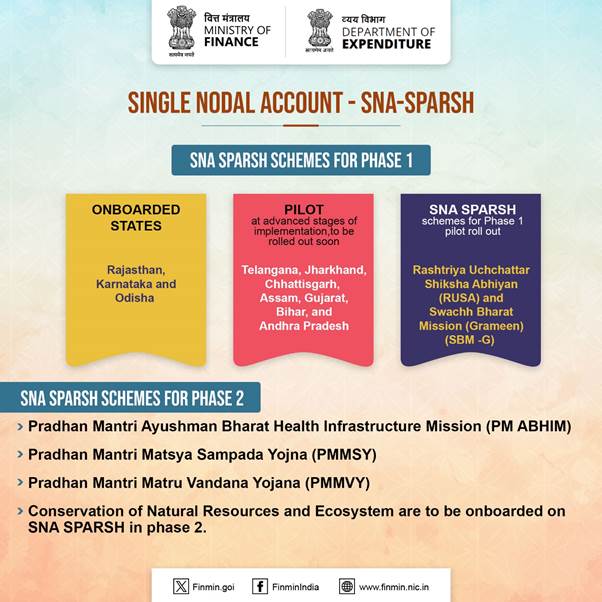
Onboarded States: Rajasthan, Karnataka and Odisha
PILOT at advanced stages of implementation, to be rolled out soon: Telangana, Jharkhand, Chhattisgarh, Assam, Gujarat, Bihar, and Andhra Pradesh
SNA SPARSH schemes for Phase 1 pilot roll out: Rashtriya Uchchattar Shiksha Abhiyan (RUSA) and Swachh Bharat Mission (Grameen) (SBM -G)
SNA SPARSH schemes for Phase 2:
- Pradhan Mantri Ayushman Bharat Health Infrastructure Mission (PM ABHIM)
- Pradhan Mantri Matsya SampadaYojna (PMMSY)
- Pradhan Mantri Matru Vandana Yojana
- Conservation of Natural Resources and Ecosystem are to be onboarded on SNA SPARSH in phase 2.
Initiatives by Central Pension Accounting Office (CPAO)
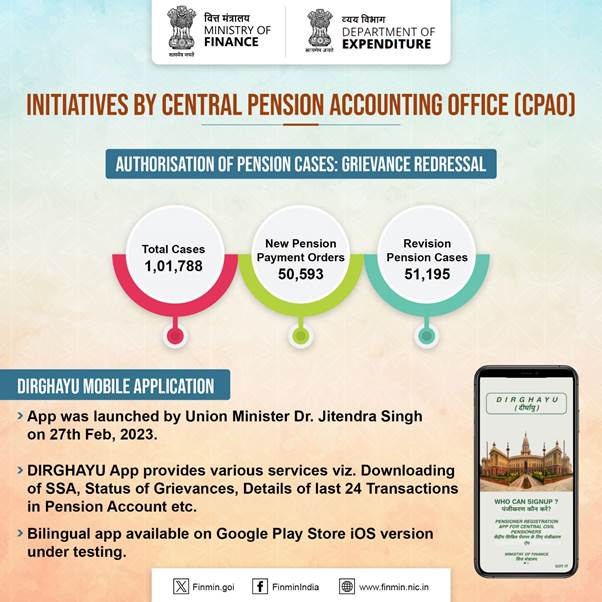
Authorisation of Pension Cases
- Total Cases 1,01,788
- New Pension Payment Orders 50,593
- Revision Pension Cases 51,195
DIRGHAYU Mobile Application
- App was launched by Union Minister Dr. Jitendra Singh on 27th Feb, 2023.
- DIRGHAYU App provides various services viz. Downloading of SSA, Status of Grievances, Details of last 24 Transactions in Pension Account etc.
- Bilingual app available on Google Play Store iOS version under testing.
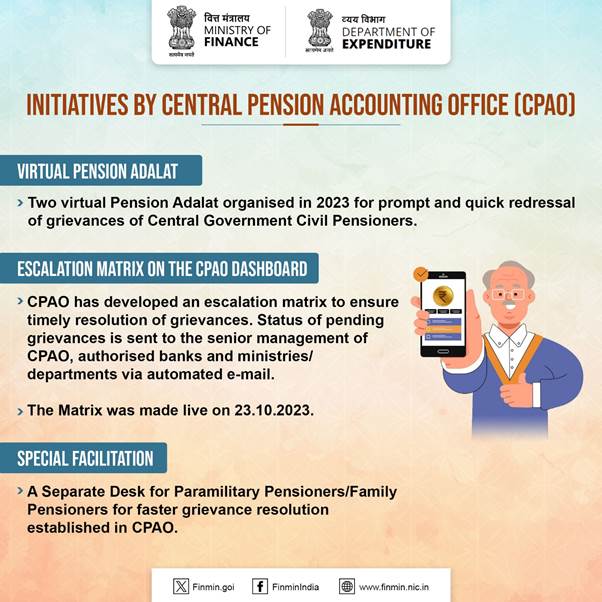
Virtual Pension Adalat:
- Two virtual pension Adalat organised in 2023 for prompt and quick redressal of grievances of Central Government Civil Pensioners
Escalation matrix on the CPAO Dashboard
- CPAO has developed an escalation matrix to ensure timely resolution of grievances. Status of pending grievances is sent to the senior management of CPAO, authorised banks and ministries/ departments via automated e-mail.
- The Matrix was made live on 23.10.2023.
SPECIAL FACILITATION
- A Separate Desk for Paramilitary Pensioners/Family Pensioners for faster grievance resolution established in CPAO.
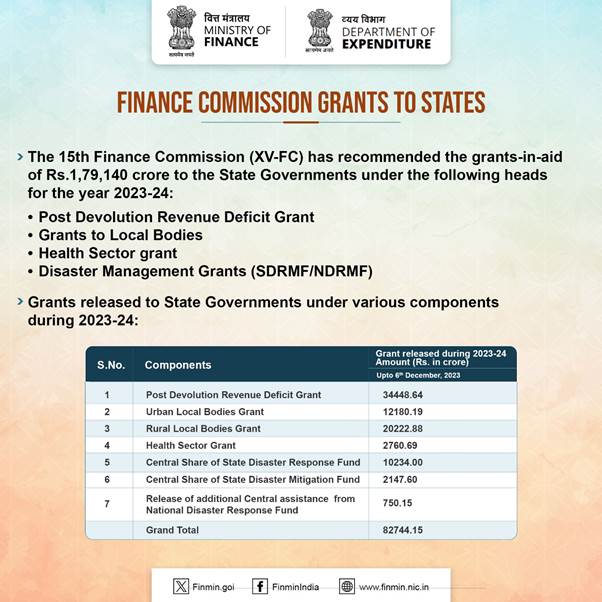
Finance Commission Grants to States
The 15th Finance Commission (XV-FC) has recommended the grants-in-aid of Rs.1,79,140 crore to the State Governments under the following heads for the year 2023-24:
- Post Devolution Revenue Deficit Grant
- Grants to Local Bodies
- Health Sector grant
- Disaster Management Grants (SDRMF/NDRMF)
Grants released to State Governments under various components during 2023-24:
| S/No. | Components | Grants release during 2023-24 (Rs. in crore) |
| Upto 6th Dec, 2023 |
| 1. | Post Devolution Revenue Deficit Grant | 34448.64 |
| 2. | Urban Local Bodies Grant | 12180.19 |
| 3. | Rural Local Bodies Grant | 20222.88 |
| 4. | Health Sector Grant | 2760.69 |
| 5. | Central Share of State Disaster Response Fund | 10234.00 |
| 6. | Central Share of State Disaster Mitigation Fund | 2147.60 |
| 7. | Release of additional Central assistance from National Disaster Response Fund | 250.15 |
| | Grand Total | 82744.15 |
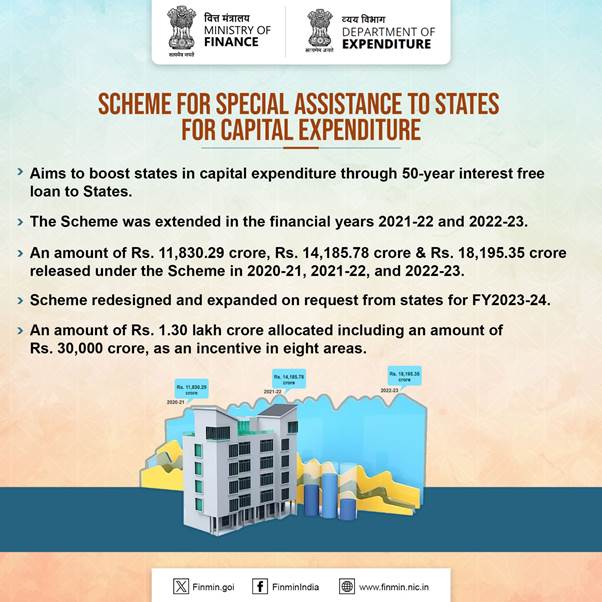
Scheme For Special Assistance To States For Capital Expenditure
- Aims to boost states in capital expenditure through 50-year interest free loan to States.
- The Scheme was extended in the financial years 2021-22 and 2022-23.
- An amount of Rs. 11,830.29 crore, Rs. 14,185.78 crore & Rs. 18,195.35 crore released under the Scheme in 2020-21, 2021-22, and 2022-23.
- Scheme redesigned and expanded on request from states for FY2023-24.
- An amount of Rs. 1.30 lakh crore allocated including an amount of Rs. 30,000 crore, as an incentive in eight areas.
Scheme For Special Assistance to States for Capital Investment 2023-24
Part-I (untied)
- Rs. 1,00,000 crore allocated to States in proportion to their share of central taxes and duties.
- Capital Expenditure amounting to Rs. 91,471.43 crore has been approved for the States of Arunachal Pradesh, Assam, Bihar, Chhattisgarh, Goa, Gujarat, Haryana, Himachal Pradesh, Jharkhand, Karnataka, Madhya Pradesh, Maharashtra, Manipur, Meghalaya, Mizoram, Nagaland, Odisha, Rajasthan, Sikkim, Tamil Nadu, Telangana, Tripura, Uttar Pradesh, Uttarakhand and West Bengal.
- Out of which Rs. 57,090.39 crore has been released to eligible States.

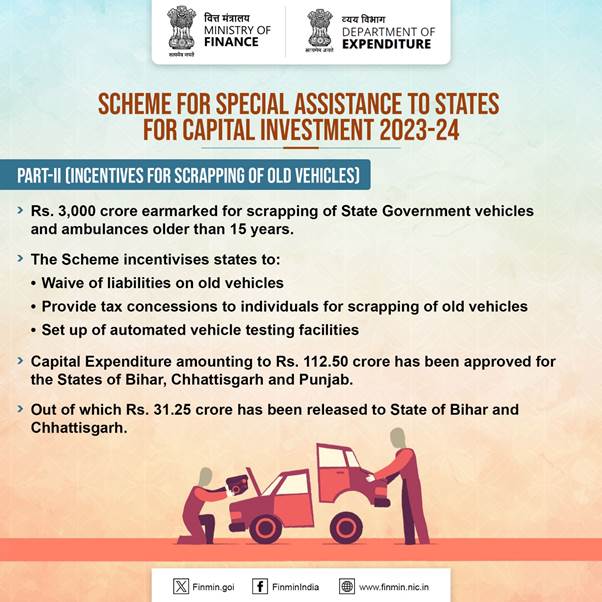
Part-II (Incentives for Scrapping of Old Vehicles)
- Rs. 3,000 crore earmarked for scrapping of State Government vehicles and ambulances older than 15 years.
- The Scheme incentivises states to:
- Waive of liabilities on old vehicles
- Provide tax concessions to individuals for scrapping of old vehicles
- Set up of automated vehicle testing facilities
- Capital Expenditure amounting to Rs. 112.50 crore has been approved for the States of Bihar, Chhattisgarh and Punjab.
- Out of which Rs. 31.25 crore has been released to State of Bihar and Chhattisgarh.
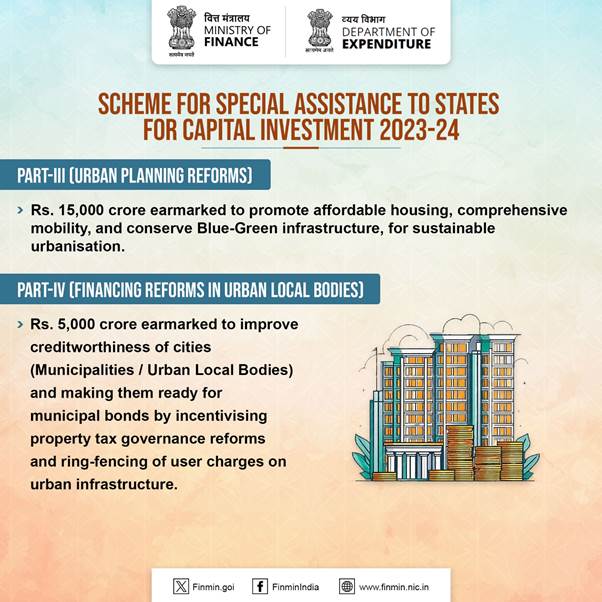
Part-III (Urban Planning Reforms)
- Rs. 15,000 crore earmarked to promote affordable housing, comprehensive mobility, and conserve Blue-Green infrastructure, for sustainable urbanisation.
Part-IV (Financing Reforms In Urban Local Bodies)
- Rs. 5,000 crore earmarked to improve creditworthiness of cities (Municipalities / Urban Local Bodies) and making them ready for municipal bonds by incentivising property tax governance reforms and ring-fencing of user charges on urban infrastructure.
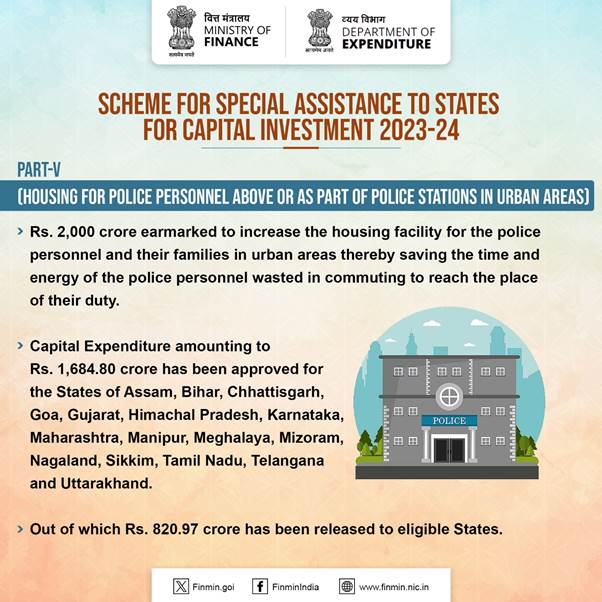
Part-V (Housing for Police personnel above or as part of Police Stations in Urban Areas)
- Rs. 2,000 crore earmarked to increase the housing facility for the police personnel and their families in urban areas thereby saving the time and energy of the police personnel wasted in commuting to reach the place of their duty.
- Capital Expenditure amounting to Rs. 1,684.80 crore has been approved for the States of Assam, Bihar, Chhattisgarh, Goa, Gujarat, Himachal Pradesh, Karnataka, Maharashtra, Manipur, Meghalaya, Mizoram, Nagaland, Sikkim, Tamil Nadu, Telangana and Uttarakhand.
- Out of which Rs. 820.97 crore has been released to eligible States.
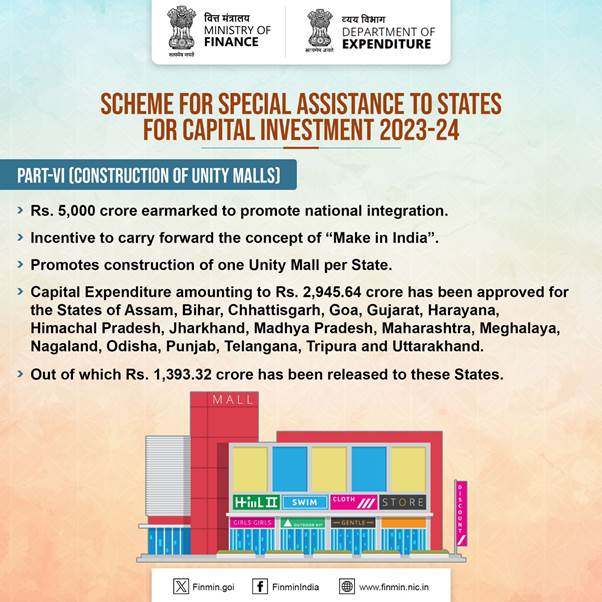
Part-VI (Construction of Unity Malls)
- Rs. 5,000 crore earmarked to promote national integration.
- Incentive to carry forward the concept of "Make in India”.
- Promotes construction of one Unity Mall per State.
- Capital Expenditure amounting to Rs. 2,945.64 crore has been approved for the States of Assam, Bihar, Chhattisgarh, Goa, Gujarat, Harayana, Himachal Pradesh, Jharkhand, Madhya Pradesh, Maharashtra, Meghalaya, Nagaland, Odisha, Punjab, Telangana, Tripura and Uttarakhand.
- Out of which Rs. 1,393.32 crore has been released to these States.
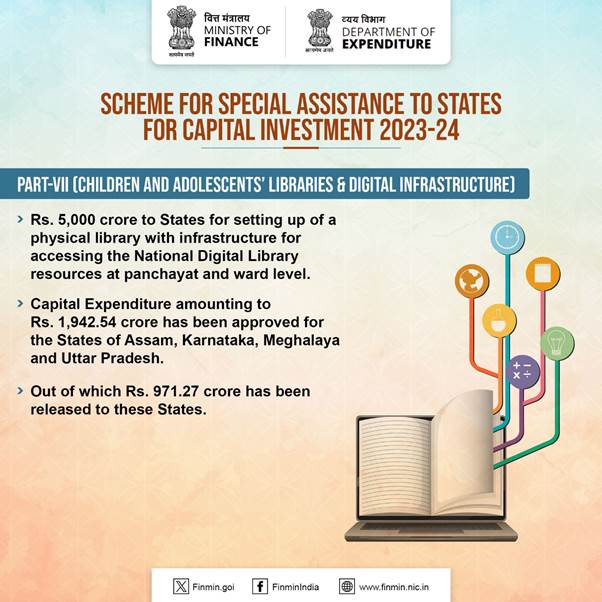
Part-VII (Children and Adolescents’ Libraries & Digital Infrastructure)
- Rs. 5,000 crore to States for setting up of a physical library with infrastructure for accessing the National Digital Library resources at panchayat and ward level.
- Capital Expenditure amounting to Rs. 1,942.54 crore has been approved for the States of Assam, Karnataka, Meghalaya and Uttar Pradesh.
- Out of which Rs. 971.27 crore has been released to these States.
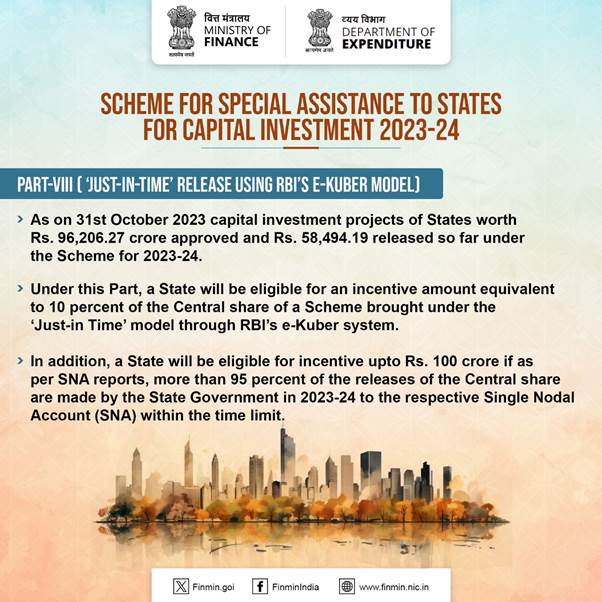
Part-VIII ('Just-In-Time' Release Using RBI'S E-Kuber Model)
- As on 31st October 2023 capital investment projects of States worth Rs. 96,206.27 crore approved and Rs. 58,494.19 released so far under the Scheme for 2023-24.
- Under this Part, a State will be eligible for an incentive amount equivalent to 10 percent of the Central share of a Scheme brought under the 'Just-in Time' model through RBI's e-Kuber system.
- In addition, a State will be eligible for incentive upto Rs. 100 crore if as per SNA reports, more than 95 percent of the releases of the Central share are made by the State Government in 2023-24 to the respective Single Nodal Account (SNA) within the time limit.
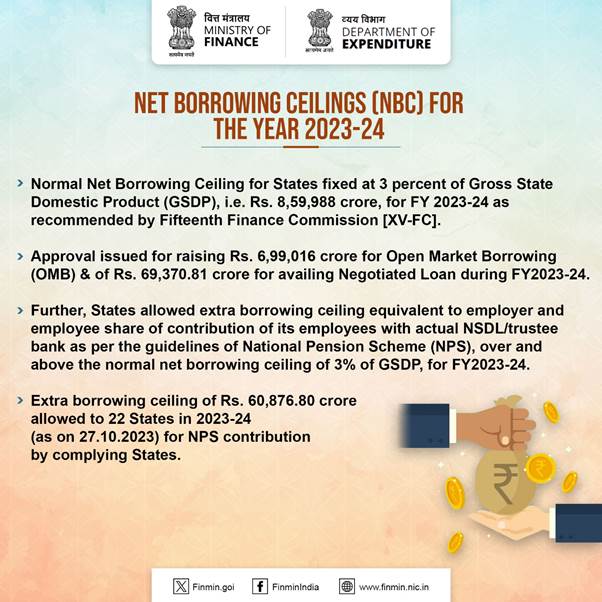
Net Borrowing Ceilings (Nbc) For The Year 2023-24
- Normal Net Borrowing Ceiling for States fixed at 3 percent of Gross State Domestic Product (GSDP), i.e. Rs. 8,59,988 crore, for FY 2023-24 as recommended by Fifteenth Finance Commission [XV-FC].
- Approval issued for raising Rs. 6,99,016 crore for Open Market Borrowing (OMB) & of Rs. 69,370.81 crore for availing Negotiated Loan during FY2023-24.
- Further, States allowed extra borrowing ceiling equivalent to employer and employee share of contribution of its employees with actual NSDL/trustee bank as per the guidelines of National Pension Scheme (NPS), over and above the normal net borrowing ceiling of 3% of GSDP, for FY2023-24.
- Extra borrowing ceiling of Rs. 60,876.80 crore allowed to 22 States in 2023-24 (as on 27.10.2023) for NPS contribution by complying States.
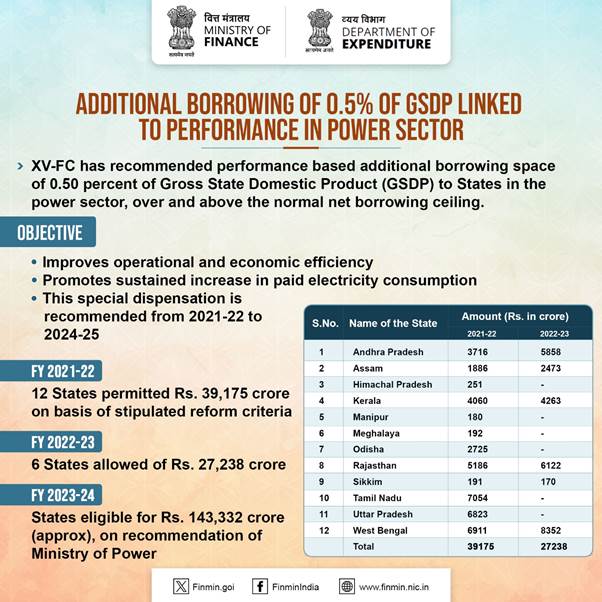
Additional Borrowing Of 0.5% Of GSDP Linked To Performance In Power Sector
- XV-FC has recommended performance based additional borrowing space of 0.50 percent of Gross State Domestic Product (GSDP) to States in the power sector, over and above the normal net borrowing ceiling.
- OBJECTIVE
- Improves operational and economic efficiency
- Promotes sustained increase in paid electricity consumption
- This special dispensation is recommended from 2021-22 to 2024-25
- FY 2021-22: 12 States permitted Rs. 39,175 crore on basis of stipulated reform criteria
- FY 2022-23: 6 States allowed of Rs. 27,238 crore
- FY 2023-24: States eligible for Rs. 143,332 crore (approx), on recommendation of Ministry of Power
| S.No. | Name of the State | Amount (Rs. in crore) |
| 2021-22 | 2022-23 |
| 1 | Andhra Pradesh | 3716 | 5858 |
| 2 | Assam | 1886 | 2473 |
| 3 | Himachal Pradesh | 251 | - |
| 4 | Kerala | 4060 | 4263 |
| 5 | Manipur | 180 | - |
| 6 | Meghalaya | 192 | - |
| 7 | Odisha | 2725 | - |
| 8 | Rajasthan | 5186 | 6122 |
| 9 | Sikkim | 191 | 170 |
| 10 | Tamil Nadu | 7054 | - |
| 11 | Uttar Pradesh | 6823 | - |
| 12 | West Bengal | 6911 | 8352 |
| | Total | 39175 | 27238 |
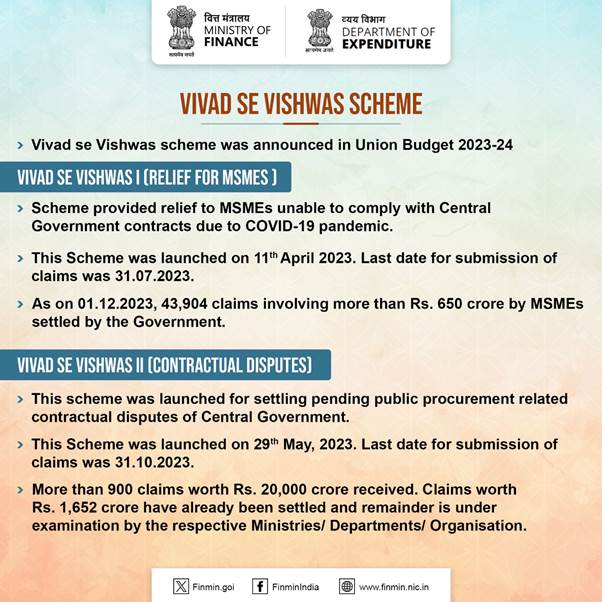
Vivad Se Vishwas Scheme
- Vivad se Vishwas scheme was announced in Union Budget 2023-24
Vivad Se Vishwas I (Relief For MSMEs)
- Scheme provided relief to MSMEs unable to comply with Central Government contracts due to COVID-19 pandemic.
- This Scheme was launched on 11th April 2023. Last date for submission of claims was 31.07.2023.
- As on 01.12.2023, 43,904 claims involving more than Rs. 650 crore by MSMEs settled by the Government.
Vivad Se Vishwas II (Contractual Disputes)
- This scheme was launched for settling pending public procurement related contractual disputes of Central Government.
- This Scheme was launched on 29th May, 2023. Last date for submission of claims was 31.10.2023.
- More than 900 claims worth Rs. 20,000 crore received. Claims worth Rs. 1,652 crore have already been settled and remainder is under examination by the respective Ministries/ Departments/ Organisation.
****
 TaxTMI
  TaxTMI
 of 3379


