

Loading...

Top
Help
×

By creating an account you can:

Logo TaxTMI
Call Us / Help / Feedback

Contact Us At :

E-mail: [email protected]

Call / WhatsApp at: +91 99117 96707

For more information, Check Contact Us

FAQs :

To know Frequently Asked Questions, Check FAQs

Most Asked Video Tutorials :

For more tutorials, Check Video Tutorials

Submit Feedback/Suggestion :

Email :
Please provide your email address so we can follow up on your feedback.
Category :
Description :
Min 15 characters 0/2000
Make Most of Text Search
  1. Checkout this video tutorial: How to search effectively on TaxTMI.
  2. Put words in double quotes for exact word search, eg: "income tax"
  3. Avoid noise words such as : 'and, of, the, a'
  4. Sort by Relevance to get the most relevant document.
  5. Press Enter to add multiple terms/multiple phrases, and then click on Search to Search.
  6. Text Search
  7. The system will try to fetch results that contains ALL your words.
  8. Once you add keywords, you'll see a new 'Search In' filter that makes your results even more precise.
  9. Text Search
Add to...
You have not created any category. Kindly create one to bookmark this item!
Create New Category
Hide
Title :
Description :
❮❮ Hide
Default View
Expand ❯❯
Close ✕
🔎 News - Adv. Search
TEXT SEARCH:

Press 'Enter' to add multiple search terms. Rules for Better Search

Search In:
Main Text + AI Text
  • Main Text
  • Main Text + AI Text
  • AI Text
Category: ?
Categorized by AI
---- All Categories ----
  • ---- All Categories ----
  • Income Tax
  • GST
  • Customs, DGFT & SEZ
  • FEMA & RBI
  • Corp. Laws, SEBI & IBC
  • PMLA, Black Money & ED
  • Budget
  • News and Press Release
  • PTI News
Month:
---- All Months ----
  • ---- All Months ----
  • January
  • February
  • March
  • April
  • May
  • June
  • July
  • August
  • September
  • October
  • November
  • December
Year:
---- All Years ----
  • ---- All Years ----
  • 2026
  • 2025
  • 2024
  • 2023
  • 2022
  • 2021
  • 2020
  • 2019
  • 2018
  • 2017
  • 2016
  • 2015
  • 2014
  • 2013
  • 2012
  • 2011
Sort By: ?
In Sort By 'Default', exact matches for text search are shown at the top, followed by the remaining results in their regular order.
Relevance Default Date
    AERA cuts user development fee for domestic, int'l passengers at Hyderabad airport
    Rupee rises 24 paise to close at 95.46 against US dollar
    India pivots to US for LPG, LNG as West Asia crisis disrupts Gulf supplies
    Experts Call for Intelligence-Led Action to Break Cross-Border Illicit Trade Networks at ASIA Security Conference 2026
    How NRIs Can Structure Bank Accounts in India When They Have Both Indian and Overseas Financial Commitments
    Sugar ex-mill prices down 18 pc to Rs 55/kg after import move, curbs on hoarding: Food secretary
    SBI eyes USD 10 bln from NRIs, foreign investors ahead of RBI swap window closure
    Industrial power tariff hike: WBSEDCL says proposed rise capped to DVC area, rates still competitive
    India-Japan Investment Partnership Gains Momentum; Commerce and Industry Minister Shri Piyush Goyal Invites Greater Japanese Institutional Capital
    Commerce and Industry Minister Piyush Goyal addresses Japanese Business Federation in Tokyo
    Third Meeting of India-Cambodia Joint Working Group on Trade and Investment (JWGTI) Held in Phnom Penh, Cambodia
    Central Bureau of Narcotics (CBN) and PHARMEXCIL Sign Memorandum of Understanding to Boost Legitimate Pharmaceutical Exports and Strengthen Regulatory...
    RBI's USD-INR Swap Facility Sparks Unprecedented Forex Inflows into India, Banks Raise USD 73 Billion in eleven weeks
    Rupee falls 4 paise to 95.74 against US dollar in early trade
    Former cop Waze files fresh plea in Mumbai court, wants PMLA case against him dropped
    Rupee settles 1 paisa higher at 95.70 against US dollar
    Ontario's premier: Canada should be ready to cut electricity, critical minerals as trade woes worsen
    UIDAI, Army launch Aadhaar biometric update camps for students in Assam's Tamulpur
    J&K PCC chief opposes electricity tariff hike, demands immediate rollback
    Govt lifts ban on wheat exports to protect farmers interest amid depressed local prices
❯❯
Maximize Maximize Maximize
0 / 200
Expand Note
Add to Folder

No Folders have been created

+

Are you sure you want to delete "My most important" ?

NOTE:

News
Showing Results for :
Reset Filters
Results Found:
Show All Summaries Hide All Summaries
August 25, 2026
Show AI Summary
User development fee rationalisation reduces departure charges and links airport cost recovery to commissioned capital projects during the tariff cycle.
Airport tariff regulation for Hyderabad airport fixes reduced User Development Fee for departing domestic and international passengers from 1 September 2026 through 31 March 2031, with rationalised landing charges. The tariff determination applies the incremental Aggregate Revenue Requirement framework, linking airport-charge cost recovery to completion, commissioning and use of identified high-value capital expenditure projects. A variable tariff plan provides landing-charge incentives upon prescribed qualifying conditions, supporting traffic development and route expansion while requiring cost-reflective, transparent and non-discriminatory aeronautical tariffs.
August 25, 2026
Show AI Summary
Rupee appreciation reflects weaker dollar, lower crude prices, positive equities, and foreign-exchange inflows through swap facilities.
Foreign-exchange market conditions supported the rupee's appreciation against the US dollar, driven by positive domestic equity markets, a weaker dollar, and declining crude-oil prices. The USD/INR pair remained within a narrow range, with oil-price movements and potential central-bank intervention identified as near-term determinants. A special USD-INR foreign-exchange swap facility covering FCNR(B) deposits, overseas foreign-currency borrowings and external commercial borrowings had mobilised foreign-exchange inflows relevant to currency liquidity.
August 25, 2026
Show AI Summary
Energy supply diversification reshapes India's LPG, LNG and crude sourcing amid constrained Gulf availability and higher logistics costs.
India's energy-import sourcing has shifted towards supply diversification as disruption in the Strait of Hormuz constrained traditional Gulf supplies. United States cargoes have become particularly important for LPG and LNG, while procurement has also broadened to Atlantic Basin and other non-traditional suppliers. Diversification increases costs through longer voyages, higher freight, insurance expenses, tighter availability and higher commodity prices, reflecting a premium for supply security. Crude sourcing continues to rely principally on Russia, alongside resilient UAE flows and increased Venezuelan heavy crude imports.
August 25, 2026
Show AI Summary
Intelligence-led enforcement against illicit trade requires coordinated data-sharing, risk profiling, digital accountability and disruption of organised supply networks.
Cross-border illicit trade enforcement should move beyond isolated seizures to intelligence-led disruption of organised criminal networks. Risk-based profiling, predictive analytics, container scanning and shipment-data analysis should support targeted action against misdeclaration, port-hopping, concealment and digital distribution. Right holders should share specific intelligence with customs targeting mechanisms, and goods entering Domestic Tariff Areas from warehousing and special economic zones require enhanced examination. Digital enforcement should trace suppliers, financial flows, data trails and small-parcel movements, supported by coordinated feedback between online marketplaces, police and customs.
August 25, 2026
Show AI Summary
NRI banking account segregation aligns overseas earnings, domestic income, foreign-currency savings, remittances, and borrowing with cross-border commitments.
NRI banking arrangements require segregation of overseas earnings, India-sourced income, savings, remittances and expenditure after residential status changes. An NRE account holds overseas income remitted to India, with interest exempt from income tax in India. An NRO account is intended for Indian income, including rent, dividends and pension, while FCNR deposits retain funds in a chosen foreign currency. A structured arrangement can align these accounts with domestic obligations, overseas spending, remittances, investments and compliant digital banking access.
August 25, 2026
Show AI Summary
Sugar import authorisation and anti-hoarding controls aim to moderate ex-mill prices amid adequate domestic stocks.
Raw sugar imports were permitted, while stock limits were imposed on bulk consumers. States were directed to strengthen inspections, and nationwide flying squads were deployed to identify hoarding and speculative conduct. These measures target sugar availability and distribution across wholesale and retail channels. Ex-mill prices declined following the measures, although wholesale and retail prices had not yet reflected the reduction.
August 25, 2026
Show AI Summary
Foreign-currency swap window closure focuses non-resident deposit mobilisation, while ECB hedging support continues for public-sector borrowers.
RBI's concessional Foreign Currency Non-Resident Bank deposit swap window closes on August 31, replacing the previous September 30 cut-off. Separately, the special US dollar-rupee foreign-exchange swap window remains available until December 31, 2026, providing concessional currency-hedging support to public sector undertakings raising external commercial borrowings. SBI expects to mobilise predominantly through deposits from non-resident Indians and foreign investors, with external commercial borrowings also visible.
August 25, 2026
Show AI Summary
Industrial power tariff revision applies only within the shared distribution area, while steel producers seek rollback and fuel supply support.
Industrial electricity tariff revision is proposed from 1 September for 33 KV and 11 KV consumers within the Damodar Valley Corporation command area. The increase is confined to the shared distribution-licence area, while a separate and higher tariff structure applies outside it. Steel and sponge-iron industry associations oppose the revision on the basis that it will raise energy costs and affect investment conditions. They seek withdrawal of the increase and request continuing supplies of high-grade coal and iron ore for sponge-iron production.
August 25, 2026
Show AI Summary
Institutional capital facilitation prioritises repatriation, market access, regulatory predictability, and cross-border partnerships supporting technology-led long-term investment.
India-Japan investment engagement focuses on increasing long-term Japanese institutional capital flows through an enabling business environment, intellectual property protection, policy reforms and integration with global value chains. Facilitation measures include simpler profit repatriation processes, improved access to Indian capital markets, greater regulatory predictability and a seamless cross-border investment environment. GIFT City is explored as a gateway for international capital and Japan-India investment flows.
August 25, 2026
Show AI Summary
Strategic investment partnership prioritises semiconductor manufacturing, resilient supply chains and advanced industrial collaboration between Indian and Japanese businesses.
India-Japan economic cooperation is directed toward deeper trade, investment, technology and business-to-business linkages, including economic security, supply-chain resilience, clean energy and innovation. Collaboration is focused on capital goods, machinery, automotive and advanced manufacturing, with stronger connections between Japanese enterprises and India's Tier-II and Tier-III suppliers, including Micro, Small and Medium Enterprises. Semiconductor manufacturing is identified as a significant investment area. The India-Japan Special Strategic and Global Partnership supports expanded engagement with manufacturing ecosystems, global value chains and resilient supply chains.
August 25, 2026
Show AI Summary
Bilateral trade and investment cooperation advances through customs alignment, digital payment integration, market access discussions and investment treaty completion.
India-Cambodia trade and investment cooperation addressed trade diversification, market access, customs alignment, digital payments and investment facilitation. Discussions covered traditional medicine, e-governance, recognition of the Indian pharmacopeia, trade statistics, agricultural cooperation, banking and insurance. The parties agreed on an MoU on Customs Cooperation to promote uniform customs procedures and considered early completion and signature of the Bilateral Investment Treaty. UPI-KHQR payment integration, investment promotion, priority-sector cooperation and a private-sector feedback mechanism were also discussed.
August 25, 2026
Show AI Summary
Voluntary pharmaceutical export compliance framework promotes legitimate trade while safeguarding controlled substances through information sharing and coordinated capacity building.
The Memorandum of Understanding creates a cooperative framework for legitimate pharmaceutical exports and safeguards against diversion of narcotic drugs, psychotropic substances and controlled precursors. A voluntary, non-binding code of conduct will recommend industry practices without imposing obligations beyond applicable law. Cooperation includes identifying export bottlenecks, streamlining procedures for compliant exporters, capacity-building programmes, lawful and confidential information sharing, and nomination of company contact persons to coordinate voluntary compliance measures.
August 25, 2026
Show AI Summary
USD-INR forex swap facility accelerates foreign-currency mobilisation through non-resident deposits and institutional borrowing, strengthening India's external buffers.
USD-INR forex swap facility for FCNR(B) deposits, overseas foreign-currency borrowings and external commercial borrowings enabled banks to access foreign-currency funding through a special swap window. FCNR(B) deposits formed the principal component of the reported foreign-exchange inflows, reflecting participation by non-resident Indians. The FCNR(B) window was scheduled for early closure after the stated mobilisation objective was achieved ahead of schedule, and the inflows were presented as strengthening external buffers through long-term non-resident deposits and institutional funding.
August 25, 2026
Show AI Summary
Foreign-exchange intervention moderated rupee depreciation as crude prices, importer dollar demand and geopolitical uncertainty sustained currency-market pressure.
Foreign-exchange conditions reflected a marginal weakening of the rupee against the US dollar, influenced by elevated crude-oil prices, importer demand for dollars, weaker Asian equities and geopolitical uncertainty. The currency remained within a narrow trading band, with RBI dollar sales described as moderating sharper depreciation. The RBI's special USD-INR forex swap facility for FCNR(B) deposits, Overseas Foreign Currency Borrowings and External Commercial Borrowings mobilised substantial foreign-exchange inflows, indicating support from non-resident Indian participants.
August 24, 2026
Show AI Summary
Prior government sanction for public servants is contested as essential before money-laundering proceedings may validly proceed for official-duty acts.
Prior prosecution sanction is asserted to be a jurisdictional precondition for money-laundering proceedings against a public servant for acts connected with official duty. A former police officer challenges cognizance and process for want of sanction under the criminal procedure framework and the Maharashtra Police Act, relying on sanctions subsequently granted for co-accused public servants. The allegations concern collection of funds through the officer and their alleged laundering through an educational trust.
August 24, 2026
Show AI Summary
Rupee exchange-rate movement gained marginal support from foreign equity inflows despite crude oil, importer demand and geopolitical pressures.
Rupee exchange-rate movement against the US dollar reflected a marginal appreciation, supported by foreign fund inflows into domestic equities. Trading remained within a narrow range amid pressures from higher crude oil prices, continuing importer demand, and geopolitical concerns. Market conditions also included a stronger dollar index, lower Brent crude futures, domestic equity declines, and net foreign institutional investment. Elevated oil prices and geopolitical uncertainty indicated a slight negative bias, while possible US dollar weakness could support the rupee.
August 24, 2026
Show AI Summary
Retaliatory trade measures may target electricity, critical minerals and integrated automotive supply chains amid escalating cross-border tariff disputes.
Canada-United States trade relations involve escalating tariffs and contemplated reciprocal restrictions affecting goods, automotive production, electricity exports and critical-mineral supplies. Potential Canadian countermeasures include limiting or increasing the price of Ontario electricity exports and restricting supplies of critical minerals, with oil and potash also identified as possible leverage. The automotive sector faces particular exposure because Ontario production and supply chains are integrated with United States manufacturing. Negotiations also raised concern over limits on Canada's ability to conclude trade agreements with other countries without United States approval.
August 24, 2026
Show AI Summary
Mandatory biometric updates for students support continued Aadhaar authentication and access to education, scholarship and benefit-related services.
Mandatory Biometric Update camps have been launched in schools across Tamulpur district, Assam, for eligible students aged 5 to 17 years to update Aadhaar biometrics. Aadhaar biometrics require updating on attaining five years of age and again on attaining fifteen years. Timely updating supports continued Aadhaar authentication and helps avoid difficulties in accessing services where authentication is applicable, including school admissions, entrance-examination registration, scholarships and Direct Benefit Transfer schemes.
August 24, 2026
Show AI Summary
Electricity tariff affordability requires immediate review, withdrawal of higher consumer charges, and relief measures for economically weaker households.
Electricity tariff increase in Jammu and Kashmir has been opposed as imposing an unjustified and unaffordable financial burden on domestic consumers amid rising household costs. Immediate review and withdrawal of the increase are sought, together with measures to reduce electricity costs for domestic consumers, particularly economically weaker sections, and ensure affordable, reliable power supply.
August 24, 2026
Show AI Summary
Wheat export liberalisation replaces prohibitions to support farm prices while domestic stocks are expected to protect consumer supply.
Wheat and wheat-product exports are liberalised with immediate effect by revising their export policy from prohibited to free. The change covers wheat, wheat flour, maida, semolina and wholemeal atta, replacing the earlier export-ban framework and simplifying exports previously permitted through licences. The measure aims to support farmers amid depressed domestic prices, while adequate domestic availability and buffer stocks are expected to meet demand and moderate consumer prices.

News

Back

All News

Showing Results for :
Reset Filters
No Records Found

News

Showing Results for : Reset Filters

Monetary Policy Statement, 2023-24 Resolution of the Monetary Policy Committee (MPC) April 3, 5 and 6, 2023

April 6, 2023

Contents
Circulars
Summary
Note

Note

-

Bookmark

Print

Print

On the basis of an assessment of the current and evolving macroeconomic situation, the Monetary Policy Committee (MPC) at its meeting today (April 6, 2023) decided to:

  • Keep the policy repo rate under the liquidity adjustment facility (LAF) unchanged at 6.50 per cent.

The standing deposit facility (SDF) rate remains unchanged at 6.25 per cent and the marginal standing facility (MSF) rate and the Bank Rate at 6.75 per cent.

  • The MPC also decided to remain focused on withdrawal of accommodation to ensure that inflation progressively aligns with the target, while supporting growth.

These decisions are in consonance with the objective of achieving the medium-term target for consumer price index (CPI) inflation of 4 per cent within a band of +/- 2 per cent, while supporting growth.

The main considerations underlying the decision are set out in the statement below.

Assessment

Global Economy

2. Global economic activity remains resilient amidst the persistence of inflation at elevated levels, turmoil in the banking system in some advanced economies (AEs), tight financial conditions and lingering geopolitical hostilities. Recent financial stability concerns have triggered risk aversion, flights to safety and heightened financial market volatility. Sovereign bond yields fell steeply in March on safe haven demand, reversing the sharp increase in February over aggressive monetary stances and communication. Equity markets have declined since the last MPC meeting and the US dollar has pared its gains. Weakening external demand, spillovers from the banking crisis in some AEs, volatile capital flows and debt distress in certain vulnerable economies weigh on growth prospects.

Domestic Economy

3. The second advance estimates (SAE) released by the National Statistical Office (NSO) on February 28, 2023 placed India’s real gross domestic product (GDP) growth at 7.0 per cent in 2022-23. Private consumption and public investment were the major drivers of growth.

4. Economic activity remained resilient in Q4. Rabi foodgrains production is expected to increase by 6.2 per cent in 2022-23. The index of industrial production (IIP) expanded by 5.2 per cent in January while the output of eight core industries rose even faster by 8.9 per cent in January and 6.0 per cent in February, indicative of the strength of industrial activity. In the services sector, domestic air passenger traffic, port freight traffic, e-way bills and toll collections posted healthy growth in Q4, while railway freight traffic registered a modest growth. Purchasing managers’ indices (PMIs) pointed towards sustained expansion in both manufacturing and services in March.

5. Amongst urban demand indicators, passenger vehicle sales recorded strong growth in February while consumer durables contracted in January. Among rural demand indicators, tractor and two-wheeler sales were robust in February. As regards investment activity, growth in steel consumption and cement output accelerated in February. Merchandise exports and non-oil non-gold imports contracted in February while the strong growth in services exports continued.

6. CPI headline inflation rose from 5.7 per cent in December 2022 to 6.4 per cent in February 2023 on the back of higher inflation in cereals, milk and fruits and slower deflation in vegetables prices. Fuel inflation remained elevated, though some softening was witnessed in February due to a fall in kerosene (PDS) prices and favourable base effects. Core inflation (i.e., CPI excluding food and fuel) remained elevated and was above 6 per cent in January-February. The moderation observed in inflation in clothing and footwear, and transportation and communication was largely offset by a pick-up in inflation in personal care and effects and housing.

7. The average daily absorption under the LAF moderated to ₹1.4 lakh crore during February-March from an average of ₹1.6 lakh crore in December-January. During 2022-23, money supply (M3) expanded by 9.0 per cent and non-food bank credit rose by 15.4 per cent. India’s foreign exchange reserves were placed at US$ 578.4 billion as on March 31, 2023.

Outlook

8. The inflation trajectory for 2023-24 would be shaped by both domestic and global factors. The expectation of a record rabi foodgrains production bodes well for the food prices outlook. The impact of recent unseasonal rains and hailstorms, however, needs to be watched. Milk prices could remain firm due to high input costs and seasonal factors. Crude oil prices outlook is subject to high uncertainty. Global financial market volatility has surged, with potential upsides for imported inflation risks. Easing cost conditions are leading to some moderation in the pace of output price increases in manufacturing and services, as indicated by the Reserve Bank’s enterprise surveys. The lagged pass-through of input costs could, however, keep core inflation elevated. Taking into account these factors and assuming an annual average crude oil price (Indian basket) of US$ 85 per barrel and a normal monsoon, CPI inflation is projected at 5.2 per cent for 2023-24, with Q1 at 5.1 per cent, Q2 at 5.4 per cent, Q3 at 5.4 per cent and Q4 at 5.2 per cent, and risks evenly balanced (Chart 1).

9. A good rabi crop should strengthen rural demand, while the sustained buoyancy in contact-intensive services should support urban demand. The government’s thrust on capital expenditure, above trend capacity utilisation in manufacturing, double digit credit growth and the moderation in commodity prices are expected to bolster manufacturing and investment activity. According to the RBI’s surveys, businesses and consumers are optimistic about the future outlook. The external demand drag could accentuate, given slowing global trade and output. Protracted geopolitical tensions, tight global financial conditions and global financial market volatility pose risks to the outlook. Taking all these factors into consideration, real GDP growth for 2023-24 is projected at 6.5 per cent with Q1:2023-24 at 7.8 per cent; Q2 at 6.2 per cent; Q3 at 6.1 per cent; and Q4 at 5.9 per cent, with risks evenly balanced (Chart 2).
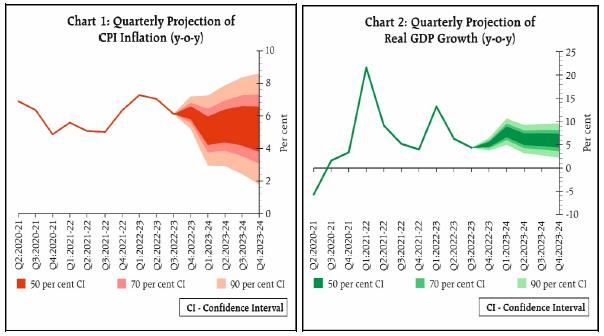
Chart 1

10. With CPI headline inflation ruling persistently above the tolerance band, the MPC decided to remain resolutely focused on aligning inflation with the target. It is essential to rein in the generalisation of price pressures and anchor inflation expectations. An environment of low and stable prices is necessary for the resilience in domestic economic activity to be sustained. While the policy rate has been increased by a cumulative 250 basis points since May 2022, which is still working through the system, there can be no room for letting down the guard on price stability. Taking these factors into account, the MPC decided to keep the policy repo rate unchanged at 6.50 per cent in this meeting, with readiness to act, should the situation so warrant. The MPC will continue to keep a strong vigil on the evolving inflation and growth outlook and will not hesitate to take further action as may be required in its future meetings. The MPC also decided to remain focused on withdrawal of accommodation to ensure that inflation progressively aligns with the target, while supporting growth.

11. All members of the MPC – Dr. Shashanka Bhide, Dr. Ashima Goyal, Prof. Jayanth R. Varma, Dr. Rajiv Ranjan, Dr. Michael Debabrata Patra and Shri Shaktikanta Das – unanimously voted to keep the policy repo rate unchanged at 6.50 per cent.

12. Dr. Shashanka Bhide, Dr. Ashima Goyal, Dr. Rajiv Ranjan, Dr. Michael Debabrata Patra and Shri Shaktikanta Das voted to remain focused on withdrawal of accommodation to ensure that inflation progressively aligns with the target, while supporting growth. Prof. Jayanth R. Varma expressed reservations on this part of the resolution.

13. The minutes of the MPC’s meeting will be published on April 20, 2023.

14. The next meeting of the MPC is scheduled during June 6-8, 2023.

(Yogesh Dayal)     
Chief General Manager

Topics

Acts Income Tax
