

Loading...

Top
Help
×

By creating an account you can:

Logo TaxTMI
Call Us / Help / Feedback

Contact Us At :

E-mail: [email protected]

Call / WhatsApp at: +91 99117 96707

For more information, Check Contact Us

FAQs :

To know Frequently Asked Questions, Check FAQs

Most Asked Video Tutorials :

For more tutorials, Check Video Tutorials

Submit Feedback/Suggestion :

Email :
Please provide your email address so we can follow up on your feedback.
Category :
Description :
Min 15 characters 0/2000
Make Most of Text Search
  1. Checkout this video tutorial: How to search effectively on TaxTMI.
  2. Put words in double quotes for exact word search, eg: "income tax"
  3. Avoid noise words such as : 'and, of, the, a'
  4. Sort by Relevance to get the most relevant document.
  5. Press Enter to add multiple terms/multiple phrases, and then click on Search to Search.
  6. Text Search
  7. The system will try to fetch results that contains ALL your words.
  8. Once you add keywords, you'll see a new 'Search In' filter that makes your results even more precise.
  9. Text Search
Add to...
You have not created any category. Kindly create one to bookmark this item!
Create New Category
Hide
Title :
Description :
❮❮ Hide
Default View
Expand ❯❯
Close ✕
🔎 News - Adv. Search
TEXT SEARCH:

Press 'Enter' to add multiple search terms. Rules for Better Search

Search In:
Main Text + AI Text
  • Main Text
  • Main Text + AI Text
  • AI Text
Category: ?
Categorized by AI
---- All Categories ----
  • ---- All Categories ----
  • Income Tax
  • GST
  • Customs, DGFT & SEZ
  • FEMA & RBI
  • Corp. Laws, SEBI & IBC
  • PMLA, Black Money & ED
  • Budget
  • News and Press Release
  • PTI News
Month:
---- All Months ----
  • ---- All Months ----
  • January
  • February
  • March
  • April
  • May
  • June
  • July
  • August
  • September
  • October
  • November
  • December
Year:
---- All Years ----
  • ---- All Years ----
  • 2026
  • 2025
  • 2024
  • 2023
  • 2022
  • 2021
  • 2020
  • 2019
  • 2018
  • 2017
  • 2016
  • 2015
  • 2014
  • 2013
  • 2012
  • 2011
Sort By: ?
In Sort By 'Default', exact matches for text search are shown at the top, followed by the remaining results in their regular order.
Relevance Default Date
    Lok Sabha passes Bankers' Books Evidence Bill to replace colonial-era law
    Sensex gains 152 pts in volatile session as RBI keeps policy rates unchanged
    DRI seizes 364 metric tonne (MT) banned Pakistan-origin dry dates imports worth Rs. 3 crore
    Rupee gains 13 paise to close at 95.15 against US dollar post-RBI policy decision
    ED raids premises linked to ex-Andhra MLA Malla Vijaya Prasad in chit fund scam
    'Gungi gudiya' remark against Sunetra shows Cong's 'ideological bankruptcy': NCP leader Tatkare
    RBI holds interest rates for fourth straight meeting, awaits clearer inflation outlook
    Highlights of RBI's August monetary policy
    RBI targeting polymer currency notes launch in early FY28: Guv Malhotra
    Two women held at Delhi airport with 1 kg gold concealed as silver-coated armlet
    Sensex trades higher, Nifty flat post RBI policy
    India's services sector growth hits four-and-a-half-year low in July on weak demand: PMI
    SC grants interim bail to businessman Anwar Dhebar in manpower commission 'scam' case
    The Taxation and Other Laws Amendment Bill 2026 - Introduced in Lok Sabha on 4th August 2026
    RBI marginally raises FY27 GDP growth projection to 6.7 pc, lowers inflation forecast
    Collaboration, Inclusion and Entrepreneurship: How SIDBI MSME Samvaad Is Shaping the Future of India’s MSME Ecosystem
    RBI keeps policy rate unchanged for third time in row in FY27 amid West Asia crisis
    RBI keeps policy rate unchanged for third time in row amid West Asia crisis
    Markets climb in early trade on falling crude oil prices; RBI monetary policy decision awaited
    Rupee jumps 39 paise to 94.89 against US dollar ahead of RBI monetary policy decision
❯❯
Maximize Maximize Maximize
0 / 200
Expand Note
Add to Folder

No Folders have been created

+

Are you sure you want to delete "My most important" ?

NOTE:

News
Showing Results for :
Reset Filters
Results Found:
Show All Summaries Hide All Summaries
August 5, 2026
Show AI Summary
Digital bank-record evidence gains a technology-neutral framework through expanded admissibility, certified authentication, and regulated production of bankers' books.
The Bankers' Books Evidence Bill, 2026, modernises the evidentiary treatment of banking records by extending "bankers' books" to physical, electronic, digital, virtual and cloud-based records. It recognises electronic bank records as admissible evidence, allows production in physical or electronic form, and provides for standardised certificates authenticated by manual, digital or electronic signatures. The Bill also defines "special cause" for compelling bank officers to produce records or testify where the bank is not a party, and permits extension to specified financial-sector entities subject to conditions.
August 5, 2026
Show AI Summary
Closing auction price discovery and unchanged policy rates shaped volatile equity trading amid inflation and geopolitical uncertainty.
The Monetary Policy Committee retained the policy repo rate and neutral policy stance while seeking greater clarity on inflation risks from higher energy costs. Stock exchanges introduced the Closing Auction Session for eligible futures and options shares in the equity cash segment to determine closing prices through a more transparent and robust auction-based price-discovery mechanism. Equity markets showed volatile, limited gains amid geopolitical uncertainty, energy-price concerns, profit booking and the new mechanism's introduction.
August 5, 2026
Show AI Summary
Pakistan-origin import prohibition covers third-country routing, false origin declarations, forged documents, and trans-shipment arrangements used to evade restrictions.
The prohibition on direct or indirect import or transit of goods originating in or exported from Pakistan extends to goods routed through third countries and falsely declared as having another origin. Misdeclaration of country of origin, false descriptions, forged documentation, and trans-shipment arrangements may contravene that prohibition and invite action under the Customs Act, 1962. Dry dates declared as UAE-origin and Guggul resin declared as Somalia-origin were investigated as goods of Pakistan origin routed through Dubai.
August 5, 2026
Show AI Summary
Foreign exchange stability measures support the rupee as policy continuity, capital inflows and global risk sentiment shape currency expectations.
Foreign exchange market movement reflected a rupee appreciation against the US dollar following the monetary policy decision to retain the repo rate and neutral stance. Market sentiment was supported by softer crude oil prices, weakness in the US dollar, lower US Treasury yields and foreign equity inflows. The monetary policy framework sought to support capital inflows and maintain an orderly rupee trajectory, with geopolitical developments and US economic data remaining relevant to near-term exchange-rate expectations.
August 5, 2026
Show AI Summary
Money-laundering investigation examines alleged proceeds from chit fund operations following searches linked to a former company managing director.
A money-laundering investigation concerns alleged proceeds of crime arising from a multi-state chit fund operation associated with Welfare Building and Estates Pvt Ltd. The company is alleged to have collected investor deposits through investment schemes promising high returns before defaulting. Searches at premises linked to its former managing director form part of the inquiry into alleged laundering. The underlying alleged fraud had previously resulted in a CBI case and multiple police FIRs.
August 5, 2026
Show AI Summary
Political restraint in public communications was urged, alongside adherence to principal-speaker protocol during press conferences and media interactions.
Political restraint in public communications was urged after a social-media remark directed at Sunetra Pawar was criticised as ideologically irresponsible. It was stated that regret alone was insufficient and that leaders should exercise care in public comments. Press-conference protocol was also emphasised: the principal dignitary should respond to media questions, and those seated alongside should not participate in the interaction. Party colleagues were expected to act more responsibly in future media engagements.
August 5, 2026
Show AI Summary
Neutral monetary policy stance continues as inflation clarity is awaited, alongside cooperative banking and lending-rate transparency measures.
Monetary policy maintained the benchmark policy repo rate and a neutral stance pending clearer evidence that energy-cost pressures will generate broad-based inflation. Inflation is expected to rise temporarily due principally to food and fuel prices before moderating, while core inflation remains benign. The approach remains data-dependent, supported by two-way liquidity operations. Proposed measures include resuming urban cooperative bank licensing, revising rural cooperative bank credit-monitoring directions, and harmonising interest-rate regulation on advances across regulated entities to improve transparency and consumer protection.
August 5, 2026
Show AI Summary
Repo rate stability preserves the policy stance amid lower inflation projections, stronger growth expectations and external-sector resilience.
Monetary policy maintained the repo rate at 5.25 per cent following a unanimous policy committee decision. The growth forecast for FY27 was marginally increased, while the inflation projection was lowered. Inflation conditions remain uncertain because of monsoon, El Nino and geopolitical developments. Liquidity remained in surplus, and external-sector indicators reflected a current-account surplus, buoyant foreign direct investment inflows, renewed foreign portfolio investment inflows, and adequate foreign-exchange reserves.
August 5, 2026
Show AI Summary
Polymer currency notes target improved durability as monetary policy remains data-dependent and rupee management pursues an orderly trajectory.
Polymer currency notes are targeted for circulation at the beginning of the next financial year, subject to implementation proceeding as planned. They are intended to improve durability, especially for lower-denomination notes with high circulation velocity. Monetary policy decisions will remain data-dependent and focused on aligning headline inflation with its medium-term target. Foreign Currency Non-Resident (Bank) scheme inflows are expected to remain healthy until closure, with no proposal for premature termination. Rupee management aims to maintain an orderly exchange-rate trajectory.
August 5, 2026
Show AI Summary
Customs anti-smuggling enforcement targets gold concealed as silver-coated armlets following passenger profiling and personal search at airport.
Customs officers intercepted two passengers arriving from Istanbul after Advance Passenger Information System profiling and their activation of the Door Frame Metal Detector. A personal search recovered approximately one kilogram of gold, silver-coated and concealed as traditional armlets worn on the upper arms. The gold was seized under the Customs Act, a smuggling case was registered, and investigation was initiated into the source and any wider smuggling network.
August 5, 2026
Show AI Summary
Closing auction price discovery for eligible derivatives shares begins as monetary policy retains the repo rate and neutral stance.
The Reserve Bank retained the repo rate with a neutral stance amid uncertainty over energy prices and supply disruptions. Stock exchanges introduced the Closing Auction Session in the equity cash segment for eligible shares with futures and options contracts. This auction-based mechanism determines closing prices of eligible stocks and aims to make price discovery more transparent and robust.
August 5, 2026
Show AI Summary
Services-sector growth slowed as weaker demand, competition and postponed orders moderated business activity, while employment improved modestly.
Services-sector growth slowed as domestic and export orders moderated amid weaker demand, competitive pressures, softer market conditions and postponed orders. Output continued to expand, but at its weakest pace in more than four years. Employment growth improved modestly, while input costs rose and firms increased selling prices. Business confidence remained positive but declined, and the composite output indicator weakened due principally to the sharp slowdown in services activity.
August 5, 2026
Show AI Summary
Interim bail conditions require residence outside the state and trial attendance in alleged manpower commission corruption proceedings.
Interim bail was granted to Anwar Dhebar in a matter involving alleged corruption and an illegal commission mechanism linked to a state marketing corporation. Conditions require him to remain outside Chhattisgarh, attend the trial court, and provide his residential address. The allegations concern manpower supply agencies allegedly being compelled to pay commissions for clearance of legitimate bills, with proceeds routed through intermediaries. The case was registered under the Indian Penal Code and the Prevention of Corruption Act.
August 5, 2026
Show AI Summary
Tax certainty measures revise fund-management safe harbours, electronic-payment charges, sectoral exemptions, business-trust treatment, and excess expenditure appropriation.
The Taxation and Other Laws (Amendment) Bill, 2026 proposes to replace the Income-tax (Amendment) Ordinance, 2026 and amend payment-system and tax laws. It would prohibit charges on notified electronic payments, revise safe-harbour conditions for eligible investment funds and fund managers, and expand tax exemptions for Government securities, qualifying rough-diamond sales and bonded-warehouse component storage. It also modifies exemptions concerning electronic-goods contract manufacturing, data centres and business-trust dividends, while imposing a differentiated surcharge on qualifying special purpose vehicles. A separately included appropriation bill authorises excess expenditure from the Consolidated Fund of India.
August 5, 2026
Show AI Summary
Growth and inflation projections reflect resilient domestic activity while energy volatility, supply disruptions, and food prices sustain inflation risks.
Monetary policy projections for fiscal 2026-27 revise real GDP growth upward to 6.7 per cent and Consumer Price Index inflation downward to 5 per cent. Domestic activity is described as resilient amid global uncertainty, but inflationary risks persist from rainfall disruption, energy-price volatility, supply-chain uncertainty, and second-round effects of higher food, fuel and input costs. Core inflation is projected at 4.3 per cent for the fiscal year.
August 5, 2026
Show AI Summary
Industry collaboration strengthens MSME competitiveness through shared resources, market linkages, capability building and inclusive support for women entrepreneurs.
MSME development is linked to collaboration, knowledge-sharing, institutional support and capability building. Industry associations can provide networking, policy advocacy, business intelligence, skills programmes, shared infrastructure and market linkages, while collective procurement, shared logistics, digital commerce and export readiness may improve competitiveness. Women-led enterprises benefit from market-oriented capability development, mentorship, continuous learning, professional networks, capacity-building programmes and institutional support. The Development of Industry Associations initiative is intended to connect associations and facilitate the sharing of best practices.
August 5, 2026
Show AI Summary
Monetary policy rate maintenance continues under a neutral stance amid energy disruption, inflation concerns and sustained currency depreciation.
Monetary policy rate maintenance was continued with the repo rate retained at 5.25 per cent under a neutral stance amid uncertainty over energy prices and supply disruptions associated with the West Asia crisis. The growth forecast was marginally increased and the inflation projection reduced. Sustained rupee depreciation against the dollar was attributed to costly oil, capital outflows, widening trade deficits and a strong US dollar.
August 5, 2026
Show AI Summary
Monetary policy rate pause maintains a neutral stance amid energy disruption, inflation concerns and sustained rupee depreciation pressures.
Monetary policy rates were retained without change for a third consecutive review, with a neutral stance maintained amid uncertainty over energy prices and supply disruptions associated with the West Asia crisis. The policy assessment noted retail inflation above the medium-term target, alongside an upward revision to growth expectations and a downward revision to the inflation projection. Continued rupee depreciation was linked to higher oil prices, capital outflows, widening trade deficits and a stronger US dollar.
August 5, 2026
Show AI Summary
Monetary policy expectations shape equity sentiment as softer crude prices and foreign investment support domestic financial assets.
Equity market sentiment improved in early trading as lower crude oil prices and foreign fund inflows supported benchmark indices, while investors awaited the monetary policy decision. Softer crude prices, rupee recovery, improving global risk sentiment, resilient economic growth, corporate earnings and sustained foreign portfolio investment supported domestic financial assets, despite continuing global and geopolitical uncertainties.
August 5, 2026
Show AI Summary
Foreign exchange market movement strengthens as lower crude prices and monetary policy signals influence the rupee's direction.
Foreign exchange market movement saw the rupee appreciate against the US dollar in early trading, supported by lower crude oil prices, a softer dollar index, domestic equity gains and net foreign institutional investment. Market attention centred on the Reserve Bank of India's monetary policy decision, with expectations of an unchanged benchmark repo rate. Policy communication on inflation and developments in Hormuz-related talks were identified as factors that could influence the rupee's direction.

News

Back

All News

Showing Results for :
Reset Filters
No Records Found

News

Back

All News

Showing Results for : Reset Filters

INDIA’S FOODGRAINS PRODUCTION TOUCHED A RECORD 315.7 MILLION TONNES IN 2021-22

January 31, 2023

Contents
Summary
Note

Note

-

Bookmark

Print

Print

INDIA’S FOODGRAINS PRODUCTION TOUCHED A RECORD 315.7 MILLION TONNES IN 2021-22

RECORD PRODUCTION OF 342.3 MILLION TONNES OF HORTICULTURE PRODUCTS IN 2021-22

₹20,050 CRORE TO PRADHAN MANTRI MATSYA SAMPADA YOJANA

FREE FOODGRAINS TO ABOUT 81.35 CRORE BENEFICIARIES UNDER THE NATIONAL FOOD SECURITY ACT, 2013 FOR ONE YEAR FROM 1ST JANUARY 2023

ONE NATION ONE RATION CARD (ONORC) SCHEME ENABLED IN ALL STATES/UTs

₹13,681 CRORE SANCTIONED FOR AGRICULTURE INFRASTRUCTURE

MORE THAN 1.7 CRORE FARMERS AND 2.3 LAKH TRADERS HAVE BEEN REGISTERED ON E-NAM PORTAL

INDIA HAS MORE THAN 500 START-UPS WORKING IN THE MILLET VALUE CHAINS

India’s foodgrains production touched a record 315.7 million tonnes in 2021-22 despite climate change challenges says the Economic Survey 2022-23 tabled in the Parliament by the Union Minister of Finance and Corporate Affairs Smt. Nirmala Sitharaman here today. Further, as per the First Advance Estimates for 2022-23 (Kharif only), total foodgrains production in the country is estimated at 149.9 million tonnes which is higher than the average Kharif foodgrain production of the previous five years (2016-17 to 2020-21). The production of pulses has also been notably higher than the average of 23.8 million tonnes in the last five years points the Survey.
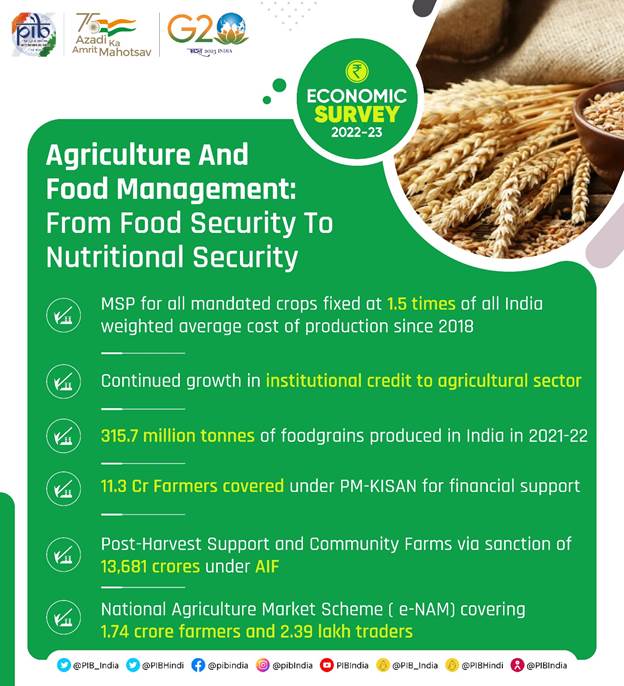
Mission for Integrated Development of Horticulture (MIDH)

The Survey describes, Horticulture as a “high growth area” and “a source of buoyant growth and improved resilience for farmer”. According to third advance estimates (2021-22), a record production of 342.3 million tonnes in an area of 28.0 million hectares was achieved. The Government has identified 55 horticulture clusters, of which 12 have been selected for the Cluster Development Programme (CDP) pilot phase. MIDH is designed to leverage the geographical specialisation of horticulture clusters, promote integrated and market-led development of pre-production, production and post-harvest activities across the entire supply chain.

Animal Husbandry, Dairying and Fisheries

The allied sectors of Indian agriculture - livestock, forestry & logging and fishing & aquaculture are gradually becoming sectors of robust growth and a potential source of better farm incomes says the Survey.
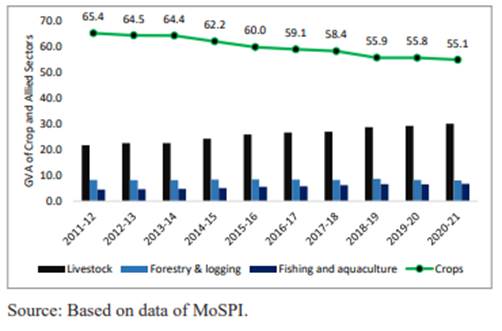
The livestock sector grew at a CAGR of 7.9 per cent during 2014-15 to 2020-21 (at constant prices), and its contribution to total agriculture GVA (at constant prices) has increased from 24.3 per cent in 2014-15 to 30.1 per cent in 2020-21. Similarly, the annual average growth rate of the fisheries sector has been about 7 per cent since 2016-17 and has a share of about 6.7 per cent in the total agricultural GVA. The dairy sector which employs more than eight crore farmers directly is critical along with products like eggs and meat. India ranks first in milk production in the world, it ranks third in egg production and eighth in meat production in the world points the Survey.

Cognisant of the importance of the allied sectors, the Government has made multiple interventions to enhance the infrastructure, improve productivity and disease control. Under, Animal Husbandry Infrastructure Development Fund, 116 projects have been approved with total cost of ₹3,731.4 crore. The scheme was launched with a total allocation of ₹15,000 crore. While the National Livestock Mission lays emphasis on breed development and entrepreneurship development, the Livestock Health & Disease Control Scheme is being implemented to prevent control and contain animal diseases of economic and zoonotic importance and the National Animal Disease Control Programme is being implemented to control Foot & Mouth Disease and Brucellosis.

Pradhan Mantri Matsya Sampada Yojana (PMMSY), with a total outlay of ₹20,050 crore. PMMSY marks the highest-ever investment in the fisheries sector in India, to be implemented over five years from FY21 to FY25 across the country to drive sustainable and responsible development of the fisheries sector while ensuring socio-economic development of the fishers, fish farmers and fish workers. Under a dedicated Fisheries and Aquaculture Infrastructure Development Fund (FIDF), proposals to the tune of ₹4,923.9 crore have been approved and have benefitted over 9.4 lakh persons, through direct and indirect employment, in fishing and allied activities as on 17th October 2022.

Food Security

The Survey describes that the food management programme in India comprises procurement of food grains from farmers at remunerative prices, distribution of food grains to consumers, particularly the vulnerable sections of society, at affordable prices and maintenance of food buffer stock for food security and price stability. The Government in a recent decision has decided to provide free foodgrains to about 81.35 crore beneficiaries under the National Food Security Act (NFSA), 2013 for one year from 1st January 2023. Further, to remove the financial burden of the poor, the government will spend more than ₹2 lakh crore in this period on food subsidies under NFSA and other welfare schemes says the Survey. During Kharif Marketing Season (KMS) 2021-22, 581.7 lakh metric tons (LMT) of Rice was procured against an estimated target of 532.7 LMT. In the current year, KMS 2022-23, a total of 355 LMT of rice has been procured up to 31 December 2022.
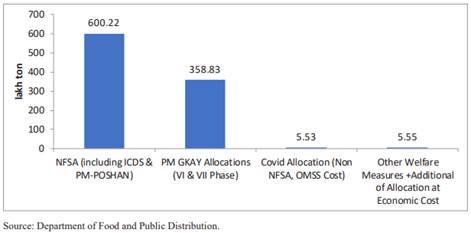
Under the PM Garib Kalyan Anna Yojana, the Government allocated about 1,118 LMT foodgrains to the States/UTs to ease the hardships faced by the poor during the COVID-19 pandemic. To further ease the process of access to food, the Government launched a citizen-centric and technology-driven scheme in 2019 called the One Nation One Ration Card (ONORC) scheme. The ONORC system enables intra-State and inter-State portability of ration cards. Presently, the national/inter-State portability is enabled in all 36 States/UT, covering 100 per cent of the total NFSA population.

International Year of Millets

The United Nations General Assembly, in its 75th session during March 2021, declared 2023 the International Year of Millets (IYM). India produces more than 50.9 million tonnes (as per fourth advance estimate) of millet which accounts for 80 per cent of Asia’s and 20 per cent of global production. The global average yield is 1229 kg/ha, whereas India has a higher average yield of 1239 kg/ha. Given the nutritional value of the millets, the Government notified Millets as Nutri-cereals in April 2018. Under the National Food Security Mission (NFSM), millets have been introduced to provide nutritional support. A sub-mission on Nutri-cereals is being implemented since 2018-19 in 212 districts of 14 States. India has more than 500 start-ups working in the millet value chains.

Food Processing Sector

Over the last five years ending FY21, the food processing industries sector has been growing at an average annual growth rate of around 8.3 per cent. The food processing sector is of enormous significance for India's development because of the strong connections and interactions it promotes between industry and agriculture. The value of agri-food exports, including processed food exports, was about 10.9 per cent of India's total exports during 2021-22 points the Survey.

Recognising the abundant potential of the sector, the Government has been at the forefront with various interventions aimed at the development of food processing in the country. Through the component schemes of Pradhan Mantri Kisan SAMPADA Yojana (PMKSY), for the overall growth and development of the food processing sector, 677 projects have been completed till 31 December 2022. Further, under the Prime Minister's Formalisation of Micro Food Processing Enterprises (PMFME) Scheme to enhance the competitiveness of individual micro-enterprises in the unorganised segment and promote the formalisation of this sector, as of 31 December 2022, 15,095 loans of ₹1402.6 crore were sanctioned. The scheme adopts One District, One product (ODOP) approach to reap the benefit of scale in procuring inputs, using shared services and marketing products. So far, 713 Districts with 137 unique products were approved under the ODOP in 35 States/ UTs. The Production Linked Incentive Scheme for Food Processing Industry (PLISFPI), launched in March 2022, has the specific mandate to incentivise investments to create global food champions. Sectors with high growth potential, like marine products, processed fruits & vegetables, and ‘Ready to Eat/ Ready to Cook’ products, are covered for support points the Survey.

Agriculture Infrastructure Fund (AIF)

The NITI Aayog Strategy for New India identifies the lack of adequate and efficient cold chain infrastructure as a critical supply-side bottleneck that leads to massive post-harvest losses (mostly of perishables) estimated at ₹92,561 crore annually. To tackle this and unlock the growth potential of the agriculture and allied sector, the Government introduced AIF. It is a financing facility operational from the year 2020-21 to 2032-33 for the creation of post-harvest management infrastructure and community farm assets, with benefits including 3 per cent interest subvention and credit guarantee support. Since its inception, an amount of ₹13,681 crore has been sanctioned for agriculture infrastructure in the country, covering more than 18,133 projects. These include 8,076 warehouses, 2,788 primary processing units, 1,860 custom hiring centres, 937 sorting & grading units, 696 cold store projects, 163 assaying units and around 3613 other kinds of post-harvest management projects and community farming assets.
National Agriculture Market (e-NAM)

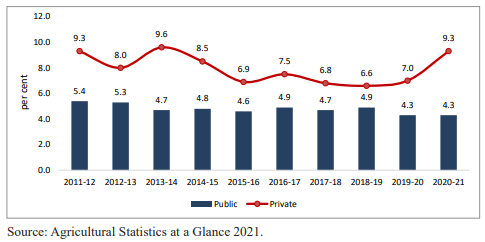
As on 31 December 2022, more than 1.7 crore farmers and 2.3 lakh traders have been registered on e-NAM portal. The scheme was launched to create an online transparent, competitive bidding system to ensure farmers get remunerative prices for their produce Under the e-NAM Scheme, the Government provides free software and assistance of ₹75 lakh per APMC mandi for related hardware, including quality assaying equipment and the creation of infrastructure like cleaning, grading, sorting, packaging, compost unit, etc.

The Survey observes that the performance of the agriculture sector remains critical to growth and employment in the country. Investment in the sector must be encouraged through an affordable, timely and inclusive approach to credit delivery. A focus on the horticulture sector and the thrust towards allied activities have diversified farmers’ income making them more resilient to weather shocks. All these initiatives have led to sustainable and inclusive development of the sector.

Topics

Acts Income Tax