Loading...

Top
Help
×

By creating an account you can:

Logo TaxTMI
Call Us / Help / Feedback

Contact Us At :

E-mail: [email protected]

Call / WhatsApp at: +91 99117 96707

For more information, Check Contact Us

FAQs :

To know Frequently Asked Questions, Check FAQs

Most Asked Video Tutorials :

For more tutorials, Check Video Tutorials

Submit Feedback/Suggestion :

Email :
Please provide your email address so we can follow up on your feedback.
Category :
Description :
Min 15 characters 0/2000
Make Most of Text Search
  1. Checkout this video tutorial: How to search effectively on TaxTMI.
  2. Put words in double quotes for exact word search, eg: "income tax"
  3. Avoid noise words such as : 'and, of, the, a'
  4. Sort by Relevance to get the most relevant document.
  5. Press Enter to add multiple terms/multiple phrases, and then click on Search to Search.
  6. Text Search
  7. The system will try to fetch results that contains ALL your words.
  8. Once you add keywords, you'll see a new 'Search In' filter that makes your results even more precise.
  9. Text Search
Add to...
You have not created any category. Kindly create one to bookmark this item!
Create New Category
Hide
Title :
Description :
❮❮ Hide
Default View
Expand ❯❯
Close ✕
🔎 News - Adv. Search
TEXT SEARCH:

Press 'Enter' to add multiple search terms. Rules for Better Search

Search In:
Main Text + AI Text
  • Main Text
  • Main Text + AI Text
  • AI Text
Category: ?
Categorized by AI
---- All Categories ----
  • ---- All Categories ----
  • Income Tax
  • GST
  • Customs, DGFT & SEZ
  • FEMA & RBI
  • Corp. Laws, SEBI & IBC
  • PMLA, Black Money & ED
  • Budget
  • News and Press Release
  • PTI News
Month:
---- All Months ----
  • ---- All Months ----
  • January
  • February
  • March
  • April
  • May
  • June
  • July
  • August
  • September
  • October
  • November
  • December
Year:
---- All Years ----
  • ---- All Years ----
  • 2026
  • 2025
  • 2024
  • 2023
  • 2022
  • 2021
  • 2020
  • 2019
  • 2018
  • 2017
  • 2016
  • 2015
  • 2014
  • 2013
  • 2012
  • 2011
Sort By: ?
In Sort By 'Default', exact matches for text search are shown at the top, followed by the remaining results in their regular order.
Relevance Default Date
    Why Most People Choose the Wrong Savings Account And How Not to Be One of Them
    RBI has proactively helped UCBs; cooperatives should look at regulator differently: Shah
    Ministry of Agriculture, Food and Rural Affairs and aT Host '2026 K-Food Fair in New Delhi, India'
    No compromise on tackling illegal immigrants' issue: Minister Priyank Kharge
    Technology, transparency key for urban cooperative banks to stay competitive: Shah
    Paul Merchants Gets RBI Approval for Perpetual AD Category-II Licence Under Revised FEMA Framework
    IEPFA Organises Stakeholder Engagement with Nodal Officers of Companies on Integrated IEPFA Portal 2.0
    Rupee settles with 5 paise gain at 95.17 against US dollar
    India weathered Hormuz disruption without fuel shortages: Puri
    RBI invites public comments on the draft Directions on ‘Credit Valuation Adjustment (CVA) Framework’
    RBI invites comments on the draft “Reserve Bank of India (Commercial Banks – Prudential Norms on Capital Adequacy) Eleventh Amendment Directions, ...
    87 Proposals Received under BHAVYA Scheme during First Round of Phase-I
    India successfully concludes the 16th BRICS Trade Ministers' Meeting in Jaipur under its BRICS Chairship 2026
    GeM Completes a Decade of Transforming Public Procurement with Cumulative GMV Exceeding ₹20 Lakh Crore
    NEWS HIGHLIGHTS
    India's forex kitty swells by USD 10.5 bn to USD 692.87 bn
    Rs 5,000 cr credited to 6.22 lakh Maharashtra farmers so far under loan waiver scheme: Fadnavis
    SBI Life and J&K Bank partner to bring comprehensive life insurance solutions closer to families across India
    DRI intensifies vigil along India's North-Eastern Frontier
    Vijayan slams Kerala govt's move to end doorstep pension delivery through cooperative banks
❯❯
Maximize Maximize Maximize
0 / 200
Expand Note
Add to Folder

No Folders have been created

+

Are you sure you want to delete "My most important" ?

NOTE:

News
Showing Results for :
Reset Filters
Results Found:
Show All Summaries Hide All Summaries
August 8, 2026
Show AI Summary
Savings account selection requires comparison of effective interest, fees, digital service, access, and individual banking needs.
Savings-account selection should compare effective interest returns under slab-based rates, recurring operating charges and the customer's actual banking needs. Net value depends not only on advertised rates but also on relevant minimum-balance, card, ATM, alert and transfer fees. Digital reliability, customer support, branch availability and ATM access should be assessed according to the customer's average balance, cash use, transfer frequency, travel patterns and need for in-person assistance. The suitable account is one that matches real banking behaviour.
August 8, 2026
Show AI Summary
Urban cooperative bank regulation promotes licensing, governance, compliance support and cybersecurity measures to strengthen stability and depositor confidence.
Urban cooperative banks are encouraged to recognise regulatory support through liberalised branch opening, doorstep banking, demand drafts, life certificates, dedicated regulatory coordination, enhanced gold-loan limits, one-time settlements and progress towards on-tap licensing. Sound governance is material to sectoral stability, while small-borrower lending is presented as a comparatively safe lending segment. The umbrella body can support member banks through technical expertise, compliance assistance, cybersecurity solutions and participation in a security operations centre to strengthen depositor confidence.
August 8, 2026
Show AI Summary
Korean food export promotion combines buyer consultations, regulatory guidance and consumer experiences to support entry into Indian and South Asian markets.
Korean food export promotion in India and South Asia combined business consultations with consumer-facing activities. Individual meetings connected Korean exporters with regional buyers and generated memoranda of understanding for products including frozen gimbap, ginseng wine and kombucha. Exporters received on-site guidance concerning non-tariff barriers, including food import customs clearance and certification requirements. Preparatory online sessions addressed import procedures, regulatory matters and consumer trends, while consumer events promoted Korean food through tasting, retail and experiential activities.
August 8, 2026
Show AI Summary
Illegal immigration enforcement prioritises dismantling entry, documentation and employment networks while requiring citizens to report information through police channels.
Illegal immigration enforcement involves continuous identification and verification operations, coordination with relevant officials, and confidential investigation of networks facilitating entry, identity documentation, accommodation and employment. Enquiries extend to intermediaries, contractors, Aadhaar procurement and verification practices, rather than focusing only on apprehended individuals. Citizen vigilantism, moral policing and social-media targeting of suspected migrants are discouraged because they may compromise investigations; information should instead be given through proper police channels.
August 8, 2026
Show AI Summary
Technology, transparency and governance strengthen urban cooperative banks through modern customer services, depositor protection and cooperative-sector support.
Technology adoption, transparency, sound governance and modern customer services are identified as necessary for urban cooperative banks to remain competitive. Banks are encouraged to join the sector's umbrella organisation and self-regulatory body, which provides capital, information-technology infrastructure and liquidity support. Protection of depositors' money remains a regulatory responsibility, while banks are expected to improve governance, train staff, adopt technology and enhance customer-centric services. Customer prosperity and reduced perception gaps between the central bank and urban cooperative banks are emphasised as measures to strengthen the sector.
August 8, 2026
Show AI Summary
Authorised Dealer Category-II licensing expands permissible FEMA current account and foreign trade transaction services for cross-border payment customers.
An Authorised Dealer Category-II approval under the Foreign Exchange Management (Authorised Persons) Regulations, 2026 enables Paul Merchants to undertake additional permissible non-trade current account transactions under FEMA, excluding gifts and donations, and foreign trade transactions within the applicable per-transaction limit. The approval supports foreign exchange and cross-border payment services, including overseas remittances for education, medical treatment, travel, and conference or event participation.
August 8, 2026
Show AI Summary
Integrated investor claim portal modernisation advances digital KYC, streamlined verification, stakeholder-informed safeguards, and efficient investor claim settlement services.
Integrated IEPFA Portal 2.0 is proposed to modernise investor claim processing through digital KYC, pre-filled Form IEPF-5, entitlement search, and a simplified e-Verification Report filing workflow. Stakeholder feedback included Aadhaar eKYC address validation, KYC for authorised representatives, entitlement-letter validation checks, bulk DSC and eSign functionality, integration of approved IEPF Form-4 data, lower-value share valuation using NSE and BSE data, and alerts for frequent address changes to prevent fraud.
August 7, 2026
Show AI Summary
Foreign capital inflows supported the rupee despite geopolitical uncertainty, oil-price pressures, and volatile global market sentiment.
Foreign capital inflows supported a marginal strengthening of the rupee against the US dollar despite global risk aversion arising from uncertainty surrounding negotiations affecting the Strait of Hormuz. Higher crude oil prices and weak domestic equity sentiment remained relevant pressures. Near-term currency movement was expected to depend on developments in the negotiations, weekend decisions, US employment data, the dollar index, crude oil prices, and the reported increase in foreign exchange reserves.
August 7, 2026
Show AI Summary
Energy security through diversified sourcing protected fuel supplies during Hormuz disruption and supports domestic exploration and alternative fuels.
Energy security measures based on diversified crude oil and LPG sourcing, expanded infrastructure, increased domestic LPG production and alternative fuels were presented as maintaining fuel availability during disruption of shipping through the Strait of Hormuz. Domestic resilience is also linked to support for private deep-water oil and gas exploration, opening offshore acreage, and expansion of compressed biogas and ethanol blending. Ethanol-blended petrol testing identified limited contamination instances rather than a systemic issue, while excise duty reductions were described as cushioning consumers against global fuel-price volatility.
August 7, 2026
Show AI Summary
Credit valuation adjustment framework revises derivative capital requirements through flexible basic approaches, hedge recognition, and risk-sensitive counterparty treatment.
Credit Valuation Adjustment framework revisions align CVA capital treatment with final Basel III standards. Eligible banks may use the full or reduced basic approach, while banks with an insignificant volume of non-centrally cleared derivatives may calculate their CVA capital charge at 100 per cent of the counterparty credit risk capital charge. The draft also clarifies CVA hedge recognition, introduces risk weights sensitive to sector and credit quality, and separates systematic and idiosyncratic CVA risk in the full basic approach.
August 7, 2026
Show AI Summary
Leverage ratio framework amendments propose Basel-aligned capital adequacy standards, with public feedback invited on the draft directions.
Proposed amendments to the leverage ratio framework would revise Chapter VII of the 2025 Commercial Banks Prudential Norms on Capital Adequacy Directions to implement the Basel Committee's Leverage Ratio 2017 Standard. Public comments and feedback on the draft Eleventh Amendment Directions, 2026, are invited until August 28, 2026, through the designated online platform, postal submission, or email.
August 7, 2026
Show AI Summary
BHAVYA Scheme project selection uses challenge-based evaluation of infrastructure, industrial ecosystems, and policy enablers under prescribed eligibility criteria.
BHAVYA Scheme Phase-I proposals submitted by State and Union Territory governments will be evaluated and scored under prescribed eligibility and evaluation criteria. Challenge-based project selection considers connectivity and site suitability, quality of core, value-added and social infrastructure in the detailed project report, and the industrial ecosystem and policy enablers. The Scheme guidelines provide for completion of the first-phase selection process within one year from notification.
August 7, 2026
Show AI Summary
Multilateral trade cooperation preserves developing economies' policy space while advancing MSME finance, diversified value chains and digital services.
BRICS ministers adopted measures supporting a development-centred multilateral trading system with the World Trade Organization at its core, preservation of Special and Differential Treatment, binding two-tier dispute settlement, and developing economies' policy space for food security and public stockholding. MSME measures include study of an invoice discounting mechanism and credit-assessment principles focused on cash flow rather than collateral. Value-chain measures provide for a GVC Action Plan, technical cooperation, Special Economic Zone cooperation and digitised trade documents, alongside principles for trusted cross-border digitally delivered services.
August 7, 2026
Show AI Summary
Digital public procurement promotes transparent sourcing, reduced seller charges, competition monitoring and evidence-based spending oversight through an integrated marketplace.
Government e-Marketplace digitises public procurement through a unified platform promoting transparency, efficiency, good governance and wider supplier participation. Seller-facing measures include reduced transaction charges, exemption of smaller orders, a cap on maximum transaction fees and reduced vendor assessment fees. The platform uses Artificial Intelligence and Machine Learning tools to identify suspected cartelisation, collusion and order splitting, while its digital transactional trail supports expenditure monitoring, identification of inefficiencies and evidence-based policy interventions.
August 7, 2026
Show AI Summary
Criminal justice, extremist-material regulation and administrative schemes feature in reports on prosecutions, demolition practices, loan waivers and fuel policy.
Criminal justice reports cover bail and an expedited trial in an assault prosecution, arrest for allegedly sheltering an accused, allegations of rape and murder of a minor, and claimed irregularities in a police recruitment examination. Regulatory developments include a ban on extremist literature associated with proscribed organisations and judicial disapproval of coercive demolition. Administrative coverage includes farmer loan-waiver transfers following Aadhaar authentication and debate over the E20 fuel-blending programme.
August 7, 2026
Show AI Summary
Foreign exchange reserves rose as foreign currency assets, gold holdings, Special Drawing Rights and IMF reserve position increased.
India's foreign exchange reserves increased during the week ended July 31, principally because of higher foreign currency assets and gold reserves. Foreign currency assets include US dollar valuation effects arising from movements in currencies such as the euro, pound and yen. Special Drawing Rights and India's reserve position with the International Monetary Fund also increased. The movement followed measures to attract foreign exchange inflows, including an FCNR(B) measure, after earlier reserve declines associated with rupee pressure and dollar sales for foreign exchange market intervention.
August 7, 2026
Show AI Summary
Farm loan waiver eligibility depends on verified beneficiary status and Aadhaar authentication for direct credit of eligible crop-loan relief.
The farm loan waiver scheme covers eligible short-term crop loans within the prescribed ceiling and eligibility period. Waiver amounts are credited to verified bank accounts after field verification and completion of Aadhaar authentication. Aadhaar authentication is the operative condition for automatic processing of benefits, while eligibility rules and technical conditions have raised concerns about exclusion of distressed farmers.
August 7, 2026
Show AI Summary
Corporate agency distribution expands access to life insurance products, supporting insurance awareness, financial inclusion and long-term household financial protection.
A corporate agency arrangement enables J&K Bank to distribute SBI Life Insurance protection, savings, retirement and child-oriented life insurance plans through its branch network. The partnership aims to improve insurance access, awareness, financial literacy and long-term financial planning for households, particularly in Jammu & Kashmir and Ladakh. It is intended to expand insurance penetration, strengthen household financial protection and support financial inclusion in line with the IRDAI vision of "Insurance for All by 2047".
August 7, 2026
Show AI Summary
Cross-border smuggling controls target narcotics, poppy seeds and areca nuts entering through the Indo-Myanmar border region.
Cross-border smuggling enforcement targeted methamphetamine, foreign-origin poppy seeds and areca nuts allegedly brought from Myanmar. Methamphetamine concealed in an ambulance was seized under the NDPS Act, 1985. Poppy seeds and areca nuts recovered in separate operations were seized under the Customs Act, 1962. Poppy-seed imports are restricted to designated countries and require registration to ensure traceability and prevent illicit produce entering legitimate supply chains. The enforcement action addresses circumvention of customs controls and regulated import requirements.
August 7, 2026
Show AI Summary
Direct benefit transfer for welfare pensions replaces cooperative-bank doorstep delivery, while retaining limited home service for excluded beneficiaries.
Direct Benefit Transfer for social security and welfare pensions is to be made through Aadhaar-linked bank accounts, replacing cooperative-bank doorstep delivery. Home delivery remains available for bedridden persons and others who cannot be excluded. The change is associated with delays in remitting undistributed amounts, record-update failures, reconciliation issues, duplicate payments, and incomplete Aadhaar-based payment implementation. Concerns have been raised that mandatory bank-account credit may disadvantage beneficiaries dependent on doorstep delivery.

News

Back

All News

Showing Results for :
Reset Filters
No Records Found

News

Back

All News

Showing Results for : Reset Filters

ECONOMIC SURVEY HIGHLIGHTS THRUST ON RURAL DEVELOPMENT

January 31, 2023

Contents
Summary
Note

Note

-

Bookmark

Print

Print

ECONOMIC SURVEY HIGHLIGHTS THRUST ON RURAL DEVELOPMENT

AIMS TO IMPROVE QUALITY OF LIFE IN RURAL AREAS FOR MORE EQUITABLE AND INCLUSIVE DEVELOPMENT

ASSETS CREATED UNDER MGNREGS POSITIVELY IMPACTING AGRICULTURAL PRODUCTIVITY AND HOUSEHOLD INCOME; REDUCING MIGRATION AND INDEBTEDNESS

SIGNIFICANT RISE IN RURAL FEMALE LABOUR FORCE PARTICIPATION RATE FROM 19.7 PERCENT (2018-19) TO 27.7 PERCENT (2020-21)

The thrust of the Government on rural development is discernable from the emphasis it gets in the Economic Survey 2022-23 tabled by the Union Minister for Finance and Corporate Affairs Smt Nirmala Sitharaman in Parliament today.

The Survey notes that 65 per cent (2021 data) of the country’s population lives in the rural areas and 47 per cent of the population is dependent on agriculture for livelihood. Thus, the focus of the government on rural development is imperative. The Government’s emphasis has been on improving the quality of life in rural areas to ensure more equitable and inclusive development. The aim of engagement of the government in the rural economy has been “transforming lives and livelihoods through proactive socio-economic inclusion, integration, and empowerment of rural India.”

The Survey refers to the National Family Health Survey data for 2019-21 which illustrates a significant improvement vis-à-vis 2015-16 in an array of indicators concerning the quality of rural lives, including, inter alia, access to electricity, presence of improved drinking water sources, coverage under health insurance schemes, etc. Women empowerment has also gained momentum, with visible progress in female participation in household decision-making, owning bank accounts, and use of mobile phones. Most of the indicators concerning the health of rural women and children have improved. These outcome-oriented statistics establish tangible medium-run progress in rural living standards, aided by the policy focus on basic amenities and efficient programme implementation.
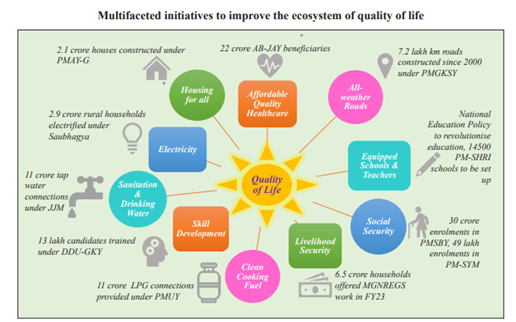
 Source: Economic Survey 2022-23

The Survey notes a multi-pronged approach to raise the rural incomes and quality of life through different schemes.  

1. Livelihood, Skill Development

  • The Deendayal Antyodaya Yojana-National Rural Livelihood Mission (DAY-NRLM), aims to enable economically weak households to access gainful self-employment and skilled wage employment opportunities resulting in sustainable and diversified livelihood options for them. This is one of the world’s largest initiatives to improve the livelihoods of the poor. The cornerstone of the Mission is its ‘community-driven’ approach which has provided a huge platform in the form of community institutions for women empowerment.

Rural women are at the core of the program which is extensively focused on their socio-economic empowerment. Nearly 4 lakh Self Help Group (SHG) members have been trained as Community Resource Persons (CRPs) (viz. Pashu Sakhi, Krishi Sakhi, Bank Sakhi, Bima Sakhi, Poshan Sakhi etc.) help in the implementation of the Mission at the ground level. The Mission has mobilised a total of 8.7 crore women from poor and vulnerable communities into 81 lakh SHGs.

  • Under Mahatma Gandhi National Rural Employment Guarantee Scheme (MGNREGS) a total of 5.6 crore households availed employment and a total of 225.8 crore person-days employment has been generated under the Scheme (until 6 January 2023). The number of works done under MGNREGS has steadily increased over the years, with 85 lakh completed works in FY22 and 70.6 lakh completed works so far in FY23 (as on 9 January 2023). These works include creating household assets such as animal sheds, farm ponds, dug wells, horticulture plantations, vermicomposting pits etc., in which the beneficiary gets both labour and material costs as per standard rates. Empirically, within a short span of 2-3 years, these assets have been observed to have a significant positive impact on agricultural productivity, production-related expenditure, and income per household, along with a negative association with migration and fall in indebtedness, especially from non-institutional sources. This, the Survey notes has long-term implications for aiding income diversification and infusing resilience into rural livelihoods. Meanwhile, the Economic Survey also observes a Year-on-Year (YoY) decline in monthly demand for Mahatma Gandhi National Rural Employment Guarantee Scheme (MGNREGS) work and this the Survey notes is emanating from normalisation of the rural economy due to strong agricultural growth and a swift bounce-back from Covid-19.
  • Skill development has also been one of focus areas for the Government. Under the Deen Dayal Upadhyaya Grameen Kaushalya Yojana (DDU-GKY), until 30 November 2022, a total of 13,06,851 candidates have been trained of which 7,89,685 have got job placements.

2. Women Empowerment

  • The transformative potential of Self Help Groups (SHGs), exemplified through their key role in the on-ground response to Covid-19, has served as the fulcrum of rural development through women empowerment. India has around 1.2 crore SHGs, 88 per cent being all-women SHGs. The SHG Bank Linkage Project (SHG-BLP), launched in 1992, has blossomed into the world’s largest microfinance project. The SHG-BLP covers 14.2 crore families through 119 lakh SHGs with savings deposits of Rs. 47,240.5 crore and 67 lakh groups with collateral-free loans outstanding of Rs. 1,51,051.3 crore, as on 31 March 2022. The number of SHGs credit linked has grown at a CAGR of 10.8 per cent during the last ten years (FY13 to FY22). Notably, SHGs’ bank repayment is more than 96 per cent, underscoring their credit discipline and reliability.

Women’s economic SHGs have a positive, statistically significant effect on women’s economic, social, and political empowerment, with positive effects on empowerment achieved through various pathways such as familiarity with handling money, financial decision-making, improved social networks, asset ownership and livelihood diversification.

According to a recent assessment of DAY-National Rural Livelihood Mission, both participants and functionaries perceived high impacts of the programme in areas related to women empowerment, self-esteem enhancement, personality development, reduced social evils; and additionally, medium impacts in terms of better education, higher participation in village institutions and better access to government schemes.

During Covid, SHGs were in action mobilising women to unite, transcend their group identity and collectively contribute to crisis management. They emerged as pivotal players in crisis management, leading from the front in - producing masks, sanitisers, and protective gear, creating awareness about the pandemic, delivering essential goods, running community kitchens, supporting farm livelihoods etc. The production of masks by SHGs has been a noteworthy contribution, enabling access to and use of masks by communities in remote rural areas and providing vital protection against the Covid-19 virus. As on 4 January 2023, more than 16.9 crore masks were produced by SHGs under DAY-NRLM.

  • Rural women are increasingly participating in economic activity. The survey notes the noticeable rise in Rural Female Labour Force Participation Rate (FLFPR) from 19.7 per cent in 2018-19 to 27.7 per cent in 2020-21. The survey calls this upturn in the FLFPR as a positive development on the gender aspect of employment, which could be attributable to rising rural amenities freeing up women’s time, and high agricultural growth over the years. Meanwhile the survey also observes that India’s female LFPR is likely to be underestimated, with reforms in survey design and content required to capture the reality of working females more accurately.

3. Housing For All

The Government rolled out “Housing for All by 2022” to provide shelter with dignity for each and every one. With this target, the Pradhan Mantri Awaas Yojana –Gramin (PMAY-G) was launched in November 2016 with the aim of providing around 3 crore pucca houses with basic amenities to all eligible houseless households living in kutcha and dilapidated houses in rural areas by 2024. Under the scheme, landless beneficiaries are accorded the highest priority in the allotment of houses. A total of 2.7 crore houses have been sanctioned and 2.1 crore houses have been completed by 6 January 2023 under the Scheme. Against the total target of completion of 52.8 lakh houses in FY23, 32.4 lakh houses have been completed.

4. Water and Sanitation

  • On the 73rd Independence Day, 15 August 2019, the Jal Jeevan Mission (JJM) was announced, to be implemented in partnership with States, to provide by 2024, tap water connection to every rural household and public institutions in villages like schools, Anganwadi centres, ashram shalas (tribal residential schools), health centres etc. At the time of the rollout of the JJM in August 2019, about 3.2 crore (17 per cent) households out of the total of 18.9 crore rural households had a tap water supply. Since the launch of the Mission, as of 18 January 2023, of 19.4 crore rural households, 11.0 crore households are getting tap water supply in their homes.
  • Mission Amrit Sarovar aimed at developing and rejuvenating of 75 water bodies in each district of the country during the Amrit Varsh - 75th year of independence. The mission was launched by the Government on National Panchayati Raj Day in 2022. Against an initial target of 50,000 Amrit Sarovars, a total of 93,291 Amrit Sarovar sites were identified, works commenced on more than 54,047 sites and out of these sites were works began, a total of 24,071 Amrit Sarovars have been constructed. The mission helped develop 32 crore cubic meters of water holding capacity and created a total carbon sequestration potential of 1.04,818 tonnes of carbon per year. The mission transformed into a mass movement with Shram Dhaan from the community, where Freedom Fighters, Padma Awardees and elder citizens of the area also participated along with the establishment of Water User Groups. This coupled with the launch of Jaldoot App that helps the Government document and monitor ground water resources and local water level would make water scarcity a thing of the past.
  • Phase II of the Swachh Bharat Mission (G) is under implementation from FY21 to FY25. It aims to transform all villages into ODF Plus with focus to sustain ODF status of villages and covering all the villages with Solid and Liquid Waste management systems. India achieved ODF status in all villages in the country on 2nd October 2019. Now, about 1,24,099 villages have been declared as ODF Plus till November 2022 under the mission. Andaman & Nicobar Islands have been declared as the first ‘Swachh, Sujal Pradesh’ with all its villages being declared as ODF plus.

5. Smoke Free Rural Homes

The release of 9.5 crore LPG connections under the Pradhan Mantri Ujjwala Yojana, has helped in increasing the LPG coverage from 62 per cent (on 1 May 2016) to 99.8 per cent (on 1 April 2021). The Union Budget for FY22, made a provision for the release of an additional one crore LPG connections under the PMUY scheme, i.e., Ujjwala 2.0 - this scheme will offer deposit-free LPG connection, first refill and hot plate free of cost to beneficiaries, and a simplified enrolment procedure. In this phase, a special facility has been given to migrant families. Under this Ujjwala 2.0 scheme, 1.6 crore connections have been released until 24 November 2022.

6. Rural Infrastructure

  • Since its inception, the Pradhan Mantri Gram Sadak Yojana helped create 1,73,775 number of roads measuring 7,23,893 km and 7,789 Long Span Bridges(LSBs) against the sanctioned, 1,84,984 roads measuring 8,01,838 km and 10,383 Long Span Bridges (LSBs) under all its verticals/interventions points the survey. The survey observes that various independent impact evaluation studies were carried out on PMGSY, which have concluded that the scheme has had a positive impact on agriculture, health, education, urbanization, employment generation etc.
  • SAUBHAGYA- Pradhan Mantri Sahaj Bijli Har Ghar Yojana, was launched to achieve universal household electrification by providing electricity connections to all willing un-electrified households in rural areas and all willing poor households in urban areas in the country. The connections were given for free to economically poor households and for others, Rs 500 was charged after the release of the connection in 10 instalments. The Saubhagya scheme has been successfully completed and closed on 31st March 2022. Deendayal Upadhyaya Gram Jyoti Yojana (DDUGJY), envisaged the creation of basic electricity infrastructure in villages/habitations, strengthening & augmentation of existing infrastructure, and metering of existing feeders/distribution transformers/consumers to improve the quality and reliability of power supply in rural areas. A total of 2.9 crore households have been electrified since the launch of the Saubhagya period in October 2017 under various schemes viz (Saubhgaya, DDUGJY, etc.).

Topics

Acts Income Tax
