Loading...

Top
Help
×

By creating an account you can:

Logo TaxTMI
Call Us / Help / Feedback

Contact Us At :

E-mail: [email protected]

Call / WhatsApp at: +91 99117 96707

For more information, Check Contact Us

FAQs :

To know Frequently Asked Questions, Check FAQs

Most Asked Video Tutorials :

For more tutorials, Check Video Tutorials

Submit Feedback/Suggestion :

Email :
Please provide your email address so we can follow up on your feedback.
Category :
Description :
Min 15 characters 0/2000
Make Most of Text Search
  1. Checkout this video tutorial: How to search effectively on TaxTMI.
  2. Put words in double quotes for exact word search, eg: "income tax"
  3. Avoid noise words such as : 'and, of, the, a'
  4. Sort by Relevance to get the most relevant document.
  5. Press Enter to add multiple terms/multiple phrases, and then click on Search to Search.
  6. Text Search
  7. The system will try to fetch results that contains ALL your words.
  8. Once you add keywords, you'll see a new 'Search In' filter that makes your results even more precise.
  9. Text Search
Add to...
You have not created any category. Kindly create one to bookmark this item!
Create New Category
Hide
Title :
Description :
❮❮ Hide
Default View
Expand ❯❯
Close ✕
🔎 News - Adv. Search
TEXT SEARCH:

Press 'Enter' to add multiple search terms. Rules for Better Search

Search In:
Main Text + AI Text
  • Main Text
  • Main Text + AI Text
  • AI Text
Category: ?
Categorized by AI
---- All Categories ----
  • ---- All Categories ----
  • Income Tax
  • GST
  • Customs, DGFT & SEZ
  • FEMA & RBI
  • Corp. Laws, SEBI & IBC
  • PMLA, Black Money & ED
  • Budget
  • News and Press Release
  • PTI News
Month:
---- All Months ----
  • ---- All Months ----
  • January
  • February
  • March
  • April
  • May
  • June
  • July
  • August
  • September
  • October
  • November
  • December
Year:
---- All Years ----
  • ---- All Years ----
  • 2026
  • 2025
  • 2024
  • 2023
  • 2022
  • 2021
  • 2020
  • 2019
  • 2018
  • 2017
  • 2016
  • 2015
  • 2014
  • 2013
  • 2012
  • 2011
Sort By: ?
In Sort By 'Default', exact matches for text search are shown at the top, followed by the remaining results in their regular order.
Relevance Default Date
    TRAI directs use of 1601-series for service, transactional calls by utilities, logistics cos
    Nagaland tax revenue rises to Rs 1,597 crore in FY'26
    India's Russian crude imports hit record for second straight month
    Stolen phone of 88-year-old leads Delhi Police to bust interstate cyber-fraud syndicate; 9 held
    Rupee falls 11 paise to close at 95.28 against US dollar on firm crude oil prices
    Loan Utsav 2026: Bajaj Finance Personal Loan Now Comes with an Exclusive Reward Bundle for Eligible Customers
    Freedom to Spend Smarter: AU Small Finance Bank Credit Cards Bring Rewards, EMI Flexibility and Lounge Access to India''s Biggest Shopping Month
    Rupee falls 8 paise to 95.25 against US dollar in early trade
    APEDA Facilitates First-Ever Export of GI-tagged Mithila Makhana by Sea Route from Bihar to Australia
    Government signs strategic MoUs with key industry leaders and ecosystems to strengthen support to StartUps
    No Charges for UPI Users
    Competition Commission of India (CCI) hosts BRICS Heads of Competition Authorities 2026 meeting
    ICoAS fraternity reaffirms commitment to cost optimisation for Atmanirbhar Bharat on ICoAS day 2026
    Govt to introduce bill in Lok Sabha to broaden NCDC's mandate for co-operative sector growth
    AAP govt indulged in large-scale financial irregularities, caused losses to exchequer: Delhi minister
    ED files chargesheets in 2 PMLA cases against Anil Ambani Group companies, ex-executives
    RJD criticises UDF govt's move not to disburse pensions through cooperative banks
    Raymond Limited reports a healthy Q1 FY27 performance
    Why Most People Choose the Wrong Savings Account And How Not to Be One of Them
    RBI has proactively helped UCBs; cooperatives should look at regulator differently: Shah
❯❯
Maximize Maximize Maximize
0 / 200
Expand Note
Add to Folder

No Folders have been created

+

Are you sure you want to delete "My most important" ?

NOTE:

News
Showing Results for :
Reset Filters
Results Found:
Show All Summaries Hide All Summaries
August 10, 2026
Show AI Summary
Trusted service-call numbering requires verified utilities and logistics entities to use dedicated numbers exclusively for transactional and service communications.
The 1601-series is introduced for verified utilities, courier and logistics entities making service and transactional voice calls. Numbers must be allocated directly to eligible entities, not intermediaries or aggregators, following verification by telecom service providers and an undertaking of exclusive use. Promotional voice calls are prohibited on this series and remain associated with the 140-series. The framework separates these calls from the 1600-series reserved for regulated financial-sector and government-to-citizen communications, supporting consumer recognition of legitimate calls and reducing impersonation risks.
August 10, 2026
Show AI Summary
GST revenue collection drives tax growth while data scrutiny, taxpayer verification, and compliance capacity remain key administrative priorities.
GST constituted the principal component of tax revenue for the 2025-26 fiscal year. Tax administration faces staff shortages, information-technology upgrade needs, and increased workloads from taxpayer registrations and return filings. Compliance oversight requires GST data scrutiny, risk assessment, identification of unregistered taxpayers, tax-evasion detection, and field verification of high-risk taxpayers. Long-term revenue planning sets progressively higher collection targets through 2063.
August 10, 2026
Show AI Summary
Russian crude imports reshape India's refining trade as processed petroleum products reach sanctioning jurisdictions despite import restrictions.
Indian imports of Russian crude oil reached a second consecutive monthly record in July 2026, with Russian crude forming the dominant share of India's Russian fossil-fuel purchases and more than half of total crude imports. Higher receipts through smaller terminals offset reduced volumes at Paradip. Indian refineries processing Russian crude also exported refined petroleum products to sanctioning jurisdictions, including the European Union, Australia and the United States, despite the European Union prohibition on imports of oil products made from Russian crude.
August 10, 2026
Show AI Summary
Cyber-fraud through stolen phones allegedly used mule accounts, banking credentials and coordinated technical operations to divert victims' funds.
Investigation into unauthorised withdrawals after theft of a mobile phone uncovered an alleged interstate cyber-fraud network using stolen devices, linked banking credentials and mule bank accounts. The scheme allegedly involved phone theft, supply of accounts and banking instruments, and a technical operation that accessed victims' accounts and routed funds for withdrawal or transfer. Digital surveillance, transaction mapping, seized devices, victim data and transaction records are being examined to identify linked complaints and the extent of funds allegedly diverted.
August 10, 2026
Show AI Summary
Rupee depreciation reflected stronger dollar, elevated crude prices and geopolitical uncertainty, while portfolio inflows and equity gains provided support.
The rupee depreciated against the US dollar amid a stronger dollar, higher global crude oil prices and uncertainty surrounding West Asia-related negotiations. Concerns over crude oil's potential impact on the trade deficit weighed on the currency, while positive domestic equity markets and foreign portfolio investment inflows provided support. Market caution remained focused on forthcoming US inflation data, dollar-index movements and Brent crude prices. Foreign-exchange reserves increased during the reported period.
August 10, 2026
Show AI Summary
Collateral-free personal loans offer extended repayment flexibility, conditional reward benefits, and online application subject to eligibility and disbursal requirements.
Loan Utsav 2026 provides eligible Bajaj Finance Personal Loan applicants an exclusive reward bundle where the loan is successfully disbursed during the campaign period. The collateral-free facility supports personal expenses, offers repayment tenures from 12 to 108 months, and may enable lower monthly EMI obligations through a longer selected tenure. Interest rates depend on eligibility, credit assessment, financial profile and lending criteria. Online applications require personal and financial details and required documents, with disbursal for eligible applicants possible after verification and approval.
August 10, 2026
Show AI Summary
Credit card payment flexibility supports seasonal shopping and travel through eligible EMIs, rewards, tracking tools and conditional merchant benefits.
Credit-card spending features include conversion of eligible purchases into EMIs, selected no-cost EMI options, reward points, cashback, merchant discounts and payment flexibility. Travel-related benefits may include domestic airport lounge access, travel-booking discounts, fuel-surcharge waiver and anniversary-linked rewards. The AU 0101 application enables transaction tracking, balance and interest-rate monitoring, EMI conversion and bill-payment management. Features and offers are subject to change, customer eligibility, internal policies and partner-merchant terms.
August 10, 2026
Show AI Summary
Foreign-exchange market conditions weakened the rupee as stronger dollar and crude prices offset support from reserve growth and inflows.
Foreign-exchange market conditions saw the rupee weaken against the US dollar in early trading, influenced by a stronger dollar and higher global crude oil prices. Foreign institutional equity inflows and increased foreign-exchange reserves moderated pressure on the rupee. Market attention remained focused on developments in West Asia and the Reserve Bank of India, alongside movements in the dollar index, crude oil prices and domestic equity markets.
August 10, 2026
Show AI Summary
GI-tagged Mithila Makhana export facilitation expands sea-route market access while supporting quality compliance and farmer-linked value chains.
Export facilitation for GI-tagged Mithila Makhana enabled the first commercial sea-route shipment from Bihar to Australia. APEDA, in association with the Bihar agriculture department, supported market access, coordination, capacity building and stakeholder engagement. The export model is intended to improve farmer price realisation, require adherence to global quality standards, and strengthen growers, processors and exporters. A separate HS Code for Makhana has taken effect under the Finance Bill, 2025, supporting product-specific trade classification.
August 10, 2026
Show AI Summary
Startup ecosystem support expands through digital payments, cloud access, AI innovation, investment readiness, governance support and global market programmes.
DPIIT has entered into strategic MoUs to support DPIIT-recognised startups through payment infrastructure, entrepreneurship development, cloud technology, mobility innovation, investment readiness and global-market access. Eligible startups may receive payment and cloud support, technical training, mentorship, startup formalisation assistance, market and investor connections, AI and mobility enablement, and programmes addressing governance, financial readiness, compliance and international expansion. The collaborations promote innovation across digital payments, clean energy, artificial intelligence, climate technology, advanced manufacturing, mobility and automotive technology.
August 10, 2026
Show AI Summary
UPI transaction charges remain unavailable for consumers and person-to-person payments, while limited threshold-based merchant MDR may be considered.
Proposed amendment of section 10A of the Payment and Settlement Systems Act, 2007 is intended to support UPI sustainability, technological advancement and resilience. Consumer payments and person-to-person transactions are to remain free. Any future merchant discount rate would apply only to limited merchant transactions above a threshold, at a nominal rate, while most merchant transactions remain free. The framework supports investment in cybersecurity, fraud prevention and infrastructure, alongside a self-sustaining and inclusive digital-payment ecosystem.
August 10, 2026
Show AI Summary
Fair competition cooperation in renewable energy markets advances knowledge-sharing and evidence-based enforcement across interconnected digital and energy markets.
BRICS competition authorities adopted a Joint Statement strengthening cooperation to promote fair competition, including in renewable energy markets. Cooperation focuses on dialogue, knowledge-sharing and consideration of cross-border competition challenges in digital markets, emerging technologies and the energy transition. Competition enforcement is to remain principled and evidence-based, supporting efficiency, consumer welfare, innovation and merit-based competition. A collaborative renewable-energy competition study identified evolving market dynamics and areas for future cooperation.
August 10, 2026
Show AI Summary
Cost optimisation in public finance strengthens investment decisions, risk allocation, indigenous manufacturing and value-driven government expenditure through specialised financial expertise.
ICoAS cost optimisation supports public financial management through prudent resource utilisation, financial oversight and improved cost management across government. Its role includes supporting indigenous manufacturing, better investment decisions, efficient public expenditure and maximum value for public spending. With greater private-sector participation and Public-Private Partnerships, ICoAS officers are expected to promote cost efficiency, appropriate risk allocation and sound project structuring. Capacity building emphasises integrity, financial modelling, data visualisation, analytical frameworks and artificial intelligence for improved public-finance management.
August 9, 2026
Show AI Summary
Co-operative development financing would expand through direct assistance, share-capital participation and wider operational powers for sectoral support.
National Cooperative Development Corporation (Amendment) Bill, 2026 proposes to broaden the Corporation's mandate to promote co-operative development. It would permit direct loans and grants to co-operative societies and other entities engaged in co-operative development, where funds are used for co-operative purposes. With Central Government approval, the Corporation could participate in the share capital of such entities. The proposals also expand the meaning of foodstuffs, remove geographical restrictions for industrial-goods assistance, and provide additional functional powers.
August 9, 2026
Show AI Summary
GST compliance failures and electricity subsidy controls raise allegations of financial irregularities and potential losses to the public exchequer.
Allegations based on a Comptroller and Auditor General report identified purported GST compliance failures involving outstanding tax liabilities, e-way bills generated after cancellation of GST registrations, limited bill scrutiny, non-compliance, and turnover mismatches. The allegations also concerned electricity subsidies extended to consumers with prolonged zero bills or apparent non-residence, presenting these issues as possible financial irregularities and losses to the public exchequer.
August 9, 2026
Show AI Summary
Money-laundering prosecution complaints allege fund diversion through shell entities, credit-facility evergreening, layered transactions and fictitious project expenditure.
Money-laundering prosecution complaints allege that funds from toll-road projects and credit facilities were diverted through group companies, contractors, shell entities and conduit accounts. In the toll-road matter, allegedly sham or back-dated subcontracting arrangements and subsequent documentation were used to portray transfers as genuine project expenditure. In the credit-facilities matter, fresh facilities were allegedly used to repay, rotate and evergreen earlier liabilities rather than for sanctioned end-use, with funds layered and presented as legitimate business expenditure or receipts. Attached assets are sought to be confiscated as alleged proceeds of crime.
August 9, 2026
Show AI Summary
Direct Benefit Transfer pension disbursement replaces cooperative-bank doorstep delivery, while preserving home payments for beneficiaries unable to use bank accounts.
Direct Benefit Transfer of social security and welfare pensions to Aadhaar-linked bank accounts is intended to replace cooperative-bank doorstep delivery, except for bedridden and similarly situated beneficiaries. The change addresses delays in remitting undistributed pensions, deficient record updates and reconciliation, duplicate payments, delivery incentives, and compliance with Direct Benefit Transfer norms. Criticism focuses on beneficiary access to linked commercial-bank accounts, possible minimum-balance deductions, exclusion of cooperative banks, and the effect on doorstep-delivery workers.
August 8, 2026
Show AI Summary
Engineering business growth supported Raymond's first-quarter performance, with export expansion, capacity investment and net-debt-free financial flexibility.
Raymond Limited reported unaudited first-quarter FY27 growth in total income, EBITDA and profit before tax before exceptional items, while remaining net-debt-free with a net cash surplus. Its Engineering business comprises Precision Technology & Auto Components and Aerospace & Defence. Growth in the former was attributed to export expansion, operating leverage, product mix and cost reductions. Aerospace & Defence growth was linked to production for global OEMs, portfolio expansion and increased capacity, although margins were affected by targeted research and development investment. Forward-looking statements remain subject to regulatory, political, economic and technological risks.
August 8, 2026
Show AI Summary
Savings account selection requires comparison of effective interest, fees, digital service, access, and individual banking needs.
Savings-account selection should compare effective interest returns under slab-based rates, recurring operating charges and the customer's actual banking needs. Net value depends not only on advertised rates but also on relevant minimum-balance, card, ATM, alert and transfer fees. Digital reliability, customer support, branch availability and ATM access should be assessed according to the customer's average balance, cash use, transfer frequency, travel patterns and need for in-person assistance. The suitable account is one that matches real banking behaviour.
August 8, 2026
Show AI Summary
Urban cooperative bank regulation promotes licensing, governance, compliance support and cybersecurity measures to strengthen stability and depositor confidence.
Urban cooperative banks are encouraged to recognise regulatory support through liberalised branch opening, doorstep banking, demand drafts, life certificates, dedicated regulatory coordination, enhanced gold-loan limits, one-time settlements and progress towards on-tap licensing. Sound governance is material to sectoral stability, while small-borrower lending is presented as a comparatively safe lending segment. The umbrella body can support member banks through technical expertise, compliance assistance, cybersecurity solutions and participation in a security operations centre to strengthen depositor confidence.

News

Back

All News

Showing Results for :
Reset Filters
No Records Found

News

Back

All News

Showing Results for : Reset Filters

ECONOMIC SURVEY HIGHLIGHTS THRUST ON RURAL DEVELOPMENT

January 31, 2023

Contents
Summary
Note

Note

-

Bookmark

Print

Print

ECONOMIC SURVEY HIGHLIGHTS THRUST ON RURAL DEVELOPMENT

AIMS TO IMPROVE QUALITY OF LIFE IN RURAL AREAS FOR MORE EQUITABLE AND INCLUSIVE DEVELOPMENT

ASSETS CREATED UNDER MGNREGS POSITIVELY IMPACTING AGRICULTURAL PRODUCTIVITY AND HOUSEHOLD INCOME; REDUCING MIGRATION AND INDEBTEDNESS

SIGNIFICANT RISE IN RURAL FEMALE LABOUR FORCE PARTICIPATION RATE FROM 19.7 PERCENT (2018-19) TO 27.7 PERCENT (2020-21)

The thrust of the Government on rural development is discernable from the emphasis it gets in the Economic Survey 2022-23 tabled by the Union Minister for Finance and Corporate Affairs Smt Nirmala Sitharaman in Parliament today.

The Survey notes that 65 per cent (2021 data) of the country’s population lives in the rural areas and 47 per cent of the population is dependent on agriculture for livelihood. Thus, the focus of the government on rural development is imperative. The Government’s emphasis has been on improving the quality of life in rural areas to ensure more equitable and inclusive development. The aim of engagement of the government in the rural economy has been “transforming lives and livelihoods through proactive socio-economic inclusion, integration, and empowerment of rural India.”

The Survey refers to the National Family Health Survey data for 2019-21 which illustrates a significant improvement vis-à-vis 2015-16 in an array of indicators concerning the quality of rural lives, including, inter alia, access to electricity, presence of improved drinking water sources, coverage under health insurance schemes, etc. Women empowerment has also gained momentum, with visible progress in female participation in household decision-making, owning bank accounts, and use of mobile phones. Most of the indicators concerning the health of rural women and children have improved. These outcome-oriented statistics establish tangible medium-run progress in rural living standards, aided by the policy focus on basic amenities and efficient programme implementation.
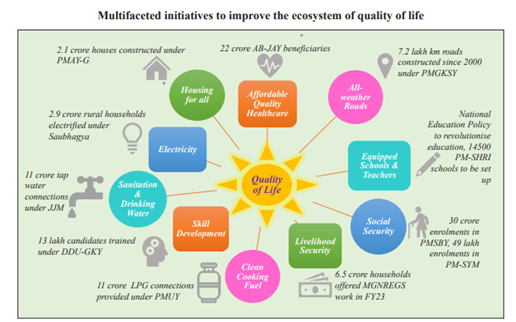
 Source: Economic Survey 2022-23

The Survey notes a multi-pronged approach to raise the rural incomes and quality of life through different schemes.  

1. Livelihood, Skill Development

  • The Deendayal Antyodaya Yojana-National Rural Livelihood Mission (DAY-NRLM), aims to enable economically weak households to access gainful self-employment and skilled wage employment opportunities resulting in sustainable and diversified livelihood options for them. This is one of the world’s largest initiatives to improve the livelihoods of the poor. The cornerstone of the Mission is its ‘community-driven’ approach which has provided a huge platform in the form of community institutions for women empowerment.

Rural women are at the core of the program which is extensively focused on their socio-economic empowerment. Nearly 4 lakh Self Help Group (SHG) members have been trained as Community Resource Persons (CRPs) (viz. Pashu Sakhi, Krishi Sakhi, Bank Sakhi, Bima Sakhi, Poshan Sakhi etc.) help in the implementation of the Mission at the ground level. The Mission has mobilised a total of 8.7 crore women from poor and vulnerable communities into 81 lakh SHGs.

  • Under Mahatma Gandhi National Rural Employment Guarantee Scheme (MGNREGS) a total of 5.6 crore households availed employment and a total of 225.8 crore person-days employment has been generated under the Scheme (until 6 January 2023). The number of works done under MGNREGS has steadily increased over the years, with 85 lakh completed works in FY22 and 70.6 lakh completed works so far in FY23 (as on 9 January 2023). These works include creating household assets such as animal sheds, farm ponds, dug wells, horticulture plantations, vermicomposting pits etc., in which the beneficiary gets both labour and material costs as per standard rates. Empirically, within a short span of 2-3 years, these assets have been observed to have a significant positive impact on agricultural productivity, production-related expenditure, and income per household, along with a negative association with migration and fall in indebtedness, especially from non-institutional sources. This, the Survey notes has long-term implications for aiding income diversification and infusing resilience into rural livelihoods. Meanwhile, the Economic Survey also observes a Year-on-Year (YoY) decline in monthly demand for Mahatma Gandhi National Rural Employment Guarantee Scheme (MGNREGS) work and this the Survey notes is emanating from normalisation of the rural economy due to strong agricultural growth and a swift bounce-back from Covid-19.
  • Skill development has also been one of focus areas for the Government. Under the Deen Dayal Upadhyaya Grameen Kaushalya Yojana (DDU-GKY), until 30 November 2022, a total of 13,06,851 candidates have been trained of which 7,89,685 have got job placements.

2. Women Empowerment

  • The transformative potential of Self Help Groups (SHGs), exemplified through their key role in the on-ground response to Covid-19, has served as the fulcrum of rural development through women empowerment. India has around 1.2 crore SHGs, 88 per cent being all-women SHGs. The SHG Bank Linkage Project (SHG-BLP), launched in 1992, has blossomed into the world’s largest microfinance project. The SHG-BLP covers 14.2 crore families through 119 lakh SHGs with savings deposits of Rs. 47,240.5 crore and 67 lakh groups with collateral-free loans outstanding of Rs. 1,51,051.3 crore, as on 31 March 2022. The number of SHGs credit linked has grown at a CAGR of 10.8 per cent during the last ten years (FY13 to FY22). Notably, SHGs’ bank repayment is more than 96 per cent, underscoring their credit discipline and reliability.

Women’s economic SHGs have a positive, statistically significant effect on women’s economic, social, and political empowerment, with positive effects on empowerment achieved through various pathways such as familiarity with handling money, financial decision-making, improved social networks, asset ownership and livelihood diversification.

According to a recent assessment of DAY-National Rural Livelihood Mission, both participants and functionaries perceived high impacts of the programme in areas related to women empowerment, self-esteem enhancement, personality development, reduced social evils; and additionally, medium impacts in terms of better education, higher participation in village institutions and better access to government schemes.

During Covid, SHGs were in action mobilising women to unite, transcend their group identity and collectively contribute to crisis management. They emerged as pivotal players in crisis management, leading from the front in - producing masks, sanitisers, and protective gear, creating awareness about the pandemic, delivering essential goods, running community kitchens, supporting farm livelihoods etc. The production of masks by SHGs has been a noteworthy contribution, enabling access to and use of masks by communities in remote rural areas and providing vital protection against the Covid-19 virus. As on 4 January 2023, more than 16.9 crore masks were produced by SHGs under DAY-NRLM.

  • Rural women are increasingly participating in economic activity. The survey notes the noticeable rise in Rural Female Labour Force Participation Rate (FLFPR) from 19.7 per cent in 2018-19 to 27.7 per cent in 2020-21. The survey calls this upturn in the FLFPR as a positive development on the gender aspect of employment, which could be attributable to rising rural amenities freeing up women’s time, and high agricultural growth over the years. Meanwhile the survey also observes that India’s female LFPR is likely to be underestimated, with reforms in survey design and content required to capture the reality of working females more accurately.

3. Housing For All

The Government rolled out “Housing for All by 2022” to provide shelter with dignity for each and every one. With this target, the Pradhan Mantri Awaas Yojana –Gramin (PMAY-G) was launched in November 2016 with the aim of providing around 3 crore pucca houses with basic amenities to all eligible houseless households living in kutcha and dilapidated houses in rural areas by 2024. Under the scheme, landless beneficiaries are accorded the highest priority in the allotment of houses. A total of 2.7 crore houses have been sanctioned and 2.1 crore houses have been completed by 6 January 2023 under the Scheme. Against the total target of completion of 52.8 lakh houses in FY23, 32.4 lakh houses have been completed.

4. Water and Sanitation

  • On the 73rd Independence Day, 15 August 2019, the Jal Jeevan Mission (JJM) was announced, to be implemented in partnership with States, to provide by 2024, tap water connection to every rural household and public institutions in villages like schools, Anganwadi centres, ashram shalas (tribal residential schools), health centres etc. At the time of the rollout of the JJM in August 2019, about 3.2 crore (17 per cent) households out of the total of 18.9 crore rural households had a tap water supply. Since the launch of the Mission, as of 18 January 2023, of 19.4 crore rural households, 11.0 crore households are getting tap water supply in their homes.
  • Mission Amrit Sarovar aimed at developing and rejuvenating of 75 water bodies in each district of the country during the Amrit Varsh - 75th year of independence. The mission was launched by the Government on National Panchayati Raj Day in 2022. Against an initial target of 50,000 Amrit Sarovars, a total of 93,291 Amrit Sarovar sites were identified, works commenced on more than 54,047 sites and out of these sites were works began, a total of 24,071 Amrit Sarovars have been constructed. The mission helped develop 32 crore cubic meters of water holding capacity and created a total carbon sequestration potential of 1.04,818 tonnes of carbon per year. The mission transformed into a mass movement with Shram Dhaan from the community, where Freedom Fighters, Padma Awardees and elder citizens of the area also participated along with the establishment of Water User Groups. This coupled with the launch of Jaldoot App that helps the Government document and monitor ground water resources and local water level would make water scarcity a thing of the past.
  • Phase II of the Swachh Bharat Mission (G) is under implementation from FY21 to FY25. It aims to transform all villages into ODF Plus with focus to sustain ODF status of villages and covering all the villages with Solid and Liquid Waste management systems. India achieved ODF status in all villages in the country on 2nd October 2019. Now, about 1,24,099 villages have been declared as ODF Plus till November 2022 under the mission. Andaman & Nicobar Islands have been declared as the first ‘Swachh, Sujal Pradesh’ with all its villages being declared as ODF plus.

5. Smoke Free Rural Homes

The release of 9.5 crore LPG connections under the Pradhan Mantri Ujjwala Yojana, has helped in increasing the LPG coverage from 62 per cent (on 1 May 2016) to 99.8 per cent (on 1 April 2021). The Union Budget for FY22, made a provision for the release of an additional one crore LPG connections under the PMUY scheme, i.e., Ujjwala 2.0 - this scheme will offer deposit-free LPG connection, first refill and hot plate free of cost to beneficiaries, and a simplified enrolment procedure. In this phase, a special facility has been given to migrant families. Under this Ujjwala 2.0 scheme, 1.6 crore connections have been released until 24 November 2022.

6. Rural Infrastructure

  • Since its inception, the Pradhan Mantri Gram Sadak Yojana helped create 1,73,775 number of roads measuring 7,23,893 km and 7,789 Long Span Bridges(LSBs) against the sanctioned, 1,84,984 roads measuring 8,01,838 km and 10,383 Long Span Bridges (LSBs) under all its verticals/interventions points the survey. The survey observes that various independent impact evaluation studies were carried out on PMGSY, which have concluded that the scheme has had a positive impact on agriculture, health, education, urbanization, employment generation etc.
  • SAUBHAGYA- Pradhan Mantri Sahaj Bijli Har Ghar Yojana, was launched to achieve universal household electrification by providing electricity connections to all willing un-electrified households in rural areas and all willing poor households in urban areas in the country. The connections were given for free to economically poor households and for others, Rs 500 was charged after the release of the connection in 10 instalments. The Saubhagya scheme has been successfully completed and closed on 31st March 2022. Deendayal Upadhyaya Gram Jyoti Yojana (DDUGJY), envisaged the creation of basic electricity infrastructure in villages/habitations, strengthening & augmentation of existing infrastructure, and metering of existing feeders/distribution transformers/consumers to improve the quality and reliability of power supply in rural areas. A total of 2.9 crore households have been electrified since the launch of the Saubhagya period in October 2017 under various schemes viz (Saubhgaya, DDUGJY, etc.).

Topics

Acts Income Tax
