

Loading...

Top
Help
×

By creating an account you can:

Logo TaxTMI
Call Us / Help / Feedback

Contact Us At :

E-mail: [email protected]

Call / WhatsApp at: +91 99117 96707

For more information, Check Contact Us

FAQs :

To know Frequently Asked Questions, Check FAQs

Most Asked Video Tutorials :

For more tutorials, Check Video Tutorials

Submit Feedback/Suggestion :

Email :
Please provide your email address so we can follow up on your feedback.
Category :
Description :
Min 15 characters 0/2000
Make Most of Text Search
  1. Checkout this video tutorial: How to search effectively on TaxTMI.
  2. Put words in double quotes for exact word search, eg: "income tax"
  3. Avoid noise words such as : 'and, of, the, a'
  4. Sort by Relevance to get the most relevant document.
  5. Press Enter to add multiple terms/multiple phrases, and then click on Search to Search.
  6. Text Search
  7. The system will try to fetch results that contains ALL your words.
  8. Once you add keywords, you'll see a new 'Search In' filter that makes your results even more precise.
  9. Text Search
Add to...
You have not created any category. Kindly create one to bookmark this item!
Create New Category
Hide
Title :
Description :
❮❮ Hide
Default View
Expand ❯❯
Close ✕
🔎 News - Adv. Search
TEXT SEARCH:

Press 'Enter' to add multiple search terms. Rules for Better Search

Search In:
Main Text + AI Text
  • Main Text
  • Main Text + AI Text
  • AI Text
Category: ?
Categorized by AI
---- All Categories ----
  • ---- All Categories ----
  • Income Tax
  • GST
  • Customs, DGFT & SEZ
  • FEMA & RBI
  • Corp. Laws, SEBI & IBC
  • PMLA, Black Money & ED
  • Budget
  • News and Press Release
  • PTI News
Month:
---- All Months ----
  • ---- All Months ----
  • January
  • February
  • March
  • April
  • May
  • June
  • July
  • August
  • September
  • October
  • November
  • December
Year:
---- All Years ----
  • ---- All Years ----
  • 2026
  • 2025
  • 2024
  • 2023
  • 2022
  • 2021
  • 2020
  • 2019
  • 2018
  • 2017
  • 2016
  • 2015
  • 2014
  • 2013
  • 2012
  • 2011
Sort By: ?
In Sort By 'Default', exact matches for text search are shown at the top, followed by the remaining results in their regular order.
Relevance Default Date
    India placed in lower tariff tier at 10 pc under US Section 301 measures on forced labour: Govt
    ED report says CMRL ex-MD cited Veena’s ties to then Kerala CM for payments
    Union Minister for Finance & Corporate Affairs Smt. Nirmala Sitharaman outlines 5Rs of responsive tax governance; Calls for greater tax certainty and ...
    Trump says US will investigate EU trade practices, claiming bloc unfairly fined tech giants
    World shares are mixed and oil prices fall, markets in Asia skid in sell-off of AI-related shares
    Sitharaman ask I-T officials to go after tax evaders, ensure convenience for honest taxpayers
    HIGHLIGHTS
    Rupee recovers 20 paise to settle at 96.53 against US dollar
    Sri Lanka welcomes US tariff reduction
    DPIIT's One District One Product Initiative Promotes 1,244 Unique Products Across 773 Districts
    India's Services Exports Rise to USD 421.3 Billion in FY 2025-26, Led by Telecommunications, Computer and Information Services and Business Services
    India and Israel Conclude Second Round of Negotiations for Proposed Free Trade Agreement
    Glomo Secures Visa's Principal Membership, Becomes India's First Non-Bank Acquirer to Join the Network
    India's forex reserves jump USD 1.08 billion to USD 676.237 billion
    Boult Earbuds in India 2026: Five Reasons They are the Smartest Budget Pick
    Stock markets extend losses for 5th straight day on US trade tariffs, West Asia tensions
    China slaps export controls on 14 EU entities in retaliation for Russia-related sanctions
    Rupee recovers 18 paise to settle at 96.55 against US dollar
    Infosys: AI Revenues at 8.2% in Q1; Resilient Operating Margin of 21.1%
    Shares skid in Asia in sell-off of AI-related shares as Brent oil trades near $100 per barrel
❯❯
Maximize Maximize Maximize
0 / 200
Expand Note
Add to Folder

No Folders have been created

+

Are you sure you want to delete "My most important" ?

NOTE:

News
Showing Results for :
Reset Filters
Results Found:
Show All Summaries Hide All Summaries
July 25, 2026
Show AI Summary
US forced-labour tariffs place India in a lower tier while preserving exclusions for specified imports and Section 232 products.
US Section 301 forced-labour measures impose an additional 10 per cent tariff on imports from India, with India placed in a lower tariff tier than initially proposed. Generic pharmaceuticals, smartphones and certain specified products outside additional duties remain excluded, as do products already covered by Section 232 measures, including steel, aluminium and auto parts. The textile-specific mechanism has not yet been established or operationalised, and engagement continues in connection with bilateral trade agreement negotiations.
July 25, 2026
Show AI Summary
Money-laundering investigation examines alleged fictitious expenses, circular vendor payments, and consultancy payments without services or deliverables.
A money-laundering investigation alleges misappropriation through fictitious expense entries, unsupported vouchers, and inflated vendor invoices used to withdraw funds in cash. The Enforcement Directorate further alleges that payments described as software or IT consultancy expenses were made to Exalogic Solutions Pvt Ltd and Veena T without services or deliverables. The report cites statements concerning the alleged sham payments, Exalogic's dependence on company funds, and subsequent transfers from its account. The PMLA case is based on a prosecution complaint concerning suspected financial irregularities.
July 25, 2026
Show AI Summary
Tax certainty and taxpayer-centric administration drive simplified compliance, reduced litigation, digital service delivery, and stronger voluntary tax compliance.
Tax administration reform under the Income-tax Act, 2025, rules and forms is directed toward a simpler, transparent and taxpayer-centric system. Key priorities include reducing compliance costs and litigation through tax certainty, faster return processing, refunds, grievance redressal, voluntary compliance and timely appeal disposal. Digital initiatives, including PAN 2.0, ITBA 2.0, IEC 3.0, Kar Saathi and SAKSHAM NUDGE, are intended to simplify compliance and improve taxpayer experience. Capacity building in technology, international taxation, transfer pricing, digital assets and cybersecurity supports this reform agenda.
July 24, 2026
Show AI Summary
Trade Practice Investigation: Tech-company antitrust fines prompt proposed tariffs and trade sanctions under federal trade law mechanisms.
A formal investigation into alleged unfair trade practices has been announced in response to European regulatory fines imposed on major United States technology companies. The stated concern is that digital antitrust penalties are unfairly directed at United States businesses, with possible tariffs on European Union imports indicated. The proposed response is linked to Section 301 of the Trade Act of 1974, permitting import taxes and other sanctions against unjustifiable, unreasonable or discriminatory trade practices.
July 24, 2026
Show AI Summary
Import tariffs and energy costs heighten inflation risks, pressuring consumers, corporate profits and monetary-policy expectations amid market volatility.
Fresh tariffs on imports, rising energy prices and Middle East conflict are identified as concurrent pressures on global financial markets. The tariff measures apply to nearly all imports into the United States and are paid by importing companies, which typically pass the additional costs to consumers. Higher energy costs and tariffs may increase inflationary pressure, reduce household discretionary spending and affect corporate profitability, while influencing monetary-policy expectations. Investors also questioned whether substantial artificial-intelligence investment can support technology-sector valuations.
July 24, 2026
Show AI Summary
Responsive tax governance promotes taxpayer convenience, correction of bona fide errors, tax certainty, prompt refunds and prevention of avoidable litigation.
Responsive tax governance requires convenience for honest taxpayers, correction of bona fide errors and firm consequences for deliberate tax evasion. The Income Tax Act, 2025 is intended to simplify the legal framework, reduce uncertainty and lower compliance costs, supported by stronger electronic filing infrastructure and prompt refund processing. Tax certainty should promote voluntary compliance and shift the focus from litigation management to litigation prevention through consistent guidance, simplified procedures, technology, standardised processes, effective grievance resolution and reduction of recurring taxpayer difficulties.
July 24, 2026
Show AI Summary
Examination integrity safeguards prompt monitoring, enforcement action and proposed stricter penalties for paper leaks and institutional failures.
Examination integrity measures include reported termination of agency officials, contemplated legal and criminal action, proposed stricter punishment for paper leaks, and Supreme Court monitoring of preventive steps. The Supreme Court also prohibited unauthorised posting or uploading of audio-video court proceedings on social media and digital platforms without prior administrative permission. The updates further address taxpayer facilitation alongside firm action against evasion, trade measures connected with forced-labour concerns, and potential legal action concerning university communications to students.
July 24, 2026
Show AI Summary
Foreign exchange market stabilisation supported rupee recovery as investor outflows, geopolitical tensions and elevated crude prices maintained currency pressure.
Foreign exchange market conditions saw the rupee recover against the US dollar amid reports of Reserve Bank of India intervention and dollar sales by public-sector banks to limit further depreciation. Foreign institutional investor outflows, weak domestic equity sentiment, geopolitical tensions, and elevated crude oil prices continued to pressure the currency. A decline in crude prices, diplomatic engagement, and central-bank intervention were identified as potential stabilising factors.
July 24, 2026
Show AI Summary
Forced-labour import prohibition enabled lower tariff treatment for Sri Lankan goods, supporting export competitiveness and responsible trade practices.
Tariff treatment for Sri Lankan goods entering the United States was reduced after Sri Lanka prohibited imports of goods produced using forced labour. The prohibition placed Sri Lanka within the lower tariff category under the stated US framework. The reduction is described as supporting exporter competitiveness while reflecting commitments to fair trade, responsible business practices, internationally accepted labour standards, and sustainable economic reforms.
July 24, 2026
Show AI Summary
One District One Product strengthens district product branding, market access, food-processing support and export-oriented value chains.
The One District One Product initiative supports district-identified products through branding, market access, exhibitions, capacity building and Government e-Marketplace onboarding. States and Union Territories select products and may leverage Central and State schemes, as no district-specific allocation is made. PM Ekta Malls and the PMFME Scheme support sales, food-processing projects, common infrastructure, branding, packaging, quality standardisation and food-safety compliance. Districts as Export Hubs promotes export-potential products through export committees, action plans and value-chain coordination.
July 24, 2026
Show AI Summary
Services export promotion expands market access, professional mobility, qualification recognition and trade outreach for Indian service suppliers.
Services export promotion combines targeted market and sector strategies, removal of domestic impediments, trade agreements and export-promotion activity. Free Trade Agreements secure market access and national treatment for Indian service suppliers, support transparent and time-bound authorisation processes, and facilitate temporary mobility of skilled professionals. Mutual Recognition Agreement provisions seek recognition of qualifications and licensing requirements. The framework also addresses social-security coordination, student mobility, traditional medicine and double-taxation commitments for IT services. The Services Export Promotion Council supports market development, trade facilitation, capacity building and international outreach.
July 24, 2026
Show AI Summary
Free trade agreement negotiations advance as India and Israel address market access, origin rules, customs facilitation and economic cooperation.
India and Israel completed the second round of negotiations for a proposed Free Trade Agreement under the Terms of Reference signed in November 2025. Technical discussions covered trade in goods and services, rules of origin, sanitary and phytosanitary measures, technical barriers to trade, intellectual property rights, customs procedures, trade facilitation and economic cooperation. Both sides sought to narrow gaps, identify areas of convergence and work towards early conclusion of a balanced, comprehensive and mutually beneficial agreement.
July 24, 2026
Show AI Summary
Direct card acquiring enables cross-border merchants to manage payment processing, settlement, risk monitoring and disputes without intermediary acquirers.
Visa Principal Membership enables Glomo to operate as a direct non-bank acquirer for Visa-powered merchant card payments through GIFT IFSC. It allows direct management of merchant acquisition, processing, settlement, transaction approval optimisation, fraud and risk monitoring, and dispute and chargeback handling without intermediary acquirers. The arrangement is intended to accelerate onboarding and processing, enhance control over risk policies and merchant experience, and support cross-border acceptance and settlement, including management of multiple currencies, banking systems and regulatory requirements.
July 24, 2026
Show AI Summary
Foreign exchange reserves rose as foreign currency assets increased, while gold reserves fell and IMF reserve position declined.
Foreign exchange reserves increased during the reported week, principally because foreign currency assets rose, including valuation effects from movements in non-US currencies held in reserve. Gold reserves declined, Special Drawing Rights increased, and the reserve position with the International Monetary Fund decreased. Earlier reserve declines were associated with rupee pressure and foreign-exchange market intervention through dollar sales.
July 24, 2026
Show AI Summary
Consumer electronics financing enables instalment purchases of affordable earbuds through in-store loan and reusable credit facilities, subject to approval.
Affordable Boult earbuds are described as offering extended battery life, fast charging, dynamic drivers, low-latency gaming modes, Environmental Noise Cancellation, Bluetooth connectivity, and selected active noise-cancellation features. Models are compared by audio, calling, gaming, and charging specifications. Purchases through partner stores may be financed through an Easy EMI Loan or Insta EMI Card, subject to in-store application and approval, with instalment tenures and possible zero-down-payment offers on selected models.
July 24, 2026
Show AI Summary
Trade-tariff concerns and oil-price volatility deepen risk aversion, extending equity market losses amid geopolitical tensions and foreign outflows.
Indian equity markets extended their losing streak amid caution over United States trade-tariff concerns, West Asia tensions, oil-price volatility, foreign equity outflows and selling in selected blue-chip shares. Higher oil prices were identified as a potential pressure on macroeconomic indicators and growth prospects. New import tariffs were described as a constraint for export-oriented economies, particularly technology-heavy markets, while investors may diversify exposure across emerging-market opportunities.
July 24, 2026
Show AI Summary
Dual-use export controls restrict supplies to European entities amid reciprocal Russia-related sanctions and non-proliferation concerns.
China imposed dual-use export controls on 14 European entities in response to European Union sanctions affecting Chinese and Hong Kong enterprises. Chinese companies cannot export dual-use items to the listed organisations, and foreign companies are barred from supplying them with dual-use items made in China. China stated that the restrictions protect national security and interests and support international non-proliferation obligations in the context of Russia-related sanctions.
July 24, 2026
Show AI Summary
Foreign-exchange market intervention supported rupee stabilisation amid investor outflows, weak equities, geopolitical tensions and elevated crude oil prices.
Foreign-exchange market conditions supported a rupee recovery against the US dollar following reported Reserve Bank of India intervention and dollar sales by public-sector banks. Pressure on the currency persisted due to foreign institutional investor outflows, weak domestic equity sentiment, geopolitical tensions and elevated crude oil prices. Lower crude prices, a weaker dollar index and further central bank intervention were identified as potential stabilising influences.
July 24, 2026
Show AI Summary
Forward-looking statements receive safe-harbor qualification amid reported IFRS performance, AI-led transformation initiatives, and revised revenue-growth guidance.
Infosys reported first-quarter IFRS financial performance, including revenue growth, operating margin, earnings per share, free cash flow, and large-deal contract value, while revising revenue-growth guidance and retaining operating-margin guidance. The release describes AI-led enterprise transformation, cloud modernization, digital banking, financial-crime operations, and technology services engagements. Forward-looking statements are subject to safe-harbor protection and may differ materially because of business, talent, economic, technological, regulatory, cybersecurity, litigation, investigation, and tariff-related risks.
July 24, 2026
Show AI Summary
Forced-labour import enforcement drives new tariffs as expiring stopgap levies and market uncertainty heighten trade-compliance concerns.
Import tariffs were announced on goods from trading partners said not to have fully enforced prohibitions on products made with forced labour. The measures apply to imports from 60 trading partners representing most United States imports and were introduced as existing stopgap levies approached expiry, following a Supreme Court setback affecting other tariff measures. The announcement occurred amid market uncertainty linked to energy-route disruptions, rising crude-oil prices, inflation concerns, and scrutiny of artificial-intelligence investment spending.

News

Back

All News

Showing Results for :
Reset Filters
No Records Found

News

Back

All News

Showing Results for : Reset Filters

INDUSTRIAL SECTOR GROSS VALUE ADDED (GVA) ROSE BY 3.7 PER CENT IN FIRST HALF OF FY23

January 31, 2023

Contents
Summary
Note

Note

-

Bookmark

Print

Print

INDUSTRIAL SECTOR GROSS VALUE ADDED (GVA) ROSE BY 3.7 PER CENT IN FIRST HALF OF FY23

PRIVATE FINAL CONSUMPTION EXPENDITURE (PFCE) AS A SHARE OF GDP IN H1 OF FY23 WAS HIGHEST AMONG ALL HALF YEARS SINCE FY15

FDI INFLOW AT US$ 21.3 BILLION IN FY22 MARKING 76 PER CENT RISE FROM FY21

INDIAN PHARMACEUTICAL EXPORTS ACHIEVED 24 PER CENT GROWTH IN FY21

CUMULATIVE FDI IN PHARMA SECTOR CROSSED US$ 20 BILLION MARK BY SEPTEMBER 2022

COAL PRODUCTION FOR FY23 ESTIMATED TO INCREASE TO 911 MILLION TONNES

INDIA IS NOW THE 3RD LARGEST AUTOMOBILE MARKET

INDIA IS 2ND LARGEST MOBILE PHONE MANUFACTURER GLOBALLY

CREDIT TO INDUSTRY GROWING, PARTICULARLY FOR MSMEs

PLI SCHEME EXPECTED TO ATTRACT CAPEX OF APPROX ₹4 LAKH CRORE OVER THE NEXT FIVE YEARS

INDUSTRY 4.0 IS INDIA’S WAY FORWARD IN ACHIEVING THE GOALS OF AATMANIRBHARTA AND AMBITIONS OF BECOMING A KEY PLAYER IN GLOBAL VALUE CHAINS

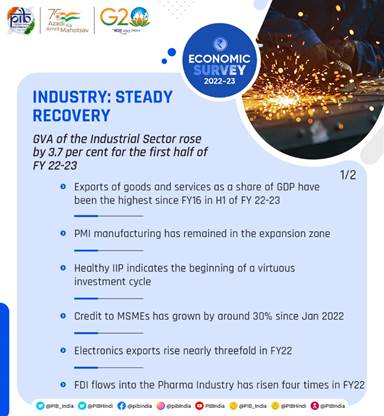
The Overall Gross Value Added (GVA) by the Industrial Sector rose 3.7 per cent, based on data available for the first half of the FY23, which is higher than the average growth of 2.8 per cent achieved in H1 of the last decade, stated the Economic Survey 2022-23 presented by the Union Minister for Finance & Corporate Affairs Smt. Nirmala Sitharaman in Parliament today.

OVERVIEW OF INDUSTRIAL SECTOR

Economic Survey tabled in the Parliament stated that Industry sector witnessed modest growth of 4.1 per cent in FY23 compared to the strong growth of 10.3 per cent in FY22. It explained that this is likely on account of input cost-push pressures, supply chain disruptions and the China lockdown impacting the availability of essential inputs and slowing the global economy.

The Survey highlighted that the PLI schemes are set to unlock manufacturing capacity, boost exports, reduce import dependence and lead to job creation for both skilled and unskilled labour. The Survey was optimistic that easing input prices and conducive demand conditions will support overall Industrial growth.

DEMAND STIMULUS TO INDUSTRIAL GROWTH

Private Final Consumption Expenditure (PFCE) as a share of GDP in H1 of FY23 was the highest among all half years, H1 or H2, since FY15, the Survey stated. The Survey optimistically expressed that with world commodity prices on a downward trajectory and showing up in declining rates of India’s wholesale inflation, core retail inflation is expected to relent, making domestic consumption demand much stronger to further induce industrial growth in the country.

Economic Survey stated that the strong export performance of FY22 continued somewhat in the first half of FY23 while exports of goods and services as a share of GDP have been the highest since FY16 during H1 of FY23.

The Survey warned that export growth may slow further in the second half of the current financial year and remain weak beyond that, too, if the global economy falls into recession. It added that however, the strong domestic consumption growth and investment revival is expected to keep industrial production humming.

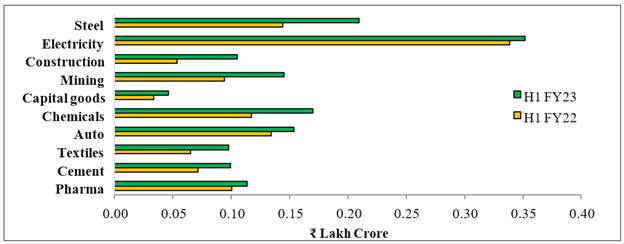
The Survey emphasized that New Investment announced in the manufacturing sector during April-December of FY23 was five times the corresponding level in FY20. The Survey analyzed this increase in investment demand was triggered by the augmented capex of the central government in the current and the previous year as compared to the pre-pandemic years. The leap also has crowded in private investment, already upbeat on the pent-up demand, export stimulus, and strengthening of the corporate balance sheets. It added that Capacity utilization in the manufacturing sector has been rising which bodes well for new investment activity in creating additional capacity.

SUPPLY RESPONSE OF INDUSTRY

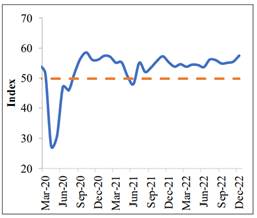
Purchaser’s Manufacturing Index (PMI) manufacturing has remained in the expansion zone for 18 months since July 2021, and its sub-indices indicate an easing of input cost pressures, improving supplier delivery times, robust export orders, and future output, highlighted the Survey.

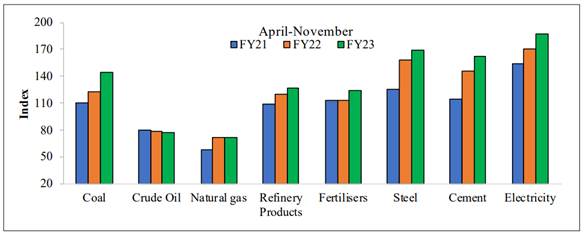
The Survey noted the growth of the eight core industries of coal, fertilizers, cement, electricity, steel, and refinery products has held steady, reflecting a broad momentum in industrial activity.

The Survey added that while growth in the consumer durables component of the Index of Industrial Production (IIP) is on account of the release of ‘pent-up’ demand, the increase in capital goods and infrastructure/ construction goods is indicative of the beginnings of a virtuous investment cycle that is expected to be led by the private sector.

ROBUST GROWTH IN BANK CREDIT TO INDUSTRY

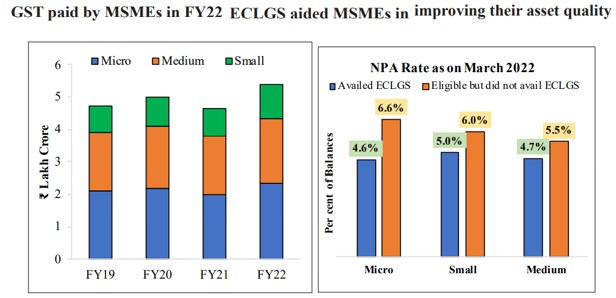
The Survey highlighted that the credit to industry started recovering from January 2022 and has been growing in double digits since July 2022. It added that Credit to MSMEs has also seen a significant increase in part, assisted by the introduction of the Emergency Credit Linked Guarantee Scheme (ECLGS).
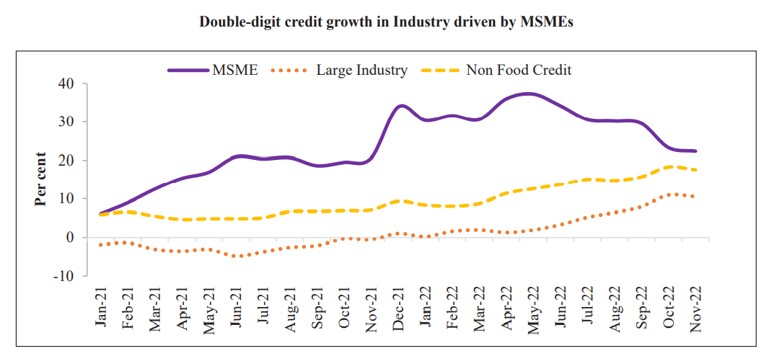
The Survey stated that the impact of ECLGS on increasing the growth of credit to MSME was felt most during the pandemic impacted years of 2020 and 2021. It continued in 2022 as the scheme was extended to March 2023.

Further it added, growth in credit to MSME was buttressed by rebounding consumption levels, particularly in the services sector. Consequently, the share of MSMEs in gross credit offtake to the industry rose from 17.7 per cent in January 2020 to 23.7 per cent in November 2022.

The Survey expressed that robust growth in credit demand combined with rising capacity utilization and investment in manufacturing underscores businesses’ optimism regarding future demand.

RESILIENT FDI INFLOW IN MANUFACTURING SECTOR

The Survey highlighted that the FDI inflow jumped to US$ 21.3 billion in FY22 from US$ 12.1 billion in FY21 as the pandemic-driven expansionary policies of advanced economies led to a surge in global liquidity.
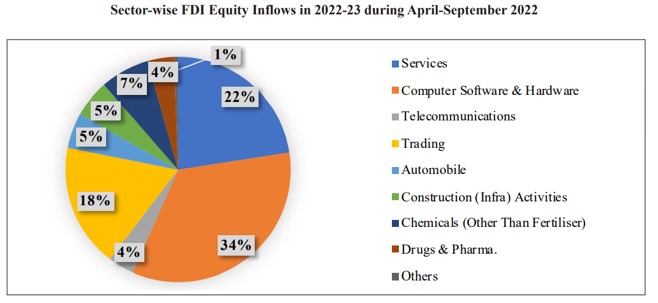
The Survey mentioned that FDI equity inflow in manufacturing in the first half of FY23 fell below its corresponding level in the first half of FY22, with the rise in global uncertainty in the wake of the Russia-Ukraine conflict.

A rebound in FDI inflows is, however, expected as the Indian economy sustains its high growth while monetary tightening the world over eventually eases with the weakening of inflationary pressures, the Survey expressed optimism.

HIGHLIGHTS OF INDUSTRY GROUPS

1. MICRO, SMALL AND MEDIUM ENTERPRISES (MSMEs)

The Survey noted that the MSME contribution to the manufacturing sector’s GVA also marginally fell to 36.0 per cent in FY21. The Survey further emphasized that the AatmaNirbhar Bharat Package by the Government provided cushion to the economic impact of the pandemic on MSMEs, which has helped post smart recovery from pandemic.

The Survey expressed that the recovery of the MSME sector from the pandemic-induced shock is evident in the trend in GST paid by the units of MSME sector in FY22 has crossed the pre-pandemic level in FY20.

Government’s initiative of the Samadhaan Portal, CHAMPIONS:the single-window grievance redressal portal for MSMEs, Trade Receivables Discounting System (TReDS) platform for facilitating the discounting of trade receivables of MSMEs with a turnover of ₹200 crore or more, ‘Raising and Accelerating MSME Performance’ scheme (RAMP) etc. has helped in strengthening the MSMEs stated the Economic Survey.
      

2. ELECTRONICS INDUSTRY

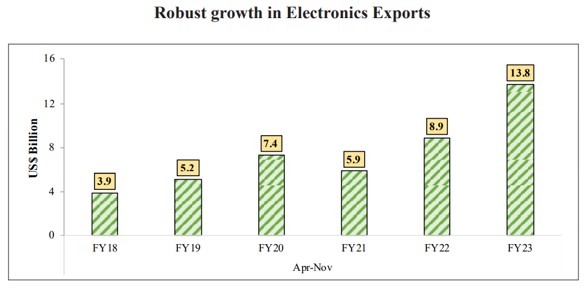
The Survey emphasized that Electronic goods were among the top five commodity groups exhibiting positive export growth in November 2022, with the exports in this segment growing YoY by 55.1 per cent.

Elaborating on the Electronics industry, the Survey stated that major drivers were mobile phones, consumer electronics and industrial electronics. It highlighted that India has become the second-largest mobile phone manufacturer globally, with the production of handsets going up from six crore units in FY15 to 31 crore units in FY22.
The Survey also mentioned that various initiatives and incentives of Government like PLI scheme for Large Scale Electronics Manufacturing, the PLI scheme for IT hardware, the Scheme for Promotion of Manufacturing of Electronic Components and Semiconductors (SPECS) has nurtured and enhanced the electronics manufacturing base.

Additionally, under the Programme for Development of Semiconductors and Display Manufacturing Ecosystem in India, the Cabinet approved the comprehensive development of a sustainable semiconductor and display ecosystem in the country with an outlay of ₹76,000 crore.

3. COAL INDUSTRY

The coal production for FY23 is estimated to increase to 911 million tonnes, about 17 per cent higher compared to the previous year, highlighted the Survey. Consequent to the well-timed measures of the Government, India has been placed in a better position to cater to excess energy demand. It further added that the coal industry is expected to grow at 6-7 per cent annually to reach a production level of 1 billion tonnes by FY26 and about 1.5 billion tonnes by 2030.

4. STEEL INDUSTRY

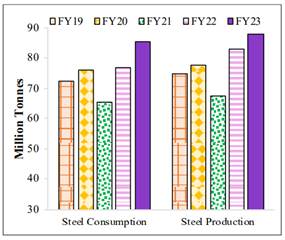
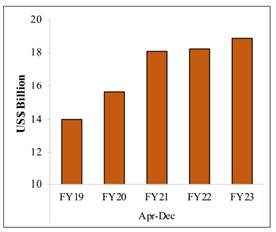
Economic Survey highlighted the steel sector’s performance in the current fiscal year as robust, with cumulative production and consumption of finished steel at 88 MT and 86 MT, respectively, during April-December 2022, higher than the corresponding period during the previous four years.

The Survey stated that iron and steel exports are higher by 20 per cent over the corresponding pre-pandemic levels of FY20, despite moderation in the first eight months of the current fiscal owing to a slowdown in the global economy.

Increasing Steel production and Consumption (Apr-Dec)
5. TEXTILE INDUSTRY

In the current financial year, the textile industry has been facing the challenge of moderating exports compared to FY22, mentioned the Survey. It added that export of readymade garments registered a growth of 3.2 per cent YoY basis during the same period.

The Government approved the setting up of seven PM Mega Integrated Textile Region and Apparel (PM MITRA) Parks and launched the Textile PLI Scheme with an approved outlay of ₹10,683 crore over five years starting from 1st January 2022 to promote investments. These would help to develop integrated large-scale and modern industrial infrastructure facilities for the entire value chain of the textile industry, the Survey stated.

6. PHARMACEUTICALS INDUSTRY

The Survey highlighted that Indian pharmaceutical exports achieved a healthy growth of 24 per cent in FY21. It expressed hope that India’s domestic pharmaceutical market is estimated to grow to US$ 65 billion by 2024 from estimated US$ 41 billion in 2021 and is further expected to reach US$ 130 billion by 2030.

Strong Growth in pharma exports     
 High Inflow of FDI in Pharma sector
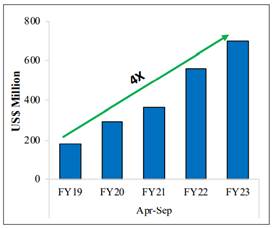
       

Carrying forward this growth momentum, drug and pharmaceutical exports during April-October 2022 was 22 per cent higher than the corresponding pre-pandemic period of FY20, noted the Survey. It added that Cumulative FDI in the pharma sector crossed the US$ 20 billion mark in September 2022 and FDI inflows have increased four-fold over five years until September 2022, to US$ 699 million, supported by investor-friendly policies and a positive outlook for the industry.

7. AUTOMOBILE INDUSTRY

India became the 3rd largest automobile market, surpassing Japan and Germany in terms of sales, in December 2022, stated the Economic Survey. It added that in 2021, India was the largest manufacturer of two-wheeler and three-wheeler vehicles and the world’s fourth-largest manufacturer of passenger cars.

Elaborating on the domestic electric vehicles (EV) market, the Survey stated that it is expected to grow at a compound annual growth rate (CAGR) of 49 per cent between 2022 and 2030 and is expected to hit one crore units annual sales by 2030. It added that the EV industry will create 5 crore direct and indirect jobs by 2030.

FOSTERING INNOVATION 

Economic Survey stated that there was a 46 per cent growth in the domestic filing of patents over 2016-2021, signaling India’s transition towards a knowledge-based economy.

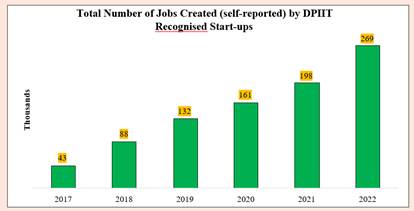
Discussing the achievements of Start-ups, the Survey highlighted that an impressive 9 lakh+ direct jobs have been created by the DPIIT recognized startups (self-reported), with a notable 64 per cent increase in 2022 over the average number of new jobs created in the last three years. About 48 per cent of our startups are from Tier II & III cities, a testimony of our grassroots’ tremendous potential.
INDUSTRY 4.0

The Survey highlighted that adoption of Industry 4.0 technologies such as cloud computing, IoT, machine learning, and artificial intelligence (AI) in the Indian manufacturing sector is underway, however, large-scale adoption is yet to happen and an enabling environment is rapidly developing.

The Survey mentioned that various Government Initiatives such as SAMARTH (Smart Advanced Manufacturing and Rapid Transformation Hubs) Udyog Bharat 4.0, establishment of the Centre for Fourth Industrial Revolution is the way forward in achieving the goals of Aatmanirbharta and its ambitions of becoming a key player in global value chains.

MAKE IN INDIA 2.0

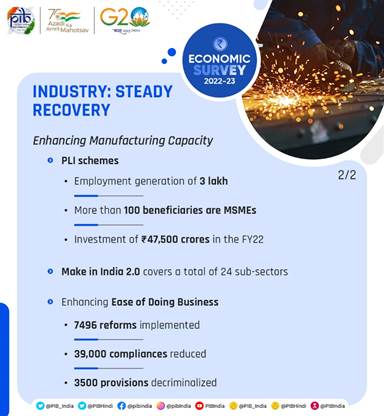
The Survey mentioned that ‘Make in India 2.0’ is now focusing on 27 sectors, which include 15 manufacturing sectors and 12 service sectors. Amongst these, 24 sub-sectors have been chosen while keeping in mind the Indian industries’ strengths and competitive edge, the need for import substitution, the potential for export and increased employability.

PERFORMANCE LINKED INCENTIVE (PLI) SCHEME

PLI scheme is expected to attract a capex of approximately ₹4 lakh crore over the next five years having a potential of generate employment for over 60 lakh in India stated the Economic Survey. It added that Sectors under which the PLI scheme has been announced currently constitute around 40 per cent of the total imports. The scheme, spread across 14 sectors, can enhance India’s annual manufacturing capex by 15 to 20 per cent from FY23.

The Survey mentioned that around ₹47,500 crore (US$ 6 billion) of actual investment has been made (As per recent reporting from implementing Ministries/ Departments); production/ sales of ₹3.85 lakh crore (US$ 47 billion) of eligible products and employment generation of around 3 lakh has been reported and 106 per cent achievement of actual investment reported versus the corresponding projections of FY22.

The Survey stated that more than 100 MSMEs are among the PLI beneficiaries in sectors such as Bulk Drugs, Medical Devices, Telecom, White Goods and Food Processing. Key sectors such as Large-Scale Electronics Manufacturing, Pharmaceuticals, Telecom & Networking Products, Food Processing and White Goods have contributed considerably to investment, production, sales and employment.
Topics

Acts Income Tax
