

Loading...

Top
Help
×

By creating an account you can:

Logo TaxTMI
Call Us / Help / Feedback

Contact Us At :

E-mail: [email protected]

Call / WhatsApp at: +91 99117 96707

For more information, Check Contact Us

FAQs :

To know Frequently Asked Questions, Check FAQs

Most Asked Video Tutorials :

For more tutorials, Check Video Tutorials

Submit Feedback/Suggestion :

Email :
Please provide your email address so we can follow up on your feedback.
Category :
Description :
Min 15 characters 0/2000
Make Most of Text Search
  1. Checkout this video tutorial: How to search effectively on TaxTMI.
  2. Put words in double quotes for exact word search, eg: "income tax"
  3. Avoid noise words such as : 'and, of, the, a'
  4. Sort by Relevance to get the most relevant document.
  5. Press Enter to add multiple terms/multiple phrases, and then click on Search to Search.
  6. Text Search
  7. The system will try to fetch results that contains ALL your words.
  8. Once you add keywords, you'll see a new 'Search In' filter that makes your results even more precise.
  9. Text Search
Add to...
You have not created any category. Kindly create one to bookmark this item!
Create New Category
Hide
Title :
Description :
❮❮ Hide
Default View
Expand ❯❯
Close ✕
🔎 News - Adv. Search
TEXT SEARCH:

Press 'Enter' to add multiple search terms. Rules for Better Search

Search In:
Main Text + AI Text
  • Main Text
  • Main Text + AI Text
  • AI Text
Category: ?
Categorized by AI
---- All Categories ----
  • ---- All Categories ----
  • Income Tax
  • GST
  • Customs, DGFT & SEZ
  • FEMA & RBI
  • Corp. Laws, SEBI & IBC
  • PMLA, Black Money & ED
  • Budget
  • News and Press Release
  • PTI News
Month:
---- All Months ----
  • ---- All Months ----
  • January
  • February
  • March
  • April
  • May
  • June
  • July
  • August
  • September
  • October
  • November
  • December
Year:
---- All Years ----
  • ---- All Years ----
  • 2026
  • 2025
  • 2024
  • 2023
  • 2022
  • 2021
  • 2020
  • 2019
  • 2018
  • 2017
  • 2016
  • 2015
  • 2014
  • 2013
  • 2012
  • 2011
Sort By: ?
In Sort By 'Default', exact matches for text search are shown at the top, followed by the remaining results in their regular order.
Relevance Default Date
    CCI approves acquisition of 100% share capital of Tao Digital Solutions by Cyient Ltd
    CCI approves acquisition of 100% stake in Kestrel Coal Group Pty Ltd. by Yancoal Australia from certain sellers
    HC bench releases Skoda Volkswagen USD 1.4 billion tax case sans verdict; matter to be heard afresh
    Canada strikes back at US with retaliatory tariffs as trade war escalates
    Rupee rises 26 paise to close at 95.44 against US dollar
    Economy shows resilience to global headwinds with buoyant domestic demand: RBI bulletin
    Goyal promises BIS certification relief for high-tech sector firms
    IICA Conducts inaugural session of 11th Batch of its Certified CSR Professional Programme
    Net Profit of Regional Rural Banks (RRBs) Rises to Record ₹10,176 Crore, Total Business Cross ₹13.5 Lakh Crore in FY 2025-26
    UP Cong chief writes to PM Modi on ethanol policy, sugar prices
    Economy shows notable resilience despite global headwinds: RBI bulletin
    Sugar prices rise by nearly Re 1 per kg to about Rs 64
    Trump says he's considering renaming Lake Ontario as 'Lake America' as trade war with escalates
    Flash Report on Central Sector Infrastructure Projects worth ₹150 crore and above
    HP minister warns orchardists against spurious PGRs sold in open market
    NEWS HIGHLIGHTS
    AERA cuts user development fee for domestic, int'l passengers at Hyderabad airport
    Rupee rises 24 paise to close at 95.46 against US dollar
    India pivots to US for LPG, LNG as West Asia crisis disrupts Gulf supplies
    Experts Call for Intelligence-Led Action to Break Cross-Border Illicit Trade Networks at ASIA Security Conference 2026
❯❯
Maximize Maximize Maximize
0 / 200
Expand Note
Add to Folder

No Folders have been created

+

Are you sure you want to delete "My most important" ?

NOTE:

News
Showing Results for :
Reset Filters
Results Found:
Show All Summaries Hide All Summaries
August 26, 2026
Show AI Summary
Competition clearance for full acquisition permits Cyient to acquire Tao Digital Solutions, a global digital transformation and technology services provider.
Competition Commission of India approved Cyient Limited's acquisition of 100% of Tao Digital Solutions Inc.'s share capital from its existing shareholders. The full share capital acquisition transfers complete ownership of Tao Digital Solutions to Cyient. Tao Digital Solutions provides global digital transformation and technology services, including product engineering, managed services, cybersecurity, payments, digitization and AI, cloud services, and data services, and operates in India through its wholly owned subsidiary, Tao Digital India Private Limited.
August 26, 2026
Show AI Summary
Competition clearance for full coal-sector acquisition addresses limited Indian market links through metallurgical and thermal coal sales.
Competition approval covers Yancoal Australia Limited's acquisition of 100% equity interest and warrants in Kestrel Coal Group Pty Ltd. The target holds an 80% interest in the Kestrel Joint Venture, which operates a Queensland coal mine producing principally metallurgical coal and a smaller volume of thermal coal. Neither the acquirer nor the target has a physical presence in India. Their Indian nexus is limited to coal exports and the joint venture's sales of metallurgical coal into India.
August 25, 2026
Show AI Summary
Customs classification of unassembled vehicle imports requires fresh hearing after reserved tax challenge was released without verdict.
The dispute concerns customs classification of imported unassembled vehicle parts. Customs authorities allege that parts imported in separate shipments should have been declared as completely knocked down (CKD) units, attracting the higher duty applicable to CKD imports, rather than as individual components subject to lower duty. The manufacturer contests the resulting customs demand. Proceedings have been released for fresh hearing before the regular indirect-tax writ bench, with status quo maintained for four weeks.
August 25, 2026
Show AI Summary
Retaliatory tariffs on imported goods escalate trade measures, targeting key sectors while maintaining support for affected domestic businesses.
Canada has imposed retaliatory tariffs on United States-origin industrial and consumer goods following increased United States tariffs on Canadian goods. Effective 8 September, the measures apply at rates of 15%, 25% and 50% across more than 700 products, including steel, aluminium, appliances, dairy products, seafood, furniture, clothing, pulp and paper, and electronics. Existing countertariffs on automobiles remain in force. The measures seek to protect domestic businesses and reduce imports, supported by assistance for affected workers and businesses amid risks to integrated cross-border supply chains.
August 25, 2026
Show AI Summary
Foreign-exchange market intervention and lower crude prices supported rupee appreciation, while USD/INR remained range-bound amid shifting dollar conditions.
Foreign-exchange market conditions supported rupee appreciation against the US dollar, driven by stronger domestic equity markets, a weaker US dollar and lower crude oil prices. The USD/INR pair remained broadly range-bound, with oil-price movements and Reserve Bank intervention identified as key near-term influences. The special USD-INR foreign-exchange swap facility for FCNR(B) deposits, overseas foreign-currency borrowings and external commercial borrowings mobilised substantial foreign-exchange inflows.
August 25, 2026
Show AI Summary
Section 301 tariffs may have lower impact where major exports remain outside their scope amid resilient domestic demand.
Economic resilience is attributed to buoyant domestic demand, increased manufacturing and services activity, improving liquidity conditions, credit growth, investment activity and rebounding foreign capital inflows. Recovery in the southwest monsoon improved kharif sowing and reservoir storage, partly mitigating agricultural-sector risks. US Section 301 tariffs are expected to have a comparatively lower effect because major Indian exports to the United States, including smartphones, petroleum products and pharmaceuticals, remain outside their scope. Foreign direct investment improved with higher gross inflows, while outward foreign direct investment continued to decline.
August 25, 2026
Show AI Summary
BIS certification exemptions may be structured for high-tech manufacturers to ensure timely equipment imports and support domestic manufacturing operations.
Mandatory Bureau of Indian Standards (BIS) certification requirements for equipment and components used by high-technology manufacturers may be addressed through a proposed exemption framework. Possible exemptions may be structured at the company, industry, product, project or bulk level to support timely availability of imported equipment, goods and services for manufacturing operations. The approach is directed at high-technology industries generally, particularly semiconductor and artificial intelligence sectors, while addressing delays associated with mandatory certification and complex procedures for specialised imported parts and equipment.
August 25, 2026
Show AI Summary
Corporate social responsibility should prioritise measurable community outcomes, transparency, capable implementing agencies, and strategic integration with sustainability objectives.
Corporate social responsibility should prioritise measurable community outcomes rather than expenditure alone. Effective CSR depends on community-responsive design, capable implementing agencies, rigorous monitoring, social audits, and transparent use of technology and data. Public sector enterprises may use thematic priorities, convergence with government programmes, and institutional collaboration to replace isolated interventions with strategic CSR. CSR capacity building encompasses legal and regulatory frameworks, governance, project planning, impact assessment, reporting, ESG and the Social Stock Exchange.
August 25, 2026
Show AI Summary
Regional rural bank performance highlights improved profitability, asset quality, priority-sector lending, financial inclusion, and digital banking expansion.
Regional Rural Banks achieved prescribed priority-sector lending targets and sub-targets, expanded financial inclusion through new Pradhan Mantri Jan Dhan Yojana accounts, and recorded improvement in profitability, asset quality, and credit-deposit ratio. Digital banking adoption is to be accelerated to improve operational efficiency, customer experience, and banking access in rural and remote areas. Sponsor Banks are expected to strengthen information-technology infrastructure and support increased area-specific credit flows and innovative lending.
August 25, 2026
Show AI Summary
Ethanol-blended fuel policy faces calls for consumer-focused review amid sugar supply pressures and older-vehicle compatibility concerns.
Consumer-focused review of the ethanol-blended fuel policy is sought because higher ethanol diversion may affect domestic sugar availability and prices, potentially requiring sugar imports that could reduce claimed foreign-exchange savings from lower petroleum imports. The review should address ethanol and sugar production, domestic prices, imports, and consumer, environmental and economic concerns. Availability of lower-blend fuel alongside E20 is advocated for owners of older vehicles, with consumer choice between E10 and E20 supporting a comprehensive reassessment.
August 25, 2026
Show AI Summary
Economic resilience remains supported by domestic demand, manufacturing, liquidity and capital inflows despite external trade and geopolitical risks.
Economic resilience is attributed to buoyant domestic demand, sustained manufacturing and services activity, and double-digit merchandise trade growth. Improved southwest monsoon conditions supported kharif sowing and partly reduced agricultural risks, although geopolitical frictions and fresh United States tariffs remained external risks. Supply-side pressures raised consumer price inflation, while stable core inflation indicated limited cost pass-through. Easing liquidity, credit growth, investment activity and rebounding foreign capital inflows supported financial and external-sector conditions.
August 25, 2026
Show AI Summary
Sugar price controls combine raw sugar imports, stockholding limits, and export restrictions to curb retail inflation.
Sugar market intervention combines permitted imports of raw sugar, stockholding limits for dealers and bulk consumers, and an existing export ban to address sharp increases in retail and wholesale prices. Limits on inventories held by trade participants and large industrial consumers are intended to curb speculation and hoarding. Although ex-mill rates declined after the import decision and anti-hoarding measures, the reduction had not yet translated fully into retail prices. The measures seek to supplement domestic availability and restrain practices that may intensify consumer-price increases.
August 25, 2026
Show AI Summary
Tariff escalation drives retaliatory planning, industry protection measures, supply-chain uncertainty, and proposed symbolic geographic renaming amid cross-border trade tensions.
United States-Canada trade tensions have intensified after tariffs were imposed on Canadian goods following unsuccessful bilateral talks. Canada is expected to pursue retaliatory measures, potentially using targeted action to protect workers and businesses rather than matching tariffs directly. Further tariff threats concern vehicles, auto parts and steel. Integrated cross-border supply chains in automotive, energy, agriculture and manufacturing face increased costs and consumer-price uncertainty. Consideration of renaming Lake Ontario as "Lake America" has also been linked to the escalating dispute.
August 25, 2026
Show AI Summary
Central infrastructure monitoring through PAIMANA-PROJ tracks implementation progress, sectoral priorities, completed works, and integration of newly monitored projects.
PAIMANA-PROJ monitors Central Sector infrastructure projects costing Rs. 150 crore and above across 17 Ministries and Departments. As of July 2026, 1,775 projects with a revised cost of Rs. 37.11 lakh crore were under monitoring, with cumulative expenditure of Rs. 19.26 lakh crore. Transport and Logistics formed the largest monitored sector, followed by Energy. The portfolio included mega and major projects at varying physical and financial completion stages. PAIMANA-CRIP serves as the central infrastructure-project data repository, with most data updated through APIs.
August 25, 2026
Show AI Summary
Plant growth regulator quality controls require farmer awareness, licensed sales, quarantine compliance, and protection against uncertified orchard inputs.
Plant Growth Regulator quality control seeks to protect farmers and orchardists from spurious products sold in the open market. Licensed pesticide and fungicide outlets receive application schedules, while farmer awareness is stressed due to purchases of cheaper PGRs that may not achieve expected results. Rootstock imports require quarantine clearance, and uncertified rootstock purchased from the market is associated with disease spread in orchards. Regulatory measures include direct departmental sale of branded chemicals, promotion of weather-based crop insurance, and demands concerning minimum support pricing and Market Intervention Scheme documentation.
August 25, 2026
Show AI Summary
Anti-conversion compliance prompts voluntary prayer declarations, alongside food-safety oversight and enforcement against demolition, liquor, and cyber-fraud allegations.
Maharashtra's anti-conversion law has commenced, and churches across the Mumbai Metropolitan Region have sought written self-declarations confirming voluntary prayer attendance without pressure. Food-safety oversight requires cleaning of cricket association eateries before a further inspection. Enforcement matters include investigation into unauthorised shop demolitions allegedly involving misuse of a municipal corporation's name, arrests connected with spurious-liquor manufacture, and a cyber-fraud network allegedly using mule accounts to launder proceeds. A retired High Court judge has been appointed as Lokayukta.
August 25, 2026
Show AI Summary
User development fee rationalisation reduces departure charges and links airport cost recovery to commissioned capital projects during the tariff cycle.
Airport tariff regulation for Hyderabad airport fixes reduced User Development Fee for departing domestic and international passengers from 1 September 2026 through 31 March 2031, with rationalised landing charges. The tariff determination applies the incremental Aggregate Revenue Requirement framework, linking airport-charge cost recovery to completion, commissioning and use of identified high-value capital expenditure projects. A variable tariff plan provides landing-charge incentives upon prescribed qualifying conditions, supporting traffic development and route expansion while requiring cost-reflective, transparent and non-discriminatory aeronautical tariffs.
August 25, 2026
Show AI Summary
Rupee appreciation reflects weaker dollar, lower crude prices, positive equities, and foreign-exchange inflows through swap facilities.
Foreign-exchange market conditions supported the rupee's appreciation against the US dollar, driven by positive domestic equity markets, a weaker dollar, and declining crude-oil prices. The USD/INR pair remained within a narrow range, with oil-price movements and potential central-bank intervention identified as near-term determinants. A special USD-INR foreign-exchange swap facility covering FCNR(B) deposits, overseas foreign-currency borrowings and external commercial borrowings had mobilised foreign-exchange inflows relevant to currency liquidity.
August 25, 2026
Show AI Summary
Energy supply diversification reshapes India's LPG, LNG and crude sourcing amid constrained Gulf availability and higher logistics costs.
India's energy-import sourcing has shifted towards supply diversification as disruption in the Strait of Hormuz constrained traditional Gulf supplies. United States cargoes have become particularly important for LPG and LNG, while procurement has also broadened to Atlantic Basin and other non-traditional suppliers. Diversification increases costs through longer voyages, higher freight, insurance expenses, tighter availability and higher commodity prices, reflecting a premium for supply security. Crude sourcing continues to rely principally on Russia, alongside resilient UAE flows and increased Venezuelan heavy crude imports.
August 25, 2026
Show AI Summary
Intelligence-led enforcement against illicit trade requires coordinated data-sharing, risk profiling, digital accountability and disruption of organised supply networks.
Cross-border illicit trade enforcement should move beyond isolated seizures to intelligence-led disruption of organised criminal networks. Risk-based profiling, predictive analytics, container scanning and shipment-data analysis should support targeted action against misdeclaration, port-hopping, concealment and digital distribution. Right holders should share specific intelligence with customs targeting mechanisms, and goods entering Domestic Tariff Areas from warehousing and special economic zones require enhanced examination. Digital enforcement should trace suppliers, financial flows, data trails and small-parcel movements, supported by coordinated feedback between online marketplaces, police and customs.

News

Back

All News

Showing Results for :
Reset Filters
No Records Found

News

Showing Results for : Reset Filters

INDUSTRIAL SECTOR GROSS VALUE ADDED (GVA) ROSE BY 3.7 PER CENT IN FIRST HALF OF FY23

January 31, 2023

Contents
Summary
Note

Note

-

Bookmark

Print

Print

INDUSTRIAL SECTOR GROSS VALUE ADDED (GVA) ROSE BY 3.7 PER CENT IN FIRST HALF OF FY23

PRIVATE FINAL CONSUMPTION EXPENDITURE (PFCE) AS A SHARE OF GDP IN H1 OF FY23 WAS HIGHEST AMONG ALL HALF YEARS SINCE FY15

FDI INFLOW AT US$ 21.3 BILLION IN FY22 MARKING 76 PER CENT RISE FROM FY21

INDIAN PHARMACEUTICAL EXPORTS ACHIEVED 24 PER CENT GROWTH IN FY21

CUMULATIVE FDI IN PHARMA SECTOR CROSSED US$ 20 BILLION MARK BY SEPTEMBER 2022

COAL PRODUCTION FOR FY23 ESTIMATED TO INCREASE TO 911 MILLION TONNES

INDIA IS NOW THE 3RD LARGEST AUTOMOBILE MARKET

INDIA IS 2ND LARGEST MOBILE PHONE MANUFACTURER GLOBALLY

CREDIT TO INDUSTRY GROWING, PARTICULARLY FOR MSMEs

PLI SCHEME EXPECTED TO ATTRACT CAPEX OF APPROX ₹4 LAKH CRORE OVER THE NEXT FIVE YEARS

INDUSTRY 4.0 IS INDIA’S WAY FORWARD IN ACHIEVING THE GOALS OF AATMANIRBHARTA AND AMBITIONS OF BECOMING A KEY PLAYER IN GLOBAL VALUE CHAINS

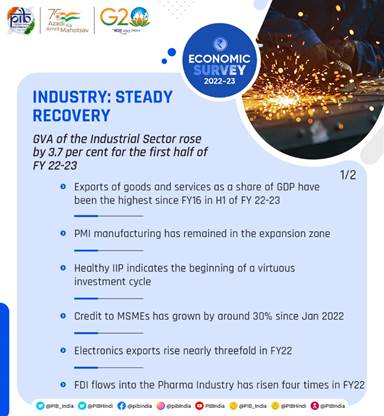
The Overall Gross Value Added (GVA) by the Industrial Sector rose 3.7 per cent, based on data available for the first half of the FY23, which is higher than the average growth of 2.8 per cent achieved in H1 of the last decade, stated the Economic Survey 2022-23 presented by the Union Minister for Finance & Corporate Affairs Smt. Nirmala Sitharaman in Parliament today.

OVERVIEW OF INDUSTRIAL SECTOR

Economic Survey tabled in the Parliament stated that Industry sector witnessed modest growth of 4.1 per cent in FY23 compared to the strong growth of 10.3 per cent in FY22. It explained that this is likely on account of input cost-push pressures, supply chain disruptions and the China lockdown impacting the availability of essential inputs and slowing the global economy.

The Survey highlighted that the PLI schemes are set to unlock manufacturing capacity, boost exports, reduce import dependence and lead to job creation for both skilled and unskilled labour. The Survey was optimistic that easing input prices and conducive demand conditions will support overall Industrial growth.

DEMAND STIMULUS TO INDUSTRIAL GROWTH

Private Final Consumption Expenditure (PFCE) as a share of GDP in H1 of FY23 was the highest among all half years, H1 or H2, since FY15, the Survey stated. The Survey optimistically expressed that with world commodity prices on a downward trajectory and showing up in declining rates of India’s wholesale inflation, core retail inflation is expected to relent, making domestic consumption demand much stronger to further induce industrial growth in the country.

Economic Survey stated that the strong export performance of FY22 continued somewhat in the first half of FY23 while exports of goods and services as a share of GDP have been the highest since FY16 during H1 of FY23.

The Survey warned that export growth may slow further in the second half of the current financial year and remain weak beyond that, too, if the global economy falls into recession. It added that however, the strong domestic consumption growth and investment revival is expected to keep industrial production humming.

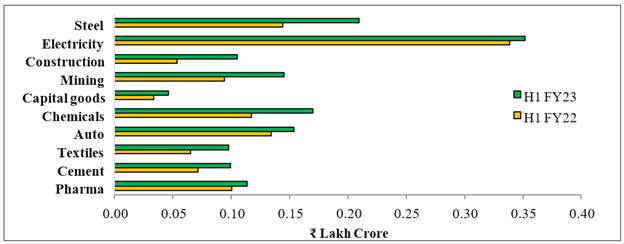
The Survey emphasized that New Investment announced in the manufacturing sector during April-December of FY23 was five times the corresponding level in FY20. The Survey analyzed this increase in investment demand was triggered by the augmented capex of the central government in the current and the previous year as compared to the pre-pandemic years. The leap also has crowded in private investment, already upbeat on the pent-up demand, export stimulus, and strengthening of the corporate balance sheets. It added that Capacity utilization in the manufacturing sector has been rising which bodes well for new investment activity in creating additional capacity.

SUPPLY RESPONSE OF INDUSTRY

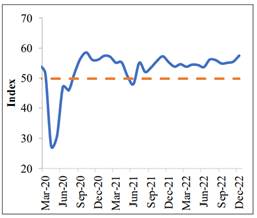
Purchaser’s Manufacturing Index (PMI) manufacturing has remained in the expansion zone for 18 months since July 2021, and its sub-indices indicate an easing of input cost pressures, improving supplier delivery times, robust export orders, and future output, highlighted the Survey.

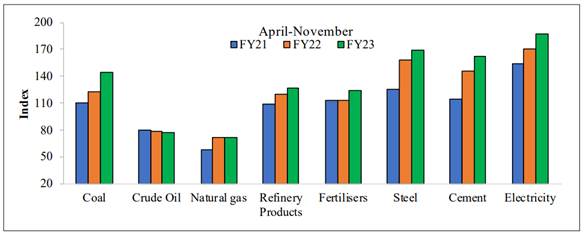
The Survey noted the growth of the eight core industries of coal, fertilizers, cement, electricity, steel, and refinery products has held steady, reflecting a broad momentum in industrial activity.

The Survey added that while growth in the consumer durables component of the Index of Industrial Production (IIP) is on account of the release of ‘pent-up’ demand, the increase in capital goods and infrastructure/ construction goods is indicative of the beginnings of a virtuous investment cycle that is expected to be led by the private sector.

ROBUST GROWTH IN BANK CREDIT TO INDUSTRY

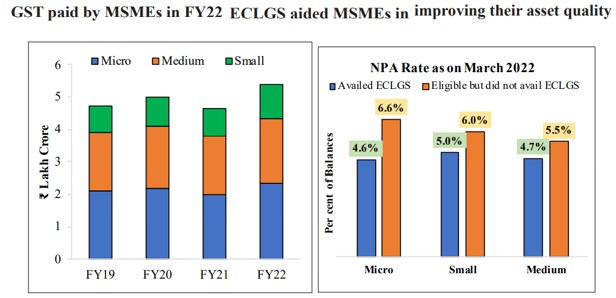
The Survey highlighted that the credit to industry started recovering from January 2022 and has been growing in double digits since July 2022. It added that Credit to MSMEs has also seen a significant increase in part, assisted by the introduction of the Emergency Credit Linked Guarantee Scheme (ECLGS).
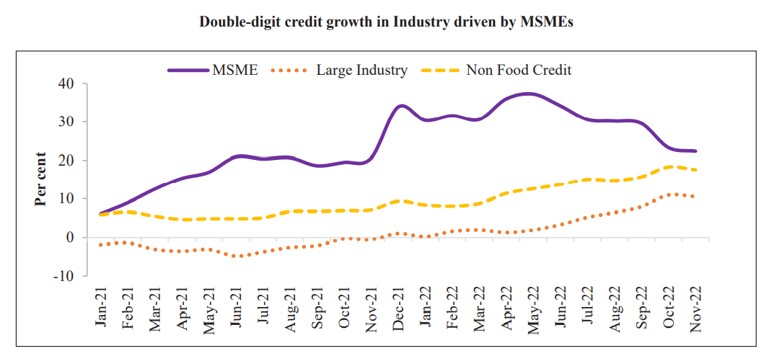
The Survey stated that the impact of ECLGS on increasing the growth of credit to MSME was felt most during the pandemic impacted years of 2020 and 2021. It continued in 2022 as the scheme was extended to March 2023.

Further it added, growth in credit to MSME was buttressed by rebounding consumption levels, particularly in the services sector. Consequently, the share of MSMEs in gross credit offtake to the industry rose from 17.7 per cent in January 2020 to 23.7 per cent in November 2022.

The Survey expressed that robust growth in credit demand combined with rising capacity utilization and investment in manufacturing underscores businesses’ optimism regarding future demand.

RESILIENT FDI INFLOW IN MANUFACTURING SECTOR

The Survey highlighted that the FDI inflow jumped to US$ 21.3 billion in FY22 from US$ 12.1 billion in FY21 as the pandemic-driven expansionary policies of advanced economies led to a surge in global liquidity.
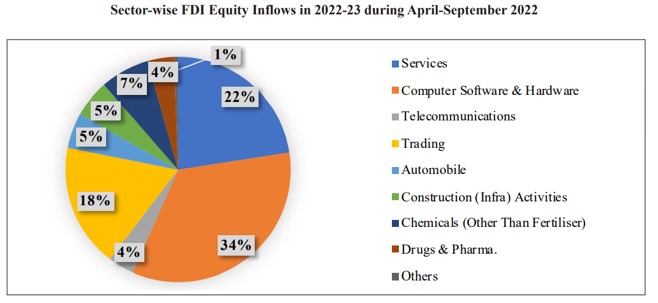
The Survey mentioned that FDI equity inflow in manufacturing in the first half of FY23 fell below its corresponding level in the first half of FY22, with the rise in global uncertainty in the wake of the Russia-Ukraine conflict.

A rebound in FDI inflows is, however, expected as the Indian economy sustains its high growth while monetary tightening the world over eventually eases with the weakening of inflationary pressures, the Survey expressed optimism.

HIGHLIGHTS OF INDUSTRY GROUPS

1. MICRO, SMALL AND MEDIUM ENTERPRISES (MSMEs)

The Survey noted that the MSME contribution to the manufacturing sector’s GVA also marginally fell to 36.0 per cent in FY21. The Survey further emphasized that the AatmaNirbhar Bharat Package by the Government provided cushion to the economic impact of the pandemic on MSMEs, which has helped post smart recovery from pandemic.

The Survey expressed that the recovery of the MSME sector from the pandemic-induced shock is evident in the trend in GST paid by the units of MSME sector in FY22 has crossed the pre-pandemic level in FY20.

Government’s initiative of the Samadhaan Portal, CHAMPIONS:the single-window grievance redressal portal for MSMEs, Trade Receivables Discounting System (TReDS) platform for facilitating the discounting of trade receivables of MSMEs with a turnover of ₹200 crore or more, ‘Raising and Accelerating MSME Performance’ scheme (RAMP) etc. has helped in strengthening the MSMEs stated the Economic Survey.
      

2. ELECTRONICS INDUSTRY

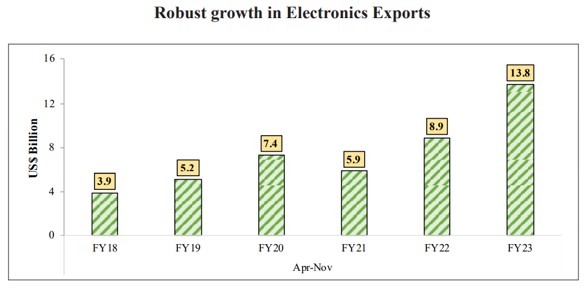
The Survey emphasized that Electronic goods were among the top five commodity groups exhibiting positive export growth in November 2022, with the exports in this segment growing YoY by 55.1 per cent.

Elaborating on the Electronics industry, the Survey stated that major drivers were mobile phones, consumer electronics and industrial electronics. It highlighted that India has become the second-largest mobile phone manufacturer globally, with the production of handsets going up from six crore units in FY15 to 31 crore units in FY22.
The Survey also mentioned that various initiatives and incentives of Government like PLI scheme for Large Scale Electronics Manufacturing, the PLI scheme for IT hardware, the Scheme for Promotion of Manufacturing of Electronic Components and Semiconductors (SPECS) has nurtured and enhanced the electronics manufacturing base.

Additionally, under the Programme for Development of Semiconductors and Display Manufacturing Ecosystem in India, the Cabinet approved the comprehensive development of a sustainable semiconductor and display ecosystem in the country with an outlay of ₹76,000 crore.

3. COAL INDUSTRY

The coal production for FY23 is estimated to increase to 911 million tonnes, about 17 per cent higher compared to the previous year, highlighted the Survey. Consequent to the well-timed measures of the Government, India has been placed in a better position to cater to excess energy demand. It further added that the coal industry is expected to grow at 6-7 per cent annually to reach a production level of 1 billion tonnes by FY26 and about 1.5 billion tonnes by 2030.

4. STEEL INDUSTRY

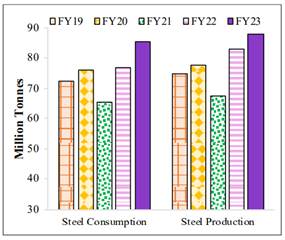
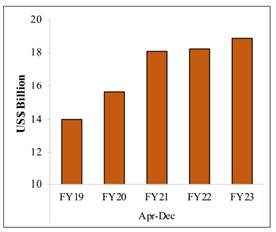
Economic Survey highlighted the steel sector’s performance in the current fiscal year as robust, with cumulative production and consumption of finished steel at 88 MT and 86 MT, respectively, during April-December 2022, higher than the corresponding period during the previous four years.

The Survey stated that iron and steel exports are higher by 20 per cent over the corresponding pre-pandemic levels of FY20, despite moderation in the first eight months of the current fiscal owing to a slowdown in the global economy.

Increasing Steel production and Consumption (Apr-Dec)
5. TEXTILE INDUSTRY

In the current financial year, the textile industry has been facing the challenge of moderating exports compared to FY22, mentioned the Survey. It added that export of readymade garments registered a growth of 3.2 per cent YoY basis during the same period.

The Government approved the setting up of seven PM Mega Integrated Textile Region and Apparel (PM MITRA) Parks and launched the Textile PLI Scheme with an approved outlay of ₹10,683 crore over five years starting from 1st January 2022 to promote investments. These would help to develop integrated large-scale and modern industrial infrastructure facilities for the entire value chain of the textile industry, the Survey stated.

6. PHARMACEUTICALS INDUSTRY

The Survey highlighted that Indian pharmaceutical exports achieved a healthy growth of 24 per cent in FY21. It expressed hope that India’s domestic pharmaceutical market is estimated to grow to US$ 65 billion by 2024 from estimated US$ 41 billion in 2021 and is further expected to reach US$ 130 billion by 2030.

Strong Growth in pharma exports     
 High Inflow of FDI in Pharma sector
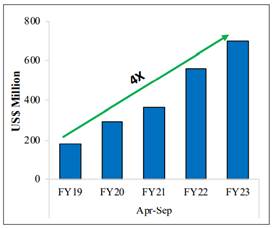
       

Carrying forward this growth momentum, drug and pharmaceutical exports during April-October 2022 was 22 per cent higher than the corresponding pre-pandemic period of FY20, noted the Survey. It added that Cumulative FDI in the pharma sector crossed the US$ 20 billion mark in September 2022 and FDI inflows have increased four-fold over five years until September 2022, to US$ 699 million, supported by investor-friendly policies and a positive outlook for the industry.

7. AUTOMOBILE INDUSTRY

India became the 3rd largest automobile market, surpassing Japan and Germany in terms of sales, in December 2022, stated the Economic Survey. It added that in 2021, India was the largest manufacturer of two-wheeler and three-wheeler vehicles and the world’s fourth-largest manufacturer of passenger cars.

Elaborating on the domestic electric vehicles (EV) market, the Survey stated that it is expected to grow at a compound annual growth rate (CAGR) of 49 per cent between 2022 and 2030 and is expected to hit one crore units annual sales by 2030. It added that the EV industry will create 5 crore direct and indirect jobs by 2030.

FOSTERING INNOVATION 

Economic Survey stated that there was a 46 per cent growth in the domestic filing of patents over 2016-2021, signaling India’s transition towards a knowledge-based economy.

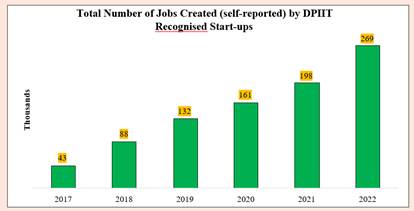
Discussing the achievements of Start-ups, the Survey highlighted that an impressive 9 lakh+ direct jobs have been created by the DPIIT recognized startups (self-reported), with a notable 64 per cent increase in 2022 over the average number of new jobs created in the last three years. About 48 per cent of our startups are from Tier II & III cities, a testimony of our grassroots’ tremendous potential.
INDUSTRY 4.0

The Survey highlighted that adoption of Industry 4.0 technologies such as cloud computing, IoT, machine learning, and artificial intelligence (AI) in the Indian manufacturing sector is underway, however, large-scale adoption is yet to happen and an enabling environment is rapidly developing.

The Survey mentioned that various Government Initiatives such as SAMARTH (Smart Advanced Manufacturing and Rapid Transformation Hubs) Udyog Bharat 4.0, establishment of the Centre for Fourth Industrial Revolution is the way forward in achieving the goals of Aatmanirbharta and its ambitions of becoming a key player in global value chains.

MAKE IN INDIA 2.0

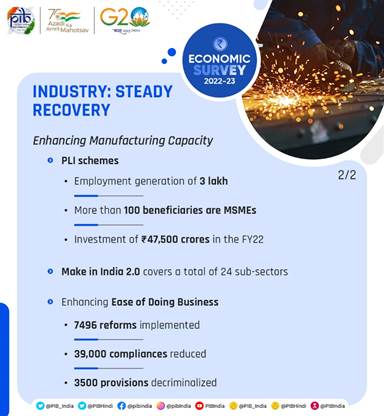
The Survey mentioned that ‘Make in India 2.0’ is now focusing on 27 sectors, which include 15 manufacturing sectors and 12 service sectors. Amongst these, 24 sub-sectors have been chosen while keeping in mind the Indian industries’ strengths and competitive edge, the need for import substitution, the potential for export and increased employability.

PERFORMANCE LINKED INCENTIVE (PLI) SCHEME

PLI scheme is expected to attract a capex of approximately ₹4 lakh crore over the next five years having a potential of generate employment for over 60 lakh in India stated the Economic Survey. It added that Sectors under which the PLI scheme has been announced currently constitute around 40 per cent of the total imports. The scheme, spread across 14 sectors, can enhance India’s annual manufacturing capex by 15 to 20 per cent from FY23.

The Survey mentioned that around ₹47,500 crore (US$ 6 billion) of actual investment has been made (As per recent reporting from implementing Ministries/ Departments); production/ sales of ₹3.85 lakh crore (US$ 47 billion) of eligible products and employment generation of around 3 lakh has been reported and 106 per cent achievement of actual investment reported versus the corresponding projections of FY22.

The Survey stated that more than 100 MSMEs are among the PLI beneficiaries in sectors such as Bulk Drugs, Medical Devices, Telecom, White Goods and Food Processing. Key sectors such as Large-Scale Electronics Manufacturing, Pharmaceuticals, Telecom & Networking Products, Food Processing and White Goods have contributed considerably to investment, production, sales and employment.
Topics

Acts Income Tax

