

Loading...

Top
Help
Draft a reply to a
tax notice — free 🎉

150 credits · 30 days · No card needed

• Basic Search 1 Credit
• Advanced Search 3 Credits
• Drafter 20 to extract + 25 per issue
(≈ up to 2-3 drafts on us)

Already used our earlier 20-Credit Demo?
You are still eligible for this new 150-Credit Demo.

Activate your FREE Demo
×

By creating an account you can:

Logo TaxTMI
Call Us / Help / Feedback

Contact Us At :

E-mail: [email protected]

Call / WhatsApp at: +91 99117 96707

For more information, Check Contact Us

FAQs :

To know Frequently Asked Questions, Check FAQs

Most Asked Video Tutorials :

For more tutorials, Check Video Tutorials

Submit Feedback/Suggestion :

Email :
Please provide your email address so we can follow up on your feedback.
Category :
Description :
Min 15 characters 0/2000
Make Most of Text Search
  1. Checkout this video tutorial: How to search effectively on TaxTMI.
  2. Put words in double quotes for exact word search, eg: "income tax"
  3. Avoid noise words such as : 'and, of, the, a'
  4. Sort by Relevance to get the most relevant document.
  5. Press Enter to add multiple terms/multiple phrases, and then click on Search to Search.
  6. Text Search
  7. The system will try to fetch results that contains ALL your words.
  8. Once you add keywords, you'll see a new 'Search In' filter that makes your results even more precise.
  9. Text Search
Add to...
You have not created any category. Kindly create one to bookmark this item!
Create New Category
Hide
Title :
Description :
❮❮ Hide
Default View
Expand ❯❯
Close ✕
🔎 News - Adv. Search
TEXT SEARCH:

Press 'Enter' to add multiple search terms. Rules for Better Search

Search In:
Main Text + AI Text
  • Main Text
  • Main Text + AI Text
  • AI Text
Category: ?
Categorized by AI
---- All Categories ----
  • ---- All Categories ----
  • Income Tax
  • GST
  • Customs, DGFT & SEZ
  • FEMA & RBI
  • Corp. Laws, SEBI & IBC
  • PMLA, Black Money & ED
  • Budget
  • News and Press Release
  • PTI News
Month:
---- All Months ----
  • ---- All Months ----
  • January
  • February
  • March
  • April
  • May
  • June
  • July
  • August
  • September
  • October
  • November
  • December
Year:
---- All Years ----
  • ---- All Years ----
  • 2026
  • 2025
  • 2024
  • 2023
  • 2022
  • 2021
  • 2020
  • 2019
  • 2018
  • 2017
  • 2016
  • 2015
  • 2014
  • 2013
  • 2012
  • 2011
Sort By: ?
In Sort By 'Default', exact matches for text search are shown at the top, followed by the remaining results in their regular order.
Relevance Default Date
    'Not haircut but mundan': Cong on NCLT clearing Subhash Chandra's Rs 6.5 crore payout
    Keralam: Escaped Assam prisoner reaches police station for Aadhaar card, flees again
    Women's Savings Account: Features that make opening one worth it
    Best Pension Plans and Annuity Plans in India 2026: A Full Comparison
    Rupee rises 4 paise to 95.40 against US dollar in early trade
    Minister of State for Commerce and Industry and Electronics & Information Technology Shri Jitin Prasada Concludes Official Visit to Morocco; Co-Chairs...
    Hyderabad police caution citizens against ''Hybrid Cyber Fraud''
    Hoping to work towards further expanding scope of India-Japan trade pact: Goyal
    Bajaj Finance Personal Loan Offers Limited-Time Rewards During Loan Utsav 2026
    Commerce and Industry Minister Shri Piyush Goyal Highlights India’s Growing Startup Ecosystem at India–Japan Startup Roundtable in Tokyo
    Sugar prices rise again by Re 1 per kg to Rs 65 in retail market
    SIDBI organizes a conclave of the Heads of Regional Rural Banks (RRBs) on expanding SIDBI-RRB MSME Co-Lending arrangement
    SC sets aside show cause notice to Tata Steel over input tax credit availed during FY19-23
    HC flags fraudulent use of Aadhaar by infiltrators to get Indian citizenship; calls for action
    IVCA Welcomes Consultative Approach on Draft FEMA NDI Rules
    India to be among top 5 Nestle markets in coming years, a major export hub : Global CEO
    Build Credit Awareness with a Free Credit Score Check from Bajaj Finance
    CARD91 Introduces Five-Point Credit Lifecycle Consistency Framework for Credit Line on UPI
    RBI's Proposed Shift from Revolving Credit to Term Loans: SwiffyLabs Lending Platform Already Supports the New Construct
❯❯
Maximize Maximize Maximize
0 / 200
Expand Note
Add to Folder

No Folders have been created

+

Are you sure you want to delete "My most important" ?

NOTE:

News
Showing Results for :
Reset Filters
Results Found:
Show All Summaries Hide All Summaries
August 27, 2026
Show AI Summary
Personal insolvency repayment plans may be approved despite minimal creditor recovery when requisite voting support and comparative valuation support them.
Personal insolvency repayment plan approval was granted under the Insolvency and Bankruptcy Code, 2016, despite objections that creditor recoveries were negligible and the proposed payment uncertain. The plan received 80.81 per cent voting support, while dissenting creditors held less than 20 per cent voting share. Valuation showed that the debtor's personal estate was materially below the offered amount, and rejection could result in bankruptcy and lower recovery. Assessment of settlement adequacy was treated as a matter of creditor commercial wisdom.
August 27, 2026
Show AI Summary
Prison escape security lapses prompt coordinated tracing measures, transport monitoring, inter-state alerts, and a detailed custodial-security inquiry.
Prison escape and custodial-security lapses arose after a detainee escaped from Aluva Sub Jail, allegedly by using an under-construction structure within the premises to cross the compound wall. Following his later appearance at a police station seeking return of his Aadhaar card, search measures included a lookout circular, information sharing with police stations, railway-security coordination, and alerting police in Assam. A detailed inquiry has been initiated into the prison-security deficiencies enabling the escape.
August 27, 2026
Show AI Summary
Women's savings account selection depends on practical benefits, charges, eligibility, and banking needs rather than the account label.
Women's Savings Accounts may provide standard banking facilities together with additional services or benefits for eligible women. Their suitability depends on practical use of digital banking, transfers, payments, alerts, debit-card facilities, accessibility, security features, charges, and minimum-balance conditions. Since regular Savings Accounts may offer comparable facilities, the additional benefits should be assessed against associated costs and conditions. Selection should be based on comparison of eligibility, facilities, balance requirements, benefits, customer support, and authentication safeguards rather than the account's women-focused label alone.
August 27, 2026
Show AI Summary
Retirement annuity selection prioritises payout structure, taxation, insurer strength and flexibility over brand comparison for informed retirement decisions.
Retirement planning may combine market-linked accumulation during working years, deferred annuities that lock future guaranteed income, and immediate annuities that convert retirement savings into regular payments. Annuity choice depends on whether the priority is higher income, continuation for a surviving spouse, or return of capital on death. Product comparison should consider market-linked growth versus income certainty, taxation of annuity income at applicable slab rates, insurer strength, and flexibility in deferment, payout frequency and policy loans.
August 27, 2026
Show AI Summary
Foreign exchange inflows through deposit and borrowing measures provided near-term rupee support amid lower crude prices.
Reserve Bank special measures relating to FCNR(B) deposits, Overseas Foreign Currency Borrowings and External Commercial Borrowings were identified as attracting foreign-exchange inflows and providing near-term support to the rupee. The Reserve Bank became a net dollar buyer in June after two months of sales to support the rupee. The FCNR(B) window remained open until August 31, while the market outlook anticipated broader rupee depreciation over subsequent weeks.
August 27, 2026
Show AI Summary
Preferential trade agreement exploration advances bilateral market access, pharmaceutical cooperation, investment partnerships, and diversified trade.
India-Morocco economic cooperation is expanded through the seventh Joint Commission framework, targeting deeper and more diversified trade, investment, industrial collaboration and market access across goods and services. An India-Morocco Joint Working Group is to examine bilateral trade opportunities and the feasibility of a preferential trade agreement, including tariff and non-tariff barriers, improved market access and trade facilitation. Cooperation also addresses pharmaceutical market authorisation and approval timelines, food safety, sustainable agriculture, renewable energy, artificial intelligence, healthcare, and phosphates and fertilisers.
August 26, 2026
Show AI Summary
Hybrid cyber fraud exploits stolen smartphones and intercepted verification codes to compromise digital banking and payment accounts.
Hybrid cyber fraud combines physical smartphone theft with digital financial exploitation. Offenders obtain screen-lock credentials, steal devices and use control of the active SIM card to intercept verification codes and reset UPI and digital banking credentials. Preventive measures include withholding PINs, passwords and OTPs; avoiding storage of financial and identity records on phones; and immediately blocking the SIM card and freezing digital banking and UPI services after a theft.
August 26, 2026
Show AI Summary
CEPA review aims to expand bilateral trade engagement, address export barriers, and support regulatory registrations for exporters.
India and Japan are considering a review of the Comprehensive Economic Partnership Agreement to make the bilateral trade framework more contemporary and expand its scope, scale and commercial opportunities. The review is linked to balanced trade and to identifying export barriers arising from procedural requirements, language issues and time involved in market access. Regulatory compliance assistance may support product registrations required for overseas markets, including costly chemical registrations and pharmaceutical registrations.
August 26, 2026
Show AI Summary
Personal loan reward eligibility depends on successful campaign-period disbursal, alongside review of borrowing costs and repayment capacity.
Loan Utsav 2026 provides a limited-period reward bundle to eligible customers whose personal loan is successfully disbursed during the campaign period, subject to applicable terms and conditions. Personal loans are collateral-free and available subject to eligibility, customer profile, documentation and applicable loan terms. Applicants may choose a loan amount and repayment tenure based on their requirements. Extended tenures can reduce monthly EMI obligations but may increase total interest payable. Customers should review interest rates, EMI, processing charges, other loan costs and repayment capacity before accepting a loan offer.
August 26, 2026
Show AI Summary
Deep-tech investment cooperation advances through capital corridors, innovation bridges, manufacturing integration and startup pitching platforms for cross-border growth.
India-Japan startup cooperation is proposed to advance through a deep-tech capital corridor, a two-way innovation bridge, manufacturing and technology integration, and joint startup pitching platforms. Collaboration is directed towards patient capital, early-stage research, deep-tech commercialisation, technology validation, precision manufacturing, investment and market access. The partnership also emphasises MSME integration with startups and global supply chains, co-investment mechanisms, plug-and-play infrastructure, and institutional links among universities, research institutions, incubators and industry.
August 26, 2026
Show AI Summary
Sugar price-control measures combine raw-sugar imports, stockholding limits and export restrictions to curb retail price pressures.
Sugar price-control measures combine authorised raw-sugar imports, stockholding limits for dealers and bulk consumers, and an existing export prohibition to address elevated domestic prices. Imports are permitted within the specified period, while stockholding restrictions seek to curb speculation and hoarding. Retail prices continued to rise despite lower ex-mill prices, and the regulatory approach focuses on augmenting supply, limiting stock accumulation, and preventing export-related pressure on domestic availability.
August 26, 2026
Show AI Summary
Alternative dispute resolution enabled settlement of long-pending disputes, alongside reporting on court administration and regulatory compliance concerns.
Legal developments include resolution of long-pending tenancy, commercial and property disputes through a special Lok Adalat mechanism, including a digitally signed international settlement. Other matters concern a challenge to a riot-related murder conviction, allegations of administrative irregularities and selective case listing, fast-track court pendency, cancellation of a recruitment process following suspected examination malpractice, fraudulent identity documents used to claim citizenship, medical-qualification standards, and opposition to uranium exploration and mining.
August 26, 2026
Show AI Summary
MSME co-lending supports digital paperless credit delivery through rural banks for underserved rural and semi-urban enterprises.
SIDBI-RRB MSME co-lending arrangement is proposed for expansion to increase credit access for micro, small and medium enterprises in rural and semi-urban areas. The arrangement combines SIDBI's understanding of MSME credit requirements with Regional Rural Banks' local reach. SIDBI's Co-Lending Origination Platform provides an end-to-end digital credit process intended to enable faster, paperless loan processing, in-principle sanction communication, documentation and direct account disbursement without branch visits.
August 26, 2026
Show AI Summary
Input tax credit mismatch alone cannot support fraud-based GST demand without an assessing officer's recorded satisfaction of fraud or suppression.
Section 74 GST demand proceedings require the assessing officer's independent satisfaction of fraud, wilful misstatement or suppression of facts. An input tax credit mismatch or alleged short payment alone cannot establish these conditions. Unsupported assertions of suppression for invoking extended limitation are insufficient, and audit objections cannot replace the assessing officer's satisfaction. A show cause-cum-demand notice lacking factual allegations of a deliberate device to evade tax or avail excess input tax credit is vulnerable.
August 26, 2026
Show AI Summary
Fraudulent Aadhaar procurement exposes identity-verification gaps and prompts disclosure, expedited investigation, deportation, and statutory review measures.
Fraudulent procurement of Aadhaar and other identity documents by foreign nationals who infiltrate borders may undermine identity verification, immigration control and national security. Coordinated action is required to trace and deport such persons, prevent re-entry, strengthen document verification, and complete investigations without delay. Amendments to the Aadhaar Act are to be considered to assist investigating agencies, while a dedicated procedure is required to address border infiltration and human trafficking. Aadhaar enrolment records are to be supplied to police, followed by timely deportation proceedings.
August 26, 2026
Show AI Summary
Foreign investment liberalisation proposals receive industry support, subject to preserving AIF treatment, grandfathering, and prospective application.
Proposed foreign-investment liberalisation, including treatment of stakes below 10 per cent and a greater role for market forces in valuation, is welcomed. Preservation of the existing treatment of Alternative Investment Funds under the IOCC framework is emphasised, together with grandfathering of transactions and funds undertaken under the current regulatory position. Newly introduced requirements should operate prospectively to support a simpler, predictable and investment-friendly foreign-investment framework.
August 26, 2026
Show AI Summary
India market expansion guides Nestle 's volume-led growth, export-hub development and long-term investment without compromising product quality.
Nestle 's India strategy focuses on volume-led growth, wider consumer reach, portfolio development, efficiency improvements and sustained long-term investment. Growth is intended to combine increased household penetration with pricing, premiumisation, affordability and value offerings. India is also intended to develop further as a production and export hub for global markets, supported by manufacturing capacity and expanding overseas supplies. Product quality and consumer interests remain constraints on the pace of expansion.
August 26, 2026
Show AI Summary
Credit awareness through regular score and report review supports responsible borrowing, error detection, and informed credit management.
Free online access to the Credit Pulse Report is available through the Bajaj Finance website. Users verify their registered mobile number through OTP authentication, provide identifying particulars including PAN and date of birth, and then view the available credit score. The report may be reviewed and downloaded to examine repayment history, active credit accounts, recent enquiries and other recorded credit information. Periodic review can help identify unfamiliar accounts, inaccurate repayment records, overdue amounts, unupdated information and changes in credit utilisation.
August 26, 2026
Show AI Summary
Credit lifecycle consistency requires facility-specific treatment so UPI-linked credit records, repayments and customer obligations remain aligned.
CARD91's Credit Lifecycle Consistency Framework calls for facility-specific treatment of Credit Line on UPI transactions and continuing credit events. Credit limits, outstanding balances, repayments, refunds, reversals and EMI conversions should be accurately connected to the relevant customer account and applied according to the underlying facility's terms. Bank policy, customer consent, transaction controls and portfolio actions should remain aligned. Customer-facing applications, statements and alerts should consistently reflect available credit, outstanding obligations and repayment schedules, while disputes and manual corrections follow documented, reviewable processes.
August 26, 2026
Show AI Summary
Non-revolving credit lines require term-loan structures supporting multiple drawdowns without replenishing sanctioned limits for NBFC lending products.
Proposed restrictions on revolving credit facilities for most NBFCs would generally require credit products to operate as term loans, rather than facilities in which principal repayment automatically restores the available borrowing limit. Compliance may require technology capable of managing multiple drawdowns within an approved sanction, separate repayment schedules, amortisation and servicing workflows, while preventing repaid principal from replenishing the sanctioned limit.

News

Back

All News

Showing Results for :
Reset Filters
No Records Found

News

Showing Results for : Reset Filters

INDUSTRIAL SECTOR GROSS VALUE ADDED (GVA) ROSE BY 3.7 PER CENT IN FIRST HALF OF FY23

January 31, 2023

Contents
Summary
Note

Note

-

Bookmark

Print

Print

INDUSTRIAL SECTOR GROSS VALUE ADDED (GVA) ROSE BY 3.7 PER CENT IN FIRST HALF OF FY23

PRIVATE FINAL CONSUMPTION EXPENDITURE (PFCE) AS A SHARE OF GDP IN H1 OF FY23 WAS HIGHEST AMONG ALL HALF YEARS SINCE FY15

FDI INFLOW AT US$ 21.3 BILLION IN FY22 MARKING 76 PER CENT RISE FROM FY21

INDIAN PHARMACEUTICAL EXPORTS ACHIEVED 24 PER CENT GROWTH IN FY21

CUMULATIVE FDI IN PHARMA SECTOR CROSSED US$ 20 BILLION MARK BY SEPTEMBER 2022

COAL PRODUCTION FOR FY23 ESTIMATED TO INCREASE TO 911 MILLION TONNES

INDIA IS NOW THE 3RD LARGEST AUTOMOBILE MARKET

INDIA IS 2ND LARGEST MOBILE PHONE MANUFACTURER GLOBALLY

CREDIT TO INDUSTRY GROWING, PARTICULARLY FOR MSMEs

PLI SCHEME EXPECTED TO ATTRACT CAPEX OF APPROX ₹4 LAKH CRORE OVER THE NEXT FIVE YEARS

INDUSTRY 4.0 IS INDIA’S WAY FORWARD IN ACHIEVING THE GOALS OF AATMANIRBHARTA AND AMBITIONS OF BECOMING A KEY PLAYER IN GLOBAL VALUE CHAINS

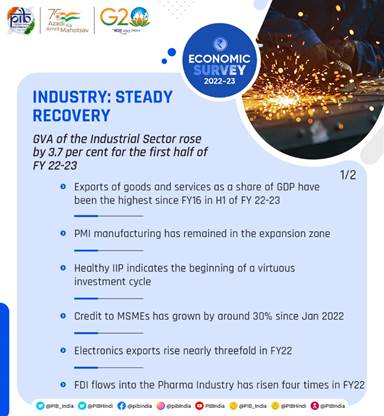
The Overall Gross Value Added (GVA) by the Industrial Sector rose 3.7 per cent, based on data available for the first half of the FY23, which is higher than the average growth of 2.8 per cent achieved in H1 of the last decade, stated the Economic Survey 2022-23 presented by the Union Minister for Finance & Corporate Affairs Smt. Nirmala Sitharaman in Parliament today.

OVERVIEW OF INDUSTRIAL SECTOR

Economic Survey tabled in the Parliament stated that Industry sector witnessed modest growth of 4.1 per cent in FY23 compared to the strong growth of 10.3 per cent in FY22. It explained that this is likely on account of input cost-push pressures, supply chain disruptions and the China lockdown impacting the availability of essential inputs and slowing the global economy.

The Survey highlighted that the PLI schemes are set to unlock manufacturing capacity, boost exports, reduce import dependence and lead to job creation for both skilled and unskilled labour. The Survey was optimistic that easing input prices and conducive demand conditions will support overall Industrial growth.

DEMAND STIMULUS TO INDUSTRIAL GROWTH

Private Final Consumption Expenditure (PFCE) as a share of GDP in H1 of FY23 was the highest among all half years, H1 or H2, since FY15, the Survey stated. The Survey optimistically expressed that with world commodity prices on a downward trajectory and showing up in declining rates of India’s wholesale inflation, core retail inflation is expected to relent, making domestic consumption demand much stronger to further induce industrial growth in the country.

Economic Survey stated that the strong export performance of FY22 continued somewhat in the first half of FY23 while exports of goods and services as a share of GDP have been the highest since FY16 during H1 of FY23.

The Survey warned that export growth may slow further in the second half of the current financial year and remain weak beyond that, too, if the global economy falls into recession. It added that however, the strong domestic consumption growth and investment revival is expected to keep industrial production humming.

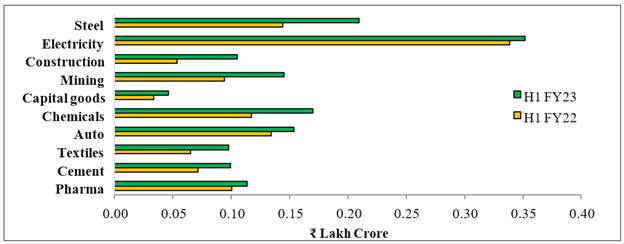
The Survey emphasized that New Investment announced in the manufacturing sector during April-December of FY23 was five times the corresponding level in FY20. The Survey analyzed this increase in investment demand was triggered by the augmented capex of the central government in the current and the previous year as compared to the pre-pandemic years. The leap also has crowded in private investment, already upbeat on the pent-up demand, export stimulus, and strengthening of the corporate balance sheets. It added that Capacity utilization in the manufacturing sector has been rising which bodes well for new investment activity in creating additional capacity.

SUPPLY RESPONSE OF INDUSTRY

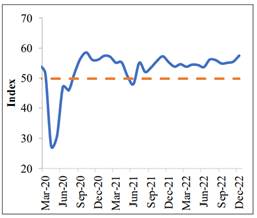
Purchaser’s Manufacturing Index (PMI) manufacturing has remained in the expansion zone for 18 months since July 2021, and its sub-indices indicate an easing of input cost pressures, improving supplier delivery times, robust export orders, and future output, highlighted the Survey.

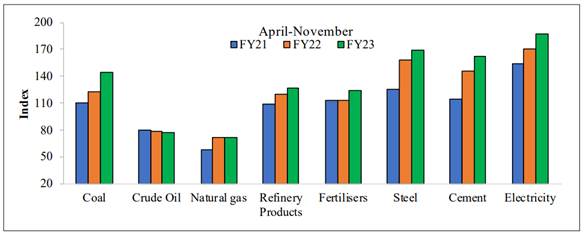
The Survey noted the growth of the eight core industries of coal, fertilizers, cement, electricity, steel, and refinery products has held steady, reflecting a broad momentum in industrial activity.

The Survey added that while growth in the consumer durables component of the Index of Industrial Production (IIP) is on account of the release of ‘pent-up’ demand, the increase in capital goods and infrastructure/ construction goods is indicative of the beginnings of a virtuous investment cycle that is expected to be led by the private sector.

ROBUST GROWTH IN BANK CREDIT TO INDUSTRY

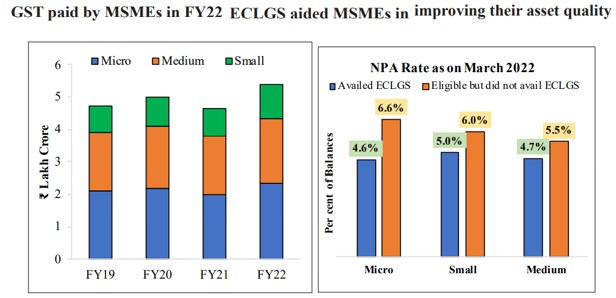
The Survey highlighted that the credit to industry started recovering from January 2022 and has been growing in double digits since July 2022. It added that Credit to MSMEs has also seen a significant increase in part, assisted by the introduction of the Emergency Credit Linked Guarantee Scheme (ECLGS).
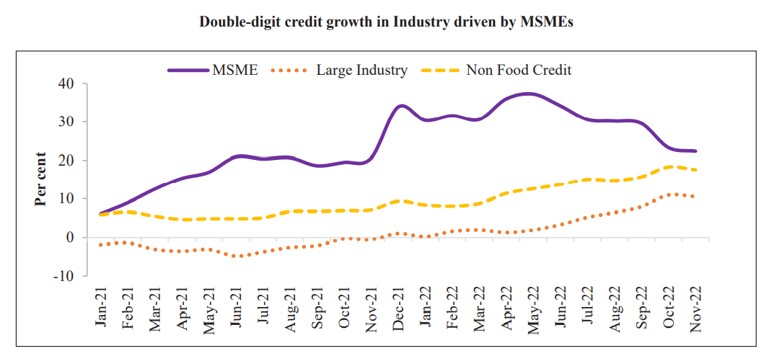
The Survey stated that the impact of ECLGS on increasing the growth of credit to MSME was felt most during the pandemic impacted years of 2020 and 2021. It continued in 2022 as the scheme was extended to March 2023.

Further it added, growth in credit to MSME was buttressed by rebounding consumption levels, particularly in the services sector. Consequently, the share of MSMEs in gross credit offtake to the industry rose from 17.7 per cent in January 2020 to 23.7 per cent in November 2022.

The Survey expressed that robust growth in credit demand combined with rising capacity utilization and investment in manufacturing underscores businesses’ optimism regarding future demand.

RESILIENT FDI INFLOW IN MANUFACTURING SECTOR

The Survey highlighted that the FDI inflow jumped to US$ 21.3 billion in FY22 from US$ 12.1 billion in FY21 as the pandemic-driven expansionary policies of advanced economies led to a surge in global liquidity.
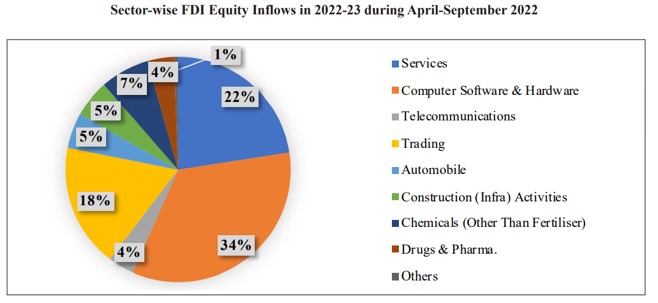
The Survey mentioned that FDI equity inflow in manufacturing in the first half of FY23 fell below its corresponding level in the first half of FY22, with the rise in global uncertainty in the wake of the Russia-Ukraine conflict.

A rebound in FDI inflows is, however, expected as the Indian economy sustains its high growth while monetary tightening the world over eventually eases with the weakening of inflationary pressures, the Survey expressed optimism.

HIGHLIGHTS OF INDUSTRY GROUPS

1. MICRO, SMALL AND MEDIUM ENTERPRISES (MSMEs)

The Survey noted that the MSME contribution to the manufacturing sector’s GVA also marginally fell to 36.0 per cent in FY21. The Survey further emphasized that the AatmaNirbhar Bharat Package by the Government provided cushion to the economic impact of the pandemic on MSMEs, which has helped post smart recovery from pandemic.

The Survey expressed that the recovery of the MSME sector from the pandemic-induced shock is evident in the trend in GST paid by the units of MSME sector in FY22 has crossed the pre-pandemic level in FY20.

Government’s initiative of the Samadhaan Portal, CHAMPIONS:the single-window grievance redressal portal for MSMEs, Trade Receivables Discounting System (TReDS) platform for facilitating the discounting of trade receivables of MSMEs with a turnover of ₹200 crore or more, ‘Raising and Accelerating MSME Performance’ scheme (RAMP) etc. has helped in strengthening the MSMEs stated the Economic Survey.
      

2. ELECTRONICS INDUSTRY

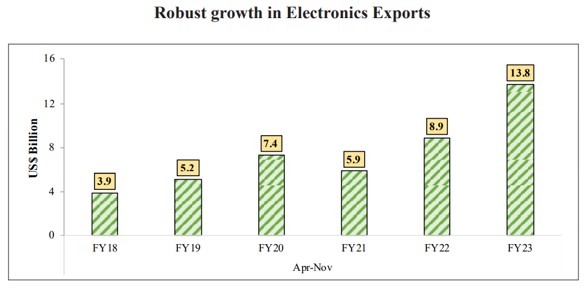
The Survey emphasized that Electronic goods were among the top five commodity groups exhibiting positive export growth in November 2022, with the exports in this segment growing YoY by 55.1 per cent.

Elaborating on the Electronics industry, the Survey stated that major drivers were mobile phones, consumer electronics and industrial electronics. It highlighted that India has become the second-largest mobile phone manufacturer globally, with the production of handsets going up from six crore units in FY15 to 31 crore units in FY22.
The Survey also mentioned that various initiatives and incentives of Government like PLI scheme for Large Scale Electronics Manufacturing, the PLI scheme for IT hardware, the Scheme for Promotion of Manufacturing of Electronic Components and Semiconductors (SPECS) has nurtured and enhanced the electronics manufacturing base.

Additionally, under the Programme for Development of Semiconductors and Display Manufacturing Ecosystem in India, the Cabinet approved the comprehensive development of a sustainable semiconductor and display ecosystem in the country with an outlay of ₹76,000 crore.

3. COAL INDUSTRY

The coal production for FY23 is estimated to increase to 911 million tonnes, about 17 per cent higher compared to the previous year, highlighted the Survey. Consequent to the well-timed measures of the Government, India has been placed in a better position to cater to excess energy demand. It further added that the coal industry is expected to grow at 6-7 per cent annually to reach a production level of 1 billion tonnes by FY26 and about 1.5 billion tonnes by 2030.

4. STEEL INDUSTRY

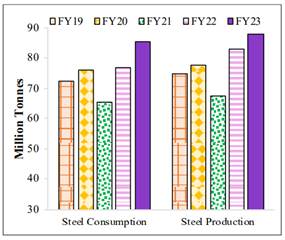
Economic Survey highlighted the steel sector’s performance in the current fiscal year as robust, with cumulative production and consumption of finished steel at 88 MT and 86 MT, respectively, during April-December 2022, higher than the corresponding period during the previous four years.

The Survey stated that iron and steel exports are higher by 20 per cent over the corresponding pre-pandemic levels of FY20, despite moderation in the first eight months of the current fiscal owing to a slowdown in the global economy.

Increasing Steel production and Consumption (Apr-Dec)
5. TEXTILE INDUSTRY

In the current financial year, the textile industry has been facing the challenge of moderating exports compared to FY22, mentioned the Survey. It added that export of readymade garments registered a growth of 3.2 per cent YoY basis during the same period.

The Government approved the setting up of seven PM Mega Integrated Textile Region and Apparel (PM MITRA) Parks and launched the Textile PLI Scheme with an approved outlay of ₹10,683 crore over five years starting from 1st January 2022 to promote investments. These would help to develop integrated large-scale and modern industrial infrastructure facilities for the entire value chain of the textile industry, the Survey stated.

6. PHARMACEUTICALS INDUSTRY

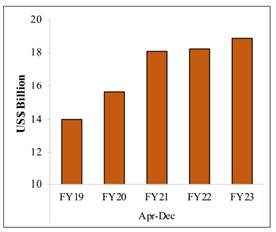
The Survey highlighted that Indian pharmaceutical exports achieved a healthy growth of 24 per cent in FY21. It expressed hope that India’s domestic pharmaceutical market is estimated to grow to US$ 65 billion by 2024 from estimated US$ 41 billion in 2021 and is further expected to reach US$ 130 billion by 2030.

Strong Growth in pharma exports     
 High Inflow of FDI in Pharma sector
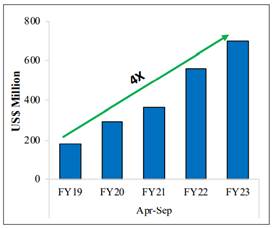
       

Carrying forward this growth momentum, drug and pharmaceutical exports during April-October 2022 was 22 per cent higher than the corresponding pre-pandemic period of FY20, noted the Survey. It added that Cumulative FDI in the pharma sector crossed the US$ 20 billion mark in September 2022 and FDI inflows have increased four-fold over five years until September 2022, to US$ 699 million, supported by investor-friendly policies and a positive outlook for the industry.

7. AUTOMOBILE INDUSTRY

India became the 3rd largest automobile market, surpassing Japan and Germany in terms of sales, in December 2022, stated the Economic Survey. It added that in 2021, India was the largest manufacturer of two-wheeler and three-wheeler vehicles and the world’s fourth-largest manufacturer of passenger cars.

Elaborating on the domestic electric vehicles (EV) market, the Survey stated that it is expected to grow at a compound annual growth rate (CAGR) of 49 per cent between 2022 and 2030 and is expected to hit one crore units annual sales by 2030. It added that the EV industry will create 5 crore direct and indirect jobs by 2030.

FOSTERING INNOVATION 

Economic Survey stated that there was a 46 per cent growth in the domestic filing of patents over 2016-2021, signaling India’s transition towards a knowledge-based economy.

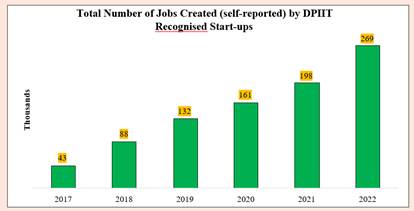
Discussing the achievements of Start-ups, the Survey highlighted that an impressive 9 lakh+ direct jobs have been created by the DPIIT recognized startups (self-reported), with a notable 64 per cent increase in 2022 over the average number of new jobs created in the last three years. About 48 per cent of our startups are from Tier II & III cities, a testimony of our grassroots’ tremendous potential.
INDUSTRY 4.0

The Survey highlighted that adoption of Industry 4.0 technologies such as cloud computing, IoT, machine learning, and artificial intelligence (AI) in the Indian manufacturing sector is underway, however, large-scale adoption is yet to happen and an enabling environment is rapidly developing.

The Survey mentioned that various Government Initiatives such as SAMARTH (Smart Advanced Manufacturing and Rapid Transformation Hubs) Udyog Bharat 4.0, establishment of the Centre for Fourth Industrial Revolution is the way forward in achieving the goals of Aatmanirbharta and its ambitions of becoming a key player in global value chains.

MAKE IN INDIA 2.0

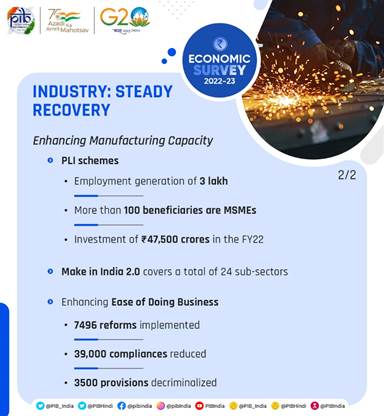
The Survey mentioned that ‘Make in India 2.0’ is now focusing on 27 sectors, which include 15 manufacturing sectors and 12 service sectors. Amongst these, 24 sub-sectors have been chosen while keeping in mind the Indian industries’ strengths and competitive edge, the need for import substitution, the potential for export and increased employability.

PERFORMANCE LINKED INCENTIVE (PLI) SCHEME

PLI scheme is expected to attract a capex of approximately ₹4 lakh crore over the next five years having a potential of generate employment for over 60 lakh in India stated the Economic Survey. It added that Sectors under which the PLI scheme has been announced currently constitute around 40 per cent of the total imports. The scheme, spread across 14 sectors, can enhance India’s annual manufacturing capex by 15 to 20 per cent from FY23.

The Survey mentioned that around ₹47,500 crore (US$ 6 billion) of actual investment has been made (As per recent reporting from implementing Ministries/ Departments); production/ sales of ₹3.85 lakh crore (US$ 47 billion) of eligible products and employment generation of around 3 lakh has been reported and 106 per cent achievement of actual investment reported versus the corresponding projections of FY22.

The Survey stated that more than 100 MSMEs are among the PLI beneficiaries in sectors such as Bulk Drugs, Medical Devices, Telecom, White Goods and Food Processing. Key sectors such as Large-Scale Electronics Manufacturing, Pharmaceuticals, Telecom & Networking Products, Food Processing and White Goods have contributed considerably to investment, production, sales and employment.
Topics

Acts Income Tax

