

Loading...

Top
Help
×

By creating an account you can:

Logo TaxTMI
Call Us / Help / Feedback

Contact Us At :

E-mail: [email protected]

Call / WhatsApp at: +91 99117 96707

For more information, Check Contact Us

FAQs :

To know Frequently Asked Questions, Check FAQs

Most Asked Video Tutorials :

For more tutorials, Check Video Tutorials

Submit Feedback/Suggestion :

Email :
Please provide your email address so we can follow up on your feedback.
Category :
Description :
Min 15 characters 0/2000
Make Most of Text Search
  1. Checkout this video tutorial: How to search effectively on TaxTMI.
  2. Put words in double quotes for exact word search, eg: "income tax"
  3. Avoid noise words such as : 'and, of, the, a'
  4. Sort by Relevance to get the most relevant document.
  5. Press Enter to add multiple terms/multiple phrases, and then click on Search to Search.
  6. Text Search
  7. The system will try to fetch results that contains ALL your words.
  8. Once you add keywords, you'll see a new 'Search In' filter that makes your results even more precise.
  9. Text Search
Add to...
You have not created any category. Kindly create one to bookmark this item!
Create New Category
Hide
Title :
Description :
❮❮ Hide
Default View
Expand ❯❯
Close ✕
🔎 News - Adv. Search
TEXT SEARCH:

Press 'Enter' to add multiple search terms. Rules for Better Search

Search In:
Main Text + AI Text
  • Main Text
  • Main Text + AI Text
  • AI Text
Category: ?
Categorized by AI
---- All Categories ----
  • ---- All Categories ----
  • Income Tax
  • GST
  • Customs, DGFT & SEZ
  • FEMA & RBI
  • Corp. Laws, SEBI & IBC
  • PMLA, Black Money & ED
  • Budget
  • News and Press Release
  • PTI News
Month:
---- All Months ----
  • ---- All Months ----
  • January
  • February
  • March
  • April
  • May
  • June
  • July
  • August
  • September
  • October
  • November
  • December
Year:
---- All Years ----
  • ---- All Years ----
  • 2026
  • 2025
  • 2024
  • 2023
  • 2022
  • 2021
  • 2020
  • 2019
  • 2018
  • 2017
  • 2016
  • 2015
  • 2014
  • 2013
  • 2012
  • 2011
Sort By: ?
In Sort By 'Default', exact matches for text search are shown at the top, followed by the remaining results in their regular order.
Relevance Default Date
    Why Most People Choose the Wrong Savings Account And How Not to Be One of Them
    RBI has proactively helped UCBs; cooperatives should look at regulator differently: Shah
    Ministry of Agriculture, Food and Rural Affairs and aT Host '2026 K-Food Fair in New Delhi, India'
    No compromise on tackling illegal immigrants' issue: Minister Priyank Kharge
    Technology, transparency key for urban cooperative banks to stay competitive: Shah
    Paul Merchants Gets RBI Approval for Perpetual AD Category-II Licence Under Revised FEMA Framework
    IEPFA Organises Stakeholder Engagement with Nodal Officers of Companies on Integrated IEPFA Portal 2.0
    Rupee settles with 5 paise gain at 95.17 against US dollar
    India weathered Hormuz disruption without fuel shortages: Puri
    RBI invites public comments on the draft Directions on ‘Credit Valuation Adjustment (CVA) Framework’
    RBI invites comments on the draft “Reserve Bank of India (Commercial Banks – Prudential Norms on Capital Adequacy) Eleventh Amendment Directions, ...
    87 Proposals Received under BHAVYA Scheme during First Round of Phase-I
    India successfully concludes the 16th BRICS Trade Ministers' Meeting in Jaipur under its BRICS Chairship 2026
    GeM Completes a Decade of Transforming Public Procurement with Cumulative GMV Exceeding ₹20 Lakh Crore
    NEWS HIGHLIGHTS
    India's forex kitty swells by USD 10.5 bn to USD 692.87 bn
    Rs 5,000 cr credited to 6.22 lakh Maharashtra farmers so far under loan waiver scheme: Fadnavis
    SBI Life and J&K Bank partner to bring comprehensive life insurance solutions closer to families across India
    DRI intensifies vigil along India's North-Eastern Frontier
    Vijayan slams Kerala govt's move to end doorstep pension delivery through cooperative banks
❯❯
Maximize Maximize Maximize
0 / 200
Expand Note
Add to Folder

No Folders have been created

+

Are you sure you want to delete "My most important" ?

NOTE:

News
Showing Results for :
Reset Filters
Results Found:
Show All Summaries Hide All Summaries
August 8, 2026
Show AI Summary
Savings account selection requires comparison of effective interest, fees, digital service, access, and individual banking needs.
Savings-account selection should compare effective interest returns under slab-based rates, recurring operating charges and the customer's actual banking needs. Net value depends not only on advertised rates but also on relevant minimum-balance, card, ATM, alert and transfer fees. Digital reliability, customer support, branch availability and ATM access should be assessed according to the customer's average balance, cash use, transfer frequency, travel patterns and need for in-person assistance. The suitable account is one that matches real banking behaviour.
August 8, 2026
Show AI Summary
Urban cooperative bank regulation promotes licensing, governance, compliance support and cybersecurity measures to strengthen stability and depositor confidence.
Urban cooperative banks are encouraged to recognise regulatory support through liberalised branch opening, doorstep banking, demand drafts, life certificates, dedicated regulatory coordination, enhanced gold-loan limits, one-time settlements and progress towards on-tap licensing. Sound governance is material to sectoral stability, while small-borrower lending is presented as a comparatively safe lending segment. The umbrella body can support member banks through technical expertise, compliance assistance, cybersecurity solutions and participation in a security operations centre to strengthen depositor confidence.
August 8, 2026
Show AI Summary
Korean food export promotion combines buyer consultations, regulatory guidance and consumer experiences to support entry into Indian and South Asian markets.
Korean food export promotion in India and South Asia combined business consultations with consumer-facing activities. Individual meetings connected Korean exporters with regional buyers and generated memoranda of understanding for products including frozen gimbap, ginseng wine and kombucha. Exporters received on-site guidance concerning non-tariff barriers, including food import customs clearance and certification requirements. Preparatory online sessions addressed import procedures, regulatory matters and consumer trends, while consumer events promoted Korean food through tasting, retail and experiential activities.
August 8, 2026
Show AI Summary
Illegal immigration enforcement prioritises dismantling entry, documentation and employment networks while requiring citizens to report information through police channels.
Illegal immigration enforcement involves continuous identification and verification operations, coordination with relevant officials, and confidential investigation of networks facilitating entry, identity documentation, accommodation and employment. Enquiries extend to intermediaries, contractors, Aadhaar procurement and verification practices, rather than focusing only on apprehended individuals. Citizen vigilantism, moral policing and social-media targeting of suspected migrants are discouraged because they may compromise investigations; information should instead be given through proper police channels.
August 8, 2026
Show AI Summary
Technology, transparency and governance strengthen urban cooperative banks through modern customer services, depositor protection and cooperative-sector support.
Technology adoption, transparency, sound governance and modern customer services are identified as necessary for urban cooperative banks to remain competitive. Banks are encouraged to join the sector's umbrella organisation and self-regulatory body, which provides capital, information-technology infrastructure and liquidity support. Protection of depositors' money remains a regulatory responsibility, while banks are expected to improve governance, train staff, adopt technology and enhance customer-centric services. Customer prosperity and reduced perception gaps between the central bank and urban cooperative banks are emphasised as measures to strengthen the sector.
August 8, 2026
Show AI Summary
Authorised Dealer Category-II licensing expands permissible FEMA current account and foreign trade transaction services for cross-border payment customers.
An Authorised Dealer Category-II approval under the Foreign Exchange Management (Authorised Persons) Regulations, 2026 enables Paul Merchants to undertake additional permissible non-trade current account transactions under FEMA, excluding gifts and donations, and foreign trade transactions within the applicable per-transaction limit. The approval supports foreign exchange and cross-border payment services, including overseas remittances for education, medical treatment, travel, and conference or event participation.
August 8, 2026
Show AI Summary
Integrated investor claim portal modernisation advances digital KYC, streamlined verification, stakeholder-informed safeguards, and efficient investor claim settlement services.
Integrated IEPFA Portal 2.0 is proposed to modernise investor claim processing through digital KYC, pre-filled Form IEPF-5, entitlement search, and a simplified e-Verification Report filing workflow. Stakeholder feedback included Aadhaar eKYC address validation, KYC for authorised representatives, entitlement-letter validation checks, bulk DSC and eSign functionality, integration of approved IEPF Form-4 data, lower-value share valuation using NSE and BSE data, and alerts for frequent address changes to prevent fraud.
August 7, 2026
Show AI Summary
Foreign capital inflows supported the rupee despite geopolitical uncertainty, oil-price pressures, and volatile global market sentiment.
Foreign capital inflows supported a marginal strengthening of the rupee against the US dollar despite global risk aversion arising from uncertainty surrounding negotiations affecting the Strait of Hormuz. Higher crude oil prices and weak domestic equity sentiment remained relevant pressures. Near-term currency movement was expected to depend on developments in the negotiations, weekend decisions, US employment data, the dollar index, crude oil prices, and the reported increase in foreign exchange reserves.
August 7, 2026
Show AI Summary
Energy security through diversified sourcing protected fuel supplies during Hormuz disruption and supports domestic exploration and alternative fuels.
Energy security measures based on diversified crude oil and LPG sourcing, expanded infrastructure, increased domestic LPG production and alternative fuels were presented as maintaining fuel availability during disruption of shipping through the Strait of Hormuz. Domestic resilience is also linked to support for private deep-water oil and gas exploration, opening offshore acreage, and expansion of compressed biogas and ethanol blending. Ethanol-blended petrol testing identified limited contamination instances rather than a systemic issue, while excise duty reductions were described as cushioning consumers against global fuel-price volatility.
August 7, 2026
Show AI Summary
Credit valuation adjustment framework revises derivative capital requirements through flexible basic approaches, hedge recognition, and risk-sensitive counterparty treatment.
Credit Valuation Adjustment framework revisions align CVA capital treatment with final Basel III standards. Eligible banks may use the full or reduced basic approach, while banks with an insignificant volume of non-centrally cleared derivatives may calculate their CVA capital charge at 100 per cent of the counterparty credit risk capital charge. The draft also clarifies CVA hedge recognition, introduces risk weights sensitive to sector and credit quality, and separates systematic and idiosyncratic CVA risk in the full basic approach.
August 7, 2026
Show AI Summary
Leverage ratio framework amendments propose Basel-aligned capital adequacy standards, with public feedback invited on the draft directions.
Proposed amendments to the leverage ratio framework would revise Chapter VII of the 2025 Commercial Banks Prudential Norms on Capital Adequacy Directions to implement the Basel Committee's Leverage Ratio 2017 Standard. Public comments and feedback on the draft Eleventh Amendment Directions, 2026, are invited until August 28, 2026, through the designated online platform, postal submission, or email.
August 7, 2026
Show AI Summary
BHAVYA Scheme project selection uses challenge-based evaluation of infrastructure, industrial ecosystems, and policy enablers under prescribed eligibility criteria.
BHAVYA Scheme Phase-I proposals submitted by State and Union Territory governments will be evaluated and scored under prescribed eligibility and evaluation criteria. Challenge-based project selection considers connectivity and site suitability, quality of core, value-added and social infrastructure in the detailed project report, and the industrial ecosystem and policy enablers. The Scheme guidelines provide for completion of the first-phase selection process within one year from notification.
August 7, 2026
Show AI Summary
Multilateral trade cooperation preserves developing economies' policy space while advancing MSME finance, diversified value chains and digital services.
BRICS ministers adopted measures supporting a development-centred multilateral trading system with the World Trade Organization at its core, preservation of Special and Differential Treatment, binding two-tier dispute settlement, and developing economies' policy space for food security and public stockholding. MSME measures include study of an invoice discounting mechanism and credit-assessment principles focused on cash flow rather than collateral. Value-chain measures provide for a GVC Action Plan, technical cooperation, Special Economic Zone cooperation and digitised trade documents, alongside principles for trusted cross-border digitally delivered services.
August 7, 2026
Show AI Summary
Digital public procurement promotes transparent sourcing, reduced seller charges, competition monitoring and evidence-based spending oversight through an integrated marketplace.
Government e-Marketplace digitises public procurement through a unified platform promoting transparency, efficiency, good governance and wider supplier participation. Seller-facing measures include reduced transaction charges, exemption of smaller orders, a cap on maximum transaction fees and reduced vendor assessment fees. The platform uses Artificial Intelligence and Machine Learning tools to identify suspected cartelisation, collusion and order splitting, while its digital transactional trail supports expenditure monitoring, identification of inefficiencies and evidence-based policy interventions.
August 7, 2026
Show AI Summary
Criminal justice, extremist-material regulation and administrative schemes feature in reports on prosecutions, demolition practices, loan waivers and fuel policy.
Criminal justice reports cover bail and an expedited trial in an assault prosecution, arrest for allegedly sheltering an accused, allegations of rape and murder of a minor, and claimed irregularities in a police recruitment examination. Regulatory developments include a ban on extremist literature associated with proscribed organisations and judicial disapproval of coercive demolition. Administrative coverage includes farmer loan-waiver transfers following Aadhaar authentication and debate over the E20 fuel-blending programme.
August 7, 2026
Show AI Summary
Foreign exchange reserves rose as foreign currency assets, gold holdings, Special Drawing Rights and IMF reserve position increased.
India's foreign exchange reserves increased during the week ended July 31, principally because of higher foreign currency assets and gold reserves. Foreign currency assets include US dollar valuation effects arising from movements in currencies such as the euro, pound and yen. Special Drawing Rights and India's reserve position with the International Monetary Fund also increased. The movement followed measures to attract foreign exchange inflows, including an FCNR(B) measure, after earlier reserve declines associated with rupee pressure and dollar sales for foreign exchange market intervention.
August 7, 2026
Show AI Summary
Farm loan waiver eligibility depends on verified beneficiary status and Aadhaar authentication for direct credit of eligible crop-loan relief.
The farm loan waiver scheme covers eligible short-term crop loans within the prescribed ceiling and eligibility period. Waiver amounts are credited to verified bank accounts after field verification and completion of Aadhaar authentication. Aadhaar authentication is the operative condition for automatic processing of benefits, while eligibility rules and technical conditions have raised concerns about exclusion of distressed farmers.
August 7, 2026
Show AI Summary
Corporate agency distribution expands access to life insurance products, supporting insurance awareness, financial inclusion and long-term household financial protection.
A corporate agency arrangement enables J&K Bank to distribute SBI Life Insurance protection, savings, retirement and child-oriented life insurance plans through its branch network. The partnership aims to improve insurance access, awareness, financial literacy and long-term financial planning for households, particularly in Jammu & Kashmir and Ladakh. It is intended to expand insurance penetration, strengthen household financial protection and support financial inclusion in line with the IRDAI vision of "Insurance for All by 2047".
August 7, 2026
Show AI Summary
Cross-border smuggling controls target narcotics, poppy seeds and areca nuts entering through the Indo-Myanmar border region.
Cross-border smuggling enforcement targeted methamphetamine, foreign-origin poppy seeds and areca nuts allegedly brought from Myanmar. Methamphetamine concealed in an ambulance was seized under the NDPS Act, 1985. Poppy seeds and areca nuts recovered in separate operations were seized under the Customs Act, 1962. Poppy-seed imports are restricted to designated countries and require registration to ensure traceability and prevent illicit produce entering legitimate supply chains. The enforcement action addresses circumvention of customs controls and regulated import requirements.
August 7, 2026
Show AI Summary
Direct benefit transfer for welfare pensions replaces cooperative-bank doorstep delivery, while retaining limited home service for excluded beneficiaries.
Direct Benefit Transfer for social security and welfare pensions is to be made through Aadhaar-linked bank accounts, replacing cooperative-bank doorstep delivery. Home delivery remains available for bedridden persons and others who cannot be excluded. The change is associated with delays in remitting undistributed amounts, record-update failures, reconciliation issues, duplicate payments, and incomplete Aadhaar-based payment implementation. Concerns have been raised that mandatory bank-account credit may disadvantage beneficiaries dependent on doorstep delivery.

News

Back

All News

Showing Results for :
Reset Filters
No Records Found

News

Back

All News

Showing Results for : Reset Filters

GOVERNMENT ON TRACK TO ACHIEVE FISCAL DEFICIT TARGET OF 6.4%

January 31, 2023

Contents
Summary
Note

Note

-

Bookmark

Print

Print

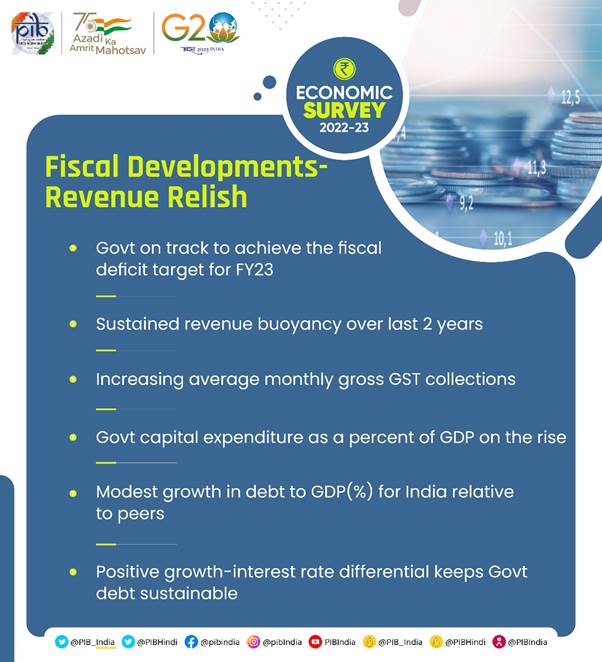
GOVERNMENT ON TRACK TO ACHIEVE FISCAL DEFICIT TARGET OF 6.4%

15.5% YoY GROWTH IN GROSS TAX REVENUE FROM APRIL TO NOVEMBER 2022

Rs. 13.40 LAKH CRORE COLLECTED AS GST REVENUE IN FIRST 3 QUARTERS OF FY23

NUMBER OF GST TAX PAYERS DOUBLED TO 1.4 CRORE FROM 70 LAKH

24.8 % YoY GROWTH IN GROSS GST COLLECTIONS DURING APRIL- DECEMBER 2022

DIRECT TAXES REGISTER A GROWTH OF 26% YoY DURING APRIL- NOVEMBER 2022

CAPITAL EXPENDITURE TO RISE BY 2.9% IN FY23 OVER LONG TERM AVERAGE OF 1.7% OF GDP

GOVERNMENT DEBT DECLINES FROM 59.2% OF GDP IN FY21 TO 56.7% IN FY22

GENERAL GOVERNMENT DEBT TO GDP RATIO INCREASED BY A MODEST 3% SINCE 2005 AS COMPARED TO SUBSTANTIAL INCREASE IN MOST COUNTRIES

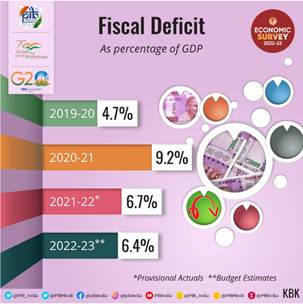
“The gradual decline in the Union government's fiscal deficit as a % of GDP, in line with the fiscal glide path envisioned by the government, is a result of careful fiscal management supported by buoyant revenue collection over the last two years” stated the Economic survey 2022-23 tabled by the Union Minister for Finance and Corporate Affairs Smt. Nirmala Sitharaman today in Parliament.
https://static.pib.gov.in/WriteReadData/userfiles/image/image00141J8.jpg

According to the Survey, fiscal deficit is expected to be at 6.4% of GDP in FY 23. The Survey highlighted that conservative budget assumptions provided a buffer during global uncertainties. The resilience in the fiscal performance was due to a recovery in economic activity and buoyancy in revenues.

Gross Tax Revenue

Gross Tax Revenue registered a Year on year (YoY) growth of 15.5 % from April to November 2022, and the Net Tax Revenue to the Centre after the assignment to states grew by 7.9 % on a YoY basis, stated the Survey. Structural reforms like the introduction of GST and the digitalisation of economic transactions have led to the greater formalisation of the economy and hence expanded the tax net and enhanced tax compliance. Thus revenues have grown at a pace much higher than the growth in GDP.

The Economic Survey highlighted that Direct taxes grew at 26 % Year On Year basis due to corporate and personal income tax growth in FY22. The Survey further added that growth rates observed in the major direct taxes during the first eight months of FY23 were much higher than their corresponding longer-term averages.

The Survey informed that high imports have led to a 12.4 % YoY growth in the customs collection from April to November 2022. The excise duty collection has declined by 20.9 % from April to November 2022 on a YoY basis.

Buoyant GST Collection

“The GST Tax payers doubled to 1.4 crore from 70 lakhs in 2022. The gross GST collections were ₹13.40 lakh crore from April to December 2022. Thus, implying a YoY growth of 24.8 % with an average monthly collection of ₹1.5 lakh crore”, noted the Survey. It further highlighted that improvement in GST collections has been due to the nationwide drive against GST evaders and fake bills and systemic changes introduced such as rate rationalisation correcting inverted duty structure.

Disinvestment

“Out of the budgeted amount of ₹65,000 crore for FY23, 48 % has been collected as of 18 January 2023 as the pandemic-induced uncertainty, the geopolitical conflict, and the associated risks have posed challenges before the plans and prospects of the government's disinvestment targets over the last three years” stated the Economic Survey 2022-23.

The Survey added that government has reaffirmed its commitment towards privatisation and strategic disinvestment of Public Sector Enterprises by implementing the New Public Sector Enterprise Policy and Asset Monetisation Strategy.

Capital expenditure

According to the Survey, the capital expenditure by the Central Government has steadily increased from a long-term average 2.5% of GDP in FY22 PA. It is further budgeted to increase to 2.9% of GDP in FY23 highlighting an improvement in the quality of Government expenditure over the years.

The Survey informed that ₹7.5 lakh crore of Capital Expenditure is budgeted for FY23, of which more than 59.6 % has been spent from April to November 2022. During this period, capital expenditure registered a YoY growth of over 60 %, much higher than the long-term average growth of 13.5 % recorded in the corresponding period from FY16 to FY20. Rs.1.5 lakh core were allocated to road transport and highways, Rs.1.20 lakh crore to railways, 0.7 lakh crore to defence and 0.3 lakh crore to telecommunications in FY22. It is considered as a counter-cyclical fiscal tool strengthening aggregate demand, generates employment and boosts other sectors.

To push for enhancing Capex from all directions, the Centre announced several incentives to boost states' capital expenditure in the form of long-term interest-free loans and capex-linked additional borrowing provisions

Revenue Expenditure

The revenue expenditure of the Union government was brought down from 15.6% of GDP in FY21 to 13.5% of GDP in FY22 Provisional Actual (PA). This contraction was led by a reduction of the subsidy expenditure which was brought down from 3.6% of GDP in FY21 to 1.9% of GDP in FY22 PA. It was further budgeted to reduce to 1.2% of GDP in FY23. However, around 94.7% of the budgeted expenditure on subsidies has been utilised from April to November 2022 due to the sudden outbreak of geopolitical conflict resulting in higher international prices for food, fertiliser and fuel. Thus, the revenue expenditure from April to November 2022 has grown by over 10% on a YoY basis, higher than the growth noted in the corresponding period last year.

Interest payments as a proportion of receipts went up after the pandemic outbreak. However, in the medium term, as we move along the fiscal glide path, buoyancy in revenues, aggressive asset monetisation, efficiency gains, and privatisation would help pay down the public debt, thus bringing down interest payments and releasing more monies for other priorities, highlights the Economic Survey.

Overview of State Government Finances

The combined Gross Fiscal Deficit (GFD) of the States, which increased to 4.1% of GDP in FY21, was brought down to 2.8% in FY22 PA. Given the geopolitical uncertainties, the consolidated GFD-GDP ratio for States has been budgeted at 3.4% in FY23. However, from April- November 2022, the combined borrowings of the 27 major states have just reached 33.5% of their total budgeted borrowings for the year. The data from last three years shows that states had unutilised borrowing limits.
https://static.pib.gov.in/WriteReadData/userfiles/image/image00281J4.jpg

The capital outlay of States grew by 31.7% in FY22 PA. This increase is attributable to strong revenue buoyancy and the support provided by the Centre in terms of advance releases of payments to the states, GST compensation payments, and interest-free loans.

Transfer from Centre to States

Total transfers to States comprising the share of States in Union taxes devolved to the States, Finance Commission Grants, Centrally Sponsored Schemes (CSS), and other transfers, have risen between FY19 and FY23 BE. The Finance Commission had recommended allocation of ₹1.92 lakh crore for FY23.

GST Compensation payments during crisis

To meet the shortfall in GST compensation for States, the Government, in addition to the release of regular GST compensation from the Fund, borrowed Rs. 2.69 lakh crore during FY21 and FY22 and passed it on to States. Moreover, the cess payments and tax devolution instalments to the States were frontloaded to give them early access to funds. Even though the total Cess collection until November 2022 was insufficient to make the entire payment to the States, the Centre released the balance from its resources.

Enhanced borrowing limits for states and incentives for reforms

Since the pandemic outbreak, the Centre has kept the Net Borrowing Ceiling of the State Governments above the Fiscal Responsibility Legislation (FRL) threshold. It was fixed at 5 % of GSDP in FY21, 4 % of GSDP in FY22 and 3.5 % of GSDP in FY23, a part of which was linked to reforms such as implementing the 'One Nation One Ration Card' System, ease of doing business reform, urban Local body/ utility reforms, and power sector reforms etc. The survey observes the progress made by various states in these reforms.

Centre’s support towards States’ capital expenditure

Amounts of Rs. 11,830 crore and Rs. 14,186 crore were provided to states in FY21 and FY22 as 50-year interest-free loans to state governments under the 'Scheme for Special Assistance to States for Capital Investment'. During the year FY23, the allocation under the Scheme has been raised to ₹1.05 lakh crore to give further impetus to State Capex plans.

Debt Profile of the Government

IMF projects the global government debt at 91% of GDP in 2022, about 7.5% points above the pre-pandemic levels. In this global backdrop, the total liabilities of the Union Government moderated from 59.2% of GDP in FY21 to 56.7% in FY22 (P).

India's public debt profile is relatively stable and is characterised by low currency and interest rate risks. Of the Union Government's total net liabilities in end-March 2021, 95.1% were denominated in domestic currency, while sovereign external debt constituted 4.9%, implying low currency risk. Further, sovereign external debt is entirely from official sources, which insulates it from volatility in the international capital markets, highlights the Economic Survey.

Furthermore, Public debt in India is primarily contracted at fixed interest rates, with floating internal debt constituting only 1.7% of GDP in end-March 2021. The debt portfolio is, therefore, insulated from interest rate volatility.

Consolidating General Government Finances

The General Government liabilities as a proportion of GDP increased steeply during FY21 on account of the additional borrowings made by Centre and States on account of the pandemic. However, the ratio has come off its peak in FY22 (RE), as observed by the Economic Survey. The General Government deficits as a percentage of GDP have also consolidated after their peak in F21.

A positive growth-interest rate differential

The Survey notes that the emphasis on capex in recent years is expected to boost GDP growth directly, and indirectly through multiplier effects on private consumption expenditure and private investment. Higher GDP growth would thereby facilitate buoyant revenue collection in the medium term, enabling a sustainable fiscal path. The General Government Debt to GDP ratio increased from 75.7% of end-March 2020 to 89.6% at the end of the pandemic year FY21. It is estimated to decline to 84.5% of GDP by end-March 2022. The emphasis on capex-led growth will enable India to keep the growth-interest rate differential positive. A positive growth-interest rate differential keeps the debt levels sustainable.

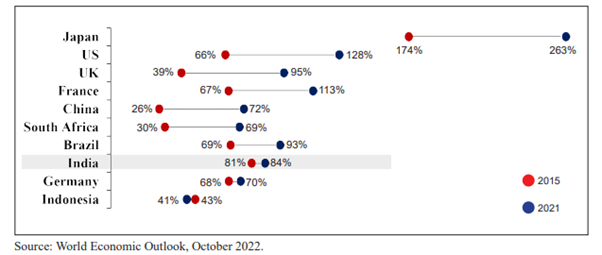
The change in General Government debt to GDP ratio from 2005 to 2021 has been substantial across the countries. For India, this increase is modest, from 81% of GDP in 2005 to around 84% of GDP in 2021. It has been possible on the back of resilient economic growth during the last 15 years leading to a positive growth-interest rate differential, which, in turn, has resulted in sustainable Government debt to GDP levels, explains the Economic Survey.

Fig.- Comparison of General Government debt to GDP ratio in 2005 with 2021 across the countries
https://static.pib.gov.in/WriteReadData/userfiles/image/image003NFRE.png

Topics

Acts Income Tax