

Loading...

Top
Help
×

By creating an account you can:

Logo TaxTMI
Call Us / Help / Feedback

Contact Us At :

E-mail: [email protected]

Call / WhatsApp at: +91 99117 96707

For more information, Check Contact Us

FAQs :

To know Frequently Asked Questions, Check FAQs

Most Asked Video Tutorials :

For more tutorials, Check Video Tutorials

Submit Feedback/Suggestion :

Email :
Please provide your email address so we can follow up on your feedback.
Category :
Description :
Min 15 characters 0/2000
Make Most of Text Search
  1. Checkout this video tutorial: How to search effectively on TaxTMI.
  2. Put words in double quotes for exact word search, eg: "income tax"
  3. Avoid noise words such as : 'and, of, the, a'
  4. Sort by Relevance to get the most relevant document.
  5. Press Enter to add multiple terms/multiple phrases, and then click on Search to Search.
  6. Text Search
  7. The system will try to fetch results that contains ALL your words.
  8. Once you add keywords, you'll see a new 'Search In' filter that makes your results even more precise.
  9. Text Search
Add to...
You have not created any category. Kindly create one to bookmark this item!
Create New Category
Hide
Title :
Description :
❮❮ Hide
Default View
Expand ❯❯
Close ✕
🔎 News - Adv. Search
TEXT SEARCH:

Press 'Enter' to add multiple search terms. Rules for Better Search

Search In:
Main Text + AI Text
  • Main Text
  • Main Text + AI Text
  • AI Text
Category: ?
Categorized by AI
---- All Categories ----
  • ---- All Categories ----
  • Income Tax
  • GST
  • Customs, DGFT & SEZ
  • FEMA & RBI
  • Corp. Laws, SEBI & IBC
  • PMLA, Black Money & ED
  • Budget
  • News and Press Release
  • PTI News
Month:
---- All Months ----
  • ---- All Months ----
  • January
  • February
  • March
  • April
  • May
  • June
  • July
  • August
  • September
  • October
  • November
  • December
Year:
---- All Years ----
  • ---- All Years ----
  • 2026
  • 2025
  • 2024
  • 2023
  • 2022
  • 2021
  • 2020
  • 2019
  • 2018
  • 2017
  • 2016
  • 2015
  • 2014
  • 2013
  • 2012
  • 2011
Sort By: ?
In Sort By 'Default', exact matches for text search are shown at the top, followed by the remaining results in their regular order.
Relevance Default Date
    Modi warns of weaponisation of resources, sea routes; urges energy self-reliance
    Current account deficit widens to USD 6.2 bn in Jun: RBI data
    Concessional swap facility attracts USD 56.85 bn forex inflows: RBI
    DFS Highlights Mechanism for Timely Redressal of Insurance Policyholders’ Grievances
    Forex kitty jumps USD 14.14 bn to USD 707 bn in one of the biggest weekly expansions
    PROVISIONAL ESTIMATES OF WHOLESALE PRICE INDEX, OUTPUT PRODUCER PRICE INDEX, AND TRIAL INPUT PRODUCER PRICE INDEX FOR THE MONTH OF JULY 2026, AND FINA...
    Logistics Data Bank Tracks 10 Crore EXIM Containers, Provides Visibility across Logistics Chain
    APEDA and Government of Tripura Organise International Organic Buyer-Seller Meet to Expand Global Market Linkages
    WPI inflation eases to 9.78 pc in July on softening in fuel prices
    IDFC FIRST Bank secures its first international rating with Investment Grade from S&P Global Ratings
    DRI busts illegal drug manufacturing facility in Jewar, UP; 30 kg drugs seized and two persons arrested
    UCO Bank launches IFSC Banking Unit at GIFT City
    Banking sector has key role to play as India on way to become 3rd largest economy: Gujarat CM
    India's exports to US rise 12.85 pc in Jul; shipments to China jump 64.57 pc: Govt data
    50 tonnes of copper without e-way bills seized by Delhi GST, Railways joint team
    India's exports surge 19.6 pc in Jul; trade deficit widens to six-month high
    CBI ARRESTS CGST SUPERINTENDENT IN BRIBERY CASE
    The cumulative exports (merchandise & services) during April-July 2026-27 is estimated at US$ 316.42 Billion, as compared to US$ 279.63 Billion in Apr...
    Unlimit Mobile Ties Up with ICICI Bank Canada, RBC Royal Bank to Add Mobile Connectivity Benefits to Student GIC Journey
    Standard Chartered Accelerates India's GCC Growth with its Global Banking Expertise and 25 Years of GCC Experience
❯❯
Maximize Maximize Maximize
0 / 200
Expand Note
Add to Folder

No Folders have been created

+

Are you sure you want to delete "My most important" ?

NOTE:

News
Showing Results for :
Reset Filters
Results Found:
Show All Summaries Hide All Summaries
August 15, 2026
Show AI Summary
Energy self-reliance drives diversified fuel sourcing, expanded offshore exploration, and domestic capacity to reduce geopolitical supply vulnerability.
Energy security policy seeks to reduce exposure to geopolitical pressure and supply disruption caused by dependence on overseas fuel and strategic maritime routes. India is diversifying crude oil and LNG sourcing while strengthening domestic hydrocarbon production through offshore exploration, seismic surveys, exploratory drilling and shared infrastructure. Expanded access to sedimentary basins is intended to unlock domestic oil and gas resources. Wider piped natural gas coverage, solar generation, critical-mineral exploration, and nuclear and other non-fossil energy sources support the broader objective of energy self-reliance.
August 14, 2026
Show AI Summary
Current account deficit widened as merchandise trade imbalance expanded, despite stronger services surplus, transfers, and positive capital inflows.
India's current account deficit widened in June 2026, principally because merchandise imports increased faster than exports and expanded the merchandise trade deficit. A higher services surplus, increased net transfers and a narrower net income deficit provided partial offsets. Net capital inflows, including foreign direct investment and foreign portfolio investment, supported a positive overall monthly balance. During the April-June quarter, despite increased services surplus and net transfers, the overall balance shifted to a deficit as the merchandise trade deficit widened.
August 14, 2026
Show AI Summary
Concessional foreign-currency swap facility closes early for new FCNR(B) deposits while ECB and OFCB access remains available.
The concessional swap facility for FCNR(B) deposits encourages foreign-currency inflows and supports foreign-exchange liquidity. New FCNR(B) deposits eligible for the facility must be mobilised by 31 August 2026, while swaps for eligible deposits may be availed until 11 September 2026. The swap arrangement for External Commercial Borrowings and Overseas Foreign Currency Borrowings remains available until 31 December 2026.
August 14, 2026
Show AI Summary
Insurance grievance redressal requires initial insurer complaint, prompt acknowledgement, and escalation through integrated monitoring channels when resolution remains unsatisfactory.
Insurance policyholder grievances must first be raised with the concerned insurer, whose Grievance Redressal Officer and Board-level monitoring committee oversee redressal. Complaints received through digital channels, correspondence or call centres are recorded in the insurer's Complaints Management System, integrated with Bima Bharosa. Insurers must acknowledge complaints immediately and resolve them within 14 days. Where no response is received within a reasonable period or the response is unsatisfactory, policyholders may escalate through Bima Bharosa or designated helplines, email or physical correspondence.
August 14, 2026
Show AI Summary
Foreign exchange reserve growth reflects increases in foreign currency assets, gold holdings, special drawing rights, and IMF reserve position.
India's foreign exchange reserves rose to USD 707.002 billion for the week ended 7 August 2026. The increase comprised higher foreign currency assets, gold reserves, special drawing rights and the reserve position with the IMF. Foreign currency asset valuation incorporates appreciation or depreciation of non-US currencies held in reserve assets. Measures including the FCNR(B) scheme were introduced to attract additional foreign exchange inflows.
August 14, 2026
Show AI Summary
Wholesale and producer price indices show July inflation movements, provisional estimates, final revisions, and manufacturing input-price trends.
Wholesale Price Index, Output Producer Price Index, and trial Input Producer Price Index estimates under the 2022-23 base-year series set out provisional July 2026 measures and final May 2026 revisions. All-commodities WPI stood at 110.0 in July 2026, with year-on-year inflation of 9.78 per cent. The all-commodities Output PPI was unchanged at 109.9, while the trial Input PPI for manufacturing was provisionally estimated at 105.9. Final May WPI, Output PPI and trial Input PPI measures were revised from their respective provisional estimates.
August 14, 2026
Show AI Summary
Logistics data visibility enables EXIM container tracking, operational analytics and multimodal shipment monitoring across India's logistics chain.
Logistics Data Bank provides near real-time visibility of India's EXIM container movement through technology-based tracking and stakeholder monitoring tools. RFID-based coverage extends across ports, terminals, inland logistics facilities, rail networks, industrial zones, borders and highways. The platform uses RFID, Internet of Things, Big Data and Cloud technologies, with analytics on dwell time, transit time, and port and terminal performance to identify logistics bottlenecks. LDB 2.0 adds high-seas tracking of export containers and multimodal shipment visibility.
August 14, 2026
Show AI Summary
International organic buyer-seller linkages support Tripura producers through direct sourcing engagement, market access and sustainable export opportunities.
International Organic Buyer-Seller Meet in Tripura created a direct platform for organic producers, Farmer Producer Organisations, exporters and international buyers to explore sourcing opportunities, market requirements and long-term commercial linkages. Organic and naturally produced goods, including Queen Pineapple, GI-tagged Kalikhasa Rice, organic ginger and turmeric, black sesame, jackfruit and scented lemon, were showcased through product displays and producer interactions. The initiative seeks to strengthen global market access, sourcing partnerships and income opportunities for organic farmers.
August 14, 2026
Show AI Summary
Wholesale price inflation moderation was driven by softer fuel prices, while manufactured goods and primary articles recorded higher inflation.
Wholesale price inflation moderated in July, led by a decline in fuel and power inflation and a marginal easing in food-article inflation. Inflation in manufactured products and primary articles increased, making the moderation uneven across groups. Mineral oils, food articles, basic metals, non-food articles, food products, and chemical products remained significant inflation drivers. The output Producer Price Index remained unchanged year-on-year, with lower manufacturing and mining inflation offset by higher agriculture and electricity producer-price inflation.
August 14, 2026
Show AI Summary
International investment-grade issuer ratings support expanded foreign-currency funding, trade finance, correspondent banking and cross-border financial market access.
IDFC FIRST Bank's inaugural international investment-grade issuer credit ratings, with a stable outlook, are expected to improve access to international funding markets and global financial counterparties. The rating is intended to support standby letter of credit lines, foreign-currency funding through its GIFT City International Banking Unit, mobilisation of FCNR(B) deposits, correspondent banking relationships and cross-border trade finance. Strong capitalisation, improving profitability, stable asset quality and a granular retail funding profile underpin the outlook.
August 14, 2026
Show AI Summary
Clandestine psychotropic drug manufacturing faces enforcement targeting precursor chemicals, concealed laboratories, illicit production networks and trafficking operations.
Enforcement action against clandestine manufacture of psychotropic substances led to the detection of a residential drug-production facility. Searches recovered amphetamine and intermediary forms, precursor chemicals, reagents, raw materials, and manufacturing equipment. Field testing indicated the presence of amphetamine, a psychotropic substance regulated under the Narcotic Drugs and Psychotropic Substances Act, 1985. The recovered apparatus and materials indicated illicit manufacture, while preliminary investigation pointed to short-term, intermittently operated facilities intended to conceal production activities.
August 13, 2026
Show AI Summary
International banking unit expands cross-border financing, trade finance and foreign-currency service access through GIFT City operations.
UCO Bank has launched an International Financial Services Centre Banking Unit at GIFT City to provide permitted international banking services. The unit offers trade finance, external commercial borrowings, foreign-currency loans, loan syndication, treasury services and other permitted financial services. It serves Indian corporates, exporters, importers, financial institutions, overseas businesses and other eligible customers requiring cross-border financing and access to global financial markets. FCNR(B) deposits are also offered through the unit.
August 13, 2026
Show AI Summary
Last-mile credit access is prioritised through timely lending, wider beneficiary coverage, digital support and stronger fraud vigilance.
Banking-sector participation is emphasised through last-mile credit access for MSMEs, women entrepreneurs, rural artisans, small farmers and other underserved beneficiaries. Banks are urged to expedite government-scheme applications, maximise coverage and use technology for timely financial support. Industrial-policy assistance and incentives cover startups, SC/ST entrepreneurs, persons with disabilities and first-generation entrepreneurs. Greater coordination, expanded village banking access, and vigilance against cyber fraud and mule accounts are also prioritised.
August 13, 2026
Show AI Summary
Merchandise trade growth saw rising exports to major markets alongside increased imports and continuing United States trade-pact negotiations.
India's merchandise trade data records increased July exports to the United States and China, alongside growth in imports from both markets. Exports to Singapore, the United Arab Emirates, the Netherlands, Germany, South Africa, Tanzania, Australia, Malaysia, Sri Lanka, Italy and Vietnam showed positive growth, while July exports declined for the United Kingdom, Bangladesh, Saudi Arabia and Nepal. Imports also increased from Russia, Korea, Singapore, Germany, Oman, Malaysia, Taiwan and Brazil. India and the United States are negotiating a trade pact amid an additional United States tariff on India.
August 13, 2026
Show AI Summary
GST transport documentation enforcement addresses freight movement of metals without valid e-way bills and invoices under applicable rules.
GST enforcement action led to the seizure of copper and aluminium ingots transported by freight train without valid e-way bills and invoices. The metals were found in three train wagons during inspection of parcel cargo. Further proceedings are to be undertaken under applicable GST rules concerning movement of goods without prescribed transport documentation.
August 13, 2026
Show AI Summary
Merchandise trade deficit widens as import growth outpaces exports despite strong petroleum, electronics and engineering shipments.
Merchandise trade in July 2026 saw exports rise 19.63 per cent and imports increase 17.52 per cent, widening the trade deficit to a six-month high. Petroleum products, electronics, engineering goods and marine goods supported export growth, while crude oil and several commodity and capital-goods categories increased imports. During April-July 2026-27, faster import growth widened the cumulative merchandise trade deficit compared with the corresponding prior-year period.
August 13, 2026
Show AI Summary
Bribery allegations in GST enforcement prompted arrest after alleged payment demand to avoid a tax-liability notice.
Bribery allegations involving GST enforcement led to the arrest of a CGST Superintendent after a complaint alleged that payment was demanded from a private company to avoid issuance of a tax-liability demand notice and to close the matter. A trap operation resulted in the public servant being apprehended while allegedly accepting part of the demanded bribe, and the amount accepted was recovered. Searches were undertaken, and investigation remained ongoing.
August 13, 2026
Show AI Summary
Trade performance shows rising merchandise and services exports, but faster import growth expands the overall trade deficit.
India's combined merchandise and services exports and imports increased in July 2026 and April-July 2026-27, while the overall trade deficit widened. Cumulative exports were estimated at US$ 316.42 billion and imports at US$ 365.85 billion, resulting in a trade deficit of US$ 49.43 billion. Merchandise exports, non-petroleum exports, and exports excluding petroleum and gems and jewellery grew, led by petroleum products, electronic goods, engineering goods and chemicals. Services trade recorded a cumulative surplus of US$ 69.17 billion.
August 13, 2026
Show AI Summary
Student GIC referral programmes integrate connectivity credits with funding verification and post-arrival banking arrangements for eligible international students.
Referral arrangements connect mobile connectivity benefits with the Student Guaranteed Investment Certificate application journey. Applicants may access an online portal through a referral link, submit documents, complete know-your-customer verification, and fund the GIC from permitted Indian bank accounts in no more than two transactions. After arrival, students may activate the GIC account and open a linked bank account for receipt of GIC transfers. Eligible verified applicants receive non-cash mobile credits usable only against mobile bills, subject to a cap on the bill portion payable through credits.
August 13, 2026
Show AI Summary
Global Capability Centre banking support connects offshore and onshore operations to simplify financial management and enable cross-border expansion.
Global Capability Centre banking support is positioned around connected offshore and onshore banking, international network access, digital banking platforms, and expertise in treasury centres, cross-border corporates, and evolving GCC operating models. The approach seeks to simplify financial operations and support GCC expansion across global markets. India's GCC ecosystem is characterised as a leading global capability hub, with capability centres evolving into strategic enterprise hubs requiring support for operational and financial complexities across markets.

News

Back

All News

Showing Results for :
Reset Filters
No Records Found

News

Back

All News

Showing Results for : Reset Filters

GOVERNMENT ON TRACK TO ACHIEVE FISCAL DEFICIT TARGET OF 6.4%

January 31, 2023

Contents
Summary
Note

Note

-

Bookmark

Print

Print

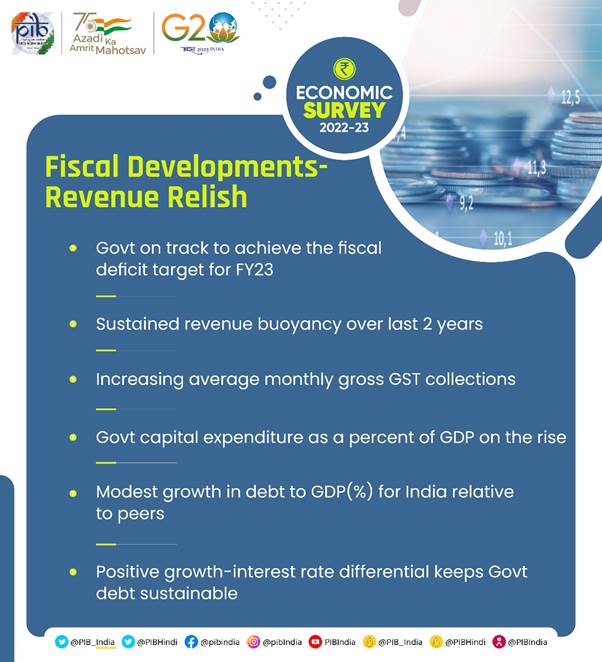
GOVERNMENT ON TRACK TO ACHIEVE FISCAL DEFICIT TARGET OF 6.4%

15.5% YoY GROWTH IN GROSS TAX REVENUE FROM APRIL TO NOVEMBER 2022

Rs. 13.40 LAKH CRORE COLLECTED AS GST REVENUE IN FIRST 3 QUARTERS OF FY23

NUMBER OF GST TAX PAYERS DOUBLED TO 1.4 CRORE FROM 70 LAKH

24.8 % YoY GROWTH IN GROSS GST COLLECTIONS DURING APRIL- DECEMBER 2022

DIRECT TAXES REGISTER A GROWTH OF 26% YoY DURING APRIL- NOVEMBER 2022

CAPITAL EXPENDITURE TO RISE BY 2.9% IN FY23 OVER LONG TERM AVERAGE OF 1.7% OF GDP

GOVERNMENT DEBT DECLINES FROM 59.2% OF GDP IN FY21 TO 56.7% IN FY22

GENERAL GOVERNMENT DEBT TO GDP RATIO INCREASED BY A MODEST 3% SINCE 2005 AS COMPARED TO SUBSTANTIAL INCREASE IN MOST COUNTRIES

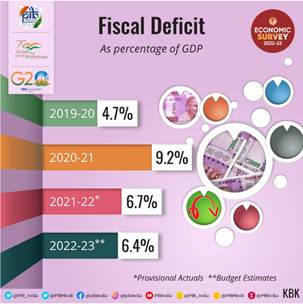
“The gradual decline in the Union government's fiscal deficit as a % of GDP, in line with the fiscal glide path envisioned by the government, is a result of careful fiscal management supported by buoyant revenue collection over the last two years” stated the Economic survey 2022-23 tabled by the Union Minister for Finance and Corporate Affairs Smt. Nirmala Sitharaman today in Parliament.
https://static.pib.gov.in/WriteReadData/userfiles/image/image00141J8.jpg

According to the Survey, fiscal deficit is expected to be at 6.4% of GDP in FY 23. The Survey highlighted that conservative budget assumptions provided a buffer during global uncertainties. The resilience in the fiscal performance was due to a recovery in economic activity and buoyancy in revenues.

Gross Tax Revenue

Gross Tax Revenue registered a Year on year (YoY) growth of 15.5 % from April to November 2022, and the Net Tax Revenue to the Centre after the assignment to states grew by 7.9 % on a YoY basis, stated the Survey. Structural reforms like the introduction of GST and the digitalisation of economic transactions have led to the greater formalisation of the economy and hence expanded the tax net and enhanced tax compliance. Thus revenues have grown at a pace much higher than the growth in GDP.

The Economic Survey highlighted that Direct taxes grew at 26 % Year On Year basis due to corporate and personal income tax growth in FY22. The Survey further added that growth rates observed in the major direct taxes during the first eight months of FY23 were much higher than their corresponding longer-term averages.

The Survey informed that high imports have led to a 12.4 % YoY growth in the customs collection from April to November 2022. The excise duty collection has declined by 20.9 % from April to November 2022 on a YoY basis.

Buoyant GST Collection

“The GST Tax payers doubled to 1.4 crore from 70 lakhs in 2022. The gross GST collections were ₹13.40 lakh crore from April to December 2022. Thus, implying a YoY growth of 24.8 % with an average monthly collection of ₹1.5 lakh crore”, noted the Survey. It further highlighted that improvement in GST collections has been due to the nationwide drive against GST evaders and fake bills and systemic changes introduced such as rate rationalisation correcting inverted duty structure.

Disinvestment

“Out of the budgeted amount of ₹65,000 crore for FY23, 48 % has been collected as of 18 January 2023 as the pandemic-induced uncertainty, the geopolitical conflict, and the associated risks have posed challenges before the plans and prospects of the government's disinvestment targets over the last three years” stated the Economic Survey 2022-23.

The Survey added that government has reaffirmed its commitment towards privatisation and strategic disinvestment of Public Sector Enterprises by implementing the New Public Sector Enterprise Policy and Asset Monetisation Strategy.

Capital expenditure

According to the Survey, the capital expenditure by the Central Government has steadily increased from a long-term average 2.5% of GDP in FY22 PA. It is further budgeted to increase to 2.9% of GDP in FY23 highlighting an improvement in the quality of Government expenditure over the years.

The Survey informed that ₹7.5 lakh crore of Capital Expenditure is budgeted for FY23, of which more than 59.6 % has been spent from April to November 2022. During this period, capital expenditure registered a YoY growth of over 60 %, much higher than the long-term average growth of 13.5 % recorded in the corresponding period from FY16 to FY20. Rs.1.5 lakh core were allocated to road transport and highways, Rs.1.20 lakh crore to railways, 0.7 lakh crore to defence and 0.3 lakh crore to telecommunications in FY22. It is considered as a counter-cyclical fiscal tool strengthening aggregate demand, generates employment and boosts other sectors.

To push for enhancing Capex from all directions, the Centre announced several incentives to boost states' capital expenditure in the form of long-term interest-free loans and capex-linked additional borrowing provisions

Revenue Expenditure

The revenue expenditure of the Union government was brought down from 15.6% of GDP in FY21 to 13.5% of GDP in FY22 Provisional Actual (PA). This contraction was led by a reduction of the subsidy expenditure which was brought down from 3.6% of GDP in FY21 to 1.9% of GDP in FY22 PA. It was further budgeted to reduce to 1.2% of GDP in FY23. However, around 94.7% of the budgeted expenditure on subsidies has been utilised from April to November 2022 due to the sudden outbreak of geopolitical conflict resulting in higher international prices for food, fertiliser and fuel. Thus, the revenue expenditure from April to November 2022 has grown by over 10% on a YoY basis, higher than the growth noted in the corresponding period last year.

Interest payments as a proportion of receipts went up after the pandemic outbreak. However, in the medium term, as we move along the fiscal glide path, buoyancy in revenues, aggressive asset monetisation, efficiency gains, and privatisation would help pay down the public debt, thus bringing down interest payments and releasing more monies for other priorities, highlights the Economic Survey.

Overview of State Government Finances

The combined Gross Fiscal Deficit (GFD) of the States, which increased to 4.1% of GDP in FY21, was brought down to 2.8% in FY22 PA. Given the geopolitical uncertainties, the consolidated GFD-GDP ratio for States has been budgeted at 3.4% in FY23. However, from April- November 2022, the combined borrowings of the 27 major states have just reached 33.5% of their total budgeted borrowings for the year. The data from last three years shows that states had unutilised borrowing limits.
https://static.pib.gov.in/WriteReadData/userfiles/image/image00281J4.jpg

The capital outlay of States grew by 31.7% in FY22 PA. This increase is attributable to strong revenue buoyancy and the support provided by the Centre in terms of advance releases of payments to the states, GST compensation payments, and interest-free loans.

Transfer from Centre to States

Total transfers to States comprising the share of States in Union taxes devolved to the States, Finance Commission Grants, Centrally Sponsored Schemes (CSS), and other transfers, have risen between FY19 and FY23 BE. The Finance Commission had recommended allocation of ₹1.92 lakh crore for FY23.

GST Compensation payments during crisis

To meet the shortfall in GST compensation for States, the Government, in addition to the release of regular GST compensation from the Fund, borrowed Rs. 2.69 lakh crore during FY21 and FY22 and passed it on to States. Moreover, the cess payments and tax devolution instalments to the States were frontloaded to give them early access to funds. Even though the total Cess collection until November 2022 was insufficient to make the entire payment to the States, the Centre released the balance from its resources.

Enhanced borrowing limits for states and incentives for reforms

Since the pandemic outbreak, the Centre has kept the Net Borrowing Ceiling of the State Governments above the Fiscal Responsibility Legislation (FRL) threshold. It was fixed at 5 % of GSDP in FY21, 4 % of GSDP in FY22 and 3.5 % of GSDP in FY23, a part of which was linked to reforms such as implementing the 'One Nation One Ration Card' System, ease of doing business reform, urban Local body/ utility reforms, and power sector reforms etc. The survey observes the progress made by various states in these reforms.

Centre’s support towards States’ capital expenditure

Amounts of Rs. 11,830 crore and Rs. 14,186 crore were provided to states in FY21 and FY22 as 50-year interest-free loans to state governments under the 'Scheme for Special Assistance to States for Capital Investment'. During the year FY23, the allocation under the Scheme has been raised to ₹1.05 lakh crore to give further impetus to State Capex plans.

Debt Profile of the Government

IMF projects the global government debt at 91% of GDP in 2022, about 7.5% points above the pre-pandemic levels. In this global backdrop, the total liabilities of the Union Government moderated from 59.2% of GDP in FY21 to 56.7% in FY22 (P).

India's public debt profile is relatively stable and is characterised by low currency and interest rate risks. Of the Union Government's total net liabilities in end-March 2021, 95.1% were denominated in domestic currency, while sovereign external debt constituted 4.9%, implying low currency risk. Further, sovereign external debt is entirely from official sources, which insulates it from volatility in the international capital markets, highlights the Economic Survey.

Furthermore, Public debt in India is primarily contracted at fixed interest rates, with floating internal debt constituting only 1.7% of GDP in end-March 2021. The debt portfolio is, therefore, insulated from interest rate volatility.

Consolidating General Government Finances

The General Government liabilities as a proportion of GDP increased steeply during FY21 on account of the additional borrowings made by Centre and States on account of the pandemic. However, the ratio has come off its peak in FY22 (RE), as observed by the Economic Survey. The General Government deficits as a percentage of GDP have also consolidated after their peak in F21.

A positive growth-interest rate differential

The Survey notes that the emphasis on capex in recent years is expected to boost GDP growth directly, and indirectly through multiplier effects on private consumption expenditure and private investment. Higher GDP growth would thereby facilitate buoyant revenue collection in the medium term, enabling a sustainable fiscal path. The General Government Debt to GDP ratio increased from 75.7% of end-March 2020 to 89.6% at the end of the pandemic year FY21. It is estimated to decline to 84.5% of GDP by end-March 2022. The emphasis on capex-led growth will enable India to keep the growth-interest rate differential positive. A positive growth-interest rate differential keeps the debt levels sustainable.

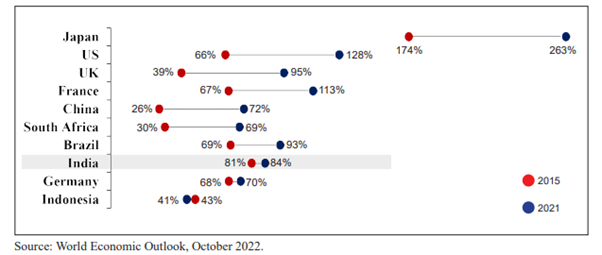
The change in General Government debt to GDP ratio from 2005 to 2021 has been substantial across the countries. For India, this increase is modest, from 81% of GDP in 2005 to around 84% of GDP in 2021. It has been possible on the back of resilient economic growth during the last 15 years leading to a positive growth-interest rate differential, which, in turn, has resulted in sustainable Government debt to GDP levels, explains the Economic Survey.

Fig.- Comparison of General Government debt to GDP ratio in 2005 with 2021 across the countries
https://static.pib.gov.in/WriteReadData/userfiles/image/image003NFRE.png

Topics

Acts Income Tax