

Loading...

Top
Help
×

By creating an account you can:

Logo TaxTMI
Call Us / Help / Feedback

Contact Us At :

E-mail: [email protected]

Call / WhatsApp at: +91 99117 96707

For more information, Check Contact Us

FAQs :

To know Frequently Asked Questions, Check FAQs

Most Asked Video Tutorials :

For more tutorials, Check Video Tutorials

Submit Feedback/Suggestion :

Email :
Please provide your email address so we can follow up on your feedback.
Category :
Description :
Min 15 characters 0/2000
Make Most of Text Search
  1. Checkout this video tutorial: How to search effectively on TaxTMI.
  2. Put words in double quotes for exact word search, eg: "income tax"
  3. Avoid noise words such as : 'and, of, the, a'
  4. Sort by Relevance to get the most relevant document.
  5. Press Enter to add multiple terms/multiple phrases, and then click on Search to Search.
  6. Text Search
  7. The system will try to fetch results that contains ALL your words.
  8. Once you add keywords, you'll see a new 'Search In' filter that makes your results even more precise.
  9. Text Search
Add to...
You have not created any category. Kindly create one to bookmark this item!
Create New Category
Hide
Title :
Description :
❮❮ Hide
Default View
Expand ❯❯
Close ✕
🔎 News - Adv. Search
TEXT SEARCH:

Press 'Enter' to add multiple search terms. Rules for Better Search

Search In:
Main Text + AI Text
  • Main Text
  • Main Text + AI Text
  • AI Text
Category: ?
Categorized by AI
---- All Categories ----
  • ---- All Categories ----
  • Income Tax
  • GST
  • Customs, DGFT & SEZ
  • FEMA & RBI
  • Corp. Laws, SEBI & IBC
  • PMLA, Black Money & ED
  • Budget
  • News and Press Release
  • PTI News
Month:
---- All Months ----
  • ---- All Months ----
  • January
  • February
  • March
  • April
  • May
  • June
  • July
  • August
  • September
  • October
  • November
  • December
Year:
---- All Years ----
  • ---- All Years ----
  • 2026
  • 2025
  • 2024
  • 2023
  • 2022
  • 2021
  • 2020
  • 2019
  • 2018
  • 2017
  • 2016
  • 2015
  • 2014
  • 2013
  • 2012
  • 2011
Sort By: ?
In Sort By 'Default', exact matches for text search are shown at the top, followed by the remaining results in their regular order.
Relevance Default Date
    Department of Commerce Organises Awareness Session on EU CBAM Regulations for Exporters
    PSB Confluence 2026 concludes with actionable strategies across seven themes for Public Sector Banks and Public Financial Institutions
    Previous LDF govt didn't fulfil many obligations related to Vizhinjam port: CM Satheesan
    Sitharaman calls on public sector banks to translate strength into competitiveness and leadership
    Sitharaman asks public sector banks to focus on youth; provide cool, simple banking to suit their needs
    I-T department officials discuss roadmap for improving services for taxpayers
    India-UK trade agreement to benefit Haryana's industries and services sector: CM Saini
    FM asks banks to keep pace with youth expectation; calls for outreach campaign from Oct 2
    CCI approves acquisition of certain equity shareholding in Bharti Life Insurance Company by Prudential Corporation Holdings
    Suspicious foreign remittances under I-T department scanner
    Delhi tightens rules for ration shops, makes big stock discrepancies an FIR offence
    Regional Rural Banks (RRBs) Record Strong Growth in Credit Delivery during FY 2025–26
    METSTO Delivers Adjustable Pallet Racking System Solutions for Warehouses
    China rolls out new measures to boost consumption in counties, smaller cities
    Strengthening Collaboration to Preserve Sovereignty: Collaborative Cash Ecosystems - Global Strategies to Preserve Trust and Sovereignty - Keynote Add...
    SC asks CBI to examine all six allegations of dubious transactions involving Indiabulls
    Cyber fraudsters invent 'boss' scam to target companies; Ahmedabad cops bust international network
    Personal Loan Prepayment Charges: What RBI Rules Say in 2026
    Zeeba Revamps Packaging and Announces Chef Vikas Khanna as Its Global Brand Ambassador
    Paul Merchants Finance Launches Loan Against Silver, Becomes India’s First NBFC to Set Up Exclusive Silver Loan Branches
❯❯
Maximize Maximize Maximize
0 / 200
Expand Note
Add to Folder

No Folders have been created

+

Are you sure you want to delete "My most important" ?

NOTE:

News
Showing Results for :
Reset Filters
Results Found:
Show All Summaries Hide All Summaries
August 19, 2026
Show AI Summary
Carbon border adjustment compliance requires reliable emissions data, reporting, accreditation and verification throughout exporters' supply chains.
European Union Carbon Border Adjustment Mechanism compliance requires exporters to address covered products, embedded-emissions calculation, data collection, reporting, accreditation and verification. Preparedness across the export value chain depends on timely emissions data from suppliers and other stakeholders, supported by credible verification mechanisms. Capacity-building and engagement seek to facilitate workable compliance with evolving sustainability-related international trade requirements.
August 19, 2026
Show AI Summary
Youth banking engagement promotes sustained customer relationships through digital access, campus outreach and financial support across evolving life stages.
Public Sector Banks and Public Financial Institutions are urged to implement actionable strategies with clear ownership and realistic timelines. Youth banking engagement is to be strengthened through a focused campaign, a common digital access platform and physical outreach, supporting young customers' evolving financial needs. Priority sector lending requires granular monitoring, early identification of target gaps and productive credit flow to intended beneficiaries. Agriculture and horticulture value-chain financing may cover farmer producer organisations, storage, processing, logistics and market linkages, while credit card strategies include digital onboarding, cross-selling and RuPay-UPI integration.
August 18, 2026
Show AI Summary
Port connectivity obligations shape Vizhinjam export-import operations, logistics integration, infrastructure acceleration, and scrutiny of prior stakeholder notification.
Vizhinjam port concession obligations include road and rail connectivity to maximise the benefits of export-import operations. The State government proposes land acquisition funding for a ring-road project, is engaging with central ministries on rail connectivity, and is seeking to expedite national-highway construction. Mission Samudra is intended to connect Cochin port and 18 mini ports with Vizhinjam to support lower-cost, faster exports. Concerns were also raised over the State government not receiving prior intimation of a proposed stake transfer in the port project company.
August 18, 2026
Show AI Summary
Public sector banking competitiveness requires distinct institutional strengths, early capability building and strategic support for economic growth priorities.
Public sector banks are urged to use their customer base, branch networks, geographic reach, institutional experience and digital capabilities to build stronger competitive positions and leadership. Each bank may develop distinct areas of excellence based on geography, customer relationships, sectoral expertise, technology capabilities or international presence. Strategic priorities include deposit mobilisation, banking for youth, support for investment and global capability centres, agriculture and horticulture infrastructure, credit-card business reorientation and priority sector lending.
August 18, 2026
Show AI Summary
Youth-focused banking requires public sector banks to deliver personalised digital services, financial awareness, and responsible credit engagement.
Public sector banks are urged to implement sustained youth-focused banking through campus outreach, simple personalised round-the-clock services, dedicated youth support and financial awareness. Engagement should develop long-term relationships beyond account opening while preserving prudential standards. Youth should receive guidance on the formal credit ecosystem, including credit scores, credit history, bank credit products and government credit schemes, to support responsible credit discipline and future financial needs. A dedicated portal may provide a single access point for banking awareness and suitable financial opportunities.
August 18, 2026
Show AI Summary
Taxpayer service improvement and litigation reduction guide administrative planning for stronger infrastructure, systems, coordination and future tax department functioning.
Improvement of taxpayer services, reduction of tax litigation, infrastructure strengthening and preparation of an actionable roadmap for future Income Tax Department functioning were considered as operational priorities. Deliberations covered e-HRMS, service matters, reservation policy, systems administration, capacity building, expenditure budgeting, TDS administration, inter-agency coordination, and office infrastructure. Officials identified institutional challenges and priorities for strengthening taxpayer-facing and internal departmental functions.
August 18, 2026
Show AI Summary
Duty-free UK market access strengthens export opportunities for Indian goods and services, supporting MSMEs, agriculture, manufacturing and global value-chain participation.
India-UK Comprehensive Economic and Trade Agreement provides duty-free access to the UK market for nearly all Indian exports and may improve the competitiveness of Haryana's manufacturing, agricultural, MSME and services sectors. Preferential access covers products including textiles, engineering goods, auto parts, processed foods and pharmaceuticals, while agricultural exports remain subject to exceptions for sensitive products. The agreement also provides market access across 137 UK services sub-sectors, supporting IT, digital, professional, financial and technical services and facilitating global value-chain participation.
August 18, 2026
Show AI Summary
Youth banking outreach promotes campus engagement, financial awareness, responsible credit discipline and long-term access to formal banking services.
Public sector banks are urged to conduct a month-long "Banking for Youth" outreach campaign from 2 October 2026 for persons above 16 years of age. Outreach through educational and skill-development campuses should combine account opening, financial awareness and direct engagement. Banks should develop tailored youth strategies to build long-term banking relationships. Proposed measures include online learning content, lifestyle-linked benefits, dedicated youth banking support, and awareness of credit scores, credit products and government credit schemes. A dedicated youth banking-awareness portal may serve as a single access point for appropriate banking services and financial opportunities.
August 18, 2026
Show AI Summary
Competition approval for Prudential's acquisition of equity shareholding in an Indian life insurer supports the proposed insurance-sector combination.
Competition approval has been granted for Prudential Corporation Holdings Limited to acquire certain equity shareholding in Bharti Life Insurance Company Limited. The acquirer is the holding company for its group's insurance and asset-management operations in Asia and supports operations in Asia and Africa. The target is an IRDAI-licensed Indian life insurer.
August 18, 2026
Show AI Summary
Foreign remittance certification due diligence faces nationwide verification targeting shell entities, their controllers, and certifying professionals.
Nationwide verification of suspicious outward foreign remittances targets entities with little or no reported business activity, their controllers, and professionals issuing tax determination certificates. Scrutiny concerns remittances disproportionate to reported turnover, inconsistent with stated purposes, or linked to entities not operating from declared addresses. Form 15CB, or Form 146 under the corresponding framework, requires certifying accountants to assess taxability from books of account and relevant records, supporting tax deduction at source and treaty compliance through due care, diligence and professional judgment.
August 18, 2026
Show AI Summary
Fair Price Shop regulation introduces graded stock-shortage penalties, mandatory FIRs for major discrepancies, and restructured licensing requirements.
Fair Price Shop regulation introduces quantity-based penalties for stock discrepancies, ranging from performance-guarantee forfeiture and replenishment obligations to interim suspension, cancellation-related action and mandatory FIR registration for major shortages. Repeated or deliberate diversion or manipulation of public distribution supplies may lead to cancellation, blacklisting and FIR registration. Licensing now includes continuing regular licences and short-term temporary licences, with wider eligibility, points-based selection, card-linked performance guarantees and compulsory approved e-PoS, weighing-scale and iris-scanner use.
August 18, 2026
Show AI Summary
Priority sector lending strengthened rural credit access through agricultural, micro-enterprise and weaker-section finance, reinforcing financial inclusion and sustainable development.
Regional Rural Banks expanded rural credit delivery while maintaining strong Priority Sector Lending performance during FY 2025-26. Almost all Regional Rural Banks met the prescribed overall priority-sector target. Agriculture and allied activities remained the largest priority-sector component, with farm credit accounting for nearly all agricultural lending. MSME finance predominantly supported micro enterprises, rural entrepreneurs, artisans and small businesses. Lending to weaker sections and finance for housing, education, renewable energy and social infrastructure promoted inclusive access to institutional credit and sustainable rural development.
August 18, 2026
Show AI Summary
Adjustable pallet racking systems support customised, scalable warehouse storage through configurable layouts, safety assessment, installation and lifecycle support.
Adjustable pallet racking systems are configurable warehouse-storage solutions for varied inventory dimensions, weights and product types. They support bulk pallet storage, multi-level picking and high-density configurations through adjustable beams and shelves, load-bearing capacity, structural durability and space-efficient layouts. Storage configurations are customised after assessing inventory dimensions, payload requirements, available space and material-movement frequency, with support for design, installation, inspections and after-sales service.
August 18, 2026
Show AI Summary
Domestic consumption expansion targets lower-tier markets through improved retail channels, distribution networks, employment support and household income opportunities.
China has introduced measures to strengthen domestic consumption in counties, smaller cities, townships and rural areas. The measures include upgrading township commercial centres, rural markets and local fairs; encouraging domestic and international brands to establish regional debut stores; and reusing existing land resources to improve services. They also seek better services for elderly persons and children, stronger urban-rural distribution networks, county-level employment and resident income channels. The strategy supports a shift towards household consumption amid weak domestic demand, property-sector pressures and subdued consumer sentiment.
August 18, 2026
Show AI Summary
Currency management preserves monetary sovereignty through clean notes, secure logistics, decentralised distribution, durable banknotes, and sustainable cash-cycle operations.
Currency management supports trust in cash and monetary sovereignty through demand planning, secure production, distribution, replacement, and disposal. The Clean Note Policy requires good-quality banknotes to be available in required denominations and locations, with unfit notes continuously withdrawn and replaced. A decentralised Currency Chest network distributes fresh currency, processes returned notes, supports linked bank branches, and operates under licensing, real-time reporting, inspection, and audit requirements. Current priorities include managing uncertain cash demand, improving note durability, and reducing the carbon footprint of the cash cycle.
August 18, 2026
Show AI Summary
Independent investigation of alleged dubious transactions requires examination of all six allegations despite prior police conclusions.
Investigation into alleged dubious transactions involving Indiabulls Housing Finance Limited and related entities must cover all six allegations identified by the Enforcement Directorate. The CBI must independently examine five allegations previously reviewed by the Delhi Police Economic Offence Wing, irrespective of its conclusion, and submit a comprehensive report. Further investigation into the sixth allegation depends on the special PMLA court deciding the CBI's pending application, after which the CBI must provide a progress or status report.
August 18, 2026
Show AI Summary
Boss scam prevention requires independent verification of payment requests and avoidance of malicious WhatsApp attachments that enable executive impersonation.
Boss scam, or CEO impersonation fraud, uses malicious WhatsApp attachments and impersonation of regulatory officials or company executives to obtain control of WhatsApp sessions and issue fraudulent payment instructions. The alleged network supplied SIM cards, dummy SIMs, WhatsApp accounts and one-time passwords to cyber-fraud operators, illustrating a Cybercrime as a Service model. Preventive measures include avoiding suspicious ZIP, executable, library and APK files and independently verifying all financial-transfer requests.
August 18, 2026
Show AI Summary
Floating-rate personal loan prepayment protections prohibit charges and compulsory lock-ins for qualifying individual non-business borrowers from 2026.
Prepayment charges are prohibited for part or full repayment of qualifying floating-rate loans availed by individual borrowers for non-business purposes and sanctioned or renewed on or after 1 January 2026. Compulsory lock-in periods cannot restrict prepayment of such loans. Fixed-rate personal loans may still attract prepayment or foreclosure charges under lender policy and contractual terms. Borrowers should check the loan's rate type, sanction letter, loan agreement and key fact statement, where applicable, and compare applicable charges with potential interest savings before early repayment.
August 18, 2026
Show AI Summary
Premium Basmati rice positioning drives Zeeba's packaging refresh and ambassador-led campaign focused on quality, authenticity and domestic expansion.
Zeeba has refreshed its packaging and appointed Chef Vikas Khanna as global brand ambassador to support expansion in India. Its "Aisa Basmati Nahi Dekha" campaign positions the brand around export-quality Basmati rice, consistency, authenticity and a superior culinary experience. Promotional activity will extend across digital, retail and consumer touchpoints. The premium Basmati range is described as carefully sourced, naturally aged and processed according to global quality standards, with emphasis on grain quality, authentic taste, purity and consistency.
August 18, 2026
Show AI Summary
Silver-collateral lending creates a formal secured-credit channel for eligible borrowers, subject to regulatory requirements and lender policies.
Loans against silver collateral have been introduced following the Reserve Bank of India's Lending Against Gold and Silver Collateral Directions, 2025, enabling eligible regulated lenders to accept silver as security. The offering provides a formal and transparent credit channel against eligible silver jewellery, ornaments and approved silver coins. It is intended for individuals, proprietors and MSMEs requiring liquidity for personal, business and other legitimate financial needs, subject to lending policies and applicable regulatory requirements.

News

Back

All News

Showing Results for :
Reset Filters
No Records Found

News

Back

All News

Showing Results for : Reset Filters

GOVERNMENT ON TRACK TO ACHIEVE FISCAL DEFICIT TARGET OF 6.4%

January 31, 2023

Contents
Summary
Note

Note

-

Bookmark

Print

Print

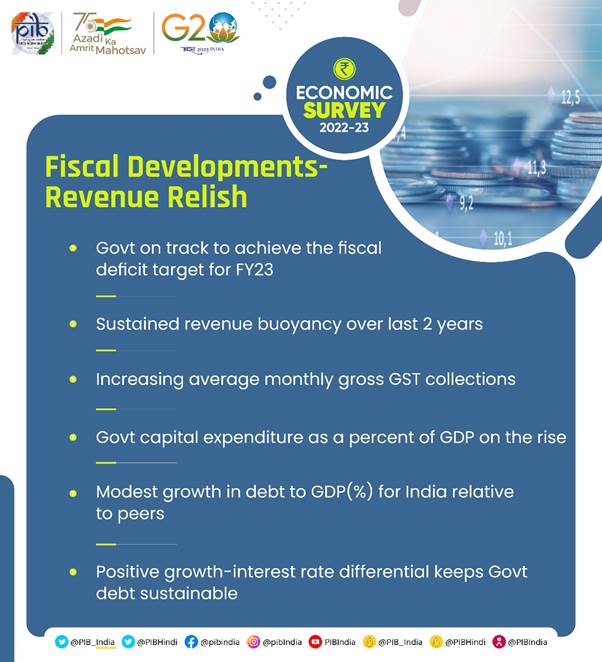
GOVERNMENT ON TRACK TO ACHIEVE FISCAL DEFICIT TARGET OF 6.4%

15.5% YoY GROWTH IN GROSS TAX REVENUE FROM APRIL TO NOVEMBER 2022

Rs. 13.40 LAKH CRORE COLLECTED AS GST REVENUE IN FIRST 3 QUARTERS OF FY23

NUMBER OF GST TAX PAYERS DOUBLED TO 1.4 CRORE FROM 70 LAKH

24.8 % YoY GROWTH IN GROSS GST COLLECTIONS DURING APRIL- DECEMBER 2022

DIRECT TAXES REGISTER A GROWTH OF 26% YoY DURING APRIL- NOVEMBER 2022

CAPITAL EXPENDITURE TO RISE BY 2.9% IN FY23 OVER LONG TERM AVERAGE OF 1.7% OF GDP

GOVERNMENT DEBT DECLINES FROM 59.2% OF GDP IN FY21 TO 56.7% IN FY22

GENERAL GOVERNMENT DEBT TO GDP RATIO INCREASED BY A MODEST 3% SINCE 2005 AS COMPARED TO SUBSTANTIAL INCREASE IN MOST COUNTRIES

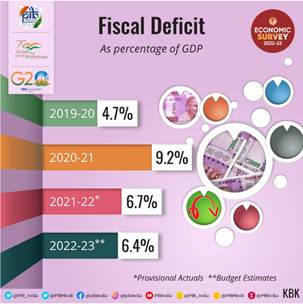
“The gradual decline in the Union government's fiscal deficit as a % of GDP, in line with the fiscal glide path envisioned by the government, is a result of careful fiscal management supported by buoyant revenue collection over the last two years” stated the Economic survey 2022-23 tabled by the Union Minister for Finance and Corporate Affairs Smt. Nirmala Sitharaman today in Parliament.
https://static.pib.gov.in/WriteReadData/userfiles/image/image00141J8.jpg

According to the Survey, fiscal deficit is expected to be at 6.4% of GDP in FY 23. The Survey highlighted that conservative budget assumptions provided a buffer during global uncertainties. The resilience in the fiscal performance was due to a recovery in economic activity and buoyancy in revenues.

Gross Tax Revenue

Gross Tax Revenue registered a Year on year (YoY) growth of 15.5 % from April to November 2022, and the Net Tax Revenue to the Centre after the assignment to states grew by 7.9 % on a YoY basis, stated the Survey. Structural reforms like the introduction of GST and the digitalisation of economic transactions have led to the greater formalisation of the economy and hence expanded the tax net and enhanced tax compliance. Thus revenues have grown at a pace much higher than the growth in GDP.

The Economic Survey highlighted that Direct taxes grew at 26 % Year On Year basis due to corporate and personal income tax growth in FY22. The Survey further added that growth rates observed in the major direct taxes during the first eight months of FY23 were much higher than their corresponding longer-term averages.

The Survey informed that high imports have led to a 12.4 % YoY growth in the customs collection from April to November 2022. The excise duty collection has declined by 20.9 % from April to November 2022 on a YoY basis.

Buoyant GST Collection

“The GST Tax payers doubled to 1.4 crore from 70 lakhs in 2022. The gross GST collections were ₹13.40 lakh crore from April to December 2022. Thus, implying a YoY growth of 24.8 % with an average monthly collection of ₹1.5 lakh crore”, noted the Survey. It further highlighted that improvement in GST collections has been due to the nationwide drive against GST evaders and fake bills and systemic changes introduced such as rate rationalisation correcting inverted duty structure.

Disinvestment

“Out of the budgeted amount of ₹65,000 crore for FY23, 48 % has been collected as of 18 January 2023 as the pandemic-induced uncertainty, the geopolitical conflict, and the associated risks have posed challenges before the plans and prospects of the government's disinvestment targets over the last three years” stated the Economic Survey 2022-23.

The Survey added that government has reaffirmed its commitment towards privatisation and strategic disinvestment of Public Sector Enterprises by implementing the New Public Sector Enterprise Policy and Asset Monetisation Strategy.

Capital expenditure

According to the Survey, the capital expenditure by the Central Government has steadily increased from a long-term average 2.5% of GDP in FY22 PA. It is further budgeted to increase to 2.9% of GDP in FY23 highlighting an improvement in the quality of Government expenditure over the years.

The Survey informed that ₹7.5 lakh crore of Capital Expenditure is budgeted for FY23, of which more than 59.6 % has been spent from April to November 2022. During this period, capital expenditure registered a YoY growth of over 60 %, much higher than the long-term average growth of 13.5 % recorded in the corresponding period from FY16 to FY20. Rs.1.5 lakh core were allocated to road transport and highways, Rs.1.20 lakh crore to railways, 0.7 lakh crore to defence and 0.3 lakh crore to telecommunications in FY22. It is considered as a counter-cyclical fiscal tool strengthening aggregate demand, generates employment and boosts other sectors.

To push for enhancing Capex from all directions, the Centre announced several incentives to boost states' capital expenditure in the form of long-term interest-free loans and capex-linked additional borrowing provisions

Revenue Expenditure

The revenue expenditure of the Union government was brought down from 15.6% of GDP in FY21 to 13.5% of GDP in FY22 Provisional Actual (PA). This contraction was led by a reduction of the subsidy expenditure which was brought down from 3.6% of GDP in FY21 to 1.9% of GDP in FY22 PA. It was further budgeted to reduce to 1.2% of GDP in FY23. However, around 94.7% of the budgeted expenditure on subsidies has been utilised from April to November 2022 due to the sudden outbreak of geopolitical conflict resulting in higher international prices for food, fertiliser and fuel. Thus, the revenue expenditure from April to November 2022 has grown by over 10% on a YoY basis, higher than the growth noted in the corresponding period last year.

Interest payments as a proportion of receipts went up after the pandemic outbreak. However, in the medium term, as we move along the fiscal glide path, buoyancy in revenues, aggressive asset monetisation, efficiency gains, and privatisation would help pay down the public debt, thus bringing down interest payments and releasing more monies for other priorities, highlights the Economic Survey.

Overview of State Government Finances

The combined Gross Fiscal Deficit (GFD) of the States, which increased to 4.1% of GDP in FY21, was brought down to 2.8% in FY22 PA. Given the geopolitical uncertainties, the consolidated GFD-GDP ratio for States has been budgeted at 3.4% in FY23. However, from April- November 2022, the combined borrowings of the 27 major states have just reached 33.5% of their total budgeted borrowings for the year. The data from last three years shows that states had unutilised borrowing limits.
https://static.pib.gov.in/WriteReadData/userfiles/image/image00281J4.jpg

The capital outlay of States grew by 31.7% in FY22 PA. This increase is attributable to strong revenue buoyancy and the support provided by the Centre in terms of advance releases of payments to the states, GST compensation payments, and interest-free loans.

Transfer from Centre to States

Total transfers to States comprising the share of States in Union taxes devolved to the States, Finance Commission Grants, Centrally Sponsored Schemes (CSS), and other transfers, have risen between FY19 and FY23 BE. The Finance Commission had recommended allocation of ₹1.92 lakh crore for FY23.

GST Compensation payments during crisis

To meet the shortfall in GST compensation for States, the Government, in addition to the release of regular GST compensation from the Fund, borrowed Rs. 2.69 lakh crore during FY21 and FY22 and passed it on to States. Moreover, the cess payments and tax devolution instalments to the States were frontloaded to give them early access to funds. Even though the total Cess collection until November 2022 was insufficient to make the entire payment to the States, the Centre released the balance from its resources.

Enhanced borrowing limits for states and incentives for reforms

Since the pandemic outbreak, the Centre has kept the Net Borrowing Ceiling of the State Governments above the Fiscal Responsibility Legislation (FRL) threshold. It was fixed at 5 % of GSDP in FY21, 4 % of GSDP in FY22 and 3.5 % of GSDP in FY23, a part of which was linked to reforms such as implementing the 'One Nation One Ration Card' System, ease of doing business reform, urban Local body/ utility reforms, and power sector reforms etc. The survey observes the progress made by various states in these reforms.

Centre’s support towards States’ capital expenditure

Amounts of Rs. 11,830 crore and Rs. 14,186 crore were provided to states in FY21 and FY22 as 50-year interest-free loans to state governments under the 'Scheme for Special Assistance to States for Capital Investment'. During the year FY23, the allocation under the Scheme has been raised to ₹1.05 lakh crore to give further impetus to State Capex plans.

Debt Profile of the Government

IMF projects the global government debt at 91% of GDP in 2022, about 7.5% points above the pre-pandemic levels. In this global backdrop, the total liabilities of the Union Government moderated from 59.2% of GDP in FY21 to 56.7% in FY22 (P).

India's public debt profile is relatively stable and is characterised by low currency and interest rate risks. Of the Union Government's total net liabilities in end-March 2021, 95.1% were denominated in domestic currency, while sovereign external debt constituted 4.9%, implying low currency risk. Further, sovereign external debt is entirely from official sources, which insulates it from volatility in the international capital markets, highlights the Economic Survey.

Furthermore, Public debt in India is primarily contracted at fixed interest rates, with floating internal debt constituting only 1.7% of GDP in end-March 2021. The debt portfolio is, therefore, insulated from interest rate volatility.

Consolidating General Government Finances

The General Government liabilities as a proportion of GDP increased steeply during FY21 on account of the additional borrowings made by Centre and States on account of the pandemic. However, the ratio has come off its peak in FY22 (RE), as observed by the Economic Survey. The General Government deficits as a percentage of GDP have also consolidated after their peak in F21.

A positive growth-interest rate differential

The Survey notes that the emphasis on capex in recent years is expected to boost GDP growth directly, and indirectly through multiplier effects on private consumption expenditure and private investment. Higher GDP growth would thereby facilitate buoyant revenue collection in the medium term, enabling a sustainable fiscal path. The General Government Debt to GDP ratio increased from 75.7% of end-March 2020 to 89.6% at the end of the pandemic year FY21. It is estimated to decline to 84.5% of GDP by end-March 2022. The emphasis on capex-led growth will enable India to keep the growth-interest rate differential positive. A positive growth-interest rate differential keeps the debt levels sustainable.

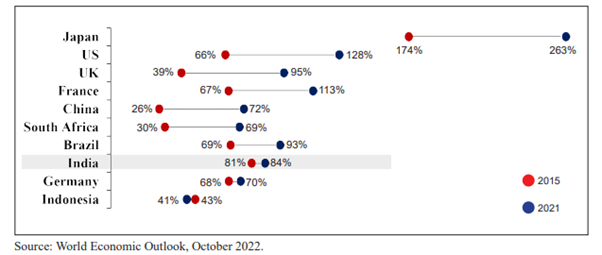
The change in General Government debt to GDP ratio from 2005 to 2021 has been substantial across the countries. For India, this increase is modest, from 81% of GDP in 2005 to around 84% of GDP in 2021. It has been possible on the back of resilient economic growth during the last 15 years leading to a positive growth-interest rate differential, which, in turn, has resulted in sustainable Government debt to GDP levels, explains the Economic Survey.

Fig.- Comparison of General Government debt to GDP ratio in 2005 with 2021 across the countries
https://static.pib.gov.in/WriteReadData/userfiles/image/image003NFRE.png

Topics

Acts Income Tax