

Loading...

Top
Help
×

By creating an account you can:

Logo TaxTMI
Call Us / Help / Feedback

Contact Us At :

E-mail: [email protected]

Call / WhatsApp at: +91 99117 96707

For more information, Check Contact Us

FAQs :

To know Frequently Asked Questions, Check FAQs

Most Asked Video Tutorials :

For more tutorials, Check Video Tutorials

Submit Feedback/Suggestion :

Email :
Please provide your email address so we can follow up on your feedback.
Category :
Description :
Min 15 characters 0/2000
Make Most of Text Search
  1. Checkout this video tutorial: How to search effectively on TaxTMI.
  2. Put words in double quotes for exact word search, eg: "income tax"
  3. Avoid noise words such as : 'and, of, the, a'
  4. Sort by Relevance to get the most relevant document.
  5. Press Enter to add multiple terms/multiple phrases, and then click on Search to Search.
  6. Text Search
  7. The system will try to fetch results that contains ALL your words.
  8. Once you add keywords, you'll see a new 'Search In' filter that makes your results even more precise.
  9. Text Search
Add to...
You have not created any category. Kindly create one to bookmark this item!
Create New Category
Hide
Title :
Description :
❮❮ Hide
Default View
Expand ❯❯
Close ✕
🔎 News - Adv. Search
TEXT SEARCH:

Press 'Enter' to add multiple search terms. Rules for Better Search

Search In:
Main Text + AI Text
  • Main Text
  • Main Text + AI Text
  • AI Text
Category: ?
Categorized by AI
---- All Categories ----
  • ---- All Categories ----
  • Income Tax
  • GST
  • Customs, DGFT & SEZ
  • FEMA & RBI
  • Corp. Laws, SEBI & IBC
  • PMLA, Black Money & ED
  • Budget
  • News and Press Release
  • PTI News
Month:
---- All Months ----
  • ---- All Months ----
  • January
  • February
  • March
  • April
  • May
  • June
  • July
  • August
  • September
  • October
  • November
  • December
Year:
---- All Years ----
  • ---- All Years ----
  • 2026
  • 2025
  • 2024
  • 2023
  • 2022
  • 2021
  • 2020
  • 2019
  • 2018
  • 2017
  • 2016
  • 2015
  • 2014
  • 2013
  • 2012
  • 2011
Sort By: ?
In Sort By 'Default', exact matches for text search are shown at the top, followed by the remaining results in their regular order.
Relevance Default Date
    Central Bureau of Narcotics (CBN) and PHARMEXCIL Sign Memorandum of Understanding to Boost Legitimate Pharmaceutical Exports and Strengthen Regulatory...
    RBI's USD-INR Swap Facility Sparks Unprecedented Forex Inflows into India, Banks Raise USD 73 Billion in eleven weeks
    Rupee falls 4 paise to 95.74 against US dollar in early trade
    Former cop Waze files fresh plea in Mumbai court, wants PMLA case against him dropped
    Rupee settles 1 paisa higher at 95.70 against US dollar
    Ontario's premier: Canada should be ready to cut electricity, critical minerals as trade woes worsen
    UIDAI, Army launch Aadhaar biometric update camps for students in Assam's Tamulpur
    J&K PCC chief opposes electricity tariff hike, demands immediate rollback
    Govt lifts ban on wheat exports to protect farmers interest amid depressed local prices
    FDA suspends licences of five food outlets on Mumbai Cricket Association premises
    Govt appoints ex-diplomat Akbaruddin, 2 other new members to RBI central board
    'Only 6.83 per cent after 4 years': Omar Abdullah defends J&K power tariff hike
    No sugar shortage in India, prices to ease in coming days following govt's measures: ISMA
    Govt lifts export ban on wheat and its products
    ED raids several places in UP, Haryana in GST fraud case; over Rs 1 crore cash seized
    From Syrup Diversion to Sugar Production: SED's Integrated Process House Solution for Shivshakti Sugars' 7,500 TCD Plant
    Chandigarh University Provides In-House Training for Civil Services, Defence, Management, Banking & PSUs
    ICSI inaugurates new Chapter Office in Hyderabad
    Curis Lifesciences Charts a New Growth Path with Uninova, Export Markets and Branded Pharma Expansion
    IBC @ Crossroads: A Decade of Evolution, The Road Ahead
❯❯
Maximize Maximize Maximize
0 / 200
Expand Note
Add to Folder

No Folders have been created

+

Are you sure you want to delete "My most important" ?

NOTE:

News
Showing Results for :
Reset Filters
Results Found:
Show All Summaries Hide All Summaries
August 25, 2026
Show AI Summary
Voluntary pharmaceutical export compliance framework promotes legitimate trade while safeguarding controlled substances through information sharing and coordinated capacity building.
The Memorandum of Understanding creates a cooperative framework for legitimate pharmaceutical exports and safeguards against diversion of narcotic drugs, psychotropic substances and controlled precursors. A voluntary, non-binding code of conduct will recommend industry practices without imposing obligations beyond applicable law. Cooperation includes identifying export bottlenecks, streamlining procedures for compliant exporters, capacity-building programmes, lawful and confidential information sharing, and nomination of company contact persons to coordinate voluntary compliance measures.
August 25, 2026
Show AI Summary
USD-INR forex swap facility accelerates foreign-currency mobilisation through non-resident deposits and institutional borrowing, strengthening India's external buffers.
USD-INR forex swap facility for FCNR(B) deposits, overseas foreign-currency borrowings and external commercial borrowings enabled banks to access foreign-currency funding through a special swap window. FCNR(B) deposits formed the principal component of the reported foreign-exchange inflows, reflecting participation by non-resident Indians. The FCNR(B) window was scheduled for early closure after the stated mobilisation objective was achieved ahead of schedule, and the inflows were presented as strengthening external buffers through long-term non-resident deposits and institutional funding.
August 25, 2026
Show AI Summary
Foreign-exchange intervention moderated rupee depreciation as crude prices, importer dollar demand and geopolitical uncertainty sustained currency-market pressure.
Foreign-exchange conditions reflected a marginal weakening of the rupee against the US dollar, influenced by elevated crude-oil prices, importer demand for dollars, weaker Asian equities and geopolitical uncertainty. The currency remained within a narrow trading band, with RBI dollar sales described as moderating sharper depreciation. The RBI's special USD-INR forex swap facility for FCNR(B) deposits, Overseas Foreign Currency Borrowings and External Commercial Borrowings mobilised substantial foreign-exchange inflows, indicating support from non-resident Indian participants.
August 24, 2026
Show AI Summary
Prior government sanction for public servants is contested as essential before money-laundering proceedings may validly proceed for official-duty acts.
Prior prosecution sanction is asserted to be a jurisdictional precondition for money-laundering proceedings against a public servant for acts connected with official duty. A former police officer challenges cognizance and process for want of sanction under the criminal procedure framework and the Maharashtra Police Act, relying on sanctions subsequently granted for co-accused public servants. The allegations concern collection of funds through the officer and their alleged laundering through an educational trust.
August 24, 2026
Show AI Summary
Rupee exchange-rate movement gained marginal support from foreign equity inflows despite crude oil, importer demand and geopolitical pressures.
Rupee exchange-rate movement against the US dollar reflected a marginal appreciation, supported by foreign fund inflows into domestic equities. Trading remained within a narrow range amid pressures from higher crude oil prices, continuing importer demand, and geopolitical concerns. Market conditions also included a stronger dollar index, lower Brent crude futures, domestic equity declines, and net foreign institutional investment. Elevated oil prices and geopolitical uncertainty indicated a slight negative bias, while possible US dollar weakness could support the rupee.
August 24, 2026
Show AI Summary
Retaliatory trade measures may target electricity, critical minerals and integrated automotive supply chains amid escalating cross-border tariff disputes.
Canada-United States trade relations involve escalating tariffs and contemplated reciprocal restrictions affecting goods, automotive production, electricity exports and critical-mineral supplies. Potential Canadian countermeasures include limiting or increasing the price of Ontario electricity exports and restricting supplies of critical minerals, with oil and potash also identified as possible leverage. The automotive sector faces particular exposure because Ontario production and supply chains are integrated with United States manufacturing. Negotiations also raised concern over limits on Canada's ability to conclude trade agreements with other countries without United States approval.
August 24, 2026
Show AI Summary
Mandatory biometric updates for students support continued Aadhaar authentication and access to education, scholarship and benefit-related services.
Mandatory Biometric Update camps have been launched in schools across Tamulpur district, Assam, for eligible students aged 5 to 17 years to update Aadhaar biometrics. Aadhaar biometrics require updating on attaining five years of age and again on attaining fifteen years. Timely updating supports continued Aadhaar authentication and helps avoid difficulties in accessing services where authentication is applicable, including school admissions, entrance-examination registration, scholarships and Direct Benefit Transfer schemes.
August 24, 2026
Show AI Summary
Electricity tariff affordability requires immediate review, withdrawal of higher consumer charges, and relief measures for economically weaker households.
Electricity tariff increase in Jammu and Kashmir has been opposed as imposing an unjustified and unaffordable financial burden on domestic consumers amid rising household costs. Immediate review and withdrawal of the increase are sought, together with measures to reduce electricity costs for domestic consumers, particularly economically weaker sections, and ensure affordable, reliable power supply.
August 24, 2026
Show AI Summary
Wheat export liberalisation replaces prohibitions to support farm prices while domestic stocks are expected to protect consumer supply.
Wheat and wheat-product exports are liberalised with immediate effect by revising their export policy from prohibited to free. The change covers wheat, wheat flour, maida, semolina and wholemeal atta, replacing the earlier export-ban framework and simplifying exports previously permitted through licences. The measure aims to support farmers amid depressed domestic prices, while adequate domestic availability and buffer stocks are expected to meet demand and moderate consumer prices.
August 24, 2026
Show AI Summary
Food safety compliance failures trigger licence suspensions for deficient hygiene, storage, refrigeration, sanitation and valid licensing practices.
Food safety enforcement measures resulted in suspension of food licences or registrations where establishments failed hygiene, food handling, storage, refrigeration, sanitation and licensing requirements. Deficiencies included unsafe temperature control, unclean refrigeration equipment, improper food storage and thawing, inadequate sanitisation, deteriorated or expired materials, deficient oil-quality checks, artificial colouring, pest infestation, cross-contamination risks and inadequate drainage. One outlet was also found to be operating under the name of an establishment without a valid food licence, resulting in suspension of its registration certificate.
August 24, 2026
Show AI Summary
Central Board Governance expands through appointments of part-time non-official directors for defined terms, alongside central bank and government representatives.
Appointments to the Reserve Bank of India's Central Board expand its part-time, non-official director membership. Syed Akbaruddin, Annie George Mathew and Janmejaya Kumar Sinha have been appointed for four years from 24 August 2026, or until further orders, whichever occurs earlier. The Central Board also includes the Governor, deputy governors, the economic affairs secretary and the financial services secretary.
August 24, 2026
Show AI Summary
Electricity tariff adjustment is linked to inflation and transmission losses, while free household units remain separately implemented.
Electricity tariff increase of 6.83 per cent after four years is presented as necessary in light of inflation and rising costs. Reducing transmission and distribution losses is identified as a means of limiting future tariff increases. Provision of 200 units of free electricity for poor and needy households through solar panels under the Muft Bijli Yojana is treated as distinct from tariff revisions.
August 24, 2026
Show AI Summary
Sugar supply management measures target speculative stockpiling through imports, stockholding limits and earlier crushing to moderate prices.
Sugar supply is characterised as adequate, and higher prices are attributed principally to speculative buying and advance stockpiling, alongside lower output, seasonal demand and global price pressures rather than an actual shortage. Duty-free raw sugar imports and stockholding limits are intended to augment availability, curb speculative accumulation and stabilise market sentiment. Imports, existing stocks, special crushing and an earlier crushing season are expected to moderate prices and improve festive-period supply. Ethanol diversion is not identified as a cause of the price movement.
August 24, 2026
Show AI Summary
Wheat export policy shifts to free trade, lifting restrictions on wheat flour, maida, semolina and wholemeal atta exports.
Wheat export policy has been revised from prohibited to free with immediate effect, lifting the export ban on wheat and related wheat products. The liberalised export treatment extends to wheat flour, maida, semolina and wholemeal atta. The restriction had been imposed to address rising domestic prices, and its removal is expected to improve international wheat availability.
August 24, 2026
Show AI Summary
Bogus input tax credit fraud investigation examines fabricated invoices, circular transactions, layered funds and alleged proceeds of crime.
Investigation into alleged bogus input tax credit fraud involved searches under the anti-money-laundering framework. The alleged scheme involved fabricated invoices and e-way bills without actual movement of goods, circular transactions, layered funds, cash withdrawals and bogus or non-existent entities. GST authorities identified fraudulent availment of input tax credit causing wrongful loss to the government exchequer. The investigation focused on tracing alleged proceeds of crime, identifying beneficiaries, and securing documentary and digital evidence.
August 24, 2026
Show AI Summary
Sugar crystallization process integration combines evaporator upgrades, continuous boiling, heat recovery and automation for efficient plantation white sugar production.
Sugar manufacturing process integration is proposed through strengthening an existing evaporator station and adding a sugar crystallization section to convert syrup production into plantation white sugar production. The scope covers design, engineering, equipment supply, erection and commissioning of condensate heaters, falling film evaporators, heat-recovery systems, continuous pans, vacuum systems and crystallizers. Continuous massecuite boiling will use chamber-specific control, while evaporator recirculation and online chemical-cleaning provisions support process control and low-grade vapour utilisation.
August 24, 2026
Show AI Summary
Competitive examination preparation supports career pathways in civil services, public employment, management, defence, research and international higher education.
Career-development and competitive-examination preparation is offered alongside academic programmes for civil services, government and public-sector employment, banking, engineering higher education, management, defence, teaching, research and overseas education. UPSC, SSC-CGL, Bank PO, GATE, CAT, CDS, UGC-NET, GRE, GMAT and IELTS preparation includes courses, workshops, mentorship, expert guidance and examination-specific resources. Access to examinations, admissions and career opportunities remains subject to applicable eligibility, selection and institutional criteria.
August 24, 2026
Show AI Summary
Corporate governance professionals gain expanded training infrastructure as Hyderabad's new Chapter Office supports Company Secretaries and students.
Institute of Company Secretaries of India has inaugurated a Chapter Office in Hyderabad to expand infrastructure for professional education, training, examinations, meetings, capacity-building programmes and stakeholder engagement. The facility is intended to support Company Secretaries and students and enable wider professional and educational activities. Company Secretaries are identified as corporate governance professionals, with expanding regulatory requirements and the formalisation and listing of micro, small and medium enterprises creating potential demand for qualified professionals.
August 24, 2026
Show AI Summary
Diversified pharmaceutical growth combines branded portfolio expansion, contract manufacturing, merchant exports, and regulatory registrations for international market development.
Curis Lifesciences Limited plans a diversified pharmaceutical strategy spanning domestic branded products, contract manufacturing and international market development. Its majority acquisition of Uninova Lifesciences is intended to strengthen own-brand marketing, distribution and portfolio expansion, including injectable products through third-party manufacturing. International initiatives include merchant exports in Kenya and a Nigerian joint venture pursuing own-brand regulatory registrations alongside contract-manufacturing and export opportunities. Commercial development in Nigeria remains contingent on relevant licences and purchase orders, while projections are subject to regulatory, market and other business factors.
August 24, 2026
Show AI Summary
Insolvency framework reform prioritises efficient resolution, value maximisation, stakeholder coordination, institutional strengthening and technology-enabled asset recovery.
Insolvency and Bankruptcy Code, 2016, entered its tenth year amid deliberations on legislative amendments, resolution timelines, stakeholder interests and value maximisation. Key areas included resolution plans and tax implications, liquidation processes, recent judicial developments, stakeholder coordination, and the roles of insolvency professionals, regulators, banking institutions and adjudicatory processes. Technological innovation, including artificial intelligence for asset tracing and recovery, alongside regulatory strengthening, capacity building and stakeholder collaboration, was emphasised for the future development of the insolvency ecosystem.

News

Back

All News

Showing Results for :
Reset Filters
No Records Found

News

Back

All News

Showing Results for : Reset Filters

GOVERNMENT ON TRACK TO ACHIEVE FISCAL DEFICIT TARGET OF 6.4%

January 31, 2023

Contents
Summary
Note

Note

-

Bookmark

Print

Print

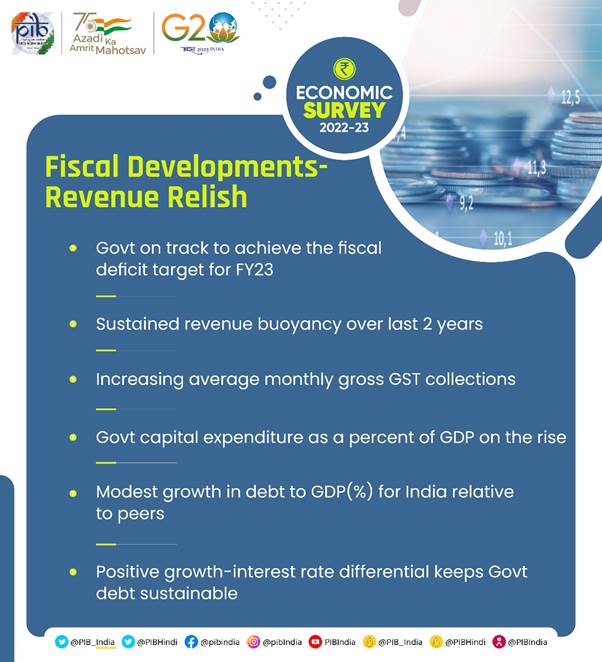
GOVERNMENT ON TRACK TO ACHIEVE FISCAL DEFICIT TARGET OF 6.4%

15.5% YoY GROWTH IN GROSS TAX REVENUE FROM APRIL TO NOVEMBER 2022

Rs. 13.40 LAKH CRORE COLLECTED AS GST REVENUE IN FIRST 3 QUARTERS OF FY23

NUMBER OF GST TAX PAYERS DOUBLED TO 1.4 CRORE FROM 70 LAKH

24.8 % YoY GROWTH IN GROSS GST COLLECTIONS DURING APRIL- DECEMBER 2022

DIRECT TAXES REGISTER A GROWTH OF 26% YoY DURING APRIL- NOVEMBER 2022

CAPITAL EXPENDITURE TO RISE BY 2.9% IN FY23 OVER LONG TERM AVERAGE OF 1.7% OF GDP

GOVERNMENT DEBT DECLINES FROM 59.2% OF GDP IN FY21 TO 56.7% IN FY22

GENERAL GOVERNMENT DEBT TO GDP RATIO INCREASED BY A MODEST 3% SINCE 2005 AS COMPARED TO SUBSTANTIAL INCREASE IN MOST COUNTRIES

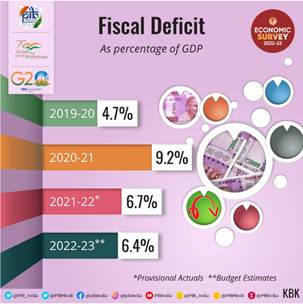
“The gradual decline in the Union government's fiscal deficit as a % of GDP, in line with the fiscal glide path envisioned by the government, is a result of careful fiscal management supported by buoyant revenue collection over the last two years” stated the Economic survey 2022-23 tabled by the Union Minister for Finance and Corporate Affairs Smt. Nirmala Sitharaman today in Parliament.
https://static.pib.gov.in/WriteReadData/userfiles/image/image00141J8.jpg

According to the Survey, fiscal deficit is expected to be at 6.4% of GDP in FY 23. The Survey highlighted that conservative budget assumptions provided a buffer during global uncertainties. The resilience in the fiscal performance was due to a recovery in economic activity and buoyancy in revenues.

Gross Tax Revenue

Gross Tax Revenue registered a Year on year (YoY) growth of 15.5 % from April to November 2022, and the Net Tax Revenue to the Centre after the assignment to states grew by 7.9 % on a YoY basis, stated the Survey. Structural reforms like the introduction of GST and the digitalisation of economic transactions have led to the greater formalisation of the economy and hence expanded the tax net and enhanced tax compliance. Thus revenues have grown at a pace much higher than the growth in GDP.

The Economic Survey highlighted that Direct taxes grew at 26 % Year On Year basis due to corporate and personal income tax growth in FY22. The Survey further added that growth rates observed in the major direct taxes during the first eight months of FY23 were much higher than their corresponding longer-term averages.

The Survey informed that high imports have led to a 12.4 % YoY growth in the customs collection from April to November 2022. The excise duty collection has declined by 20.9 % from April to November 2022 on a YoY basis.

Buoyant GST Collection

“The GST Tax payers doubled to 1.4 crore from 70 lakhs in 2022. The gross GST collections were ₹13.40 lakh crore from April to December 2022. Thus, implying a YoY growth of 24.8 % with an average monthly collection of ₹1.5 lakh crore”, noted the Survey. It further highlighted that improvement in GST collections has been due to the nationwide drive against GST evaders and fake bills and systemic changes introduced such as rate rationalisation correcting inverted duty structure.

Disinvestment

“Out of the budgeted amount of ₹65,000 crore for FY23, 48 % has been collected as of 18 January 2023 as the pandemic-induced uncertainty, the geopolitical conflict, and the associated risks have posed challenges before the plans and prospects of the government's disinvestment targets over the last three years” stated the Economic Survey 2022-23.

The Survey added that government has reaffirmed its commitment towards privatisation and strategic disinvestment of Public Sector Enterprises by implementing the New Public Sector Enterprise Policy and Asset Monetisation Strategy.

Capital expenditure

According to the Survey, the capital expenditure by the Central Government has steadily increased from a long-term average 2.5% of GDP in FY22 PA. It is further budgeted to increase to 2.9% of GDP in FY23 highlighting an improvement in the quality of Government expenditure over the years.

The Survey informed that ₹7.5 lakh crore of Capital Expenditure is budgeted for FY23, of which more than 59.6 % has been spent from April to November 2022. During this period, capital expenditure registered a YoY growth of over 60 %, much higher than the long-term average growth of 13.5 % recorded in the corresponding period from FY16 to FY20. Rs.1.5 lakh core were allocated to road transport and highways, Rs.1.20 lakh crore to railways, 0.7 lakh crore to defence and 0.3 lakh crore to telecommunications in FY22. It is considered as a counter-cyclical fiscal tool strengthening aggregate demand, generates employment and boosts other sectors.

To push for enhancing Capex from all directions, the Centre announced several incentives to boost states' capital expenditure in the form of long-term interest-free loans and capex-linked additional borrowing provisions

Revenue Expenditure

The revenue expenditure of the Union government was brought down from 15.6% of GDP in FY21 to 13.5% of GDP in FY22 Provisional Actual (PA). This contraction was led by a reduction of the subsidy expenditure which was brought down from 3.6% of GDP in FY21 to 1.9% of GDP in FY22 PA. It was further budgeted to reduce to 1.2% of GDP in FY23. However, around 94.7% of the budgeted expenditure on subsidies has been utilised from April to November 2022 due to the sudden outbreak of geopolitical conflict resulting in higher international prices for food, fertiliser and fuel. Thus, the revenue expenditure from April to November 2022 has grown by over 10% on a YoY basis, higher than the growth noted in the corresponding period last year.

Interest payments as a proportion of receipts went up after the pandemic outbreak. However, in the medium term, as we move along the fiscal glide path, buoyancy in revenues, aggressive asset monetisation, efficiency gains, and privatisation would help pay down the public debt, thus bringing down interest payments and releasing more monies for other priorities, highlights the Economic Survey.

Overview of State Government Finances

The combined Gross Fiscal Deficit (GFD) of the States, which increased to 4.1% of GDP in FY21, was brought down to 2.8% in FY22 PA. Given the geopolitical uncertainties, the consolidated GFD-GDP ratio for States has been budgeted at 3.4% in FY23. However, from April- November 2022, the combined borrowings of the 27 major states have just reached 33.5% of their total budgeted borrowings for the year. The data from last three years shows that states had unutilised borrowing limits.
https://static.pib.gov.in/WriteReadData/userfiles/image/image00281J4.jpg

The capital outlay of States grew by 31.7% in FY22 PA. This increase is attributable to strong revenue buoyancy and the support provided by the Centre in terms of advance releases of payments to the states, GST compensation payments, and interest-free loans.

Transfer from Centre to States

Total transfers to States comprising the share of States in Union taxes devolved to the States, Finance Commission Grants, Centrally Sponsored Schemes (CSS), and other transfers, have risen between FY19 and FY23 BE. The Finance Commission had recommended allocation of ₹1.92 lakh crore for FY23.

GST Compensation payments during crisis

To meet the shortfall in GST compensation for States, the Government, in addition to the release of regular GST compensation from the Fund, borrowed Rs. 2.69 lakh crore during FY21 and FY22 and passed it on to States. Moreover, the cess payments and tax devolution instalments to the States were frontloaded to give them early access to funds. Even though the total Cess collection until November 2022 was insufficient to make the entire payment to the States, the Centre released the balance from its resources.

Enhanced borrowing limits for states and incentives for reforms

Since the pandemic outbreak, the Centre has kept the Net Borrowing Ceiling of the State Governments above the Fiscal Responsibility Legislation (FRL) threshold. It was fixed at 5 % of GSDP in FY21, 4 % of GSDP in FY22 and 3.5 % of GSDP in FY23, a part of which was linked to reforms such as implementing the 'One Nation One Ration Card' System, ease of doing business reform, urban Local body/ utility reforms, and power sector reforms etc. The survey observes the progress made by various states in these reforms.

Centre’s support towards States’ capital expenditure

Amounts of Rs. 11,830 crore and Rs. 14,186 crore were provided to states in FY21 and FY22 as 50-year interest-free loans to state governments under the 'Scheme for Special Assistance to States for Capital Investment'. During the year FY23, the allocation under the Scheme has been raised to ₹1.05 lakh crore to give further impetus to State Capex plans.

Debt Profile of the Government

IMF projects the global government debt at 91% of GDP in 2022, about 7.5% points above the pre-pandemic levels. In this global backdrop, the total liabilities of the Union Government moderated from 59.2% of GDP in FY21 to 56.7% in FY22 (P).

India's public debt profile is relatively stable and is characterised by low currency and interest rate risks. Of the Union Government's total net liabilities in end-March 2021, 95.1% were denominated in domestic currency, while sovereign external debt constituted 4.9%, implying low currency risk. Further, sovereign external debt is entirely from official sources, which insulates it from volatility in the international capital markets, highlights the Economic Survey.

Furthermore, Public debt in India is primarily contracted at fixed interest rates, with floating internal debt constituting only 1.7% of GDP in end-March 2021. The debt portfolio is, therefore, insulated from interest rate volatility.

Consolidating General Government Finances

The General Government liabilities as a proportion of GDP increased steeply during FY21 on account of the additional borrowings made by Centre and States on account of the pandemic. However, the ratio has come off its peak in FY22 (RE), as observed by the Economic Survey. The General Government deficits as a percentage of GDP have also consolidated after their peak in F21.

A positive growth-interest rate differential

The Survey notes that the emphasis on capex in recent years is expected to boost GDP growth directly, and indirectly through multiplier effects on private consumption expenditure and private investment. Higher GDP growth would thereby facilitate buoyant revenue collection in the medium term, enabling a sustainable fiscal path. The General Government Debt to GDP ratio increased from 75.7% of end-March 2020 to 89.6% at the end of the pandemic year FY21. It is estimated to decline to 84.5% of GDP by end-March 2022. The emphasis on capex-led growth will enable India to keep the growth-interest rate differential positive. A positive growth-interest rate differential keeps the debt levels sustainable.

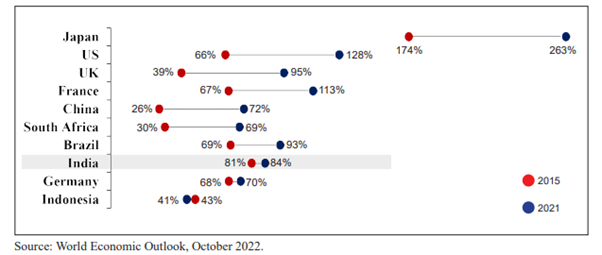
The change in General Government debt to GDP ratio from 2005 to 2021 has been substantial across the countries. For India, this increase is modest, from 81% of GDP in 2005 to around 84% of GDP in 2021. It has been possible on the back of resilient economic growth during the last 15 years leading to a positive growth-interest rate differential, which, in turn, has resulted in sustainable Government debt to GDP levels, explains the Economic Survey.

Fig.- Comparison of General Government debt to GDP ratio in 2005 with 2021 across the countries
https://static.pib.gov.in/WriteReadData/userfiles/image/image003NFRE.png

Topics

Acts Income Tax