

Loading...

Top
Help
×

By creating an account you can:

Logo TaxTMI
Call Us / Help / Feedback

Contact Us At :

E-mail: [email protected]

Call / WhatsApp at: +91 99117 96707

For more information, Check Contact Us

FAQs :

To know Frequently Asked Questions, Check FAQs

Most Asked Video Tutorials :

For more tutorials, Check Video Tutorials

Submit Feedback/Suggestion :

Email :
Please provide your email address so we can follow up on your feedback.
Category :
Description :
Min 15 characters 0/2000
Make Most of Text Search
  1. Checkout this video tutorial: How to search effectively on TaxTMI.
  2. Put words in double quotes for exact word search, eg: "income tax"
  3. Avoid noise words such as : 'and, of, the, a'
  4. Sort by Relevance to get the most relevant document.
  5. Press Enter to add multiple terms/multiple phrases, and then click on Search to Search.
  6. Text Search
  7. The system will try to fetch results that contains ALL your words.
  8. Once you add keywords, you'll see a new 'Search In' filter that makes your results even more precise.
  9. Text Search
Add to...
You have not created any category. Kindly create one to bookmark this item!
Create New Category
Hide
Title :
Description :
❮❮ Hide
Default View
Expand ❯❯
Close ✕
🔎 News - Adv. Search
TEXT SEARCH:

Press 'Enter' to add multiple search terms. Rules for Better Search

Search In:
Main Text + AI Text
  • Main Text
  • Main Text + AI Text
  • AI Text
Category: ?
Categorized by AI
---- All Categories ----
  • ---- All Categories ----
  • Income Tax
  • GST
  • Customs, DGFT & SEZ
  • FEMA & RBI
  • Corp. Laws, SEBI & IBC
  • PMLA, Black Money & ED
  • Budget
  • News and Press Release
  • PTI News
Month:
---- All Months ----
  • ---- All Months ----
  • January
  • February
  • March
  • April
  • May
  • June
  • July
  • August
  • September
  • October
  • November
  • December
Year:
---- All Years ----
  • ---- All Years ----
  • 2026
  • 2025
  • 2024
  • 2023
  • 2022
  • 2021
  • 2020
  • 2019
  • 2018
  • 2017
  • 2016
  • 2015
  • 2014
  • 2013
  • 2012
  • 2011
Sort By: ?
In Sort By 'Default', exact matches for text search are shown at the top, followed by the remaining results in their regular order.
Relevance Default Date
    Union Minister for Finance & Corporate Affairs Smt. Nirmala Sitharaman will embark on official visit to Canada and USA from 25th August to 2nd Septemb...
    UPI Completes 10 Years of Digital Payments Revolution- Globally Recognised as World’s Largest Real‑Time Payment System
    PROVISIONAL ESTIMATES OF SERVICE PRODUCER PRICE INDICES (BASE YEAR 2022-23) FOR Q1 OF FY 2026-27 AND FINAL INDICES FOR Q4 OF FY 2025-26.
    Minister of State for Commerce and Industry and Electronics & Information Technology Shri Jitin Prasada on Official Visit to Morocco.
    Rupee falls 3 paise to close at 95.74 against US dollar
    HSBC INDIA OPENS NEW BRANCH IN NASHIK TO SUPPORT WEALTH EXPANSION
    Commerce and Industry Minister Shri Piyush Goyal Leads A 200-Member Business Delegation to Japan.
    CBN busts inter-state heroin syndicate in ‘Op Black Hawk’; seizes over 18.6 kg crude heroin - Three members of inter-state trafficking network arr...
    Bank unions threaten nationwide strike on Sep 11 to press for 5-day banking, other demands
    Goyal says India negotiating FTAs with 8-9 more blocs, aims to cover 75 pc of global trade
    Rupee rises 7 paise to 95.64 against US dollar in early trade
    Woman passenger from Sharjah held with undeclared gold chain at Ahmedabad airport
    Delhi: Retired railway employee put under 'digital arrest', duped of Rs 30 lakh; one held
    CPI(M) accuses ED of ‘politically targeting’ Pinarayi Vijayan in CMRL case
    ED arrests ex-Andhra minister K Nageswara Rao in liquor transport 'scam'
    Orris Infrastructure MD Amit Gupta arrested in cheating case
    In a knot: Surat weaving units take voluntary two-day holiday as yarn prices shoot up
    Canada will impose retaliatory tariffs on US goods beginning Sept 8 as trade negotiations collapse
    Trade war between Canada, US deepens rupture in what had been close and durable alliance
    Canada will impose retaliatory tariffs on US good beginning Sept 8
❯❯
Maximize Maximize Maximize
0 / 200
Expand Note
Add to Folder

No Folders have been created

+

Are you sure you want to delete "My most important" ?

NOTE:

News
Showing Results for :
Reset Filters
Results Found:
Show All Summaries Hide All Summaries
August 24, 2026
Show AI Summary
Bilateral economic and financial cooperation will advance through investment dialogues, business engagement, financial-sector partnerships, and global economic discussions.
Official visits to Canada and the United States are scheduled to strengthen bilateral economic and financial partnerships, deepen investment linkages, and advance cooperation on global economic priorities. Engagements include an Economic and Financial Dialogue, investment and business roundtables, corporate meetings, and discussions on financial-sector cooperation, technology, innovation, critical minerals, resilient supply chains, and a Comprehensive Economic Partnership Agreement. Participation in the G20 Finance Ministers and Central Bank Governors Meeting will address global economic growth, stability, and international financial cooperation.
August 24, 2026
Show AI Summary
Interoperable real-time payments enable inclusive retail transactions, bank participation, and cross-border digital payment expansion through UPI.
Unified Payments Interface (UPI) operates as an interoperable, real-time digital payments platform for peer-to-peer and person-to-merchant transactions. Its network includes varied banking institutions acting as remitter and beneficiary payment service providers, with performance monitoring across participants. Person-to-merchant payments drive transaction volume through routine small-ticket retail use, while person-to-person payments represent a larger share of transaction value. UPI also supports cross-border digital payments, with future growth linked to technological advancement, broader adoption, policy support, and financial inclusion.
August 24, 2026
Show AI Summary
Service Producer Price Indices track quarterly price movements across financial, transport, telecom and insurance services using sub-service weights.
Service Producer Price Indices based on 2022-23 set out provisional first-quarter estimates for FY 2026-27 and final fourth-quarter estimates for FY 2025-26 across financial, insurance, telecom, railway and air-passenger services. Latest quarterly data show negative year-on-year inflation for securities transaction and banking services, while banking service contribution, pension-fund management, insurance, telecom and railway services record positive inflation. Aggregate weights are not assigned because the covered services do not represent the entire service sector; sub-service weights are used to derive service-level PPIs.
August 24, 2026
Show AI Summary
Food safety cooperation supports imported-food quality information exchange and technical collaboration within broader bilateral economic and trade engagement.
India-Morocco economic cooperation is being advanced through discussions on trade diversification, market access, investment, industrial cooperation, customs, agriculture, food safety, energy, digital transformation and logistics. A proposed food safety Memorandum of Understanding would support exchanges on imported-food safety and quality, testing laboratories, analytical methods, import procedures, quality control, sampling, testing, packaging and labelling. Proposed cultural cooperation would promote professional exchanges, heritage conservation and institutional linkages.
August 24, 2026
Show AI Summary
Foreign-exchange market conditions pressured the rupee as dollar strength, crude concerns and geopolitical uncertainty shaped narrow USD/INR trading.
Foreign-exchange market conditions led the rupee to close marginally lower against the US dollar after reversing initial gains. The USD/INR pair traded within a narrow range amid a stronger dollar index, weak domestic equity markets, importer demand, crude-oil concerns and geopolitical uncertainty. Market commentary indicated a slight negative bias for the rupee, although possible US-dollar weakness could provide support at lower levels. India's foreign-exchange reserves increased during the referenced reporting week.
August 24, 2026
Show AI Summary
Branch expansion for wealth and cross-border banking services targets emerging commercial centres and affluent customer segments across India.
HSBC India's branch expansion is directed at extending wealth, international banking, and corporate banking services to affluent, high-net-worth, ultra-high-net-worth, and non-resident Indian customers in emerging commercial centres. The Nashik opening forms part of a broader branch-expansion programme undertaken after Reserve Bank of India approval to establish additional branches in key cities. The programme is intended to expand delivery of banking and financial services, including support for cross-border wealth management, overseas investment by Indian companies, and foreign investment into India.
August 24, 2026
Show AI Summary
Bilateral trade and investment cooperation advances through business engagement in high-technology manufacturing, clean energy, innovation and industrial collaboration.
India's commerce and industry engagement with Japan is structured around a business delegation visit to deepen bilateral trade, investment, technology and industrial collaboration. Sector-focused discussions cover semiconductors, artificial intelligence, start-ups, automotive manufacturing, steel, electronics, industrial and consumer markets. Business roadshows and investor interactions are directed at presenting opportunities in India's manufacturing, clean-energy and consumer sectors, while advancing cooperation in high-technology manufacturing and next-generation industries.
August 24, 2026
Show AI Summary
Inter-state heroin trafficking enforcement uncovered concealed narcotics in transport vehicles, triggering arrests, confiscation, and continuing supply-chain investigations.
Operation Black Hawk targeted an alleged inter-state heroin trafficking network moving crude heroin from the North-East region towards Uttar Pradesh. Intelligence-led vehicle tracking and highway interceptions resulted in the seizure of over 18.6 kg of crude heroin and the arrest of three suspected network members under the Narcotic Drugs and Psychotropic Substances Act, 1985. The narcotics were detected in specially fabricated concealed compartments within a passenger vehicle fuel tank and a heavy commercial vehicle body frame. Both vehicles and the contraband were confiscated, while financial and logistical investigations continue into suppliers and distribution channels.
August 24, 2026
Show AI Summary
Five-day banking and uniform performance incentives drive proposed bank union action over unresolved pension and employment demands.
Banking labour relations are affected by proposed nationwide industrial action over five-day banking, performance-linked incentives, and pension-related demands. Five-day banking remains pending despite a bipartite arrangement for extended weekday hours. Unions dispute an incentive scheme that differentiates awards by seniority and individual performance, contending that it departs from bank-level performance linkage and uniformity across cadres. They also allege that implementation during pending conciliation breaches a status quo obligation, while pension revision, uniform dearness allowance, and a pension-scheme switch option remain unresolved.
August 24, 2026
Show AI Summary
Free trade agreement strategy expands preferential market access and supports India's integration into global value chains and investment partnerships.
India's free trade agreement strategy seeks to expand preferential market access and integrate the country into global value chains as a trusted trading partner. Negotiations with additional country groups and individual nations are intended to extend agreement coverage to a substantial share of global trade. Investment opportunities are identified in data centres, manufacturing and artificial intelligence, alongside an objective of developing more balanced trade relations between India and Japan.
August 24, 2026
Show AI Summary
Foreign exchange market conditions supported rupee appreciation, but crude prices, importer demand and geopolitical sanctions concerns limited gains.
Foreign exchange market conditions supported a modest early appreciation of the rupee against the US dollar due to relative dollar softness. The gain was limited by elevated crude oil prices, importer demand for dollars, and caution over anticipated sanctions affecting Iranian oil trade, banking networks and shipping routes. Currency markets remained sensitive to geopolitical uncertainty and possible wider trade effects.
August 23, 2026
Show AI Summary
Undeclared gold importation led to customs interception, seizure, arrest and continuing investigation after concealment inside passenger clothing.
Customs enforcement against undeclared gold importation involved interception of a passenger arriving from Sharjah at Ahmedabad airport following passenger profiling. A gold chain concealed inside clothing was recovered after it was not declared for customs purposes. The chain was seized and the passenger was arrested under the Customs Act, 1962, before being released on bail, with further investigation continuing.
August 23, 2026
Show AI Summary
Digital arrest cyber fraud used impersonation, forged notices and coercive video calls to obtain transfers through mule accounts.
Digital arrest cyber fraud allegedly used impersonation of law-enforcement and central banking officials, fabricated notices, threats of arrest and continuous video communications to coerce a retired railway employee into disclosing financial details and transferring funds for purported verification. The alleged proceeds were routed through mule and shell accounts. Banking records, KYC details, digital evidence and transaction trails allegedly connected a recipient account with suspicious transactions and multiple cyber-fraud cases; part of the cheated amount was recovered or refunded.
August 23, 2026
Show AI Summary
Political targeting allegations challenge money-laundering enforcement actions, searches, questioning, and public disclosures in the CMRL investigation.
CPI(M) alleges that enforcement action under the Prevention of Money Laundering Act in the CMRL matter is politically motivated targeting of Pinarayi Vijayan, family members and party associates. It contends that searches, questioning and public communications during the investigation were used to create suspicion without incriminating evidence, and characterises references to hawala as a new investigative narrative. The party also alleges selective anti-money-laundering enforcement against opposition leaders and states that the company will address the CMRL-related matter.
August 23, 2026
Show AI Summary
Money-laundering investigation into alleged liquor transport irregularities results in arrests connected with claimed loss to the government exchequer.
Money-laundering proceedings concerning alleged financial irregularities in liquor transport led to the arrest of former Andhra Pradesh minister Karumuri Nageswara Rao under the Prevention of Money Laundering Act. The inquiry concerns alleged wrongful loss to the government exchequer arising from liquor-transport operations. Investigative measures included raids and the arrest of Rao's son, along with arrests of a former state beverages corporation managing director and the person described as the principal accused.
August 23, 2026
Show AI Summary
Alleged LLP record forgery raises cheating, breach of trust and conspiracy concerns over unauthorised partnership interest changes.
Alleged forgery, cheating, criminal breach of trust and conspiracy concern purported unauthorised changes to LLP statutory records filed with the Registrar of Companies. The allegations include use of false documents to remove a nominated partner, substitute another person as partner and transfer a partner's interest in the LLP. The matter also draws attention to separate land-collaboration allegations and delayed possession claims by homebuyers in a halted housing project.
August 23, 2026
Show AI Summary
Voluntary production curtailment addresses polyester yarn cost volatility as weaving units seek customs-duty relief on inputs.
Voluntary production curtailment by weaving units is being adopted in response to increased polyester yarn and related input costs. Units may reduce shifts or observe periodic holidays according to individual commercial feasibility to limit yarn consumption until prices and fabric-market conditions stabilise. Industry representatives allege that yarn-price increases exceed corresponding input-cost movements and seek examination of possible artificial pricing, along with customs-duty relief on yarn and relevant inputs.
August 22, 2026
Show AI Summary
Retaliatory tariffs escalate trade restrictions as historic tariff authority enables duties without prior investigation or a prescribed duration.
Retaliatory tariffs are set to escalate bilateral trade restrictions after the United States imposed tariffs of up to 50 per cent on specified Canadian imports. Canada proposes dollar-for-dollar countermeasures covering sectors including steel, dairy, appliances, agricultural equipment, pulp and paper and electronics. Section 338 of the Tariff Act of 1930 is invoked as the legal basis for the United States measures, permitting presidential import duties up to 50 per cent without a prior investigation or prescribed maximum duration. Escalation creates uncertainty for supply chains and renewal of the United States-Mexico-Canada Agreement.
August 22, 2026
Show AI Summary
Reciprocal tariffs reshape Canada-United States trade relations, increasing supply-chain risks and accelerating Canadian trade diversification beyond its primary export market.
Canada-United States trade relations are described as entering a confrontational phase after tariff negotiations collapsed. The United States imposed tariffs on specified Canadian goods, while Canada committed to reciprocal import taxes and suspended negotiations. The dispute marks a retreat from preferential market access and continental integration. Canada's export dependence on the United States may limit retaliation and increase risks to output, employment, investment and integrated supply chains. Trade diversification, non-United States investment and expanded Pacific export infrastructure are identified as responses to a potentially enduring protectionist bilateral relationship.
August 22, 2026
Show AI Summary
Retaliatory tariffs on United States goods will target key sectors after trade negotiations failed and reciprocal tariff relief was unavailable.
Retaliatory tariffs on United States goods will take effect from 8 September in response to United States tariffs on Canadian products and unsuccessful negotiations. The dollar-for-dollar measures will cover steel, dairy, appliances, agricultural equipment, pulp and paper, and electronics, with product-specific details to follow. Canada had been willing to remove certain retaliatory tariffs if corresponding United States tariffs were substantially reduced, but considered the final demands unacceptable.

News

Back

All News

Showing Results for :
Reset Filters
No Records Found

News

Back

All News

Showing Results for : Reset Filters

ONCE THE GLOBAL SHOCKS OF THE PANDEMIC AND RUSSIAN-UKRAINE CONFLICT RESULTING IN SPIKE OF COMMODITY CRISES FADE AWAY, INDIAN ECONOMY IS POISED TO GROW FASTER IN THE COMING DECADE

January 31, 2023

Contents
Summary
Note

Note

-

Bookmark

Print

Print

ONCE THE GLOBAL SHOCKS OF THE PANDEMIC AND RUSSIAN-UKRAINE CONFLICT RESULTING IN SPIKE OF COMMODITY CRISES FADE AWAY, INDIAN ECONOMY IS POISED TO GROW FASTER IN THE COMING DECADE

WITH IMPROVED BALANCE SHEETS OF THE BANKING, NON-BANKING AND CORPORATE SECTORS, A FRESH CREDIT CYCLE HAS BEGUN AS IS EVIDENT FROM DOUBLE DIGIT GROWTH IN BANK CREDIT OVER THE PAST MONTHS

ECONOMY HAS STARTED BENEFITING FROM THE EFFICIENCY GAINS RESULTING FROM GREATER FORMALISATION, HIGHER FINANCIAL INCLUSION AND ECONOMIC OPPORTUNITIES CREATED BY DIGITAL TECHNOLOGY-BASED ECONOMIC REFORMS

INDIA’S GROWTH OUTLOOK SEEMS BETTER THAN IN THE PRE-PANDEMIC YEARS AND IT IS PREPARED TO GROW AT ITS POTENTIAL IN THE MEDIUM TERM

STRONG MEDIUM-TERM GROWTH MAGNETS TO AID INDIA’S ECONOMIC GROWTH

VARIOUS REFORMS UNDERTAKEN BETWEEN 2014-2022 STRENGHTENED THE INDIAN ECONOMY

EMPHASIS OF REFORMS ON ENHANCING THE EASE OF LIVING AND DOING BUSINESS

During the period of 2014-2022, the Indian Economy underwent a gamut of wide-ranging structural and governance reforms that strengthened the economy’s fundamentals by enhancing its overall efficiency. The Economic Survey 2022-23 presented in Parliament today by the Union Minister for Finance & Corporate Affairs, Smt. Nirmala Sitharaman stated that with an underlying emphasis on improving the ease of living and doing business, these reforms were based on the broad principles of creating public goods, adopting trust-based governance, co-partnering with the private sector for development, and improving agricultural productivity.
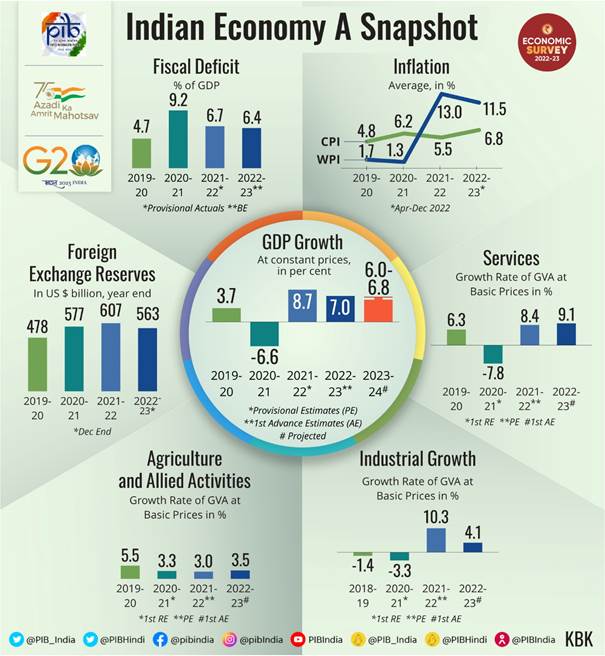
The Economic Survey highlights that the above transformative reforms undertaken by the government had lagged growth returns due to temporary shocks in the economy. However, in the present decade, the presence of strong medium-term growth magnets provides optimism and hope that once these global shocks of the pandemic and the spike in commodity prices in 2022 fade away, the Indian economy is well placed to grow faster in the coming decade.

Reforms for New India - Sabka Saath Sabka Vikaas

According to the Economic Survey, the reforms undertaken before 2014 primarily catered to product and capital market space. They were necessary and continued post-2014 as well. The government, however, imparted a new dimension to these reforms in the last eight years. With an underlying emphasis on enhancing the ease of living and doing business and improving economic efficiency, the reforms are well placed to lift the economy’s potential growth. The broad principles behind the reforms were creating public goods, adopting trust-based governance, co-partnering with the private sector for development, and improving agricultural productivity. “This approach reflects a paradigm shift in the growth and development strategy of the government, with the emphasis shifted towards building partnerships amongst various stakeholders in the development process, where each contributes to and reaps the development benefits (Sabka Saath, Sabka Vikaas)”, stated the Survey.

Creating public goods to enhance opportunities, efficiencies and ease of living

The Economic Survey notes that a quantum leap in policy commitment and outlay for infrastructure is now visible in the last few years, cushioning economic growth when the non-financial corporate sector was unable to invest due to balance sheet troubles. In doing so, the government has laid a good platform for crowding in private investments and growth in the coming decade. Besides the push to physical infrastructure, the government’s emphasis on developing public digital infrastructure during the last few years has been a game changer in enhancing the economic potential of individuals and businesses. With its strong forward linkages to the non-digital sectors, digitalisation strengthens potential economic growth through various channels. Some of these, such as higher financial inclusion, greater formalisation, increased efficiencies and enhanced opportunities.
Trust-based Governance

According to the Economic Survey, building trust between the government and the citizens/businesses unleashes efficiency gains through improved investor sentiment, better ease of doing business, and more effective governance. Consistent reforms have been made in this direction during the last eight years. Simplification of regulatory frameworks through reforms such as the Insolvency and Bankruptcy Code (IBC) and the Real Estate (Regulation and Development) Act (RERA) have enhanced the ease of doing business. Decriminalisation of minor economic offences under the Companies Act of 2013, simplifying processes by doing away with 25000 unnecessary compliances, repealing more than 1400 archaic laws, abolishing the Angel tax and removing retrospective taxation on offshore indirect transfer of assets located in India, signal the government’s resolve to ensure a non-adversarial policy environment.  In particular, the taxation ecosystem in the country has undergone substantial reforms in the post-2014 period. Tax policy reforms such as adopting a unified GST, reducing corporate tax rates, exemption of sovereign wealth funds and pension funds from taxes, and removing the Dividend Distribution tax have reduced the tax burden on individuals and businesses; and removed the distortionary incentives from the economy.

Promoting the private sector as a co-partner in the development

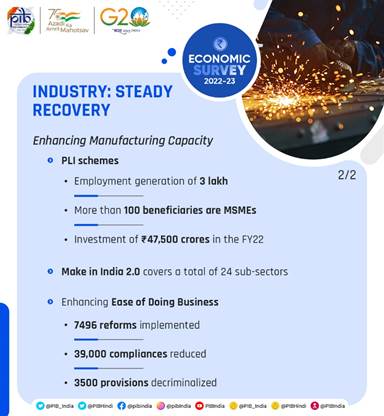
The Survey notes that a fundamental principle behind the government’s policy in the post- 2014 period has been the engagement with the private sector as a partner in the development process. The New Public Sector Enterprise Policy for Aatmanirbhar Bharat has thus been introduced to realise higher efficiency gains by minimising the presence of the government in the PSEs to only a few strategic sectors. Significant initiatives have been introduced under Aatmanirbhar Bharat and Make in India programmes to enhance India’s manufacturing capabilities and exports across the industries. The National Logistics Policy (2022) has been launched to create an overarching logistics ecosystem for lowering the cost of logistics and bringing it to par with other developed countries. Liberalisation of FDI policy has resulted in a visible structural shift in the gross FDI flows to India during the last decade. Opening the strategic sectors, such as defence, mining and space, for the private sector has enhanced the business opportunities in the economy. Reforms to address the structural challenges faced by MSMEs have also been a vital part of the industrial policy in recent years.

Enhancing productivity in agriculture

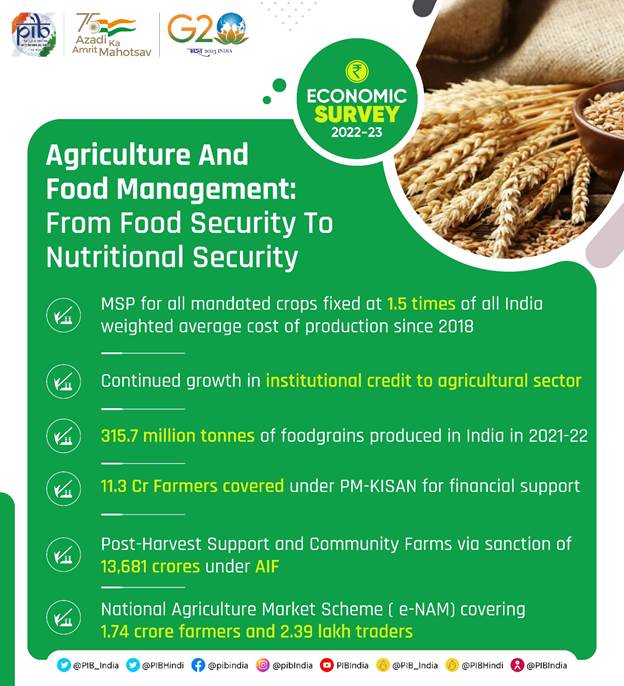
The agriculture sector in India has grown at an average annual growth rate of 4.6 per cent during the last six years, as observed by the Economic Survey. This growth is partly attributable to good monsoon years and partly to the various reforms undertaken by the government to enhance agricultural productivity. Policies such as Soil Health Cards, the Micro Irrigation Fund, and organic and natural farming have helped the farmers optimise resource use and reduce the cultivation cost. The promotion of Farmer Producer Organisations (FPOs) and the National Agriculture Market (e-NAM) extension Platform have empowered farmers, enhanced their resources, and enabled them to get good returns. Agri Infrastructure Fund (AIF) has supported the creation of various agriculture infrastructures. Kisan Rail exclusively caters to the movement of perishable Agri Horti commodities. According to the survey, all these measures are directed towards supporting the growth in agricultural productivity and sustaining its contribution to overall economic growth in the medium term.
Shocks that the economy faced during 2014-22

The Economic Survey notes that during 1998- 2002, transformative reforms were launched but yielded lagged growth dividends. This phenomenon was attributed to a series of one-off shocks resulting from external factors and the domestic financial sector clean-up, which overshadowed the growth returns from 1998 to 2002. By 2003, when the shocks dissipated, India participated in the global boom and grew at a higher rate. Similarly, in the present context, as the global shocks of the pandemic and the spike in commodity prices in 2022 fade away, the Indian economy is well placed to grow at its potential in the coming decade.

Growth Magnets in this Decade (2023-2030)

The Economic Survey states that the health and economic shocks of the pandemic and the spike in commodity prices in 2022 wear off, the Indian economy is thus well placed to grow at its potential in the coming decade, similar to the growth experience of the economy after 2003. The Economic Survey observes that with improved and healthier balance sheets of the banking, non-banking and corporate sectors, a fresh credit cycle has already begun, evident from the double-digit growth in bank credit over the past months. This is the primary reason for expecting India’s growth outlook to be better than it was in the pre-pandemic years.
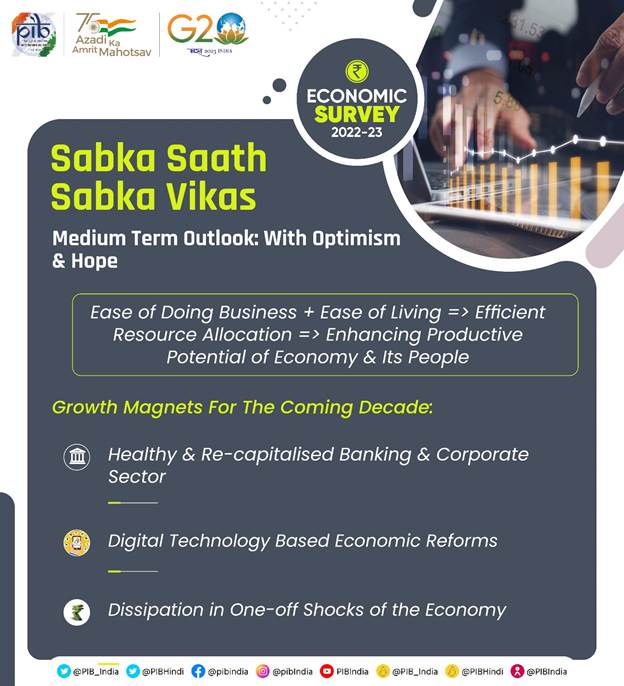
The Survey further states that the digitalisation reforms and the resulting efficiency gains in terms of greater formalisation, higher financial inclusion, and more economic opportunities will be the second most important driver of India’s economic growth in the medium term. These productivity-enhancing reforms along with the Government's Skilling initiatives, will also help unleash the benefits of the demographic dividend in the coming years.

Considering the evolving geo-political situation, the Survey notes that India has an opportunity to benefit from the diversification of global supply chains. The last few years have exposed multinational firms to unprecedented risks due to global trade tensions, pandemic-induced supply chain disruptions, and the conflict in Europe. With enabling policy frameworks, India presents itself as a credible destination for capital diversifying out of other countries.

Thus, India’s growth outlook seems better than in the pre-pandemic years, and the Indian economy is prepared to grow at its potential in the medium term.

Topics

Acts Income Tax