

Loading...

Top
Help
×

By creating an account you can:

Logo TaxTMI
Call Us / Help / Feedback

Contact Us At :

E-mail: [email protected]

Call / WhatsApp at: +91 99117 96707

For more information, Check Contact Us

FAQs :

To know Frequently Asked Questions, Check FAQs

Most Asked Video Tutorials :

For more tutorials, Check Video Tutorials

Submit Feedback/Suggestion :

Email :
Please provide your email address so we can follow up on your feedback.
Category :
Description :
Min 15 characters 0/2000
Make Most of Text Search
  1. Checkout this video tutorial: How to search effectively on TaxTMI.
  2. Put words in double quotes for exact word search, eg: "income tax"
  3. Avoid noise words such as : 'and, of, the, a'
  4. Sort by Relevance to get the most relevant document.
  5. Press Enter to add multiple terms/multiple phrases, and then click on Search to Search.
  6. Text Search
  7. The system will try to fetch results that contains ALL your words.
  8. Once you add keywords, you'll see a new 'Search In' filter that makes your results even more precise.
  9. Text Search
Add to...
You have not created any category. Kindly create one to bookmark this item!
Create New Category
Hide
Title :
Description :
❮❮ Hide
Default View
Expand ❯❯
Close ✕
🔎 News - Adv. Search
TEXT SEARCH:

Press 'Enter' to add multiple search terms. Rules for Better Search

Search In:
Main Text + AI Text
  • Main Text
  • Main Text + AI Text
  • AI Text
Category: ?
Categorized by AI
---- All Categories ----
  • ---- All Categories ----
  • Income Tax
  • GST
  • Customs, DGFT & SEZ
  • FEMA & RBI
  • Corp. Laws, SEBI & IBC
  • PMLA, Black Money & ED
  • Budget
  • News and Press Release
  • PTI News
Month:
---- All Months ----
  • ---- All Months ----
  • January
  • February
  • March
  • April
  • May
  • June
  • July
  • August
  • September
  • October
  • November
  • December
Year:
---- All Years ----
  • ---- All Years ----
  • 2026
  • 2025
  • 2024
  • 2023
  • 2022
  • 2021
  • 2020
  • 2019
  • 2018
  • 2017
  • 2016
  • 2015
  • 2014
  • 2013
  • 2012
  • 2011
Sort By: ?
In Sort By 'Default', exact matches for text search are shown at the top, followed by the remaining results in their regular order.
Relevance Default Date
    CARD91 Introduces Five-Point Credit Lifecycle Consistency Framework for Credit Line on UPI
    RBI's Proposed Shift from Revolving Credit to Term Loans: SwiffyLabs Lending Platform Already Supports the New Construct
    The US and Canada could pull back from an all-out trade war. It's not clear that they will
    Indian Community in Japan Playing Key Role in Strengthening India-Japan Ties: Commerce and Industry Minister Shri Piyush Goyal
    Union Minister of Commerce and Industry Shri Piyush Goyal Chairs India-Japan Industry Roundtable on Semiconductors and Artificial Intelligence in Toky...
    National Traders’ Welfare Board Holds 100th VC Meeting to Strengthen Engagement with Traders Across the Country
    CCI approves acquisition of 100% share capital of Tao Digital Solutions by Cyient Ltd
    CCI approves acquisition of 100% stake in Kestrel Coal Group Pty Ltd. by Yancoal Australia from certain sellers
    HC bench releases Skoda Volkswagen USD 1.4 billion tax case sans verdict; matter to be heard afresh
    Canada strikes back at US with retaliatory tariffs as trade war escalates
    Rupee rises 26 paise to close at 95.44 against US dollar
    Economy shows resilience to global headwinds with buoyant domestic demand: RBI bulletin
    Goyal promises BIS certification relief for high-tech sector firms
    IICA Conducts inaugural session of 11th Batch of its Certified CSR Professional Programme
    Net Profit of Regional Rural Banks (RRBs) Rises to Record ₹10,176 Crore, Total Business Cross ₹13.5 Lakh Crore in FY 2025-26
    UP Cong chief writes to PM Modi on ethanol policy, sugar prices
    Economy shows notable resilience despite global headwinds: RBI bulletin
    Sugar prices rise by nearly Re 1 per kg to about Rs 64
    Trump says he's considering renaming Lake Ontario as 'Lake America' as trade war with escalates
    Flash Report on Central Sector Infrastructure Projects worth ₹150 crore and above
❯❯
Maximize Maximize Maximize
0 / 200
Expand Note
Add to Folder

No Folders have been created

+

Are you sure you want to delete "My most important" ?

NOTE:

News
Showing Results for :
Reset Filters
Results Found:
Show All Summaries Hide All Summaries
August 26, 2026
Show AI Summary
Credit lifecycle consistency requires facility-specific treatment so UPI-linked credit records, repayments and customer obligations remain aligned.
CARD91's Credit Lifecycle Consistency Framework calls for facility-specific treatment of Credit Line on UPI transactions and continuing credit events. Credit limits, outstanding balances, repayments, refunds, reversals and EMI conversions should be accurately connected to the relevant customer account and applied according to the underlying facility's terms. Bank policy, customer consent, transaction controls and portfolio actions should remain aligned. Customer-facing applications, statements and alerts should consistently reflect available credit, outstanding obligations and repayment schedules, while disputes and manual corrections follow documented, reviewable processes.
August 26, 2026
Show AI Summary
Non-revolving credit lines require term-loan structures supporting multiple drawdowns without replenishing sanctioned limits for NBFC lending products.
Proposed restrictions on revolving credit facilities for most NBFCs would generally require credit products to operate as term loans, rather than facilities in which principal repayment automatically restores the available borrowing limit. Compliance may require technology capable of managing multiple drawdowns within an approved sanction, separate repayment schedules, amortisation and servicing workflows, while preventing repaid principal from replenishing the sanctioned limit.
August 26, 2026
Show AI Summary
Reciprocal trade tariffs intensify as negotiations confront market access, cultural protections, industrial safeguards, and sovereignty concerns.
US-Canada tariff escalation involves reciprocal import duties following failed negotiations over market access and trade in dairy, alcoholic beverages, automobiles, steel, aluminium and softwood lumber. United States tariff action relies on a rarely used trade-law power permitting duties against countries considered to discriminate against American businesses, without a prior investigation or stated time limit. Negotiations also raised concerns about protection of major industries, cultural protections and Canada's freedom to conclude trade agreements with other countries.
August 26, 2026
Show AI Summary
Diaspora engagement supports skilled mobility, investment links, remittances, and citizen welfare while encouraging compliance with local laws.
Indian diaspora engagement in Japan supports bilateral goodwill, business links, investment opportunities and people-to-people ties. Skilled Indian professionals are encouraged to understand local requirements, learn Japanese language and culture, and pursue opportunities in healthcare, trades, engineering, artificial intelligence, accountancy and maritime work. Diaspora members are also encouraged to maintain connections with India, contribute through digital education and knowledge-sharing, and comply with local laws and regulations. Remittances and government support for citizens' welfare, safety and crisis assistance abroad are recognised as important aspects of diaspora engagement.
August 26, 2026
Show AI Summary
Semiconductor and AI cooperation advances through industry engagement, investment facilitation, and accelerated economic partnership review.
India-Japan cooperation in semiconductors and artificial intelligence is being strengthened through industry engagement, investment facilitation, technology partnerships and an economic-security-oriented framework. India's semiconductor strategy covers chip design, machinery and materials, fabrication, ATMP/OSAT, research, and talent development, supported by Semicon India initiatives. Bilateral engagement also seeks to address industry concerns, expand manufacturing and innovation partnerships, and accelerate review of the Comprehensive Economic Partnership Agreement to reflect emerging economic opportunities.
August 26, 2026
Show AI Summary
Virtual trader engagement platform strengthens weekly grievance feedback, policy information sharing, and institutional dialogue between government and trading communities.
The Virtual Conference Interaction Meetings provide a weekly, accessible forum for retail traders to engage with the Government, receive information on relevant schemes, policies and reforms, and submit grievances and suggestions. The platform enables recurring concerns to be identified and communicated to concerned Ministries and Departments for consideration and redressal. It seeks to strengthen institutionalised dialogue, feedback, transparency, trust and cooperation between the Government and the trader community.
August 26, 2026
Show AI Summary
Competition clearance for full acquisition permits Cyient to acquire Tao Digital Solutions, a global digital transformation and technology services provider.
Competition Commission of India approved Cyient Limited's acquisition of 100% of Tao Digital Solutions Inc.'s share capital from its existing shareholders. The full share capital acquisition transfers complete ownership of Tao Digital Solutions to Cyient. Tao Digital Solutions provides global digital transformation and technology services, including product engineering, managed services, cybersecurity, payments, digitization and AI, cloud services, and data services, and operates in India through its wholly owned subsidiary, Tao Digital India Private Limited.
August 26, 2026
Show AI Summary
Competition clearance for full coal-sector acquisition addresses limited Indian market links through metallurgical and thermal coal sales.
Competition approval covers Yancoal Australia Limited's acquisition of 100% equity interest and warrants in Kestrel Coal Group Pty Ltd. The target holds an 80% interest in the Kestrel Joint Venture, which operates a Queensland coal mine producing principally metallurgical coal and a smaller volume of thermal coal. Neither the acquirer nor the target has a physical presence in India. Their Indian nexus is limited to coal exports and the joint venture's sales of metallurgical coal into India.
August 25, 2026
Show AI Summary
Customs classification of unassembled vehicle imports requires fresh hearing after reserved tax challenge was released without verdict.
The dispute concerns customs classification of imported unassembled vehicle parts. Customs authorities allege that parts imported in separate shipments should have been declared as completely knocked down (CKD) units, attracting the higher duty applicable to CKD imports, rather than as individual components subject to lower duty. The manufacturer contests the resulting customs demand. Proceedings have been released for fresh hearing before the regular indirect-tax writ bench, with status quo maintained for four weeks.
August 25, 2026
Show AI Summary
Retaliatory tariffs on imported goods escalate trade measures, targeting key sectors while maintaining support for affected domestic businesses.
Canada has imposed retaliatory tariffs on United States-origin industrial and consumer goods following increased United States tariffs on Canadian goods. Effective 8 September, the measures apply at rates of 15%, 25% and 50% across more than 700 products, including steel, aluminium, appliances, dairy products, seafood, furniture, clothing, pulp and paper, and electronics. Existing countertariffs on automobiles remain in force. The measures seek to protect domestic businesses and reduce imports, supported by assistance for affected workers and businesses amid risks to integrated cross-border supply chains.
August 25, 2026
Show AI Summary
Foreign-exchange market intervention and lower crude prices supported rupee appreciation, while USD/INR remained range-bound amid shifting dollar conditions.
Foreign-exchange market conditions supported rupee appreciation against the US dollar, driven by stronger domestic equity markets, a weaker US dollar and lower crude oil prices. The USD/INR pair remained broadly range-bound, with oil-price movements and Reserve Bank intervention identified as key near-term influences. The special USD-INR foreign-exchange swap facility for FCNR(B) deposits, overseas foreign-currency borrowings and external commercial borrowings mobilised substantial foreign-exchange inflows.
August 25, 2026
Show AI Summary
Section 301 tariffs may have lower impact where major exports remain outside their scope amid resilient domestic demand.
Economic resilience is attributed to buoyant domestic demand, increased manufacturing and services activity, improving liquidity conditions, credit growth, investment activity and rebounding foreign capital inflows. Recovery in the southwest monsoon improved kharif sowing and reservoir storage, partly mitigating agricultural-sector risks. US Section 301 tariffs are expected to have a comparatively lower effect because major Indian exports to the United States, including smartphones, petroleum products and pharmaceuticals, remain outside their scope. Foreign direct investment improved with higher gross inflows, while outward foreign direct investment continued to decline.
August 25, 2026
Show AI Summary
BIS certification exemptions may be structured for high-tech manufacturers to ensure timely equipment imports and support domestic manufacturing operations.
Mandatory Bureau of Indian Standards (BIS) certification requirements for equipment and components used by high-technology manufacturers may be addressed through a proposed exemption framework. Possible exemptions may be structured at the company, industry, product, project or bulk level to support timely availability of imported equipment, goods and services for manufacturing operations. The approach is directed at high-technology industries generally, particularly semiconductor and artificial intelligence sectors, while addressing delays associated with mandatory certification and complex procedures for specialised imported parts and equipment.
August 25, 2026
Show AI Summary
Corporate social responsibility should prioritise measurable community outcomes, transparency, capable implementing agencies, and strategic integration with sustainability objectives.
Corporate social responsibility should prioritise measurable community outcomes rather than expenditure alone. Effective CSR depends on community-responsive design, capable implementing agencies, rigorous monitoring, social audits, and transparent use of technology and data. Public sector enterprises may use thematic priorities, convergence with government programmes, and institutional collaboration to replace isolated interventions with strategic CSR. CSR capacity building encompasses legal and regulatory frameworks, governance, project planning, impact assessment, reporting, ESG and the Social Stock Exchange.
August 25, 2026
Show AI Summary
Regional rural bank performance highlights improved profitability, asset quality, priority-sector lending, financial inclusion, and digital banking expansion.
Regional Rural Banks achieved prescribed priority-sector lending targets and sub-targets, expanded financial inclusion through new Pradhan Mantri Jan Dhan Yojana accounts, and recorded improvement in profitability, asset quality, and credit-deposit ratio. Digital banking adoption is to be accelerated to improve operational efficiency, customer experience, and banking access in rural and remote areas. Sponsor Banks are expected to strengthen information-technology infrastructure and support increased area-specific credit flows and innovative lending.
August 25, 2026
Show AI Summary
Ethanol-blended fuel policy faces calls for consumer-focused review amid sugar supply pressures and older-vehicle compatibility concerns.
Consumer-focused review of the ethanol-blended fuel policy is sought because higher ethanol diversion may affect domestic sugar availability and prices, potentially requiring sugar imports that could reduce claimed foreign-exchange savings from lower petroleum imports. The review should address ethanol and sugar production, domestic prices, imports, and consumer, environmental and economic concerns. Availability of lower-blend fuel alongside E20 is advocated for owners of older vehicles, with consumer choice between E10 and E20 supporting a comprehensive reassessment.
August 25, 2026
Show AI Summary
Economic resilience remains supported by domestic demand, manufacturing, liquidity and capital inflows despite external trade and geopolitical risks.
Economic resilience is attributed to buoyant domestic demand, sustained manufacturing and services activity, and double-digit merchandise trade growth. Improved southwest monsoon conditions supported kharif sowing and partly reduced agricultural risks, although geopolitical frictions and fresh United States tariffs remained external risks. Supply-side pressures raised consumer price inflation, while stable core inflation indicated limited cost pass-through. Easing liquidity, credit growth, investment activity and rebounding foreign capital inflows supported financial and external-sector conditions.
August 25, 2026
Show AI Summary
Sugar price controls combine raw sugar imports, stockholding limits, and export restrictions to curb retail inflation.
Sugar market intervention combines permitted imports of raw sugar, stockholding limits for dealers and bulk consumers, and an existing export ban to address sharp increases in retail and wholesale prices. Limits on inventories held by trade participants and large industrial consumers are intended to curb speculation and hoarding. Although ex-mill rates declined after the import decision and anti-hoarding measures, the reduction had not yet translated fully into retail prices. The measures seek to supplement domestic availability and restrain practices that may intensify consumer-price increases.
August 25, 2026
Show AI Summary
Tariff escalation drives retaliatory planning, industry protection measures, supply-chain uncertainty, and proposed symbolic geographic renaming amid cross-border trade tensions.
United States-Canada trade tensions have intensified after tariffs were imposed on Canadian goods following unsuccessful bilateral talks. Canada is expected to pursue retaliatory measures, potentially using targeted action to protect workers and businesses rather than matching tariffs directly. Further tariff threats concern vehicles, auto parts and steel. Integrated cross-border supply chains in automotive, energy, agriculture and manufacturing face increased costs and consumer-price uncertainty. Consideration of renaming Lake Ontario as "Lake America" has also been linked to the escalating dispute.
August 25, 2026
Show AI Summary
Central infrastructure monitoring through PAIMANA-PROJ tracks implementation progress, sectoral priorities, completed works, and integration of newly monitored projects.
PAIMANA-PROJ monitors Central Sector infrastructure projects costing Rs. 150 crore and above across 17 Ministries and Departments. As of July 2026, 1,775 projects with a revised cost of Rs. 37.11 lakh crore were under monitoring, with cumulative expenditure of Rs. 19.26 lakh crore. Transport and Logistics formed the largest monitored sector, followed by Energy. The portfolio included mega and major projects at varying physical and financial completion stages. PAIMANA-CRIP serves as the central infrastructure-project data repository, with most data updated through APIs.

News

Back

All News

Showing Results for :
Reset Filters
No Records Found

News

Showing Results for : Reset Filters

Joint Statement on the 9th India-U.S. Economic and Financial Partnership

November 11, 2022

Contents
Summary
Note

Note

-

Bookmark

Print

Print

Indian Union Minister of Finance & Corporate Affairs Smt. Nirmala Sitharaman and United States Treasury Secretary Dr. Janet L. Yellen met here today for the 9th meeting of India-U.S. Economic and Financial Partnership.
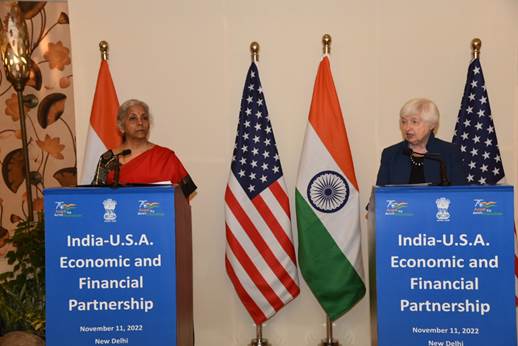
Union Minister of Finance & Corporate Affairs Smt. Nirmala Sitharaman and United States Treasury Secretary Dr. Janet L. Yellen give opening remarks at the start of the meeting of 9th India-US Economic Financial Partnership, in New Delhi.

Following the conclusion of the dialogue, Finance Minister Smt. Sitharaman and Treasury Secretary Dr. Yellen signed the following joint statement:

We were pleased to lead for a second consecutive year the India-U.S. Economic and Financial Partnership meeting and to welcome Federal Reserve Chair Mr Jerome Powell, Governor Reserve Bank of India Shri Shaktikanta Das, and other participants. 

The U.S. Treasury and Ministry of Finance launched our Economic and Financial Partnership in 2010 as a framework to cement the economic bonds between our two nations and build a foundation for greater cooperation and economic growth.  At this ninth meeting of the Economic and Financial Partnership we reaffirmed that our regular dialogue is crucial to the U.S.-India economic relationship and to advancing global efforts to tackle pressing economic challenges. 

During the ministerial meeting, we took stock of the extensive efforts that have recently been undertaken by both sides to deepen cooperation in a number of areas and we enhanced our mutual understanding on topics of global consequence.  We had productive discussions on a range of subjects, including the macroeconomic outlook, supply chain resilience, climate finance, multilateral engagement, global debt vulnerabilities, anti-money laundering and combating the financing of terrorism. 

Today’s meeting featured a dedicated session on climate finance for the second time under the Economic and Financial Partnership, reflecting our respective commitments to drive urgent progress in combating climate change by collaborating closely on the shared goal of scaling up and mobilizing climate finance to meet our ambitious climate goals.  We shared views on the re-energized global efforts to increase climate ambition as well as our respective domestic efforts to meet our publicly expressed climate goals.  We agreed that public finance, when paired with enabling policies, can promote private finance.  We also noted the importance of the evolving role of the multilateral development banks (MDBs) to better address global challenges, including climate change. We acknowledge the developed country goal to jointly mobilize $100 billion every year till 2025 from public and private sources for developing countries, in the context of meaningful mitigation actions and transparency on implementation.  We also agree to work together in arriving at a new collective quantified goal from a floor of $100 billion annually for the post 2025 period, taking into account the needs and priorities of developing countries. We agreed that India and the U.S. should work together with partners to pursue a broad mix of public and private financing to facilitate India’s energy transition in line with its nationally determined climate goals and capabilities. We also look forward to continuing the discussion of climate-aligned finance under the G20 Sustainable Finance Working Group with US as the co-chair and India holding the G20 Presidency next year.

In the context of the conflict in Ukraine, we discussed the current headwinds to the global macroeconomic outlook including increased commodity and energy prices as well as supply side disruptions, and we reemphasized our commitment to the central role of multilateral cooperation in addressing these global macroeconomic challenges. Both sides affirmed their commitment to debt sustainability, transparency in bilateral lending, and coordinating closely on extending fair and equal debt treatment to countries facing debt distress.  We reiterated our commitment to step up our efforts to implement the G20 Common Framework for Debt Treatment in a predictable, timely, orderly and coordinated manner.  We acknowledged the importance of working through MDBs to help India access and mobilize available financing to support development objectives, including climate action.  We plan to continue engaging on these and other global economic issues both multilaterally and bilaterally. India and the United States look forward to continued collaboration to meet the most pressing global challenges under India’s G20 Presidency commencing December this year. The United States warmly welcomes India’s upcoming leadership role and stands ready to support India in hosting a successful and productive year.

We welcome the OECD/G20 Inclusive Framework political agreement as representing a significant accomplishment for updating the international tax architecture to reflect the modern economy and establish an international tax system that is more stable, fairer, and fit for purpose for the 21st century.  We welcome the progress on Pillar One and reaffirm our commitment to work together and with all partners to expeditiously complete the remaining technical work on Pillar One with respect to Amount A and Amount B.  We call on the OECD/G20 Inclusive Framework on Base Erosion and Profit Shifting (BEPS) to conclude work on the Multilateral Convention during the first half of 2023.  We look forward to the completion of the GloBE Implementation Framework under Pillar Two and call on member countries and the OECD/G20 Inclusive Framework on BEPS to conclude the negotiations on the Subject to Tax Rule (STTR).

Both countries will continue to work to enhance mutual collaboration in sharing of information to tackle offshore tax evasion.  India and the United States make note of the progress made under the Inter-Governmental Agreement pursuant to the Foreign Account Tax Compliance Act (FATCA) with respect to sharing of financial account information. The two sides will continue to engage in discussions on full reciprocal arrangement on FATCA.

The United States and India look forward to sustained engagement through the longstanding U.S.-India Financial Regulatory Dialogue, a platform for discussing emerging financial sector issues and priority areas, including banking and insurance sector reforms, capital market development, digital assets and payment system modernization, sustainable finance, and data security and protection frameworks.    Both countries underscore their commitment towards exploring promising avenues of mutual collaboration, including India’s maiden IFSC in GIFT City, Gujarat, during the 11th U.S.-India Financial Regulatory Dialogue to be held in the first half of 2023.

We are continuing our successful collaboration on attracting more private sector capital to finance India’s infrastructure needs, which will support growth in both countries.  The Treasury Department continues to provide technical support to India’s National Infrastructure and Investment Fund (NIIF), including the scaling of debt and equity platforms devoted to renewable energy and implementing new environmental, social, and corporate governance policies to meet international standards, while catalyzing private institutional investment in Indian infrastructure.  We are also collaborating through continued technical support for the issuance of municipal bonds for critical urban infrastructure improvements.  India and the United States look forward to working together to prepare more cities to issue municipal bonds.

We continue to strengthen our cooperation in anti-money laundering and combating the financing of terrorism (AML/CFT) efforts, through increased information sharing and coordination, including expeditious sharing of digital evidence and information for ML/TF investigations, as well as through the U.S.-India AML/CFT bilateral dialogue.  Both sides agree on the importance of fighting financial crimes and on the effective implementation of the Financial Action Task Force standards to protect our financial systems from abuse.  Moving forward, the United States and India will continue to exchange views on best practices and solutions for combating AML/CFT challenges.

This ninth meeting of the Economic and Financial Partnership reflected the growing importance of the U.S.-India relationship and the increasing economic and financial ties between our two economies.  Both sides eagerly anticipate continued dialogue under the Economic and Financial Partnership and the further strengthening of our bilateral relationship.

Topics

Acts Income Tax
