

Loading...

Top
Help
×

By creating an account you can:

Logo TaxTMI
Call Us / Help / Feedback

Contact Us At :

E-mail: [email protected]

Call / WhatsApp at: +91 99117 96707

For more information, Check Contact Us

FAQs :

To know Frequently Asked Questions, Check FAQs

Most Asked Video Tutorials :

For more tutorials, Check Video Tutorials

Submit Feedback/Suggestion :

Email :
Please provide your email address so we can follow up on your feedback.
Category :
Description :
Min 15 characters 0/2000
Make Most of Text Search
  1. Checkout this video tutorial: How to search effectively on TaxTMI.
  2. Put words in double quotes for exact word search, eg: "income tax"
  3. Avoid noise words such as : 'and, of, the, a'
  4. Sort by Relevance to get the most relevant document.
  5. Press Enter to add multiple terms/multiple phrases, and then click on Search to Search.
  6. Text Search
  7. The system will try to fetch results that contains ALL your words.
  8. Once you add keywords, you'll see a new 'Search In' filter that makes your results even more precise.
  9. Text Search
Add to...
You have not created any category. Kindly create one to bookmark this item!
Create New Category
Hide
Title :
Description :
❮❮ Hide
Default View
Expand ❯❯
Close ✕
🔎 News - Adv. Search
TEXT SEARCH:

Press 'Enter' to add multiple search terms. Rules for Better Search

Search In:
Main Text + AI Text
  • Main Text
  • Main Text + AI Text
  • AI Text
Category: ?
Categorized by AI
---- All Categories ----
  • ---- All Categories ----
  • Income Tax
  • GST
  • Customs, DGFT & SEZ
  • FEMA & RBI
  • Corp. Laws, SEBI & IBC
  • PMLA, Black Money & ED
  • Budget
  • News and Press Release
  • PTI News
Month:
---- All Months ----
  • ---- All Months ----
  • January
  • February
  • March
  • April
  • May
  • June
  • July
  • August
  • September
  • October
  • November
  • December
Year:
---- All Years ----
  • ---- All Years ----
  • 2026
  • 2025
  • 2024
  • 2023
  • 2022
  • 2021
  • 2020
  • 2019
  • 2018
  • 2017
  • 2016
  • 2015
  • 2014
  • 2013
  • 2012
  • 2011
Sort By: ?
In Sort By 'Default', exact matches for text search are shown at the top, followed by the remaining results in their regular order.
Relevance Default Date
    RBI invites comments on the draft “Reserve Bank of India (Non-Banking Financial Companies – Credit Facilities) Amendment Directions, 2026”
    West Bengal seeks 100pc foodgrain, 40pc sugar jute packaging quota at SAC meeting
    RBI clasifies Tata Sons, 16 others as large NBFCs
    Sensex climbs 374 points on buying in Reliance, ICICI Bank; Nifty ends flat
    Insurance Division, DFS Secures 3rd Rank in Group A Category of Grievance Redressal Assessment & Index (GRAI) for June 2026
    VKDL Group’s NPA Bazaar Strengthens India’s Distressed Asset Resolution Ecosystem Under the Leadership of V K Dubey
    Lok Sabha passes bill to authorise govt to permit banks to levy charges on UPI transactions
    Monetary Policy Statement, 2026-27 Resolution of the Monetary Policy Committee August 3 to 5, 2026
    Stock markets edged higher in early trade amid lower crude oil prices, buying in Reliance Industries
    Monthly review of accounts of Government of India upto June 2026 (FY 2026-27)
    DRI busts illegal drug manufacturing unit in Satara district in Maharashtra; two arrested
    CCI approves proposed combination inter alia involving share acquisition(s) and merger of certain entities e.g. AAPC India, Triguna, Caddie, SMPL, Tec...
    Rupee gains 20 paise to close at 95.08 against US dollar post-RBI policy decision
    TN Budget: Revenue deficit at Rs 55,775 crore, fiscal deficit estimated at Rs 1,21,819 crore
    Tatkare slams ‘gungi gudiya’ jibe against Sunetra; Cong says row being exploited for political gains
    RBI invites public comments on Draft Guidelines for ‘on tap’ Licensing of Urban Co-operative Banks
    Pakistan-origin dry dates, routed through UAE, seized at Kandla port
    RBI keeps rates unchanged, retains neutral stance; outlook uncertain on El Nino, geopolitical risks
    Government Notifies Inventory-based Cross-border E-Commerce Export Framework under Foreign Trade Policy 2023
    Customs official among 5 held for smuggling gold of Rs 1.44 crore at Indore airport
❯❯
Maximize Maximize Maximize
0 / 200
Expand Note
Add to Folder

No Folders have been created

+

Are you sure you want to delete "My most important" ?

NOTE:

News
Showing Results for :
Reset Filters
Results Found:
Show All Summaries Hide All Summaries
August 6, 2026
Show AI Summary
Draft NBFC credit-facilities amendments open for stakeholder consultation through designated online and email feedback channels.
Draft amendments to the Non-Banking Financial Companies credit-facilities framework have been released for public consultation. Regulated entities and other interested stakeholders may submit comments or feedback through the 'Connect 2 Regulate' platform or by email using the specified subject line.
August 6, 2026
Show AI Summary
Mandatory jute packaging reservations were urged to protect cultivators, mill workers, crop absorption, and environmentally sustainable packaging.
Mandatory jute packaging reservations were sought to be retained at full coverage for foodgrains and increased for sugar packaging for the forthcoming Jute Year. The submission before the Standing Advisory Committee emphasised absorption of bumper jute output, remunerative prices for cultivators, uninterrupted mill operations, and protection of farm and worker livelihoods. It also stressed that biodegradable jute bags offer an environmentally friendly alternative to HDPE and polypropylene woven sacks, and that dilution of compulsory packaging could undermine plastic-pollution reduction efforts.
August 6, 2026
Show AI Summary
NBFC Upper Layer classification imposes enhanced regulation and listing obligations, while de-registration applications remain under examination.
NBFC Upper Layer classification subjects identified large non-banking financial companies to enhanced regulatory requirements for at least five years and requires stock-exchange listing within three years of identification. The framework divides NBFCs into Base, Middle, Upper and Top Layers. Seventeen large NBFCs were included in the Upper Layer list, while Tata Sons' classification remains subject to the pending examination of its de-registration application.
August 6, 2026
Show AI Summary
Closing auction price discovery may affect benchmark levels differently based on constituent liquidity and concentrated institutional order flow.
The Closing Auction Session in the equity cash segment uses an auction-based method to determine closing prices of eligible shares with futures and options contracts, aiming to strengthen transparent and robust price discovery. Its effect on benchmark closing levels may differ according to constituent liquidity and institutional order flow. The Reserve Bank of India retained the policy repo rate and neutral stance, indicating that future policy decisions will be data-dependent and influenced by assessment of energy-cost effects on inflation.
August 6, 2026
Show AI Summary
Public grievance redressal strengthens through monitoring, senior review, workshops, stakeholder coordination, and customer-centric service delivery improvements.
Public grievance redressal is assessed through the Grievance Redressal Assessment and Index, which analyses grievance categories and disposal. The Department of Financial Services' Insurance and Banking Divisions received third and sixth ranks respectively in the June 2026 assessment. Its framework includes disposal of grievances, random reviews by senior officials, and workshops on effective grievance redressal, supporting best practices, stakeholder coordination, technology use, customer-centric service, and accountable public service delivery.
August 6, 2026
Show AI Summary
Distressed asset resolution integrates restructuring, insolvency advisory, funding facilitation and digital marketplaces for transparent financial recovery transactions.
The platform provides integrated advisory, management and transaction-facilitation services for Non-Performing Assets, stressed assets and distressed assets. Its services include NPA resolution, debt restructuring, One-Time Settlements, funding assistance, insolvency and bankruptcy advisory, asset reconstruction, financial restructuring and capital raising. Digital and offline marketplaces facilitate transactions involving distressed assets, receivables and related movable or immovable properties, supported by collaborations with banks, Non-Banking Financial Companies, Asset Reconstruction Companies, corporates and investors.
August 6, 2026
Show AI Summary
Merchant discount rate framework may permit charges on notified UPI and digital payments through a government notification mechanism.
The proposed amendment to Section 10A of the Payment and Settlement Systems Act, 2007 replaces the existing income-tax-linked reference with a Central Government notification-based mechanism for electronic payment modes. It removes the current statutory restriction preventing banks and payment service providers from charging Merchant Discount Rate on notified modes, enabling the Government to permit charges for UPI and other digital payments. The policy rationale is to support funding for payment infrastructure and a sustainable revenue model for service providers.
August 6, 2026
Show AI Summary
Neutral monetary policy stance continues as resilient growth and food-fuel inflation risks require close macroeconomic monitoring.
The Monetary Policy Committee retained the policy repo rate and continued the neutral monetary policy stance, citing the need to assess evolving growth-inflation conditions. Domestic activity was assessed as resilient, supported by consumption, investment, credit, manufacturing, services and exports, although global uncertainty, energy prices, supply-chain pressures, geopolitical developments and monsoon conditions remain risks. CPI inflation increased mainly because of food and fuel pressures, while underlying inflation remained moderate. The Committee considered that price pressures were not yet generalised and reaffirmed its commitment to align inflation with the target.
August 6, 2026
Show AI Summary
Closing auction price discovery and a neutral monetary policy stance shaped equity market conditions amid lower crude prices.
The Closing Auction Session in the equity cash segment introduced an auction-based mechanism for determining closing prices of eligible shares with futures and options contracts, intended to make price discovery more transparent and robust. The Reserve Bank of India retained its neutral stance and left the benchmark policy rate unchanged, pending greater clarity on the inflationary effects of higher energy costs. Future policy decisions were stated to be data dependent.
August 6, 2026
Show AI Summary
Monthly public accounts review records receipts, expenditure, tax devolution, interest payments, subsidies, and capital spending through June.
Consolidated monthly accounts up to June 2026 report total receipts of Rs.10,49,243 crore, comprising net tax revenue, non-tax revenue and non-debt capital receipts. Tax devolution transfers to State Governments total Rs.2,63,336 crore. Total expenditure is Rs.13,57,076 crore, including revenue expenditure of Rs.10,16,818 crore and capital expenditure of Rs.3,40,258 crore. Revenue expenditure includes interest payments and major subsidies.
August 6, 2026
Show AI Summary
Illicit psychotropic drug manufacture triggered seizure, apprehensions, and investigation into planned trafficking under narcotics control law.
Illicit manufacture and trafficking of Alprazolam and Diazepam, psychotropic substances regulated under the Narcotic Drugs and Psychotropic Substances Act, 1985, were detected at a clandestine facility. Searches recovered finished and intermediary substances, together with raw materials and reaction mixtures used in manufacture, and the goods were seized under the Act. The manufacturer and an intended buyer were apprehended, with material indicating a proposed transaction for further illicit trafficking. Preliminary investigation indicated prior involvement in illegal drug production and trafficking.
August 6, 2026
Show AI Summary
Competition approval for hotel-sector consolidation covers share acquisitions and merger of Accor-branded hotel entities into InterGlobe Hotels.
Competition approval was granted for related share acquisitions and the merger of AAPC India, Caddie, Triguna, Srilanand Mansions, Techpark and Accent into InterGlobe Hotels. The combination involves entities jointly controlled by the Bhatia Family Group and the Accor Group, including hotel-owning and developing entities, hotel management and franchising operations, leasing activities, and captive consultancy and support services relating to Accor-branded hotels in India.
August 5, 2026
Show AI Summary
Rupee appreciation followed unchanged monetary policy, lower crude prices, weaker dollar and expectations of orderly exchange-rate management.
The rupee strengthened after the central bank maintained its policy rate and neutral monetary-policy stance. Lower crude oil prices, a weaker US dollar and declining US Treasury yields supported investor sentiment. Earlier measures to attract capital inflows remained part of the framework supporting the rupee, while the central bank stressed its endeavour to preserve an orderly currency trajectory. Future movement was linked to geopolitical de-escalation, global risk sentiment and US economic data.
August 5, 2026
Show AI Summary
Fiscal consolidation through revenue mobilisation and leakage control aims to reduce deficits while expanding capital expenditure capacity.
Tamil Nadu's Revised Budget Estimates for 2026-27 project a revenue deficit and fiscal deficit, with outstanding liabilities comprising public debt and public-account liabilities. Revenue mobilisation is proposed through improved tax administration, collection efficiency, closure of leakages, liquor-manufacturer privilege fees, and eligible Union grants. The strategy projects gradual deficit reduction to create room for capital expenditure, supported by expenditure reforms aimed at eliminating leakages, optimising expenditure, and improving service delivery.
August 5, 2026
Show AI Summary
Political criticism of public office-holders raises debate over media accountability, personal remarks, and acceptable public discourse.
Political criticism followed a social-media post describing Maharashtra Deputy Chief Minister Sunetra Pawar as "gungi gudiya" in connection with a press interaction on law-and-order issues in Beed district. Congress representatives stated that the post was not a personal insult, had been deleted after adverse reactions, and was followed by an expression of regret. NCP representatives termed the expression inappropriate and stressed that the principal dignitary should conduct media interactions. Shiv Sena (UBT) representatives described the phrase as not unparliamentary and linked it to criticism of a guardian minister's public responsibilities.
August 5, 2026
Show AI Summary
On-tap licensing for Urban Co-operative Banks enters public consultation through draft guidelines inviting stakeholder feedback.
Draft guidelines for 'on tap' licensing of Urban Co-operative Banks have been issued for public and stakeholder consultation. Comments and feedback may be submitted until September 05, 2026, through the designated online consultation facility or by written or email submission to the specified regulatory department.
August 5, 2026
Show AI Summary
Prohibition on indirect Pakistan-origin imports targets alleged origin misdeclaration and UAE routing used to circumvent trade restrictions.
Import prohibition on goods originating in Pakistan applies to direct and indirect imports under the Foreign Trade Policy, 2023. Pakistan-origin dry dates routed through the UAE were allegedly declared as UAE-origin goods for import, and were intercepted under the Customs Act, 1962. Investigation indicated that the goods were first sent from Pakistan to Dubai, re-containerised, and then exported to India. A separate interception involved Pakistan-origin guggul resin allegedly declared as Somali natural resin and routed through Dubai.
August 5, 2026
Show AI Summary
Neutral monetary policy stance keeps benchmark rates unchanged while inflation risks, liquidity management and consumer-protection reforms remain under review.
Monetary policy maintains the benchmark policy rate unchanged and retains a neutral stance, with future decisions guided by incoming data. The central bank remains committed to aligning headline inflation with its medium-term target while monitoring food, fuel and other input-cost risks. Surplus liquidity will be managed through two-way operations, and the regulatory framework for interest rates on advances is proposed to be harmonised and standardised across regulated entities to improve transparency and consumer protection.
August 5, 2026
Show AI Summary
Export-only e-commerce inventory framework enables seller exports through registered exporters while requiring traceability, timely payments and domestic-diversion controls.
The export-only inventory framework permits eligible e-commerce entities to export through a registered Exporter-on-Record, which procures goods from Indian Sellers-on-Record against confirmed overseas orders and assumes export and destination-country compliance responsibilities. Inventory must be segregated, digitally traceable and cannot be diverted to domestic sale. The framework requires timely seller payments, visibility of overseas sales and shipment information, proportional pass-through of export rebates and refunds, annual compliance certification and digital records.
August 5, 2026
Show AI Summary
Gold smuggling enforcement targets concealed foreign-origin gold, airport control evasion, and illicit railway transport under customs law.
Gold smuggling enforcement operations under the Customs Act, 1962 involved alleged concealment and unlawful movement of foreign-origin gold. At an international airport, an alleged syndicate used an airline employee to transfer gold received from arriving passengers outside Customs and immigration controls, with gold disguised as silver-coloured bracelets. A separate railway operation concerned gold concealed in a specially made cloth waist belt and intended for delivery to a jeweller. The actions addressed concealment, evasion of Customs controls, and illicit transport of foreign-origin gold.

News

Back

All News

Showing Results for :
Reset Filters
No Records Found

News

Back

All News

Showing Results for : Reset Filters

PM attends the first “Arun Jaitley Memorial Lecture”

July 9, 2022

Contents
Summary
Note

Note

-

Bookmark

Print

Print

PM attends the first “Arun Jaitley Memorial Lecture”

Arun Jaitley’s personality was full of diversity and his nature was friendly to all. Everyone feels his absence: PM

The gist of my experiences of 20 years as Head of Government is that - without inclusion, real growth and without growth the goal of inclusion cannot be accomplished: PM

Today’s India is preparing a roadmap for the next 25 years with ‘Reforms by conviction’ rather than ‘Reforms by Compulsion’: PM

We do not consider reforms as a necessary evil but a win-win choice: PM

Our policy-making is based on the pulse of the people: PM

We did not let the policy come under the pressure of populist impulses: PM

Now is the time that the government should encourage the private sector as a partner in progress and we are moving forward in this direction: PM

Inaugural “Arun Jaitley Memorial Lecture” delivered by Mr Tharman Shanmugaratnam, Senior Minister, Government of Singapore

Mr Shanmugaratnam praises India’s unparalleled success in digital payments; emphasises large scale provision of basic social amenities to the population and empowerment of women

Smt. Nirmala Sitharaman: Shri Arun Jaitley made invaluable contribution to the nation

The Prime Minister, Shri Narendra Modi attended the first ‘Arun Jaitley Memorial Lecture’ (AJML), by Mr. Tharman Shanmugaratnam, Senior Minister, Government of Singapore, New Delhi. The Prime Minister also addressed the gathering during the event.
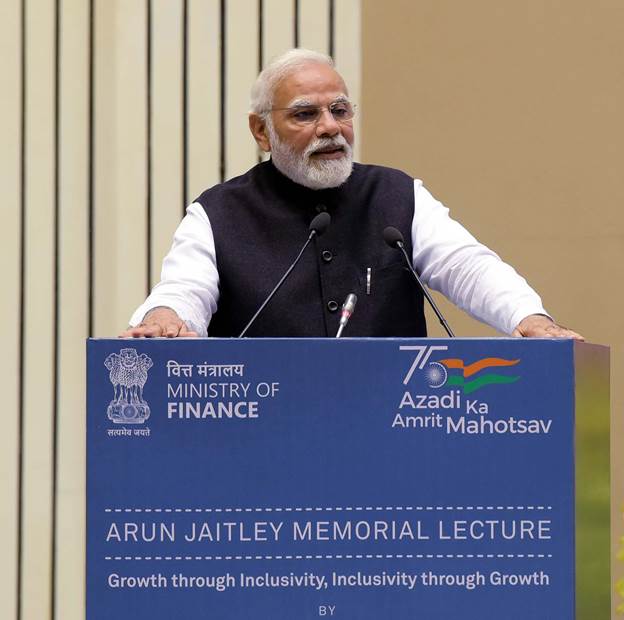
Speaking on the occasion, the Prime Minister recalled his close friendship with the former Prime Minister of Japan Mr Shinzo Abe, who passed away today. Paying rich tributes to Mr Abe, the Prime Minister said that today is a day of irreparable loss and unbearable pain for him. Calling Mr Abe a reliable friend of India, the Prime Minister underlined the growth of India-Japan relations based on the shared heritage of the two countries during the tenure of Mr Shinzo Abe. Through the projects that are being undertaken with the help of Japan, Mr Abe will remain in the hearts of Indians for years to come, he said.

The Prime Minister fondly remembered his other friend, Shri Arun Jaitley, in whose memory today’s programme was held. The Prime Minister said, “When we remember the days gone by, I remember many things about them, many incidents related to them. We all were in awe of his oratory. His personality was full of diversity, his nature was friendly to all.”
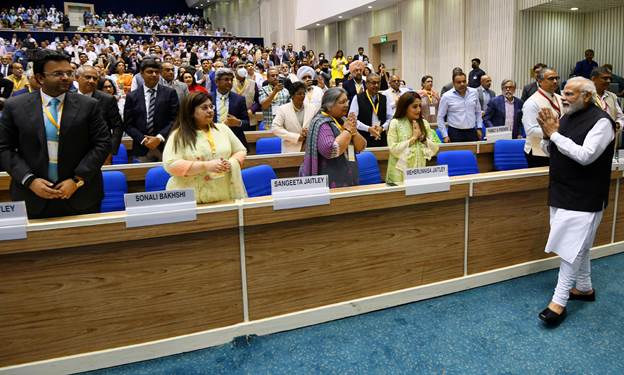
The Prime Minister recalled Shri Jaitely’s enduring one-liners. Paying homage to Shri Jaitley, the Prime Minister said that everyone feels his absence.

The Prime Minister thanked Mr. Tharman Shanmugaratnam, Senior Minister, Government of Singapore, for his ‘Arun Jaitley Memorial Lecture’. He praised the depth of his intellect, research and inclusion of local touch in his research.  The Prime Minister said that the topic of today’s lecture “Growth through Inclusivity, Inclusivity through Growth’ is the foundation of the government’s development policy. “In simple terms, this theme, according to me, is Sabka Saath Sabka Vikas”, he said.

The theme, the Prime Minister continued, captures the challenges and dilemma of today’s policy makers. The Prime Minister posed the question “Is right growth possible without inclusion? Can inclusion be thought of without growth?” The Prime Minister replied “The gist of my experiences of 20 years as Head of Government is that - without inclusion, real growth is not possible. And, without growth the goal of inclusion too cannot be accomplished.” That is why, he added, ‘we adopted the way of growth through inclusivity and tried for everyone’s inclusion’.

He said the speed and scale of inclusion in the last 8 years has been unprecedented in the world. To illustrate his point, the Prime Minister  listed measures like providing gas connections to more than 9 crore women, more than 10 crore toilets for the poor, more than 45 crore Jan Dhan accounts, 3 crore pucca houses to the poor. He further explained that by ensuring free treatment of upto Rs 5 lakh for 50 crore people under Ayushman Scheme and more than 3.5 crore patients having availed the free treatment in the last 4 years, inclusion was focussed but this led to increased demand and much better growth and opportunities as almost one third population of India came in the ambit of quality healthcare. Ayushman Bharat has transformed the healthcare sector in India, he said and went on to describe the strides in the healthcare infrastructure. He pointed out that “before 2014, the average of our country was that 50 medical colleges were built in 10 years. Whereas in the last 7-8 years, 209 new medical colleges have been built in India, more than 4 times than before.” Furthermore, “There has been an increase of 75% in undergraduate medical seats in India in the last 7-8 years. Now the number of annual total medical seats has almost doubled in India.” The Prime Minister said through these figures we can see the impact of an inclusivity scheme on the growth of the sector.

The Prime Minister said through 5 lakh common service centres, UPI and PM SVANidhi scheme for street vendors the ambit of inclusion has been widened. Similarly, Aspirational District and education in mother tongue in NEP, UDAAN scheme for making air travel accessible are leading to both inclusion and growth. He also talked of massive inclusion through Har Ghar Jal by providing 6 crore tap water connections. Through the SVAMITVA scheme property rights of the most vulnerable sections are being ensured. Already 80 lakh property cards have already been issued, enabling them to avail finances.

“Today’s India is preparing a roadmap for the coming 25 years with Reforms by conviction rather than Reforms by Compulsion. Earlier, major reforms took place in India only when the earlier governments were left with no other option. We do not consider reforms as a necessary evil but a win-win choice, in which there is national interest and public interest,” he said. 

The Prime Minister continued elaborating the government’s approach to reforms “Our policy-making is based on the pulse of the people. We listen to more and more people, understand their needs and their aspirations. That's why we did not let the policy come under the pressure of populist impulses.”

The Prime Minister said that the approach of Minimum Government and Maximum Governance is yielding great results. He gave an example of partnership of private and public sector in vaccine development for COVID. “Private players of our country have done a very good job. But behind them stood the full force of the government in the form of a partner in progress. Today India is one of the most reliable and state-of-the-art Space Service Providers in the whole world. Our Private Sector Ecosystem is doing a great job in this area too. But behind them also, as a ‘Partner in Progress’, the government is standing with full power”, he said. “Now only the extreme models dominated by the private sector or government have become obsolete. Now is the time that the government should encourage the private sector as a partner in progress and we are moving forward in this direction,” he added.

The Prime Minister said that thinking about tourism is also expanding in India. He said recent Yoga Day celebrations at 75 iconic places made people aware of many new places of tourism.

The Prime Minister remarked that Azadi Ka Amrit Kaal is bringing many opportunities for the country and our resolve to achieve them is unshakable.

The keynote address at the first AJML was delivered by Mr. Tharman Shanmugaratnam, Senior Minister, Government of Singapore, on “Growth through Inclusivity, Inclusivity through Growth’. The lecture was followed by a panel discussion by Mr. Mathias Cormann, Secretary General, Organisation for Economic Cooperation and Development (OECD), and Shri Arvind Panagariya, Professor of Economics, SIPA Columbia University, USA. The discussion built on the thoughts shared by Shri Tharman and Prime Minister. The panel discussion ended with Q&A session.

The Department of Economic Affairs, Ministry of Finance, organised the first ‘Arun Jaitley Memorial Lecture’ in recognition of Shri Arun Jaitley’s invaluable contribution to the nation.

The Prime Minister also interacted with the delegates participating in the Kautilya Economic Conclave (KEC), a three day event being organised from 8th to 10th July.

In her welcome address, Union Minister for Finance and Corporate Affairs, Smt. Nirmala Sitharaman, recalled the invaluable contribution made by Shri Jaitley to the nation including the reforms he piloted such as Insolvency and Bankruptcy Code, Goods and Services Tax and Budget processes. She also welcomed and introduced the Senior Minister of Singapore, Mr Tharman Shanmugaratnam and invited him to deliver the first AJML on “Growth through Inclusivity, Inclusivity through Growth”.

Mr Tharman highlighted that the world is facing four challenges: Rising Geo Political tension, stagflation, Climate Change and Pandemic setting back the developing world. He advocated multilateralism as the way forward for the world to grow as interdependence gives more opportunities to maintain a peaceful global order. He further stated that India faces both great challenges and opportunities in the next 25 years. He emphasised large scale provision of basic social amenities to the population and empowerment of women.

The Singapore Senior Minister praised the achievement of India in the digital world stating that the progress of India was unique among all nations. He underlined the potential of demographic dividend stating the urgent need to skill a large number of youth. He pointed out that high growth cannot be sustained without increase in Inclusivity and without growth one cannot have Inclusivity. India must grow by at least 8-10 per cent in the next 25 years, to create jobs. Increasing convergence between low and high income states will boost growth. In this regard, he underscored the value of labour reforms being brought in by the government, reiterating that export focus is critical to growth. He pointed out that India must address the challenge of child growth stunting through improved nourishment and medical support. Learning outcomes also must improve through improved governance in public schools.  Higher education must have a higher applied and skill orientation. Co-empowerment across all sectors, genders, religion is the way.

Watch full programme on following YouTube link:

Topics

Acts Income Tax