Loading...

Top
Help
×

By creating an account you can:

Logo TaxTMI
Call Us / Help / Feedback

Contact Us At :

E-mail: [email protected]

Call / WhatsApp at: +91 99117 96707

For more information, Check Contact Us

FAQs :

To know Frequently Asked Questions, Check FAQs

Most Asked Video Tutorials :

For more tutorials, Check Video Tutorials

Submit Feedback/Suggestion :

Email :
Please provide your email address so we can follow up on your feedback.
Category :
Description :
Min 15 characters 0/2000
Make Most of Text Search
  1. Checkout this video tutorial: How to search effectively on TaxTMI.
  2. Put words in double quotes for exact word search, eg: "income tax"
  3. Avoid noise words such as : 'and, of, the, a'
  4. Sort by Relevance to get the most relevant document.
  5. Press Enter to add multiple terms/multiple phrases, and then click on Search to Search.
  6. Text Search
  7. The system will try to fetch results that contains ALL your words.
  8. Once you add keywords, you'll see a new 'Search In' filter that makes your results even more precise.
  9. Text Search
Add to...
You have not created any category. Kindly create one to bookmark this item!
Create New Category
Hide
Title :
Description :
❮❮ Hide
Default View
Expand ❯❯
Close ✕
🔎 News - Adv. Search
TEXT SEARCH:

Press 'Enter' to add multiple search terms. Rules for Better Search

Search In:
Main Text + AI Text
  • Main Text
  • Main Text + AI Text
  • AI Text
Category: ?
Categorized by AI
---- All Categories ----
  • ---- All Categories ----
  • Income Tax
  • GST
  • Customs, DGFT & SEZ
  • FEMA & RBI
  • Corp. Laws, SEBI & IBC
  • PMLA, Black Money & ED
  • Budget
  • News and Press Release
  • PTI News
Month:
---- All Months ----
  • ---- All Months ----
  • January
  • February
  • March
  • April
  • May
  • June
  • July
  • August
  • September
  • October
  • November
  • December
Year:
---- All Years ----
  • ---- All Years ----
  • 2026
  • 2025
  • 2024
  • 2023
  • 2022
  • 2021
  • 2020
  • 2019
  • 2018
  • 2017
  • 2016
  • 2015
  • 2014
  • 2013
  • 2012
  • 2011
Sort By: ?
In Sort By 'Default', exact matches for text search are shown at the top, followed by the remaining results in their regular order.
Relevance Default Date
    CCS discusses global security situation, supply chain constraints
    US economy grows a sluggish 1.5% second-quarter with inflation remaining stubbornly high
    Gold rises Rs 1,000 to Rs 1.48 lakh/10g on fresh retail buying
    DFS Launches Protection & Indemnity Insurance Product under Bharat Maritime Insurance Pool (BMIP)
    Investec Selects Infosys Finacle SaaS Platform on Microsoft Azure for Digital Banking Transformation
    Kotak Securities Earns Great Place to Work® Certification and Recognition Among India's Best Workplaces™ in Investments 2026
    India rises from 82nd to 57th in global rankings, in structural and pro-competitive reforms: Report by Competere Foundation
    Aadhaar enrolment in Manipur has reached 87-88 pc: Officials
    IndoStar Capital Finance Limited Q1FY27 Disbursements ₹ 1,235 crore up 44% vis-à-vis Q1FY26
    Global gold demand flat at 1,269 tonnes in June quarter, says WGC
    MCD to launch 5-year PPP policy to modernise school stadiums, offer free sports coaching
    Piramal Pharma Limited Announces Results for Q1 FY27
    Advisory on Keeping on Hold the Proposed e-Way Bill Enhancements
    Innovation, Startups, MSMEs and Quality Manufacturing are Pillars of India's Future Growth: Shri Piyush Goyal at 22nd J.R.D. Tata Memorial Lecture
    UP ATS nabs kingpin of fake document racket from West Bengal
    Calcutta HC says voter ID, Aadhaar, PAN not proof of Indian citizenship
    Corporate Mitra Scheme Awareness Webinar organized by IICA Shillong, Ministry of Corporate Affairs witnessing overwhelming participation of youth and ...
    CCI approves amalgamation of Go Digit Infoworks Services, holding company of Go Digit General Insurance Ltd, with Go Digit General Insurance Ltd, such...
    CCI approves acquisition of units of Oaktree capital group Holdings, L.P. (OCGH), and Oaktree Equity Plan, L.P. (OEP) by Brookfield Asset Management L...
    Assam Exports First International Consignment of Purabi Ice Cream to Bhutan
❯❯
Maximize Maximize Maximize
0 / 200
Expand Note
Add to Folder

No Folders have been created

+

Are you sure you want to delete "My most important" ?

NOTE:

News
Showing Results for :
Reset Filters
Results Found:
Show All Summaries Hide All Summaries
July 30, 2026
Show AI Summary
Supply-chain resilience amid maritime conflict drives measures to protect energy imports, fertiliser supplies, seafarers and overseas citizens.
Supply-chain continuity was reviewed in response to conflicts affecting maritime routes through the Strait of Hormuz, the Black Sea, the Red Sea and the Gulf of Aden. The concerns included disruptions to imports of petroleum, natural gas, fertilisers and other essential goods, risks to ships and seafarers, and the safety of Indian citizens in conflict areas. Measures were considered to maintain uninterrupted imports, protect economic interests and address constraints affecting critical energy and trade corridors.
July 30, 2026
Show AI Summary
Economic growth and persistent inflation shaped slower output, import pressures, and continued interest-rate restraint despite resilient consumer spending.
United States economic growth slowed in the second quarter as increased imports reduced gross domestic product growth, despite stronger consumer spending and business investment linked to artificial intelligence. The preferred inflation measure moderated but remained above the central bank's target, with core consumer prices showing limited change. The benchmark interest rate was retained for a fifth consecutive meeting, though some regional presidents supported an increase to address elevated inflation. Employment growth and consumer spending continued to support economic resilience amid high living costs and energy-price pressures.
July 30, 2026
Show AI Summary
Gold market volatility reflects retail buying, global price trends, currency movements, and weaker domestic demand linked to higher customs duty.
Gold prices rose on fresh buying by jewellers and retailers amid firm international trends, while silver prices declined. Improved domestic demand and a pullback in the US dollar supported gold, though a stronger rupee limited further gains. India's gold demand declined year-on-year during April-June, attributed to seasonally subdued sales, higher customs duty and an appeal to reduce purchases. Global gold demand remained broadly unchanged, while precious metals were expected to remain volatile and range-bound.
July 30, 2026
Show AI Summary
Protection and indemnity insurance expands domestic maritime risk coverage for third-party liabilities and strengthens self-reliant insurance capacity.
Bharat Maritime Insurance Pool has introduced a sovereign-backed Protection & Indemnity insurance product to cover third-party maritime liabilities, including crew and cargo claims, pollution liability and wreck removal. The product expands the pool beyond cargo and hull war-risk coverage and is supported by combined indemnity capacity and a port-correspondent network. The pool is intended to maintain uninterrupted maritime war-risk insurance, build domestic underwriting capacity, strengthen maritime risk management, reduce foreign-market dependence and promote self-reliance in specialised insurance solutions.
July 30, 2026
Show AI Summary
Cloud-native digital banking transformation integrates lending, cash management and liquidity tools while supporting scalable, resilient and compliant operations.
Digital banking transformation through a cloud-native software-as-a-service platform entails migration from legacy systems to integrated deposits, lending, virtual account management and liquidity-management capabilities. Real-time data, artificial intelligence foundations, open APIs and event-driven architecture are intended to support digital banking products, corporate cash management and operational agility. Liquidity tools are designed to provide visibility and control over cash positions and working capital. The implementation is intended to deliver scalability, resilience, security and high availability while assisting regulatory compliance; projected benefits remain subject to risks and uncertainties.
July 30, 2026
Show AI Summary
Workplace culture recognition highlights continued investment in employee wellbeing, inclusion, learning, collaboration and growth at a stockbroking firm.
Workplace culture recognition was awarded to Kotak Securities through Great Place to Work Certification for a second consecutive year and inclusion among India's Best Workplaces in Investments 2026. The recognition followed assessment of employee feedback, workplace practices and organisational culture, reflecting employee trust, engagement and belonging. The company states that it will continue initiatives supporting employee wellbeing, learning and development, inclusion, collaboration and growth.
July 30, 2026
Show AI Summary
Pro-competitive reforms strengthen market conditions through competition policy, investment review, trade facilitation, and reduced international regulatory barriers.
Structural and pro-competitive reforms between 2010 and 2023 are assessed as reducing market distortions and strengthening competitiveness. The assessment covers property-rights protection, domestic competition and international competition, including the Goods and Services Tax, Insolvency and Bankruptcy Code, regulatory improvements and trade-facilitation modernisation. Further priorities include evidence-based competition policy, consumer-welfare review of sector-specific investment restrictions, and cooperation to address international regulatory barriers.
July 30, 2026
Show AI Summary
Aadhaar enrolment access expands through a new service centre, with coordinated efforts focused on improving young children's coverage.
Aadhaar enrolment in Manipur has reached approximately 87-88 per cent, with comparatively lower coverage among children aged 0-5 years. The first Aadhaar Seva Kendra in Imphal has been inaugurated to expand access to enrolment and Aadhaar-related services. The State Government is coordinating with welfare and health departments, hospitals and UIDAI to improve young children's enrolment, alongside services available through Deputy Commissioners' offices and authorised enrolment centres.
July 30, 2026
Show AI Summary
Secured retail lending growth accompanied enhanced credit controls, digital lending processes, and branch expansion by a middle-layer non-banking finance company.
IndoStar Capital Finance Limited, a middle-layer non-banking finance company registered with the Reserve Bank of India, reported growth in secured used-vehicle finance and micro loans against property for the quarter ended June 30, 2026. It reported higher disbursements, assets under management and net interest income, alongside a lower weighted average cost of funds. The company also stated that it strengthened underwriting, customer-selection filters, scorecards and early-warning systems, while advancing electronic lending processes and expanding its branch and micro-loans-against-property network.
July 30, 2026
Show AI Summary
Gold demand trends show central bank buying and OTC investment offsetting weaker ETF and jewellery demand.
Global gold demand remained broadly unchanged during the April-June quarter, with reduced gold exchange-traded fund, bar and coin investment offset in part by over-the-counter investment supported by Asian investors. Central banks and official institutions increased net additions to gold reserves, while high prices reduced jewellery volumes and encouraged demand for lighter products. Total supply was unchanged as increased mine production was offset by lower recycling. Investment is expected to drive future demand, while high prices may continue to constrain jewellery demand and recycling.
July 30, 2026
Show AI Summary
Sports infrastructure PPP framework enables private stadium operation while requiring free coaching, child protection compliance, and student performance tracking.
The PPP framework permits private operators to modernise, operate and maintain school sports stadiums at their own cost, while providing free organised sports training to enrolled students. Operators may commercially offer paid coaching and facilities to external users outside school hours, subject to student-related obligations. Selection is based on technical eligibility and detailed evaluation of sports, PPP, operational and technology capabilities. Agreements have an initial five-year term, with possible extension based on performance, mutual consent and public interest. Child-protection compliance, bank-routed transactions and disqualification for insolvency or statutory and child-safety violations apply.
July 30, 2026
Show AI Summary
Quarterly financial reporting highlights operational growth, FDA inspection compliance, product integration, and prior insolvency proceeds in pharmaceutical operations.
Quarterly financial reporting records revenue growth and improved EBITDA performance across CDMO, Complex Hospital Generics and Consumer Healthcare operations. CDMO growth was linked to order inflows, higher capacity utilisation, pricing discipline and commercial expansion, while quality compliance included an Establishment Inspection Report for the Sellersville facility and continued Zero Official Action Indicated status. The prior-year exceptional item related to one-time insolvency proceeds from a supplier claim filed before the NCLT. Consumer Healthcare growth was attributed to power brands, e-commerce, premiumisation, pricing and cost optimisation.
July 30, 2026
Show AI Summary
Proposed e-Way Bill enhancements remain on hold, with no production changes required pending further communication.
Proposed e-Way Bill enhancements have been kept on hold until further notice. Stakeholders are not required to make production-environment changes pursuant to the earlier advisories concerning those enhancements. The related advisories and FAQs are to be withdrawn from the GST Portal pending further communication.
July 30, 2026
Show AI Summary
Innovation-led industrial growth promotes deep-tech investment, startup commercialisation, technology-enabled MSMEs, quality manufacturing and global market expansion.
Innovation-led industrial growth is linked to deep technology, research and development, skilled manpower, startups, MSMEs and globally competitive manufacturing. Public initiatives include long-term risk capital for emerging technologies, affordable computing capacity and semiconductor investment support. Startups are encouraged to move from prototypes to commercialisation through industry adoption and early domestic investment. Manufacturing and MSME policy emphasise technology adoption, automation, productivity, branding and uncompromising quality. Free Trade Agreements are presented as supporting global market access and export expansion.
July 29, 2026
Show AI Summary
Fraudulent Aadhaar enrolment allegations involve forged supporting documents, misuse of operator credentials, remote access, and continuing investigation.
Forgery of Indian identity and supporting documents is alleged in an interstate racket using false birth, domicile and school certificates to obtain Aadhaar cards for foreign nationals. The racket allegedly misused authorised Aadhaar enrolment operator login credentials and used virtual private networks and remote access to enrol applicants. The alleged mastermind was arrested, and investigation, including proposed custodial interrogation, remains ongoing.
July 29, 2026
Show AI Summary
Citizenship proof requires more than identity, tax, electoral or banking records when nationality remains unestablished.
Voter identity cards, Aadhaar cards, PAN cards and bank-account records were treated as non-conclusive proof of Indian citizenship. The petitioner and detainee were required to establish citizenship under the Immigration and Foreigners Act, 2025, and an appeal against deletion from electoral rolls did not itself satisfy that burden. The inability to identify the burial locations of the detainee's parents prevented proposed DNA-based verification and supported an adverse inference concerning their citizenship.
July 29, 2026
Show AI Summary
Corporate Mitra Scheme builds local compliance professionals to strengthen MSME regulatory, financial, taxation, accounting and governance support.
The Corporate Mitra Scheme develops qualified and accredited para-professionals to provide MSMEs with accessible, affordable compliance and business-support services. Corporate Mitras are intended to assist enterprises with regulatory compliance, finance, taxation, accounting and governance-related requirements, enabling MSMEs to focus on innovation, expansion and growth. IICA Shillong serves as the nodal agency for Northeast regional coordination, stakeholder liaison, promotion and awareness, with regional participation encouraged through reserved course seats and a fee concession.
July 29, 2026
Show AI Summary
Amalgamation of Go Digit Infoworks with Go Digit General Insurance approved, with the general insurer continuing as surviving entity.
The Competition Commission of India approved the amalgamation of Go Digit Infoworks Services Private Limited, the holding company of Go Digit General Insurance Limited, with Go Digit General Insurance Limited as the surviving entity. Infoworks has no present market-facing business activities. Go Digit General provides general and health insurance products and services in India, with a specialised focus on general insurance.
July 29, 2026
Show AI Summary
Competition approval enables Brookfield's indirect acquisition of Oaktree entities, combining alternative investment management businesses.
Competition approval was granted for Brookfield Asset Management Ltd. to indirectly acquire units in Oaktree Capital Group Holdings, L.P. and Oaktree Equity Plan, L.P., resulting in the acquisition of the Oaktree operating group of entities. Brookfield Asset Management is a global alternative asset manager, while the Oaktree group provides alternative investment management services.
July 29, 2026
Show AI Summary
Processed dairy exports to Bhutan expand through compliance support, market access facilitation, and planned diversification of longer-shelf-life products.
Processed dairy exports from Assam to Bhutan commenced with a Purabi Ice Cream consignment exported by North East Dairy and Foods Limited and manufactured through Assam's cooperative dairy network. The Agricultural and Processed Food Products Export Development Authority supported export documentation, regulatory compliance, market access and stakeholder coordination. The initiative seeks to expand value-added dairy exports from the North Eastern Region, with plans to introduce longer-shelf-life products and increase exports according to market demand.

News

Back

All News

Showing Results for :
Reset Filters
No Records Found

News

Back

All News

Showing Results for : Reset Filters

India’s Capital Account Management – An assessment (Speech delivered by Shri T Rabi Sankar, Deputy Governor, Reserve Bank of India – October 14, 2021- at the Fifth Foreign Exchange Dealers’ Association of India (FEDAI) Annual Day)

October 16, 2021

Contents
Acts
Summary
Note

Note

-

Bookmark

Print

Print

1. In the previous FEDAI Annual Day address in November 2020, Governor Shri Shaktikanta Das had observed that CAC will continue to be approached “as a process rather than an event”. What I will do in this address is to expand on that theme and bring into focus some of the important issues on which, in my opinion, further public debate is warranted, to continue along this process of capital account convertibility.

What is capital account convertibility?

2. The balance of payments (BOP) of a country records all economic transactions of a country (that is, of its individuals, businesses and governments) with the rest of the world during a defined period, usually one year. These transactions are broadly divided into two heads – current account and capital account. The current account covers exports and imports of goods and services, factor income and unilateral transfers. The capital account records the net change in foreign assets and liabilities held buy a country. Convertibility refers to the ability to convert domestic currency into foreign currencies and vice versa to make payments for balance of payments transactions. Current account convertibility is the ability or freedom to convert domestic currency for current account transactions while capital account convertibility is the ability or freedom to convert domestic currency for capital account transactions. The Tarapore Committee (2006), for instance, defined capital account convertibility as the “freedom to convert local financial assets into foreign financial assets and vice versa.”

3. The degree of BOP convertibility of a country usually depends on the level of its economic development and degree of maturity of its financial markets. Therefore, advanced economies (AEs) are almost fully convertible while emerging market economies (EMEs) are convertible to different degrees.

Why is capital account convertibility important?

4. Free capital mobility, or internationalization of capital markets, is commonly recognized as an engine of global growth. Specifically, benefits of internationalization of capital markets are well accepted, in terms of broadening the investor base for recipient country financial assets, improved liquidity in financial markets and positive pressures for market infrastructure and market practices. International capital markets, by enabling access to a global savings pool and to different currencies, can potentially reduce borrowing costs, facilitate better risk allocation and enhance global liquidity (OECD, 2017)2.

What are the risks of free capital mobility and how are these risks managed?

5. The various currency and banking crises experienced over the last few decades have simultaneously highlighted the costs and risks of internationalization such as exposure to global shocks, credit and asset bubbles, exchange rate volatility associated with sudden exit of capital and higher refinancing risk. Increased globalization has brought to the fore the vulnerability to contagion effects. While it was argued that such risks are the short-term pains needed to reap long term gains (Kaminsky and others, 2008)3, there is now a wider acceptance that benefits of internationalization are not an unmixed blessing and that there is a nuanced trade off between growth and crisis risk. Such awareness has led to policy focus on three fronts.

a. First, that benefits of internationalization presupposes sound macroeconomic fundamentals, a well developed financial system and a sound market infrastructure, including efficient markets for funding and risk transfer.

b. Second, that countries need to develop appropriate tools to deal with the risks of internationalization, in particular, tools to manage the volume and composition of capital inflows and macro prudential tools.

c. And third, that different types of capital flows carry different risks – some are riskier than others. The agreed hierarchy of capital flows is that foreign direct investment is the least risky, followed by equity investment, followed by debt capital. While FDI is seen to contribute to long-run growth, portfolio equity gives a shorter run boost. Debt flows, while necessary, are susceptible to be volatile. Understandably, the focus of capital flow regulations, and macro-prudential regulations, has been debt flows.

6. Capital flow measures are effective insofar as they lead to safer external liability structures, by reducing dependence on foreign borrowing and could be particularly effective during sudden-stop episodes. They work essentially by avoiding risky flows or containing short-term debt or controlling currency exposure of domestic borrowers. Especially for economies where capital flows are relatively large, or the exposure of banking systems is significant, these measures could be more effective than macro prudential tools.

7. Macro prudential measures target systemic stability issues and tend to be capital based or liquidity based or borrower based. Capital based measures like counter cyclical capital buffers or higher-than-standard capital requirements or calibration of capital risk weights intended to change incentives for certain types of funding are commonly used. Liquidity Coverage Ratio or Net Stable Funding Ratio can be used to manage exposure to short term flows. Similarly, credit or asset bubbles can be controlled using Loan-to-Value ratio or Debt Service-to-Income ratios.

8. There is extensive global discussion on the choice and effectiveness of these tools to deal with specific vulnerabilities. There is reasonable consensus that none of these measures is undesirable in itself. There is also broad agreement on the sequencing of these measures. That the first line of defence against risks of capital flows are prudent macroeconomic policies and a strong institutional base. External borrowing should be controlled until corporate governance and supervisory standards are robust.

9. Not all emerging economies, however, may have this choice, and may be constrained to depend on capital flows, either to meet their investment needs or to develop financial markets. For many of these countries, the required development of policy and markets has to happen simultaneously with dependence on foreign capital. Often, there is only a limited choice on the type of capital that flows in, leading to dependence on risky debt capital. Managing these flows with a not-so-efficient domestic institutional base requires policy flexibility. Usually, managing the spillover risks of global capital involves a combination of these and macro prudential measures. Building up reserves has been an acceptable course, especially after the Asian crisis. Having some control on the amount of debt capital as well as on its nature is another defence. Long-term debt flows could be preferred to short-term flows, stable investors (pension or insurance funds, reserve portfolios) could be preferred to flighty investors such as carry traders, arbitrage traders etc. In a sense capital flow measures may really be used to compensate for lack of strong macro-fundamentals and adjustment mechanisms (Fratzscher, 2012)4.

10. Thus, capital flows are useful, and in case of many EMEs, even necessary. The choice is in how to manage the attendant risks. Effective management of these risks, especially those associated with debt flows, requires a diversified policy tool-kit. Which of these is used is basically a function of the degree of development of the economy and markets of the country.

Capital flow management in India

11. External sector liberalisation started in India with the economic liberalisation process that commenced in the early nineties – moving to a a floating exchange rate regime and freeing up current account transactions. The enactment of the Foreign Exchange Management Act, 1999 codified this arrangement with relatively free current account transactions (except for a negative list) and controlled capital account transactions. Liberalisation in this context basically meant gradually freeing up capital account transactions. Over the last two decades, FDI has become more or less unrestricted except (i) for some sectoral caps and (ii) restrictions in a few socially sensitive (e.g., gambling) or volatile (e.g., real estate) or strategic (e.g., atomic energy) sectors.

12. The policy regime for foreign portfolio investments in India commenced in 1992 when Foreign Institutional Investors (FIIs, or, since January 2014, FPIs) were allowed to invest in domestic financial instruments, basically equity. FPIs were given access to corporate debt markets in 1995 and to G-secs in 1997. Thus, the FPI regime has followed the standard process of liberalising equity flows first and then gradually freeing up debt capital. Apart from sectoral caps to regulate control, portfolio flows into equities in India are virtually unrestricted. Access to debt markets - sovereign and corporate - is subject to macro caps and other macroprudential limits. These are designed to safeguard the domestic economy from excessively speculative hot money flows.

13. There is an effort to liberalize FPI debt flows further with the introduction of the Fully Accessible Route (FAR) which places no limit on non-resident investment in specified benchmark securities. Since over time, virtually all securities will fall under the FAR category, the move is unambiguously towards an eventual unfettered access for non-residents into Government securities. Efforts to get India included under global bond indexes and the complementary move towards placing G-secs under global custodians, once implemented, will encourage debt flows in future.

14. The first comprehensive guidelines on External Commercial Borrowing (ECB) were issued by Government, in July 1999. It has been liberalised over time. Currently, ECB by corporates, while more open than portfolio flows, seeks to enable medium to long term debt (minimum tenor) only healthy corporates to borrow (through cost ceilings) subject to an overall soft limit. A few “end uses” – real estate, capital market, equity - are not permitted.

15. Chart 1 (see Annex for all charts) shows that the actual flows of capital have been broadly in the desirable direction with direct investments (FDI flows) outstripping portfolio investments (FPI flows) and equity flows (FDI plus FPI equity5) outstripping debt flows (FPI Debt plus ECB). The gradual liberalization of capital inflows has been consistent with the realization of the preferred composition of capital inflows.

16. The focus on capital outflows has understandably been far less given that India’s priority is to attract foreign capital to fund its savings gap. There is basically one channel – Overseas Direct Investment (ODI). The Liberalized Remittance Scheme (LRS) for individuals, while it is open for both current and capital account transactions, is largely (more than 90%) in current account transactions like travel, studies etc.

Issues for wider debate

17. While the progress so far can be considered to have moved broadly along the desirable direction, there are some issues which require a wider debate as there are no standard answers. We will discuss some of these issues below.

a. With the Fully Accessible Route, as discussed above, over time the entire G-sec issuance would be eligible for non-resident investment. While experience of other countries suggest that non-residents are unlikely to hold a major portion of outstanding stock, substantial debt holdings might make India vulnerable to the risk of sudden reversals. Since this channel was permitted in the context of inclusion of India’s G-secs in global bond indices, there is a natural safety mechanism as index investors are unlikely to indulge in sudden reversals. It may need to be considered, from a macroprudential perspective, whether FAR should be linked to index inclusion.

b. As the LRS Scheme has operated for some time, there may be a need to review it keeping in mind the changing requirements such as higher education for the youth, requirement of start-ups etc. There might even be a case for reviewing whether the limit can remain uniform or can be linked to some economic variable for individuals.

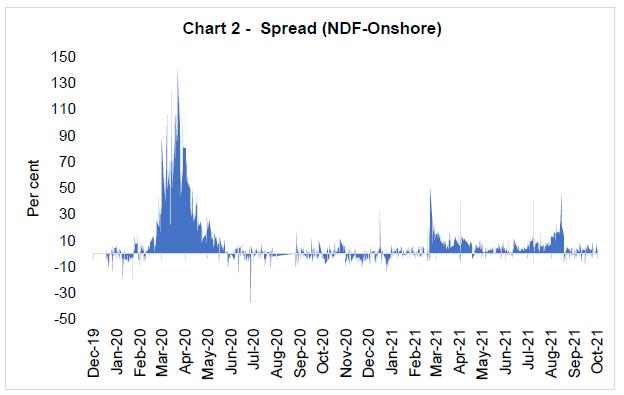
c. A key aspect of currency convertibility is integration of financial markets. Over time, it is essential that two markets – onshore and offshore - for domestic currency or interest rates cannot exist with efficiency. With increased convertibility, these markets need to be linked. An effort has already commenced in the interest rate derivative segment. Allowing Indian banks access to NDF markets for the Rupee is also consistent with this objective. As G-secs get held by global custodians and traded abroad more and more non-residents get to hold Rupee assets and take Rupee exposure. These measures are already seeing the desired results - for instance, NDF-onshore spreads have substantially narrowed after allowing Indian banks into the NDF space (Chart 2, see Annex). We need to now consider whether India is ready to allow such non-residents to hold Rupee accounts. This will be an important early step in internationalization of the Rupee and, therefore, needs to be carefully considered. Further, there is a need to consider a proper mechanism for information flow so that exchange and interest rate management can continue to be effective in an environment of larger offshore transactions.

d. As onshore and offshore financial markets get integrated, it should be ensured that price discovery in the domestic markets is efficient lest flows move to the offshore segment. Take the case of the Rupee exchange rate. It is market determined with fairly tight bid-ask spreads in the interbank market. Major corporates also seem to benefit from tight pricing. Yet many entities, especially SMEs, small exporters, individuals, etc., are prone to over-pricing. Do processing charges and market risk for warehousing odd lot positions justify these spreads? An effective way is to shift price discovery for the retail forex users to a platform. While such a platform (FX Retail) has been developed, it appears that banks do not find it in their interest to navigate customers to use that platform. In this age of technology, it may not really be possible to shun superior technology for any length of time. There should be a debate on the use of the platform and banks should make an effort to give it a fair trial.

Conclusion

18. India has come a long way in achieving increasing levels of convertibility on the capital account. It has broadly achieved the desired outcome for the policy choices it has made, in terms of achieving a stable composition of foreign capital inflow. At the same time, India is on the cusp of some fundamental shifts in this space with increased market integration in the offing and freer non-resident access to debt on the table. The rate of change in capital convertibility will only increase with each of these and similar measures. With that comes the responsibility to ensure that such flows are managed effectively with the right combination of capital flow measures, macro-prudential measures and market intervention. All of us need to consider deeply the issues I have highlighted above and arrive at effective solutions. Market participants, particularly banks, will have to prepare themselves to manage the business process changes and the global risks associated with capital convertibility. The regulator’s job is somewhat different. As someone once said, the job of a regulator is like the gas regulator in the kitchen - it cannot ensure the quality of the dish, but it can prevent the kitchen from blowing up. The quality of the dish – that is, the efficiency with which investment needs of the country are met - is up to how well Authorized Dealers and other intermediaries adjust to the increasingly fuller capital account convertibility.

Annex - Charts
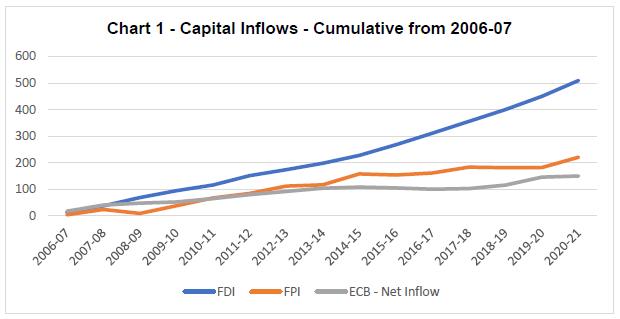
Chart 1

Chart 2

----

1 Speech delivered by Deputy Governor Shri T Rabi Sankar on the Fifth Foreign Exchange Dealers’ Association of India (FEDAI) Annual Day on October 14th, 2021. It was delivered via virtual platform.

2 OECD (2017), Open and Orderly Capital Movements: Interventions from the 2016 OECD High-Level Seminar.

3 Kaminsky Graciela Laura and Sergio L. Schmukler: Short-Run Pain, Long-Run Gain: Financial Liberalization and Stock Market Cycles, review of Finance, 2008

4 Fratzscher, Marcel: Capital Controls and Foreign Exchange Policy, Working Paper Series, European Central bank, February 2012.

5 FPI flows into equity over the 15-year period (2006-07 to 2020-21) accounts for 73% of total FPI inflows, while flows into debt account for the remaining 27%.

Topics

Acts Income Tax