Loading...

Top
Help
×

By creating an account you can:

Logo TaxTMI
Call Us / Help / Feedback

Contact Us At :

E-mail: [email protected]

Call / WhatsApp at: +91 99117 96707

For more information, Check Contact Us

FAQs :

To know Frequently Asked Questions, Check FAQs

Most Asked Video Tutorials :

For more tutorials, Check Video Tutorials

Submit Feedback/Suggestion :

Email :
Please provide your email address so we can follow up on your feedback.
Category :
Description :
Min 15 characters 0/2000
Make Most of Text Search
  1. Checkout this video tutorial: How to search effectively on TaxTMI.
  2. Put words in double quotes for exact word search, eg: "income tax"
  3. Avoid noise words such as : 'and, of, the, a'
  4. Sort by Relevance to get the most relevant document.
  5. Press Enter to add multiple terms/multiple phrases, and then click on Search to Search.
  6. Text Search
  7. The system will try to fetch results that contains ALL your words.
  8. Once you add keywords, you'll see a new 'Search In' filter that makes your results even more precise.
  9. Text Search
Add to...
You have not created any category. Kindly create one to bookmark this item!
Create New Category
Hide
Title :
Description :
❮❮ Hide
Default View
Expand ❯❯
Close ✕
🔎 News - Adv. Search
TEXT SEARCH:

Press 'Enter' to add multiple search terms. Rules for Better Search

Search In:
Main Text + AI Text
  • Main Text
  • Main Text + AI Text
  • AI Text
Category: ?
Categorized by AI
---- All Categories ----
  • ---- All Categories ----
  • Income Tax
  • GST
  • Customs, DGFT & SEZ
  • FEMA & RBI
  • Corp. Laws, SEBI & IBC
  • PMLA, Black Money & ED
  • Budget
  • News and Press Release
  • PTI News
Month:
---- All Months ----
  • ---- All Months ----
  • January
  • February
  • March
  • April
  • May
  • June
  • July
  • August
  • September
  • October
  • November
  • December
Year:
---- All Years ----
  • ---- All Years ----
  • 2026
  • 2025
  • 2024
  • 2023
  • 2022
  • 2021
  • 2020
  • 2019
  • 2018
  • 2017
  • 2016
  • 2015
  • 2014
  • 2013
  • 2012
  • 2011
Sort By: ?
In Sort By 'Default', exact matches for text search are shown at the top, followed by the remaining results in their regular order.
Relevance Default Date
    No guidelines to regulate online astrology platforms: Consumer affairs department to CIC
    Yellow.ai, a Global Leader in Enterprise Agentic AI, to Go Public via $550 Million Merger with Bluerock Acquisition Corp.
    Shri Piyush Goyal Invites Indian and Uzbek Businesses to Co-invest and Co-manufacture; Calls for Doubling Bilateral Trade at India-Uzbekistan Business...
    Every ₹1 invested under Kisan Credit Card– Modified Interest Subvention Scheme (KCC-MISS) contributes ₹2.30 to net value addition in the...
    India achieves near-universal banking coverage, with 99.92% of inhabited villages now served by a banking outlet
    Rupee rises for 6th day, gains 12 paise to 95.31 against US dollar as crude drops
    ACE Software Posts Earnings Turnaround; Standalone Profit Before Tax Up 43% YoY
    Rajya Sabha passes bill to tackle payment delays faced by MSMEs amid Opposition protests
    MPC's 3-day meeting begins amid expectations of status quo on interest rates
    Trane Technologies Reports Strong Second Quarter Results; Raises Full-Year Revenue and EPS Guidance
    CBN dismantles inter-state counterfeit drug network in Bihar under Operation Vajra; mastermind arrested
    DRI seizes quantities of gold; drugs, e-cigarettes and other contraband in pan-India Ops; 20 persons, including 5 foreign nationals, arrested
    Union Government releases tax devolution of ₹1,09,019 crore to State Governments, as one advance instalment to accelerate their capital and deve...
    Raymond Lifestyle Limited Delivered a stable Q1 FY27 Performance
    Rupee rises 31 paise to 95.12 against US dollar in early trade
    Customs seizes 8 kg gold worth over Rs 11 cr at Kerala airports in one week
    Drill, Baby, Drill: India to fund Rs 650 cr per well for 60 deepsea wells to break its oil import habit
    Punjab GST revenue rises 20 pc to Rs 10,447 crore in April-July: Cheema
    India-China trade through Shipli La resumes after six years
    Odisha's export can reach USD 50 billion by FY 2029-30: Study
❯❯
Maximize Maximize Maximize
0 / 200
Expand Note
Add to Folder

No Folders have been created

+

Are you sure you want to delete "My most important" ?

NOTE:

News
Showing Results for :
Reset Filters
Results Found:
Show All Summaries Hide All Summaries
August 3, 2026
Show AI Summary
Online Astrology Platform Regulation: consumer department reported no guidelines, while information requests required revised factual disclosures.
Online astrology platforms were reported as lacking specific regulatory guidelines within the consumer affairs department. The RTI application sought information on alleged unfair trade practices, investigations, complaints, licences, approvals, and applicable rules. The National Consumer Helpline stated that it had not investigated because it functions as a grievance-resolution platform. A revised factual response was required on investigations and complaint data, while queries concerning regulation, licences, approvals, and related investigations were to be transferred to the public authorities likely to hold that information.
August 3, 2026
Show AI Summary
Business combination disclosure outlines shareholder approval, registration requirements, financing conditions, and forward-looking risks for the proposed public listing.
The proposed business combination would take Yellow.ai public through a definitive agreement with Bluerock Acquisition Corp., subject to customary closing conditions and shareholder approval. Bluerock intends to file a Form S-4 registration statement containing a proxy statement/prospectus for proxy solicitation and securities issuance in connection with the transaction. The communication is not an offer or solicitation and states that no securities offering may occur without compliance with applicable registration, qualification or exemption requirements. Transaction projections and anticipated benefits are forward-looking statements subject to material risks and uncertainties.
August 3, 2026
Show AI Summary
Bilateral investment and trade facilitation drive proposed co-investment, digital cooperation and advanced manufacturing partnerships between Indian and Uzbek businesses.
India-Uzbekistan cooperation is proposed through co-investment, co-manufacturing and co-innovation, supported by the Bilateral Investment Treaty to promote investor confidence and reciprocal investment. Priority sectors include mining, textiles, healthcare, agriculture, food processing, digital technologies and advanced manufacturing. Trade facilitation measures include reducing trade barriers, mutual recognition of standards, approvals, testing and certification, customs digitalisation and improved trade routes. Regulators and standard-setting bodies are expected to cooperate under a structured, time-bound economic partnership.
August 3, 2026
Show AI Summary
Concessional agricultural credit supports working capital, crop diversification, allied activities, and digital expansion under the Kisan Credit Card scheme.
The Kisan Credit Card-Modified Interest Subvention Scheme provides concessional institutional credit to reduce farmers' interest burdens and improve timely working-capital access. The scheme is reported to support cropping intensity, multi-season cultivation, diversified crop portfolios, timely input use, and credit discipline through the Prompt Repayment Incentive. It also supports dairy, livestock, and fisheries-based income diversification. Credit-delivery measures include collateral-free lending, digital platforms, simplified applications, coverage expansion, and awareness campaigns. State-wise data tracks operative accounts, outstanding credit, and non-performing Kisan Credit Card accounts.
August 3, 2026
Show AI Summary
Banking inclusion expands rural access while digital credit systems and payment security controls address service delivery and cyber fraud.
Banking inclusion is pursued by providing banking outlets within a five-kilometre radius of inhabited villages, with branch expansion permitted subject to rural-coverage requirements and continuing assessment of uncovered areas. Agricultural credit delivery uses digital loan, beneficiary-verification, processing and claim-settlement systems. Digital payment security measures require minimum controls for payment channels and include fraud-intelligence sharing, artificial-intelligence-based identification of money-mule activity, digital lending-app analysis, cyber-incident reporting, public awareness campaigns and electronic-banking training.
August 3, 2026
Show AI Summary
Foreign exchange market movement strengthened the rupee as lower crude prices, investment inflows and improved risk sentiment provided support.
Foreign exchange market movement saw the rupee strengthen for a sixth consecutive trading session against the US dollar, supported by declining global crude oil prices, a softer dollar, foreign institutional investment inflows and gains in domestic equity markets. Improved global risk sentiment followed the decision to defer planned US military strikes against Iran and allow diplomatic engagement. Renewed geopolitical tensions were identified as a factor that could limit further appreciation.
August 3, 2026
Show AI Summary
Quarterly financial performance reflects revenue growth, improved standalone profitability, and continued investment in AI-led digital technology platforms.
Quarterly financial performance reported revenue growth in standalone and consolidated operations, higher standalone profit before tax, and a return to consolidated profitability. The company continues to invest in an AI-led, intellectual-property-driven digital technology strategy through enterprise software, SaaS platforms, digital commerce, cloud, data and AI solutions. Its priorities include scalable platforms, proprietary technology assets, recurring-revenue offerings, partnerships and selective acquisitions. Complete financial results, notes to accounts and regulatory disclosures are available through exchange filings and the company website.
August 3, 2026
Show AI Summary
MSME delayed-payment reforms strengthen award recovery, faster dispute adjudication, invoice discounting, and interim supplier payment protection.
MSME delayed-payment reforms seek faster adjudication, strengthened recovery and improved liquidity for enterprise suppliers. Courts may direct payment of at least half of an awarded amount where a setting-aside application remains pending beyond six months. Mediated settlements and arbitral awards may be recovered as arrears of land revenue and recognised as legally enforceable debts under the insolvency framework. The measures also provide graded penalties, voluntary digital registration, invoice settlement through the Trade Receivables Discounting System, and additional Facilitation Councils.
August 3, 2026
Show AI Summary
Monetary policy rate setting remains cautious as inflation, liquidity, growth and global uncertainty shape the policy stance.
Monetary policy rate setting is expected to remain cautious amid global uncertainty, rising inflation risks and steady domestic growth. The inflation outlook is affected by energy-price pass-through, higher input costs, and seasonal and monsoon-related food-price pressures. Policy decisions are expected to remain data-dependent, guided primarily by domestic inflation, liquidity conditions and economic growth. A cautious or neutral stance is identified as preferable while external risks and inflation developments persist.
August 3, 2026
Show AI Summary
Forward-looking financial disclosure raises revenue and earnings guidance while describing non-GAAP measures, capital allocation, and material business risks.
Financial performance reporting identifies increased bookings, revenue growth, continuing earnings, and backlog, with segment-level operating and margin measures. The release addresses cash flow, capital allocation through dividends, acquisitions and share repurchases, and increased full-year revenue and earnings guidance. Forward-looking statements concerning financial performance, operations, demand, liquidity and capital deployment are subject to identified risks and uncertainties. Non-GAAP measures are presented as supplemental to GAAP measures, with definitions and reconciliations stated to be available in accompanying materials.
August 3, 2026
Show AI Summary
Counterfeit drug enforcement targets illicit manufacture, storage and trafficking networks, with coordinated seizures and referral of non-narcotic stock.
Counterfeit-drug enforcement under Operation Vajra addressed an inter-state network involved in the illicit manufacture, storage and distribution of narcotic drugs, psychotropic substances and spurious pharmaceutical products. Searches of unregistered godowns recovered narcotic products, unauthorisedly manufactured Buprenorphine injection ampoules, and counterfeit non-NDPS medicines. A farmhouse-based illicit manufacturing facility was dismantled, with machinery, chemicals and related materials seized under the NDPS Act, 1985.
August 3, 2026
Show AI Summary
Anti-smuggling enforcement targets concealed gold, narcotics, protected products, prohibited e-cigarettes and restricted imports through coordinated intelligence operations.
Intelligence-led anti-smuggling operations resulted in seizures of foreign-origin gold, narcotic drugs, hydroponic weed, protected wildlife and forest products, prohibited electronic cigarettes, and restricted poppy seeds and areca nuts. The operations identified concealment through fabricated baggage cavities, false cargo declarations, misdeclaration of origin, forged documentation, and concealment in transport vehicles. Poppy seeds are restricted under the Foreign Trade Policy and may be imported only subject to conditions concerning legally cultivated produce from designated countries and registration of import contracts with the Narcotics Commissioner.
August 3, 2026
Show AI Summary
Tax devolution advance instalment strengthens State finances for accelerated capital and developmental expenditure through distribution of Union tax proceeds.
Tax devolution was released to State Governments as an additional advance instalment alongside the normal monthly devolution schedule. The fiscal transfer shares net proceeds of Union taxes and duties with States, with the stated purpose of strengthening State finances and supporting accelerated capital and developmental expenditure. The release includes a State-wise distribution of tax-devolution proceeds.
August 3, 2026
Show AI Summary
Financial performance reporting highlights revenue and EBITDA growth, garmenting recovery, retail optimisation, ESG commitments, and forward-looking risk disclosures.
Financial performance reflects growth in total income and EBITDA, with improved margin, reduced net working-capital days, and a net-cash position. Branded textiles and high-value cotton shirting reported lower revenue due to the prior-year base effect, while branded apparel grew but faced lower margin from channel mix. Garmenting improved through order-book execution, tariff rationalisation, and new global clients. ESG priorities include female representation, waste-management initiatives, renewable energy, emissions reduction, and workplace safety. Forward-looking statements remain subject to regulatory, political, economic, and technological risks.
August 3, 2026
Show AI Summary
Foreign exchange market support strengthens the rupee as lower crude prices, portfolio inflows and reserve growth improve sentiment.
Foreign exchange market conditions supported an early appreciation of the rupee against the US dollar, attributed to lower global crude oil prices, a weaker dollar, sustained foreign portfolio inflows, higher foreign exchange reserves, and Reserve Bank of India presence in the foreign exchange market. Domestic equity market gains and net foreign institutional equity purchases were also identified as supporting factors.
August 2, 2026
Show AI Summary
Gold smuggling detection targets sophisticated concealment methods through strengthened passenger profiling, intelligence gathering and coordinated investigations into organised networks.
Gold smuggling detection at Kerala airports led to multiple seizures, registration of cases and arrests in alleged smuggling attempts. Organised networks reportedly use gold in paste or compound forms concealed in clothing, body cavities, aircraft seats and other unconventional locations. Enforcement measures include strengthened passenger profiling, intelligence gathering and inter-agency coordination, while investigations continue to identify associated syndicates and financiers.
August 2, 2026
Show AI Summary
Offshore exploration funding supports deepwater drilling, shared infrastructure and seismic data to strengthen domestic hydrocarbon production potential.
The Samudra Manthan National Offshore Exploration Scheme provides direct budgetary support for high-risk deepwater and ultra-deepwater exploratory drilling, subject to cost-sharing and per-well limits. Support is available to eligible operators holding or securing exploration acreage. The scheme also funds offshore data acquisition and shared subsea, receipt and processing infrastructure through a Common Hub Infrastructure model. It is intended to promote risk exploration, improve commercialisation of offshore discoveries and strengthen domestic hydrocarbon production potential within the existing exploration and licensing framework.
August 1, 2026
Show AI Summary
GST compliance enforcement combines taxpayer refunds, analytics-based fraud detection, cancellation of fake registrations, and recovery of outstanding VAT arrears.
Punjab attributed increased GST collections to voluntary compliance, intelligence-based enforcement and technology-driven tax administration, while facilitating compliant taxpayers through timely GST refunds. Data analytics, risk profiling and field verification were used to identify tax evasion, bogus billing, fake input tax credit networks and misuse of the GST registration framework. Measures included penalties, cancellation of fraudulent registrations and recovery of long-pending VAT arrears through attachment and auction of defaulters' properties.
August 1, 2026
Show AI Summary
Cross-border barter trade resumes through Shipki La, subject to permitted goods, time limits, and import-export compliance requirements.
Cross-border barter trade through Shipki La between India and Tibet resumed after a six-year interruption. Traders may exchange specified goods under a barter arrangement and must return within 72 hours. Traders are required to comply strictly with import-export regulations prescribed by the Union Ministry of Commerce, emphasising transparency and regulatory compliance. Expansion of permitted goods may be pursued through prescribed governmental and external-affairs channels.
August 1, 2026
Show AI Summary
Export growth projections outline pathways for Odisha to expand merchandise trade through export diversification, MSME support and financing initiatives.
Export growth projections for Odisha set out base, optimistic and ambitious scenarios through FY 2029-30, based respectively on historical growth, envisaged national export growth, and a larger share of national exports. Odisha's export basket remains concentrated in metals and minerals, led by aluminium products, with China as the principal export destination. Odisha Vision 2047 identifies exports, including MSME contributions, as an economic transformation driver, while export-financing and risk-mitigation initiatives aim to address financing gaps for exporters and MSMEs.

News

Back

All News

Showing Results for :
Reset Filters
No Records Found

News

Back

All News

Showing Results for : Reset Filters

India’s Capital Account Management – An assessment (Speech delivered by Shri T Rabi Sankar, Deputy Governor, Reserve Bank of India – October 14, 2021- at the Fifth Foreign Exchange Dealers’ Association of India (FEDAI) Annual Day)

October 16, 2021

Contents
Acts
Summary
Note

Note

-

Bookmark

Print

Print

1. In the previous FEDAI Annual Day address in November 2020, Governor Shri Shaktikanta Das had observed that CAC will continue to be approached “as a process rather than an event”. What I will do in this address is to expand on that theme and bring into focus some of the important issues on which, in my opinion, further public debate is warranted, to continue along this process of capital account convertibility.

What is capital account convertibility?

2. The balance of payments (BOP) of a country records all economic transactions of a country (that is, of its individuals, businesses and governments) with the rest of the world during a defined period, usually one year. These transactions are broadly divided into two heads – current account and capital account. The current account covers exports and imports of goods and services, factor income and unilateral transfers. The capital account records the net change in foreign assets and liabilities held buy a country. Convertibility refers to the ability to convert domestic currency into foreign currencies and vice versa to make payments for balance of payments transactions. Current account convertibility is the ability or freedom to convert domestic currency for current account transactions while capital account convertibility is the ability or freedom to convert domestic currency for capital account transactions. The Tarapore Committee (2006), for instance, defined capital account convertibility as the “freedom to convert local financial assets into foreign financial assets and vice versa.”

3. The degree of BOP convertibility of a country usually depends on the level of its economic development and degree of maturity of its financial markets. Therefore, advanced economies (AEs) are almost fully convertible while emerging market economies (EMEs) are convertible to different degrees.

Why is capital account convertibility important?

4. Free capital mobility, or internationalization of capital markets, is commonly recognized as an engine of global growth. Specifically, benefits of internationalization of capital markets are well accepted, in terms of broadening the investor base for recipient country financial assets, improved liquidity in financial markets and positive pressures for market infrastructure and market practices. International capital markets, by enabling access to a global savings pool and to different currencies, can potentially reduce borrowing costs, facilitate better risk allocation and enhance global liquidity (OECD, 2017)2.

What are the risks of free capital mobility and how are these risks managed?

5. The various currency and banking crises experienced over the last few decades have simultaneously highlighted the costs and risks of internationalization such as exposure to global shocks, credit and asset bubbles, exchange rate volatility associated with sudden exit of capital and higher refinancing risk. Increased globalization has brought to the fore the vulnerability to contagion effects. While it was argued that such risks are the short-term pains needed to reap long term gains (Kaminsky and others, 2008)3, there is now a wider acceptance that benefits of internationalization are not an unmixed blessing and that there is a nuanced trade off between growth and crisis risk. Such awareness has led to policy focus on three fronts.

a. First, that benefits of internationalization presupposes sound macroeconomic fundamentals, a well developed financial system and a sound market infrastructure, including efficient markets for funding and risk transfer.

b. Second, that countries need to develop appropriate tools to deal with the risks of internationalization, in particular, tools to manage the volume and composition of capital inflows and macro prudential tools.

c. And third, that different types of capital flows carry different risks – some are riskier than others. The agreed hierarchy of capital flows is that foreign direct investment is the least risky, followed by equity investment, followed by debt capital. While FDI is seen to contribute to long-run growth, portfolio equity gives a shorter run boost. Debt flows, while necessary, are susceptible to be volatile. Understandably, the focus of capital flow regulations, and macro-prudential regulations, has been debt flows.

6. Capital flow measures are effective insofar as they lead to safer external liability structures, by reducing dependence on foreign borrowing and could be particularly effective during sudden-stop episodes. They work essentially by avoiding risky flows or containing short-term debt or controlling currency exposure of domestic borrowers. Especially for economies where capital flows are relatively large, or the exposure of banking systems is significant, these measures could be more effective than macro prudential tools.

7. Macro prudential measures target systemic stability issues and tend to be capital based or liquidity based or borrower based. Capital based measures like counter cyclical capital buffers or higher-than-standard capital requirements or calibration of capital risk weights intended to change incentives for certain types of funding are commonly used. Liquidity Coverage Ratio or Net Stable Funding Ratio can be used to manage exposure to short term flows. Similarly, credit or asset bubbles can be controlled using Loan-to-Value ratio or Debt Service-to-Income ratios.

8. There is extensive global discussion on the choice and effectiveness of these tools to deal with specific vulnerabilities. There is reasonable consensus that none of these measures is undesirable in itself. There is also broad agreement on the sequencing of these measures. That the first line of defence against risks of capital flows are prudent macroeconomic policies and a strong institutional base. External borrowing should be controlled until corporate governance and supervisory standards are robust.

9. Not all emerging economies, however, may have this choice, and may be constrained to depend on capital flows, either to meet their investment needs or to develop financial markets. For many of these countries, the required development of policy and markets has to happen simultaneously with dependence on foreign capital. Often, there is only a limited choice on the type of capital that flows in, leading to dependence on risky debt capital. Managing these flows with a not-so-efficient domestic institutional base requires policy flexibility. Usually, managing the spillover risks of global capital involves a combination of these and macro prudential measures. Building up reserves has been an acceptable course, especially after the Asian crisis. Having some control on the amount of debt capital as well as on its nature is another defence. Long-term debt flows could be preferred to short-term flows, stable investors (pension or insurance funds, reserve portfolios) could be preferred to flighty investors such as carry traders, arbitrage traders etc. In a sense capital flow measures may really be used to compensate for lack of strong macro-fundamentals and adjustment mechanisms (Fratzscher, 2012)4.

10. Thus, capital flows are useful, and in case of many EMEs, even necessary. The choice is in how to manage the attendant risks. Effective management of these risks, especially those associated with debt flows, requires a diversified policy tool-kit. Which of these is used is basically a function of the degree of development of the economy and markets of the country.

Capital flow management in India

11. External sector liberalisation started in India with the economic liberalisation process that commenced in the early nineties – moving to a a floating exchange rate regime and freeing up current account transactions. The enactment of the Foreign Exchange Management Act, 1999 codified this arrangement with relatively free current account transactions (except for a negative list) and controlled capital account transactions. Liberalisation in this context basically meant gradually freeing up capital account transactions. Over the last two decades, FDI has become more or less unrestricted except (i) for some sectoral caps and (ii) restrictions in a few socially sensitive (e.g., gambling) or volatile (e.g., real estate) or strategic (e.g., atomic energy) sectors.

12. The policy regime for foreign portfolio investments in India commenced in 1992 when Foreign Institutional Investors (FIIs, or, since January 2014, FPIs) were allowed to invest in domestic financial instruments, basically equity. FPIs were given access to corporate debt markets in 1995 and to G-secs in 1997. Thus, the FPI regime has followed the standard process of liberalising equity flows first and then gradually freeing up debt capital. Apart from sectoral caps to regulate control, portfolio flows into equities in India are virtually unrestricted. Access to debt markets - sovereign and corporate - is subject to macro caps and other macroprudential limits. These are designed to safeguard the domestic economy from excessively speculative hot money flows.

13. There is an effort to liberalize FPI debt flows further with the introduction of the Fully Accessible Route (FAR) which places no limit on non-resident investment in specified benchmark securities. Since over time, virtually all securities will fall under the FAR category, the move is unambiguously towards an eventual unfettered access for non-residents into Government securities. Efforts to get India included under global bond indexes and the complementary move towards placing G-secs under global custodians, once implemented, will encourage debt flows in future.

14. The first comprehensive guidelines on External Commercial Borrowing (ECB) were issued by Government, in July 1999. It has been liberalised over time. Currently, ECB by corporates, while more open than portfolio flows, seeks to enable medium to long term debt (minimum tenor) only healthy corporates to borrow (through cost ceilings) subject to an overall soft limit. A few “end uses” – real estate, capital market, equity - are not permitted.

15. Chart 1 (see Annex for all charts) shows that the actual flows of capital have been broadly in the desirable direction with direct investments (FDI flows) outstripping portfolio investments (FPI flows) and equity flows (FDI plus FPI equity5) outstripping debt flows (FPI Debt plus ECB). The gradual liberalization of capital inflows has been consistent with the realization of the preferred composition of capital inflows.

16. The focus on capital outflows has understandably been far less given that India’s priority is to attract foreign capital to fund its savings gap. There is basically one channel – Overseas Direct Investment (ODI). The Liberalized Remittance Scheme (LRS) for individuals, while it is open for both current and capital account transactions, is largely (more than 90%) in current account transactions like travel, studies etc.

Issues for wider debate

17. While the progress so far can be considered to have moved broadly along the desirable direction, there are some issues which require a wider debate as there are no standard answers. We will discuss some of these issues below.

a. With the Fully Accessible Route, as discussed above, over time the entire G-sec issuance would be eligible for non-resident investment. While experience of other countries suggest that non-residents are unlikely to hold a major portion of outstanding stock, substantial debt holdings might make India vulnerable to the risk of sudden reversals. Since this channel was permitted in the context of inclusion of India’s G-secs in global bond indices, there is a natural safety mechanism as index investors are unlikely to indulge in sudden reversals. It may need to be considered, from a macroprudential perspective, whether FAR should be linked to index inclusion.

b. As the LRS Scheme has operated for some time, there may be a need to review it keeping in mind the changing requirements such as higher education for the youth, requirement of start-ups etc. There might even be a case for reviewing whether the limit can remain uniform or can be linked to some economic variable for individuals.

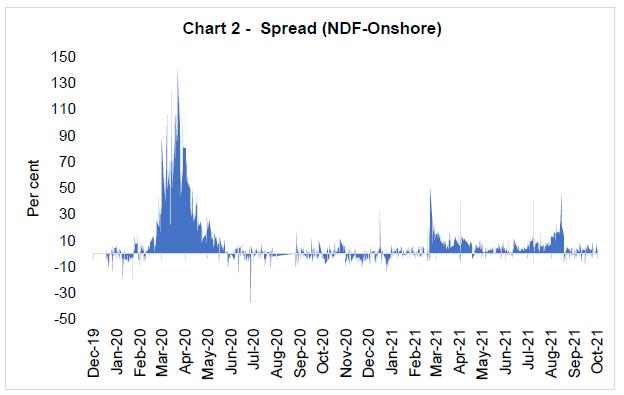
c. A key aspect of currency convertibility is integration of financial markets. Over time, it is essential that two markets – onshore and offshore - for domestic currency or interest rates cannot exist with efficiency. With increased convertibility, these markets need to be linked. An effort has already commenced in the interest rate derivative segment. Allowing Indian banks access to NDF markets for the Rupee is also consistent with this objective. As G-secs get held by global custodians and traded abroad more and more non-residents get to hold Rupee assets and take Rupee exposure. These measures are already seeing the desired results - for instance, NDF-onshore spreads have substantially narrowed after allowing Indian banks into the NDF space (Chart 2, see Annex). We need to now consider whether India is ready to allow such non-residents to hold Rupee accounts. This will be an important early step in internationalization of the Rupee and, therefore, needs to be carefully considered. Further, there is a need to consider a proper mechanism for information flow so that exchange and interest rate management can continue to be effective in an environment of larger offshore transactions.

d. As onshore and offshore financial markets get integrated, it should be ensured that price discovery in the domestic markets is efficient lest flows move to the offshore segment. Take the case of the Rupee exchange rate. It is market determined with fairly tight bid-ask spreads in the interbank market. Major corporates also seem to benefit from tight pricing. Yet many entities, especially SMEs, small exporters, individuals, etc., are prone to over-pricing. Do processing charges and market risk for warehousing odd lot positions justify these spreads? An effective way is to shift price discovery for the retail forex users to a platform. While such a platform (FX Retail) has been developed, it appears that banks do not find it in their interest to navigate customers to use that platform. In this age of technology, it may not really be possible to shun superior technology for any length of time. There should be a debate on the use of the platform and banks should make an effort to give it a fair trial.

Conclusion

18. India has come a long way in achieving increasing levels of convertibility on the capital account. It has broadly achieved the desired outcome for the policy choices it has made, in terms of achieving a stable composition of foreign capital inflow. At the same time, India is on the cusp of some fundamental shifts in this space with increased market integration in the offing and freer non-resident access to debt on the table. The rate of change in capital convertibility will only increase with each of these and similar measures. With that comes the responsibility to ensure that such flows are managed effectively with the right combination of capital flow measures, macro-prudential measures and market intervention. All of us need to consider deeply the issues I have highlighted above and arrive at effective solutions. Market participants, particularly banks, will have to prepare themselves to manage the business process changes and the global risks associated with capital convertibility. The regulator’s job is somewhat different. As someone once said, the job of a regulator is like the gas regulator in the kitchen - it cannot ensure the quality of the dish, but it can prevent the kitchen from blowing up. The quality of the dish – that is, the efficiency with which investment needs of the country are met - is up to how well Authorized Dealers and other intermediaries adjust to the increasingly fuller capital account convertibility.

Annex - Charts
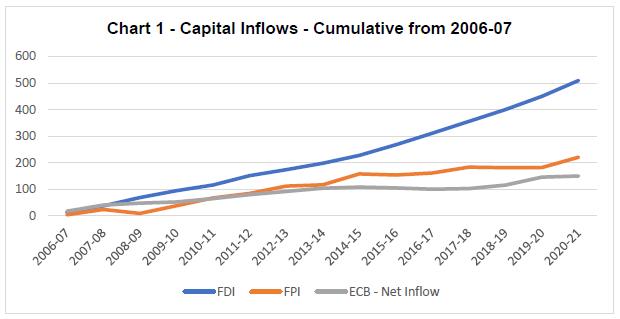
Chart 1

Chart 2

----

1 Speech delivered by Deputy Governor Shri T Rabi Sankar on the Fifth Foreign Exchange Dealers’ Association of India (FEDAI) Annual Day on October 14th, 2021. It was delivered via virtual platform.

2 OECD (2017), Open and Orderly Capital Movements: Interventions from the 2016 OECD High-Level Seminar.

3 Kaminsky Graciela Laura and Sergio L. Schmukler: Short-Run Pain, Long-Run Gain: Financial Liberalization and Stock Market Cycles, review of Finance, 2008

4 Fratzscher, Marcel: Capital Controls and Foreign Exchange Policy, Working Paper Series, European Central bank, February 2012.

5 FPI flows into equity over the 15-year period (2006-07 to 2020-21) accounts for 73% of total FPI inflows, while flows into debt account for the remaining 27%.

Topics

Acts Income Tax