Loading...

Top
Help
×

By creating an account you can:

Logo TaxTMI
Call Us / Help / Feedback

Contact Us At :

E-mail: [email protected]

Call / WhatsApp at: +91 99117 96707

For more information, Check Contact Us

FAQs :

To know Frequently Asked Questions, Check FAQs

Most Asked Video Tutorials :

For more tutorials, Check Video Tutorials

Submit Feedback/Suggestion :

Email :
Please provide your email address so we can follow up on your feedback.
Category :
Description :
Min 15 characters 0/2000
Make Most of Text Search
  1. Checkout this video tutorial: How to search effectively on TaxTMI.
  2. Put words in double quotes for exact word search, eg: "income tax"
  3. Avoid noise words such as : 'and, of, the, a'
  4. Sort by Relevance to get the most relevant document.
  5. Press Enter to add multiple terms/multiple phrases, and then click on Search to Search.
  6. Text Search
  7. The system will try to fetch results that contains ALL your words.
  8. Once you add keywords, you'll see a new 'Search In' filter that makes your results even more precise.
  9. Text Search
Add to...
You have not created any category. Kindly create one to bookmark this item!
Create New Category
Hide
Title :
Description :
❮❮ Hide
Default View
Expand ❯❯
Close ✕
🔎 News - Adv. Search
TEXT SEARCH:

Press 'Enter' to add multiple search terms. Rules for Better Search

Search In:
Main Text + AI Text
  • Main Text
  • Main Text + AI Text
  • AI Text
Category: ?
Categorized by AI
---- All Categories ----
  • ---- All Categories ----
  • Income Tax
  • GST
  • Customs, DGFT & SEZ
  • FEMA & RBI
  • Corp. Laws, SEBI & IBC
  • PMLA, Black Money & ED
  • Budget
  • News and Press Release
  • PTI News
Month:
---- All Months ----
  • ---- All Months ----
  • January
  • February
  • March
  • April
  • May
  • June
  • July
  • August
  • September
  • October
  • November
  • December
Year:
---- All Years ----
  • ---- All Years ----
  • 2026
  • 2025
  • 2024
  • 2023
  • 2022
  • 2021
  • 2020
  • 2019
  • 2018
  • 2017
  • 2016
  • 2015
  • 2014
  • 2013
  • 2012
  • 2011
Sort By: ?
In Sort By 'Default', exact matches for text search are shown at the top, followed by the remaining results in their regular order.
Relevance Default Date
    NEWS HIGHLIGHTS
    India's forex kitty swells by USD 10.5 bn to USD 692.87 bn
    Rs 5,000 cr credited to 6.22 lakh Maharashtra farmers so far under loan waiver scheme: Fadnavis
    SBI Life and J&K Bank partner to bring comprehensive life insurance solutions closer to families across India
    DRI intensifies vigil along India's North-Eastern Frontier
    Vijayan slams Kerala govt's move to end doorstep pension delivery through cooperative banks
    Kerala to stop welfare pension delivery through cooperative banks, shifts to DBT
    China's exports slow slightly in July despite robust demand for high-tech products
    India successfully concludes the Tenth BRICS Industry Ministers' Meeting in Jaipur under its BRICS Chairship 2026
    APEDA Organises BIOFACH INDIA 2026 to Promote India's Certified Organic Products and Expand Global Market Access
    RBI bars banks from disabling mobile devices of defaulting borrowers
    Par panel for early conclusion of India-US trade pact, tariff exemptions on key goods
    No commitments relating to ethanol import from US for fuel blending under FTA talks: Govt
    No concession or commitment on import of Ethanol for fuel blending from the United States
    Office of the Controller General of Patents, Designs and Trade Marks Announces Tentative Schedule for Patent and Trade Marks Agent Examinations 2027 a...
    RBI invites comments on the draft “Reserve Bank of India (Non-Banking Financial Companies – Credit Facilities) Amendment Directions, 2026”
    West Bengal seeks 100pc foodgrain, 40pc sugar jute packaging quota at SAC meeting
    RBI clasifies Tata Sons, 16 others as large NBFCs
    Sensex climbs 374 points on buying in Reliance, ICICI Bank; Nifty ends flat
    Insurance Division, DFS Secures 3rd Rank in Group A Category of Grievance Redressal Assessment & Index (GRAI) for June 2026
❯❯
Maximize Maximize Maximize
0 / 200
Expand Note
Add to Folder

No Folders have been created

+

Are you sure you want to delete "My most important" ?

NOTE:

News
Showing Results for :
Reset Filters
Results Found:
Show All Summaries Hide All Summaries
August 7, 2026
Show AI Summary
Criminal justice, extremist-material regulation and administrative schemes feature in reports on prosecutions, demolition practices, loan waivers and fuel policy.
Criminal justice reports cover bail and an expedited trial in an assault prosecution, arrest for allegedly sheltering an accused, allegations of rape and murder of a minor, and claimed irregularities in a police recruitment examination. Regulatory developments include a ban on extremist literature associated with proscribed organisations and judicial disapproval of coercive demolition. Administrative coverage includes farmer loan-waiver transfers following Aadhaar authentication and debate over the E20 fuel-blending programme.
August 7, 2026
Show AI Summary
Foreign exchange reserves rose as foreign currency assets, gold holdings, Special Drawing Rights and IMF reserve position increased.
India's foreign exchange reserves increased during the week ended July 31, principally because of higher foreign currency assets and gold reserves. Foreign currency assets include US dollar valuation effects arising from movements in currencies such as the euro, pound and yen. Special Drawing Rights and India's reserve position with the International Monetary Fund also increased. The movement followed measures to attract foreign exchange inflows, including an FCNR(B) measure, after earlier reserve declines associated with rupee pressure and dollar sales for foreign exchange market intervention.
August 7, 2026
Show AI Summary
Farm loan waiver eligibility depends on verified beneficiary status and Aadhaar authentication for direct credit of eligible crop-loan relief.
The farm loan waiver scheme covers eligible short-term crop loans within the prescribed ceiling and eligibility period. Waiver amounts are credited to verified bank accounts after field verification and completion of Aadhaar authentication. Aadhaar authentication is the operative condition for automatic processing of benefits, while eligibility rules and technical conditions have raised concerns about exclusion of distressed farmers.
August 7, 2026
Show AI Summary
Corporate agency distribution expands access to life insurance products, supporting insurance awareness, financial inclusion and long-term household financial protection.
A corporate agency arrangement enables J&K Bank to distribute SBI Life Insurance protection, savings, retirement and child-oriented life insurance plans through its branch network. The partnership aims to improve insurance access, awareness, financial literacy and long-term financial planning for households, particularly in Jammu & Kashmir and Ladakh. It is intended to expand insurance penetration, strengthen household financial protection and support financial inclusion in line with the IRDAI vision of "Insurance for All by 2047".
August 7, 2026
Show AI Summary
Cross-border smuggling controls target narcotics, poppy seeds and areca nuts entering through the Indo-Myanmar border region.
Cross-border smuggling enforcement targeted methamphetamine, foreign-origin poppy seeds and areca nuts allegedly brought from Myanmar. Methamphetamine concealed in an ambulance was seized under the NDPS Act, 1985. Poppy seeds and areca nuts recovered in separate operations were seized under the Customs Act, 1962. Poppy-seed imports are restricted to designated countries and require registration to ensure traceability and prevent illicit produce entering legitimate supply chains. The enforcement action addresses circumvention of customs controls and regulated import requirements.
August 7, 2026
Show AI Summary
Direct benefit transfer for welfare pensions replaces cooperative-bank doorstep delivery, while retaining limited home service for excluded beneficiaries.
Direct Benefit Transfer for social security and welfare pensions is to be made through Aadhaar-linked bank accounts, replacing cooperative-bank doorstep delivery. Home delivery remains available for bedridden persons and others who cannot be excluded. The change is associated with delays in remitting undistributed amounts, record-update failures, reconciliation issues, duplicate payments, and incomplete Aadhaar-based payment implementation. Concerns have been raised that mandatory bank-account credit may disadvantage beneficiaries dependent on doorstep delivery.
August 7, 2026
Show AI Summary
Direct Benefit Transfer for welfare pensions replaces doorstep cooperative-bank delivery, while home delivery remains for bedridden beneficiaries.
Direct Benefit Transfer of social security and welfare pensions is to be made mandatory through Aadhaar-linked bank accounts, replacing cooperative-bank doorstep distribution. Home delivery continues for completely bedridden beneficiaries and others who cannot be excluded. The change addresses delays in remitting undistributed amounts, record-update and reconciliation deficiencies, duplicate payments linked to incomplete Aadhaar-based payments, delivery incentive costs, and the need to comply with Direct Benefit Transfer norms to avoid loss of central financial assistance.
August 7, 2026
Show AI Summary
Customs trade data show moderating July growth while high-technology exports, vehicles and advanced manufacturing supplies remain strongly supported.
Customs and trade data showed that China's July export and import growth moderated and its trade surplus narrowed from the preceding month. Typhoon-related port disruptions affected trade flows, but demand for electronics and green technology products supported elevated values. High-technology items, vehicles, electronics and machinery recorded strong January-July export growth, while trade performance varied among the United States, the European Union and Southeast Asia.
August 7, 2026
Show AI Summary
BRICS industrial cooperation advances MSME, photovoltaic, startup and logistics frameworks alongside resilient trade and digital services collaboration.
BRICS industrial cooperation under PartNIR was strengthened through a Joint Declaration and institutional measures addressing MSMEs, photovoltaics, startup-led innovation, and resilient transport and logistics. The measures include an SME cooperation framework, Terms of Reference and an Action Plan for photovoltaic industry cooperation, and a startup innovation action plan. Trade discussions focused on the multilateral trading system, MSME participation in international trade, resilient global value chains, and cross-border digitally delivered services within a rules-based trading framework.
August 7, 2026
Show AI Summary
Certified organic export promotion: BIOFACH INDIA facilitates buyer-seller engagement, certification awareness, traceability discussions and international market access.
BIOFACH INDIA 2026 promotes certified organic exports by providing a platform for Indian organic enterprises to showcase diverse certified products and engage with overseas buyers through structured Buyer-Seller Meets. Technical sessions address organic certification, traceability, sustainability, quality standards, international regulatory requirements and export-market expectations. The initiative supports quality assurance, international market access, export linkages and sustainable agricultural practices across the organic value chain.
August 6, 2026
Show AI Summary
Device-based loan recovery restrictions protect essential mobile functions while permitting gradual locking only for lender-financed devices.
Technology-based recovery mechanisms cannot restrict or disable a borrower's mobile device unless the bank financed acquisition of that device. Where permitted, banks must adopt a gradual approach and preserve essential functions, including incoming calls, SMS access, and emergency SOS features. Regulated entities and service providers must obtain manufacturer or operating-system certification for device-locking technology. Disclosure of borrower or guarantor information to recovery personnel must be limited to what is necessary for loan-recovery duties.
August 6, 2026
Show AI Summary
Bilateral trade agreement negotiations should secure tariff certainty, protect key exports, strengthen supply chains, and support vulnerable small industries.
An early Bilateral Trade Agreement is proposed to protect Indian interests, secure tariff exemptions for key exports, reduce barriers affecting industrial products, and create predictable trade conditions. Recommended measures include financial and export-credit support for small industries, real-time monitoring of customs requirements, documentation assistance, and timely policy support against tariff and non-tariff barriers. Export strategy should develop knowledge services and critical supply-chain integration, while a National Fund should assist suppliers with redesign, tooling, certification and entry into new global supply chains.
August 6, 2026
Show AI Summary
Ethanol imports for fuel blending remain excluded from trade commitments, with domestic producers continuing to supply the blending programme.
Ethanol imports for fuel blending remain outside concessions or commitments in India-US trade discussions. Under the Ethanol Blended with Petrol Programme, ethanol procurement is governed solely by domestic policy requirements and is sourced entirely from domestic producers. Claims of existing or intended large-scale ethanol imports from the United States for fuel blending, or of a policy change permitting them, are stated to be baseless.
August 6, 2026
Show AI Summary
Domestic ethanol sourcing for fuel blending continues unchanged, with no import commitments or concessions involving United States ethanol.
Ethanol used for fuel blending under the Ethanol Blended with Petrol Programme is sourced entirely from domestic producers, with no imports from the United States for that purpose. No concessions or commitments on importing United States ethanol for fuel blending have been made in trade discussions. Fuel blending and ethanol procurement continue to be governed solely by domestic policy requirements, and claims of a policy change allowing large-scale imports are incorrect.
August 6, 2026
Show AI Summary
Patent and trade marks agent qualification examinations require written-paper minimums, aggregate passing scores, and viva voce assessment for registration.
Patent and trade marks agent examinations comprise an objective Paper I, a descriptive Paper II and a viva voce assessing suitability to practise before the Intellectual Property Office. Candidates must secure the stipulated minimum marks in each written paper and the required aggregate score to pass. Registration in the relevant Register of Patent Agents or Register of Trade Marks Agents is available only to candidates who satisfy all prescribed eligibility conditions and qualify the examination.
August 6, 2026
Show AI Summary
Draft NBFC credit-facilities amendments open for stakeholder consultation through designated online and email feedback channels.
Draft amendments to the Non-Banking Financial Companies credit-facilities framework have been released for public consultation. Regulated entities and other interested stakeholders may submit comments or feedback through the 'Connect 2 Regulate' platform or by email using the specified subject line.
August 6, 2026
Show AI Summary
Mandatory jute packaging reservations were urged to protect cultivators, mill workers, crop absorption, and environmentally sustainable packaging.
Mandatory jute packaging reservations were sought to be retained at full coverage for foodgrains and increased for sugar packaging for the forthcoming Jute Year. The submission before the Standing Advisory Committee emphasised absorption of bumper jute output, remunerative prices for cultivators, uninterrupted mill operations, and protection of farm and worker livelihoods. It also stressed that biodegradable jute bags offer an environmentally friendly alternative to HDPE and polypropylene woven sacks, and that dilution of compulsory packaging could undermine plastic-pollution reduction efforts.
August 6, 2026
Show AI Summary
NBFC Upper Layer classification imposes enhanced regulation and listing obligations, while de-registration applications remain under examination.
NBFC Upper Layer classification subjects identified large non-banking financial companies to enhanced regulatory requirements for at least five years and requires stock-exchange listing within three years of identification. The framework divides NBFCs into Base, Middle, Upper and Top Layers. Seventeen large NBFCs were included in the Upper Layer list, while Tata Sons' classification remains subject to the pending examination of its de-registration application.
August 6, 2026
Show AI Summary
Closing auction price discovery may affect benchmark levels differently based on constituent liquidity and concentrated institutional order flow.
The Closing Auction Session in the equity cash segment uses an auction-based method to determine closing prices of eligible shares with futures and options contracts, aiming to strengthen transparent and robust price discovery. Its effect on benchmark closing levels may differ according to constituent liquidity and institutional order flow. The Reserve Bank of India retained the policy repo rate and neutral stance, indicating that future policy decisions will be data-dependent and influenced by assessment of energy-cost effects on inflation.
August 6, 2026
Show AI Summary
Public grievance redressal strengthens through monitoring, senior review, workshops, stakeholder coordination, and customer-centric service delivery improvements.
Public grievance redressal is assessed through the Grievance Redressal Assessment and Index, which analyses grievance categories and disposal. The Department of Financial Services' Insurance and Banking Divisions received third and sixth ranks respectively in the June 2026 assessment. Its framework includes disposal of grievances, random reviews by senior officials, and workshops on effective grievance redressal, supporting best practices, stakeholder coordination, technology use, customer-centric service, and accountable public service delivery.

News

Back

All News

Showing Results for :
Reset Filters
No Records Found

News

Back

All News

Showing Results for : Reset Filters

India’s Capital Account Management – An assessment (Speech delivered by Shri T Rabi Sankar, Deputy Governor, Reserve Bank of India – October 14, 2021- at the Fifth Foreign Exchange Dealers’ Association of India (FEDAI) Annual Day)

October 16, 2021

Contents
Acts
Summary
Note

Note

-

Bookmark

Print

Print

1. In the previous FEDAI Annual Day address in November 2020, Governor Shri Shaktikanta Das had observed that CAC will continue to be approached “as a process rather than an event”. What I will do in this address is to expand on that theme and bring into focus some of the important issues on which, in my opinion, further public debate is warranted, to continue along this process of capital account convertibility.

What is capital account convertibility?

2. The balance of payments (BOP) of a country records all economic transactions of a country (that is, of its individuals, businesses and governments) with the rest of the world during a defined period, usually one year. These transactions are broadly divided into two heads – current account and capital account. The current account covers exports and imports of goods and services, factor income and unilateral transfers. The capital account records the net change in foreign assets and liabilities held buy a country. Convertibility refers to the ability to convert domestic currency into foreign currencies and vice versa to make payments for balance of payments transactions. Current account convertibility is the ability or freedom to convert domestic currency for current account transactions while capital account convertibility is the ability or freedom to convert domestic currency for capital account transactions. The Tarapore Committee (2006), for instance, defined capital account convertibility as the “freedom to convert local financial assets into foreign financial assets and vice versa.”

3. The degree of BOP convertibility of a country usually depends on the level of its economic development and degree of maturity of its financial markets. Therefore, advanced economies (AEs) are almost fully convertible while emerging market economies (EMEs) are convertible to different degrees.

Why is capital account convertibility important?

4. Free capital mobility, or internationalization of capital markets, is commonly recognized as an engine of global growth. Specifically, benefits of internationalization of capital markets are well accepted, in terms of broadening the investor base for recipient country financial assets, improved liquidity in financial markets and positive pressures for market infrastructure and market practices. International capital markets, by enabling access to a global savings pool and to different currencies, can potentially reduce borrowing costs, facilitate better risk allocation and enhance global liquidity (OECD, 2017)2.

What are the risks of free capital mobility and how are these risks managed?

5. The various currency and banking crises experienced over the last few decades have simultaneously highlighted the costs and risks of internationalization such as exposure to global shocks, credit and asset bubbles, exchange rate volatility associated with sudden exit of capital and higher refinancing risk. Increased globalization has brought to the fore the vulnerability to contagion effects. While it was argued that such risks are the short-term pains needed to reap long term gains (Kaminsky and others, 2008)3, there is now a wider acceptance that benefits of internationalization are not an unmixed blessing and that there is a nuanced trade off between growth and crisis risk. Such awareness has led to policy focus on three fronts.

a. First, that benefits of internationalization presupposes sound macroeconomic fundamentals, a well developed financial system and a sound market infrastructure, including efficient markets for funding and risk transfer.

b. Second, that countries need to develop appropriate tools to deal with the risks of internationalization, in particular, tools to manage the volume and composition of capital inflows and macro prudential tools.

c. And third, that different types of capital flows carry different risks – some are riskier than others. The agreed hierarchy of capital flows is that foreign direct investment is the least risky, followed by equity investment, followed by debt capital. While FDI is seen to contribute to long-run growth, portfolio equity gives a shorter run boost. Debt flows, while necessary, are susceptible to be volatile. Understandably, the focus of capital flow regulations, and macro-prudential regulations, has been debt flows.

6. Capital flow measures are effective insofar as they lead to safer external liability structures, by reducing dependence on foreign borrowing and could be particularly effective during sudden-stop episodes. They work essentially by avoiding risky flows or containing short-term debt or controlling currency exposure of domestic borrowers. Especially for economies where capital flows are relatively large, or the exposure of banking systems is significant, these measures could be more effective than macro prudential tools.

7. Macro prudential measures target systemic stability issues and tend to be capital based or liquidity based or borrower based. Capital based measures like counter cyclical capital buffers or higher-than-standard capital requirements or calibration of capital risk weights intended to change incentives for certain types of funding are commonly used. Liquidity Coverage Ratio or Net Stable Funding Ratio can be used to manage exposure to short term flows. Similarly, credit or asset bubbles can be controlled using Loan-to-Value ratio or Debt Service-to-Income ratios.

8. There is extensive global discussion on the choice and effectiveness of these tools to deal with specific vulnerabilities. There is reasonable consensus that none of these measures is undesirable in itself. There is also broad agreement on the sequencing of these measures. That the first line of defence against risks of capital flows are prudent macroeconomic policies and a strong institutional base. External borrowing should be controlled until corporate governance and supervisory standards are robust.

9. Not all emerging economies, however, may have this choice, and may be constrained to depend on capital flows, either to meet their investment needs or to develop financial markets. For many of these countries, the required development of policy and markets has to happen simultaneously with dependence on foreign capital. Often, there is only a limited choice on the type of capital that flows in, leading to dependence on risky debt capital. Managing these flows with a not-so-efficient domestic institutional base requires policy flexibility. Usually, managing the spillover risks of global capital involves a combination of these and macro prudential measures. Building up reserves has been an acceptable course, especially after the Asian crisis. Having some control on the amount of debt capital as well as on its nature is another defence. Long-term debt flows could be preferred to short-term flows, stable investors (pension or insurance funds, reserve portfolios) could be preferred to flighty investors such as carry traders, arbitrage traders etc. In a sense capital flow measures may really be used to compensate for lack of strong macro-fundamentals and adjustment mechanisms (Fratzscher, 2012)4.

10. Thus, capital flows are useful, and in case of many EMEs, even necessary. The choice is in how to manage the attendant risks. Effective management of these risks, especially those associated with debt flows, requires a diversified policy tool-kit. Which of these is used is basically a function of the degree of development of the economy and markets of the country.

Capital flow management in India

11. External sector liberalisation started in India with the economic liberalisation process that commenced in the early nineties – moving to a a floating exchange rate regime and freeing up current account transactions. The enactment of the Foreign Exchange Management Act, 1999 codified this arrangement with relatively free current account transactions (except for a negative list) and controlled capital account transactions. Liberalisation in this context basically meant gradually freeing up capital account transactions. Over the last two decades, FDI has become more or less unrestricted except (i) for some sectoral caps and (ii) restrictions in a few socially sensitive (e.g., gambling) or volatile (e.g., real estate) or strategic (e.g., atomic energy) sectors.

12. The policy regime for foreign portfolio investments in India commenced in 1992 when Foreign Institutional Investors (FIIs, or, since January 2014, FPIs) were allowed to invest in domestic financial instruments, basically equity. FPIs were given access to corporate debt markets in 1995 and to G-secs in 1997. Thus, the FPI regime has followed the standard process of liberalising equity flows first and then gradually freeing up debt capital. Apart from sectoral caps to regulate control, portfolio flows into equities in India are virtually unrestricted. Access to debt markets - sovereign and corporate - is subject to macro caps and other macroprudential limits. These are designed to safeguard the domestic economy from excessively speculative hot money flows.

13. There is an effort to liberalize FPI debt flows further with the introduction of the Fully Accessible Route (FAR) which places no limit on non-resident investment in specified benchmark securities. Since over time, virtually all securities will fall under the FAR category, the move is unambiguously towards an eventual unfettered access for non-residents into Government securities. Efforts to get India included under global bond indexes and the complementary move towards placing G-secs under global custodians, once implemented, will encourage debt flows in future.

14. The first comprehensive guidelines on External Commercial Borrowing (ECB) were issued by Government, in July 1999. It has been liberalised over time. Currently, ECB by corporates, while more open than portfolio flows, seeks to enable medium to long term debt (minimum tenor) only healthy corporates to borrow (through cost ceilings) subject to an overall soft limit. A few “end uses” – real estate, capital market, equity - are not permitted.

15. Chart 1 (see Annex for all charts) shows that the actual flows of capital have been broadly in the desirable direction with direct investments (FDI flows) outstripping portfolio investments (FPI flows) and equity flows (FDI plus FPI equity5) outstripping debt flows (FPI Debt plus ECB). The gradual liberalization of capital inflows has been consistent with the realization of the preferred composition of capital inflows.

16. The focus on capital outflows has understandably been far less given that India’s priority is to attract foreign capital to fund its savings gap. There is basically one channel – Overseas Direct Investment (ODI). The Liberalized Remittance Scheme (LRS) for individuals, while it is open for both current and capital account transactions, is largely (more than 90%) in current account transactions like travel, studies etc.

Issues for wider debate

17. While the progress so far can be considered to have moved broadly along the desirable direction, there are some issues which require a wider debate as there are no standard answers. We will discuss some of these issues below.

a. With the Fully Accessible Route, as discussed above, over time the entire G-sec issuance would be eligible for non-resident investment. While experience of other countries suggest that non-residents are unlikely to hold a major portion of outstanding stock, substantial debt holdings might make India vulnerable to the risk of sudden reversals. Since this channel was permitted in the context of inclusion of India’s G-secs in global bond indices, there is a natural safety mechanism as index investors are unlikely to indulge in sudden reversals. It may need to be considered, from a macroprudential perspective, whether FAR should be linked to index inclusion.

b. As the LRS Scheme has operated for some time, there may be a need to review it keeping in mind the changing requirements such as higher education for the youth, requirement of start-ups etc. There might even be a case for reviewing whether the limit can remain uniform or can be linked to some economic variable for individuals.

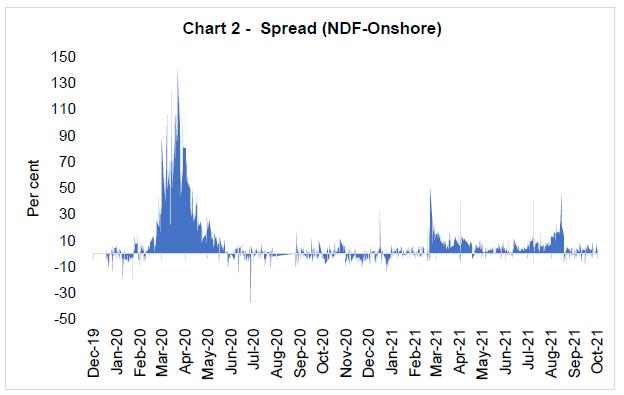
c. A key aspect of currency convertibility is integration of financial markets. Over time, it is essential that two markets – onshore and offshore - for domestic currency or interest rates cannot exist with efficiency. With increased convertibility, these markets need to be linked. An effort has already commenced in the interest rate derivative segment. Allowing Indian banks access to NDF markets for the Rupee is also consistent with this objective. As G-secs get held by global custodians and traded abroad more and more non-residents get to hold Rupee assets and take Rupee exposure. These measures are already seeing the desired results - for instance, NDF-onshore spreads have substantially narrowed after allowing Indian banks into the NDF space (Chart 2, see Annex). We need to now consider whether India is ready to allow such non-residents to hold Rupee accounts. This will be an important early step in internationalization of the Rupee and, therefore, needs to be carefully considered. Further, there is a need to consider a proper mechanism for information flow so that exchange and interest rate management can continue to be effective in an environment of larger offshore transactions.

d. As onshore and offshore financial markets get integrated, it should be ensured that price discovery in the domestic markets is efficient lest flows move to the offshore segment. Take the case of the Rupee exchange rate. It is market determined with fairly tight bid-ask spreads in the interbank market. Major corporates also seem to benefit from tight pricing. Yet many entities, especially SMEs, small exporters, individuals, etc., are prone to over-pricing. Do processing charges and market risk for warehousing odd lot positions justify these spreads? An effective way is to shift price discovery for the retail forex users to a platform. While such a platform (FX Retail) has been developed, it appears that banks do not find it in their interest to navigate customers to use that platform. In this age of technology, it may not really be possible to shun superior technology for any length of time. There should be a debate on the use of the platform and banks should make an effort to give it a fair trial.

Conclusion

18. India has come a long way in achieving increasing levels of convertibility on the capital account. It has broadly achieved the desired outcome for the policy choices it has made, in terms of achieving a stable composition of foreign capital inflow. At the same time, India is on the cusp of some fundamental shifts in this space with increased market integration in the offing and freer non-resident access to debt on the table. The rate of change in capital convertibility will only increase with each of these and similar measures. With that comes the responsibility to ensure that such flows are managed effectively with the right combination of capital flow measures, macro-prudential measures and market intervention. All of us need to consider deeply the issues I have highlighted above and arrive at effective solutions. Market participants, particularly banks, will have to prepare themselves to manage the business process changes and the global risks associated with capital convertibility. The regulator’s job is somewhat different. As someone once said, the job of a regulator is like the gas regulator in the kitchen - it cannot ensure the quality of the dish, but it can prevent the kitchen from blowing up. The quality of the dish – that is, the efficiency with which investment needs of the country are met - is up to how well Authorized Dealers and other intermediaries adjust to the increasingly fuller capital account convertibility.

Annex - Charts
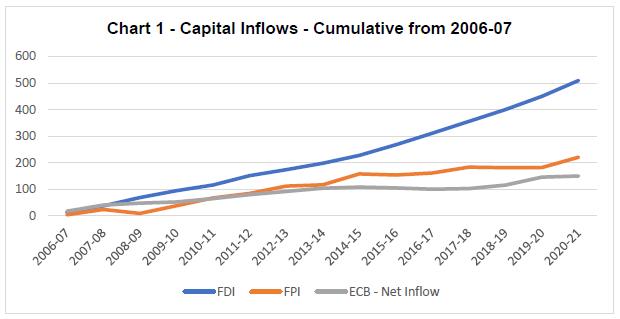
Chart 1

Chart 2

----

1 Speech delivered by Deputy Governor Shri T Rabi Sankar on the Fifth Foreign Exchange Dealers’ Association of India (FEDAI) Annual Day on October 14th, 2021. It was delivered via virtual platform.

2 OECD (2017), Open and Orderly Capital Movements: Interventions from the 2016 OECD High-Level Seminar.

3 Kaminsky Graciela Laura and Sergio L. Schmukler: Short-Run Pain, Long-Run Gain: Financial Liberalization and Stock Market Cycles, review of Finance, 2008

4 Fratzscher, Marcel: Capital Controls and Foreign Exchange Policy, Working Paper Series, European Central bank, February 2012.

5 FPI flows into equity over the 15-year period (2006-07 to 2020-21) accounts for 73% of total FPI inflows, while flows into debt account for the remaining 27%.

Topics

Acts Income Tax