Loading...

Top
Help
×

By creating an account you can:

Logo TaxTMI
Call Us / Help / Feedback

Contact Us At :

E-mail: [email protected]

Call / WhatsApp at: +91 99117 96707

For more information, Check Contact Us

FAQs :

To know Frequently Asked Questions, Check FAQs

Most Asked Video Tutorials :

For more tutorials, Check Video Tutorials

Submit Feedback/Suggestion :

Email :
Please provide your email address so we can follow up on your feedback.
Category :
Description :
Min 15 characters 0/2000
Make Most of Text Search
  1. Checkout this video tutorial: How to search effectively on TaxTMI.
  2. Put words in double quotes for exact word search, eg: "income tax"
  3. Avoid noise words such as : 'and, of, the, a'
  4. Sort by Relevance to get the most relevant document.
  5. Press Enter to add multiple terms/multiple phrases, and then click on Search to Search.
  6. Text Search
  7. The system will try to fetch results that contains ALL your words.
  8. Once you add keywords, you'll see a new 'Search In' filter that makes your results even more precise.
  9. Text Search
Add to...
You have not created any category. Kindly create one to bookmark this item!
Create New Category
Hide
Title :
Description :
❮❮ Hide
Default View
Expand ❯❯
Close ✕
🔎 News - Adv. Search
TEXT SEARCH:

Press 'Enter' to add multiple search terms. Rules for Better Search

Search In:
Main Text + AI Text
  • Main Text
  • Main Text + AI Text
  • AI Text
Category: ?
Categorized by AI
---- All Categories ----
  • ---- All Categories ----
  • Income Tax
  • GST
  • Customs, DGFT & SEZ
  • FEMA & RBI
  • Corp. Laws, SEBI & IBC
  • PMLA, Black Money & ED
  • Budget
  • News and Press Release
  • PTI News
Month:
---- All Months ----
  • ---- All Months ----
  • January
  • February
  • March
  • April
  • May
  • June
  • July
  • August
  • September
  • October
  • November
  • December
Year:
---- All Years ----
  • ---- All Years ----
  • 2026
  • 2025
  • 2024
  • 2023
  • 2022
  • 2021
  • 2020
  • 2019
  • 2018
  • 2017
  • 2016
  • 2015
  • 2014
  • 2013
  • 2012
  • 2011
Sort By: ?
In Sort By 'Default', exact matches for text search are shown at the top, followed by the remaining results in their regular order.
Relevance Default Date
    Rupee recovers 18 paise to settle at 96.55 against US dollar
    Infosys: AI Revenues at 8.2% in Q1; Resilient Operating Margin of 21.1%
    Shares skid in Asia in sell-off of AI-related shares as Brent oil trades near $100 per barrel
    30-member Indian commerce chamber delegation to visit Sri Lanka
    Rupee rises 22 paise to 96.51 against US dollar in early trade
    ED conducts raids in UP, Delhi and Punjab in Rs 450-crore bank loan 'fraud'
    US slaps 10 per cent tariff on goods imported from India over forced labour concerns
    NICDC Organises Cross-Learning Site Visit to AURIC Smart City to Strengthen Industrial Corridor Development
    India Concludes Eighth Trade Policy Review at WTO in Geneva
    US' temporary 10 pc tariff set to expire on Friday unless extended or new duties announced
    PNB to establish Quantum Finance Innovation Hub in Amaravati
    Infosys veteran Ashiss Kumar Dash to succeed Salil Parekh as new CEO in 2027
    Gold falls Rs 400 per 10 grams amid surging oil prices
    PNB and Andhra Pradesh sign MoU to establish India's first Bank-led Quantum Finance Hub at Amaravati
    Govt allows FDI in inventory-based e-commerce model only for export purposes
    Joint home loans in India - interest rates start at 7.25%* p.a. for salaried applicants
    6Wresearch: India Export Attractiveness Tracker 2026
    Govt allows FDI in inventory-based model of e-commerce only for export purposes
    CRIF India Launches Chennai Chapter of 'Credit Goes to HER' to Strengthen Women's Leadership in the Credit Ecosystem
    Loan Fest 2026: Apply for a Bajaj Finance Personal Loan Online with Attractive Offers
❯❯
Maximize Maximize Maximize
0 / 200
Expand Note
Add to Folder

No Folders have been created

+

Are you sure you want to delete "My most important" ?

NOTE:

News
Showing Results for :
Reset Filters
Results Found:
Show All Summaries Hide All Summaries
July 24, 2026
Show AI Summary
Foreign-exchange market intervention supported rupee stabilisation amid investor outflows, weak equities, geopolitical tensions and elevated crude oil prices.
Foreign-exchange market conditions supported a rupee recovery against the US dollar following reported Reserve Bank of India intervention and dollar sales by public-sector banks. Pressure on the currency persisted due to foreign institutional investor outflows, weak domestic equity sentiment, geopolitical tensions and elevated crude oil prices. Lower crude prices, a weaker dollar index and further central bank intervention were identified as potential stabilising influences.
July 24, 2026
Show AI Summary
Forward-looking statements receive safe-harbor qualification amid reported IFRS performance, AI-led transformation initiatives, and revised revenue-growth guidance.
Infosys reported first-quarter IFRS financial performance, including revenue growth, operating margin, earnings per share, free cash flow, and large-deal contract value, while revising revenue-growth guidance and retaining operating-margin guidance. The release describes AI-led enterprise transformation, cloud modernization, digital banking, financial-crime operations, and technology services engagements. Forward-looking statements are subject to safe-harbor protection and may differ materially because of business, talent, economic, technological, regulatory, cybersecurity, litigation, investigation, and tariff-related risks.
July 24, 2026
Show AI Summary
Forced-labour import enforcement drives new tariffs as expiring stopgap levies and market uncertainty heighten trade-compliance concerns.
Import tariffs were announced on goods from trading partners said not to have fully enforced prohibitions on products made with forced labour. The measures apply to imports from 60 trading partners representing most United States imports and were introduced as existing stopgap levies approached expiry, following a Supreme Court setback affecting other tariff measures. The announcement occurred amid market uncertainty linked to energy-route disruptions, rising crude-oil prices, inflation concerns, and scrutiny of artificial-intelligence investment spending.
July 24, 2026
Show AI Summary
Cross-border commercial engagement supports Indian and Sri Lankan businesses in identifying partnerships and strengthening trade and investment relationships.
Cross-border trade and investment engagement between India and Sri Lanka is proposed through a commerce chamber delegation representing diverse Indian industry sectors. A networking session is intended to enable direct interactions between businesses, identify partnership opportunities, discuss commercial collaboration and develop new business connections. The engagement seeks to strengthen commercial relationships across participating industries within the established bilateral trade and investment relationship.
July 24, 2026
Show AI Summary
Foreign exchange market intervention limited rupee depreciation amid elevated oil prices, importer dollar demand, capital outflows and equity market weakness.
Foreign exchange market conditions reflected an early appreciation of the rupee against the US dollar, with likely central bank intervention through state-owned banks reported as limiting sharper depreciation. Softer dollar conditions provided limited support, while elevated crude oil prices increased dollar demand from oil marketing companies and sustained importer buying pressure. Foreign institutional investor equity outflows, domestic equity weakness, and West Asia tensions affecting oil prices also influenced the rupee.
July 24, 2026
Show AI Summary
Money-laundering investigation examines alleged bank-loan fund diversion through shell entities, accommodation entries, fake invoices and circular transactions.
A money-laundering investigation under the Prevention of Money Laundering Act concerns alleged bank-loan fraud involving Santosh Overseas Ltd., its promoters and linked entities. Searches were conducted at premises in Uttar Pradesh, Delhi and Punjab. The investigation, arising from a Central Bureau of Investigation case, alleges diversion and layering of loan funds through shell entities, accommodation-entry operators and related companies by means of purportedly fake invoices and circular financial transactions.
July 24, 2026
Show AI Summary
Forced-labour import prohibitions shape tariff treatment as India's policy amendment secures a lower rate for imported goods.
Forced-labour import prohibitions are linked to tariff treatment under Section 301 of the Trade Act of 1974. Goods imported from India receive a lower tariff rate after India amended its foreign trade policy to prohibit imports of goods produced using forced labour. The framework excludes certain raw materials, goods causing economy-wide disruption, and products unavailable in sufficient domestic quantities. India has contested the underlying investigations and proposes that the issues be addressed through a bilateral trade agreement.
July 24, 2026
Show AI Summary
Integrated industrial city development promotes cross-learning on digital governance, investor facilitation, infrastructure planning and plug-and-play industrial parks.
Industrial corridor development is being supported through cross-learning on AURIC Smart City's integrated planning, infrastructure and governance practices. The programme addresses master planning, utility systems, digital monitoring, land utilisation, investor facilitation, project implementation and coordination among implementing agencies. It also considers application of these practices to the Bharat Audyogik Vikas Yojana for plug-and-play industrial parks, with emphasis on integrated utilities, digital land management, investor-friendly approvals, sustainable infrastructure and multimodal connectivity.
July 24, 2026
Show AI Summary
WTO trade policy review highlights India's commitment to transparent trade rules, development policy space and multilateral engagement.
India reaffirmed an open, transparent, predictable and WTO-consistent trade and investment regime through tariff reform, customs simplification and free trade agreement initiatives. Its trade policy was presented as balancing developmental needs with WTO principles: agricultural tariffs protect vulnerable farmers, while industrial tariffs support supply-chain resilience and domestic manufacturing. India also committed to transparent, consultative and rules-compliant sanitary measures, technical regulations and trade remedies, with investigations based on objective evidence, due process and judicial oversight, including continued application of the Lesser Duty Rule in anti-dumping matters.
July 23, 2026
Show AI Summary
Temporary Section 122 surcharge expiry may restore MFN treatment for Indian exports, while Section 301 tariff uncertainty continues.
The US temporary Section 122 import surcharge on Indian goods is scheduled to expire unless extended or replaced, restoring affected imports to normal US MFN tariff treatment. Liability depends on entry for consumption or warehouse withdrawal. Section 232 national-security tariffs remain unchanged. Indian exports may still face fresh measures under Section 301 investigations into forced labour and excess manufacturing capacity, alongside potential country-specific or sectoral tariffs. The expiry may improve export competitiveness and market access, particularly for labour-intensive and MSME-driven sectors.
July 23, 2026
Show AI Summary
Quantum finance innovation will advance secure digital banking through cybersecurity, fraud detection, collaborative research, workforce development and digital literacy.
A Quantum Finance Innovation Hub is proposed to apply quantum technologies to banking through stronger cybersecurity, proactive financial-fraud detection and secure digital financial ecosystems. The initiative will bring together industry, academia, startups, research organisations and government agencies to promote innovation in quantum computing, artificial intelligence and related technologies. It also focuses on workforce development, digital literacy, public confidence in digital financial services, and technology-enabled responses to cybercrime and digital-arrest scams.
July 23, 2026
Show AI Summary
Chief executive succession plan appoints a CEO designate, subject to shareholder approval, for an AI-led corporate leadership transition.
Corporate leadership succession at Infosys is proposed through the appointment of Ashiss Kumar Dash as Managing Director and Chief Executive Officer designate from 1 April 2027. The five-year appointment is subject to shareholder approval and follows a recommendation of the Board's Nomination and Remuneration Committee. The incumbent will remain in office until the transition date and support an orderly transfer of responsibilities. The succession plan identifies the CEO designate's business, technology-delivery, client and global operations experience as relevant to AI-led transformation.
July 23, 2026
Show AI Summary
Bullion market pressure intensified as rising oil prices, inflation concerns and restrictive monetary policy expectations weakened gold and silver sentiment.
Gold and silver prices declined amid weaker global bullion trends, profit-booking, and higher crude oil prices linked to Middle East tensions. Market commentary associated the decline with inflation concerns and expectations that major central banks may sustain restrictive monetary policy for longer. Gold was described as facing near-term pressure from higher interest-rate expectations, inflation risks, and geopolitical uncertainty.
July 23, 2026
Show AI Summary
Quantum finance innovation will develop secure, AI-enabled banking solutions through collaborative research, startup incubation, cybersecurity enhancement and workforce development.
Quantum finance innovation is to be advanced through a memorandum of understanding for establishing the PNB Quantum Finance Hub at Amaravati Quantum Valley. The hub will develop, test and support adoption of secure, intelligent and future-ready banking solutions using Quantum Computing and Artificial Intelligence. It will bring together industry, academia, startups and government agencies for research, innovation, incubation and acceleration of financial technologies, focusing on cybersecurity, fraud detection, operational efficiency, risk management and customer experience.
July 23, 2026
Show AI Summary
Foreign investment in inventory-based e-commerce is allowed only for exports of Indian-made goods, while domestic retail remains prohibited.
Foreign direct investment in inventory-based e-commerce is permitted exclusively for exports of goods or products manufactured or produced in India. Restrictions on business-to-consumer and inventory-based e-commerce do not apply to these exports, subject to the Foreign Trade Policy 2023 and export regulations. Foreign direct investment in inventory-based e-commerce retailing for domestic sales remains prohibited, with the revised position taking effect upon the relevant foreign exchange notification.
July 23, 2026
Show AI Summary
Joint Home Loan Eligibility and Shared Repayment Liability Shape Borrowing Capacity, Tax Claims, Documentation, and Exit Planning.
Joint home loans allow eligible applicants to combine income for a single housing loan, while making every co-applicant fully responsible for repayment. Eligibility depends on each applicant's income, financial obligations, credit history, age, repayment capacity and property criteria. Applicants should agree on EMI sharing, ownership proportions and exit arrangements before applying, as removal of a co-applicant requires lender approval and reassessment. Co-owner borrowers may claim applicable interest and principal repayment deductions subject to ownership, contribution and income-tax requirements. Each applicant must provide separate identity, income and banking documentation.
July 23, 2026
Show AI Summary
Export competitiveness increasingly depends on regulatory compliance, preferential trade access and diversification into smartphones, medicines, petroleum products and semiconductors.
India's export potential to 2031 is centred on smartphones, polished diamonds, petroleum products and medicines, with the United States, Hong Kong, Japan, China, Singapore and the United Arab Emirates as important markets. New product opportunities include iron ore concentrates, gasoline vehicles and light petroleum oils. Although selected destinations offer duty-free or preferential access, market entry in mature markets increasingly depends on compliance with non-tariff measures, including registration, quality certification, safety documentation and product standards. Semiconductor-related manufacturing is identified as a long-term opportunity supported by expanding electronics capacity, supply-chain diversification and domestic incentives.
July 23, 2026
Show AI Summary
Foreign investment in inventory-based e-commerce is permitted exclusively for exports of Indian-manufactured or produced goods under export compliance rules.
Foreign direct investment in inventory-based e-commerce is permitted exclusively for exports of goods or products manufactured or produced in India. Foreign direct investment remains permitted in business-to-business e-commerce and the marketplace model, while business-to-consumer and inventory-based direct sales to consumers remain prohibited except for the specified export activity. Export-oriented inventory-based operations must comply with the applicable Foreign Trade Policy and foreign exchange regulations governing exports.
July 23, 2026
Show AI Summary
Women's leadership in credit expands through a Chennai community platform supporting mentorship, inclusive lending practices, and financial ecosystem collaboration.
The Chennai chapter of the 'Credit Goes to HER' initiative provides a platform for women professionals in banking, NBFCs, fintech, housing finance, academia and policy to share knowledge, obtain mentorship and collaborate on inclusive credit practices. It seeks to strengthen women's leadership and participation in the credit ecosystem while supporting responsible lending, financial inclusion, transparency and data-driven decision-making.
July 23, 2026
Show AI Summary
Digital personal-loan campaign combines online collateral-free borrowing, eligibility-based assessment, flexible repayment options and conditional lifestyle rewards for successful disbursals.
Digital personal-loan campaign permits eligible customers to apply online for collateral-free borrowing and receive specified lifestyle rewards upon successful disbursal, subject to campaign terms. Applicants may check an offer, provide personal, financial and employment information, review loan terms, complete know-your-customer and bank-account verification, and undergo assessment. Interest rates, loan amounts and repayment tenures depend on eligibility, credit profile, income and internal assessment. An EMI calculator supports comparison of repayment options and estimation of monthly instalments before application.

News

Back

All News

Showing Results for :
Reset Filters
No Records Found

News

Back

All News

Showing Results for : Reset Filters
News and Press Release

NITI Aayog Releases SDG India Index and Dashboard 2020–21

June 3, 2021

Contents
Summary
Note

Note

-

Bookmark

Print

Print

The third edition of the SDG India Index and Dashboard 2020–21 was released by NITI Aayog today. Since its inaugural launch in 2018, the index has been comprehensively documenting and ranking the progress made by States and Union Territories towards achieving the Sustainable Development Goals. Now in its third year, the index has become the primary tool for monitoring progress on the SDGs in the country and has simultaneously fostered competition among the States and Union Territories.

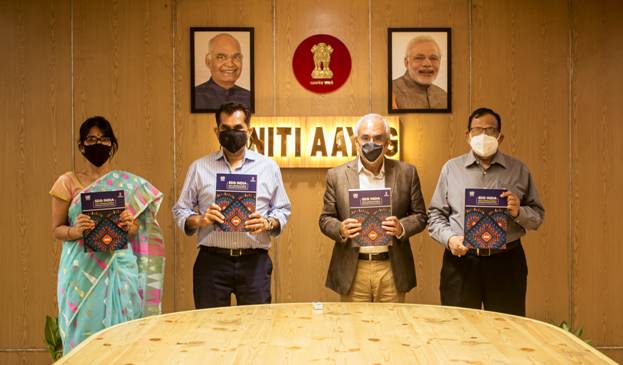
NITI  Aayog Vice Chairperson Dr Rajiv Kumar launched the report titled,SDG India Index and Dashboard 2020–21: Partnerships in the Decade of Action, in the presence of Dr Vinod Paul, Member (Health), NITI Aayog, Shri Amitabh Kant, CEO, NITI Aayog, and Ms.Sanyukta Samaddar,Adviser (SDGs), NITI Aayog. Designed and developed by NITI Aayog, the preparation of the index followed extensive consultations with the primary stakeholders-the States and Union Territories; the UN agencies led by United Nations in India;Ministry of Statistics and Programme Implementation (MoSPI), and the key Union Ministries.

“Our effort of monitoring SDGs through the SDG India Index & Dashboard continues to be widely noticed and applauded around the world. It remains a rare data-driven initiative to rank our States and Union Territories by computing a composite index on the SDGs. We are confident that it will remain a matter of aspiration and emulation and help propel monitoring efforts at the international level,”Dr. Rajiv Kumar, Vice Chairman, NITI Aayog said during the launch.

With one-third of the journey towards achieving the 2030 Agenda behind us, this edition of the index report focuses on the significance of partnerships as its theme. Shri Amitabh Kant, CEO, NITI Aayog said, “The report reflects on the partnerships we have built and strengthened during our SDG efforts. The narrative throws light on how collaborative initiatives can result in better outcomes and greater impacts.”

On thetheme of partnerships which is central to Goal 17, Dr. Vinod Paul, Member (Health), NITI Aayog, said,“It is clear that by working togetherwe can build a more resilient and sustainable future, where no one is left behind.”

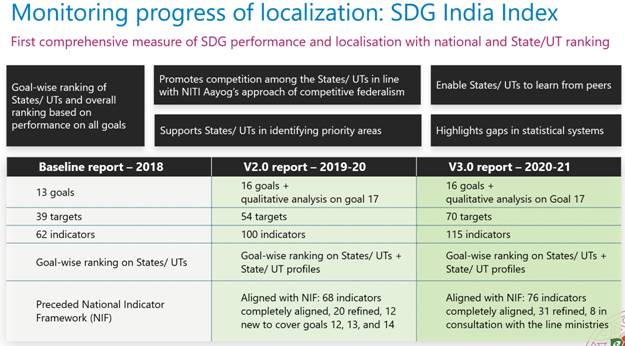
“From covering 13 Goals with 62 indicators in its first edition in 2018, the third edition covers 16 Goals on 115 quantitative indicators, with a qualitative assessment on Goal 17, thereby reflecting our continuous efforts towards refining this important tool,” said Ms. Sanyukta Samaddar, Adviser (SDGs), NITI Aayog.

NITI Aayog has the twin mandate to oversee the adoption and monitoring of the SDGs in the country, and also promote competitive and cooperative federalism among States and UTs. The index represents the articulation of the comprehensive nature of the Global Goals under the 2030 Agenda while being attuned to the national priorities. The modular nature of the index has become a policy tool and a ready reckoner for gauging progress of States and UTs on the expansive nature of the Goals, including health, education, gender, economic growth, institutions, climate change and environment.
https://static.pib.gov.in/WriteReadData/userfiles/image/image001MLG2.jpg

From right to left: Dr Vinod Paul, Member (Health);Dr Rajiv Kumar,Vice Chairperson; Shri Amitabh Kant, CEO; and Ms. Sanyukta Samaddar, Adviser (SDGs), NITI Aayog

SDG India Index andDashboard 2020–21: An Introduction to the Third Edition

The SDG India Index 2020–21, developed in collaboration with the United Nations in India, tracks progress of all States and UTs on 115 indicators that are aligned to MoSPI’s National Indicator Framework (NIF). The initiative to refine and improve this important tool with each edition has been steered by the need to continuously benchmark performance and measure progress, and to account for the availability of latest SDG-related data on States and UTs. The process of selecting these 115 indicators included multiple consultations with Union Ministries. Feedback was sought from all States and UTs and as the essential stakeholder and audience of this localisation tool, they played a crucial role in shaping the index by enriching the feedback process with localised insights and experience from the ground.

The SDG India Index 2020–21 is more robust than the previous editions on account of wider coverage of targets and indicators with greater alignment with the NIF.The 115 indicators incorporate16 out of 17 SDGs, with a qualitative assessment on Goal 17,andcover 70 SDG targets. This is an improvement over the 2018–19 and 2019–20 editions of the index, which had utilised 62 indicators across 39 targets and 13 Goals, and 100 indicators across 54 targets and 16 Goals, respectively. 
https://static.pib.gov.in/WriteReadData/userfiles/image/image002V4Z4.jpg

The SDG India Index computes goal-wise scores on the 16 SDGs for each State and Union Territory. Overall State and UT scores are generated from goal-wise scores to measure aggregate performance of the sub-national unit based on its performance across the 16 SDGs. These scores range between 0–100, and if a State/UT achieves a score of 100, it signifies it has achieved the 2030 targets. The higher the score of a State/UT, the greater the distance to target achieved.

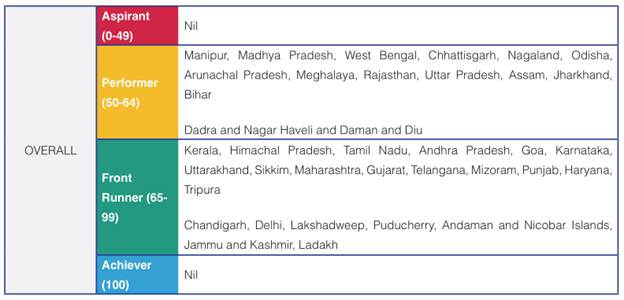
States and Union Territories are classified as below based on their SDG India Index score:
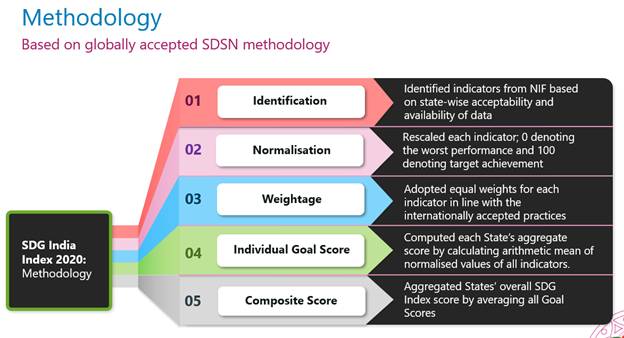
  • Aspirant: 0–49
  • Performer: 50–64
  • Front-Runner: 65–99
  • Achiever: 100


https://static.pib.gov.in/WriteReadData/userfiles/image/image003VG71.jpg


Overall Results and Findings

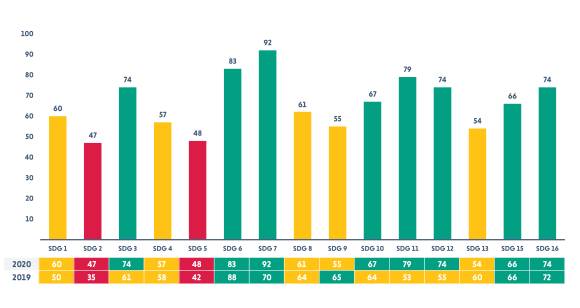
The country’s overall SDG score improved by 6 points-from 60 in 2019 to 66 in 2020–21. This positive stride towards achieving the targets is largely driven by exemplary country-wide performance in Goal 6 (Clean Water and Sanitation) and Goal 7(Affordable and Clean Energy), where the composite Goal scoresare 83 and 92, respectively.

Goal-wise India results, 2019–20 and 2020–21:
https://static.pib.gov.in/WriteReadData/userfiles/image/image004HSF4.jpg

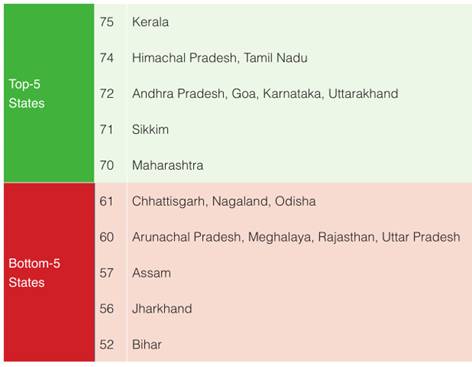
The top-fiveand bottom-fiveStates in SDG India Index 2020–21:
https://static.pib.gov.in/WriteReadData/userfiles/image/image005FTTM.jpg

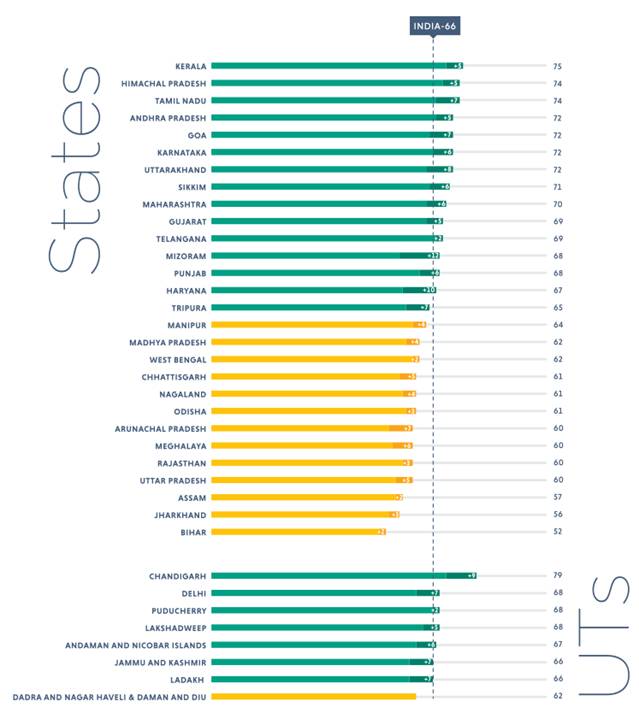
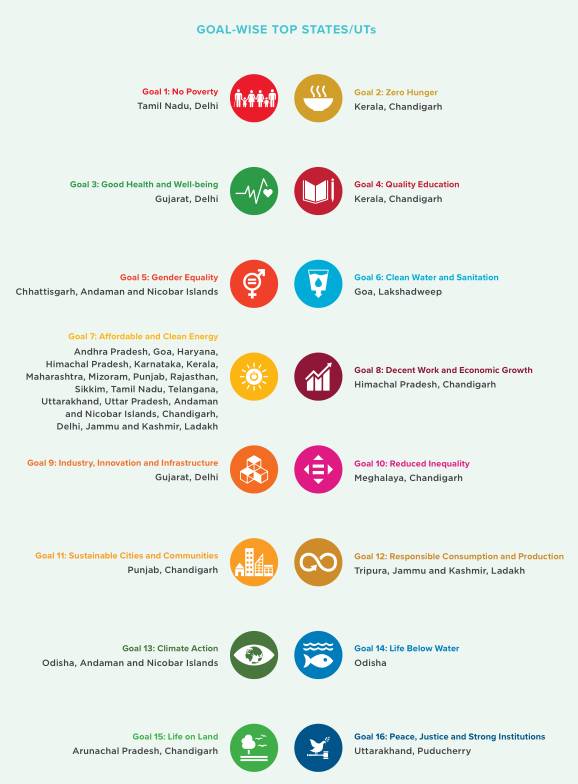
Performance and Ranking of States and UTs on SDGs 2020–21, including change in score from last year:
https://static.pib.gov.in/WriteReadData/userfiles/image/image006JTWS.jpg

https://static.pib.gov.in/WriteReadData/userfiles/image/image007XM1X.jpg

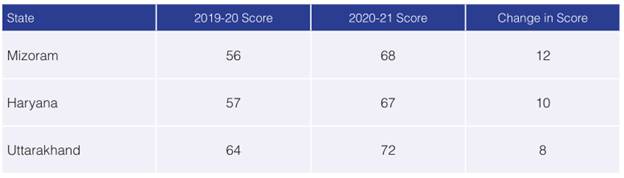
Mizoram, Haryana, and Uttarakhand are the top gainers in 2020–21in terms of improvement in score from 2019, with an increase of 12, 10 and 8 points, respectively.

Top Fast-Moving States (Score-Wise):
 

https://static.pib.gov.in/WriteReadData/userfiles/image/image0082BPP.jpg

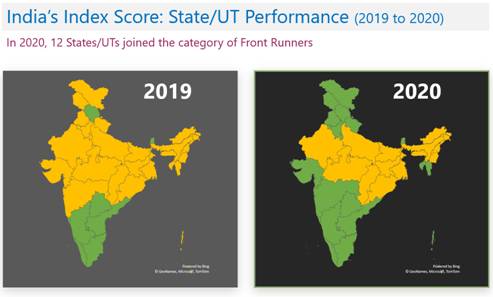
While in 2019, ten States/UTs belonged to the category of Front-Runners (score in the range 65–99, including both) twelve more States/UTs find themselves in this category in 2020–21. Uttarakhand, Gujarat, Maharashtra, Mizoram, Punjab, Haryana, Tripura, Delhi, Lakshadweep, Andaman and Nicobar Islands, Jammu and Kashmir and Ladakh graduated to the category of Front-Runners (scores between 65 and 99, including both).
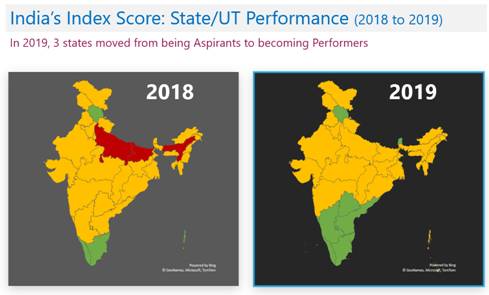
https://static.pib.gov.in/WriteReadData/userfiles/image/image009CVDV.jpg

https://static.pib.gov.in/WriteReadData/userfiles/image/image0105R60.jpghttps://static.pib.gov.in/WriteReadData/userfiles/image/image011PHAO.jpg

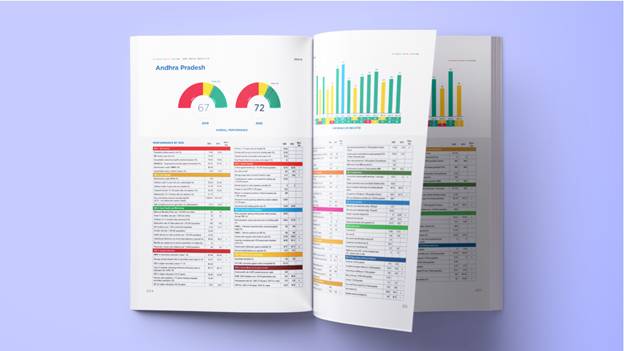
Asection of the SDG India Index report is dedicated to all the 36 Statesand UTs of the country. These State and UT profiles will be very useful for policymakers, scholars and the general public, to analyse the performance on the 115 indicators across all Goals.

Sample of a State/UT profile from the report:
https://static.pib.gov.in/WriteReadData/userfiles/image/image012R6JG.jpg

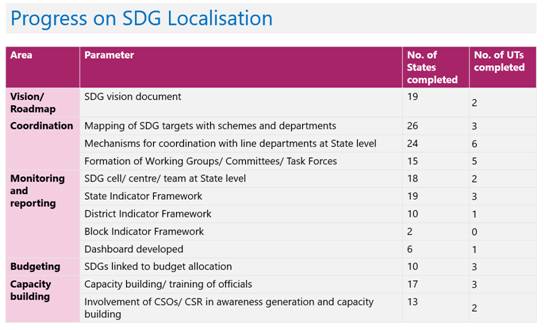
It is followed by a unique section on the progress on SDG localisation in States and Union Territories. It provides an update on the institutional structures, SDG vision documents, State and District Indicator Frameworks and other initiatives taken by the State and UT governments.
https://static.pib.gov.in/WriteReadData/userfiles/image/image013Y892.jpg

The SDG India Index2020–21 is also live on an online dashboard, which has cross-sectoral relevance across policy, civil society, business, and academia. The index is designed to function as a tool for focused policy dialogue, formulation and implementation through development actions,which are pegged to the globally recognisable metric of the SDG framework.The index and dashboard will also facilitate in identifying crucial gaps related to tracking the SDGs and the need for India to develop its statistical systems at the State/UT levels.As another milestone in the SDG localisation journey of the country, the Index is presently being adapted and developed by NITI Aayogat the granular level of districts for the upcoming North Eastern Region District SDG Index.

A snapshot of the SDG India Index 2020–21 dashboard:

https://static.pib.gov.in/WriteReadData/userfiles/image/image014Q7QF.jpg

NITI Aayog has the mandate for coordinating the adoption and monitoring of SDGs at the national and sub-national levels. The SDG India Index and Dashboard represents NITI Aayog’s efforts inencouraging evidence-based policymaking by supporting States and UTs to benchmark their progress, identify the priority areas and share good practices.
https://static.pib.gov.in/WriteReadData/userfiles/image/image015OU5B.jpg

The full SDG India Index report can be accessed here: https://wgz.short.gy/SDGIndiaIndex

The interactive dashboard can be accessed here: http://sdgindiaindex.niti.gov.in/

Topics

Acts Income Tax