Loading...

Top
Help
×

By creating an account you can:

Logo TaxTMI
Call Us / Help / Feedback

Contact Us At :

E-mail: [email protected]

Call / WhatsApp at: +91 99117 96707

For more information, Check Contact Us

FAQs :

To know Frequently Asked Questions, Check FAQs

Most Asked Video Tutorials :

For more tutorials, Check Video Tutorials

Submit Feedback/Suggestion :

Email :
Please provide your email address so we can follow up on your feedback.
Category :
Description :
Min 15 characters 0/2000
Make Most of Text Search
  1. Checkout this video tutorial: How to search effectively on TaxTMI.
  2. Put words in double quotes for exact word search, eg: "income tax"
  3. Avoid noise words such as : 'and, of, the, a'
  4. Sort by Relevance to get the most relevant document.
  5. Press Enter to add multiple terms/multiple phrases, and then click on Search to Search.
  6. Text Search
  7. The system will try to fetch results that contains ALL your words.
  8. Once you add keywords, you'll see a new 'Search In' filter that makes your results even more precise.
  9. Text Search
Add to...
You have not created any category. Kindly create one to bookmark this item!
Create New Category
Hide
Title :
Description :
❮❮ Hide
Default View
Expand ❯❯
Close ✕
🔎 News - Adv. Search
TEXT SEARCH:

Press 'Enter' to add multiple search terms. Rules for Better Search

Search In:
Main Text + AI Text
  • Main Text
  • Main Text + AI Text
  • AI Text
Category: ?
Categorized by AI
---- All Categories ----
  • ---- All Categories ----
  • Income Tax
  • GST
  • Customs, DGFT & SEZ
  • FEMA & RBI
  • Corp. Laws, SEBI & IBC
  • PMLA, Black Money & ED
  • Budget
  • News and Press Release
  • PTI News
Month:
---- All Months ----
  • ---- All Months ----
  • January
  • February
  • March
  • April
  • May
  • June
  • July
  • August
  • September
  • October
  • November
  • December
Year:
---- All Years ----
  • ---- All Years ----
  • 2026
  • 2025
  • 2024
  • 2023
  • 2022
  • 2021
  • 2020
  • 2019
  • 2018
  • 2017
  • 2016
  • 2015
  • 2014
  • 2013
  • 2012
  • 2011
Sort By: ?
In Sort By 'Default', exact matches for text search are shown at the top, followed by the remaining results in their regular order.
Relevance Default Date
    Taxation laws (Amendment) Bill to attract more foreign capital, provide policy certainty introduced in LS
    Champion Mirabai Chanu Unveils MMTC-PAMP's 'Virasat' Recycled Gold Coin to Celebrate India's 80th Year of Independence
    Indian economy to hit USD 5-trillion mark in FY29 as per IMF: FM
    SVC Co-operative Bank Concludes 120th Annual General Meeting, Reaffirms Growth, Governance and Digital Focus
    Rupee falls 3 paise to close at 95.40 against US dollar
    Government Boosts MSME Financing Through SIDBI and ECLGS 5.0
    India's Market Opportunity is Growing, and the Trade is Taking Notice
    50,000 Students to Participate in Season 2 of the Franklin Templeton National Mutual Fund Olympiad 2026
    Currently nine trade disputes pending against India under WTO rules: Govt
    MNLU Mumbai Launches MBA in Entrepreneurship & Digital Business Law
    AU Small Finance Bank Savings Accounts: Competitive Interest Rates, Zero-Balance Digital Account Opening and 24x7 Mobile Banking
    Rupee opens on flat note, rises 3 paise to 95.34 against US dollar in early trade
    Meeting of Heads of National Statistical Offices of BRICS Countries “Quality Statistics as Driver of Change”
    Modernization of National Sample Surveys through adoption of digital platforms such as Computer Assisted Personal Interview (CAPI) integrated with e- ...
    Govt hikes windfall gains tax on petrol, diesel, ATF exports
    No guidelines to regulate online astrology platforms: Consumer affairs department to CIC
    Yellow.ai, a Global Leader in Enterprise Agentic AI, to Go Public via $550 Million Merger with Bluerock Acquisition Corp.
    Shri Piyush Goyal Invites Indian and Uzbek Businesses to Co-invest and Co-manufacture; Calls for Doubling Bilateral Trade at India-Uzbekistan Business...
    Every ₹1 invested under Kisan Credit Card– Modified Interest Subvention Scheme (KCC-MISS) contributes ₹2.30 to net value addition in the...
    India achieves near-universal banking coverage, with 99.92% of inhabited villages now served by a banking outlet
❯❯
Maximize Maximize Maximize
0 / 200
Expand Note
Add to Folder

No Folders have been created

+

Are you sure you want to delete "My most important" ?

NOTE:

News
Showing Results for :
Reset Filters
Results Found:
Show All Summaries Hide All Summaries
August 4, 2026
Show AI Summary
Tax policy certainty reforms propose easier fund management, data-centre access, electronics incentives and revised electronic-payment charging rules.
The proposed Bill seeks to simplify conditions for foreign investment funds using fund managers in India without being treated as carrying on business in India, while retaining safeguards against misuse and round-tripping. It proposes removal of approval requirements for foreign cloud companies using Indian data centres and permits leased operation of Indian data centres. It also extends tax support for foreign companies participating in electronics contract manufacturing and component warehousing, preserves tax-free dividends for REIT and InvIT investors in specified circumstances, and removes the prohibition on Merchant Discount Rate charges for notified electronic payment modes.
August 4, 2026
Show AI Summary
Responsible precious-metals recycling supports recycled-gold products, organised buyback channels and a more self-reliant domestic supply chain.
Responsible precious-metals recycling is promoted through a commemorative recycled-gold coin intended to support domestic recycling, responsible sourcing and a self-reliant supply chain. The product is described as having certified purity authentication, tamper-proof packaging, a unique identification number and an assayer-certified minted card. The initiative seeks to reduce dependence on imported gold and expand organised, transparent recycling infrastructure. An organised silver buyback programme is also described as supporting secure consumer sales and a circular economy for precious metals.
August 4, 2026
Show AI Summary
Broad-based growth strategy links tax reforms, trade resilience, industrial support and services development to medium-term economic expansion.
The growth strategy combines agricultural productivity, manufacturing, MSME support, infrastructure, logistics, ease of doing business, streamlined income-tax and GST reforms, innovation, digitalisation, human-capital development, energy security, public capital expenditure, foreign direct investment liberalisation, export promotion, fiscal prudence and price stability. Trade resilience is to be strengthened through expanded trade agreements, while manufacturing, services, agriculture and strategic sectors receive targeted policy support. The material also reports secured-asset enforcement cases and recoveries by banks under the SARFAESI framework during FY25.
August 4, 2026
Show AI Summary
Co-operative bank governance and financial disclosure support digital transformation, risk management, priority-sector lending and sustainable member-focused growth.
Co-operative bank governance and financial disclosure were addressed at the annual general meeting, where the member-notice agenda was transacted and audited financial statements were presented. The bank reported growth in business, deposits and advances, together with net profit, asset quality, provisioning coverage and capital adequacy indicators. Its operational priorities include digital transformation, risk management, selective network expansion, customer service and operational discipline. Future priorities include retail and priority-sector lending, MSMEs, affordable housing and institutional deposits.
August 4, 2026
Show AI Summary
Foreign-exchange market conditions weakened the rupee as oil prices, domestic equities and dollar strength shaped near-term currency expectations.
The rupee weakened against the US dollar amid elevated crude oil prices, weaker domestic equities and a stronger dollar index, while foreign fund inflows moderated the decline. Attention shifted to the central bank's monetary policy meeting, with continuation of the existing benchmark policy rate anticipated. Earlier measures encouraging overseas dollar deposits and facilitating foreign participation in government bonds were reported to support capital inflows and India's external position.
August 4, 2026
Show AI Summary
MSME credit expansion combines SIDBI lending initiatives with guaranteed additional working-capital facilities for eligible borrowers.
MSME credit access is being expanded through SIDBI's branch network, direct lending, refinance support, co-lending arrangements, affordable credit for informal micro-entrepreneurs, and invoice-based digital credit for micro enterprises. Emergency Credit Line Guarantee Scheme 5.0 enables eligible MSMEs to obtain additional credit linked to peak fund-based working-capital outstanding, with full guarantee coverage for member lending institutions against defaults on the additional facility. The scheme also covers scheduled passenger airlines under distinct eligibility and guarantee parameters.
August 4, 2026
Show AI Summary
Furniture and interiors sourcing platform connects Indian manufacturers with domestic and international trade buyers through direct procurement opportunities.
imm india 2026 is presented as a business-to-business sourcing platform linking Indian furniture, home de cor, rug, carpet, mattress and handicraft manufacturers with domestic and international trade buyers. It is intended to provide direct manufacturer access, design-led sourcing and project-scale procurement opportunities for architects, designers, retailers, hospitality professionals and real estate developers. The programme includes a hosted buyer initiative, industry conferences, knowledge sessions and awards addressing innovation, sustainability, craftsmanship and design.
August 4, 2026
Show AI Summary
Financial literacy Olympiad builds students' practical understanding of mutual funds, financial planning, market concepts and responsible investment participation.
Financial literacy and investment awareness are promoted through a nationwide, multi-level educational competition for undergraduate and postgraduate students. Participants are assessed on mutual funds, investment fundamentals, financial planning, market concepts and long-term wealth creation, with exposure to market-linked products including ETFs, portfolio management services, alternative investment funds and specialised investment funds. The initiative combines academic institutions and financial-sector participants to improve practical investment knowledge, informed decision-making and responsible participation in investment markets.
August 4, 2026
Show AI Summary
WTO dispute settlement challenges test India's safeguards, agricultural support, technology tariffs and production-linked incentives across pending proceedings.
Nine pending WTO disputes against India concern safeguard measures, sugar support and export schemes, information and communications technology tariffs, and technology-sector incentives. India contests the claims as consistent with its WTO rights and obligations. Appeals concerning iron and steel safeguards, sugar measures, and certain information and communications technology tariff reports remain pending, including because the WTO Appellate Body is non-functional. Other proceedings concern Chinese challenges to production-linked incentives, tariffs, and solar, automotive, renewable-energy and information-technology measures; one panel proceeding is ongoing and another panel has not been constituted.
August 4, 2026
Show AI Summary
Digital business law and entrepreneurship education combine management, compliance and innovation training for technology-driven enterprise careers and ventures.
The MBA programme integrates management education, entrepreneurial capability, digital business law, and legal and policy awareness for technology-driven enterprise. It addresses compliance, digital platforms, data-driven decision-making, artificial intelligence, digital transactions, intellectual property, cross-border commerce and evolving regulatory frameworks. The programme is designed for prospective founders, start-up professionals, transforming family businesses and careers in consulting, strategy, business development, policy-oriented enterprises and digital commerce, with industry-relevant entrepreneurship education and digital-first learning.
August 4, 2026
Show AI Summary
Savings account access expands through video KYC, mobile banking, no-minimum-balance options, monthly interest payments and deposit insurance coverage.
Savings accounts provide monthly interest payments, liquidity and access to funds, subject to eligibility, internal policies and applicable terms. Digital account opening through Video KYC is available for an account with no minimum balance requirement, supported by mobile banking for UPI transfers, bill payments and balance monitoring. Account variants include premium, value-oriented, agricultural, financial-inclusion, children's and basic no-frills accounts. Deposit insurance applies up to the prescribed limit per depositor per bank.
August 4, 2026
Show AI Summary
Foreign-exchange market conditions supported a modest early rupee gain, while importer demand and policy data remained key factors.
Foreign-exchange market conditions supported a marginal early appreciation of the rupee against the US dollar, led by broad US-dollar weakness, improved risk sentiment, lower oil-price levels and foreign portfolio inflows. Importer demand for dollars moderated the movement. Market direction remained linked to the forthcoming monetary-policy decision and US economic data, while reported central-bank activity was described as helping smooth currency volatility. The US dollar index, crude-oil movements, global supply expectations and domestic equity-market activity were relevant exchange-rate influences.
August 4, 2026
Show AI Summary
Quality statistics drive statistical-system reform through administrative data, interoperable systems, stronger governance, and international cooperation for evidence-based policymaking.
Quality statistics are advanced through modernised national statistical systems, administrative data, digital public infrastructure, and stronger data-governance and privacy standards. Cooperation among national statistical offices is intended to address data gaps through knowledge sharing, methodological harmonisation and statistical innovation. Discussions also emphasised digital dissemination, transformational statistical reforms, and the use of administrative data for timely, cost-effective and granular official statistics, supported by harmonised metadata, interoperable systems and institutional collaboration.
August 4, 2026
Show AI Summary
Digital statistical modernisation strengthens survey quality, macroeconomic indicators, international standards alignment and infrastructure performance monitoring through standardised data systems.
National statistical modernisation uses digital survey platforms with validation checks, AI-enabled support and multilingual interfaces, alongside short-duration surveys and administrative data to improve sampling and timely official statistics. Reforms include base revisions for Gross Domestic Product, Consumer Price Index and Index of Industrial Production; adoption of metadata, quality-assessment and classification standards; and alignment with international statistical principles and methodologies. Sustainable development indicators and infrastructure monitoring are supported through a national indicator framework, PAIMANA and a standardised performance dashboard.
August 3, 2026
Show AI Summary
Windfall gains tax on petroleum exports increases to discourage exports and preserve domestic fuel availability during regional supply disruptions.
Special additional excise duty on exports of petrol, diesel and aviation turbine fuel has been increased for the relevant fortnightly period, while existing duty rates for petrol and diesel cleared for domestic consumption remain unchanged. The windfall gains tax is intended to preserve domestic availability of petroleum products during the West Asia crisis and prevent exporters from benefiting unduly from price differences linked to elevated global crude oil prices.
August 3, 2026
Show AI Summary
Online Astrology Platform Regulation: consumer department reported no guidelines, while information requests required revised factual disclosures.
Online astrology platforms were reported as lacking specific regulatory guidelines within the consumer affairs department. The RTI application sought information on alleged unfair trade practices, investigations, complaints, licences, approvals, and applicable rules. The National Consumer Helpline stated that it had not investigated because it functions as a grievance-resolution platform. A revised factual response was required on investigations and complaint data, while queries concerning regulation, licences, approvals, and related investigations were to be transferred to the public authorities likely to hold that information.
August 3, 2026
Show AI Summary
Business combination disclosure outlines shareholder approval, registration requirements, financing conditions, and forward-looking risks for the proposed public listing.
The proposed business combination would take Yellow.ai public through a definitive agreement with Bluerock Acquisition Corp., subject to customary closing conditions and shareholder approval. Bluerock intends to file a Form S-4 registration statement containing a proxy statement/prospectus for proxy solicitation and securities issuance in connection with the transaction. The communication is not an offer or solicitation and states that no securities offering may occur without compliance with applicable registration, qualification or exemption requirements. Transaction projections and anticipated benefits are forward-looking statements subject to material risks and uncertainties.
August 3, 2026
Show AI Summary
Bilateral investment and trade facilitation drive proposed co-investment, digital cooperation and advanced manufacturing partnerships between Indian and Uzbek businesses.
India-Uzbekistan cooperation is proposed through co-investment, co-manufacturing and co-innovation, supported by the Bilateral Investment Treaty to promote investor confidence and reciprocal investment. Priority sectors include mining, textiles, healthcare, agriculture, food processing, digital technologies and advanced manufacturing. Trade facilitation measures include reducing trade barriers, mutual recognition of standards, approvals, testing and certification, customs digitalisation and improved trade routes. Regulators and standard-setting bodies are expected to cooperate under a structured, time-bound economic partnership.
August 3, 2026
Show AI Summary
Concessional agricultural credit supports working capital, crop diversification, allied activities, and digital expansion under the Kisan Credit Card scheme.
The Kisan Credit Card-Modified Interest Subvention Scheme provides concessional institutional credit to reduce farmers' interest burdens and improve timely working-capital access. The scheme is reported to support cropping intensity, multi-season cultivation, diversified crop portfolios, timely input use, and credit discipline through the Prompt Repayment Incentive. It also supports dairy, livestock, and fisheries-based income diversification. Credit-delivery measures include collateral-free lending, digital platforms, simplified applications, coverage expansion, and awareness campaigns. State-wise data tracks operative accounts, outstanding credit, and non-performing Kisan Credit Card accounts.
August 3, 2026
Show AI Summary
Banking inclusion expands rural access while digital credit systems and payment security controls address service delivery and cyber fraud.
Banking inclusion is pursued by providing banking outlets within a five-kilometre radius of inhabited villages, with branch expansion permitted subject to rural-coverage requirements and continuing assessment of uncovered areas. Agricultural credit delivery uses digital loan, beneficiary-verification, processing and claim-settlement systems. Digital payment security measures require minimum controls for payment channels and include fraud-intelligence sharing, artificial-intelligence-based identification of money-mule activity, digital lending-app analysis, cyber-incident reporting, public awareness campaigns and electronic-banking training.

News

Back

All News

Showing Results for :
Reset Filters
No Records Found

News

Back

All News

Showing Results for : Reset Filters
News and Press Release

NITI Aayog Releases SDG India Index and Dashboard 2020–21

June 3, 2021

Contents
Summary
Note

Note

-

Bookmark

Print

Print

The third edition of the SDG India Index and Dashboard 2020–21 was released by NITI Aayog today. Since its inaugural launch in 2018, the index has been comprehensively documenting and ranking the progress made by States and Union Territories towards achieving the Sustainable Development Goals. Now in its third year, the index has become the primary tool for monitoring progress on the SDGs in the country and has simultaneously fostered competition among the States and Union Territories.

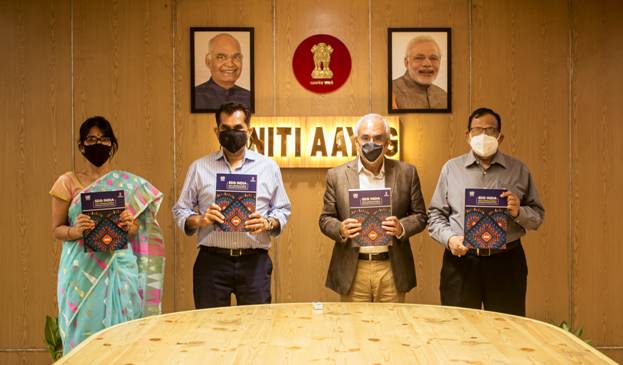
NITI  Aayog Vice Chairperson Dr Rajiv Kumar launched the report titled,SDG India Index and Dashboard 2020–21: Partnerships in the Decade of Action, in the presence of Dr Vinod Paul, Member (Health), NITI Aayog, Shri Amitabh Kant, CEO, NITI Aayog, and Ms.Sanyukta Samaddar,Adviser (SDGs), NITI Aayog. Designed and developed by NITI Aayog, the preparation of the index followed extensive consultations with the primary stakeholders-the States and Union Territories; the UN agencies led by United Nations in India;Ministry of Statistics and Programme Implementation (MoSPI), and the key Union Ministries.

“Our effort of monitoring SDGs through the SDG India Index & Dashboard continues to be widely noticed and applauded around the world. It remains a rare data-driven initiative to rank our States and Union Territories by computing a composite index on the SDGs. We are confident that it will remain a matter of aspiration and emulation and help propel monitoring efforts at the international level,”Dr. Rajiv Kumar, Vice Chairman, NITI Aayog said during the launch.

With one-third of the journey towards achieving the 2030 Agenda behind us, this edition of the index report focuses on the significance of partnerships as its theme. Shri Amitabh Kant, CEO, NITI Aayog said, “The report reflects on the partnerships we have built and strengthened during our SDG efforts. The narrative throws light on how collaborative initiatives can result in better outcomes and greater impacts.”

On thetheme of partnerships which is central to Goal 17, Dr. Vinod Paul, Member (Health), NITI Aayog, said,“It is clear that by working togetherwe can build a more resilient and sustainable future, where no one is left behind.”

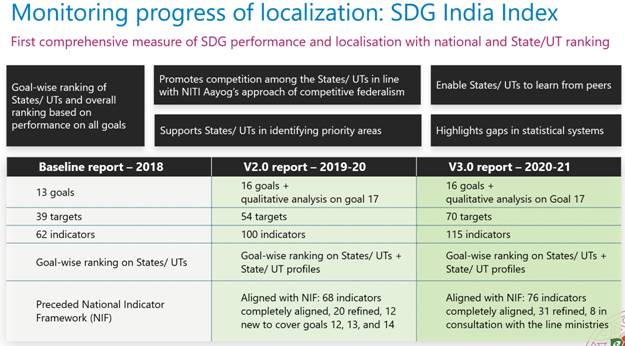
“From covering 13 Goals with 62 indicators in its first edition in 2018, the third edition covers 16 Goals on 115 quantitative indicators, with a qualitative assessment on Goal 17, thereby reflecting our continuous efforts towards refining this important tool,” said Ms. Sanyukta Samaddar, Adviser (SDGs), NITI Aayog.

NITI Aayog has the twin mandate to oversee the adoption and monitoring of the SDGs in the country, and also promote competitive and cooperative federalism among States and UTs. The index represents the articulation of the comprehensive nature of the Global Goals under the 2030 Agenda while being attuned to the national priorities. The modular nature of the index has become a policy tool and a ready reckoner for gauging progress of States and UTs on the expansive nature of the Goals, including health, education, gender, economic growth, institutions, climate change and environment.
https://static.pib.gov.in/WriteReadData/userfiles/image/image001MLG2.jpg

From right to left: Dr Vinod Paul, Member (Health);Dr Rajiv Kumar,Vice Chairperson; Shri Amitabh Kant, CEO; and Ms. Sanyukta Samaddar, Adviser (SDGs), NITI Aayog

SDG India Index andDashboard 2020–21: An Introduction to the Third Edition

The SDG India Index 2020–21, developed in collaboration with the United Nations in India, tracks progress of all States and UTs on 115 indicators that are aligned to MoSPI’s National Indicator Framework (NIF). The initiative to refine and improve this important tool with each edition has been steered by the need to continuously benchmark performance and measure progress, and to account for the availability of latest SDG-related data on States and UTs. The process of selecting these 115 indicators included multiple consultations with Union Ministries. Feedback was sought from all States and UTs and as the essential stakeholder and audience of this localisation tool, they played a crucial role in shaping the index by enriching the feedback process with localised insights and experience from the ground.

The SDG India Index 2020–21 is more robust than the previous editions on account of wider coverage of targets and indicators with greater alignment with the NIF.The 115 indicators incorporate16 out of 17 SDGs, with a qualitative assessment on Goal 17,andcover 70 SDG targets. This is an improvement over the 2018–19 and 2019–20 editions of the index, which had utilised 62 indicators across 39 targets and 13 Goals, and 100 indicators across 54 targets and 16 Goals, respectively. 
https://static.pib.gov.in/WriteReadData/userfiles/image/image002V4Z4.jpg

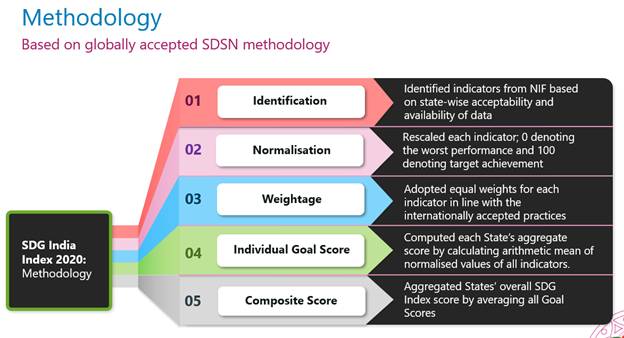
The SDG India Index computes goal-wise scores on the 16 SDGs for each State and Union Territory. Overall State and UT scores are generated from goal-wise scores to measure aggregate performance of the sub-national unit based on its performance across the 16 SDGs. These scores range between 0–100, and if a State/UT achieves a score of 100, it signifies it has achieved the 2030 targets. The higher the score of a State/UT, the greater the distance to target achieved.

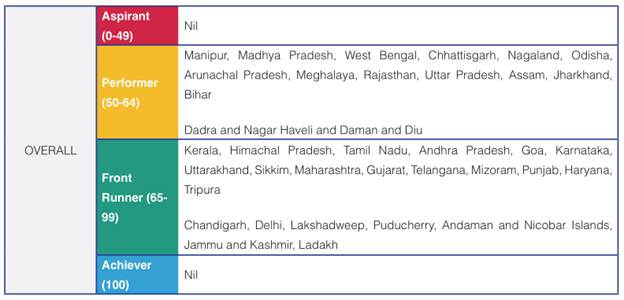
States and Union Territories are classified as below based on their SDG India Index score:
  • Aspirant: 0–49
  • Performer: 50–64
  • Front-Runner: 65–99
  • Achiever: 100


https://static.pib.gov.in/WriteReadData/userfiles/image/image003VG71.jpg


Overall Results and Findings

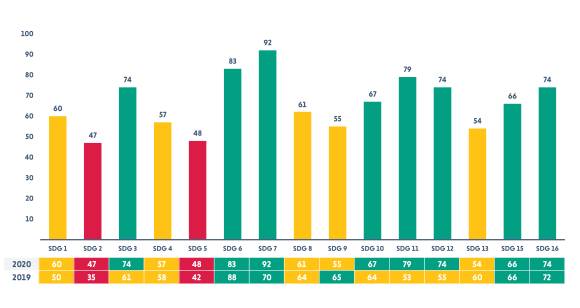
The country’s overall SDG score improved by 6 points-from 60 in 2019 to 66 in 2020–21. This positive stride towards achieving the targets is largely driven by exemplary country-wide performance in Goal 6 (Clean Water and Sanitation) and Goal 7(Affordable and Clean Energy), where the composite Goal scoresare 83 and 92, respectively.

Goal-wise India results, 2019–20 and 2020–21:
https://static.pib.gov.in/WriteReadData/userfiles/image/image004HSF4.jpg

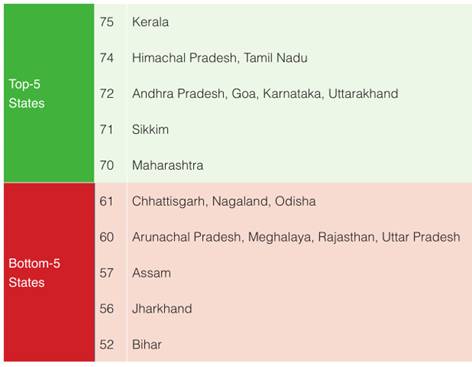
The top-fiveand bottom-fiveStates in SDG India Index 2020–21:
https://static.pib.gov.in/WriteReadData/userfiles/image/image005FTTM.jpg

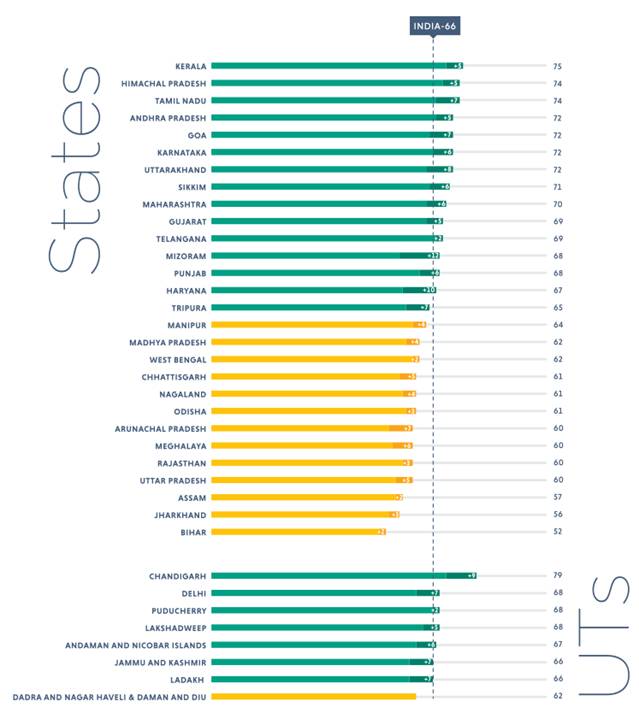
Performance and Ranking of States and UTs on SDGs 2020–21, including change in score from last year:
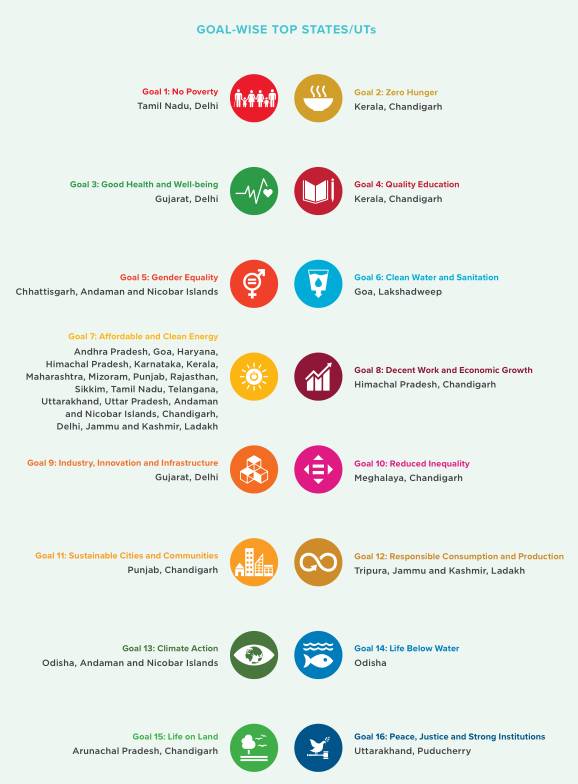
https://static.pib.gov.in/WriteReadData/userfiles/image/image006JTWS.jpg

https://static.pib.gov.in/WriteReadData/userfiles/image/image007XM1X.jpg

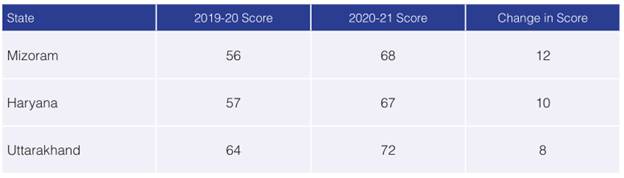
Mizoram, Haryana, and Uttarakhand are the top gainers in 2020–21in terms of improvement in score from 2019, with an increase of 12, 10 and 8 points, respectively.

Top Fast-Moving States (Score-Wise):
 

https://static.pib.gov.in/WriteReadData/userfiles/image/image0082BPP.jpg

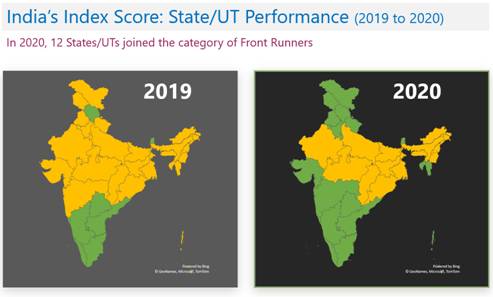
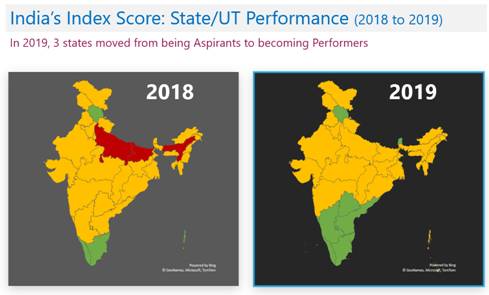
While in 2019, ten States/UTs belonged to the category of Front-Runners (score in the range 65–99, including both) twelve more States/UTs find themselves in this category in 2020–21. Uttarakhand, Gujarat, Maharashtra, Mizoram, Punjab, Haryana, Tripura, Delhi, Lakshadweep, Andaman and Nicobar Islands, Jammu and Kashmir and Ladakh graduated to the category of Front-Runners (scores between 65 and 99, including both).
https://static.pib.gov.in/WriteReadData/userfiles/image/image009CVDV.jpg

https://static.pib.gov.in/WriteReadData/userfiles/image/image0105R60.jpghttps://static.pib.gov.in/WriteReadData/userfiles/image/image011PHAO.jpg

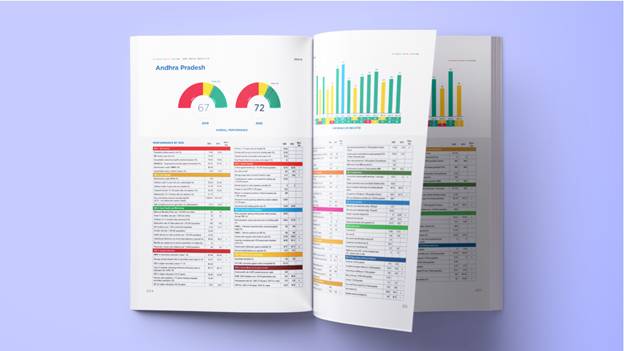
Asection of the SDG India Index report is dedicated to all the 36 Statesand UTs of the country. These State and UT profiles will be very useful for policymakers, scholars and the general public, to analyse the performance on the 115 indicators across all Goals.

Sample of a State/UT profile from the report:
https://static.pib.gov.in/WriteReadData/userfiles/image/image012R6JG.jpg

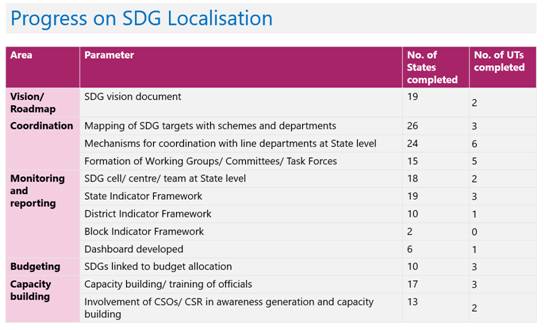
It is followed by a unique section on the progress on SDG localisation in States and Union Territories. It provides an update on the institutional structures, SDG vision documents, State and District Indicator Frameworks and other initiatives taken by the State and UT governments.
https://static.pib.gov.in/WriteReadData/userfiles/image/image013Y892.jpg

The SDG India Index2020–21 is also live on an online dashboard, which has cross-sectoral relevance across policy, civil society, business, and academia. The index is designed to function as a tool for focused policy dialogue, formulation and implementation through development actions,which are pegged to the globally recognisable metric of the SDG framework.The index and dashboard will also facilitate in identifying crucial gaps related to tracking the SDGs and the need for India to develop its statistical systems at the State/UT levels.As another milestone in the SDG localisation journey of the country, the Index is presently being adapted and developed by NITI Aayogat the granular level of districts for the upcoming North Eastern Region District SDG Index.

A snapshot of the SDG India Index 2020–21 dashboard:

https://static.pib.gov.in/WriteReadData/userfiles/image/image014Q7QF.jpg

NITI Aayog has the mandate for coordinating the adoption and monitoring of SDGs at the national and sub-national levels. The SDG India Index and Dashboard represents NITI Aayog’s efforts inencouraging evidence-based policymaking by supporting States and UTs to benchmark their progress, identify the priority areas and share good practices.
https://static.pib.gov.in/WriteReadData/userfiles/image/image015OU5B.jpg

The full SDG India Index report can be accessed here: https://wgz.short.gy/SDGIndiaIndex

The interactive dashboard can be accessed here: http://sdgindiaindex.niti.gov.in/

Topics

Acts Income Tax