Loading...

Top
Help
×

By creating an account you can:

Logo TaxTMI
Call Us / Help / Feedback

Contact Us At :

E-mail: [email protected]

Call / WhatsApp at: +91 99117 96707

For more information, Check Contact Us

FAQs :

To know Frequently Asked Questions, Check FAQs

Most Asked Video Tutorials :

For more tutorials, Check Video Tutorials

Submit Feedback/Suggestion :

Email :
Please provide your email address so we can follow up on your feedback.
Category :
Description :
Min 15 characters 0/2000
Make Most of Text Search
  1. Checkout this video tutorial: How to search effectively on TaxTMI.
  2. Put words in double quotes for exact word search, eg: "income tax"
  3. Avoid noise words such as : 'and, of, the, a'
  4. Sort by Relevance to get the most relevant document.
  5. Press Enter to add multiple terms/multiple phrases, and then click on Search to Search.
  6. Text Search
  7. The system will try to fetch results that contains ALL your words.
  8. Once you add keywords, you'll see a new 'Search In' filter that makes your results even more precise.
  9. Text Search
Add to...
You have not created any category. Kindly create one to bookmark this item!
Create New Category
Hide
Title :
Description :
❮❮ Hide
Default View
Expand ❯❯
Close ✕
🔎 News - Adv. Search
TEXT SEARCH:

Press 'Enter' to add multiple search terms. Rules for Better Search

Search In:
Main Text + AI Text
  • Main Text
  • Main Text + AI Text
  • AI Text
Category: ?
Categorized by AI
---- All Categories ----
  • ---- All Categories ----
  • Income Tax
  • GST
  • Customs, DGFT & SEZ
  • FEMA & RBI
  • Corp. Laws, SEBI & IBC
  • PMLA, Black Money & ED
  • Budget
  • News and Press Release
  • PTI News
Month:
---- All Months ----
  • ---- All Months ----
  • January
  • February
  • March
  • April
  • May
  • June
  • July
  • August
  • September
  • October
  • November
  • December
Year:
---- All Years ----
  • ---- All Years ----
  • 2026
  • 2025
  • 2024
  • 2023
  • 2022
  • 2021
  • 2020
  • 2019
  • 2018
  • 2017
  • 2016
  • 2015
  • 2014
  • 2013
  • 2012
  • 2011
Sort By: ?
In Sort By 'Default', exact matches for text search are shown at the top, followed by the remaining results in their regular order.
Relevance Default Date
    'Gungi gudiya' remark against Sunetra shows Cong's 'ideological bankruptcy': NCP leader Tatkare
    RBI holds interest rates for fourth straight meeting, awaits clearer inflation outlook
    Highlights of RBI's August monetary policy
    RBI targeting polymer currency notes launch in early FY28: Guv Malhotra
    Two women held at Delhi airport with 1 kg gold concealed as silver-coated armlet
    Sensex trades higher, Nifty flat post RBI policy
    India's services sector growth hits four-and-a-half-year low in July on weak demand: PMI
    SC grants interim bail to businessman Anwar Dhebar in manpower commission 'scam' case
    The Taxation and Other Laws Amendment Bill 2026 - Introduced in Lok Sabha on 4th August 2026
    RBI marginally raises FY27 GDP growth projection to 6.7 pc, lowers inflation forecast
    Collaboration, Inclusion and Entrepreneurship: How SIDBI MSME Samvaad Is Shaping the Future of India’s MSME Ecosystem
    RBI keeps policy rate unchanged for third time in row in FY27 amid West Asia crisis
    RBI keeps policy rate unchanged for third time in row amid West Asia crisis
    Markets climb in early trade on falling crude oil prices; RBI monetary policy decision awaited
    Rupee jumps 39 paise to 94.89 against US dollar ahead of RBI monetary policy decision
    Punjab govt committed to paying all valid dues; legal options being examined: FM Cheema
    ED searches multiple locations in Punjab, Chandigarh in PMLA case against PSIEC officials
    Rupee gains 9 paise against US dollar
    India, US working towards interim trade agreement: MEA
    Govt to adopt appropriate measures to mitigate fuel price volatility: MoS Finance
❯❯
Maximize Maximize Maximize
0 / 200
Expand Note
Add to Folder

No Folders have been created

+

Are you sure you want to delete "My most important" ?

NOTE:

News
Showing Results for :
Reset Filters
Results Found:
Show All Summaries Hide All Summaries
August 5, 2026
Show AI Summary
Political restraint in public communications was urged, alongside adherence to principal-speaker protocol during press conferences and media interactions.
Political restraint in public communications was urged after a social-media remark directed at Sunetra Pawar was criticised as ideologically irresponsible. It was stated that regret alone was insufficient and that leaders should exercise care in public comments. Press-conference protocol was also emphasised: the principal dignitary should respond to media questions, and those seated alongside should not participate in the interaction. Party colleagues were expected to act more responsibly in future media engagements.
August 5, 2026
Show AI Summary
Neutral monetary policy stance continues as inflation clarity is awaited, alongside cooperative banking and lending-rate transparency measures.
Monetary policy maintained the benchmark policy repo rate and a neutral stance pending clearer evidence that energy-cost pressures will generate broad-based inflation. Inflation is expected to rise temporarily due principally to food and fuel prices before moderating, while core inflation remains benign. The approach remains data-dependent, supported by two-way liquidity operations. Proposed measures include resuming urban cooperative bank licensing, revising rural cooperative bank credit-monitoring directions, and harmonising interest-rate regulation on advances across regulated entities to improve transparency and consumer protection.
August 5, 2026
Show AI Summary
Repo rate stability preserves the policy stance amid lower inflation projections, stronger growth expectations and external-sector resilience.
Monetary policy maintained the repo rate at 5.25 per cent following a unanimous policy committee decision. The growth forecast for FY27 was marginally increased, while the inflation projection was lowered. Inflation conditions remain uncertain because of monsoon, El Nino and geopolitical developments. Liquidity remained in surplus, and external-sector indicators reflected a current-account surplus, buoyant foreign direct investment inflows, renewed foreign portfolio investment inflows, and adequate foreign-exchange reserves.
August 5, 2026
Show AI Summary
Polymer currency notes target improved durability as monetary policy remains data-dependent and rupee management pursues an orderly trajectory.
Polymer currency notes are targeted for circulation at the beginning of the next financial year, subject to implementation proceeding as planned. They are intended to improve durability, especially for lower-denomination notes with high circulation velocity. Monetary policy decisions will remain data-dependent and focused on aligning headline inflation with its medium-term target. Foreign Currency Non-Resident (Bank) scheme inflows are expected to remain healthy until closure, with no proposal for premature termination. Rupee management aims to maintain an orderly exchange-rate trajectory.
August 5, 2026
Show AI Summary
Customs anti-smuggling enforcement targets gold concealed as silver-coated armlets following passenger profiling and personal search at airport.
Customs officers intercepted two passengers arriving from Istanbul after Advance Passenger Information System profiling and their activation of the Door Frame Metal Detector. A personal search recovered approximately one kilogram of gold, silver-coated and concealed as traditional armlets worn on the upper arms. The gold was seized under the Customs Act, a smuggling case was registered, and investigation was initiated into the source and any wider smuggling network.
August 5, 2026
Show AI Summary
Closing auction price discovery for eligible derivatives shares begins as monetary policy retains the repo rate and neutral stance.
The Reserve Bank retained the repo rate with a neutral stance amid uncertainty over energy prices and supply disruptions. Stock exchanges introduced the Closing Auction Session in the equity cash segment for eligible shares with futures and options contracts. This auction-based mechanism determines closing prices of eligible stocks and aims to make price discovery more transparent and robust.
August 5, 2026
Show AI Summary
Services-sector growth slowed as weaker demand, competition and postponed orders moderated business activity, while employment improved modestly.
Services-sector growth slowed as domestic and export orders moderated amid weaker demand, competitive pressures, softer market conditions and postponed orders. Output continued to expand, but at its weakest pace in more than four years. Employment growth improved modestly, while input costs rose and firms increased selling prices. Business confidence remained positive but declined, and the composite output indicator weakened due principally to the sharp slowdown in services activity.
August 5, 2026
Show AI Summary
Interim bail conditions require residence outside the state and trial attendance in alleged manpower commission corruption proceedings.
Interim bail was granted to Anwar Dhebar in a matter involving alleged corruption and an illegal commission mechanism linked to a state marketing corporation. Conditions require him to remain outside Chhattisgarh, attend the trial court, and provide his residential address. The allegations concern manpower supply agencies allegedly being compelled to pay commissions for clearance of legitimate bills, with proceeds routed through intermediaries. The case was registered under the Indian Penal Code and the Prevention of Corruption Act.
August 5, 2026
Show AI Summary
Tax certainty measures revise fund-management safe harbours, electronic-payment charges, sectoral exemptions, business-trust treatment, and excess expenditure appropriation.
The Taxation and Other Laws (Amendment) Bill, 2026 proposes to replace the Income-tax (Amendment) Ordinance, 2026 and amend payment-system and tax laws. It would prohibit charges on notified electronic payments, revise safe-harbour conditions for eligible investment funds and fund managers, and expand tax exemptions for Government securities, qualifying rough-diamond sales and bonded-warehouse component storage. It also modifies exemptions concerning electronic-goods contract manufacturing, data centres and business-trust dividends, while imposing a differentiated surcharge on qualifying special purpose vehicles. A separately included appropriation bill authorises excess expenditure from the Consolidated Fund of India.
August 5, 2026
Show AI Summary
Growth and inflation projections reflect resilient domestic activity while energy volatility, supply disruptions, and food prices sustain inflation risks.
Monetary policy projections for fiscal 2026-27 revise real GDP growth upward to 6.7 per cent and Consumer Price Index inflation downward to 5 per cent. Domestic activity is described as resilient amid global uncertainty, but inflationary risks persist from rainfall disruption, energy-price volatility, supply-chain uncertainty, and second-round effects of higher food, fuel and input costs. Core inflation is projected at 4.3 per cent for the fiscal year.
August 5, 2026
Show AI Summary
Industry collaboration strengthens MSME competitiveness through shared resources, market linkages, capability building and inclusive support for women entrepreneurs.
MSME development is linked to collaboration, knowledge-sharing, institutional support and capability building. Industry associations can provide networking, policy advocacy, business intelligence, skills programmes, shared infrastructure and market linkages, while collective procurement, shared logistics, digital commerce and export readiness may improve competitiveness. Women-led enterprises benefit from market-oriented capability development, mentorship, continuous learning, professional networks, capacity-building programmes and institutional support. The Development of Industry Associations initiative is intended to connect associations and facilitate the sharing of best practices.
August 5, 2026
Show AI Summary
Monetary policy rate maintenance continues under a neutral stance amid energy disruption, inflation concerns and sustained currency depreciation.
Monetary policy rate maintenance was continued with the repo rate retained at 5.25 per cent under a neutral stance amid uncertainty over energy prices and supply disruptions associated with the West Asia crisis. The growth forecast was marginally increased and the inflation projection reduced. Sustained rupee depreciation against the dollar was attributed to costly oil, capital outflows, widening trade deficits and a strong US dollar.
August 5, 2026
Show AI Summary
Monetary policy rate pause maintains a neutral stance amid energy disruption, inflation concerns and sustained rupee depreciation pressures.
Monetary policy rates were retained without change for a third consecutive review, with a neutral stance maintained amid uncertainty over energy prices and supply disruptions associated with the West Asia crisis. The policy assessment noted retail inflation above the medium-term target, alongside an upward revision to growth expectations and a downward revision to the inflation projection. Continued rupee depreciation was linked to higher oil prices, capital outflows, widening trade deficits and a stronger US dollar.
August 5, 2026
Show AI Summary
Monetary policy expectations shape equity sentiment as softer crude prices and foreign investment support domestic financial assets.
Equity market sentiment improved in early trading as lower crude oil prices and foreign fund inflows supported benchmark indices, while investors awaited the monetary policy decision. Softer crude prices, rupee recovery, improving global risk sentiment, resilient economic growth, corporate earnings and sustained foreign portfolio investment supported domestic financial assets, despite continuing global and geopolitical uncertainties.
August 5, 2026
Show AI Summary
Foreign exchange market movement strengthens as lower crude prices and monetary policy signals influence the rupee's direction.
Foreign exchange market movement saw the rupee appreciate against the US dollar in early trading, supported by lower crude oil prices, a softer dollar index, domestic equity gains and net foreign institutional investment. Market attention centred on the Reserve Bank of India's monetary policy decision, with expectations of an unchanged benchmark repo rate. Policy communication on inflation and developments in Hormuz-related talks were identified as factors that could influence the rupee's direction.
August 4, 2026
Show AI Summary
Dearness allowance arrears must be cleared promptly, while the government examines legal remedies and continues its structured liquidation plan.
Pending dearness allowance arrears of government employees and pensioners are to be cleared within a fortnight, with restraint on unproductive expenditure until admissible dues are paid. The government states that it will pay constitutionally and legally valid dues while examining the judgment, precedents and possible legal remedies. It attributes the arrears to delayed pay commission implementation and frozen dearness allowance, and states that a structured liquidation plan has been prepared and partly implemented.
August 4, 2026
Show AI Summary
Money-laundering investigation examines alleged fraudulent industrial plot allotments, benami holdings and diversion of plots to residential use.
A money-laundering investigation under the Prevention of Money Laundering Act examines alleged irregularities in industrial-plot allotments involving corporation officials, private persons, property dealers and alleged benamidars. The inquiry concerns alleged use of fictitious firms and false addresses to obtain plots, allotments to relatives and associates, and alleged diversion or change of land use from industrial to residential purposes. These activities are alleged to have generated private gains while causing loss to the public exchequer.
August 4, 2026
Show AI Summary
Rupee exchange-rate movement gains support from capital inflows, while oil prices, dollar strength and monetary policy shape sentiment.
Rupee exchange-rate movement was supported by foreign capital inflows and improved global risk sentiment, while elevated crude-oil prices and a stronger US dollar constrained gains. Market attention shifted to monetary policy, overseas dollar-deposit incentives and easier foreign access to government bonds, which were reported to support capital inflows and India's external position. A cautious approach to the benchmark repo rate was expected amid assessment of the West Asia conflict.
August 4, 2026
Show AI Summary
Interim bilateral trade agreement negotiations continue as both sides work to finalise unresolved issues in the proposed arrangement.
Interim bilateral trade agreement negotiations between India and the United States are continuing. Both sides have undertaken substantial work, while certain issues remain to be finalised before completion of the proposed interim trade arrangement. A United States Trade Representative delegation visited India to advance discussions. The text records the status of negotiations and identifies no concluded agreement or operative customs measure.
August 4, 2026
Show AI Summary
Fuel-price volatility mitigation will combine fiscal measures, consumer protection, energy security and fiscal sustainability during external energy shocks.
Fuel-price volatility is to be mitigated through fiscal and administrative measures that protect consumers while maintaining fiscal sustainability. The approach includes monitoring revenue and expenditure, reprioritising spending, and using fiscal measures when economic conditions require. Reduced central excise duty on petrol and diesel moderated the impact of elevated international crude prices and partly offset under-recoveries of public-sector oil marketing companies. Longer-term measures include revenue mobilisation, import diversification, Strategic Petroleum Reserves, cleaner fuels and energy efficiency.

News

Back

All News

Showing Results for :
Reset Filters
No Records Found

News

Back

All News

Showing Results for : Reset Filters
News and Press Release

NITI Aayog Releases SDG India Index and Dashboard 2020–21

June 3, 2021

Contents
Summary
Note

Note

-

Bookmark

Print

Print

The third edition of the SDG India Index and Dashboard 2020–21 was released by NITI Aayog today. Since its inaugural launch in 2018, the index has been comprehensively documenting and ranking the progress made by States and Union Territories towards achieving the Sustainable Development Goals. Now in its third year, the index has become the primary tool for monitoring progress on the SDGs in the country and has simultaneously fostered competition among the States and Union Territories.

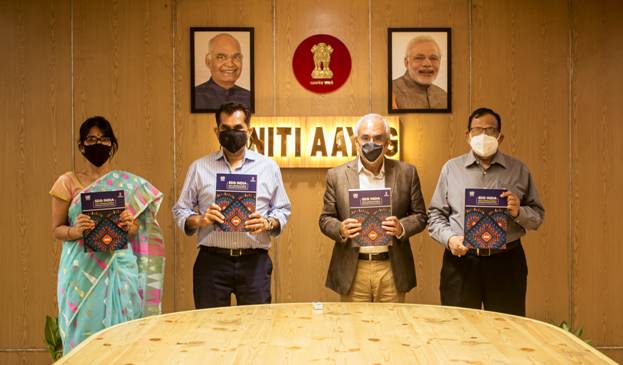
NITI  Aayog Vice Chairperson Dr Rajiv Kumar launched the report titled,SDG India Index and Dashboard 2020–21: Partnerships in the Decade of Action, in the presence of Dr Vinod Paul, Member (Health), NITI Aayog, Shri Amitabh Kant, CEO, NITI Aayog, and Ms.Sanyukta Samaddar,Adviser (SDGs), NITI Aayog. Designed and developed by NITI Aayog, the preparation of the index followed extensive consultations with the primary stakeholders-the States and Union Territories; the UN agencies led by United Nations in India;Ministry of Statistics and Programme Implementation (MoSPI), and the key Union Ministries.

“Our effort of monitoring SDGs through the SDG India Index & Dashboard continues to be widely noticed and applauded around the world. It remains a rare data-driven initiative to rank our States and Union Territories by computing a composite index on the SDGs. We are confident that it will remain a matter of aspiration and emulation and help propel monitoring efforts at the international level,”Dr. Rajiv Kumar, Vice Chairman, NITI Aayog said during the launch.

With one-third of the journey towards achieving the 2030 Agenda behind us, this edition of the index report focuses on the significance of partnerships as its theme. Shri Amitabh Kant, CEO, NITI Aayog said, “The report reflects on the partnerships we have built and strengthened during our SDG efforts. The narrative throws light on how collaborative initiatives can result in better outcomes and greater impacts.”

On thetheme of partnerships which is central to Goal 17, Dr. Vinod Paul, Member (Health), NITI Aayog, said,“It is clear that by working togetherwe can build a more resilient and sustainable future, where no one is left behind.”

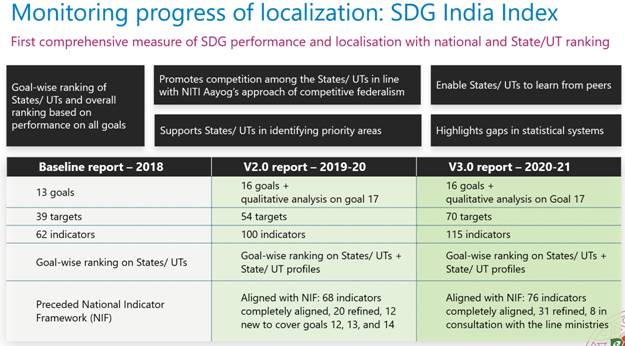
“From covering 13 Goals with 62 indicators in its first edition in 2018, the third edition covers 16 Goals on 115 quantitative indicators, with a qualitative assessment on Goal 17, thereby reflecting our continuous efforts towards refining this important tool,” said Ms. Sanyukta Samaddar, Adviser (SDGs), NITI Aayog.

NITI Aayog has the twin mandate to oversee the adoption and monitoring of the SDGs in the country, and also promote competitive and cooperative federalism among States and UTs. The index represents the articulation of the comprehensive nature of the Global Goals under the 2030 Agenda while being attuned to the national priorities. The modular nature of the index has become a policy tool and a ready reckoner for gauging progress of States and UTs on the expansive nature of the Goals, including health, education, gender, economic growth, institutions, climate change and environment.
https://static.pib.gov.in/WriteReadData/userfiles/image/image001MLG2.jpg

From right to left: Dr Vinod Paul, Member (Health);Dr Rajiv Kumar,Vice Chairperson; Shri Amitabh Kant, CEO; and Ms. Sanyukta Samaddar, Adviser (SDGs), NITI Aayog

SDG India Index andDashboard 2020–21: An Introduction to the Third Edition

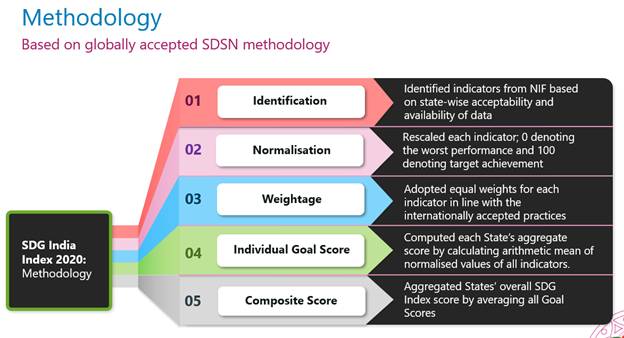
The SDG India Index 2020–21, developed in collaboration with the United Nations in India, tracks progress of all States and UTs on 115 indicators that are aligned to MoSPI’s National Indicator Framework (NIF). The initiative to refine and improve this important tool with each edition has been steered by the need to continuously benchmark performance and measure progress, and to account for the availability of latest SDG-related data on States and UTs. The process of selecting these 115 indicators included multiple consultations with Union Ministries. Feedback was sought from all States and UTs and as the essential stakeholder and audience of this localisation tool, they played a crucial role in shaping the index by enriching the feedback process with localised insights and experience from the ground.

The SDG India Index 2020–21 is more robust than the previous editions on account of wider coverage of targets and indicators with greater alignment with the NIF.The 115 indicators incorporate16 out of 17 SDGs, with a qualitative assessment on Goal 17,andcover 70 SDG targets. This is an improvement over the 2018–19 and 2019–20 editions of the index, which had utilised 62 indicators across 39 targets and 13 Goals, and 100 indicators across 54 targets and 16 Goals, respectively. 
https://static.pib.gov.in/WriteReadData/userfiles/image/image002V4Z4.jpg

The SDG India Index computes goal-wise scores on the 16 SDGs for each State and Union Territory. Overall State and UT scores are generated from goal-wise scores to measure aggregate performance of the sub-national unit based on its performance across the 16 SDGs. These scores range between 0–100, and if a State/UT achieves a score of 100, it signifies it has achieved the 2030 targets. The higher the score of a State/UT, the greater the distance to target achieved.

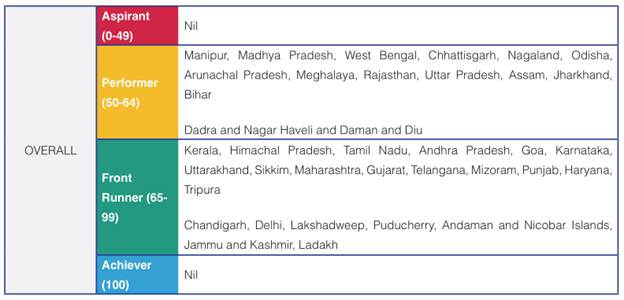
States and Union Territories are classified as below based on their SDG India Index score:
  • Aspirant: 0–49
  • Performer: 50–64
  • Front-Runner: 65–99
  • Achiever: 100


https://static.pib.gov.in/WriteReadData/userfiles/image/image003VG71.jpg


Overall Results and Findings

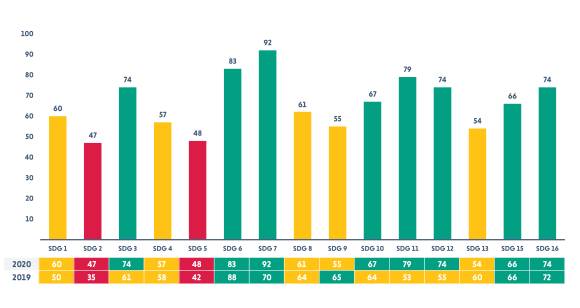
The country’s overall SDG score improved by 6 points-from 60 in 2019 to 66 in 2020–21. This positive stride towards achieving the targets is largely driven by exemplary country-wide performance in Goal 6 (Clean Water and Sanitation) and Goal 7(Affordable and Clean Energy), where the composite Goal scoresare 83 and 92, respectively.

Goal-wise India results, 2019–20 and 2020–21:
https://static.pib.gov.in/WriteReadData/userfiles/image/image004HSF4.jpg

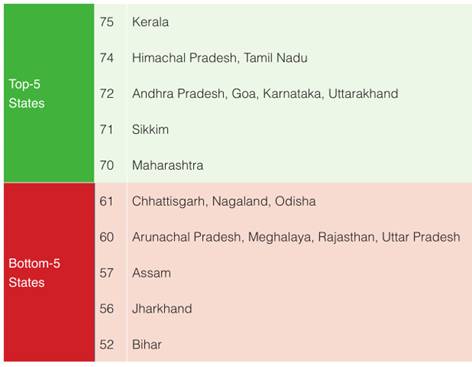
The top-fiveand bottom-fiveStates in SDG India Index 2020–21:
https://static.pib.gov.in/WriteReadData/userfiles/image/image005FTTM.jpg

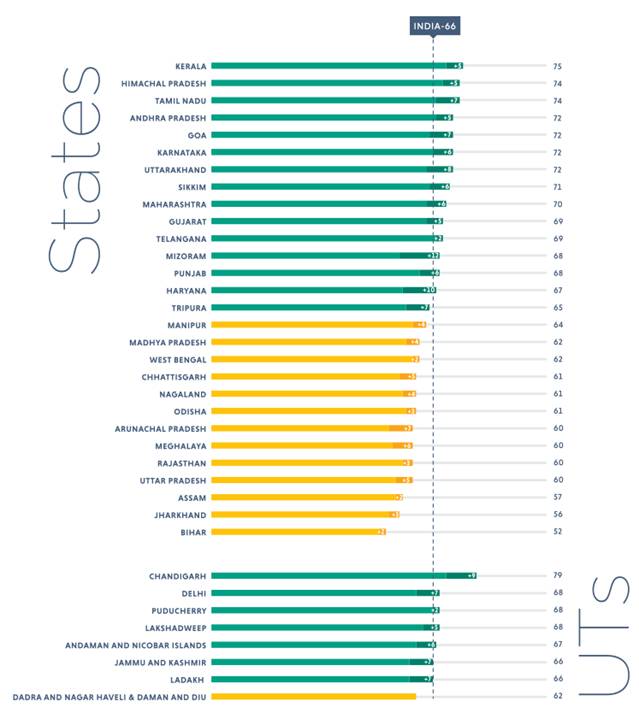
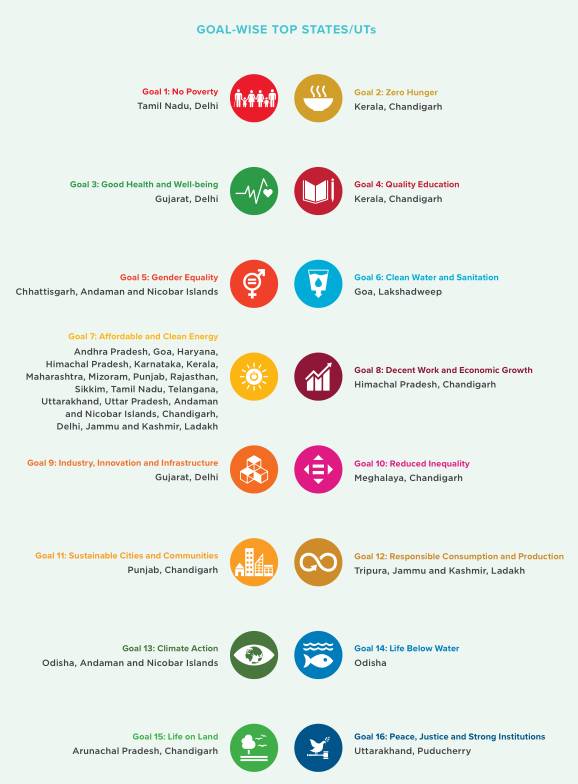
Performance and Ranking of States and UTs on SDGs 2020–21, including change in score from last year:
https://static.pib.gov.in/WriteReadData/userfiles/image/image006JTWS.jpg

https://static.pib.gov.in/WriteReadData/userfiles/image/image007XM1X.jpg

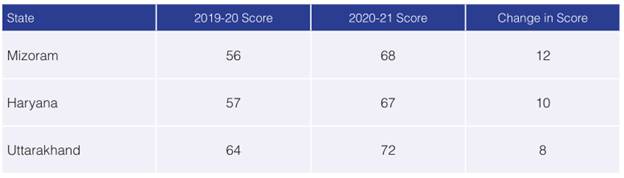
Mizoram, Haryana, and Uttarakhand are the top gainers in 2020–21in terms of improvement in score from 2019, with an increase of 12, 10 and 8 points, respectively.

Top Fast-Moving States (Score-Wise):
 

https://static.pib.gov.in/WriteReadData/userfiles/image/image0082BPP.jpg

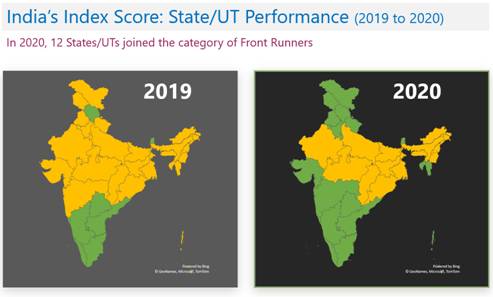
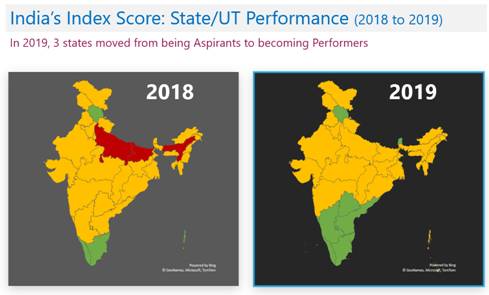
While in 2019, ten States/UTs belonged to the category of Front-Runners (score in the range 65–99, including both) twelve more States/UTs find themselves in this category in 2020–21. Uttarakhand, Gujarat, Maharashtra, Mizoram, Punjab, Haryana, Tripura, Delhi, Lakshadweep, Andaman and Nicobar Islands, Jammu and Kashmir and Ladakh graduated to the category of Front-Runners (scores between 65 and 99, including both).
https://static.pib.gov.in/WriteReadData/userfiles/image/image009CVDV.jpg

https://static.pib.gov.in/WriteReadData/userfiles/image/image0105R60.jpghttps://static.pib.gov.in/WriteReadData/userfiles/image/image011PHAO.jpg

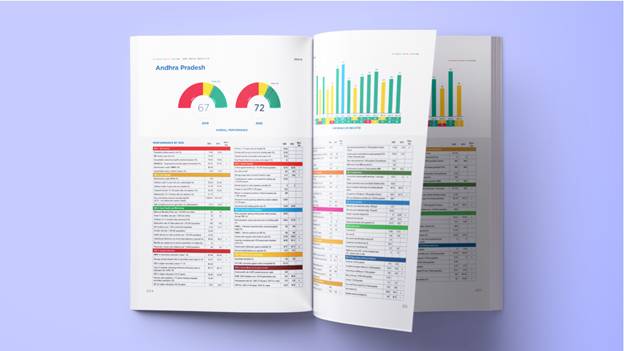
Asection of the SDG India Index report is dedicated to all the 36 Statesand UTs of the country. These State and UT profiles will be very useful for policymakers, scholars and the general public, to analyse the performance on the 115 indicators across all Goals.

Sample of a State/UT profile from the report:
https://static.pib.gov.in/WriteReadData/userfiles/image/image012R6JG.jpg

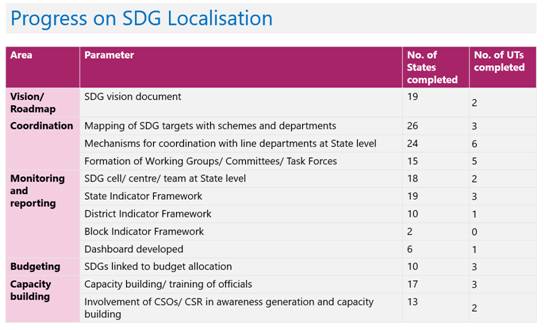
It is followed by a unique section on the progress on SDG localisation in States and Union Territories. It provides an update on the institutional structures, SDG vision documents, State and District Indicator Frameworks and other initiatives taken by the State and UT governments.
https://static.pib.gov.in/WriteReadData/userfiles/image/image013Y892.jpg

The SDG India Index2020–21 is also live on an online dashboard, which has cross-sectoral relevance across policy, civil society, business, and academia. The index is designed to function as a tool for focused policy dialogue, formulation and implementation through development actions,which are pegged to the globally recognisable metric of the SDG framework.The index and dashboard will also facilitate in identifying crucial gaps related to tracking the SDGs and the need for India to develop its statistical systems at the State/UT levels.As another milestone in the SDG localisation journey of the country, the Index is presently being adapted and developed by NITI Aayogat the granular level of districts for the upcoming North Eastern Region District SDG Index.

A snapshot of the SDG India Index 2020–21 dashboard:

https://static.pib.gov.in/WriteReadData/userfiles/image/image014Q7QF.jpg

NITI Aayog has the mandate for coordinating the adoption and monitoring of SDGs at the national and sub-national levels. The SDG India Index and Dashboard represents NITI Aayog’s efforts inencouraging evidence-based policymaking by supporting States and UTs to benchmark their progress, identify the priority areas and share good practices.
https://static.pib.gov.in/WriteReadData/userfiles/image/image015OU5B.jpg

The full SDG India Index report can be accessed here: https://wgz.short.gy/SDGIndiaIndex

The interactive dashboard can be accessed here: http://sdgindiaindex.niti.gov.in/

Topics

Acts Income Tax