Loading...

Top
Help
×

By creating an account you can:

Logo TaxTMI
Call Us / Help / Feedback

Contact Us At :

E-mail: [email protected]

Call / WhatsApp at: +91 99117 96707

For more information, Check Contact Us

FAQs :

To know Frequently Asked Questions, Check FAQs

Most Asked Video Tutorials :

For more tutorials, Check Video Tutorials

Submit Feedback/Suggestion :

Email :
Please provide your email address so we can follow up on your feedback.
Category :
Description :
Min 15 characters 0/2000
Make Most of Text Search
  1. Checkout this video tutorial: How to search effectively on TaxTMI.
  2. Put words in double quotes for exact word search, eg: "income tax"
  3. Avoid noise words such as : 'and, of, the, a'
  4. Sort by Relevance to get the most relevant document.
  5. Press Enter to add multiple terms/multiple phrases, and then click on Search to Search.
  6. Text Search
  7. The system will try to fetch results that contains ALL your words.
  8. Once you add keywords, you'll see a new 'Search In' filter that makes your results even more precise.
  9. Text Search
Add to...
You have not created any category. Kindly create one to bookmark this item!
Create New Category
Hide
Title :
Description :
❮❮ Hide
Default View
Expand ❯❯
Close ✕
🔎 News - Adv. Search
TEXT SEARCH:

Press 'Enter' to add multiple search terms. Rules for Better Search

Search In:
Main Text + AI Text
  • Main Text
  • Main Text + AI Text
  • AI Text
Category: ?
Categorized by AI
---- All Categories ----
  • ---- All Categories ----
  • Income Tax
  • GST
  • Customs, DGFT & SEZ
  • FEMA & RBI
  • Corp. Laws, SEBI & IBC
  • PMLA, Black Money & ED
  • Budget
  • News and Press Release
  • PTI News
Month:
---- All Months ----
  • ---- All Months ----
  • January
  • February
  • March
  • April
  • May
  • June
  • July
  • August
  • September
  • October
  • November
  • December
Year:
---- All Years ----
  • ---- All Years ----
  • 2026
  • 2025
  • 2024
  • 2023
  • 2022
  • 2021
  • 2020
  • 2019
  • 2018
  • 2017
  • 2016
  • 2015
  • 2014
  • 2013
  • 2012
  • 2011
Sort By: ?
In Sort By 'Default', exact matches for text search are shown at the top, followed by the remaining results in their regular order.
Relevance Default Date
    Korea Industry Expo (KoINDEX) 2026 Opens at Yashobhoomi on 27 August
    Protection in predicate offence doesn't automatically extend to PMLA case: Delhi HC
    DFS Concludes Two-Day Workshop on Enhancing Accessibility of Financial Services for Divyangjans
    National Financial Reporting Authority (NFRA) conducts sixth outreach programmes with focus on small and medium auditors under the theme “Creating a...
    CCI imposes monetary and non-monetary sanctions on Agro Input Dealers Association, Agro Input Welfare Association for indulging in anti-competitive co...
    India-Finland cooperation takes centre stage at circular economy forum
    CCI imposes penalty on Rekha Agencies and SS Marketing for indulging in anti-competitive conduct in respect of Himachal Pradesh Tender 2013 for the pr...
    US is set to impose 50% tariffs on $20 billion worth of Canadian products
    Rupee settles 3 paise higher at 95.71 against US dollar
    29 FDI Investments Worth ₹4,895.65 Crore Reported Under Revised Framework
    India and ADB sign $230 million loan to modernise water supply and sanitation in Chennai
    DGGI unearths clandestine pan masala and tobacco manufacturing network in Uttar Pradesh; 27 undeclared pouch-packing machines seized, evasion of about...
    Mission SAKSHAM: Scaling Capability through Co-operation - Keynote Address by Shri Swaminathan J, Deputy Governor at Mission SAKSHAM Programme for Dir...
    India’s Foreign Exchange Markets: Getting ready for the next Decade [Keynote Address delivered by Deputy Governor Shri Rohit Jain on the Annual Day ...
    Govt rejects ethanol link to sugar price surge, says duty free imports allowed to curb prices
    China moves to wrap up saga of troubled property giant Evergrande after founder gets life sentence
    India's forex kitty swells USD 9.9 bn to USD 716.9 bn
    Bengaluru airport: AERA slashes user development fee to Rs 300 for domestic passengers
    NUMR Inc. helps deliver Axis Bank's data-driven excellence in customer experience
    ED can't add old FIR to Enforcement Case Information Report to sustain PMLA proceedings: Delhi HC
❯❯
Maximize Maximize Maximize
0 / 200
Expand Note
Add to Folder

No Folders have been created

+

Are you sure you want to delete "My most important" ?

NOTE:

News
Showing Results for :
Reset Filters
Results Found:
Show All Summaries Hide All Summaries
August 22, 2026
Show AI Summary
Trade exhibition connects Korean exporters with Indian buyers through sector-specific consultations and certification guidance for market entry.
KoINDEX 2026 is a business-to-business trade exhibition bringing Korean manufacturers and exporters together with buyers in India and South Asia. It focuses on beauty and personal-care products, processed and functional foods, and construction, building and safety products. Commercial engagement includes pre-matched export consultations with project owners, contractors, distributors, wholesalers, e-commerce platforms and food distribution businesses. A seminar addresses Bureau of Indian Standards certification and market-entry requirements for Korean products entering the Indian market.
August 22, 2026
Show AI Summary
Independent PMLA proceedings require separate anticipatory bail assessment; predicate-offence protection alone cannot establish pre-arrest protection.
Protection in a predicate-offence FIR does not automatically extend to independent PMLA proceedings. Anticipatory bail in a money-laundering investigation must be assessed under the applicable PMLA condition and on the material connecting the applicant to alleged proceeds of crime. Relevant considerations include the financial trail, recorded statements, bank-account analysis, compliance with summonses, cooperation with inquiry, and the need for personal participation in evidence collection and confrontation with documentary and digital material.
August 22, 2026
Show AI Summary
Financial accessibility for Divyangjans requires compliance standards, practical implementation measures and stronger institutional capacity across financial services.
Accessibility of financial services for Divyangjans was examined through a workshop focused on public sector banks, insurance companies, regulators and public financial institutions. Discussions covered accessibility standards, compliance requirements, legal provisions, practical implementation challenges and institutional best practices under the Sugamya Bharat initiative. Participants considered operational measures to strengthen institutional capacity, inclusivity and equitable access to financial services.
August 22, 2026
Show AI Summary
Audit quality enhancement for small and medium auditors emphasises technology, global standards, inspection insights and stronger financial reporting.
Audit quality and financial reporting reliability were the focus of NFRA's outreach programme for small and medium audit firms. The programme promoted professional capacity-building, alignment with contemporary global standards, adoption of appropriate audit technology, and the public-interest role of the accountancy profession. Technical sessions covered audit strategy documentation, risks of material misstatement, and practical lessons from audit-firm oversight to support improved day-to-day audit practice and high-quality financial reporting.
August 22, 2026
Show AI Summary
Cartelisation by agro-input dealer associations attracted monetary sanctions, cease-and-desist directions, and mandatory competition-compliance training for responsible officials.
Cartelisation by the two agro-input dealer associations and named individuals contravened Section 3(3)(b) read with Section 3(1) of the Competition Act, 2002. Monetary sanctions were imposed, and association office-bearers were held liable under Section 48. The parties and liable officials were directed to cease and desist from future anti-competitive conduct and to organise competition-compliance training to promote awareness and compliance within the associations.
August 22, 2026
Show AI Summary
Circular economy partnerships promote resilient value chains, resource efficiency and sustainable growth alongside evolving India-EU trade integration.
India-Finland circular economy cooperation is being developed through business, technology, investment and commercial partnerships supporting resource-efficient and sustainable growth. Discussions focused on competitive and resilient value chains based on circularity, traceability, resource efficiency and sustainable business practices. Circular economy principles extend beyond waste management into product design, value chains, resource use, skills development and new business models. The India-EU free trade agreement remains subject to legal review and formal ratification and is not yet in force.
August 22, 2026
Show AI Summary
Bid rigging through pre-bid exchange of sensitive price information attracted penalties and cease-and-desist directions in tyre procurement.
Bid rigging in tyre procurement was established where Rekha Agencies and SS Marketing exchanged commercially sensitive price-bid information before submitting bids for the Himachal Pradesh Tender 2013. The concerted conduct contravened the prohibition on anti-competitive agreements and bid rigging. Monetary penalties and cease-and-desist directions were imposed on both enterprises. An official of Rekha Agencies was also penalised for liability arising from the contravention, while proceedings against the official of SS Marketing stood abated following his death.
August 22, 2026
Show AI Summary
Import tariffs on Canadian products trigger potential retaliatory levies after bilateral negotiations fail to reach agreement.
Import tariffs on Canadian products are set to be imposed by the United States at a 50% rate after bilateral negotiations did not produce an agreement. The measures cover products including hockey sticks and tongue depressors and affect a limited share of Canada's annual exports to the United States. Canada has indicated possible retaliatory levies, intensifying the bilateral trade dispute.
August 21, 2026
Show AI Summary
Rupee exchange-rate movement reflected geopolitical tensions, crude oil conditions and market intervention, while export payment rules expanded rupee invoicing.
Foreign Trade Policy amendments facilitate export invoicing and receipt of payments in Indian rupees. For exports to countries outside the Asian Clearing Union, export contracts and invoices may be denominated in Indian rupees or any foreign currency. The earlier general requirement that export earnings be received in a freely convertible currency is thereby eased, while applicable rules continue to vary according to destination.
August 21, 2026
Show AI Summary
Non-controlling land-bordering country ownership permits eligible foreign investment through the automatic route, subject to sectoral conditions and reporting.
Foreign direct investment may use the automatic route where non-controlling beneficial ownership from a land-bordering country in the investor entity does not exceed 10%, subject to sectoral caps, entry routes and other applicable conditions. The beneficial ownership test applies at the investor-entity level. Eligible investors need not obtain separate prior Government approval after reporting relevant information to the Government. The framework replaces the earlier approval requirement applicable even to minimal beneficial ownership from land-bordering countries.
August 21, 2026
Show AI Summary
Climate-resilient urban water security modernises Chennai's supply and sanitation systems through ring-main infrastructure, digital monitoring, and safer sewer operations.
Chennai Climate-Resilient Water Security and Sewerage Project modernises and expands water supply and sanitation infrastructure through a loan arrangement between the Government of India and the Asian Development Bank. Measures include new pipelines, upgraded pumping stations, performance-based utility operations, and a comprehensive ring-main system to improve water-pressure balance, distribution efficiency, reliability and climate resilience. Digital monitoring and advanced blockage-detection technology are intended to improve operational decisions, customer responsiveness and worker safety while eliminating hazardous manual sewer inspections.
August 21, 2026
Show AI Summary
Capacity-based taxation targets undeclared pouch-packing machinery used for clandestine pan masala and tobacco production and untaxed clearances.
Capacity-based taxation of pan masala and specified tobacco products is determined by the number, type and capacity of installed pouch-packing machines. Searches at interconnected manufacturing and trading premises detected unregistered operations using undeclared machinery for clandestine manufacture and clearance of pan masala, scented jarda and gutkha without payment of GST, HSNS cess and central excise duty. Finished goods, raw materials, packing materials and machinery were seized. The manufacturing firm's proprietor was prima facie identified as managing the operation and was arrested under the applicable cess and central excise laws.
August 21, 2026
Show AI Summary
Technology risk oversight requires Urban Co-operative Banks to retain accountability while building shared and role-specific capabilities.
Urban Co-operative Banks must strengthen digital and risk-management capabilities as technology dependence exposes them to cyber threats, fraud, service-provider failures and common-platform vulnerabilities. Outsourcing critical systems does not transfer the bank's responsibility for oversight, safeguards and continuity. Boards and senior management must retain sufficient knowledge to supervise external providers effectively. Mission SAKSHAM supports role-specific, continuous capability building through physical and online learning, while collective infrastructure and shared expertise can supplement individual institutional capacity.
August 21, 2026
Show AI Summary
Foreign exchange market modernisation prioritises delegated decisions, customer transparency, digital workflows, local-currency settlement and accountable risk management.
Foreign exchange market modernisation advances a facilitative, principles-based framework based on delegated decision-making by Authorised Dealers, risk-based reporting, and customer-centric service standards. Authorised Dealers must apply clear internal policies, avoid unnecessary documentation, disclose charges, timelines and grievance mechanisms, and ensure consistent treatment of comparable transactions. Local-currency settlement requires viable trade corridors, competitive hedging, correspondent relationships and robust AML/CFT controls. Digital workflows, electronic trading and reporting infrastructure should improve transparency and resilience, while automated tools remain subject to explainability, review and data-protection safeguards.
August 21, 2026
Show AI Summary
Sugar price containment measures restrict stockholding, permit duty-free imports, and strengthen inventory verification to deter hoarding.
Sugar price containment measures include stock limits for dealers, consumption-based inventory restrictions for bulk consumers, duty-free raw sugar imports, and physical verification of mill stocks to prevent hoarding and artificial scarcity. Price increases are attributed to lower domestic output, festive demand, crop damage, tighter global supplies, and speculation rather than sugar diversion for ethanol. Earlier crushing is advised to improve seasonal availability, while the ethanol programme supports management of sugar surpluses, mill liquidity, and timely sugarcane payments.
August 21, 2026
Show AI Summary
Cross-border insolvency enforcement constrains asset recovery as Evergrande liquidation, founder asset confiscation, and audit-related claims continue.
Evergrande's insolvency process involves liquidation proceedings for its mainland property-development unit and its Hong Kong-listed holding company. Cross-border recovery is constrained by separate Hong Kong and mainland China legal systems, particularly because most operational assets are located in mainland China. Liquidators are pursuing asset-tracing and recovery measures against the founder and connected persons, as well as claims concerning pre-collapse audits. Investigations identified revenue overstatement through manipulated financial data. Creditor recoveries are expected to be limited due to substantial liabilities and constraints on asset realisation.
August 21, 2026
Show AI Summary
Foreign exchange reserves rose through higher currency assets and gold holdings amid measures to attract external forex inflows.
India's foreign exchange reserves increased during the reporting week, led by higher foreign currency assets and gold reserves. Foreign currency assets include the dollar-value effects of movements in non-US currencies held as reserves. Special drawing rights declined marginally, while the reserve position with the International Monetary Fund increased marginally. Concessional swap arrangements formed part of measures to attract foreign-exchange inflows, while earlier reserve movements were linked to rupee pressure and dollar-sale intervention in the foreign-exchange market.
August 21, 2026
Show AI Summary
Incremental tariff recovery aligns airport user charges with completed infrastructure, preventing passengers from funding non-operational capital projects prematurely.
User development fees and airport tariffs for Bengaluru International Airport have been revised for the April 2026 to March 2031 control period. The incremental Average Revenue Requirement framework excludes costs of identified high-value capital projects from tariffs until the relevant assets are completed, commissioned and available for users. Incremental tariff recovery may begin only upon operational availability, aligning charges with infrastructure use, reducing premature recovery risk for passengers and airlines, and encouraging timely completion of major capital works.
August 21, 2026
Show AI Summary
Customer experience analytics enables banks to convert real-time feedback into operational improvements across high-value customer journeys.
Customer experience analytics is used in banking to transform customer data and real-time feedback into operational improvements across key customer journeys. Operational teams retain responsibility for strategy and execution, supported by in-house analytics and technology platforms for multi-channel journey mapping, journey analytics and prioritisation of high-value customer segments. AI-driven customer experience management tools capture customer signals, analyse journey performance and operationalise actionable insights across teams.
August 21, 2026
Show AI Summary
Predicate-offence dependency limits retrospective addition of old FIRs to preserve money-laundering proceedings after the original scheduled offence is closed.
Predicate-offence dependency under the Prevention of Money Laundering Act requires an ECIR to rest on a subsisting scheduled offence. Closure of the FIR forming its basis through an accepted cancellation report prevents continuation of money-laundering proceedings unless that closure is overturned. A previously registered FIR cannot be belatedly added merely to preserve an existing ECIR and coercive powers. Where statutory requirements are met, an independently registered ECIR may be required. Expansion of an ECIR cannot rest solely on tenuous factual links between successive disputes.

News

Back

All News

Showing Results for :
Reset Filters
No Records Found

News

Back

All News

Showing Results for : Reset Filters
News and Press Release

NITI Aayog Releases SDG India Index and Dashboard 2020–21

June 3, 2021

Contents
Summary
Note

Note

-

Bookmark

Print

Print

The third edition of the SDG India Index and Dashboard 2020–21 was released by NITI Aayog today. Since its inaugural launch in 2018, the index has been comprehensively documenting and ranking the progress made by States and Union Territories towards achieving the Sustainable Development Goals. Now in its third year, the index has become the primary tool for monitoring progress on the SDGs in the country and has simultaneously fostered competition among the States and Union Territories.

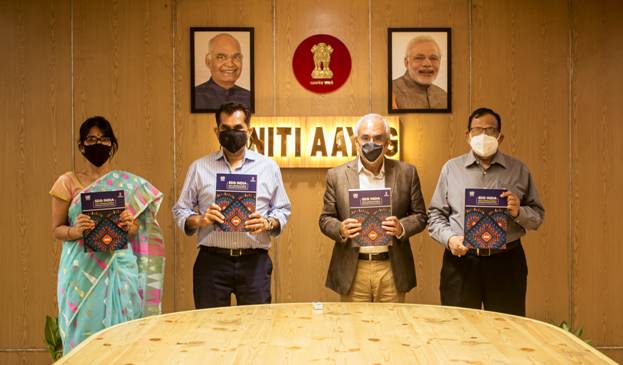
NITI  Aayog Vice Chairperson Dr Rajiv Kumar launched the report titled,SDG India Index and Dashboard 2020–21: Partnerships in the Decade of Action, in the presence of Dr Vinod Paul, Member (Health), NITI Aayog, Shri Amitabh Kant, CEO, NITI Aayog, and Ms.Sanyukta Samaddar,Adviser (SDGs), NITI Aayog. Designed and developed by NITI Aayog, the preparation of the index followed extensive consultations with the primary stakeholders-the States and Union Territories; the UN agencies led by United Nations in India;Ministry of Statistics and Programme Implementation (MoSPI), and the key Union Ministries.

“Our effort of monitoring SDGs through the SDG India Index & Dashboard continues to be widely noticed and applauded around the world. It remains a rare data-driven initiative to rank our States and Union Territories by computing a composite index on the SDGs. We are confident that it will remain a matter of aspiration and emulation and help propel monitoring efforts at the international level,”Dr. Rajiv Kumar, Vice Chairman, NITI Aayog said during the launch.

With one-third of the journey towards achieving the 2030 Agenda behind us, this edition of the index report focuses on the significance of partnerships as its theme. Shri Amitabh Kant, CEO, NITI Aayog said, “The report reflects on the partnerships we have built and strengthened during our SDG efforts. The narrative throws light on how collaborative initiatives can result in better outcomes and greater impacts.”

On thetheme of partnerships which is central to Goal 17, Dr. Vinod Paul, Member (Health), NITI Aayog, said,“It is clear that by working togetherwe can build a more resilient and sustainable future, where no one is left behind.”

“From covering 13 Goals with 62 indicators in its first edition in 2018, the third edition covers 16 Goals on 115 quantitative indicators, with a qualitative assessment on Goal 17, thereby reflecting our continuous efforts towards refining this important tool,” said Ms. Sanyukta Samaddar, Adviser (SDGs), NITI Aayog.

NITI Aayog has the twin mandate to oversee the adoption and monitoring of the SDGs in the country, and also promote competitive and cooperative federalism among States and UTs. The index represents the articulation of the comprehensive nature of the Global Goals under the 2030 Agenda while being attuned to the national priorities. The modular nature of the index has become a policy tool and a ready reckoner for gauging progress of States and UTs on the expansive nature of the Goals, including health, education, gender, economic growth, institutions, climate change and environment.
https://static.pib.gov.in/WriteReadData/userfiles/image/image001MLG2.jpg

From right to left: Dr Vinod Paul, Member (Health);Dr Rajiv Kumar,Vice Chairperson; Shri Amitabh Kant, CEO; and Ms. Sanyukta Samaddar, Adviser (SDGs), NITI Aayog

SDG India Index andDashboard 2020–21: An Introduction to the Third Edition

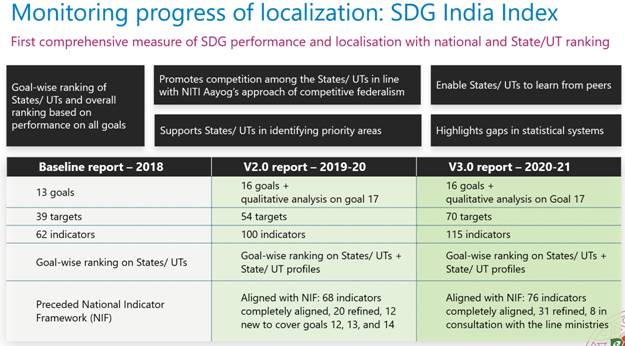
The SDG India Index 2020–21, developed in collaboration with the United Nations in India, tracks progress of all States and UTs on 115 indicators that are aligned to MoSPI’s National Indicator Framework (NIF). The initiative to refine and improve this important tool with each edition has been steered by the need to continuously benchmark performance and measure progress, and to account for the availability of latest SDG-related data on States and UTs. The process of selecting these 115 indicators included multiple consultations with Union Ministries. Feedback was sought from all States and UTs and as the essential stakeholder and audience of this localisation tool, they played a crucial role in shaping the index by enriching the feedback process with localised insights and experience from the ground.

The SDG India Index 2020–21 is more robust than the previous editions on account of wider coverage of targets and indicators with greater alignment with the NIF.The 115 indicators incorporate16 out of 17 SDGs, with a qualitative assessment on Goal 17,andcover 70 SDG targets. This is an improvement over the 2018–19 and 2019–20 editions of the index, which had utilised 62 indicators across 39 targets and 13 Goals, and 100 indicators across 54 targets and 16 Goals, respectively. 
https://static.pib.gov.in/WriteReadData/userfiles/image/image002V4Z4.jpg

The SDG India Index computes goal-wise scores on the 16 SDGs for each State and Union Territory. Overall State and UT scores are generated from goal-wise scores to measure aggregate performance of the sub-national unit based on its performance across the 16 SDGs. These scores range between 0–100, and if a State/UT achieves a score of 100, it signifies it has achieved the 2030 targets. The higher the score of a State/UT, the greater the distance to target achieved.

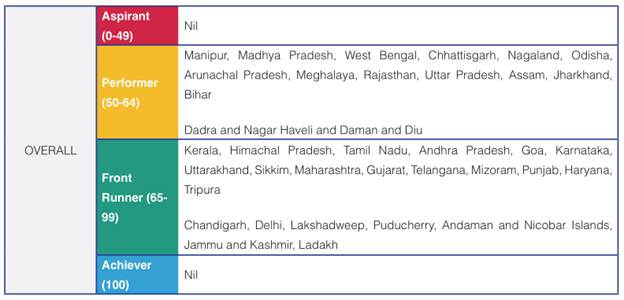
States and Union Territories are classified as below based on their SDG India Index score:
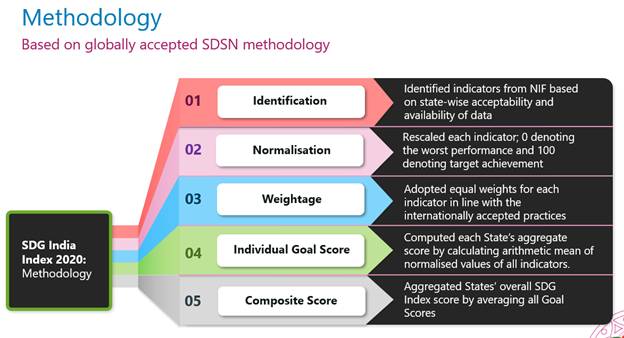
  • Aspirant: 0–49
  • Performer: 50–64
  • Front-Runner: 65–99
  • Achiever: 100


https://static.pib.gov.in/WriteReadData/userfiles/image/image003VG71.jpg


Overall Results and Findings

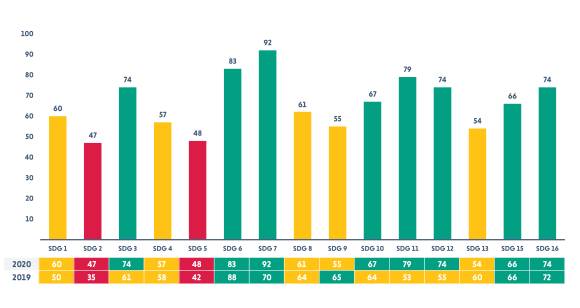
The country’s overall SDG score improved by 6 points-from 60 in 2019 to 66 in 2020–21. This positive stride towards achieving the targets is largely driven by exemplary country-wide performance in Goal 6 (Clean Water and Sanitation) and Goal 7(Affordable and Clean Energy), where the composite Goal scoresare 83 and 92, respectively.

Goal-wise India results, 2019–20 and 2020–21:
https://static.pib.gov.in/WriteReadData/userfiles/image/image004HSF4.jpg

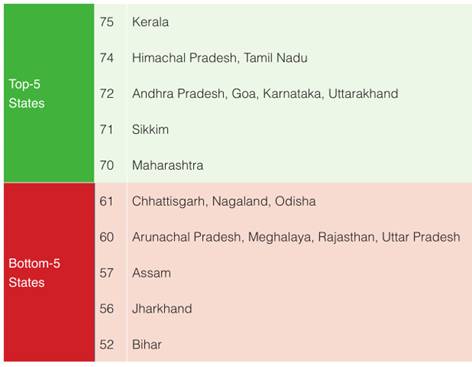
The top-fiveand bottom-fiveStates in SDG India Index 2020–21:
https://static.pib.gov.in/WriteReadData/userfiles/image/image005FTTM.jpg

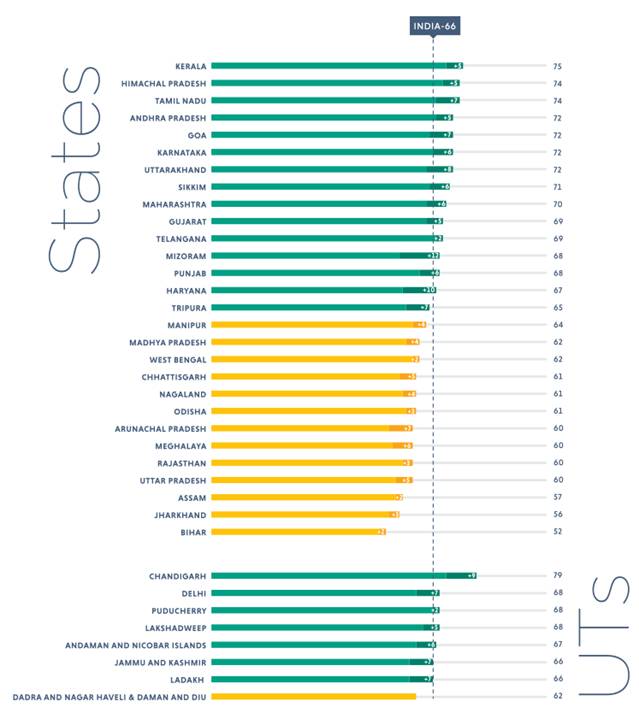
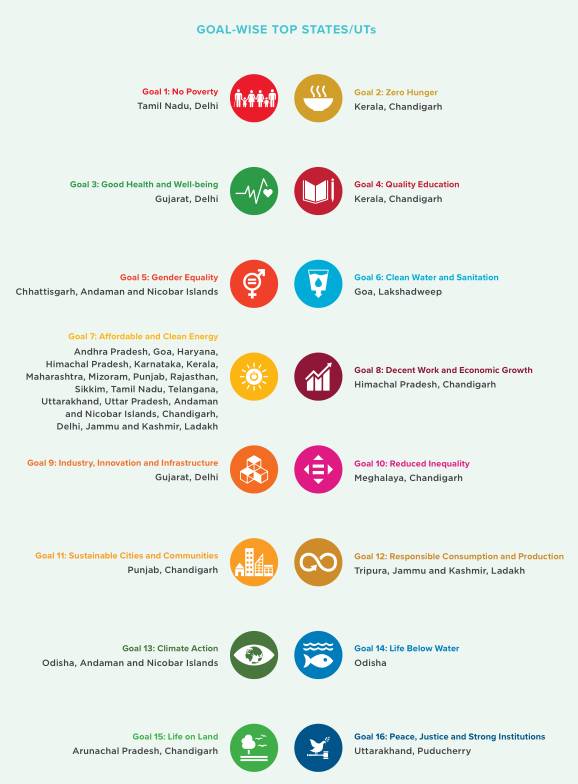
Performance and Ranking of States and UTs on SDGs 2020–21, including change in score from last year:
https://static.pib.gov.in/WriteReadData/userfiles/image/image006JTWS.jpg

https://static.pib.gov.in/WriteReadData/userfiles/image/image007XM1X.jpg

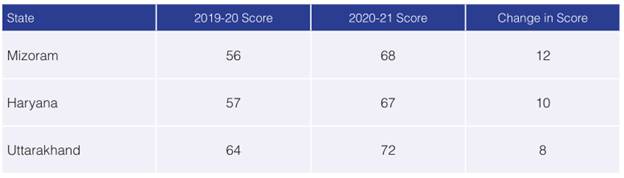
Mizoram, Haryana, and Uttarakhand are the top gainers in 2020–21in terms of improvement in score from 2019, with an increase of 12, 10 and 8 points, respectively.

Top Fast-Moving States (Score-Wise):
 

https://static.pib.gov.in/WriteReadData/userfiles/image/image0082BPP.jpg

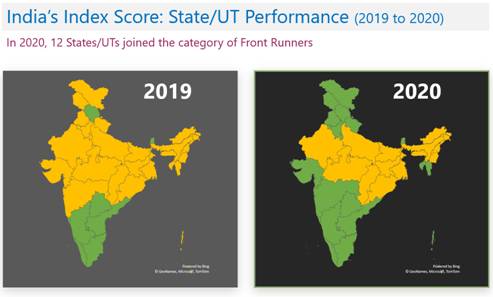
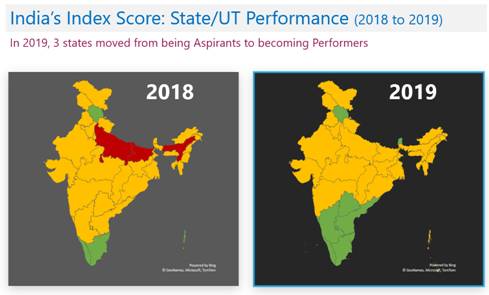
While in 2019, ten States/UTs belonged to the category of Front-Runners (score in the range 65–99, including both) twelve more States/UTs find themselves in this category in 2020–21. Uttarakhand, Gujarat, Maharashtra, Mizoram, Punjab, Haryana, Tripura, Delhi, Lakshadweep, Andaman and Nicobar Islands, Jammu and Kashmir and Ladakh graduated to the category of Front-Runners (scores between 65 and 99, including both).
https://static.pib.gov.in/WriteReadData/userfiles/image/image009CVDV.jpg

https://static.pib.gov.in/WriteReadData/userfiles/image/image0105R60.jpghttps://static.pib.gov.in/WriteReadData/userfiles/image/image011PHAO.jpg

Asection of the SDG India Index report is dedicated to all the 36 Statesand UTs of the country. These State and UT profiles will be very useful for policymakers, scholars and the general public, to analyse the performance on the 115 indicators across all Goals.

Sample of a State/UT profile from the report:

https://static.pib.gov.in/WriteReadData/userfiles/image/image012R6JG.jpg

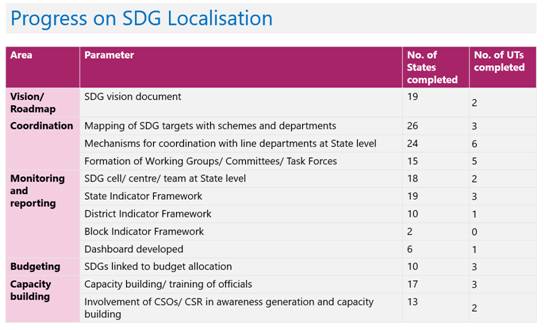
It is followed by a unique section on the progress on SDG localisation in States and Union Territories. It provides an update on the institutional structures, SDG vision documents, State and District Indicator Frameworks and other initiatives taken by the State and UT governments.
https://static.pib.gov.in/WriteReadData/userfiles/image/image013Y892.jpg

The SDG India Index2020–21 is also live on an online dashboard, which has cross-sectoral relevance across policy, civil society, business, and academia. The index is designed to function as a tool for focused policy dialogue, formulation and implementation through development actions,which are pegged to the globally recognisable metric of the SDG framework.The index and dashboard will also facilitate in identifying crucial gaps related to tracking the SDGs and the need for India to develop its statistical systems at the State/UT levels.As another milestone in the SDG localisation journey of the country, the Index is presently being adapted and developed by NITI Aayogat the granular level of districts for the upcoming North Eastern Region District SDG Index.

A snapshot of the SDG India Index 2020–21 dashboard:

https://static.pib.gov.in/WriteReadData/userfiles/image/image014Q7QF.jpg

NITI Aayog has the mandate for coordinating the adoption and monitoring of SDGs at the national and sub-national levels. The SDG India Index and Dashboard represents NITI Aayog’s efforts inencouraging evidence-based policymaking by supporting States and UTs to benchmark their progress, identify the priority areas and share good practices.
https://static.pib.gov.in/WriteReadData/userfiles/image/image015OU5B.jpg

The full SDG India Index report can be accessed here: https://wgz.short.gy/SDGIndiaIndex

The interactive dashboard can be accessed here: http://sdgindiaindex.niti.gov.in/

Topics

Acts Income Tax