

Loading...

Top
Help
×

By creating an account you can:

Logo TaxTMI
Call Us / Help / Feedback

Contact Us At :

E-mail: [email protected]

Call / WhatsApp at: +91 99117 96707

For more information, Check Contact Us

FAQs :

To know Frequently Asked Questions, Check FAQs

Most Asked Video Tutorials :

For more tutorials, Check Video Tutorials

Submit Feedback/Suggestion :

Email :
Please provide your email address so we can follow up on your feedback.
Category :
Description :
Min 15 characters 0/2000
Make Most of Text Search
  1. Checkout this video tutorial: How to search effectively on TaxTMI.
  2. Put words in double quotes for exact word search, eg: "income tax"
  3. Avoid noise words such as : 'and, of, the, a'
  4. Sort by Relevance to get the most relevant document.
  5. Press Enter to add multiple terms/multiple phrases, and then click on Search to Search.
  6. Text Search
  7. The system will try to fetch results that contains ALL your words.
  8. Once you add keywords, you'll see a new 'Search In' filter that makes your results even more precise.
  9. Text Search
Add to...
You have not created any category. Kindly create one to bookmark this item!
Create New Category
Hide
Title :
Description :
❮❮ Hide
Default View
Expand ❯❯
Close ✕
🔎 News - Adv. Search
TEXT SEARCH:

Press 'Enter' to add multiple search terms. Rules for Better Search

Search In:
Main Text + AI Text
  • Main Text
  • Main Text + AI Text
  • AI Text
Category: ?
Categorized by AI
---- All Categories ----
  • ---- All Categories ----
  • Income Tax
  • GST
  • Customs, DGFT & SEZ
  • FEMA & RBI
  • Corp. Laws, SEBI & IBC
  • PMLA, Black Money & ED
  • Budget
  • News and Press Release
  • PTI News
Month:
---- All Months ----
  • ---- All Months ----
  • January
  • February
  • March
  • April
  • May
  • June
  • July
  • August
  • September
  • October
  • November
  • December
Year:
---- All Years ----
  • ---- All Years ----
  • 2026
  • 2025
  • 2024
  • 2023
  • 2022
  • 2021
  • 2020
  • 2019
  • 2018
  • 2017
  • 2016
  • 2015
  • 2014
  • 2013
  • 2012
  • 2011
Sort By: ?
In Sort By 'Default', exact matches for text search are shown at the top, followed by the remaining results in their regular order.
Relevance Default Date
    Rupee rises 1 paisa to 95.73 against US dollar in early trade
    CCI approves acquisition of 23% equity shareholding of TM International Logistics by Tata Steel Ltd
    CCI approves acquisition of additional shareholding of Acko Technology & Services Pvt Ltd. by General Atlantic Singapore ACK Pte. Ltd
    Union Minister of Commerce & Industry Shri Piyush Goyal invites Japanese businesses to deepen investments and partnerships in India
    Department of Commerce Organises Awareness Session on EU CBAM Regulations for Exporters
    PSB Confluence 2026 concludes with actionable strategies across seven themes for Public Sector Banks and Public Financial Institutions
    Previous LDF govt didn't fulfil many obligations related to Vizhinjam port: CM Satheesan
    Sitharaman calls on public sector banks to translate strength into competitiveness and leadership
    Sitharaman asks public sector banks to focus on youth; provide cool, simple banking to suit their needs
    I-T department officials discuss roadmap for improving services for taxpayers
    India-UK trade agreement to benefit Haryana's industries and services sector: CM Saini
    FM asks banks to keep pace with youth expectation; calls for outreach campaign from Oct 2
    CCI approves acquisition of certain equity shareholding in Bharti Life Insurance Company by Prudential Corporation Holdings
    Suspicious foreign remittances under I-T department scanner
    Delhi tightens rules for ration shops, makes big stock discrepancies an FIR offence
    Regional Rural Banks (RRBs) Record Strong Growth in Credit Delivery during FY 2025–26
    METSTO Delivers Adjustable Pallet Racking System Solutions for Warehouses
    China rolls out new measures to boost consumption in counties, smaller cities
    Strengthening Collaboration to Preserve Sovereignty: Collaborative Cash Ecosystems - Global Strategies to Preserve Trust and Sovereignty - Keynote Add...
    SC asks CBI to examine all six allegations of dubious transactions involving Indiabulls
❯❯
Maximize Maximize Maximize
0 / 200
Expand Note
Add to Folder

No Folders have been created

+

Are you sure you want to delete "My most important" ?

NOTE:

News
Showing Results for :
Reset Filters
Results Found:
Show All Summaries Hide All Summaries
August 19, 2026
Show AI Summary
Foreign exchange market conditions supported marginal rupee strength despite crude oil pressures, regional tensions and oil-company dollar demand.
Foreign exchange market conditions reflected a marginal strengthening of the rupee against the US dollar in early trading, supported by reported Reserve Bank of India intervention, a softer dollar index and foreign institutional equity inflows. Higher global crude oil prices, West Asia tensions and oil-company demand for dollars continued to exert pressure, resulting in a range-bound trading environment.
August 19, 2026
Show AI Summary
Competition approval for Tata Steel's share acquisition restructures ownership of logistics joint venture following an existing partner's exit.
Competition approval has been granted for Tata Steel Ltd.'s acquisition of IQ Martrade Holding Und Management GmbH's entire 23% equity shareholding in TM International Logistics Ltd., resulting in IQ Martrade's exit. Following completion, Tata Steel and NYK (Europe) B.V. will hold 74% and 26% equity shareholding, respectively. TM International Logistics primarily serves Tata Steel's logistics and cargo transportation requirements through railway cargo transportation, port operations and cargo handling, freight forwarding, and value-added logistics services.
August 19, 2026
Show AI Summary
Competition approval enables increased insurtech shareholding through a rights issue, crossing the prescribed ownership threshold in insurance businesses.
Competition approval has been granted for General Atlantic Singapore ACK Pte. Ltd. to acquire additional shareholding in Acko Technology & Services Private Limited through the target's rights issue, resulting in the acquirer crossing the 25% shareholding threshold on a fully diluted basis. The target is an Indian insurtech company with subsidiaries conducting licensed general and life insurance businesses, while another subsidiary awaits a corporate agency licence for insurance-policy distribution.
August 19, 2026
Show AI Summary
India-Japan investment partnership prioritises technology, manufacturing and infrastructure collaboration, with Uttar Pradesh positioned for deeper Japanese commercial engagement.
India-Japan economic cooperation is positioned for deeper investment and commercial partnerships in manufacturing, technology, infrastructure, energy, defence, artificial intelligence, semiconductors, critical minerals, batteries and next-generation mobility. Uttar Pradesh is identified as a prospective destination for Japanese investment because of its workforce, connectivity, manufacturing base, MSME sector, export capacity, transport infrastructure and industrial clusters. Investment facilitation is associated with reforms in ease of doing business, digital public infrastructure and multimodal logistics.
August 19, 2026
Show AI Summary
Carbon border adjustment compliance requires reliable emissions data, reporting, accreditation and verification throughout exporters' supply chains.
European Union Carbon Border Adjustment Mechanism compliance requires exporters to address covered products, embedded-emissions calculation, data collection, reporting, accreditation and verification. Preparedness across the export value chain depends on timely emissions data from suppliers and other stakeholders, supported by credible verification mechanisms. Capacity-building and engagement seek to facilitate workable compliance with evolving sustainability-related international trade requirements.
August 19, 2026
Show AI Summary
Youth banking engagement promotes sustained customer relationships through digital access, campus outreach and financial support across evolving life stages.
Public Sector Banks and Public Financial Institutions are urged to implement actionable strategies with clear ownership and realistic timelines. Youth banking engagement is to be strengthened through a focused campaign, a common digital access platform and physical outreach, supporting young customers' evolving financial needs. Priority sector lending requires granular monitoring, early identification of target gaps and productive credit flow to intended beneficiaries. Agriculture and horticulture value-chain financing may cover farmer producer organisations, storage, processing, logistics and market linkages, while credit card strategies include digital onboarding, cross-selling and RuPay-UPI integration.
August 18, 2026
Show AI Summary
Port connectivity obligations shape Vizhinjam export-import operations, logistics integration, infrastructure acceleration, and scrutiny of prior stakeholder notification.
Vizhinjam port concession obligations include road and rail connectivity to maximise the benefits of export-import operations. The State government proposes land acquisition funding for a ring-road project, is engaging with central ministries on rail connectivity, and is seeking to expedite national-highway construction. Mission Samudra is intended to connect Cochin port and 18 mini ports with Vizhinjam to support lower-cost, faster exports. Concerns were also raised over the State government not receiving prior intimation of a proposed stake transfer in the port project company.
August 18, 2026
Show AI Summary
Public sector banking competitiveness requires distinct institutional strengths, early capability building and strategic support for economic growth priorities.
Public sector banks are urged to use their customer base, branch networks, geographic reach, institutional experience and digital capabilities to build stronger competitive positions and leadership. Each bank may develop distinct areas of excellence based on geography, customer relationships, sectoral expertise, technology capabilities or international presence. Strategic priorities include deposit mobilisation, banking for youth, support for investment and global capability centres, agriculture and horticulture infrastructure, credit-card business reorientation and priority sector lending.
August 18, 2026
Show AI Summary
Youth-focused banking requires public sector banks to deliver personalised digital services, financial awareness, and responsible credit engagement.
Public sector banks are urged to implement sustained youth-focused banking through campus outreach, simple personalised round-the-clock services, dedicated youth support and financial awareness. Engagement should develop long-term relationships beyond account opening while preserving prudential standards. Youth should receive guidance on the formal credit ecosystem, including credit scores, credit history, bank credit products and government credit schemes, to support responsible credit discipline and future financial needs. A dedicated portal may provide a single access point for banking awareness and suitable financial opportunities.
August 18, 2026
Show AI Summary
Taxpayer service improvement and litigation reduction guide administrative planning for stronger infrastructure, systems, coordination and future tax department functioning.
Improvement of taxpayer services, reduction of tax litigation, infrastructure strengthening and preparation of an actionable roadmap for future Income Tax Department functioning were considered as operational priorities. Deliberations covered e-HRMS, service matters, reservation policy, systems administration, capacity building, expenditure budgeting, TDS administration, inter-agency coordination, and office infrastructure. Officials identified institutional challenges and priorities for strengthening taxpayer-facing and internal departmental functions.
August 18, 2026
Show AI Summary
Duty-free UK market access strengthens export opportunities for Indian goods and services, supporting MSMEs, agriculture, manufacturing and global value-chain participation.
India-UK Comprehensive Economic and Trade Agreement provides duty-free access to the UK market for nearly all Indian exports and may improve the competitiveness of Haryana's manufacturing, agricultural, MSME and services sectors. Preferential access covers products including textiles, engineering goods, auto parts, processed foods and pharmaceuticals, while agricultural exports remain subject to exceptions for sensitive products. The agreement also provides market access across 137 UK services sub-sectors, supporting IT, digital, professional, financial and technical services and facilitating global value-chain participation.
August 18, 2026
Show AI Summary
Youth banking outreach promotes campus engagement, financial awareness, responsible credit discipline and long-term access to formal banking services.
Public sector banks are urged to conduct a month-long "Banking for Youth" outreach campaign from 2 October 2026 for persons above 16 years of age. Outreach through educational and skill-development campuses should combine account opening, financial awareness and direct engagement. Banks should develop tailored youth strategies to build long-term banking relationships. Proposed measures include online learning content, lifestyle-linked benefits, dedicated youth banking support, and awareness of credit scores, credit products and government credit schemes. A dedicated youth banking-awareness portal may serve as a single access point for appropriate banking services and financial opportunities.
August 18, 2026
Show AI Summary
Competition approval for Prudential's acquisition of equity shareholding in an Indian life insurer supports the proposed insurance-sector combination.
Competition approval has been granted for Prudential Corporation Holdings Limited to acquire certain equity shareholding in Bharti Life Insurance Company Limited. The acquirer is the holding company for its group's insurance and asset-management operations in Asia and supports operations in Asia and Africa. The target is an IRDAI-licensed Indian life insurer.
August 18, 2026
Show AI Summary
Foreign remittance certification due diligence faces nationwide verification targeting shell entities, their controllers, and certifying professionals.
Nationwide verification of suspicious outward foreign remittances targets entities with little or no reported business activity, their controllers, and professionals issuing tax determination certificates. Scrutiny concerns remittances disproportionate to reported turnover, inconsistent with stated purposes, or linked to entities not operating from declared addresses. Form 15CB, or Form 146 under the corresponding framework, requires certifying accountants to assess taxability from books of account and relevant records, supporting tax deduction at source and treaty compliance through due care, diligence and professional judgment.
August 18, 2026
Show AI Summary
Fair Price Shop regulation introduces graded stock-shortage penalties, mandatory FIRs for major discrepancies, and restructured licensing requirements.
Fair Price Shop regulation introduces quantity-based penalties for stock discrepancies, ranging from performance-guarantee forfeiture and replenishment obligations to interim suspension, cancellation-related action and mandatory FIR registration for major shortages. Repeated or deliberate diversion or manipulation of public distribution supplies may lead to cancellation, blacklisting and FIR registration. Licensing now includes continuing regular licences and short-term temporary licences, with wider eligibility, points-based selection, card-linked performance guarantees and compulsory approved e-PoS, weighing-scale and iris-scanner use.
August 18, 2026
Show AI Summary
Priority sector lending strengthened rural credit access through agricultural, micro-enterprise and weaker-section finance, reinforcing financial inclusion and sustainable development.
Regional Rural Banks expanded rural credit delivery while maintaining strong Priority Sector Lending performance during FY 2025-26. Almost all Regional Rural Banks met the prescribed overall priority-sector target. Agriculture and allied activities remained the largest priority-sector component, with farm credit accounting for nearly all agricultural lending. MSME finance predominantly supported micro enterprises, rural entrepreneurs, artisans and small businesses. Lending to weaker sections and finance for housing, education, renewable energy and social infrastructure promoted inclusive access to institutional credit and sustainable rural development.
August 18, 2026
Show AI Summary
Adjustable pallet racking systems support customised, scalable warehouse storage through configurable layouts, safety assessment, installation and lifecycle support.
Adjustable pallet racking systems are configurable warehouse-storage solutions for varied inventory dimensions, weights and product types. They support bulk pallet storage, multi-level picking and high-density configurations through adjustable beams and shelves, load-bearing capacity, structural durability and space-efficient layouts. Storage configurations are customised after assessing inventory dimensions, payload requirements, available space and material-movement frequency, with support for design, installation, inspections and after-sales service.
August 18, 2026
Show AI Summary
Domestic consumption expansion targets lower-tier markets through improved retail channels, distribution networks, employment support and household income opportunities.
China has introduced measures to strengthen domestic consumption in counties, smaller cities, townships and rural areas. The measures include upgrading township commercial centres, rural markets and local fairs; encouraging domestic and international brands to establish regional debut stores; and reusing existing land resources to improve services. They also seek better services for elderly persons and children, stronger urban-rural distribution networks, county-level employment and resident income channels. The strategy supports a shift towards household consumption amid weak domestic demand, property-sector pressures and subdued consumer sentiment.
August 18, 2026
Show AI Summary
Currency management preserves monetary sovereignty through clean notes, secure logistics, decentralised distribution, durable banknotes, and sustainable cash-cycle operations.
Currency management supports trust in cash and monetary sovereignty through demand planning, secure production, distribution, replacement, and disposal. The Clean Note Policy requires good-quality banknotes to be available in required denominations and locations, with unfit notes continuously withdrawn and replaced. A decentralised Currency Chest network distributes fresh currency, processes returned notes, supports linked bank branches, and operates under licensing, real-time reporting, inspection, and audit requirements. Current priorities include managing uncertain cash demand, improving note durability, and reducing the carbon footprint of the cash cycle.
August 18, 2026
Show AI Summary
Independent investigation of alleged dubious transactions requires examination of all six allegations despite prior police conclusions.
Investigation into alleged dubious transactions involving Indiabulls Housing Finance Limited and related entities must cover all six allegations identified by the Enforcement Directorate. The CBI must independently examine five allegations previously reviewed by the Delhi Police Economic Offence Wing, irrespective of its conclusion, and submit a comprehensive report. Further investigation into the sixth allegation depends on the special PMLA court deciding the CBI's pending application, after which the CBI must provide a progress or status report.

News

Back

All News

Showing Results for :
Reset Filters
No Records Found

News

Back

All News

Showing Results for : Reset Filters

Finance Minister unveils Doorstep Banking Services and declares EASE 2.0 Index Results

September 10, 2020

Contents
Summary
Note

Note

-

Bookmark

Print

Print

Union Minister of Finance & Corporate Affairs Smt. Nirmala Sitharaman inaugurated Doorstep Banking Services by PSBs and participated in the awards ceremony to felicitate best performing banks on EASE Banking Reforms Index.

Secretary, Department of Financial Services Shri Debasish Panda and Chairman IBA, Shri Rajnish Kumar,were also present at the virtual event.

Doorstep Banking Services by PSBs

As part of the EASE Reforms, Doorstep Banking Services is envisaged to provide convenience of banking services to the customers at their door step through the universal touch points of Call Centre, Web Portal or Mobile App.  Customers canalso track their service request through these channels.

The services shall be rendered by the Doorstep Banking Agents deployed by the selected Service Providers at 100 centres across the country. 

At present only non-financial services viz. Pick up of negotiable instruments (cheque / demand draft / pay order, etc.), Pick up new cheque book requisition slip, Pick up of 15G / 15H forms, Pick up of IT / GST challan, Issue request for standing instructions, Request for account statement, Delivery of non-personalised cheque book, demand draft, pay order, Delivery of term deposit receipt, acknowledgement, etc., Delivery of TDS / Form 16 certificate issuance, Delivery of pre-paid instrument / gift card  are available to customers.  Financial services shall be made available from October 2020.

The services can be availed by customers of Public Sector Banks at nominal charges. The services shall benefit all customers, particularly Senior Citizens and Divyangs who would find it at ease to avail these services. 

Performance of PSB on EASE 2.0 Index

A common reform agenda for PSBs, EASE Agenda is aimed at institutionalizing clean and smart banking. It was launched in January 2018, and the subsequent edition of the program ― EASE 2.0 built on the foundation laid in EASE 1.0 and furthered the progress on reforms. Reform Action Points in EASE 2.0 aimed at making the reforms journey irreversible, strengthening processes and systems, and driving outcomes.

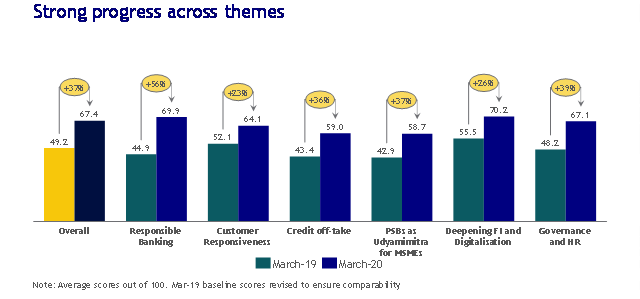
PSBs have shown a healthy trajectory in their performance over fourquarters since the launch of EASE 2.0 Reforms Agenda. The overall score of PSBs increased by 37% between March-2019 and March-2020, with the average EASE index score improving from 49.2 to 67.4 out of 100. Significant progress is seen across six themes of the Reforms Agenda, with the highest improvement seen in the themes of‘Responsible Banking’, ‘Governance and HR’, ‘PSBs as Udyamimitra for MSMEs’, and ‘Credit off-take’.
PSBs have adopted tech-enabled, smart banking in all areas, setting up retail and MSME Loan Management Systems for reduced loan turnaround time andPSBloansin59minutes.comandTReDS for digital lending. PSBs have instituted real-time visibility to retail and MSME customers on the status of their loans. Most branch-based services are now accessible from home and mobile, including in local languages.

EASE Reforms Index has equipped Boards and leadership for effective governance, instituted risk appetite frameworks, created technology- and data-driven risk assessment and prudential underwriting and pricing systems, introduced Early Warning Signals (EWS) systems and specialised monitoring for time-bound action in respect of stress, put in place focussed recovery arrangements, and established outcome-centric HR systems.

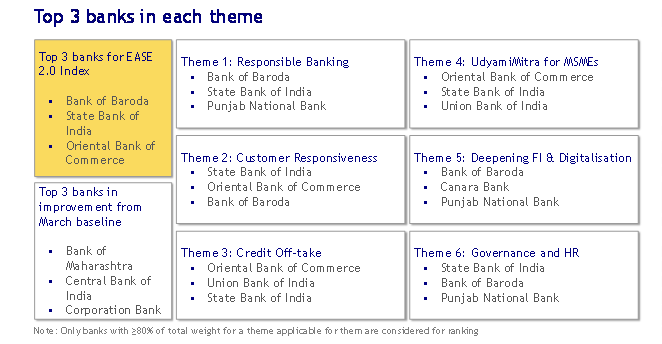
Bank of Baroda, State Bank of India, and erstwhile Oriental Bank of Commerce were felicitated for being the top three (in that order) in the ‘Top Performing Banks’ category according to the EASE 2.0 Index Results. Bank of Maharashtra, Central Bank of India &erstwhile Corporation Bank were awarded in the ‘Top Improvers’ category basis EASE 2.0 Index. Punjab National Bank, Union Bank of India, and Canara Bank were also recognized for outstanding performance in select themes.
Major Reform achievements between March 2018 to March 2020

  • Most PSB customers now have access to 35+ services such as IMPS, NEFT, RTGS, intra-bank transfer, account statement, cheque book request on mobile/ Internet banking and23 services such as chequebook issuance, cheque status, issuance of form 16A, block/activate debit card on the call centre. The availability of services has nearly doubled over the last 24 months.
  • Nearly 4cractive customers on mobile and internet banking with 140% increase in financial transactions through mobile and internet banking channels and almost 50% of financial transactionsthrough digital channels.
  • Call centers now offer services in 13regional languagessuch as Telugu, Marathi, Kannada, Tamil, Malayalam, Gujarati, Bengali, Odia.
  • Complaint redressal average turnaround time reduced from the average of approximately 9 days to 5 days
  • 23 branch-equivalent services such as account opening, cash deposit, cash withdrawal, fund transfer made available by PSBs through Bank Mitras
  • PSBs have issued RuPay credit cards to nearly 23 crore basic savings account customers
  • Significant improvement in customer outreach through dedicated marketing force and external partnerships. The number of dedicated marketing employees has increased from 8,920 to 18,053.
  • Sourcing of retail and MSME loans through the dedicated salesforce and marketing tie-ups has increased nearly five times from 1.5 lakhs to 8.3 lakh loans
  • Turnaround time (weighted average) for retail loans reduced by 67% from the average of nearly 30 days to nearly 10 days
  • Cross-sell of non-banking financial products has made available bouquet of financial products to the customer
  • For prudential lending, PSBs are now systematically keeping watch on adherence to risk-based pricing, and cases with deviation have reduced from 59% to 20%, and have put in place data-driven risk-scoring for appraisal of high-value loans that factors in group-entities.
  • Most PSBs have deployed IT-based EWS systems leveraging third-party data, which have enabled early, time-bound action in stressed accounts. Monitoring has also been strengthened by deploying Agencies for Specialised Monitoring, and proactively monitoring listed entities based on published financials. Slippage into NPA has reduced from 3.90 lakh crore in 12-months ending March-18 to 1.45 lakh crorein 11-months ending February-20.
  • PSBs have adopted digital platforms such as online OTS, e-Bक्रय, e-DRT for expedited recovery. 88% of one-time settlement (OTS) cases are now tracked through dedicated IT systems.
  • PSBs have adopted new ways of credit, such as PSBloansin59minutes.com and Trade Receivables Discounting System (TReDS) for digital lending for MSMEs and retail. 73% of all PSB inland bills are now discounted through online TReDS.
  • The Government has introduced several governance reforms. The governance reforms include arm’s length selection of top bank management through Banks Board Bureau, introduction of non-executive chairpersons, broader talent pool for such selections, empowered bank Boards,  strengthening of the Board committees system, enhancing the effectiveness of non-official directors, and leadership development and succession planning for the top two levels below the Board. In larger PSBs, Executive Director strength has been increased, and Boards are empowered to introduce CGM level for increased business.

Like in the previous year, progress made by PSBs was tracked quarterly through a published EASE Reforms Index leading up to the annual review. In addition to the inclusion of the EASE Reforms Index in the evaluation of Whole Time Directors of PSBs, it has now been made part of the annual appraisal of PSB leadership up to two levels below the Whole Time Directors.

The Index measures the performance of each PSB on 120+objective metrics across six themes. It provides all PSBs a comparative evaluation showing where banks stand vis-à-vis benchmarks and peers on the Reforms Agenda. The Index follows a fully transparent scoring methodology, which enables banks to identify precisely their strengths as well as areas for improvement. The goal is to continue driving change by spurring healthy competition among PSBs and by encouraging them to learn from each other.

PSBs have stepped up to support the country during COVID-19

PSBs have massively stepped up to support the nation during the COVID-19 crisis. From different modes of staffing to remote working, 80,000+ bank branches were operational during COVID-19. Additionally, there has been 90% uptime of self-service machines during the COVID times andaroundthree times increase in Aadhaar Enabled Payment System (AEPS) transactions through micro ATMs, and enhanced doorstep banking support by 75,000+Bank Mitras. To further support the customers in these times, the banks have drastically increased the number of services being offered at the call centers, from 11 in March-19 to 23 as of June-20 in 13 regional languages.

PSBs way forward to Smart, Tech-enabled Banking for Aspiring India

A comprehensive agenda for smart, tech-enabled banking has been adopted for FY2020-21, under which PSBs have initiated eShishu Mudra for straight-through processing of loans to micro-enterprises and digital personal loan for customers. PSBs have started providing customer-need driven credit offers through analytics and partnerships with FinTechs and e-commerce companies.

Many PSBs have already started taking steps in line with the reform priorities. Progress of PSBs will continue to be tracked on metrics linked to Reform Action Points, and their progress will be published through a quarterly index.

Financial Health of the PSBsduring the EASE Reforms journey

Following the completion of recognition of legacy stress as NPA, PSBs have returned to profitability with sound financial health and institutionalised systems to prevent the recurrence of past weaknesses. The improved financial health of PSBs reflects in many parameters-

  • Gross NPAs reduced from ₹8.96 lakh crore in March-2018 to ₹6.78 lakh crore in March-2020;
  • A sharp decline in fraud occurrence from 0.65% of advances during FY10-FY14 to 0.06% in FY19-20; due to fraud prevention reforms and proactive checking of legacy NPA
  • Record recovery of 2.27 lakh crore in FY19-FY20 driven by newly setup dedicated stressed account management verticals in PSBs;
  • Asset quality has improved significantly, with the net NPA ratio reducing from 7.97% in March 2018 to 3.75% in March 2020
  • Number of PSBs under PCA down to three;
  • CRAR 197 bps above the regulatory minimum; and
  • The highest provision coverage ratio of 80.9% in eight years.

Link for Doorstep Banking Services and Declaration of EASE 2.0 Index Results: https://www.iba.org.in/events/past-events/launch-of-dsb-and-declaration-of-ease-2-0-index-results_972.htmlor https://www.iba.org.in

Topics

Acts Income Tax