

Just a moment...

Top
Help
×

By creating an account you can:

Logo TaxTMI
>
Call Us / Help / Feedback

Contact Us At :

E-mail: [email protected]

Call / WhatsApp at: +91 99117 96707

For more information, Check Contact Us

FAQs :

To know Frequently Asked Questions, Check FAQs

Most Asked Video Tutorials :

For more tutorials, Check Video Tutorials

Submit Feedback/Suggestion :

Email :
Please provide your email address so we can follow up on your feedback.
Category :
Description :
Min 15 characters0/2000
Add to...
You have not created any category. Kindly create one to bookmark this item!
Create New Category
Hide
Title :
Description :
❮❮ Hide
Default View
Expand ❯❯
Close ✕
🔎 News - Adv. Search
TEXT SEARCH:

Press 'Enter' to add multiple search terms. Rules for Better Search

Search In:
Main Text + AI Text
  • Main Text
  • Main Text + AI Text
  • AI Text
Category: ?
Categorized by AI
---- All Categories ----
  • ---- All Categories ----
  • Income Tax
  • GST
  • Customs, DGFT & SEZ
  • FEMA & RBI
  • Corp. Laws, SEBI & IBC
  • PMLA, Black Money & ED
  • Budget
  • News and Press Release
  • PTI News
Month:
---- All Months ----
  • ---- All Months ----
  • January
  • February
  • March
  • April
  • May
  • June
  • July
  • August
  • September
  • October
  • November
  • December
Year:
---- All Years ----
  • ---- All Years ----
  • 2026
  • 2025
  • 2024
  • 2023
  • 2022
  • 2021
  • 2020
  • 2019
  • 2018
  • 2017
  • 2016
  • 2015
  • 2014
  • 2013
  • 2012
  • 2011
Sort By: ?
In Sort By 'Default', exact matches for text search are shown at the top, followed by the remaining results in their regular order.
RelevanceDefaultDate
    Income-Tax department extends deadline for filing revised ITR for AY25 to January 15
    Ministry of Finance Year Ender 2024: Department of Expenditure
    Dr. Arunish Chawla took charge as Secretary, Department of Revenue, Ministry of Finance
    Ministry of Finance Year Ender 2024: Department of Financial Services
    Year-end review 2024: Ministry of Statistics and Programme Implementation (MoSPI) during 2024
    Ministry of Finance Year Ender 2024: Department of Revenue
    Government of India and Asian Development Bank sign $500 million loan to support sustainable infrastructure projects aligned with the India’s climat...
    Key stakeholders from NPS ecosystem to come together with the launch of Association of NPS Intermediaries (ANI)
    Minutes of the Monetary Policy Committee Meeting, December 4 to 6, 2024 [Under Section 45ZL of the Reserve Bank of India Act, 1934]
    $350 Million Loan signing between Government of India and ADB
    Union Minister for Finance and Corporate Affairs Smt. Nirmala Sitharaman chairs the Pre-Budget Consultation Meeting with States and UTs (with legislat...
    Government of India and Asian Development Bank (ADB) sign $42 million loan to strengthen coastal protection to help boost community resilience in Maha...
    CBDT launches Electronic Campaign to address income and transaction mismatches for FY 2023-24 and FY 2021-22
    3rd India-UK Financial Markets Dialogue: Joint Statement
    India’s FDI Journey Hits $1 Trillion
    Government of India and ADB sign $50 million loan for climate-adaptative water harvesting project in Meghalaya
    Revenue Secretary Shri Sanjay Malhotra inaugurates 67th Foundation Day of the Directorate of Revenue Intelligence in New Delhi
    India's Advancing Role in Global Trade Competitiveness
    CBDT extends due date for filing return of income in the case of an assessee withrequirement to furnish report referred to in section 92E, for AY 2024...
    Government of India and ADB sign $98 million loan to promote plant health management in India’s horticulture
❯❯
MaximizeMaximizeMaximize
0 / 200
Expand Note
Add to Folder

No Folders have been created

    +

    Are you sure you want to delete "My most important" ?

    NOTE:

    News
    Showing Results for :
    Reset Filters
    Results Found:
    Show All SummariesHide All Summaries
    December 31, 2024
    Show AI Summary
    Deadline extension for belated and revised income tax returns gives resident taxpayers extra time to reconcile books before filing.
    The Central Board of Direct Taxes extended the last date for resident individuals to furnish belated or revised returns of income for Assessment Year 2024-25, shifting the deadline from the prior year end date to a later date in mid January, allowing taxpayers additional time to reconcile books and make rectifications before filing.
    December 27, 2024
    Show AI Summary
    Direct Benefit Transfer via PFMS strengthens transparent beneficiary payments alongside procurement, borrowing and pension reforms.
    The Department of Expenditure expanded PFMS enabled Direct Benefit Transfer coverage and operational tools, integrated 117 external systems, and reduced credit failures; fixed the states' net borrowing ceiling at 3% of GSDP with an additional 0.5% GSDP borrowing window for power sector performance; enacted procurement reforms reducing performance security to 5%, raising monetary thresholds and issuing a revised Goods Procurement Manual; introduced Delegation of Financial Powers Rules, 2024; and approved the Unified Pension Scheme to commence 1 April 2025 with assured pension, family pension, minimum pension and inflation indexing.
    December 27, 2024
    Show AI Summary
    Administrative appointment: Secretary, Department of Revenue assumes charge, bringing extensive finance and international economic experience.
    Dr. Arunish Chawla assumed charge as Secretary, Department of Revenue, Ministry of Finance, following appointment by the Appointments Committee of the Cabinet. The release records his 1992-batch IAS (Bihar cadre) background, immediate prior tenure as Secretary, Department of Pharmaceuticals from 1 November 2023, earlier roles including Managing Director of the Metro Rail Project Patna, senior economic postings on foreign assignment (including at the IMF and as Minister (Economic) in Washington), service as Joint Secretary in the Department of Expenditure, and academic credentials of a Master's and Doctorate in Economics from the London School of Economics.
    December 26, 2024
    Show AI Summary
    Banking Sector Resilience strengthened through reforms, digital payments expansion and financial inclusion expanding credit and service access.
    Departmental reforms in 2024 enhanced banking-sector resilience through asset-recognition and resolution measures, recapitalisation and prudential frameworks that reduced gross and net NPAs and improved provision coverage and capital adequacy. Concurrently, the digital-payments ecosystem was expanded and internationalised via enhanced UPI features, interoperability measures, and regulatory directions including BBPS Master Direction and escrow protections. Financial inclusion was advanced through scale-up of basic bank accounts, low-cost insurance schemes, MUDRA and targeted credit programs, while agricultural credit and Kisan Credit Card saturation drives increased concessional lending to farmers and allied activities.
    December 26, 2024
    Show AI Summary
    Data governance strengthened: MoSPI unified metadata, launched eSankhyiki and rebased macrostatistical processes to improve accessibility.
    MoSPI strengthened the National Statistical System by fast tracking survey releases, publishing an Advance Release Calendar, launching the eSankhyiki portal and APIs for centralised access, issuing NMDS 2.0 and statistical standards for metadata and interoperability, constituting committees for base revision of GDP/CPI/IIP, delegating financial powers to regional HODs, reorganising survey divisions into product focused verticals, and operationalising a Research & Analysis Unit and Data Innovation Lab to support methodological innovation and stakeholder collaboration.
    December 26, 2024
    Show AI Summary
    Tax Administration Reforms: digital processes and risk-based GST and customs measures streamline compliance and facilitate refunds.
    The document describes a coordinated programme to enhance tax administration and trade facilitation through digitalisation, procedural reliefs, and risk-based compliance. Income tax measures emphasize faceless processes, e-verification, pre-filling, and rapid ITR/refund processing alongside demand resolution and taxpayer outreach. GST reforms focus on registration integrity, sequential return filing, input tax credit relaxations, conditional waivers for historical periods, and reduced pre-deposit for appeals. Customs modernisation highlights ICEGATE 2.0, ICETAB mobile examination, exchange rate automation, bonded warehouse digitisation, and expanded courier/postal export benefit processing, supported by international cooperation and financial intelligence enhancements.
    December 24, 2024
    Show AI Summary
    Sovereign-guaranteed financing expands institutional capacity for green infrastructure and sustainability assessment under new loan agreement.
    A sovereign-guaranteed multilateral loan will be extended to a public infrastructure finance company to provide long-term capital for green and sustainable infrastructure, support connectivity and energy transition, and target under-resourced sectors. The project emphasises mobilising private capital via innovative financing and risk-mitigation instruments and builds institutional capacity by establishing a sustainability unit, an environmental sustainability framework, and a sustainability scoring method to integrate sustainability practices into project assessment.
    December 23, 2024
    Show AI Summary
    Pension coverage expansion urged as Association of NPS Intermediaries launches to enhance subscriber welfare and regulatory collaboration.
    The Association of NPS Intermediaries (ANI) creates a collective platform of NPS stakeholders to expand pension coverage, promote NPS as a tax-efficient retirement product, strengthen subscriber welfare, streamline transparent subscriber processes, and provide coordinated feedback to regulators and policymakers to refine the NPS framework and develop the pension market.
    December 21, 2024
    Show AI Summary
    Monetary policy decision: repo rate unchanged and neutral stance to prioritise disinflation while supporting growth.
    The MPC meeting under Section 45ZL concluded with a resolution to keep the policy repo rate unchanged and to continue a neutral monetary policy stance focused on a durable alignment of CPI inflation with the medium term target while supporting growth. The minutes set out the macroeconomic and inflation outlook underpinning this choice-weak Q2 GDP driven by industrial slowdown, elevated food led headline inflation with core uptick, projected quarter by quarter GDP and CPI trajectories with evenly balanced risks-and record the voting split and individual member statements proposing alternative measures including a repo rate cut and non rate liquidity options.
    December 21, 2024
    Show AI Summary
    Policy-based loan expands manufacturing resilience through logistics reforms and institutional and regulatory strengthening, with digital integration to boost efficiency.
    A programmatic policy-based loan under the SMILE second subprogram supports a coordinated reform agenda to expand manufacturing and strengthen supply chain resilience by operationalizing a comprehensive policy framework that: strengthens institutional bases for multimodal logistics at national, state and city levels; standardizes warehousing and logistics assets to attract private investment; improves external trade logistics efficiencies; and adopts smart, low-emission digital logistics systems.
    December 21, 2024
    Show AI Summary
    State fund devolution under the 15th Finance Commission increases transfers and expands untied capital support for States.
    Devolution of central funds under the 15th Finance Commission has exceeded prior-transfer levels, increasing States' fiscal capacity. The 2024-25 SASCI allocation adds untied capital funds for State use across sectors and creates a disaster dispensation allowing eligible States, as assessed by an Inter Ministerial Central Team, to receive up to fifty percent of their Part 1 (Untied) SASCI allocation for reconstruction of infrastructure, in addition to resources under the National Disaster Response and Mitigation Fund.
    December 20, 2024
    Show AI Summary
    Climate-resilient coastal protection to combine hybrid engineering, nature-based solutions and institutional capacity building for community resilience.
    The Government of India and the Asian Development Bank agreed a loan to finance climate-resilient coastal and riverbank protection in Maharashtra through hybrid engineering and nature-based measures, enhanced climate-impact forecasting and remote-sensing shoreline monitoring, and institutional strengthening including a coastal infrastructure management unit and capacity building for gender equality, social inclusion, livelihoods, and disaster preparedness.
    December 17, 2024
    Show AI Summary
    AIS-ITR mismatch resolution campaign enables taxpayers to file revised or belated returns before applicable limitation deadlines.
    The CBDT's electronic campaign notifies taxpayers of AIS-ITR mismatches and non-filing for specified years, urging filing of revised, belated, or updated returns within the applicable limitation windows and permitting taxpayers to contest AIS entries or provide feedback via the AIS portal; the initiative is implemented under the e-Verification Scheme, 2021 and uses third-party data to enhance voluntary compliance and transparency.
    December 14, 2024
    Show AI Summary
    Cross-border financial cooperation to facilitate listings, regulatory alignment and joint workstreams driving investment and market access.
    The Dialogue prioritised facilitation of cross-border financial services and investment through regulatory alignment and market-access measures across capital markets, insurance, pensions, FinTech, sustainable finance and the IFSC. Key operative measures included exploring direct listings via GIFT IFSC, proposed increases in foreign investment limits in insurance, reforms to reinsurance frameworks and pension regulation to enable overseas investment, and joint workstreams-notably the Capital Markets Working Group, Fintech Joint Working Group, and Sustainable Finance Forum-to advance regulatory sandbox collaboration, digital payment connectivity, CBDC cooperation, disclosure standards and transition finance.
    December 12, 2024
    Show AI Summary
    Foreign direct investment policy attracts record cumulative inflows after reforms expanding automatic route and easing tax compliance.
    India has achieved cumulative FDI inflows of one trillion dollars since April 2000, supported by a 26% rise in FDI in the first half of the current fiscal year. The growth is attributed to investor friendly policy liberalisation-permitting 100% FDI under the automatic route in most sectors-pro business regulatory reforms, and measures enacted in 2024 abolishing the angel tax and reducing the income tax rate for foreign companies to simplify tax compliance for investors.
    December 5, 2024
    Show AI Summary
    Climate-adaptive water harvesting funds community-led water security infrastructure and capacity building for resilient rural irrigation systems.
    A concessional loan funds a climate-adaptive community-based water-harvesting project in Meghalaya to construct climate-resilient small water-storage facilities, develop command-area irrigation and micro-irrigation systems, establish weather stations, and pilot renewable micro-hydropower. The project will prepare a WHS master plan and village-level water security plans managed by local institutions, and strengthen capacity of state watershed and conservation departments while training farmers, especially women, to enhance irrigated agriculture, fisheries and horticulture and integrate climate adaptation into water-security planning.
    December 5, 2024
    Show AI Summary
    Integration of AI and ML urged to boost detection and enforcement against smuggling while preserving legitimate trade.
    DRI is urged to integrate Machine Learning and Artificial Intelligence to enhance detection and enforcement; its intelligence has helped identify policy gaps, and recent empowerment under wildlife protection legislation aids wildlife smuggling enforcement. Expansion of technical and human capacity is recommended to counter technologically sophisticated criminals while balancing enforcement with facilitation of legitimate trade; publication of smuggling reports and regional international cooperation initiatives support intelligence-led responses to smuggling and commercial frauds.
    December 3, 2024
    Show AI Summary
    Foreign Trade Policy reforms expand export incentives and digital facilitation to strengthen global supply chain integration and exporter support.
    The document sets out India's export policy architecture centred on the Foreign Trade Policy, organised around remission incentives, collaborative export promotion, digital ease of doing business measures, and focus on emerging sectors including SCOMET and e commerce. It details incentive mechanisms such as interest equalisation, rebate and remission schemes, PLI support for manufacturing, tariff line corrections, and investment reforms, together with operational facilitation through the National Single Window System, Trade Connect, Common Digital Platform for Certificates of Origin, ICEGATE and eBRC automation to reduce compliance costs and bolster MSME and district level export promotion.
    December 2, 2024
    Show AI Summary
    Due date extension for transfer pricing return filings: filing deadline moved to mid-December under CBDT circular.
    CBDT issued Circular No. 18/2024 (F.No.225/205/2024/ITA-II) dated 30.11.2024 extending the due date to 15th December of the assessment year for assessees required to furnish a transfer pricing report under section 92E; the original due date for filing the return of income under the filing provision was the 30th of November for AY 2024-25.
    November 30, 2024
    Show AI Summary
    Plant health management initiative to establish certified clean plant centres and accreditation enhancing horticulture resilience to climate impacts.
    The programme will establish dedicated clean plant centres with diagnostic laboratories, trained staff, and operating procedures to maintain disease free foundation material, and will roll out a certification and accreditation scheme to test and certify planting materials and accredit private nurseries. Implementation is by the Ministry of Agriculture and Farmers Welfare through the National Horticulture Board and the Indian Council of Agricultural Research, with consultations involving private nurseries, researchers, state governments, and growers' associations.

    News

    Back

    All News

    Showing Results for :
    Reset Filters
      No Records Found

      News

      Back

      All News

      whatsappJoin Channel
      Showing Results for : Reset Filters

      India's Advancing Role in Global Trade Competitiveness

      December 3, 2024

      Contents
      Summary
      Note

      Note

      -

      Bookmark

      Print

      Print

      India's journey toward becoming a global economic powerhouse is marked by remarkable achievements in its export landscape. The nation has demonstrated significant progress in diverse sectors, ranging from petroleum oils and agrochemicals to semiconductors and precious stones. This growth reflects India's ability to leverage advanced technology, innovative practices, and competitive manufacturing to meet global demands. Supported by robust government initiatives, the country is not only expanding its export base but also strengthening its position as a reliable global supplier. India's export performance in several key product categories at the 4-digit HS level has shown notable success, with the country maintaining or improving its rank among the top 10 global suppliers, all with export values exceeding $1 billion in 2023.

      Below is a detailed exploration of India's robust performance in various key export categories, highlighting its advancements in global trade:
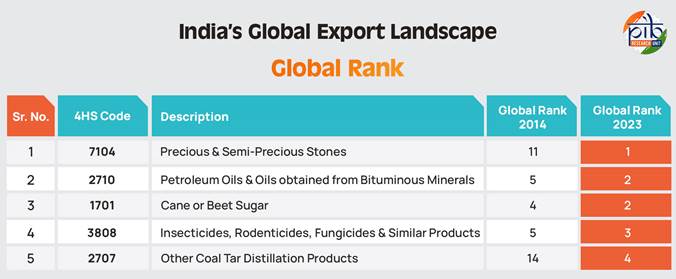
      India has emerged as a dominant player in the global export market, showcasing remarkable growth across various sectors. The petroleum sector (Petroleum Oils and Oils Obtained from Bituminous Minerals) has seen a dramatic rise, with export values increasing from $60.84 billion in 2014 to $84.96 billion in 2023, capturing a global market share of 12.59%. This significant leap has propelled India to the position of the second-largest global exporter, driven by advanced refining infrastructure, increased production capacity, and adherence to international standards, solidifying its reputation as a dependable energy supplier worldwide.

      In the agrochemical sector, India has achieved notable success, particularly in insecticides, rodenticides, and fungicides. By 2023, exports reached $4.32 billion, marking a global market share of 10.85%, up from 5.89% in 2014. Investments in research and development, coupled with compliance with international agricultural standards, have positioned India as the third-largest exporter globally. This growth underscores India’s pivotal role in supporting sustainable agriculture.
      India’s sugar exports have also witnessed exceptional growth, with the country’s share in the global market for cane or beet sugar rising from 4.31% in 2014 to 12.21% in 2023. Export values reached $3.72 billion in 2023, cementing India’s position as the second-largest sugar exporter. Strong production bases and favourable agricultural policies have enabled India to cater to growing demand, particularly in Southeast Asia and Africa, strengthening its agricultural economy.
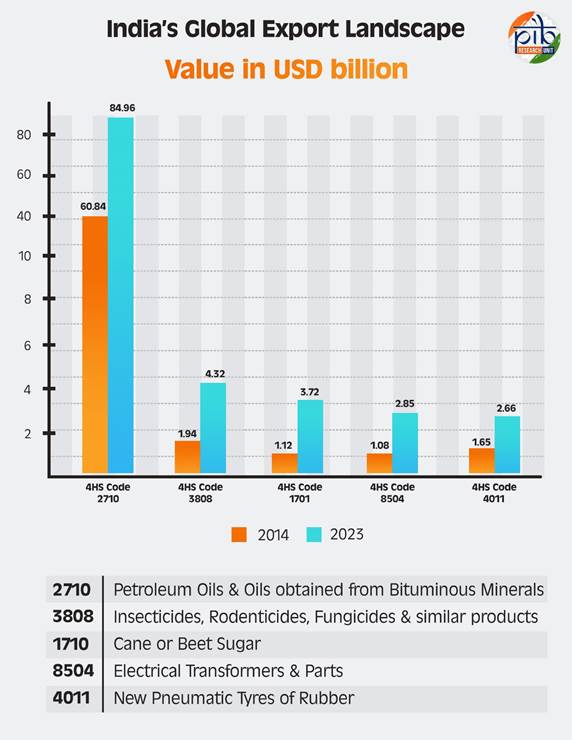
      The electronics manufacturing sector has shown significant advancements, reflected in the exports of electrical transformers and related components, which grew from $1.08 billion in 2014 to $2.85 billion in 2023. India’s global market share increased to 2.11% in 2023, and it is in 10th position, up from 17th in 2014. Government initiatives such as "Make in India" and production-linked incentive schemes have bolstered this progress, creating a robust manufacturing ecosystem.

      India has made remarkable strides in rubber pneumatic tyre exports, which reached $2.66 billion in 2023. Its global market share rose to 3.31%, securing the 8th position, a notable leap from 14th in 2014. This growth reflects India’s emphasis on quality, cost competitiveness, and the ability to serve diverse markets, particularly in emerging economies. Similarly, exports of taps, valves, and similar industrial products reached $2.12 billion in 2023, capturing a 2.16% global market share and earning India the 10th position globally. Advanced manufacturing processes and adherence to international standards have contributed to this success.
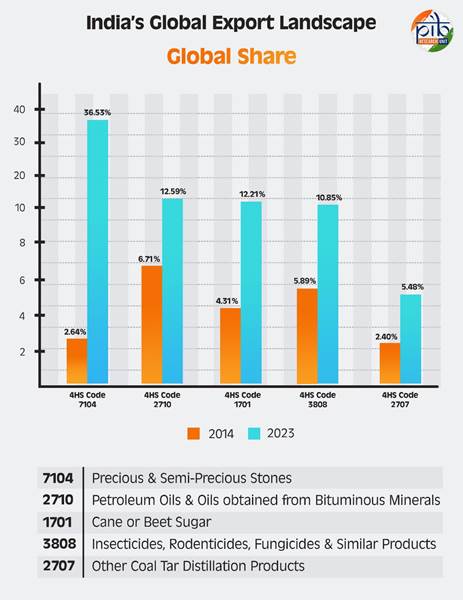
      The country’s strategic focus on electronics and semiconductors has yielded impressive results. Exports grew from $0.23 billion in 2014 to $1.91 billion in 2023, achieving a global market share of 1.40% and securing the 9th position, a significant jump from 20th in 2014. This progress highlights India’s growing role in the global semiconductor supply chain, supported by efforts to enhance domestic manufacturing and innovation. Additionally, India’s exports of coal tar distillation products reached $1.71 billion in 2023, capturing a 5.48% global market share and securing 4th place globally showcasing its importance in industrial value chains.

      In the export of precious and semi-precious stones, India has established itself as the world leader, with its global share surging from 2.64% in 2014 to an astounding 36.53% in 2023. Exports valued at $1.52 billion highlight India’s centuries-old craftsmanship and adoption of modern technology in gemstone processing. Exports of parts for electric motors and generators have also shown significant growth, reaching $1.15 billion in 2023, with a global share of 4.86%, elevating India to 6th place from 21 in 2014 globally. This growth aligns with the rising global demand for renewable energy and electric vehicle components, positioning India as a key supplier in this transformative industry.

      Government Initiatives to Strengthen India’s Export Landscape

      The Central Government has implemented various initiatives and policies to enhance exports, attract investments, and promote ease of doing business. A New Foreign Trade Policy was launched on March 31, 2023, and took effect on April 1, 2023. The policy's core approach is built on four key pillars: (i) Incentives for Remission, (ii) Export promotion through collaboration with exporters, states, districts, and Indian missions, (iii) Enhancing ease of doing business by reducing transaction costs and implementing e-initiatives, and (iv) Focus on emerging areas such as e-commerce, developing districts as export hubs, and streamlining the SCOMET (Special Chemicals Organisms Materials Equipment and Technologies) policy. It emphasizes emerging sectors like dual-use high-end technology under SCOMET, boosting e-commerce exports, and fostering collaboration between states and districts for export growth. The new Foreign Trade Policy (FTP) introduces a one-time Amnesty Scheme to help exporters clear old pending authorizations and start anew. It also promotes the recognition of new towns through the "Towns of Export Excellence Scheme" and acknowledges exporters via the "Status Holder Scheme."

      To further support exporters, the Interest Equalization Scheme on pre- and post-shipment rupee export credit has been extended until August 31, 2024, with an allocation of Rs. 12,788 crores. Assistance is also being provided through schemes like the Trade Infrastructure for Export Scheme (TIES) and the Market Access Initiative (MAI).

      To promote labour-intensive sector exports, the Rebate of State and Central Levies and Taxes (RoSCTL) Scheme has been in place since March 7, 2019, while the Remission of Duties and Taxes on Exported Products (RoDTEP) Scheme has been implemented since January 1, 2021. The RoDTEP Scheme was further expanded on December 15, 2022, to cover previously excluded sectors like pharmaceuticals, organic and inorganic chemicals, and iron and steel products. Additionally, anomalies in 432 tariff lines were addressed with revised rates effective from January 16, 2023. A Common Digital Platform for the Certificate of Origin has been launched to boost Free Trade Agreement (FTA) utilization by exporters.

      The Districts as Export Hubs initiative identifies export-potential products in each district and addresses bottlenecks while supporting local exporters and manufacturers to generate employment. Indian missions abroad play an enhanced role in promoting India’s trade, tourism, technology, and investment goals. There is regular monitoring of performance involving with Commercial Missions abroad, Export Promotion Councils, Commodity Boards/ Authorities and Industry Associations, with corrective measures implemented as needed.

      To attract domestic and foreign investments, the Government has introduced reforms such as the Goods and Services Tax (GST), corporate tax reduction, FDI policy changes, measures to reduce compliance burdens, and initiatives to boost domestic manufacturing through public procurement orders, the Phased Manufacturing Programme (PMP), and Quality Control Orders (QCOs). The Production-Linked Incentive (PLI) Schemes for 14 key sectors, with an outlay of Rs. 1.97 lakh crore, aim to enhance manufacturing capabilities and exports.

      The Government has prioritized simplifying, rationalizing, digitizing, and decriminalizing its interface with businesses and citizens across all States and UTs. Over 42,000 compliances have been reduced, and more than 3,800 provisions have been decriminalized. The National Single Window System (NSWS) allows businesses to apply for 277 Central approvals, with information on 661 approvals available through the Know Your Approvals (KYA) module. The Jan Vishwas (Amendment of Provisions) Act, 2023, promotes trust-based governance, decriminalizing 183 provisions under 42 Acts managed by 19 ministries and departments.

      India’s roadmap for 2047 emphasizes global competitiveness, innovation, and integration into global supply chains. Policy reforms have improved India’s rank in the World Bank’s Doing Business Report from 142nd in 2014 to 63rd in 2019. Also, India’s rank in the Global Innovation Index (GII) amongst 132 economies has improved from 81st in 2015 to 40th in 2023. Intellectual Property Right (IPR) reforms have boosted patent grants from 5,978 in 2014-15 to 103,057 in 2023-24, while the number of designs registered grew from 7,147 to 30,672 during the same period.

      The Startup India initiative, launched to foster innovation and entrepreneurship, has created a strong ecosystem, with 1.33 lakh DPIIT-recognized startups. Its action plan spans simplification, funding support, and industry-academia partnerships. Trade policy reforms have furthered India’s participation in global supply chains. The Foreign Trade Policy focuses on cost competitiveness, trade facilitation, and emerging sectors, provides a strong framework for promoting global supply chain participation.

      On October 13th, 2021, the Government of India launched the PM GatiShakti National Master Plan to support infrastructure and social sector planning through the PM GatiShakti NMP GIS-enabled portal. The implementation of PMGS promotes multimodal connectivity, improves last-mile connectivity, and contributes to both Ease of Doing Business and Ease of Living. To complement the PM GatiShakti NMP, the National Logistics Policy (NLP) was introduced on September 17th, 2022 with the goal of reducing logistics costs and enhancing logistics efficiency across the country. Together, these policies are driving innovation and enabling greater integration with global supply chains.

      The comprehensive Trade Connect e-Platform launch has successfully linked more than 6 lakh IEC holders, 185 Indian Mission officials, and over 600 Export Promotion Council members with the Directorate General of Foreign Trade (DGFT)/DoC offices and banks. This digital initiative improves the ease of doing business for small and medium enterprises (SMEs) by offering them valuable information and support, creating a more efficient and transparent export ecosystem. The government has rolled out Enhanced Insurance Cover for MSME Exporters to promote exports, which is expected to provide Rs. 20,000 crore in credit at reduced costs. This initiative aims to enhance the competitiveness of Indian exports and will benefit approximately 10,000 exporters.

      The self-certified electronic Bank Realization Certificate (eBRC) system reduces compliance costs, saving exporters over ₹125 crore. This system also supports the government's broader objectives of fostering a digital, eco-friendly economy, reducing both administrative and environmental costs. The bulk generation and Application Programming Interface (API) integration of eBRCs streamline the process for exporters, especially small e-commerce businesses, by efficiently managing high-volume, low-cost transactions. This system helps them claim benefits and refunds more effectively, supporting their growth in international trade.

      The E-Commerce Export Hub (ECEH) initiative aims to revolutionize India’s cross-border e-commerce, potentially reaching USD 100 billion in exports by 2030. These hubs connect SMEs, artisans, and One District One Product (ODOP) producers to global markets, boosting logistics efficiency and economic inclusion in Tier 2 and Tier 3 cities. On the Government e-Marketplace (GeM), revised pricing slabs now cap charges at ₹3 lakh for orders above Rs. 10 crore, significantly reducing transaction costs. The Bharat Mart in Dubai provides Indian MSMEs affordable access to Gulf Cooperation Council (GCC), African, and CIS markets, enhancing exports to these regions.

      Jansunwai, a platform that facilitates direct communication between stakeholders and the Government, eliminating intermediaries and saving time. A revamped National Programme of Organic Production (NPOP) is set to benefit approximately 20 lakh farmers from 5,000 grower groups through enhanced export opportunities. It is expected to drive organic exports beyond USD 1 billion by 2025-26, benefiting approximately 20 lakh farmers.

      ICEGATE (Indian Customs Electronic Commerce/Electronic Data Interchange Gateway) offers e-filing services to trade, cargo carriers, and other trading partners. Additionally, it provides facilities like e-payment, online registration for IPR, document tracking status at Customs EDI, online verification of DEPB/DES/EPCG licenses, IE code status, PAN-based CHA data, and links to various other key Customs-related websites and information. The platform also features a 24/7 helpdesk for trading partners.

      These initiatives underline the Government’s dedication to expanding India’s trade and fostering inclusive development, positioning India as a global economic powerhouse by 2047.

      Conclusion

      India’s export achievements are a testament to its evolving manufacturing capabilities, strategic policies, and commitment to innovation. From dominating the global market in precious stones to making inroads in advanced sectors like semiconductors and electrical components, India’s export journey underscores its growing economic prowess. The government's forward-looking initiatives, such as the New Foreign Trade Policy, PLI Schemes, and many others, play a pivotal role in enhancing India’s competitiveness on the global stage. As India diversifies its export portfolio and strengthens its global presence, it is poised to achieve its vision of becoming a global economic power by 2047.

      Topics

      ActsIncome Tax