

Loading...

⚠ ✕
❮ Top
☎ Help
☰
×

By creating an account you can:

Logo TaxTMI
Call Us / Help / Feedback✕

Contact Us At :

✉ E-mail: [email protected]

✆ Call / WhatsApp at: +91 99117 96707

For more information, Check Contact Us

FAQs :

To know Frequently Asked Questions, Check FAQs

Most Asked Video Tutorials :

For more tutorials, Check Video Tutorials

Submit Feedback/Suggestion :

Email :
Please provide your email address so we can follow up on your feedback.
Category :
Description :
Min 15 characters 0/2000
Make Most of Text Search ✕
  1. Checkout this video tutorial: How to search effectively on TaxTMI.
  2. Put words in double quotes for exact word search, eg: "income tax"
  3. Avoid noise words such as : 'and, of, the, a'
  4. Sort by Relevance to get the most relevant document.
  5. Press Enter to add multiple terms/multiple phrases, and then click on Search to Search.
  6. Text Search
  7. The system will try to fetch results that contains ALL your words.
  8. Once you add keywords, you'll see a new 'Search In' filter that makes your results even more precise.
  9. Text Search
╳
Add to...
You have not created any category. Kindly create one to bookmark this item!
✕
Create New Category
Hide
Title :
Description :
❮❮ Hide
❮ Default View
Expand ❯❯
Close ✕
🔎 Filters / Advanced Search ❯
TEXT

Press 'Enter' to add multiple search terms. Rules for Better Search

Search In
Main Text + AI Text ❯
  • Main Text
  • Main Text + AI Text
  • AI Text
Category: ?
Categorized by AI
---- All Categories ---- ❯
  • ---- All Categories ----
  • Income Tax
  • GST
  • Customs, DGFT & SEZ
  • FEMA & RBI
  • Corp. Laws, SEBI & IBC
  • PMLA, Black Money & ED
  • Budget
  • News and Press Release
  • PTI News
Month:
---- All Months ---- ❯
  • ---- All Months ----
  • January
  • February
  • March
  • April
  • May
  • June
  • July
  • August
  • September
  • October
  • November
  • December
Year:
---- All Years ---- ❯
  • ---- All Years ----
  • 2026
  • 2025
  • 2024
  • 2023
  • 2022
  • 2021
  • 2020
  • 2019
  • 2018
  • 2017
  • 2016
  • 2015
  • 2014
  • 2013
  • 2012
  • 2011
Sort By: ?
In Sort By 'Default', exact matches for text search are shown at the top, followed by the remaining results in their regular order.
Relevance Default Date
    ‘SATURATION APPROACH’ TO BE ADOPTED FOR INCLUSIVE AND COMPREHENSIVE RESOURCE DEVELOPMENT AND SOCIAL JUSTICE
    POLICY FOR PROMOTING PUMPED STORAGE PROJECTS TO BE BROUGHT OUT FOR ELECTRICITY STORAGE
    UNION BUDGET ANNOUNCES A VENTURE CAPITAL FUND OF ₹ 1,000 CRORE TO EXPAND THE SPACE ECONOMY BY 5 TIMES IN THE NEXT 10 YEARS
    LAND REFORM AND ACTIONS TO BE INCENTIVISED FOR COMPLETION WITHIN NEXT 3 YEARS
    TWELVE INVESTMENT-READY “PLUG AND PLAY” INDUSTRIAL PARKS TO BE CREATED UNDER NATIONAL INDUSTRIAL CORRIDOR DEVELOPMENT PROGRAMME: UNION BUDGET 2024...
    ₹ 11,11,111 CRORE ALLOCATED FOR CAPITAL EXPENDITURE IN BUDGET 2024-25
    THE FINANCE (NO. 2) BILL, 2024
    Union Budget 2024-25 (Full) + FINANCE (No.2) ACT, 2024
    Webinar on “Budgetary Schemes for 2024–25 : Strengthening Justice delivery - Strengthening India” to be organised on coming Wednesday (24th July...
    INDIA’S REAL GDP PROJECTED TO GROW BETWEEN 6.5–7 PER CENT IN 2024-25
    ECONOMIC SURVEY CONSERVATIVELY PROJECTS A REAL GDP GROWTH OF 6.5–7 PER CENT IN FY25
    PREFACE OF ECONOMIC SURVEY 2023-24 CALLS FOR STEERING THE COUNTRY THROUGH MULTIPLE COMPACTS AND CONSENSUS WITH GOVERNMENTS, PRIVATE SECTOR AND ACADMIA
    SUSTAINING AND ACCELERATING INDIA'S PROGRESS IN THE FACE OF EVOLVING CHALLENGES REQUIRES DEDICATED INVESTMENT IN STATE MACHINERY TO REINVENT AND REINV...
    INFRASTRUCTURE EXPANSION IN INDIA WITNESSES SIGNIFICANT GROWTH IN RECENT YEARS: ECONOMIC SURVEY 2023-24
    INDIAN ECONOMY NEEDS TO GENERATE NEARLY 78.5 LAKH JOBS ANNUALLY IN THE NON-FARM SECTOR UNTIL 2030 TO CATER TO THE RISING WORKFORCE
    INDIAN LABOUR MARKET WITNESSES IMPROVEMENT IN LAST SIX YEARS WITH THE UNEMPLOYMENT RATE DECLINING TO 3.2 PER CENT IN 2022-23
    STELLAR PERFORMACE OF INDIA’s BANKING AND FINANCIAL SECTOR AMIDST GLOBAL HEADWINDS
    INDIA’S EXTERNAL SECTOR SHOWS RESILIENCE AMIDST GEOPOLITICAL HEADWINDS
    GOVERNMENT'S PRUDENT MONETARY & TRADE POLICY SUPPORTED BY STRONG OUTPUT GROWTH REDUCES RETAIL INFLATION TO A FOUR-YEAR LOW OF 5.4% IN FY24
    INDIAN AGRICULTURE SECTOR IS A SUCCESS STORY: ECONOMIC SURVEY 2023-24
❮
❯
❯❯
Maximize Maximize Maximize
0 / 200
Expand Note
Add to Folder

No Folders have been created

+

Are you sure you want to delete "My most important" ?

NOTE:

News
Showing Results for :
Reset Filters
Results Found:
Show All Summaries Hide All Summaries
July 23, 2024
Show AI Summary
Saturation Approach to inclusive human resource development and social justice covering eligible people through stepped-up livelihood schemes.
The Budget adopts a Saturation Approach to achieve inclusive human resource development and social justice by covering all eligible people through education, health and capability building programmes, with stepped up implementation of targeted livelihood and enterprise schemes such as PM Vishwakarma, PM SVANidhi, National Livelihood Missions and Stand Up India to empower farmers, youth, women, artisans, self help groups, scheduled castes, scheduled tribes and street vendors.
July 23, 2024
Show AI Summary
Pumped storage policy to enable electricity storage and smooth integration of variable renewable energy into the grid.
A policy for promoting pumped storage projects will be issued to enable electricity storage and smooth integration of variable renewable energy. The Budget expands the list of exempted capital goods for solar cell and panel manufacture while discontinuing customs duty exemptions for solar glass and tinned copper interconnect. The Government will support R&D and private sector partnership for small nuclear reactors and fund indigenous deployment of Advanced Ultra Super Critical thermal technology through a public joint venture with fiscal support, alongside a roadmap to shift hard to abate industries from energy efficiency to emission targets and into the Indian Carbon Market.
July 23, 2024
Show AI Summary
Customs duty changes on electronics and PCBA reshape tariff incentives while a venture capital fund supports space economy expansion.
The budget lowers customs duty to 15 per cent on mobile phones, mobile PCBA and mobile chargers; removes customs duty, subject to conditions, on oxygen free copper for resistor manufacture and exempts certain parts for connector manufacture; and increases customs duty on PCBA of specified telecom equipment to 15 per cent. It also directs use of sectoral databases for improved data governance and proposes population scale DPI applications across multiple service areas, while establishing a venture capital fund to expand the space economy.
July 23, 2024
Show AI Summary
Land reform incentives will establish parcel identification and digitised records to enable credit flow and modern property administration.
The fiscal announcement incentivises land sector reforms to be completed within three years: rural actions include assigning a Unique Land Parcel Identification Number, digitising cadastral maps, surveying subdivisions to reflect current ownership, establishing a land registry and linking records to a farmers registry to facilitate credit and agricultural services; urban actions require digitisation of land records with GIS mapping and an IT based system for property record administration, updating and tax administration to improve the financial position of urban local bodies.
July 23, 2024
Show AI Summary
Critical Mineral Mission to boost domestic production, recycling and overseas acquisition of critical mineral assets with tech and workforce measures.
The Budget proposes twelve investment-ready "plug and play" industrial parks under the National Industrial Corridor Development Programme to provide complete infrastructure and attract investment. It also proposes a Critical Mineral Mission to promote domestic production, recycling and overseas acquisition of critical mineral assets, including technology development, workforce upskilling, an extended producer responsibility framework and financing, and to launch auctions for offshore mining blocks. Additionally, integration of the e-Shram portal and revamps of ShramSuvidha and Samadhan portals aim to streamline labour services and regulatory compliance.
July 23, 2024
Show AI Summary
Infrastructure capital allocation and interest free state loans to boost projects, plus rural connectivity and flood management support.
A major increase in capital spending prioritises infrastructure, including provision of long term interest free loans to states to support state infrastructure investment, measures to promote private investment through viability gap funding and a market based financing framework, launch of a new phase of the rural roads programme for additional habitations, and targeted irrigation, flood mitigation and disaster reconstruction assistance for affected states.
July 23, 2024
Show AI Summary
Finance (No. 2) Bill, 2024 revises income tax rates, overhauls search/block assessment rules and updates GST determination and TDS regimes.
The Bill prescribes income tax rates and surcharge for AY 2024 25, revises capital gains and withholding tax rates, inserts section 44BBC for cruise ship taxation, replaces Chapter XIV B with a new block assessment regime for search/requisition cases, introduces the Direct Tax Vivad Se Vishwas Scheme, substantially reforms TDS/TCS and procedural timelines, and inserts CGST section 74A for determination of tax short payments and related penalty and limitation rules, with numerous consequential amendments across direct and indirect tax statutes.
July 23, 2024
Show AI Summary
Union Budget 2024 25 implements wide tax changes: revised rates, new block assessment procedure and GST reforms.
The Act enacts wide ranging tax changes: revised income tax and surcharge rates and capital gains taxation rules; new special computation for cruise ship operations; amendments to withholding, collection and pre deposit requirements; replacement of search assessment procedure with a new Chapter providing block period assessment, computation of undisclosed income, timelines, limited interest/penalty rules and delegated approval requirements; introduction of the Direct Tax Vivad Se Vishwas Scheme, 2024; and numerous GST, customs and miscellaneous amendments with targeted commencement dates and delegated rule making powers.
July 22, 2024
Show AI Summary
Budgetary schemes steering justice delivery - webinar to explain allocations and procedural innovations enhancing access to justice.
Announcement of a webinar on Budgetary Schemes for 2024-25 to explain key budget allocations for justice administration, evaluate their utility for ongoing and new projects, and discuss operational implications for project planning, execution, and institutional capacity through four sessions focused on best practices, judicial insights, and procedural innovations to enhance judicial efficiency and access to justice.
July 22, 2024
Show AI Summary
Economic growth projection: India's real GDP expected to grow amid fiscal consolidation and potential external risks.
India's real GDP is projected to grow 6.5-7 per cent in 2024-25 after 8.2 per cent growth in FY24, driven by consumption and strengthening investment. Manufacturing and construction recorded strong growth while services remain the largest GVA contributor. Fiscal consolidation continued with the Union fiscal deficit at 5.6 per cent of GDP and elevated capital expenditure supporting growth. Inflation moderated to 5.4 per cent, the RBI held rates amid global uncertainty, banking asset quality improved to a 12 year low GNPA, and external balances reflected comfortable reserves and a low current account deficit, though geopolitical risks could disrupt this outlook.
July 22, 2024
Show AI Summary
Real GDP projection signals a cautious growth outlook, stressing macroeconomic stability and focus on private investment and green transition.
The Survey projects a conservative real GDP growth baseline while reporting prior year stronger growth and lower retail inflation achieved through coordinated administrative and monetary measures. It emphasises sustaining macroeconomic stability, steady monetary policy, robust bank credit expansion and rising capital market intermediation. Policy direction focuses on the six priorities of Amrit Kaal-private investment, MSME expansion, agriculture as a growth engine, financing the green transition, bridging education employment gaps, and building State capacity-to catalyse investment, employment and structural transformation while aligning climate and social sector objectives.
July 22, 2024
Show AI Summary
Tripartite compact among government, private sector and academia urged to drive jobs, skills and coordinated economic reform.
The Economic Survey 2023 24 calls for a tripartite compact among Centre and State governments, the private sector and citizens (and a related compact with academia) to sustain growth and job creation amid geopolitical and macroeconomic headwinds. It notes macroeconomic strengths-recovery in growth, contained inflation, healthier capital formation and adequate reserves-while warning of constraints on FDI and risks from NPAs and the pandemic. The Survey urges corporates to invest for the long term, targeted farm policy reform, coordinated energy transition planning, skills and health investments, and relief from regulatory compliance for small enterprises.
July 22, 2024
Show AI Summary
State capacity enhancement via competency-based training and expanded lateral entry to improve public administration outcomes.
Enhancing state capacity requires targeted investment in administrative machinery, role-specific competency development, and expanded digital delivery through the iGOT Karmayogi platform to provide tailored, need-based training and track gaps. Mission Karmayogi organises capacity challenges into manageable components and links pre-service and in-service development. The note also urges expanding transparent lateral entry into senior ministry ranks, re-imagining foundational and mid-career training, recognising tenure length for senior effectiveness, and instituting annual goal-setting and measurement conversations to ensure accountability and policy delivery at scale.
July 22, 2024
Show AI Summary
Infrastructure investment boosts road and rail network upgrades, enhancing logistics efficiency and capacity expansion nationwide.
Strategic increase in public capital expenditure has driven expansion and modernization of transport infrastructure, scaling up road construction and expanding high-speed and multi-lane corridors through corridor-based planning and Bharatmala, while promoting private investment and the development of Multi-Modal Logistics Parks to enhance freight movement and last-mile linkages. Railways received substantially higher capital allocations aimed at new lines, gauge conversion, doubling, modern rolling stock and corridor projects to reduce logistics costs and carbon emissions, supported by intensified project monitoring and streamlined land acquisition and clearances.
July 22, 2024
Show AI Summary
Employment generation imperative requires policy alignment to harness AI, gig work, agro processing and care economy for quality jobs.
The Economic Survey urges coordinated policy to generate large-scale non farm employment by aligning technological change with collective welfare: it flags AI as a major labour market disruptor requiring an Inter Agency Coordination Authority for AI and investments like the India AI Mission; endorses expanded social security for gig and platform workers under the Code on Social Security; and promotes agro processing, the care economy, green transition investments, and targeted skill and public investment measures to create inclusive, quality jobs.
July 22, 2024
Show AI Summary
Employment generation links rising youth and female participation to policy measures boosting formal jobs and wage growth.
The Survey records declining unemployment alongside rising labour force participation and worker-population ratios, with notable increases in youth and female employment. Organized manufacturing recovered above pre-pandemic levels and contributed to factory employment growth while rural nominal wages rose, supporting demand. Policy measures credited for these outcomes include EPFO payroll expansion, Aatmanirbhar Bharat Rojgar Yojana, Production Linked Incentive schemes, National Career Service and e-Shram portals, credit access reforms for self-employment, and consolidation into labour codes to promote formalisation, social security and job creation.
July 22, 2024
Show AI Summary
Financial inclusion and market development underpin sector resilience, with stronger credit, improved asset quality and regulatory coordination.
The Survey details a steady monetary policy with the repo rate unchanged and active liquidity operations, robust credit growth across banks and NBFCs led by personal, services and agricultural lending, and materially improved bank asset quality with GNPAs at a multi year low; it highlights expanded primary and secondary capital markets, surging retail participation and mutual fund AUM, and stresses digital financial inclusion and regulatory coordination (including insolvency reforms and strengthened institutional capacity) as pillars of financial stability and market development.
July 22, 2024
Show AI Summary
Export Promotion Measures strengthen trade competitiveness and ease external imbalances through logistics, digital platforms, and targeted incentives.
India's external sector shows resilience through narrowing trade and current account deficits, stronger services exports and remittances, reduced external debt to GDP ratio, and augmented foreign exchange reserves. The Government's regulatory measures to expand exports and lower logistics costs include the PM GatiShakti National Master Plan, the National Logistics Policy, digital platforms like the Unified Logistics Interface Platform and Logistics Data Bank, export credit facilitation for MSMEs, and targeted incentives including the Production Linked Incentive and Districts as Export Hubs.
July 22, 2024
Show AI Summary
Price stability reinforced through monetary tightening and supply-side measures to moderate headline inflation going forward.
Prudent coordination of fiscal and monetary policy, plus administrative supply-side measures, reduced retail and core inflation in FY24 and underpins a framework for sustaining price stability. The Survey links monetary tightening and liquidity absorption with lower core inflation, credits price adjustments and trade measures for moderating energy and food prices, and identifies interstate and rural-urban inflation differentials driven by food baskets. It recommends expanding domestic edible oil and pulse production, upgrading storage and processing, strengthening high-frequency price monitoring, and revising the Consumer Price Index using 2022-23 expenditure data.
July 22, 2024
Show AI Summary
Crop neutral incentive structures to align agricultural production with nutrition and sustainability while avoiding ad hoc market bans.
The Economic Survey 2023-24 urges a policy shift from basic food security to nutritional security, endorses crop neutral incentive structures to discourage water intensive and high emission crops, calls for smarter regulatory design of futures and options rather than bans, restricts export bans to exceptional circumstances so farmers can access higher world prices, proposes considering inflation targeting excluding food with targeted transfers for the poor, and prioritises expanding irrigated area and adopting water efficient farming and climate smart practices.

News

Back

All News

Showing Results for :
Reset Filters
No Records Found

News

Back

All News

GOVERNMENT'S PRUDENT MONETARY & TRADE POLICY SUPPORTED BY STRONG OUTPUT GROWTH REDUCES RETAIL INFLATION TO A FOUR-YEAR LOW OF 5.4% IN FY24

July 22, 2024

Contents
Plus +
Summary
Note

Note

-

Bookmark

Print

Print

CORE SERVICES INFLATION FALLS TO A NINE-YEAR LOW IN FY24

RBI EXPECTS 4.5% HEADLINE INFLATION IN FY25 & 4.1% IN FY26

ECONOMIC SURVEY RECOMMENDS REVISING CONSUMER PRICE INDEX WITH FRESH WEIGHTS AND ITEM BASKETS

ECONOMIC SURVEY ADVISES EXPANDING PULSES & OIL SEEDS CULTIVATION WHILE DEVELOPING MODERN STORAGE AND PROCESSING FACILITIES TO REDUCE INFLATIONARY PRESSURES

The Economic Survey 2023-24, that was tabled in Parliament today, lays special emphasis on controlling Prices and Inflation as 'Low and stable inflation is key to sustaining economic growth.' It states that Governments and Central Banks face the challenge of keeping inflation at a moderate level while ensuring financial stability. Achieving this delicate balance requires careful monitoring of economic indicators and taking appropriate and timely corrective actions. With the commitment of the Reserve Bank of India (RBI) to the goal of price stability and policy actions by the Central Government, India has successfully managed to keep retail inflation at 5.4 per cent in FY24, the lowest level in 4 years, since the Covid-19 pandemic period.

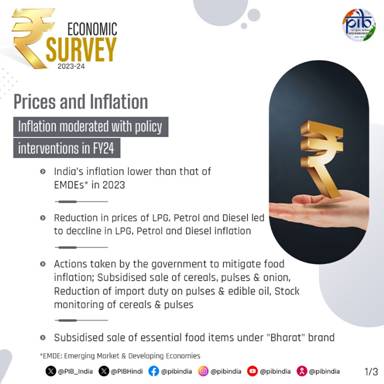
The Economic Survey highlights the fact that India's retail inflation is lower than the emerging markets & developing economies (EMDES) and world average in 2022 and 2023 as per IMF data. Survey states that factors such as established monetary policies, economic stability, well-developed and efficient markets that balance supply and demand conditions, and stable currencies contribute to the effective management of inflation. Historically, inflation in advanced economies has generally been lower than in EMDEs.
Inflation Management

With the goal of maintaining price stability, many countries have established their own inflation targets based on various factors that serve their economic objectives best. Lauding India's Inflation Management, the Economic Survey states that interestingly, India is performing better than various developed and emerging economies in relation to its inflation target. In 2023, India's inflation rate was within its target range of 2 to 6 per cent. Compared to advanced economies like the USA, Germany, and France, India had one of the lowest deviations from its inflation target in the triennial average inflation from 2021-2023. Despite the challenges posed by global demand- supply imbalances due to ongoing geopolitical tensions, India's inflation rate was 1.4 percentage points below the global average in 2023.

Since 2020, countries have been facing challenges in controlling inflation. India has been able to bring about a declining trend in Headline and Core Inflation through its prudent administrative measures and monetary policy. As per the Economic Survey, since May 2022, monetary policy broadly focused on absorbing excess liquidity in the system by increasing the policy repo rate by 250 basis points from 4 per cent in May 2022 to 6.5 per cent in February, 2023. Thereafter, the policy rate was kept unchanged by focusing on the gradual withdrawal of accommodation, aiming to align inflation with the target, while simultaneously fostering growth. Consequently, the persistent and sticky core inflation observed in FY23 declined to 3.1 per cent in June, 2024

The Survey further asserts that administrative measures such as price cuts for LPG, petrol, and diesel led to lower LPG and petroleum product inflation. LPG inflation rate has been in the deflationary zone since September 2023 while retail inflation in petrol and diesel moved to the deflationary zone in March 2024. Additionally, global commodity prices declined in 2023, reducing price pressure in energy, metals, minerals, and agricultural commodities through the imported inflation channel. Low fuel and core inflation ensured a downward trajectory for headline inflation, despite volatility in food prices in FY24. As per the recent data released by MoSPI, the retail inflation rate was 5.1 per cent in June 2024.

Core inflation, measured by excluding food and energy items from CPI headline inflation has witnessed a four year low in FY24. From the pandemic-driven highs, inflationary pressures in India eased in FY22, aided by softening food inflation. Inflationary pressures firmed up in FY23 yet again driven by the Russia-Ukraine war disrupting the recouping supply chains leading to a rise in food and fuel prices. In FY24, the price situation improved. CPI inflation moderated, driven by a decline in core inflation in both goods and services. Core services inflation eased to a nine-year low in FY24; at the same time, core goods inflation also declined to a four-year low.
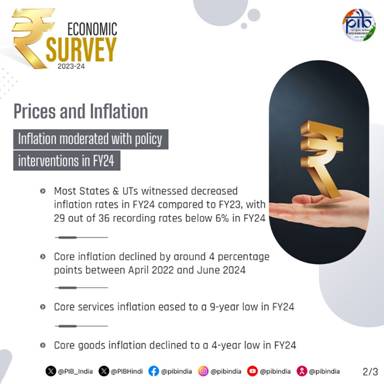
Trends in core inflation are important in determining the contours of monetary policy. Assessing the emerging patterns of price pressures, the RBI increased the repo rate gradually by 250 basis points since May 2022 to curtail inflationary pressures, leading to reduction of around 4 percentage points in core inflation between April 2022 and June 2024. This was aided by moderation in housing rental inflation, with a significant increase in the stock of new houses in 2023.

Consumer durables inflation increased progressively between FY20 and FY23 by more than 5 percentage points, mainly due to increase in gold prices in FY21 and clothing in FY22 and FY23. With the improvement in the supply of key raw materials, the inflation rate for consumer durables declined in FY24. However, record-high gold prices, driven by anticipated Fed rate cuts and escalating geopolitical uncertainty, have exerted upward pressure on overall durables inflation. Consumer non-durables (CND) inflation plunged in FY20, it started to inch up in FY21, reached an all-time in FY22, and declined sharply in FY23 and FY24.

Food Inflation has been a global phenomenon in the last two years. Research indicates the rising vulnerability of food prices to climate change. In FY23 and FY24, the agriculture sector was affected by extreme weather events, lower reservoir levels, and damaged crops that adversely affected farm output and food prices. So, food inflation based on the Consumer Food Price Index (CFPI) increased from 3.8 per cent in FY22 to 6.6 per cent in FY23 and further to 7.5 per cent in FY24. However, the government took prompt actions, including open market sales, retailing in specified outlets, and timely imports, to ensure an adequate supply of essential food items. Additionally, to ensure food security for the poor, the Pradhan Mantri Garib Kalyan Anna Yojana, which provides free food grains to more than 81 crore beneficiaries, was extended for a period of five years starting from January 2024.

Global Food Prices and Domestic Inflation

Global food prices also have an impact on domestic inflation. In India, the edible oil market is heavily depends on imports, with more than 50 per cent of the total edible oil requirement being imported, making it sensitive to global prices. The Government closely monitors global market trends to ensure the availability of edible oils for consumers at an affordable price. Efforts are also made to balance imports with domestic production to mitigate the risks associated with global price volatility. In this context, the National Mission on Edible Oils Oil Palm aims to increase domestic crude palm oil production to reduce the import burden. In the case of sugar, the Government announced restrictions on export in June 2022 to ensure sufficient local supplies and thereby manage sugar inflation. These export restrictions have indeed played a role in stabilising domestic sugar prices. As a result, even though the global sugar price index inflated and has been showing volatility since February 2023, domestic sugar prices have remained much less volatile.

Elaborating on the Interstate variations in Retail Inflation, the Economic Survey asserts that inflation rate was less than 6 per cent in 29 out of the 36 States and Union Territories. These Interstate variations in inflation are more pronounced in rural areas since rural consumption basket has a much higher weightage of food items (47.3%) than the urban (29.6%). Hence, in the last two years, States that witnessed elevated food prices also experienced higher rural inflation.

Future Inflation Projections

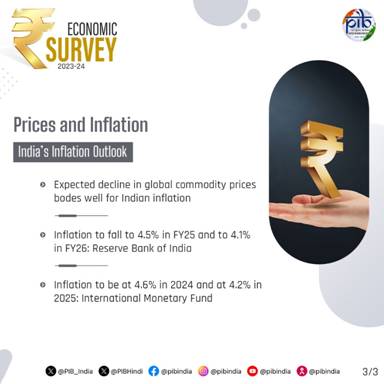
RBI and IMF have projected India's consumer price inflation will progressively align towards the inflation target in FY26. Assuming a normal monsoon and no further external or policy shocks, the RBI expects headline inflation to be 4.5 per cent in FY25 and 4.1 per cent in FY26. IMF has projected an inflation rate of 4.6 per cent in 2024 and 4.2 per cent in 2025 for India. The World Bank expects that the global supply of commodities will increase, and so will their demand due to improved industrial activity and trade growth. It projects a 3 per cent decline in the commodity price index in 2024 and a 4 per cent decrease in 2025, mainly driven by lower energy, food and fertiliser prices. The energy price index is expected to reduce due to significant declines in coal and natural gas prices this year. Fertiliser prices are likely to weaken but remain above 2015-2019 levels due to strong demand and export restrictions. Base metal prices are projected to rise, reflecting increased global industrial activity and clean energy production. In general, the current downward movement in the prices of commodities imported by India is a positive for the domestic inflation outlook.
The short-term inflation outlook for India is benign. However, from the angle of long-term price stability, the Economic Survey suggests exploring the following options as the way forward:

1. Reducing import dependence for edible oils by increasing domestic production of major oilseeds, Exploring potential of non-conventional oils such as rice bran oil and corn oil and expanding scope of National Mission on Edible Oils

2. Expand the area under pulses, particularly lentils, tur, and urad, in more districts and rice- fallow areas. Promoting the summer cultivation of urad and moong in areas with assured irrigation facilities.

3. Further improving and developing modern storage and processing facilities for vegetables, especially tomatoes and onions.

4. Improving swiftness and effectiveness of administrative action by the Government to deal with price flare-ups in specific items by collating high-frequency price monitoring data, from the farm gate to the final consumer, in a quantifiable manner. Expediting producer price index for goods and services for better grasp on episodes of cost-push inflation and

5. Revising the consumer price index with fresh weights and item baskets using Household Consumer Expenditure Survey, 2022-23.

Topics

Acts Income Tax