

Just a moment...

Top
Help
×

By creating an account you can:

Logo TaxTMI
>
Call Us / Help / Feedback

Contact Us At :

E-mail: [email protected]

Call / WhatsApp at: +91 99117 96707

For more information, Check Contact Us

FAQs :

To know Frequently Asked Questions, Check FAQs

Most Asked Video Tutorials :

For more tutorials, Check Video Tutorials

Submit Feedback/Suggestion :

Email :
Please provide your email address so we can follow up on your feedback.
Category :
Description :
Min 15 characters0/2000
Add to...
You have not created any category. Kindly create one to bookmark this item!
Create New Category
Hide
Title :
Description :
❮❮ Hide
Default View
Expand ❯❯
Close ✕
🔎 News - Adv. Search
TEXT SEARCH:

Press 'Enter' to add multiple search terms. Rules for Better Search

Search In:
Main Text + AI Text
  • Main Text
  • Main Text + AI Text
  • AI Text
Category: ?
Categorized by AI
---- All Categories ----
  • ---- All Categories ----
  • Income Tax
  • GST
  • Customs, DGFT & SEZ
  • FEMA & RBI
  • Corp. Laws, SEBI & IBC
  • PMLA, Black Money & ED
  • Budget
  • News and Press Release
  • PTI News
Month:
---- All Months ----
  • ---- All Months ----
  • January
  • February
  • March
  • April
  • May
  • June
  • July
  • August
  • September
  • October
  • November
  • December
Year:
---- All Years ----
  • ---- All Years ----
  • 2026
  • 2025
  • 2024
  • 2023
  • 2022
  • 2021
  • 2020
  • 2019
  • 2018
  • 2017
  • 2016
  • 2015
  • 2014
  • 2013
  • 2012
  • 2011
Sort By: ?
In Sort By 'Default', exact matches for text search are shown at the top, followed by the remaining results in their regular order.
RelevanceDefaultDate
    Gold set to extend record run; may hit Rs 90,000 in 2025 on global cues
    Calendar for Auction of Government of India Treasury Bills (For the Quarter ending March 2025)
    Auction for Sale (issue/re-issue) of (i) ‘6.79% GS 2034’ and (ii) ‘7.09% GS 2074’
    Gross NPAs of banks decline to 12-year low of 2.6 pc: RBI report
    Gross NPAs of banks decline to 12-yr low of 2.6 pc: RBI report
    Rupee falls 4 paise to close at 85.52 against US dollar
    Economy exhibiting resilience, GDP to grow at 6.6 pc in FY25: RBI report
    Remittix: What Is PayFi? The Newest Crypto Narrative Taking The Blockchain By Storm As Smart Money Positions Early
    Rupee falls 5 paise to 85.53 against US dollar in early trade
    Auction for Sale (issue/re-issue) of (i) ‘New GS 2031’, (ii) ‘6.92% GS 2039’ and (iii) ‘7.09% GS 2054’
    Strengthening the IBC Framework for Effective Resolution (Inaugural address delivered by Shri M. Rajeshwar Rao, Deputy Governor, Reserve Bank of India...
    DPIIT signs MoU with HDFC Bank to strengthen startup ecosystem and foster innovation
    IBC amended six times to strengthen the process of Insolvency Resolution, more than 100 amendments in regulations by IBBI for the purpose
    Auction for Sale (issue/re-issue) of (i) ‘New GS 2029’ and (ii) ‘7.34% GS 2064’
    Public Sector Banks: A Resurgent Force
    GNPA of PSBs declined from the peak of 14.58% in Mar-18 to 3.12% in Sep-24
    Prime Minister Shri Narendra Modi launches LIC’s Bima Sakhi Yojana
    Insolvency and Bankruptcy Board of India in association with INSOL India organises International Conclave 2024 on “Insolvency Resolution: Evolution ...
    Monetary Policy Statement, 2024-25 Resolution of the Monetary Policy Committee December 4 to 6, 2024
    Mitigating Climate Change Risks and Fostering a Robust Ecosystem for Sustainable Finance (Keynote address delivered by Shri M. Rajeshwar Rao, Deputy G...
❯❯
MaximizeMaximizeMaximize
0 / 200
Expand Note
Add to Folder

No Folders have been created

    +

    Are you sure you want to delete "My most important" ?

    NOTE:

    News
    Showing Results for :
    Reset Filters
    Results Found:
    Show All SummariesHide All Summaries
    December 31, 2024
    Show AI Summary
    Gold price outlook: safe haven demand and policy shifts may keep bullion elevated despite countervailing monetary and flow risks.
    Gold is expected to continue rising driven by geopolitical tensions, central bank purchases and a global move toward lower interest rates, while domestic import duty cuts have reduced local prices and spurred jewellery and investment demand; the interaction of monetary policy, currency movements, ETF flows and retail consumption will determine the pace and durability of future gains.
    December 31, 2024
    Show AI Summary
    Treasury bill issuance schedule notified with flexibility to modify auctions based on market conditions and prior notice.
    Notified schedule sets auction and issue dates for Treasury Bills across 91 day, 182 day and 364 day tenors for the quarter, with aggregate quarterly amounts. The Government, in consultation with the Reserve Bank, may modify notified amounts or timing due to market conditions or intervening events after giving due notice; auctions are governed by the standing General Notification and changes will be communicated via press releases.
    December 31, 2024
    Show AI Summary
    Government securities auction: sale and re-issue via multiple-price method with non-competitive allocation and defined bid windows.
    Auction and re-issue of two Government of India securities will be conducted by the Reserve Bank of India via price-based auctions using the multiple price method; the government may retain additional subscriptions within announced limits. Up to 5% of each notified amount is reserved for non-competitive bidders under the Scheme for Non-Competitive Bidding. Competitive and non-competitive bids must be submitted electronically on the RBI E-Kuber system within prescribed time windows. Securities will be eligible for When Issued trading under RBI guidelines.
    December 30, 2024
    Show AI Summary
    Asset quality improvement continues but rising write-offs may mask unsecured loan risks, says RBI report.
    The Financial Stability Report records a multi-year low in the aggregate GNPA ratio driven by lower slippages, higher write-offs and steady credit demand, while warning that elevated write-offs-notably in private sector banks-may mask worsening asset quality in the unsecured loan segment and dilution in underwriting standards; the report also notes a decline in the liquidity coverage ratio, improved large-borrower metrics, stronger profitability and modeled increases in GNPA under adverse scenarios.
    December 30, 2024
    Show AI Summary
    Gross non-performing assets decline, but rising write-offs and unsecured loan slippages raise concerns for bank asset quality.
    Gross non-performing assets (GNPA) of scheduled commercial banks fell to a multi year low due to lower slippages, higher write offs and steady credit demand, with fresh NPA accretion concentrated in unsecured retail loans; rising write offs-especially in private banks-may obscure weakening asset quality and diluted underwriting. Liquidity coverage declined amid higher net cash outflows, while large borrower GNPA shares fell and profitability and the banking stability indicator improved, supported by capital buffers and stronger earnings.
    December 30, 2024
    Show AI Summary
    Currency volatility: rupee pressured by importer dollar demand, foreign outflows and weak equities, with central bank support possible.
    The report explains that importer dollar demand, foreign institutional outflows and weak domestic equities caused rupee volatility and depreciation, amplified by currency futures expiries and maturing forwards; central bank intervention and reserve drawdowns have been used to smooth volatility amid pressures from higher crude prices and month-end dollar needs.
    December 30, 2024
    Show AI Summary
    Financial stability signals resilience with adequate bank capital buffers and projected GDP support for broader economic stability.
    The Financial Stability Report projects economic resilience with GDP supported by rural consumption, public investment and services exports, while identifying food-price disinflation from bumper harvests offset by inflation risks from extreme weather and geopolitical fragmentation. It highlights strengthened bank soundness-higher profitability, improved returns and lower gross non-performing assets-and reports macroprudential stress tests showing most banks maintain capital buffers above regulatory minimums; stress tests likewise validate mutual funds and clearing corporations.
    December 30, 2024
    Show AI Summary
    PayFi merges crypto and fiat payments, enabling instant cross-border transfers and driving strong token presale momentum.
    Remittix (RTX) is presented as a PayFi platform combining blockchain and traditional banking to convert cryptocurrencies to fiat and remit funds cross border via a native RTX token and Pay API. The document claims near instant settlement, single flat cross border fees, no buy/sell taxes, staking rewards based on lock up periods, completed security audits by identified firms, active presale sales, and planned listings on centralized and decentralized exchanges.
    December 30, 2024
    Show AI Summary
    Currency Depreciation pressures persist as import dollar demand, FII outflows and reserve interventions keep markets volatile.
    Rupee depreciation driven by elevated import dollar demand, foreign portfolio outflows and weak domestic equities intensified by futures expiry and maturing forwards produced sharp volatility. Reserve Bank interventions and a decline in forex reserves have partly mitigated losses, while a widening trade deficit, lower FII inflows and anticipated global volatility sustain near-term pressure on the currency.
    December 24, 2024
    Show AI Summary
    Government securities auction: multiple-price yield- and price-based auctions with non-competitive allocation and when-issued trading eligibility.
    The Government announced auctions for three central government securities using the multiple price method-one yield based and two price based-with discretionary additional subscription retention. Auctions will be conducted by the Reserve Bank of India via E Kuber, with prescribed competitive and non competitive bid windows and up to five percent of each issue reserved for the Scheme for Non Competitive Bidding Facility. Results, payment timetable, and eligibility for "When Issued" trading follow RBI guidelines.
    December 18, 2024
    Show AI Summary
    Insolvency resolution: strengthen creditor action, CoC conduct rules, RP incentives and data-driven, tech-enabled restructuring.
    The address assesses the Insolvency and Bankruptcy Code (IBC) as a key statutory resolution mechanism that has improved bank asset quality but remains constrained by delays in initiation, weak coordination in out-of-court workouts and low adoption of pre-pack processes, deficiencies in Committee of Creditors conduct, and variable capacity and incentives for Resolution Professionals; it proposes enforceable conduct norms, market-aligned RP compensation, systematic resolution data collection, technology adoption for valuation and default prediction, and closer integration between out-of-court and statutory processes to preserve enterprise value.
    December 18, 2024
    Show AI Summary
    Startup ecosystem partnership expands customised banking, mentorship and capacity-building to improve access to finance and scaling opportunities.
    An MoU creates a public-private partnership between DPIIT and HDFC Bank to provide DPIIT-supported startups with customised banking and financial products addressing working capital, credit access, and cash-flow management, while leveraging the bank's network. The collaboration also includes knowledge sharing, mentorship, and capacity-building programmes intended to strengthen the startup ecosystem, improve access to finance and investment, and support scaling and market entry for startups.
    December 17, 2024
    Show AI Summary
    Insolvency resolution of large non-bank finance companies brought under IBC framework via FSP rules, strengthening resolution process.
    Six amendments to the Insolvency and Bankruptcy Code and over one hundred regulatory changes by the Insolvency and Bankruptcy Board of India have been made to strengthen insolvency resolution, streamline implementation, and maximize asset value. Under Section 227, the Central Government, in consultation with the Reserve Bank of India, has notified that insolvency and liquidation proceedings of specified Non-Banking Finance Companies shall proceed under the Code read with the Insolvency and Bankruptcy (Insolvency and Liquidation Proceedings of Financial Service Providers and Application to Adjudicating Authority) Rules, 2019.
    December 16, 2024
    Show AI Summary
    Government securities auction using multiple price methods; non-competitive allocation and when-issued trading permitted under RBI rules.
    The Government of India announced auctions for two government securities to be conducted via the Reserve Bank of India's E-Kuber system: one through a yield-based auction using the multiple price method and the other through a price-based auction using the multiple price method, with the government retaining an option to accept additional subscriptions. Up to five percent of each issue is reserved under the Scheme for Non-Competitive Bidding. Competitive and non-competitive bids must be submitted electronically within prescribed windows; auction results and a specified settlement date will follow. The securities are eligible for When Issued trading per Reserve Bank guidelines.
    December 16, 2024
    Show AI Summary
    Decline in gross non-performing assets restores public sector bank resilience and strengthens capital adequacy and financial inclusion.
    The release reports a recovery of Public Sector Banks driven by reduced GNPA levels following the Asset Quality Review, strengthened capital buffers as reflected in higher CRAR, and institutional reforms under the EASE framework; it links these improvements to expanded branch networks, broader financial inclusion initiatives, and increased targeted credit to farmers and MSMEs, enabling reduced dependence on government recapitalisation.
    December 12, 2024
    Show AI Summary
    Banking sector asset quality improvement leads to strengthened capital, higher profitability, and expanded financial inclusion.
    Reforms since 2015 combining transparent NPA recognition, resolution and recovery, recapitalisation and systemic changes have improved PSB asset quality, strengthened capital adequacy, raised aggregate profitability and reduced reliance on government recapitalisation; parallel measures expanded financial inclusion through branch growth and targeted credit schemes and instituted uniform HR policies and enhanced welfare benefits for employees and retirees.
    December 10, 2024
    Show AI Summary
    Women insurance agent empowerment: scheme trains and pays stipends and commissions to expand female LIC agents nationwide.
    A national women focused insurance agent programme recruits women meeting basic age and educational eligibility for specialised training, provides a time limited stipend during the first three years of capacity building, and thereafter commission based earnings as LIC agents. The initiative sets recruitment targets to scale female participation, integrates with village sakhi intermediary models to enhance financial inclusion and social security outreach, and offers a pathway for trained agents to be considered for Development Officer roles within the insurer.
    December 9, 2024
    Show AI Summary
    Insolvency resolution reforms prioritize reducing delays and promoting mediation, creditor led processes, and investor facilitation in stressed assets.
    Speakers highlighted the transformative role of the Insolvency and Bankruptcy Code (IBC) in improving bank asset quality and debtor creditor behaviour, emphasising regulatory reforms to reduce delays and maximise asset value. Attention was given to mediation, creditor led resolution, group insolvency mechanisms, investor facilitation in stressed assets, and cross border enforcement issues-all aimed at strengthening resolution efficacy and market infrastructure.
    December 6, 2024
    Show AI Summary
    Monetary policy stance: neutral maintained and policy rate unchanged to prioritize durable inflation alignment while supporting growth.
    The MPC kept the policy repo rate unchanged and maintained corresponding liquidity facility rates, while continuing a neutral monetary policy stance focused on durable alignment of CPI inflation with the medium term target within the tolerance band, alongside supporting growth; the Committee highlighted near term upside risks to inflation from food and input costs, geopolitical uncertainty and market volatility, and recorded a minority vote in favour of a rate reduction.
    December 4, 2024
    Show AI Summary
    Climate-related financial risk: regulators push stronger disclosures, data infrastructure and capacity building to enable sustainable finance.
    Climate-related financial risks - both physical and transition - threaten price and financial stability by interacting with credit, market, liquidity and operational risks and can be amplified through interconnectedness and cross-border linkages. Effective regulatory response requires prudential safeguards plus enabling measures: disclosure standards, capacity building, inter-regulatory coordination, and improved data infrastructure. The Reserve Bank proposes measures including climate risk surveys, a draft disclosure framework, guidance on green deposits, and creation of a standardised data repository (RB-CRIS) to address fragmented climate data and support credible scenario analysis and sustainable finance mobilization.

    News

    Back

    All News

    Showing Results for :
    Reset Filters
      No Records Found

      News

      Back

      All News

      whatsappJoin Channel
      Showing Results for : Reset Filters

      Monetary Policy Statement, 2024-25 Resolution of the Monetary Policy Committee December 4 to 6, 2024

      December 6, 2024

      Contents
      Summary
      Note

      Note

      -

      Bookmark

      Print

      Print

      Monetary Policy Decisions

      After assessing the current and evolving macroeconomic situation, the Monetary Policy Committee (MPC) at its meeting today (December 6, 2024) decided to:

      • Keep the policy repo rate under the liquidity adjustment facility (LAF) unchanged at 6.50 per cent.

      Consequently, the standing deposit facility (SDF) rate remains unchanged at 6.25 per cent and the marginal standing facility (MSF) rate and the Bank Rate at 6.75 per cent.

      • The MPC also decided to continue with the neutral monetary policy stance and to remain unambiguously focused on a durable alignment of inflation with the target, while supporting growth.

      These decisions are in consonance with the objective of achieving the medium-term target for consumer price index (CPI) inflation of 4 per cent within a band of +/- 2 per cent, while supporting growth.

      Growth and Inflation Outlook

      2. The global economy remains stable with growth holding up amidst waning inflation, albeit at a slow pace. Geopolitical risks and policy uncertainty, especially with respect to trade policies, have imparted heightened volatility to global financial markets.

      3. On the domestic front, real gross domestic product (GDP) registered a lower than expected growth of 5.4 per cent in Q2:2024-25 as private consumption and investment decelerated even while government spending recovered from a contraction in the previous quarter. On the supply side, the growth in gross value added (GVA) during Q2 was aided by resilient services and improving agriculture sector, but weakness in industrial activity – manufacturing, electricity and mining – tempered overall growth. Looking ahead, robust kharif foodgrain production and good rabi prospects, coupled with an expected pickup in industrial activity and sustained buoyancy in services augur well for private consumption. Investment activity is expected to pick up. Resilient world trade prospects should provide support to external demand and exports. Headwinds from geo-political uncertainties, volatility in international commodity prices, and geo-economic fragmentation continue to pose risks to the outlook. Taking all these factors into consideration, real GDP growth for 2024-25 is projected at 6.6 per cent with Q3 at 6.8 per cent; and Q4 at 7.2 per cent. Real GDP growth for Q1:2025-26 is projected at 6.9 per cent; and Q2 at 7.3 per cent (Chart 1). The risks are evenly balanced.

      4. Headline CPI inflation surged above the upper tolerance level to 6.2 per cent in October from 5.5 per cent in September and sub-4.0 per cent prints in July-August, propelled by a sharp pick-up in food inflation and an uptick in core (CPI excluding food and fuel) inflation. Going forward, food inflation is likely to soften in Q4 with seasonal easing of vegetables prices and kharif harvest arrivals; and good soil moisture conditions along with comfortable reservoir levels auguring well for rabi production. Adverse weather events and rise in international agricultural commodity prices, however, pose upside risks to food inflation. Even though energy prices have softened in the recent past, its sustenance needs to be monitored. Businesses expect pressures from input costs to remain elevated and growth in selling prices to accelerate from Q4.1 Taking all these factors into consideration, CPI inflation for 2024-25 is projected at 4.8 per cent with Q3 at 5.7 per cent; and Q4 at 4.5 per cent. CPI inflation for Q1:2025-26 is projected at 4.6 per cent; and Q2 at 4.0 per cent (Chart 2). The risks are evenly balanced.
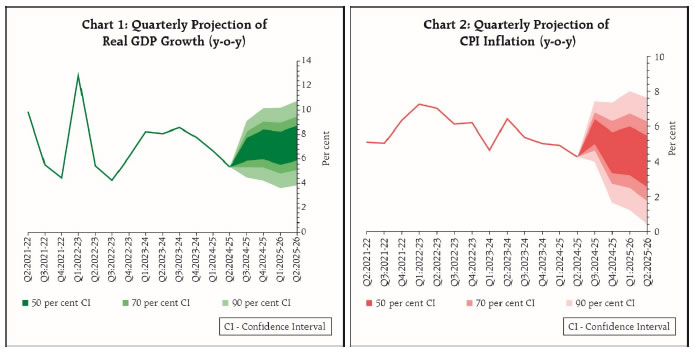
      Chart_1and2

      Rationale for Monetary Policy Decisions

      5. The MPC noted that the near-term inflation and growth outcomes in India have turned somewhat adverse since the October policy. Going forward, however, economic activity is set to improve along with rising business and consumer sentiments, as reflected in the Reserve Bank’s surveys. The recent spike in inflation highlights the continuing risks of multiple and overlapping shocks to the inflation outlook and expectations. Heightened geo-political uncertainties and financial market volatility add further upside risks to inflation. High inflation reduces the purchasing power of both rural and urban consumers and may adversely impact private consumption. The MPC emphasises that strong foundations for high growth can be secured only with durable price stability. The MPC remains committed to restoring the balance between inflation and growth in the overall interest of the economy. Accordingly, the MPC decided to keep the policy repo rate unchanged at 6.50 per cent in this meeting. The MPC also decided to continue with the neutral stance of monetary policy as it provides flexibility to monitor the progress and outlook on disinflation and growth and to act appropriately. The MPC remains unambiguously focused on a durable alignment of inflation with the target, while supporting growth.

      6. Shri Saugata Bhattacharya, Dr. Rajiv Ranjan, Dr. Michael Debabrata Patra and Shri Shaktikanta Das voted to keep the policy repo rate unchanged at 6.50 per cent. Dr. Nagesh Kumar and Professor Ram Singh voted to reduce the policy repo rate by 25 basis points.

      7. Dr. Nagesh Kumar, Shri Saugata Bhattacharya, Professor Ram Singh, Dr. Rajiv Ranjan, Dr. Michael Debabrata Patra and Shri Shaktikanta Das voted for continuing with the neutral stance of monetary policy and to remain unambiguously focused on a durable alignment of inflation with the target, while supporting growth.

      8. The minutes of the MPC’s meeting will be published on December 20, 2024.

      9. The next meeting of the MPC is scheduled during February 5 to 7, 2025.

      (Puneet Pancholy)  
      Chief General Manager

      Topics

      ActsIncome Tax