

Just a moment...

Top
Help
×

By creating an account you can:

Logo TaxTMI
>
Call Us / Help / Feedback

Contact Us At :

E-mail: [email protected]

Call / WhatsApp at: +91 99117 96707

For more information, Check Contact Us

FAQs :

To know Frequently Asked Questions, Check FAQs

Most Asked Video Tutorials :

For more tutorials, Check Video Tutorials

Submit Feedback/Suggestion :

Email :
Please provide your email address so we can follow up on your feedback.
Category :
Description :
Min 15 characters0/2000
Add to...
You have not created any category. Kindly create one to bookmark this item!
Create New Category
Hide
Title :
Description :
❮❮ Hide
Default View
Expand ❯❯
Close ✕
🔎 News - Adv. Search
TEXT SEARCH:

Press 'Enter' to add multiple search terms. Rules for Better Search

Search In:
Main Text + AI Text
  • Main Text
  • Main Text + AI Text
  • AI Text
Category: ?
Categorized by AI
---- All Categories ----
  • ---- All Categories ----
  • Income Tax
  • GST
  • Customs, DGFT & SEZ
  • FEMA & RBI
  • Corp. Laws, SEBI & IBC
  • PMLA, Black Money & ED
  • Budget
  • News and Press Release
  • PTI News
Month:
---- All Months ----
  • ---- All Months ----
  • January
  • February
  • March
  • April
  • May
  • June
  • July
  • August
  • September
  • October
  • November
  • December
Year:
---- All Years ----
  • ---- All Years ----
  • 2026
  • 2025
  • 2024
  • 2023
  • 2022
  • 2021
  • 2020
  • 2019
  • 2018
  • 2017
  • 2016
  • 2015
  • 2014
  • 2013
  • 2012
  • 2011
Sort By: ?
In Sort By 'Default', exact matches for text search are shown at the top, followed by the remaining results in their regular order.
RelevanceDefaultDate
    Calendar for Auction of Government of India Treasury Bills (For the Quarter ending March 2023)
    Auction for Sale (re-issue) of (i) ‘6.69% GS 2024’, (ii) ‘7.10% GS 2029’, (iii) ‘7.41% GS 2036’, (iv) ‘7.40% GS 2062’
    Challenges and Opportunities in Scaling up Green Finance (Address by Shri M. Rajeshwar Rao, Deputy Governor, Reserve Bank of India - December 22, 2022...
    Auction for Sale (re-issue) of (i)’7.38% GS 2027’, (ii) ‘7.26% GS 2032’, (iii) ‘7.36% GS 2052’
    Sovereign Gold Bond Scheme 2022-23 (Series III) – Issue Price
    India hosts the 1st G20 Finance and Central Bank Deputies (FCBD) meeting under the G20 India Presidency in Bengaluru, Karnataka
    Auction for Sale (issue/re-issue) of (i) ‘6.69% GS 2024’, (ii) ‘7.10% GS 2029’, (iii) New GS 2036 (iv) ‘7.40% GS 2062’
    More than 37.76 crore loans amounting to over Rs. 20.43 lakh crore disbursed since inception of Pradhan Mantri Mudra Yojana
    More than 12 lakh loans extended in rural areas across the country between April, 2020 and November, 2022
    94 Financial Institutions onboarded on Account Aggregator (AA) platform as Financial Information User (FIU) 26 Financial Institutions onboard as Finan...
    DICGC settles deposit insurance claims of 3,06,146 eligible depositors of 35 banks under AID, amounting to ₹4,055.10 crore since inception
    Central Bank Digital Currency (CBDC) pilot launched by RBI in retail segment has components based on blockchain technology
    Capacity Building in the Financial Sector in the face of Emerging Challenges (Speech delivered by Shri M K Jain, Deputy Governor, Reserve Bank of Indi...
    Most sectors except certain strategically important sectors open for 100% FDI under the automatic route
    Monetary Policy Statement, 2022-23 Resolution of the Monetary Policy Committee (MPC) December 5-7, 2022
    Auction for Sale (re-issue) of (i) ‘7.38% GS 2027’, (ii) ‘7.26% GS 2032’, (iii) ‘7.36% GS 2052’
    Sale of Electoral Bonds at Authorized Branches of State Bank of India (SBI)
    Financial Benchmarks in India: A Coming of Age (Speech delivered by Shri T. Rabi Sankar, Deputy Governor, Reserve Bank of India - November 28, 2022 - ...
    Signing of arrangement regarding Republic of Korea’s Economic Development Cooperation Fund (EDCF) loan to India
    Auction for Sale (re-issue) of (i) ‘6.69% GS 2024’, (ii) ‘7.10% GS 2029’, (iii) ‘7.54% GS 2036’, (iv) ‘7.40% GS 2062
❯❯
MaximizeMaximizeMaximize
0 / 200
Expand Note
Add to Folder

No Folders have been created

    +

    Are you sure you want to delete "My most important" ?

    NOTE:

    News
    Showing Results for :
    Reset Filters
    Results Found:
    Show All SummariesHide All Summaries
    December 30, 2022
    Show AI Summary
    Treasury bill auction schedule announced with flexibility to modify timing and amounts in response to cash needs and markets.
    Notification sets the quarterly auction calendar and allocations for 91 day, 182 day and 364 day Treasury Bills for Jan-Mar 2023, with aggregate quarterly totals; it provides that the Government, in consultation with the Reserve Bank of India, may modify amounts or auction timing in response to cash requirements and market conditions after giving due notice, and that auctions are subject to the terms and conditions of General Notification No. F.No.4(2)-W&M/2018 (as amended).
    December 26, 2022
    Show AI Summary
    Government securities auction re issue announced with mixed pricing methods and non competitive allocation reserved and specified settlement dates.
    Re issue auctions are announced for four Central Government securities with specified notified nominal amounts, to be conducted by the Reserve Bank of India. Three securities will be sold by price based auction using the uniform price method and one by multiple price method. The Government may retain additional subscription up to a stated amount for each security. Up to five percent of each notified amount is reserved for eligible individuals and institutions under the non competitive bidding facility. Bids are to be submitted electronically on E Kuber within prescribed time windows; auction results, payment dates, and when issued trading eligibility are set as per RBI guidelines.
    December 22, 2022
    Show AI Summary
    Climate-related financial risks demand disclosures, data, scenario analysis and regulatory tools to scale credible green finance.
    Climate-related financial risks require regulated entities to both channel finance to carbon-efficient sectors and strengthen risk management for physical, transition, legal and reputational exposures. Effective action depends on four interlinked building blocks: decision-useful disclosures, high-quality granular data, macro-level vulnerabilities analysis including scenario-based stress testing, and calibrated regulatory and supervisory tools. A formal taxonomy, third-party verification, capacity building, and fine-tuning of prudential frameworks are necessary to scale green finance and limit greenwashing while supporting the national transition agenda.
    December 19, 2022
    Show AI Summary
    Government securities auction: re-issue use of uniform and multiple price methods with non-competitive allocation provision.
    Re-issue auctions are announced for three Central Government securities, using uniform price auctions for two and a multiple price auction for one, with notified nominal amounts and a government option to accept additional subscriptions up to a stated ceiling per security. Up to a specified proportion of each notified amount is reserved for eligible individuals and institutions under the Scheme for Non-Competitive Bidding Facility. Competitive and non-competitive bids must be submitted electronically on the Reserve Bank's E-Kuber platform within designated time windows; auction results, payment schedule and eligibility for When Issued trading are provided in accordance with Reserve Bank guidelines.
    December 17, 2022
    Show AI Summary
    Sovereign Gold Bond issue price set for recent series; discount permitted for online digital payment applicants.
    Sovereign Gold Bonds Series III are open for subscription December 19-23, 2022, with settlement on December 27, 2022; the issue price is fixed at Rs 5,409 per gram, and a conditional Rs 50 per gram discount applies to investors who apply online and pay through digital modes, resulting in a reduced issue price for such eligible applicants.
    December 14, 2022
    Show AI Summary
    G20 Finance Track priorities outline India's agenda on MDB strengthening, climate finance, international taxation and financial inclusion.
    India convened the inaugural G20 Finance and Central Bank Deputies meeting to shape Finance Track priorities, focusing on global macroeconomic risks, strengthening the International Financial Architecture through enhanced MDB effectiveness and a stronger global financial safety net, advancing Sustainable Finance and climate finance for SDGs, infrastructure finance for resilient cities, monitoring implementation of the Two-Pillar international tax framework and improving tax transparency, coordinating finance and health policy for pandemic preparedness, and promoting financial inclusion alongside financial stability.
    December 12, 2022
    Show AI Summary
    Government securities auction procedures: issuance methods, non-competitive allocation, electronic bidding and when-issued trading eligibility announced.
    The Government announced auctions of four central government securities with specified notified nominal amounts, using price-based (uniform price) and yield-based methods and one multiple price auction; GoI may retain additional subscriptions against each security. Up to 5% of each notified amount is reserved for eligible applicants under the Non-Competitive Bidding scheme. Both competitive and non-competitive bids must be submitted electronically on the RBI E-Kuber system within stated time windows; auction results and payment dates are scheduled and the securities qualify for when-issued trading under RBI guidelines.
    December 12, 2022
    Show AI Summary
    Collateral-free credit under PMMY expanded microenterprise lending and supported notable employment generation and loan disbursements.
    Pradhan Mantri Mudra Yojana provides collateral-free institutional credit up to ten lakh through Member Lending Institutions to eligible individuals with business plans for income-generating activities in manufacturing, trading, services and agriculture allied sectors, delivered via three tiered loan products: Shishu, Kishore and Tarun.
    December 12, 2022
    Show AI Summary
    Deregulation of bank credit enables increased rural lending after the Covid period under banks' own lending policies.
    Banks extended substantial numbers of loans in rural areas after the Covid period, with public sector banks reporting over twelve lakh loans between April 2020 and November 2022, and banks providing credit to youths for setting up enterprises. Credit decisions, including interest rates, are governed by banks' internal lending policies following the Reserve Bank circular of 9 April 2010, which deregulated credit matters and permits banks to set terms within regulatory guidelines considering cost of funds, margins and risk premiums. Establishment of industries remains a State subject.
    December 12, 2022
    Show AI Summary
    Account Aggregator adoption expands as financial institutions and providers join the consent-based financial data-sharing network.
    A substantial number of financial entities have joined the Account Aggregator ecosystem as Financial Information Users and Financial Information Providers, a tax information network has been included as a Provider, and multiple companies have been granted Certificates of Registration to operate as Account Aggregators. The AA network, established under the NBFC Account Aggregator master direction, is a consent-driven financial data sharing system that operates only on an individual's direction and consent and underpins credit and investment facilitation.
    December 12, 2022
    Show AI Summary
    Deposit insurance access via interim payments after All Inclusive Directions, with mandatory depositor lists and time-bound settlement.
    Amendments require DICGC to make interim payments of insured deposits up to five lakh within the statutory settlement period after imposition of All Inclusive Directions; banks under AID must furnish a verified depositor list showing net outstanding deposits within the prescribed furnishing period, and DICGC must settle claims within the statutory timeline. DICGC implemented this regime by settling claims for over three lakh depositors of thirty-five banks between 1 September 2021 and 30 November 2022, with attendant recoveries and some banks entering liquidation after payments.
    December 12, 2022
    Show AI Summary
    Central Bank Digital Currency pilot expands retail blockchain-based token as legal tender with phased bank participation and wallets.
    The retail pilot (eRs.-R) operates within a closed user group through participating banks offering digital wallets; the eRs.-R is a digital token representing legal tender, issued in the same denominations as banknotes and coins, distributable via financial intermediaries, and supporting P2P and P2M transactions while preserving features of cash including trust, safety and settlement finality.
    December 9, 2022
    Show AI Summary
    Capacity building in the financial sector boosts resilience through supervisory modernisation, technology adoption and workforce upskilling.
    Capacity building is essential to bolster financial sector resilience through supervisory enhancements, technology adoption and human resource development. RBI measures combined calibrated liquidity and regulatory interventions with market based resolution methods while strengthening offsite supervision, data quality, automated asset classification and Sup tech deployment. Banks must modernise legacy systems, scale technology investment, foster continuous innovation, collaborate for synergies, and ensure data privacy. Realising benefits from data analytics and digital pilots requires concurrent upskilling, research capacity and adequate infrastructure so training yields operational capacity.
    December 7, 2022
    Show AI Summary
    Full FDI automatic route policy expands investor access while DPIIT reforms and bank consolidation improve ease of doing business.
    The Government allows full foreign direct investment under the automatic route in most sectors, with ongoing policy review and stakeholder consultation to keep the regime investor friendly. DPIIT implements the Business Reforms Action Plan to streamline regulations and promote competitive federalism among States/UTs. Public Sector Bank reforms and amalgamations are pursued to consolidate banks, achieve economies of scale, harmonise products and services, expand branch and ATM access, accelerate loan processing, and enable wider digital lending and customer servicing.
    December 7, 2022
    Show AI Summary
    Monetary policy rate hike tightens liquidity stance to anchor inflation expectations and support balanced growth.
    The Monetary Policy Committee raised the policy repo rate and shifted to withdrawal of accommodation to anchor inflation expectations and break persistent core inflation, while signalling further calibrated action as needed to return inflation to the medium-term target and to support growth; the resolution adjusts related liquidity rates and records divergent votes and procedural timetable for minutes and the next meeting.
    December 5, 2022
    Show AI Summary
    Government securities auction re-issue: uniform and multiple price methods with non competitive allocation and when issued trading eligibility.
    Re-issue auctions for three government securities will be conducted using uniform price and multiple price methods with Government option to retain additional subscriptions; up to five percent allocation reserved for eligible individuals and institutions under the non-competitive bidding facility. Competitive and non-competitive bids must be submitted electronically via the RBI E-Kuber system within prescribed windows on the auction date; results and payment dates are scheduled and the securities are eligible for when issued trading under RBI guidelines.
    December 3, 2022
    Show AI Summary
    Electoral Bonds: sale and encashment limited to eligible purchasers and registered political parties, processed through authorized bank branches.
    Electoral Bonds are purchasable only by Indian citizens or entities incorporated/established in India; individuals may buy singly or jointly. Only political parties registered under Section 29A that secured at least one per cent of votes in the relevant last General Election are eligible to receive and encash bonds. Encashment must occur through the party's bank account with an authorized bank; bonds are valid for fifteen calendar days and, if deposited within validity, are credited to the party's account the same day. A specified authorized bank was designated to issue and encash bonds through listed authorized branches for the sale phase.
    December 1, 2022
    Show AI Summary
    Financial benchmarks robustness: transition to transaction based rates and enhanced governance to protect market integrity.
    Financial benchmarks must be reliable, representative and transaction based to support price integrity and stability. India has reformed benchmark administration-creating a dedicated administrator and regulatory Directions for significant benchmarks-and migrated key rates toward transaction based methodologies. Persistent challenges include shrinking unsecured call market volumes underpinning MIBOR, low secondary liquidity for term instruments, concentrated g sec liquidity across tenors, and market segmentation between onshore and offshore venues. Strengthening benchmarks requires participant diversification, removal of taxation/accounting impediments, interoperable market infrastructure, and calibrated oversight to guard against extra territorial regulatory disruption.
    November 30, 2022
    Show AI Summary
    Economic Development Cooperation Fund loan supports intelligent transport system project, enhancing traffic and toll management via technology transfer.
    Economic Development Cooperation Fund (EDCF) loan arrangement executed to finance establishment of an Intelligent Transport System and associated ITS infrastructure on the Nagpur-Mumbai Super Communication Expressway, including an Intelligent Traffic Management System, traffic centre, and Toll Collection System, with provision for a sustainable operation and maintenance model through technology transfer from the Republic of Korea; Korea designated as India's Official Development Assistance partner and this is the first EDCF-funded project.
    November 29, 2022
    Show AI Summary
    Government securities auction: re issue via price and multiple price methods with non competitive bidding facility and electronic submission requirement.
    Re issue auctions for four central government securities are announced with notified nominal amounts and an option to retain additional subscriptions. Three securities will be offered by price based auction using the uniform price method and one by multiple price method. Up to 5% of each notified amount is reserved for eligible individuals and institutions under the Non Competitive Bidding Facility. Competitive and non competitive bids must be submitted electronically through the central bank's core banking auction system within prescribed time windows, and the securities are eligible for When Issued trading under the central bank's guidelines.

    News

    Back

    All News

    Showing Results for :
    Reset Filters
      No Records Found

      News

      Back

      All News

      whatsappJoin Channel
      Showing Results for : Reset Filters

      Monetary Policy Statement, 2022-23 Resolution of the Monetary Policy Committee (MPC) December 5-7, 2022

      December 7, 2022

      Contents
      Summary
      Note

      Note

      -

      Bookmark

      Print

      Print

      On the basis of an assessment of the current and evolving macroeconomic situation, the Monetary Policy Committee (MPC) at its meeting today (December 7, 2022) decided to:

      • Increase the policy repo rate under the liquidity adjustment facility (LAF) by 35 basis points to 6.25 per cent with immediate effect.

      Consequently, the standing deposit facility (SDF) rate stands adjusted to 6.00 per cent and the marginal standing facility (MSF) rate and the Bank Rate to 6.50 per cent.

      • The MPC also decided to remain focused on withdrawal of accommodation to ensure that inflation remains within the target going forward, while supporting growth.

      These decisions are in consonance with the objective of achieving the medium-term target for consumer price index (CPI) inflation of 4 per cent within a band of +/- 2 per cent, while supporting growth.

      The main considerations underlying the decision are set out in the statement below.

      Assessment

      Global Economy

      2. The global economic outlook is skewed to the downside. Global growth is set to lose momentum as monetary policy actions tighten financial conditions and as consumer confidence weakens with the rising cost of livelihood. Inflation remains elevated and persistent across countries as they grapple with food and energy price shocks and shortages. More recently, however, there are some signs of moderation in price pressures, which have raised expectations of an easing in the pace of monetary tightening. Alongside easing in sovereign bond yields, the US dollar has come off its highs. Capital flows to emerging market economies (EMEs) remain volatile and global spillovers pose risks to growth prospects.

      Domestic Economy

      3. On the domestic front, real gross domestic product (GDP) increased by 6.3 per cent year-on-year (y-o-y) in Q2:2022-23 after an increase of 13.5 per cent in Q1. On the supply side, gross value added (GVA) rose by 5.6 per cent in Q2.

      4. In Q3, economic activity is exhibiting resilience. In the agricultural sector, a pick-up in rabi sowing (6.4 per cent higher than a year ago on December 2) is supported by the good progress of the north-east monsoon and above average reservoir levels. Activity in the industry and services sectors is in expansion mode, as reflected in purchasing managers’ indices (PMIs) and other high frequency indicators.

      5. Aggregate demand conditions have been supported by pent-up spending and discretionary expenditures during the festival season, although their evolution is somewhat uneven across sectors. Urban demand has remained buoyant, and rural demand is recovering. Investment activity is in modest expansion. Merchandise exports contracted in October after an expansion for 19 consecutive months. Growth in non-oil non-gold imports decelerated.

      6. CPI inflation moderated to 6.8 per cent (y-o-y) in October 2022 from 7.4 per cent in September, with favourable base effects mitigating the impact of pick-up in price momentum in October. Food inflation softened, aided by easing inflation in vegetables and edible oils, despite sustained pressures from prices of cereals, milk and spices. Fuel inflation registered some easing in October, driven by softening of price inflation in LPG, kerosene (PDS) and firewood and chips. Core CPI (i.e., CPI excluding food and fuel) inflation persisted at elevated levels at 6 per cent, with price pressures across most of its constituent sub-groups.

      7. The overall liquidity remains in surplus, with average daily absorption under the liquidity adjustment facility (LAF) at ₹1.4 lakh crore during October-November as compared with ₹2.2 lakh crore in August-September. On a y-o-y basis, money supply (M3) expanded by 8.9 per cent as on November 18, 2022 while bank credit rose by 17.2 per cent. India’s foreign exchange reserves were placed at US$ 561.2 billion as on December 2, 2022.

      Outlook

      8. The inflation trajectory going ahead would be shaped by both global and domestic factors. In case of food, while vegetable prices are likely to see seasonal winter correction, prices of cereals and spices may stay elevated in the near-term on supply concerns. High feed costs could also keep inflation elevated in respect of milk. Adverse climate events – both domestic and global – are increasingly becoming a significant source of upside risk to food prices. Global demand is weakening. Unabating geopolitical tensions continue to impart uncertainty to the food and energy prices outlook. The correction in industrial input prices and supply chain pressures, if sustained, could help ease pressures on output prices; but the pending pass-through of input costs could keep core inflation firm. Imported inflation risks from the US dollar movements need to be watched closely. Taking into account these factors and assuming an average crude oil price (Indian basket) of US$ 100 per barrel, inflation is projected at 6.7 per cent in 2022-23, with Q3 at 6.6 per cent and Q4 at 5.9 per cent, and risks evenly balanced. CPI inflation for Q1:2023-24 is projected at 5.0 per cent and for Q2 at 5.4 per cent, on the assumption of a normal monsoon (Chart 1).

      9. On growth, the agricultural outlook has brightened, with the prospects of a good rabi harvest. The sustained rebound in contact-intensive sectors is supporting urban consumption. Robust and broad-based credit growth and government’s thrust on capital spending and infrastructure should bolster investment activity. According to the RBI’s survey, consumer confidence is improving. The economy, however, faces accentuated headwinds from protracted geopolitical tensions, tightening global financial conditions and slowing external demand. Taking all these factors into consideration, the real GDP growth for 2022-23 is projected at 6.8 per cent with Q3 at 4.4 per cent and Q4 at 4.2 per cent, with risks evenly balanced. Real GDP growth is projected at 7.1 per cent for Q1:2023-24 and at 5.9 per cent for Q2 (Chart 2).
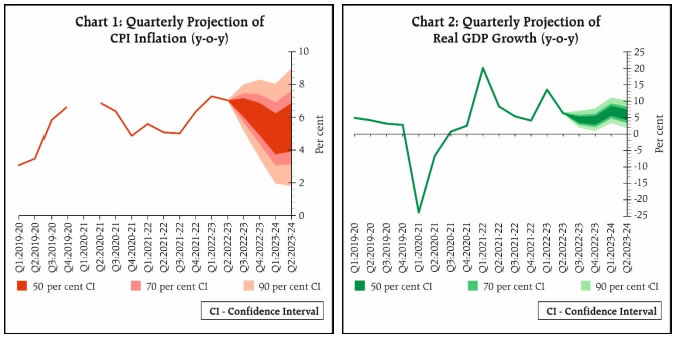
      Chart 1 and Chart 2

      10. Inflation has ruled at or above the upper tolerance band since January 2022 and core inflation is persisting around 6 per cent. Headline inflation is expected to remain above or close to the upper threshold in Q3 and Q4:2022-23. It is likely to moderate in H1:2023-24 but will still remain well above the target. Meanwhile, economic activity has held up well and is expected to be resilient, supported by domestic demand. Net exports would remain subdued due to the drag from evolving external demand conditions. Further, the impact of monetary policy measures undertaken needs to be watched. On balance, the MPC is of the view that, further calibrated monetary policy action is warranted to keep inflation expectations anchored, break the core inflation persistence and contain second round effects, so as to strengthen medium-term growth prospects. Accordingly, the MPC decided to increase the policy repo rate by 35 basis points to 6.25 per cent. The MPC also decided to remain focused on withdrawal of accommodation to ensure that inflation remains within the target going forward, while supporting growth.

      11. Dr. Shashanka Bhide, Dr. Ashima Goyal, Dr. Rajiv Ranjan, Dr. Michael Debabrata Patra and Shri Shaktikanta Das voted to increase the policy repo rate by 35 basis points. Prof. Jayanth R. Varma voted against the repo rate hike.

      12. Dr. Shashanka Bhide, Dr. Rajiv Ranjan, Dr. Michael Debabrata Patra and Shri Shaktikanta Das voted to remain focused on withdrawal of accommodation to ensure that inflation remains within the target going forward, while supporting growth. Dr. Ashima Goyal and Prof. Jayanth R. Varma voted against this part of the resolution.

      13. The minutes of the MPC’s meeting will be published on December 21, 2022.

      14. The next meeting of the MPC is scheduled during February 6-8, 2023.

      (Yogesh Dayal)     
      Chief General Manager

      Topics

      ActsIncome Tax