

Just a moment...

Top
Help
×

By creating an account you can:

Logo TaxTMI
>
Call Us / Help / Feedback

Contact Us At :

E-mail: [email protected]

Call / WhatsApp at: +91 99117 96707

For more information, Check Contact Us

FAQs :

To know Frequently Asked Questions, Check FAQs

Most Asked Video Tutorials :

For more tutorials, Check Video Tutorials

Submit Feedback/Suggestion :

Email :
Please provide your email address so we can follow up on your feedback.
Category :
Description :
Min 15 characters0/2000
Add to...
You have not created any category. Kindly create one to bookmark this item!
Create New Category
Hide
Title :
Description :
❮❮ Hide
Default View
Expand ❯❯
Close ✕
🔎 News - Adv. Search
TEXT SEARCH:

Press 'Enter' to add multiple search terms. Rules for Better Search

Search In:
Main Text + AI Text
  • Main Text
  • Main Text + AI Text
  • AI Text
Category: ?
Categorized by AI
---- All Categories ----
  • ---- All Categories ----
  • Income Tax
  • GST
  • Customs, DGFT & SEZ
  • FEMA & RBI
  • Corp. Laws, SEBI & IBC
  • PMLA, Black Money & ED
  • Budget
  • News and Press Release
  • PTI News
Month:
---- All Months ----
  • ---- All Months ----
  • January
  • February
  • March
  • April
  • May
  • June
  • July
  • August
  • September
  • October
  • November
  • December
Year:
---- All Years ----
  • ---- All Years ----
  • 2026
  • 2025
  • 2024
  • 2023
  • 2022
  • 2021
  • 2020
  • 2019
  • 2018
  • 2017
  • 2016
  • 2015
  • 2014
  • 2013
  • 2012
  • 2011
Sort By: ?
In Sort By 'Default', exact matches for text search are shown at the top, followed by the remaining results in their regular order.
RelevanceDefaultDate
    MCA Initiatives During 2011.
    RBI delegates Compounding Powers under FEMA to its Regional Offices
    India-EU committed to A balanced, ambitious BTIA by early 2012 India Belgium look for ways to diversify trade.
    Issue of Demand Drafts for Rs. 20,000/- and above.
    Payment of Cheques/Drafts/Pay Orders/Banker’s Cheques.
    Press Release on FDI Circular 2 of 2011.
    UPDATED USER GUIDE ON PAYING MCA21 FEES VIA NEFT
    Anand Sharma Pushes for Making India HUB for Manufacturing Advanced Electronics Components Cautions against Protectionism by The United States Present...
    1003 Bank Branches Opened in Rural Areas in 2011-11
    FDI Equity Inflows for June, 2011
    Overseas Direct Investment for June 2011
    Branch Authorization Policy - Opening of branches in unbanked rural centres
    Filing of Balance Sheet and Profit and Loss Account in eXtensible Business Reporting Language (XBRL) mode
    Sources of Variation in Foreign Exchange Reserves in India during 2010-11
    Section 19 of the Banking Regulation Act, 1949- Equity Investments in subsidiaries and other companies– Draft Guidelines
    Economic Reforms for Sustainable Growth
    Recent Initiatives taken by the Ministry of Corporate Affairs.
    Shri P. Vijaya Bhaskar and Shri B. Mahapatra take charge as New EDs at RBI
    Financial Stability Report June 2011
    India Russia Express Intent for CECA 9000 Crore Steel Plant to Come Up Near Bellary Our Common Target is to Achieve Usd 20 Billion in Trade by 2015: A...
❯❯
MaximizeMaximizeMaximize
0 / 200
Expand Note
Add to Folder

No Folders have been created

    +

    Are you sure you want to delete "My most important" ?

    NOTE:

    News
    Showing Results for :
    Reset Filters
    Results Found:
    Show All SummariesHide All Summaries
    December 28, 2011
    Show AI Summary
    Corporate law reform expands e governance and streamlines company compliance through procedural simplifications and digital filings.
    Comprehensive corporate regulatory reforms in 2011 focused on introducing the Companies Bill, 2011 and strengthening MCA21 e Governance to expand electronic filing, XBRL monitoring, e payments and digital service of documents; procedural simplifications included 24 hour incorporation, DIN/DPIN integration, delegation of section 25 licences to RoCs, Fast Track and Easy Exit schemes, reduced ROC timelines, and measures to improve LLP governance and investor awareness.
    December 13, 2011
    Show AI Summary
    Compounding powers under FEMA delegated to regional offices to settle specified foreign exchange contraventions administratively.
    Compounding powers under FEMA are delegated to specified Regional Offices to compound contraventions including delay in reporting inward remittances, delay in filing Form FC-GPR after allotment of shares, and delay in issuance of shares; the delegation establishes a two-tier regime where certain Regional Offices may compound reporting and filing contraventions subject to a monetary cap and principal Regional Offices may compound those contraventions plus delayed issuance of shares without a monetary limit, implemented by a central circular with detailed instructions.
    November 15, 2011
    Show AI Summary
    Broad-based Trade and Investment Agreement aims to expand market access and diversify bilateral trade and investment sectors.
    Negotiations target a balanced, ambitious Broad-based Trade and Investment Agreement (BTIA) between India and the EU by early 2012 to enhance reciprocal market access in goods and services, relying on predictable and stable regulatory arrangements to facilitate private-sector participation. The statement identifies sectoral priorities for trade diversification-communication, pharmaceuticals, biotechnology, chemicals, automotive parts, energy, ports, construction, banking and finance, electronics and software, fertilizers and renewable energy-and highlights infrastructure investment opportunities across highways, power, railways, airports, ports, waterways and industrial facilities.
    November 5, 2011
    Show AI Summary
    Account payee crossing requirement: banks must issue demand drafts above the specified threshold with crossing to prevent cash misuse.
    Banks must issue demand drafts of Rs. 20,000 and above with account payee crossing to prevent their misuse as substitutes for cash; uncrossed drafts used to transfer money should be avoided, and crossed instruments must be credited to the payee's account rather than paid in cash over the counter.
    November 5, 2011
    Show AI Summary
    Cheque presentment period shortened - banks barred from paying instruments presented beyond the revised three-month presentment timeframe.
    Banks are directed to refuse payment of cheques, drafts, pay orders and banker's cheques dated on or after the effective date if presented beyond three months from the date of the instrument; banks must ensure strict compliance and notify holders by printing or stamping presentment instructions on instruments issued on or after that date.
    September 30, 2011
    Show AI Summary
    Foreign direct investment policy update: expanded sector permissions and eased conversion, pledge, and escrow rules for investors.
    The circular exempts construction-development activities for educational institutions and old-age homes from general conditionalities, permits apiculture under controlled conditions and includes R&D in biotechnology, pharmaceutical and life sciences within industrial park activities; it raises the foreign investment limit in terrestrial/FM radio, clarifies conversion of imported capital goods and pre-operative expenses to equity with defined application procedures and allows pledging of shares and non-interest-bearing escrow accounts under specified regulator conditions.
    September 26, 2011
    Show AI Summary
    MCA21 NEFT payments: upload eForm, transfer funds, then link UTN and SRN to confirm payment.
    MCA21 allows NEFT payments: upload eForm, select NEFT, generate SRN/eChallan, transfer full amount to designated MCA collection account, obtain UTN, then log into MCA21 to link UTN with SRN by supplying originating account number and amount; successful matching notifies MCA21 to create a work item. Separate SRNs and separate single transactions are required for filing fees and stamp duty, and SRNs expire if payment/notification does not reach MCA21 within the settlement window.
    September 22, 2011
    Show AI Summary
    Protectionism warnings: openness in trade and professional mobility urged to foster India-US electronics manufacturing collaboration.
    India aims to build a manufacturing hub for advanced electronics by promoting US-India collaboration in education, research, and institutional linkages to support innovation and high end production. The Minister warned that protectionism and barriers to trade or the movement of professionals would be counter productive, urging openness, diaspora engagement, and cooperative frameworks to facilitate investment, talent flows, and technology partnerships.
    August 30, 2011
    Show AI Summary
    Rural banking expansion: directive requires banks to extend services to designated habitations via business correspondents and oversight.
    Banks were directed to extend banking facilities to designated rural habitations using the Business Correspondent model with technology support; authorities allocated identified habitations to banks for outreach. Progress reporting showed a significant number of habitations covered and that scheduled commercial banks opened additional rural branches during the reporting year, with implementation monitored through periodic government meetings and official submissions.
    August 8, 2011
    Show AI Summary
    Foreign direct investment inflows show a pronounced year-on-year rise, with strong monthly, quarterly and midyear gains reported.
    FDI equity inflows for June 2011 demonstrate a sustained high-inflow trend: a record second-highest monthly equity inflow in the last eleven financial years, substantial year-on-year increase for June, marked growth for the April-June quarter compared with the same quarter in the prior financial year, and a significant rise in cumulative inflows for January-June compared with the previous calendar year, as reported by the Reserve Bank of India.
    July 17, 2011
    Show AI Summary
    Overseas Direct Investment data release: monthly disclosure covering Automatic and Approval investment routes, notifying regulatory reporting.
    Overseas Direct Investment data for the month was released as a regulatory disclosure covering flows reported under both the Automatic Route and the Approval Route, published as an official press release indicating the availability of monthly ODI figures and their categorisation by investment route.
    July 17, 2011
    Show AI Summary
    Branch allocation mandate requires banks to open a significant share of new branches in unbanked rural centres.
    Banks must allocate at least 25 percent of branches proposed under their Annual Branch Expansion Plan to unbanked rural centres (Tier 5 and Tier 6), defined as rural centres lacking any brick-and-mortar branch of a scheduled commercial bank. General permission remains for opening branches in Tier 3-6 without prior approval, while Tier 1-2 openings require prior authorisation that will factor in this 25 percent allocation and banks' performance in financial inclusion and service. An incentive grants additional Tier 1 authorisation for each branch opened in underbanked districts of underbanked States, excluding those counted toward the 25 percent requirement.
    July 11, 2011
    Show AI Summary
    XBRL filing requirement: electronic-format financial statements must include statutory auditor certification before portal submission.
    XBRL is mandated for filing balance sheet and profit and loss accounts on the electronic filing portal for financial years from the revised effective date; statutory signing requirements continue and the Statutory Auditor must certify XBRL-prepared financial statements prior to portal submission. Specified company classes and certain sectoral exemptions unable to file in XBRL are temporarily protected from additional fee penalties for delayed filings subject to the announced interim concession.
    July 10, 2011
    Show AI Summary
    Valuation gains drove nearly half of India's foreign exchange reserves increase, with capital and current account flows shaping the rest.
    Reserves rose during April-March 2010-11 through net capital inflows and valuation gains. The current account deficit reduced reserves, while net capital account surpluses-driven by foreign investment (FDI and portfolio inflows), external commercial borrowings, banking capital including NRI deposits, short term trade credit, and external assistance-added to reserves, partly offset by other capital items. Valuation gains from US dollar depreciation against major currencies accounted for about half of the total increase; on a BoP basis (excluding valuation effects) reserve accumulation was substantially smaller.
    July 10, 2011
    Show AI Summary
    Equity investment limits restrict banks from exercising control via non subsidiary firms, requiring approvals for significant holdings.
    Prudential guidelines under Section 19 restrict banks' equity investments to prevent indirect undertaking of prohibited activities: subsidiaries may be formed only for permitted banking functions or with RBI approval; equity in financial services entities requires prior RBI approval and counts toward prudential ceilings; non financial investee holdings are capped relative to the investee's paid up capital or the bank's capital and reserves, with trading category holdings included. Aggregation rules and accounting standard tests determine control, and banks must review and regularise non conforming relationships or seek RBI approval.
    July 10, 2011
    Show AI Summary
    Sustainable growth requires coordinated reforms in food supply, human capital, infrastructure and financial inclusion to improve livelihoods.
    Sustainable growth must be assessed by household welfare and requires reforms across four areas: increase food supply and reduce distribution losses to address protein led food inflation; enhance human capital via secondary education, vocational training, labour regulation reform and safety nets to translate demographic advantage into productive employment; close sectoral and urban infrastructure gaps through regulatory clarity and improved urban governance to accommodate rapid urbanisation; and deepen financial inclusion and develop the corporate bond market to finance infrastructure, alongside principles of welfare orientation, risk mitigation and pragmatic, locally adapted implementation.
    July 8, 2011
    Show AI Summary
    Corporate governance reforms expand electronic compliance, CSR guidelines and streamlined incorporation to ease business regulation.
    The Ministry of Corporate Affairs issued National Voluntary Guidelines on business social, environmental and economic responsibilities and implemented electronic and procedural reforms to simplify compliance: authorised e service of statutory documents, digital Registrar certificates, video conferencing and electronic voting, online DIN allotment and paperless incorporation forms, delegation of section 25 licensing, DPIN-DIN integration for LLPs, priority registration for foreign businesses, Fast Track Exit and enforcement measures blocking e form filing by chronic defaulters until compliance is restored.
    June 29, 2011
    Show AI Summary
    Appointment of Executive Directors: two officers given specified departmental portfolios and supervisory responsibilities at the central bank.
    Appointment of two Executive Directors at the Reserve Bank of India with specified departmental responsibilities: Shri P. Vijaya Bhaskar to oversee Central Security Cell, Department of Banking Supervision and Department of Non Banking Supervision; Shri B. Mahapatra to oversee Department of Banking Operations and Development, Department of Government and Bank Accounts, Inspection Department and Legal Department, including prior positions and qualifications noted.
    June 20, 2011
    Show AI Summary
    Systemic risk assessment flags banking interconnectedness and regulatory priorities to bolster resilience and strengthen oversight frameworks.
    The FSR assesses the financial system as broadly stable while identifying systemic risks from global and domestic macroeconomic pressures, rising foreign currency corporate borrowings, and banking sector interconnectedness. New tools-Network Analysis, Banking Stability Indicator, and bank Toxicity and Vulnerability indices-support stress testing that indicates adequate capitalisation but potential liquidity and profitability strains under severe scenarios. The report calls for strengthened, coordinated regulation, Basel migration, enhanced oversight of NBFCs and CCP liquidity management, and improved OTC derivatives reporting to reinforce system resilience.
    June 17, 2011
    Show AI Summary
    Comprehensive economic cooperation intent expands bilateral trade and investment, including pharma collaboration and a planned steel joint venture.
    India and Russia signalled intent to pursue a Comprehensive Economic Cooperation Agreement to expand bilateral trade and investment, with preparatory consultations between customs authorities. Sectoral measures include pharma cooperation-establishing production units, streamlined registration, information sharing and a Task Force under an MOU-and an industrial joint venture between NMDC and OJSC Severstal to build an expandable steel plant near Bellary. Six working groups under the India Russia Working Group on Trade and Economic Cooperation will focus on IT, pharma, banking and finance modernization, precision engineering, and nanotechnology.

    News

    Back

    All News

    Showing Results for :
    Reset Filters
      No Records Found

      News

      Back

      All News

      whatsappJoin Channel
      Showing Results for : Reset Filters

      Financial Stability Report June 2011

      June 20, 2011

      Contents
      Summary
      Note

      Note

      -

      Bookmark

      Print

      Print

      The Reserve Bank of India presented its assessment of the health of India’s financial sector in its Financial Stability Report (FSR), released here today. The report reflects the Reserve Bank’s continuing endeavour to communicate its assessment of the incipient risks to financial sector stability. The first FSR was released in March 2010 and the second in December 2010. Going forward, FSRs will be released bi-annually in June and December every year.

      As in the case of the previous reports, this FSR holistically assesses, from a systemic risk perspective, disparate elements of the financial sector eco-structure – the macroeconomic setting, policies, markets, institutions. However, the tools and techniques used to assess the stability of the financial sector, the build up of systemic risks, if any, and the movements of various vulnerabilities between December 2010 and June 2011, have been considerably upgraded.

      The FSR states that the Indian financial system remains stable in the face of some fragilities being observed in the global macro-financial environment. Growth is slackening in most parts of the world, even as the risks from global imbalances and sovereign debt crises in Europe continue to hover. The uncertainties in global environment with persistently high energy and commodity prices have contributed to a slight moderation in India’s growth momentum as well. The macroeconomic fundamentals for India, however, continue to stay strong, notwithstanding the prevailing inflationary pressures and concerns on fiscal fronts.

      During the period since the publication of the previous FSR in December 2010, Indian financial markets have remained stress free, according to the FSR, even as the reliance of domestic firms on international sources of finance denominated in foreign currency has been growing. The regulatory arrangements are being strengthened, emphasising a coordinated approach, in line with the current international developments and best practices.

      The FSR assesses that the banking sector continues to be stable, though the structure of the sector - characterized by significantly ‘connected’ and ‘clustered’ banks, carries certain inherent risks, as shown by the Network Analysis - one of the newly introduced analytical techniques in this FSR (diagram below).
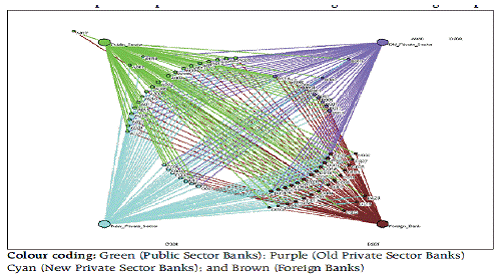
      2

      The Banking Stability Indicator, introduced in the previous FSR, endorses the overall improvement in the stability of banking sector, according to the FSR. The various macro-financial stress tests, including the newly introduced ones based on more rigorous computation methodologies; also show that the banking sector remains adequately capitalised and resilient to asset quality shocks and other plausible adverse changes in macroeconomic scenario. For the purpose of assessing the systemic importance of individual banks, the probability of a bank causing distress to another bank or being affected by the distress of another bank have been analysed through the construction of, inter alia, ‘Toxicity Index’ and a ‘Vulnerability Index’ for each bank, which have been presented in the FSR (diagrams below).
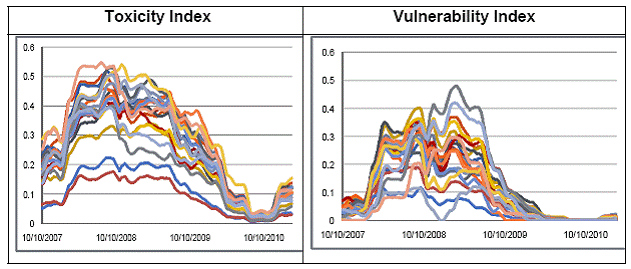
      2

      Reflecting deepening inter-regulatory collaborative process for financial stability, this FSR carries significant contributions from the Securities and Exchange Board of India (SEBI) and the Insurance Development Regulatory Authority (IRDA) on systemic issues pertaining to the respective segments.

      The next FSR is scheduled to be published in December 2011.

      Highlights

      Global Macroeconomic Developments

      • The global risk scenario has improved, though there are signs of a slowdown in growth during 2011 in most countries, including some developing economies in Asia.

      • The main underlying factors causing global imbalances remain largely unaddressed, increasing the uncertainty around the path of global recovery.

      • The sovereign debt crisis in some Euro area countries and the increasingly high levels of government debt in some advanced countries remain threats to global stability.

      Domestic Macroeconomic Developments

      • There are downside risks to GDP growth on account of some domestic and international factors.

      • Inflation is likely to continue facing upward pressure.

      • Financing of the CAD is not a major concern at present although slow down in capital inflows could occur as the advanced economies exit from the accommodative policy.

      • Management of government expenditure will pose challenges to the process of fiscal consolidation.

      Financial Markets

      • The domestic financial markets remain stress free and are expected to remain so in the near term.

      • Liquidity in the system remained in deficit mode given strong credit demand and high level of currency in circulation.

      • Government bond yields hardened across all maturities, more so in the short end, resulting in a flattening of the yield curve.

      • Greater access of domestic corporates to ECBs has resulted in increased currency mismatches.

      • Domestic corporate issuers of FCCBs may face refunding risks as many bonds nearing maturity by March 2013, may not be converted to equity.

      • Events like ‘flash crashes’ witnessed in US equity markets in May 2010, need to be guarded against even as program trading systems are introduced in the country.

      Financial Institutions

      • The banking sector remains well capitalized with both core capital adequacy and leverage ratios at comfortable level.

      • Credit growth rebounded amid improvements in asset quality. Certain specific sectors, however, may pose concerns, going forward.

      • Increased reliance of market borrowings could adversely affect the liquidity position of banks.

      • The robust growth in credit warrants tightening of individual underwriting standards to prevent slippages when credit growth slows.

      • Banks’ profitability improved, buoyed by increased net interest income though non-interest income remained stagnant. Going ahead, cost factors may impact profitability.

      • Increase in off balance sheet exposures, especially in case of foreign banks, may need to be monitored.

      • The insurance sector in the country has, over the years, grown in size and reach, particularly after opening up to private players. The sector remains robust and well regulated.

      Regulatory environment

      • Proposed amendments to banking legislations are expected to fortify the regulatory structure.

      • Banks in India will face many challenges as they migrate to the advanced approaches under Basel II and prepare for Basel III.

      • The calibration of the countercyclical buffers proposed under Basel III will require a combination of qualitative judgment and quantitative indicators.

      • There remain gaps in the regulatory framework for NBFCs while raising of funds by cooperative societies outside any regulatory ambit needs to be addressed.

      • The systemic importance of Government owned NBFCs has grown and the regulatory exemptions granted to such entities are being reexamined.

      Financial Market Infrastructure

      • The operational performance of the payment and settlement infrastructure in India continued to be robust.

      • The integration and inter-relationships among various segments of the payment and settlement systems could pose some concerns.

      • The management of liquidity risks faced by the CCPs needs to be carefully managed given the collateral damage from any failure, however unlikely.

      • The existing reporting arrangements for OTC derivative markets need to be leveraged as more products /markets are brought within the reporting framework.

      Stress testing

      • A series of stress testing in respect of credit, liquidity and interest rate risks showed that banks remained reasonably resilient though their profitability could be affected significantly.

      • Under severe stress scenarios, banks may face liquidity constraints.

      • Banks need to remain vigilant to the headwinds from the prevailing inflation and interest rate situation which may affect their asset quality as changes in interest rate were found to have the most significant (negative) impact on slippage ratio of the banks.

      • A new set of banking stability measures revealed that, when assessed from different combinations of distress dependencies, systemic risks rise faster than individual risks of banks during periods of crisis.

      Ajit Prasad
      Assistant General Manager

      Press Release : 2010-2011/ 1814


      Topics

      ActsIncome Tax