 TaxTMI
Login
 TaxTMI

Login
Loading...
Press 'Enter' to add multiple search terms. Rules for Better Search

Press 'Enter' after typing page number.
Press 'Enter' after typing page number.


No Folders have been created
Are you sure you want to delete "My most important" ?
NOTE:
Press 'Enter' after typing page number.









Press 'Enter' after typing page number.

All TMI Notes
Press 'Enter' after typing page number.
All TMI Notes

Note

Bookmark

Share


This commentary provides doctrinal analysis and practical insights on the legal issue discussed below. The judgment is analysed in the context of its factual background, issues framed, and conclusions reached by the Court.
2026 (8) TMI 1621 - CESTAT MUMBAI
The classification of low-ethoxylated non-ionic fatty alcohol ethoxylates turns on a precise statutory inquiry, rather than on their general description as surfactants or their acknowledged ability to reduce surface tension. The central question is whether a product containing one or two moles of ethylene oxide satisfies the definition of "organic surface-active agents" in Chapter Note 3 to Chapter 34 and, consequently, falls under tariff item 3402 1300 as a non-ionic organic surface-active agent. Where that definition is not met, the relevant alternative is Heading 3824, which covers chemical products and preparations not elsewhere specified or included.
In 2026 (8) TMI 1621 - CESTAT MUMBAI, the tribunal sustained classification of the disputed low-ethoxylated fatty alcohol ethoxylates under CTI 3824 9090/3824 9990, and rejected the proposed classification under CTI 3402 1300. The determinative feature was the sample behaviour in water: although the products were non-ionic and displayed surface activity, the test results recorded a translucent liquid with separation into two layers. That result was inconsistent with the cumulative requirements of Chapter Note 3.
The decision importantly distinguishes the broad chemical or commercial expression "non-ionic surfactant" from the legally defined expression "organic surface-active agents" for Heading 3402. A product may exhibit surface activity but still remain outside Heading 3402 if it fails the mandatory solubility and stability requirement embedded in the Chapter Note.
Customs duty is levied under Section 12 of the Customs Act, 1962, at the rates specified in the Customs Tariff Act, 1975. Section 2 of the Customs Tariff Act, 1975 provides that the rates at which customs duty is levied under the Customs Act are specified in the First and Second Schedules.
The classification exercise is governed by the General rules for the interpretation of this Schedule. GIR 1 states that, for legal purposes, classification is determined according to the terms of the headings and any relative Section or Chapter Notes. GIR 6 extends that exercise to sub-heading classification, requiring comparison among sub-headings at the same level while applying the relevant Section and Chapter Notes. Thus, a product cannot enter the non-ionic sub-heading merely because it is chemically non-ionic; it must first satisfy the scope of Heading 3402 as controlled by Chapter Note 3.
Heading 3402 covers "Organic surface-active agents (other than soap); surface-active preparations, washing preparations ... and cleaning preparations". Its non-ionic tariff item is CTI 3402 1300. Chapter Note 3 supplies a special legal definition for this heading:
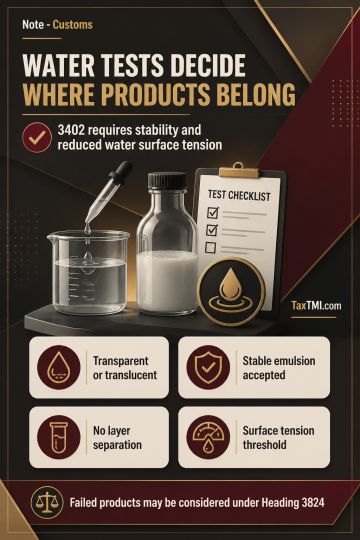
"For the purposes of heading 3402, 'organic surface-active agents' are products which when mixed with water at a concentration of 0.5% at 20 C and left to stand for one hour at the same temperature: (a) give a transparent or translucent liquid or stable emulsion without separation of insoluble matter; and (b) reduce the surface tension of water 4.5 x 10⁻² N/m (45 dyne/Cm) or less."
Heading 3824, by contrast, covers "chemical products and preparations of the chemical or allied industries ... not elsewhere specified or included." Its residual character does not permit recourse to the heading until the possibility of classification in a more specific heading has been tested. However, the HSN Explanatory Notes to Heading 3402 expressly exclude "water-insoluble naphthenates, petroleum sulphonates and other water-insoluble surface-active products and preparations", directing them to Heading 3824, provided that no more specific heading applies.
The word "and" connecting clauses (a) and (b) is decisive. The product must both yield the prescribed water mixture or stable emulsion and reduce water surface tension to the stated threshold. Satisfaction of clause (b), even when demonstrated by laboratory testing, does not cure failure under clause (a).
Clause (a) itself has two interconnected elements. The sample must produce either a transparent liquid, a translucent liquid, or a stable emulsion; additionally, the result must be "without separation of insoluble matter". The statutory phrase cannot be confined only to the expression "stable emulsion". If that construction were adopted, a product that visibly separates into layers could qualify merely because one layer appears translucent. Such an interpretation would detach appearance from stability and undermine the solubility condition expressed through the Note.
The tariff structure recognises anionic, cationic, non-ionic and other organic surface-active agents. These are classifications within Heading 3402, not independent gateways into the heading. Consequently, a laboratory conclusion that the sample is "non-ionic" establishes the nature of the material but does not establish that it fulfils the statutory definition of an organic surface-active agent.
Low-ethoxylated fatty alcohol ethoxylates involve a hydrophobic fatty alcohol chain and an ethoxylate chain. The technical material considered in the decision showed that increasing the number of ethylene oxide groups increases hydrophilicity and water solubility. An ethoxylate with only two ethylene oxide groups may have virtually no water solubility and may instead be oil-soluble. This chemical characteristic explains why the mole count is materially relevant, although classification remains governed by the statutory water test rather than molecular description alone.
The disputed products were low-ethoxylated, non-ionic fatty alcohol ethoxylates derived from C12-C14 fatty alcohols, having one or two moles of ethylene oxide. The departmental laboratory found the presence of an organic surface-active agent, recorded the sample as non-ionic, and gave positive results for alcohol and ethoxylate. Those findings supported the department's proposed classification under CTI 3402 1300 only at a preliminary level.
The same test evidence contained the decisive qualification: "the sample in water gives translucent liquid with separation in two layers." This finding did not answer the statutory test in the importer's favour merely because the liquid was translucent. It established visible phase separation. Under the HSN Explanatory Notes, an emulsion is not stable if, after the prescribed standing period, it has separated into visually distinguishable phases or into a transparent and a translucent part visible to the naked eye. The two-layer result therefore negated the required stability and revealed separation of insoluble matter.
The tribunal accordingly treated the statutory definition as exhaustive for Heading 3402. The result is doctrinally sound for two reasons. First, tariff classification must begin with the heading terms and relative Chapter Notes under GIR 1. Secondly, where the Tariff incorporates an objective laboratory standard of concentration, temperature, duration, appearance, stability and surface-tension reduction, a general description in technical literature cannot displace the stipulated legal test.
The HSN Notes reinforced this construction. They describe the organic surface-active agents of Heading 3402 as compounds which, at 0.5% concentration in water at 20 C and after one hour, give "a transparent or translucent liquid or stable emulsion without separation of insoluble matter." They further clarify that phase separation or separation into transparent and translucent parts precludes stable-emulsion character. More significantly, the Notes specifically exclude water-insoluble surface-active products and preparations from Heading 3402 and place them in Heading 3824, subject to any more specific classification.
Thus, Heading 3824 did not prevail because it is a broad residual heading in the abstract. It applied because the more specific candidate, Heading 3402, was legally unavailable once the product failed Chapter Note 3(a). The sequence is important: Heading 3402 must first be tested under its own restrictive statutory definition; only upon failure of that test can the product be considered under Heading 3824.
The tribunal also recognised that a statutory definition supersedes trade parlance. The commercial understanding that fatty alcohol ethoxylates are non-ionic surfactants may be relevant as technical background, but it cannot convert a water-insoluble or phase-separating material into an "organic surface-active agent" defined by Chapter Note 3. The legal identity under the tariff is narrower than generic industrial terminology.
The principal ruling in 2026 (8) TMI 1621 - CESTAT MUMBAI applies the statutory and HSN framework directly to low-ethoxylated fatty alcohol ethoxylates. The tribunal held that the two-layer test result prevented classification under CTI 3402 1300 and sustained CTI 3824 9090/3824 9990. Since the proposed duty demand failed on merits, the consequential proposals for interest and penalty did not survive.
The administrative materials were consistent with this conclusion. A foreign customs ruling for a two-mole C12-C14 alcohol ethoxylate recorded both surface-tension reduction and visible separation into transparent and translucent parts. It classified the product under Heading 3824 because it failed the equivalent of Chapter Note 3(a). A separate verification referred to fatty alcohol polyoxyethylene ethers under Heading 382499. These materials have persuasive, not binding, relevance; their value lies in corroborating the technical proposition that surface activity and water solubility are separate requirements.
2006 (5) TMI 91 - Supreme Court is significant on the evidentiary dimension. It held, on its particular technical record, that unrebutted governmental chemical reports supporting surface-active properties could not be casually disregarded and that the burden to establish a different classification lies on the revenue authority. The authority does not establish that every non-ionic product belongs to Heading 3402. Rather, it confirms that sample-specific technical evidence must be assessed in its entirety. Here, the test report supporting non-ionic surface activity also recorded two-layer separation, which was fatal under Chapter Note 3(a).
1999 (3) TMI 345 - CEGAT, NEW DELHI considered the exclusion of preparations in which a surface-active agent's function is only subsidiary to the product's main function. It preferred a sample-specific Chemical Examiner's report over a general expert opinion and classified the products under Chapter 38. The factual issue differed, but the decision supports the broader proposition that the presence of a surfactant does not, by itself, settle classification under Heading 3402.
2008 (3) TMI 188 - CESTAT, CHENNAI distinguished organic surface-active agents from washing preparations within Heading 3402. A face-wash preparation was held classifiable under Heading 3402 as a washing preparation even though the test report stated that it did not satisfy Chapter Note 3 for an organic surface-active agent. This distinction is particularly relevant: Heading 3402 contains separate categories, and failure of Note 3 does not invariably exclude a formulated washing or cleaning preparation. Low-ethoxylated fatty alcohol ethoxylates imported as such, however, must satisfy Note 3 when classification is claimed as organic surface-active agents under CTI 3402 1300.
2007 (8) TMI 150 - CESTAT, AHMEDABAD similarly treated a product predominantly based on surface-active agents as a washing preparation under Chapter 34 rather than a skin-care product. Its relevance is confined to the proposition that product composition, function and the statutory scheme prevail over marketing assertions. It does not dilute the special definition applicable to an imported material claimed as an organic surface-active agent.
Import classification should be supported by testing that directly reproduces the parameters in Chapter Note 3: 0.5% concentration, 20 C temperature, one-hour standing period, observation of phase separation, and measurement of surface-tension reduction.
A test certificate should clearly record whether the sample remains a single transparent or translucent phase, whether it forms a stable emulsion, and whether insoluble matter or separate layers appear. A bare finding of "non-ionic surfactant" is insufficient for CTI 3402 1300.
Low ethoxylation is a practical risk indicator. Where one- or two-mole ethoxylates are involved, importers and revenue authorities should scrutinise the solubility and stability limb independently from the surface-tension limb.
Technical literature, safety data sheets, CAS references, overseas classifications and end uses may assist in identifying the product, but they cannot override the Chapter Note. Their strongest use is corroborative, particularly where they address the precise test conditions prescribed by the tariff.
Heading 3824 should not be approached as an automatic destination for every product with surfactant characteristics. Its application depends on demonstrating that the product is not elsewhere specified or included, including because it fails the mandatory statutory definition under Heading 3402.
For litigation, parties should examine the entire laboratory report. A report may contain apparently favourable statements concerning non-ionic nature or surface activity while simultaneously recording facts, such as two-layer separation, that determine classification against Heading 3402.
The classification of low-ethoxylated non-ionic fatty alcohol ethoxylates is controlled by the exact language of Chapter Note 3 to Chapter 34. The Note imposes a cumulative test: the product must yield the prescribed transparent or translucent liquid or stable emulsion without separation of insoluble matter, and must reduce water surface tension to the prescribed level. A product producing a translucent liquid with separation into two layers fails the first limb even if it is chemically non-ionic and capable of reducing surface tension.
Accordingly, the tribunal's classification under CTI 3824 9090/3824 9990 in 2026 (8) TMI 1621 - CESTAT MUMBAI demonstrates the governing approach: statutory definition first, objectively compliant test evidence next, and generic commercial nomenclature only thereafter. For water-insoluble or phase-separating low-ethoxylated surface-active products, Heading 3824 becomes the appropriate classification route where no more specific heading applies.
Full Text:

