Loading...

⚠ ✕
❮ Top
☎ Help
☰
×

By creating an account you can:

Logo TaxTMI
Call Us / Help / Feedback✕

Contact Us At :

✉ E-mail: [email protected]

✆ To Call / Whatsapp, Check Contact Us

FAQs :

To know Frequently Asked Questions, Check FAQs

Most Asked Video Tutorials :

For more tutorials, Check Video Tutorials

Submit Feedback/Suggestion :

Email :
Please provide your email address so we can follow up on your feedback.
Category :
Description :
Min 15 characters 0/2000
Make Most of Text Search ✕
  1. Checkout this video tutorial: How to search effectively on TaxTMI.
  2. Put words in double quotes for exact word search, eg: "income tax"
  3. Avoid noise words such as : 'and, of, the, a'
  4. Sort by Relevance to get the most relevant document.
  5. Press Enter to add multiple terms/multiple phrases, and then click on Search to Search.
  6. Text Search
  7. The system will try to fetch results that contains ALL your words.
  8. Once you add keywords, you'll see a new 'Search In' filter that makes your results even more precise.
  9. Text Search
╳
Add to...
You have not created any category. Kindly create one to bookmark this item!
✕
Create New Category
Hide
Title :
Description :
❮❮ Hide
❮ Default View
Expand ❯❯
Close ✕
🔎 Filters / Advanced Search ❯
TEXT

Press 'Enter' to add multiple search terms. Rules for Better Search

Search In
Main Text + AI Text ❯
  • Main Text
  • Main Text + AI Text
  • AI Text
Law:
---- All Laws---- ❯
  • ---- All Laws----
  • Benami Property
  • Bill
  • Central Excise
  • Companies Law
  • Customs
  • DGFT
  • FEMA
  • GST
  • GST - States
  • IBC
  • Income Tax
  • Indian Laws
  • Money Laundering
  • SEBI
  • SEZ
  • Service Tax
  • VAT / Sales Tax
Types:
---- All Types ---- ❯
  • ---- All Types ----
  • Act Rules
  • Case Laws
  • Circulars
  • Manuals
  • News
  • Notifications
Sort By: ?
In Sort By 'Default', exact matches for text search are shown at the top, followed by the remaining results in their regular order.
Relevance Default Date
☰   Show Results ❯
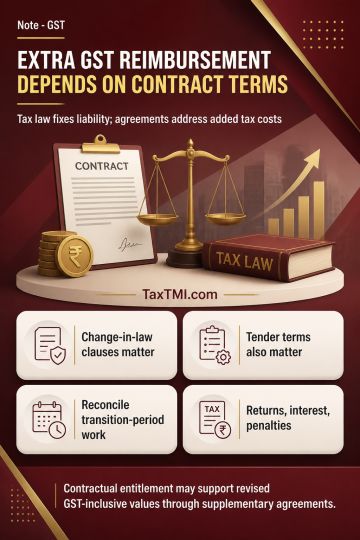
    Contractual Reimbursement of Incremental GST on Works Contracts and the Statutory-Contractual Divide
    Case Laws Customs
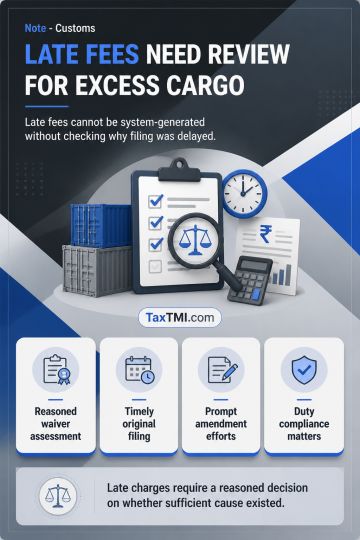
    Waiver of Late Fee on Supplementary Bills of Entry under Section 46(3) of the Customs Act, 1962: Exc...
    Detention and Confiscation of Inter-State Consignments: Territorial Limits on State GST Officers - J...
    Common Show Cause Notices across Multiple Financial Years: Scope of Sections 73 and 74 and Limitatio...
    Input Tax Credit Eligibility under the CGST Act: Supplier Tax Non-Payment and Recipient ITC Claims: ...
    Actionable Claims, Contingent Winnings and Gross Valuation in GST on Gaming Transactions
    Invocation of Extended Limitation under Section 74 of the CGST Act: Foundational Facts, Prima Facie ...
    Assignment of Leasehold Rights in Industrial Plots under the CGST Act: Distinguishing Lease Services...
    Service of GST Show Cause Notices and Orders through the Common Portal: Validity of Service, Hearing...
    News GST
    Bill-To Ship-To E-Way Bill Compliance, Portal Closure and Transit Controls: GST E-Way Bills: Rule 13...
    E-Way Bill Requirements Under Rule 138: GST E-Way Bill Framework for Movement of Goods, Transit Docu...
    Case Laws Customs
    Limits of Website Upload (of Notifications) as Notice for Delegated Legislation Where the Parent Sta...
    Case Laws Indian Laws
    Illegality of Arrest and Remand for Non-Supply of Written Grounds: The Two-Hour Pre-Remand Standard ...
    When Trademark Ownership Controversies Fall Outside Insolvency Adjudication: Application of the 'Nex...
    Locus Standi - Intervention by Homebuyer Societies in Insolvency Proceedings: Statutory Limits under...
    News Bill
    Rates of income-tax in respect of income liable to tax for the assessment year 2026-27 for the purpo...
    News Bill
    Tax rates under section 115BAC of the Income-tax Act, 1961
    News Bill
    Individual, HUF, association of persons, body of individuals, artificial juridical person.
    News Bill
    Co-operative Societies
    News Bill
    Firms
❮
❯
❯❯
Maximize Maximize Maximize
0 / 200
Expand Note
Add to Folder

No Folders have been created

+

Are you sure you want to delete "My most important" ?

NOTE:

Notes
Showing Results for :
Reset Filters
Results Found:
Show All Summaries Hide All Summaries
Case Laws GST
Show AI Summary
Contractual GST reimbursement in works contracts depends on tax-risk clauses and cannot alter statutory compliance obligations.
GST liability for a works contractor is governed by statute, while reimbursement of incremental GST from an employer depends on the contract's allocation of tax risk. An inclusive-tax clause must be read with change-in-law, price-adjustment, tender and amendment terms. Contract-wise reconciliation of pre-transition and post-transition work may support a supplementary agreement and revised GST-inclusive value where contractual entitlement exists. It cannot alter statutory valuation, return, limitation, interest or penalty requirements, which remain governed by GST law.
Case Laws Customs
Show AI Summary
Sufficient cause for delayed supplementary Bills of Entry requires a reasoned waiver assessment, not automatic system-generated late charges.
Late-presentation charges under Section 46(3) require the proper officer to be satisfied that no sufficient cause existed for delayed filing. Regulation 4(3) prescribes the late-charge framework and permits waiver where the reasons for delay are satisfactory. A delayed supplementary Bill of Entry for excess cargo is not automatically liable or automatically exempt; the assessment depends on timely original filing, linkage of the excess cargo to the same consignment, prompt amendment efforts, absence of importer fault, bona fides and duty compliance. Electronic calculation cannot substitute for a reasoned determination on sufficient cause.
Case Laws GST
Show AI Summary
Territorial GST jurisdiction limits detention and confiscation of inter-State consignments when the intercepting State lacks fiscal nexus.
Physical presence of goods in an intermediate State therefore does not alone create authority to detain, seize, penalise or confiscate. Cross-empowerment is functional and taxpayer-linked, preserving the single-interface administrative structure without creating geographically unlimited enforcement power. Where verification establishes that both origin and destination lie outside the intercepting State, the officer may verify documents, identify and record apparent discrepancies, and communicate them to the proper officers of the consignor and consignee, but lacks coercive jurisdiction over a pure transit supply.
Case Laws GST
Show AI Summary
Consolidated GST show cause notices may cover multiple financial years, while each demand component remains independently subject to limitation.
Sections 73 and 74 do not expressly bar a common show cause notice covering multiple tax periods or financial years. The expressions "for any period" and "such periods" support consolidation, while financial-year references in the limitation provisions govern the deadline for adjudication orders rather than the scope of notice issuance. Each component demand must independently satisfy applicable limitation requirements. Section 74 requires disclosed material supporting fraud, wilful misstatement, or suppression of facts to evade tax; its extended limitation is not automatic.
Case Laws GST
Show AI Summary
Supplier tax payment remains a substantive input tax credit condition, requiring reversal and allowing re-availment after compliance.
Section 16(2)(c) of the CGST Act makes actual payment of tax to the Government a substantive condition for input tax credit. The conditions under Section 16(2) operate cumulatively, and invoice reflection, receipt of supplies, or supplier return filing do not independently establish tax payment. Section 41 requires reversal of credit where the supplier has not paid tax, with re-availment allowed after payment. Rule 37A prescribes reversal and re-availment where the supplier fails to furnish the corresponding GSTR-3B within the prescribed period.
Case Laws GST
Show AI Summary
GST valuation of stake-based gaming treats committed stakes as consideration for taxable actionable claims, irrespective of skill.
GST on stake-based gaming applies to the supply of actionable claims where money or money's worth is committed to an uncertain outcome in an organised betting or gambling arrangement. Skill in the underlying game does not remove the stake-based character of the transaction. Participants acquire contingent beneficial interests in pooled movable property, and committed stakes become consideration for participation. The platform is the supplier where it controls pooling, participation, gameplay and payouts. Gross stake valuation applies unless a statutory deduction is authorised, with specialised valuation mechanisms governing online gaming and casinos.
Case Laws GST
Show AI Summary
Extended GST limitation requires disclosed prima facie material linking tax shortfall to fraud, wilful misstatement, or suppression.
Section 74 permits extended GST limitation only where available material supports a rational prima facie view that a tax shortfall, erroneous refund or wrongful credit arose by reason of fraud, wilful misstatement or suppression of facts to evade tax. Final proof is not required at initiation, but suspicion or bare statutory labels are insufficient. Prior scrutiny, audit, inspection or pre-notice communications may provide the factual foundation if actually communicated and linked to the notice. The notice and final order must preserve fair opportunity, disclose the material basis, and remain within the grounds stated.
Case Laws GST
Show AI Summary
Complete assignment of industrial leasehold rights can fall outside GST when it transfers the entire proprietary estate.
A complete assignment of an industrial lessee's entire leasehold interest, together with the building on the plot, is distinguished from leasing, renting, or sub-leasing. Where the assignor retains no reversionary interest or continuing right to earn rent, the consideration is for transfer of proprietary rights constituting benefits arising out of land. Schedule II classification of an original lease as a service does not govern the subsequent absolute assignment. Section 7(2), read with Schedule III, excludes a qualifying transfer of immovable-property benefits from the scope of supply.
Case Laws GST
Show AI Summary
Common Portal service requires effective access to complete GST notices and orders, preserving hearing rights and appellate limitation.
GST service through the Common Portal is an express statutory mode, but portal availability must be distinguished from effective service of an adjudicatory communication. Rule 142 preserves the distinction between a substantive show cause notice or order and its electronic summary in FORM GST DRC-01 or DRC-07. Electronic summaries do not, without more, demonstrate communication of complete allegations, grounds, facts and reasons. Portal-based service must be assessed by statutory compliance, accessibility of the complete communication, and the taxpayer's real opportunity to respond, particularly where appellate limitation is involved.
News GST
Show AI Summary
E-way bill compliance strengthens traceability through Ship-To GSTIN capture, voluntary closure, and disciplined transit controls.
Rule 138 and Rule 138A require pre-movement e-way bill generation, carriage of the prescribed invoice or challan documents, and distance-based validity, with cancellation confined to cases where goods are not transported as declared. The portal advisory adds mandatory Ship-To GSTIN capture in Bill-To/Ship-To transactions and a voluntary post-delivery closure facility, while circular guidance treats transporter godowns as an additional place of business when declared by the recipient. Enforcement under Section 129 and Section 130 distinguishes detention for transit contravention from confiscation linked to intent to evade tax, and minor e-way bill defects are described as technical lapses rather than automatic proof of evasion.
Act Rules GST
Show AI Summary
E-way bill compliance under GST rules governs prior movement information, transit documents, validity, cancellation, and special goods regimes.
Rule 138 of the Central Goods and Services Tax Rules, 2017 governs the e-way bill system for movement of goods and requires prior electronic information before movement begins in specified cases, generally where consignment value exceeds fifty thousand rupees. The rule allocates responsibility for Part A and Part B of FORM GST EWB-01 among registered persons, authorised transporters, e-commerce operators, courier agencies and fallback transporters, while also covering special cases such as job work, handicraft goods, consolidated movement and transport by road, rail, air or vessel. Rule 138A specifies the documents that must accompany the conveyance, Rule 138 provides validity, cancellation and exemption rules, and Rule 138F creates a special intra-State regime for notified precious goods.
Case Laws Customs
Show AI Summary
Import regulation: Gazette publication is required before a notification binds importers; website uploads do not suffice for enforceability.
Publication in the Official Gazette is a condition precedent to the enforceability of notifications under Section 3 of the Foreign Trade (Development and Regulation) Act, 1992; website uploads cannot substitute for Gazette promulgation. Internal references to the "date of this Notification" must be read as the Gazette publication date, and where a notification incorporates paragraph 1.05(b) of the Foreign Trade Policy, transitional protection applies if its objective conditions (LC established before imposition, timely registration, shipment within validity) are satisfied.
Case Laws Indian Laws
Show AI Summary
Arrest communication: written grounds generally required; oral only temporarily, written copy at least two hours before remand.
The obligation to communicate grounds of arrest applies across statutes and, as a rule, must be met by supplying written grounds in a language the arrestee understands. In exceptional exigencies oral communication at arrest is permissible temporarily, but a written copy must be provided within a reasonable time and no later than two hours before production for remand; remand papers must include the grounds and explain any delay. Non compliance renders the arrest and remand illegal, though authorities may seek fresh custody after supplying written grounds with reasons for earlier non supply.
Case Laws IBC
Show AI Summary
Trademark ownership disputes in insolvency require a clear nexus to CIRP; complex title issues belong to full proceedings.
A disputed trademark cannot be declared an asset of the corporate debtor in summary CIRP proceedings absent a demonstrable nexus with insolvency; where title turns on contested private transactions and rival claims, the approved resolution plan governs stakeholders and summary disposition that effectively alters plan rights is impermissible. Avoidance conclusions require properly pleaded applications, material and notice; absent these safeguards, invoking preferential or undervalued transaction provisions in collateral proceedings violates natural justice.
Case Laws IBC
Show AI Summary
Homebuyer societies' intervention in insolvency is limited; representation must follow authorised representative routes post-admission.
Locus standi under the IBC is stage-sensitive: pre-admission proceedings are in personam and participation is confined to the applicant and corporate debtor, while post-admission proceedings are in rem and allow broader standing subject to statutory channels. Individual allottees recognised as financial creditors must be represented through the Code's authorised-representation mechanisms rather than by separate societies asserting membership rights, and inherent tribunal powers cannot create substantive participatory rights absent statutory basis.
News Bill
Show AI Summary
Income-tax rates for assessment year 2026-27 remain unchanged; schedule placement for advance tax and salary TDS is preserved.
Tax rates for assessment year 2026-27 remain unchanged and continue to be prescribed either in specific sections of the Income-tax Act (including concessional regimes for domestic companies, cooperative societies and the alternate individual regime) or in the First Schedule. Rates formerly listed in Part III of the First Schedule to the Finance Act, 2025 - used for advance tax computation, TDS from salaries and charging tax payable in certain cases - are reclassified as Part I of the First Schedule for AY 2026-27.
News Bill
Show AI Summary
Tax rates under section 115BAC prescribe slab rates up to 30% with surcharge tiers and caps on dividend and capital gains.
Section 115BAC(1A) sets default slab rates for certain resident taxpayers ranging from nil up to 30% above Rs.24,00,000; these apply unless an option under section 115BAC(6) is exercised. Income-tax under clause (1A)(iii) is subject to surcharge tiers (10%, 15%, 25%) based on total-income thresholds, with the surcharge on dividend income and specified capital gains capped at 15% and a 15% cap also for associations of persons consisting only of companies. Marginal relief is available.
News Bill
Show AI Summary
Individual tax rates set in the Finance Bill 2026: progressive slabs with higher nil thresholds for senior residents.
The Finance Bill 2026 prescribes progressive income-tax slabs for individuals, HUFs, associations of persons, bodies of individuals and artificial juridical persons: nil up to Rs. 2,50,000; 5% on Rs. 2,50,001-5,00,000; 20% on Rs. 5,00,001-10,00,000; 30% above Rs. 10,00,000; with higher nil thresholds for resident senior citizens (Rs. 3,00,000 for 60-79 years; Rs. 5,00,000 for 80+), and states these rates mirror the prior year.
News Bill
Show AI Summary
Co-operative societies: the Finance Bill preserves the existing three-band income-tax rate structure (10%, 20%, 30%).
Specified income-tax rates for co-operative societies are set out in Paragraph B of Part I-A of the First Schedule to the Finance Bill. The Bill retains the existing three-band structure: 10% on income up to the first band, 20% on the middle band, and 30% on income above the top band, thereby preserving the prior rate structure for co-operative societies.
News Bill
Show AI Summary
Firms' income-tax rate unchanged at 30% under the Finance Bill, specified in Paragraph C of Part I-A.
The Finance Bill specifies the income-tax rate for firms in Paragraph C of Part I A of the First Schedule, maintaining the rate at 30%.

TMI Notes

Back

All TMI Notes

Showing Results for :
Reset Filters
No Records Found

TMI Notes

Back

All TMI Notes

Taxation of Special Incomes in India "Profits and gains from Life Insurance Business" : Clause 194 of the Income Tax Bill, 2025 Vs. Section 115B of the Income-tax Act, 1961

1 May, 2025

Contents
Acts
Rules & Regulations
Summary
Note

Note

-

Bookmark

(New) -

Download

Print

Print

Clause 194 Tax on certain incomes.

Income Tax Bill, 2025

Introduction

Clause 194 of the Income Tax Bill, 2025 represents a significant evolution in the Indian income tax regime, specifically addressing the taxation of certain special categories of income. This provision not only consolidates and updates the taxation framework for winnings from lotteries, games, and gambling, but also incorporates contemporary income streams such as virtual digital assets (VDAs), carbon credits, and royalties from Indian-developed patents. Additionally, it addresses the taxation of profits and gains from life insurance business, a domain historically governed by Section 115B of the Income-tax Act, 1961. The move to introduce Clause 194 is reflective of the legislature's intent to modernize, streamline, and clarify the tax treatment of these special income categories, particularly in response to evolving business models and technological advancements. The inclusion of new income sources such as VDAs and carbon credits underlines the adaptive nature of tax policy to emerging economic realities. At the same time, the provision retains and refines the approach to long-standing income streams, ensuring continuity and stability in the tax system. This commentary undertakes a comprehensive analysis of Clause 194, examining its structure, purpose, and practical implications. It further provides a detailed comparative analysis with Section 115B, particularly focusing on the treatment of profits and gains from life insurance business, to highlight the continuities, departures, and policy considerations embedded in the legislative evolution.

Objective and Purpose

The legislative intent behind Clause 194 is multifold:

  • To provide a consolidated and updated framework for taxing specified incomes that merit special treatment, either due to their nature, volatility, or policy considerations.
  • To address gaps and ambiguities in the existing law, particularly with respect to new forms of income such as virtual digital assets and carbon credits.
  • To incentivize innovation and domestic research by offering concessional tax rates on royalties from patents developed and registered in India.
  • To ensure equitable and efficient taxation of windfall gains and speculative incomes, such as those from lotteries, gambling, and online games, which are generally considered non-recurring and not reflective of regular economic activity.
  • To maintain a consistent and predictable tax regime for profits and gains from life insurance business, a sector of systemic financial importance.

The historical background to these provisions lies in the recognition that certain income streams, due to their peculiar characteristics, require distinct tax treatment. For example, the high rate of tax on winnings from gambling and lotteries is designed both to discourage such activities and to ensure a fair share of revenue from windfall gains. The concessional rate on patent royalties aims to foster indigenous innovation.

Detailed Analysis of Clause 194 of the Income Tax Bill, 2025

Clause 194 is structured to apply "irrespective of anything contained in any other provision of this Act," thereby granting it overriding effect. The clause operates by reference to a comprehensive table, which sets out the categories of taxpayers, the specific income streams, the applicable tax rates, and any conditions or restrictions.

1. Winnings from Lotteries, Games, and Gambling (30%)

[*******]

2. Royalty from Indian Patents (10%)

[*******]

3. Income from Transfer of Carbon Credits (10%)

[*******]

4. Income from Transfer of Virtual Digital Assets (30%)

[*******]

5. Net Winnings from Online Games (30%)

[*******]

6. Profits and Gains from Life Insurance Business (12.5%)

Scope: Applies to any person with profits and gains from life insurance business.

Tax Rate: 12.5%, flat.

Conditions: None specified.

Interpretation: The provision continues the long-standing policy of taxing life insurance business profits at a concessional rate, recognizing the sector's systemic importance and unique business model.

Ambiguities/Potential Issues: The absence of detailed conditions may lead to interpretational issues regarding the computation of "profits and gains" from life insurance business.

Definitions and Explanations

Clause 194(2) provides detailed definitions for key terms such as "carbon credit," "computer resource," "developed," "patentee," "patent," "royalty," and "virtual digital asset." These definitions are largely aligned with existing statutes (such as the Patents Act and the Information Technology Act), ensuring coherence and minimizing interpretational disputes.

Practical Implications

Clause 194, by consolidating and updating the taxation of special income streams, has several practical implications:

  • Taxpayers: Individuals and entities earning income from the specified categories must be aware of the flat rates and the denial of deductions/set-offs. This may require adjustments in tax planning and compliance processes.
  • Businesses: Companies involved in patent development, carbon credits, or VDAs must ensure robust documentation and timely exercise of options to avail concessional rates where applicable.
  • Life Insurance Sector: The continuation of the 12.5% rate provides certainty, but any changes in the computation of profits and gains may require adjustments in reporting and tax calculation.
  • Regulators: The need for clear rules and guidance, especially for new income streams like VDAs and online games, will be critical to ensure consistent enforcement and minimize disputes.
  • Compliance: The denial of deductions and set-offs simplifies computation but may increase the effective tax burden for some taxpayers. The stringent penalty for non-compliance (e.g., in the patent royalty regime) underscores the importance of timely and accurate compliance.

Comparative Analysis with Section 115B of the Income-tax Act, 1961

Section 115B, as it stands, is a focused provision dealing exclusively with the taxation of profits and gains from life insurance business.

Key Features of Section 115B

  • Scope: Applies where the total income includes profits and gains from life insurance business.
  • Tax Rate: 12.5% on profits and gains from life insurance business.
  • Aggregate Computation: Tax is the sum of (i) tax at 12.5% on life insurance profits, and (ii) tax on the remainder of total income at normal rates.
  • Special Deposit Requirement (Historical): Sub-section (2) required, for certain years, a deposit of one-third of the tax computed into a social security fund, with a reduction if a deposit of at least 2.5% of profits was made. This was a temporary measure for assessment years 1989-90 and 1990-91.

Comparison with Clause 194 of the Income Tax Bill, 2025

  1. Scope and Breadth:
    • Section 115B is limited to life insurance business. Clause 194 is much broader, covering multiple categories of special income, including life insurance business.
  2. Tax Rate:
    • Both provisions prescribe the same concessional rate (12.5%) for life insurance business.
    • Clause 194, however, brings this within a consolidated framework for special incomes, rather than as a standalone section.
  3. Computational Method:
    • Both provisions use the "aggregate" method: tax at special rate on specified income, plus tax at normal rates on the remainder.
  4. Denial of Deductions:
    • Section 115B does not expressly deny deductions for expenses; such matters are governed by the general provisions of the Act.
    • Clause 194, for some categories (but not life insurance), expressly denies deductions. For life insurance business, no specific denial is mentioned, so general rules likely apply.
  5. Special Deposit Requirement:
    • Section 115B(2) had a requirement for contributions to a social security fund for certain years. Clause 194 contains no such requirement.
    • This reflects a policy shift, possibly due to the redundancy of the earlier requirement or the existence of alternative mechanisms for social security funding.
  6. Definitions:
    • Clause 194 provides comprehensive definitions for each special income, ensuring clarity.
    • Section 115B relies on general definitions and the computation methodology u/s 44 and the First Schedule for life insurance business.
  7. Legislative Approach:
    • Section 115B represents a piecemeal approach, with each special income category addressed in separate sections.
    • Clause 194 consolidates various special incomes under a single umbrella, reflecting a modern trend towards codification and simplification.
  8. Alignment with Contemporary Developments:
    • Clause 194 incorporates new income streams (digital assets, carbon credits, online games) absent in the 1961 Act, demonstrating adaptability to technological and economic change.

Comparison Table on Key Points:

Feature Section 115B of the Income-tax Act, 1961 Clause 194 of the Income Tax Bill, 2025 Analysis
Applicability Profits and gains from life insurance business Profits and gains from life insurance business (among other incomes) Clause 194 subsumes and continues the treatment of life insurance business, while expanding to other income streams.
Tax Rate 12.5% 12.5% No change; provides continuity and certainty for the sector.
Computation Tax on life insurance profits at 12.5% + tax on balance income as if life insurance profits excluded Same aggregation method for all specified incomes Clause 194 adopts the same computational mechanism, ensuring consistency.
Additional Requirements For AYs 1989-90 & 1990-91, deposit in social security fund No such requirement The social security fund deposit was a temporary measure, not continued in Clause 194.
Other Incomes Covered Only life insurance business Winnings, patent royalties, carbon credits, VDAs, online games, etc. Clause 194 is broader in scope, reflecting contemporary economic realities.
Conditions/Restrictions None specified (other than for social security fund) Specific conditions for other income streams; none for life insurance business Life insurance business remains subject to minimal conditions, maintaining simplicity.

Key Points of Evolution:

  • Clause 194 represents a structural consolidation, bringing together the taxation of various special income streams under one provision, whereas Section 115B was focused solely on life insurance business.
  • The tax rate and computation method for life insurance business remain unchanged, ensuring policy continuity.
  • The additional requirement of deposit in a social security fund, present in Section 115B for specific years, is not carried forward, indicating a move towards simplification.
  • The inclusion of new income streams (VDAs, carbon credits, online games) in Clause 194 reflects legislative responsiveness to new economic activities and technologies.

Conclusion

Clause 194 of the Income Tax Bill, 2025 marks a significant step towards a more comprehensive, transparent, and adaptive taxation regime for special categories of income in India. By consolidating the tax treatment of winnings, royalties, carbon credits, virtual digital assets, online games, and life insurance business, it provides clarity and certainty to taxpayers and administrators alike. The provision retains the established approach for life insurance business, as set out in Section 115B, while expanding the scope to address new and emerging income streams. The explicit denial of deductions and set-offs for certain categories, the requirement to exercise options for concessional regimes, and the detailed definitions provided are all indicative of a policy intent to ensure fair, efficient, and enforceable taxation. While the legislative framework is robust, its success will depend on effective implementation, clear rule-making (especially for new areas like VDAs and online games), and ongoing responsiveness to judicial interpretation and market developments. Potential areas for further refinement include clarifying definitions, simplifying compliance for small taxpayers, and ensuring that the regime remains competitive and equitable in a rapidly changing economic environment.


Full Text:

Clause 194 Tax on certain incomes.

Topics

Acts Income Tax