Loading...

⚠ ✕
❮ Top
☎ Help
☰
×

By creating an account you can:

Logo TaxTMI
Call Us / Help / Feedback✕

Contact Us At :

✉ E-mail: [email protected]

✆ To Call / Whatsapp, Check Contact Us

FAQs :

To know Frequently Asked Questions, Check FAQs

Most Asked Video Tutorials :

For more tutorials, Check Video Tutorials

Submit Feedback/Suggestion :

Email :
Please provide your email address so we can follow up on your feedback.
Category :
Description :
Min 15 characters 0/2000
Make Most of Text Search ✕
  1. Checkout this video tutorial: How to search effectively on TaxTMI.
  2. Put words in double quotes for exact word search, eg: "income tax"
  3. Avoid noise words such as : 'and, of, the, a'
  4. Sort by Relevance to get the most relevant document.
  5. Press Enter to add multiple terms/multiple phrases, and then click on Search to Search.
  6. Text Search
  7. The system will try to fetch results that contains ALL your words.
  8. Once you add keywords, you'll see a new 'Search In' filter that makes your results even more precise.
  9. Text Search
╳
Add to...
You have not created any category. Kindly create one to bookmark this item!
✕
Create New Category
Hide
Title :
Description :
❮❮ Hide
❮ Default View
Expand ❯❯
Close ✕
🔎 Filters / Advanced Search ❯
TEXT

Press 'Enter' to add multiple search terms. Rules for Better Search

Search In
Main Text + AI Text ❯
  • Main Text
  • Main Text + AI Text
  • AI Text
Law:
---- All Laws---- ❯
  • ---- All Laws----
  • Benami Property
  • Bill
  • Central Excise
  • Companies Law
  • Customs
  • DGFT
  • FEMA
  • GST
  • GST - States
  • IBC
  • Income Tax
  • Indian Laws
  • Money Laundering
  • SEBI
  • SEZ
  • Service Tax
  • VAT / Sales Tax
Types:
---- All Types ---- ❯
  • ---- All Types ----
  • Act Rules
  • Case Laws
  • Circulars
  • Manuals
  • News
  • Notifications
Sort By: ?
In Sort By 'Default', exact matches for text search are shown at the top, followed by the remaining results in their regular order.
Relevance Default Date
☰   Show Results ❯
    Case Laws Income Tax
    Reassessment Limitation under Section 149: Exclusion of Reply Time under Section 148A(b)
    Case Laws Money Laundering
    Pre-Cognizance Hearing under Section 223 BNSS in PMLA Complaints
    Case Laws Income Tax
    Treaty Entitlement of Non-UK Resident Partners in a Fiscally Transparent UK Partnership
    Indirect Corporate Control and Related-Party Classification in the Corporate Insolvency Resolution P...
    Section 74 Extended Period of Limitation: Departmental Knowledge, Audit Observations and Distinct Sc...
    Renting of Immovable Property and Blocked Input Tax Credit under Sections 16 and 17(5) of the CGST A...
    Case Laws Indian Laws
    Betting on Skill-Based Games: Constitutional Scope of Entry 34 and the Distinction between Skill and...
    Case Laws Benami Property
    Benami Transactions: Proof of Consideration, Fund Routing and Beneficial Ownership under Section 2(9...
    Wrong-Head GST Payment and the Distinction Between Appropriation and Refund Under Sections 19 and 77
    Condonation of Delay in GST Appeals under Section 107: Statutory Limits and Writ Jurisdiction
    Case Laws Income Tax
    Validity of Scrutiny Notice under Section 143(2) and Non-Conformity with CBDT-Prescribed Formats
    Case Laws Income Tax
    Article 8 of the India-UK DTAA and Taxability of Ground Handling and Engineering Service Receipts
    Cancellation of GST Registration for Continuous Non-Filing of Returns under Section 29 and Rule 22
    Finality of Approved Resolution Plans and Extinguishment of Pending Operational-Creditor Claims unde...
    Case Laws Customs
    Interest on Refund of Amounts Deposited under Protest during Customs Investigation
    Case Laws Indian Laws
    Admitted Cheque Signature and Presumption of Legally Enforceable Debt under Sections 118 and 139 of ...
    Case Laws Customs
    Principal Function, Network Capability and Customs Classification of Composite Electronic Devices (G...
    Case Laws Income Tax
    Enhanced Tax Rate Under Section 115BBE for Financial Year 2016-17: Classification of Unexplained Inc...
    Case Laws Income Tax
    Retrenchment Compensation under Section 10(10B) and Leave Encashment Exemption under Section 10(10AA...
    Case Laws Income Tax
    Renewal of Registration under Section 12AB for Charitable Hospitals Engaged in Medical Relief: Retro...
❮
❯
❯❯
Maximize Maximize Maximize
0 / 200
Expand Note
Add to Folder

No Folders have been created

+

Are you sure you want to delete "My most important" ?

NOTE:

Notes
Showing Results for :
Reset Filters
Results Found:
Show All Summaries Hide All Summaries
Case Laws Income Tax
Show AI Summary
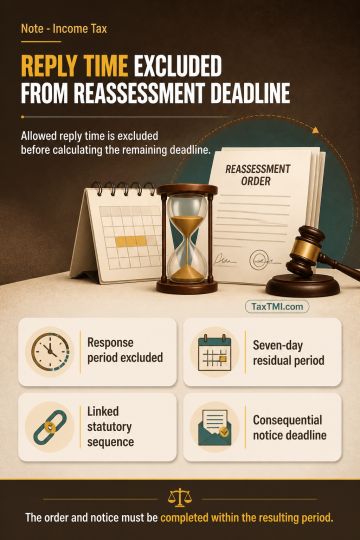
Reassessment limitation requires exclusion of allowed reply time, followed by a finite statutory period for consequential notice issuance.
Under the former reassessment framework, the time or extended time allowed for responding to a Section 148A(b) show-cause notice is excluded when computing limitation for the consequential notice. If the period remaining immediately after that exclusion does not exceed seven days, the sixth proviso supplies a seven-day residual period. The Section 148A(d) order and reassessment notice form a linked statutory sequence and must be completed within the resulting limitation period.
Case Laws Money Laundering
Show AI Summary
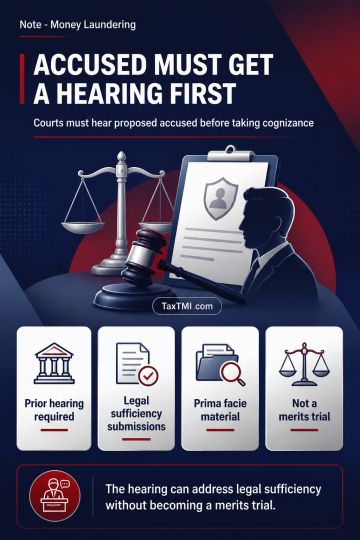
Pre-cognizance hearing protects proposed accused in money-laundering complaints by making prior hearing essential before valid cognizance.
Section 44 of the PMLA removes committal to the Special Court but does not exclude the criminal complaint procedure incorporated through Sections 46 and 65. Section 71 gives priority to the PMLA only where an actual inconsistency exists. Where the BNSS governs cognizance, the first proviso to Section 223(1) requires a meaningful hearing for the proposed accused before cognizance. The safeguard is distinct from exemptions from complainant examination, is mandatory and substantive, and permits submissions on legal sufficiency and prima facie material without converting the stage into a merits trial.
Case Laws Income Tax
Show AI Summary
Partner-specific treaty entitlement requires transparent partnership income to follow each partner's residence, preventing automatic technical-service characterization of legal fees.
For fiscally transparent UK partnerships, Indian-source receipts must be allocated and tested according to each partner's residence and treaty entitlement. India-UK treaty residence applies only to income taxed in the United Kingdom as income of a UK resident. Non-UK resident partners may require examination under India's treaty with their own residence State. Domestic fees-for-technical-services characterisation does not replace treaty analysis, particularly for legal and professional services. Treaty claims require residence certificates, prescribed information, and factual examination of applicable income articles, fixed-base or permanent-establishment tests, and other taxing conditions.
Case Laws IBC
Show AI Summary
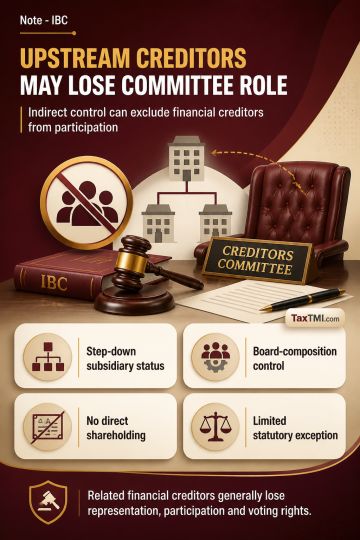
Indirect corporate control can classify an upstream financial creditor as a related party, excluding it from creditor committee participation.
Related-party classification under section 5(24) of the Insolvency and Bankruptcy Code extends to an upstream body corporate where the corporate debtor is its step-down subsidiary, even without direct shareholding. Companies Act concepts permit subsidiary status through control exercised by another subsidiary of the holding company. Board-composition control is an independent basis for related-party status. A related financial creditor is excluded from representation, participation and voting in the Committee of Creditors under the first proviso to section 21(2), subject to the limited statutory exception.
Case Laws GST
Show AI Summary
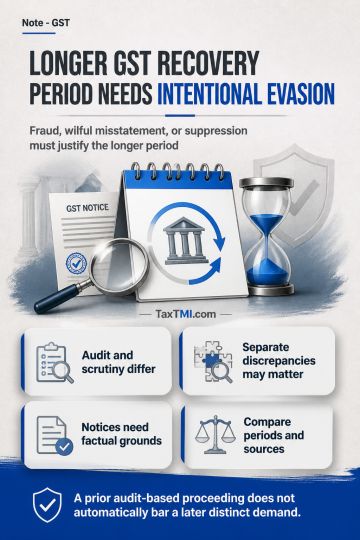
Extended GST limitation requires fraud, wilful misstatement or suppression, while distinct scrutiny discrepancies may independently support demand proceedings.
Extended limitation under Section 74 applies only where unpaid or short-paid tax, erroneous refund, or wrongly availed or utilised input tax credit is attributable to fraud, wilful misstatement, or suppression of facts intended to evade tax. Audit under Section 65 and return scrutiny under Section 61 are distinct processes, and either may lead to proceedings under Section 73 or Section 74. A prior audit-based proceeding does not automatically bar a later Section 74 demand founded on a materially distinct discrepancy in return or reconciliation data. The notice must specify its factual grounds, and duplication must be assessed by comparing the factual basis, periods, source material, and legal allegations.
Case Laws GST
Show AI Summary
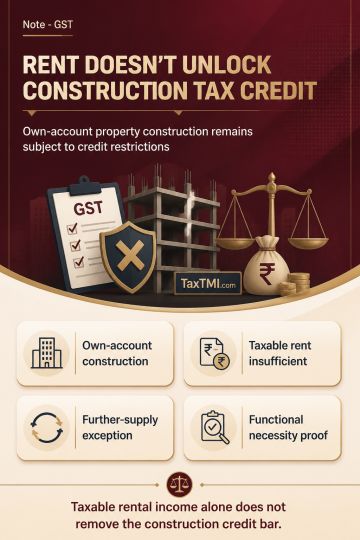
Blocked construction input tax credit: taxable rental income does not override restrictions for property built on the taxpayer's own account.
Input tax credit for goods, services and works contract services used to construct immovable property is subject to the overriding restrictions in Section 17(5), notwithstanding a business nexus under Section 16. Renting is a taxable supply of services but does not by itself satisfy the exception for further supply of works contract services or remove the own-account construction bar. A plant, plant-and-machinery, or qualifying foundation-and-structural-support claim requires fact-specific proof of functional necessity; taxable rental income alone is insufficient. Timely availment, statutory disclosure and the conditions for fraud-based proceedings, interest and penalty require separate assessment.
Case Laws Indian Laws
Show AI Summary
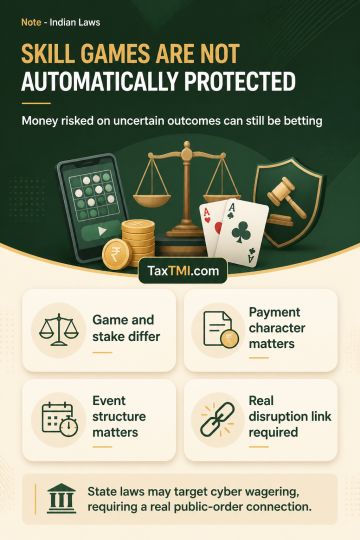
Betting on skill games remains distinct from protected skill play when money is risked on uncertain outcomes.
Entry 34 of List II is analysed as extending to betting on uncertain outcomes even when the underlying game substantially involves skill. The legal inquiry separates the game from an outcome-linked monetary stake: skill classification does not itself immunise wagering. A genuine participation fee for a skill competition may differ from betting, depending on the payment's character, the event structure and its connection to potential gain. State laws may target wagering in cyber space, while public-order competence requires a real and proximate nexus with community-wide disruption.
Case Laws Benami Property
Show AI Summary
Benami fund routing requires proof of consideration, holding and benefit; formal invoices alone may not establish genuine commercial credits.
Benami character under Section 2(9)(A) depends on the real relationship between the property holder, provider of consideration and intended beneficiary. Cash deposits routed through entities linked to an alleged benamidar and transferred by RTGS may support an inference of beneficial ownership when formal invoices, ledgers and tax records lack independent commercial corroboration. Bank funds and proceeds fall within the broad concept of property. Sworn statements, banking records and surrounding circumstances must be assessed together; the party alleging benami bears the initial burden, though evidentiary burdens may shift on proved facts.
Case Laws GST
Show AI Summary
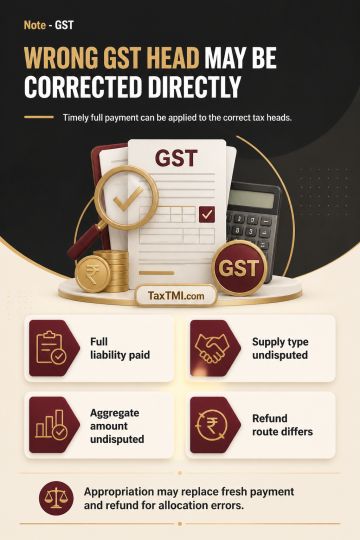
Wrong-head GST payments require appropriation of timely discharged liability, while supply-characterisation errors follow the statutory refund framework.
Wrong-head GST payment must be distinguished from a substantive error in classifying a supply as inter-State or intra-State. Sections 19 and 77 address supplies subsequently held to have a different character and do not automatically govern a mere allocation error where the supply classification and aggregate tax liability are undisputed. Where the full aggregate liability was remitted within time under an incorrect tax head, correction may occur through appropriation against the correct heads rather than a second payment followed by a refund claim.
Case Laws GST
Show AI Summary
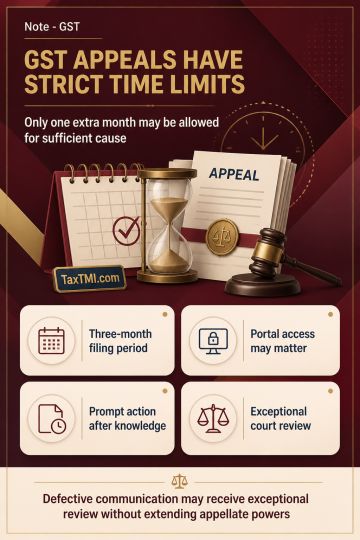
GST appeal limitation strictly confines statutory condonation; exceptional writ review may address defective communication and lost merits hearings.
Section 107 requires a GST appeal within three months from communication of the order and permits condonation only for a further one-month period on sufficient cause. This is a statutory outer limit on the Appellate Authority, which cannot be enlarged through Section 5 of the Limitation Act. Communication through the portal, post or other recognised modes may require factual scrutiny where effective access to the complete order is disputed. Article 226 may exceptionally examine manifest injustice arising from defective communication, prompt action after knowledge, absence of merits adjudication and other credible circumstances, without enlarging the Appellate Authority's statutory jurisdiction.
Case Laws Income Tax
Show AI Summary
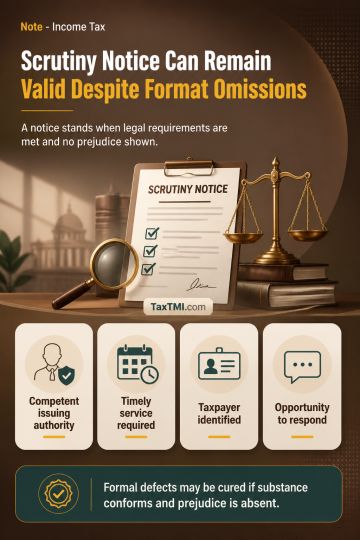
Scrutiny notice validity turns on statutory compliance and prejudice, not omission of an administrative scrutiny classification.
Validity of a scrutiny notice under section 143(2) depends on statutory compliance, not merely on use of a prescribed administrative format. A notice remains effective where it is issued by a competent authority, timely served, identifies the taxpayer and assessment year, conveys scrutiny, and affords an opportunity to support the return. Section 292B may cure formal defects where the notice substantively conforms to the Act and no actual prejudice is established. This issue is distinct from the restriction that limited-scrutiny inquiries cannot be expanded without prescribed conversion safeguards.
Case Laws Income Tax
Show AI Summary
Article 8 treaty protection excludes independent third-party ground handling and engineering receipts lacking a direct transportation nexus.
Article 8 of the India-UK DTAA confines protection to profits derived from treaty-defined international aircraft operations and qualifying participation in air-transport pools. Engineering and ground-handling services supplied to other airlines are independently organised commercial services where they lack a direct nexus to the enterprise's own international transportation. A qualifying pool requires substantive evidence of its legal and commercial structure, including reciprocal arrangements and settlement mechanisms; industry arrangements or aviation-sector relevance alone are insufficient.
Case Laws GST
Show AI Summary
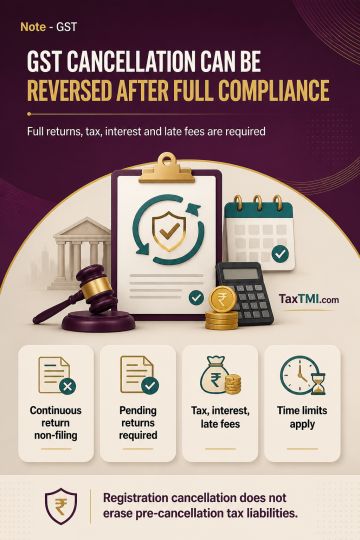
GST registration cancellation for return default remains reversible only through complete, time-bound filing and payment compliance.
GST registration may be cancelled for continuous non-filing of returns, but cancellation does not discharge pre-cancellation tax liabilities. Before cancellation, Rule 22(4) requires proceedings to be dropped where the taxpayer files all pending returns and pays tax, interest and late fee. Post-cancellation revocation under Rule 23 is a separate mechanism requiring complete filing and payment compliance within the applicable time limits. Conditional restoration may be appropriate where liabilities are fully regularised, while absence of fraud does not excuse default or replace statutory compliance.
Case Laws IBC
Show AI Summary
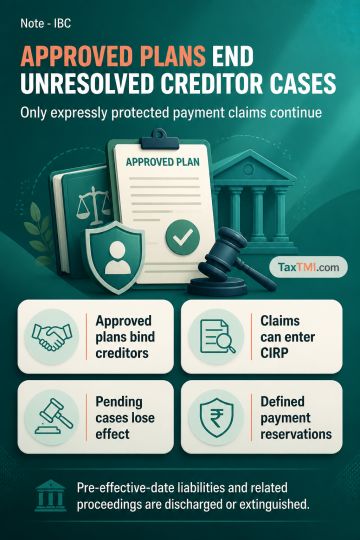
Resolution-plan finality extinguishes unresolved operational-creditor proceedings unless the plan expressly preserves liability and payment rights.
Finality of an approved resolution plan fixes the treatment of corporate-debtor liabilities and binds creditors within the corporate insolvency resolution process. A disputed or unadjudicated right to payment may be submitted as a claim during CIRP, but does not independently preserve civil or arbitral proceedings after plan approval. Where the final claims list and the plan provide for discharge of pre-effective-date liabilities and extinguishment of related proceedings, unresolved operational-creditor claims survive only if the plan expressly preserves them through a defined payment or reservation mechanism.
Case Laws Customs
Show AI Summary
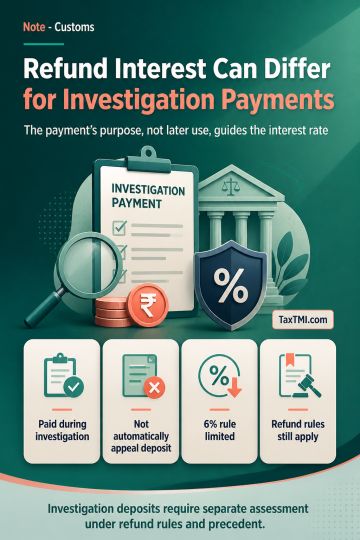
Investigation deposits: refund interest may differ from statutory appellate pre-deposit interest when the underlying demand fails.
Interest on the refund of amounts deposited under protest during a customs investigation depends on the legal character of the payment, rather than its later appropriation towards a differential-duty demand. An amount paid pending investigation does not become a statutory appellate pre-deposit merely because part of the overall payment is treated as a pre-deposit for appeal purposes. The rate fixed at 6% for Section 129EE is confined to amounts deposited under Section 129E, while an investigation deposit requires assessment under the applicable refund framework and binding jurisdictional precedent.
Case Laws Indian Laws
Show AI Summary
Admitted cheque signatures trigger presumptions of consideration and enforceable debt, requiring evidence-based probable defences in dishonour proceedings.
Once execution of a cheque is admitted or proved, consideration must be presumed and the holder must be presumed to have received the cheque towards discharge, wholly or partly, of a legally enforceable debt or other liability. The drawer may rebut these presumptions on a preponderance of probabilities, but the defence must have a factual foundation. Bare denials, unsupported misuse allegations, and blank-cheque or security-cheque assertions ordinarily do not displace the presumptions. Financial capacity becomes material only upon a credible, specific, and evidence-based challenge.
Case Laws Customs
Show AI Summary
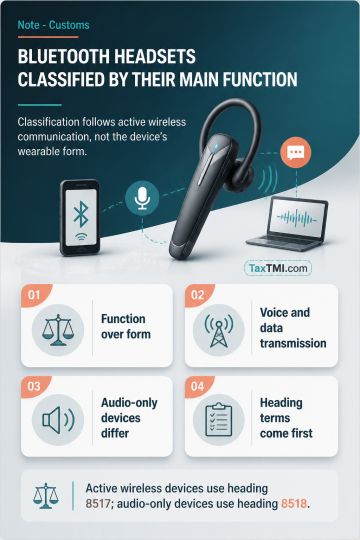
Bluetooth headset classification turns on active wireless network communication, not audio form, when determining principal function and essential character.
Bluetooth-enabled personal audio devices are classified by objective technical function rather than wearable form, product label, audio output or microphone. Heading 8517 applies where Bluetooth capability makes the device an active wireless-network apparatus that receives, converts and transmits voice or data; heading 8518 covers ordinary headphones or earphones carrying only audio signals. Classification begins with the heading terms and relevant notes, with essential character and principal function applied only through the sequential General Rules where competing headings remain.
Case Laws Income Tax
Show AI Summary
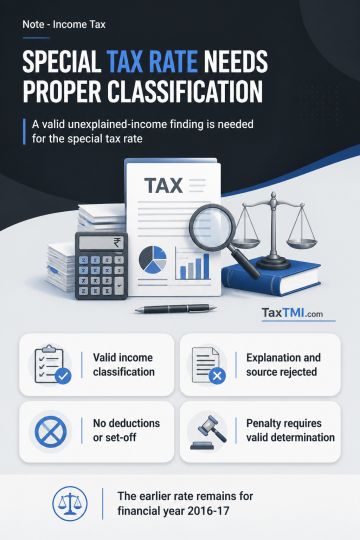
Unexplained-income taxation requires valid deeming classification, while enhanced special rates apply prospectively under the stated effective-date framework.
Section 115BBE applies only where income is validly assessed under the deeming provisions for unexplained income; a surrender, disclosure or addition alone is insufficient. The assessing authority must identify the relevant provision and reject the explanation of nature and source where required. The special computation denies deductions, allowances and loss set-off against qualifying income. The Rajasthan High Court treated the enhanced rate introduced with effect from 1 April 2017 as prospective, preserving the earlier rate for financial year 2016-17. Penalty under section 271AAC depends on a valid section 115BBE determination.
Case Laws Income Tax
Show AI Summary
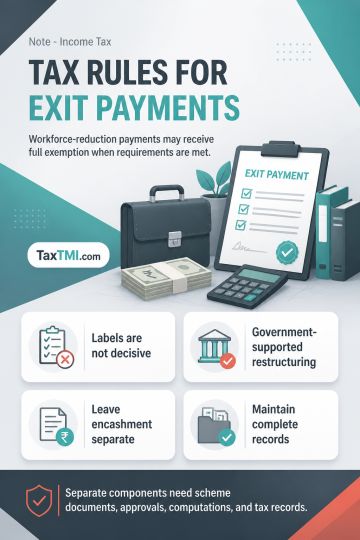
Substance-over-form treatment of VRS compensation can place retrenchment-linked payments within the distinct full-exemption framework for approved workforce reduction schemes.
Tax treatment of VRS-labelled separation payments depends on their substantive character. Payments connected with Government-supported workforce restructuring may qualify as retrenchment compensation under section 10(10B), rather than as voluntary-retirement compensation under section 10(10C), where the special-protection requirements are satisfied. Leave encashment must be examined separately under section 10(10AA), according to employee status and the applicable conditions or notified limit. Settlement components should be segregated and supported by scheme documents, approvals, computations, and tax records.
Case Laws Income Tax
Show AI Summary
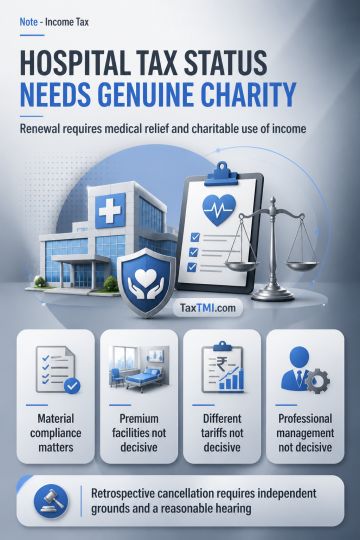
Charitable hospital renewal depends on genuine medical relief, charitable application of income, and material regulatory compliance.
Renewal of section 12AB registration for a charitable hospital depends on genuine activities in furtherance of medical relief, application of income and assets to charitable objects, and compliance with other laws only where material to those objects. Receipts, premium facilities, tariff differentials, sophisticated infrastructure and professional management do not alone negate charitable status. Other-law non-compliance requires attention to the specified-violation framework and competent regulatory determinations. Retrospective cancellation is distinct from refusing renewal and requires an independent statutory and factual foundation, with reasonable opportunity of hearing.

TMI Notes

Back

All TMI Notes

Showing Results for :
Reset Filters
No Records Found

TMI Notes

Back

All TMI Notes

Taxation of Special Incomes in India "Profits and gains from Life Insurance Business" : Clause 194 of the Income Tax Bill, 2025 Vs. Section 115B of the Income-tax Act, 1961

1 May, 2025

Contents
Acts
Rules & Regulations
Summary
Note

Note

-

Bookmark

(New) -

Download

Print

Print

Clause 194 Tax on certain incomes.

Income Tax Bill, 2025

Introduction

Clause 194 of the Income Tax Bill, 2025 represents a significant evolution in the Indian income tax regime, specifically addressing the taxation of certain special categories of income. This provision not only consolidates and updates the taxation framework for winnings from lotteries, games, and gambling, but also incorporates contemporary income streams such as virtual digital assets (VDAs), carbon credits, and royalties from Indian-developed patents. Additionally, it addresses the taxation of profits and gains from life insurance business, a domain historically governed by Section 115B of the Income-tax Act, 1961. The move to introduce Clause 194 is reflective of the legislature's intent to modernize, streamline, and clarify the tax treatment of these special income categories, particularly in response to evolving business models and technological advancements. The inclusion of new income sources such as VDAs and carbon credits underlines the adaptive nature of tax policy to emerging economic realities. At the same time, the provision retains and refines the approach to long-standing income streams, ensuring continuity and stability in the tax system. This commentary undertakes a comprehensive analysis of Clause 194, examining its structure, purpose, and practical implications. It further provides a detailed comparative analysis with Section 115B, particularly focusing on the treatment of profits and gains from life insurance business, to highlight the continuities, departures, and policy considerations embedded in the legislative evolution.

Objective and Purpose

The legislative intent behind Clause 194 is multifold:

  • To provide a consolidated and updated framework for taxing specified incomes that merit special treatment, either due to their nature, volatility, or policy considerations.
  • To address gaps and ambiguities in the existing law, particularly with respect to new forms of income such as virtual digital assets and carbon credits.
  • To incentivize innovation and domestic research by offering concessional tax rates on royalties from patents developed and registered in India.
  • To ensure equitable and efficient taxation of windfall gains and speculative incomes, such as those from lotteries, gambling, and online games, which are generally considered non-recurring and not reflective of regular economic activity.
  • To maintain a consistent and predictable tax regime for profits and gains from life insurance business, a sector of systemic financial importance.

The historical background to these provisions lies in the recognition that certain income streams, due to their peculiar characteristics, require distinct tax treatment. For example, the high rate of tax on winnings from gambling and lotteries is designed both to discourage such activities and to ensure a fair share of revenue from windfall gains. The concessional rate on patent royalties aims to foster indigenous innovation.

Detailed Analysis of Clause 194 of the Income Tax Bill, 2025

Clause 194 is structured to apply "irrespective of anything contained in any other provision of this Act," thereby granting it overriding effect. The clause operates by reference to a comprehensive table, which sets out the categories of taxpayers, the specific income streams, the applicable tax rates, and any conditions or restrictions.

1. Winnings from Lotteries, Games, and Gambling (30%)

[*******]

2. Royalty from Indian Patents (10%)

[*******]

3. Income from Transfer of Carbon Credits (10%)

[*******]

4. Income from Transfer of Virtual Digital Assets (30%)

[*******]

5. Net Winnings from Online Games (30%)

[*******]

6. Profits and Gains from Life Insurance Business (12.5%)

Scope: Applies to any person with profits and gains from life insurance business.

Tax Rate: 12.5%, flat.

Conditions: None specified.

Interpretation: The provision continues the long-standing policy of taxing life insurance business profits at a concessional rate, recognizing the sector's systemic importance and unique business model.

Ambiguities/Potential Issues: The absence of detailed conditions may lead to interpretational issues regarding the computation of "profits and gains" from life insurance business.

Definitions and Explanations

Clause 194(2) provides detailed definitions for key terms such as "carbon credit," "computer resource," "developed," "patentee," "patent," "royalty," and "virtual digital asset." These definitions are largely aligned with existing statutes (such as the Patents Act and the Information Technology Act), ensuring coherence and minimizing interpretational disputes.

Practical Implications

Clause 194, by consolidating and updating the taxation of special income streams, has several practical implications:

  • Taxpayers: Individuals and entities earning income from the specified categories must be aware of the flat rates and the denial of deductions/set-offs. This may require adjustments in tax planning and compliance processes.
  • Businesses: Companies involved in patent development, carbon credits, or VDAs must ensure robust documentation and timely exercise of options to avail concessional rates where applicable.
  • Life Insurance Sector: The continuation of the 12.5% rate provides certainty, but any changes in the computation of profits and gains may require adjustments in reporting and tax calculation.
  • Regulators: The need for clear rules and guidance, especially for new income streams like VDAs and online games, will be critical to ensure consistent enforcement and minimize disputes.
  • Compliance: The denial of deductions and set-offs simplifies computation but may increase the effective tax burden for some taxpayers. The stringent penalty for non-compliance (e.g., in the patent royalty regime) underscores the importance of timely and accurate compliance.

Comparative Analysis with Section 115B of the Income-tax Act, 1961

Section 115B, as it stands, is a focused provision dealing exclusively with the taxation of profits and gains from life insurance business.

Key Features of Section 115B

  • Scope: Applies where the total income includes profits and gains from life insurance business.
  • Tax Rate: 12.5% on profits and gains from life insurance business.
  • Aggregate Computation: Tax is the sum of (i) tax at 12.5% on life insurance profits, and (ii) tax on the remainder of total income at normal rates.
  • Special Deposit Requirement (Historical): Sub-section (2) required, for certain years, a deposit of one-third of the tax computed into a social security fund, with a reduction if a deposit of at least 2.5% of profits was made. This was a temporary measure for assessment years 1989-90 and 1990-91.

Comparison with Clause 194 of the Income Tax Bill, 2025

  1. Scope and Breadth:
    • Section 115B is limited to life insurance business. Clause 194 is much broader, covering multiple categories of special income, including life insurance business.
  2. Tax Rate:
    • Both provisions prescribe the same concessional rate (12.5%) for life insurance business.
    • Clause 194, however, brings this within a consolidated framework for special incomes, rather than as a standalone section.
  3. Computational Method:
    • Both provisions use the "aggregate" method: tax at special rate on specified income, plus tax at normal rates on the remainder.
  4. Denial of Deductions:
    • Section 115B does not expressly deny deductions for expenses; such matters are governed by the general provisions of the Act.
    • Clause 194, for some categories (but not life insurance), expressly denies deductions. For life insurance business, no specific denial is mentioned, so general rules likely apply.
  5. Special Deposit Requirement:
    • Section 115B(2) had a requirement for contributions to a social security fund for certain years. Clause 194 contains no such requirement.
    • This reflects a policy shift, possibly due to the redundancy of the earlier requirement or the existence of alternative mechanisms for social security funding.
  6. Definitions:
    • Clause 194 provides comprehensive definitions for each special income, ensuring clarity.
    • Section 115B relies on general definitions and the computation methodology u/s 44 and the First Schedule for life insurance business.
  7. Legislative Approach:
    • Section 115B represents a piecemeal approach, with each special income category addressed in separate sections.
    • Clause 194 consolidates various special incomes under a single umbrella, reflecting a modern trend towards codification and simplification.
  8. Alignment with Contemporary Developments:
    • Clause 194 incorporates new income streams (digital assets, carbon credits, online games) absent in the 1961 Act, demonstrating adaptability to technological and economic change.

Comparison Table on Key Points:

Feature Section 115B of the Income-tax Act, 1961 Clause 194 of the Income Tax Bill, 2025 Analysis
Applicability Profits and gains from life insurance business Profits and gains from life insurance business (among other incomes) Clause 194 subsumes and continues the treatment of life insurance business, while expanding to other income streams.
Tax Rate 12.5% 12.5% No change; provides continuity and certainty for the sector.
Computation Tax on life insurance profits at 12.5% + tax on balance income as if life insurance profits excluded Same aggregation method for all specified incomes Clause 194 adopts the same computational mechanism, ensuring consistency.
Additional Requirements For AYs 1989-90 & 1990-91, deposit in social security fund No such requirement The social security fund deposit was a temporary measure, not continued in Clause 194.
Other Incomes Covered Only life insurance business Winnings, patent royalties, carbon credits, VDAs, online games, etc. Clause 194 is broader in scope, reflecting contemporary economic realities.
Conditions/Restrictions None specified (other than for social security fund) Specific conditions for other income streams; none for life insurance business Life insurance business remains subject to minimal conditions, maintaining simplicity.

Key Points of Evolution:

  • Clause 194 represents a structural consolidation, bringing together the taxation of various special income streams under one provision, whereas Section 115B was focused solely on life insurance business.
  • The tax rate and computation method for life insurance business remain unchanged, ensuring policy continuity.
  • The additional requirement of deposit in a social security fund, present in Section 115B for specific years, is not carried forward, indicating a move towards simplification.
  • The inclusion of new income streams (VDAs, carbon credits, online games) in Clause 194 reflects legislative responsiveness to new economic activities and technologies.

Conclusion

Clause 194 of the Income Tax Bill, 2025 marks a significant step towards a more comprehensive, transparent, and adaptive taxation regime for special categories of income in India. By consolidating the tax treatment of winnings, royalties, carbon credits, virtual digital assets, online games, and life insurance business, it provides clarity and certainty to taxpayers and administrators alike. The provision retains the established approach for life insurance business, as set out in Section 115B, while expanding the scope to address new and emerging income streams. The explicit denial of deductions and set-offs for certain categories, the requirement to exercise options for concessional regimes, and the detailed definitions provided are all indicative of a policy intent to ensure fair, efficient, and enforceable taxation. While the legislative framework is robust, its success will depend on effective implementation, clear rule-making (especially for new areas like VDAs and online games), and ongoing responsiveness to judicial interpretation and market developments. Potential areas for further refinement include clarifying definitions, simplifying compliance for small taxpayers, and ensuring that the regime remains competitive and equitable in a rapidly changing economic environment.


Full Text:

Clause 194 Tax on certain incomes.

Topics

Acts Income Tax