Loading...

⚠ ✕
❮ Top
☎ Help
☰
×

By creating an account you can:

Logo TaxTMI
Call Us / Help / Feedback✕

Contact Us At :

✉ E-mail: [email protected]

✆ To Call / Whatsapp, Check Contact Us

FAQs :

To know Frequently Asked Questions, Check FAQs

Most Asked Video Tutorials :

For more tutorials, Check Video Tutorials

Submit Feedback/Suggestion :

Email :
Please provide your email address so we can follow up on your feedback.
Category :
Description :
Min 15 characters 0/2000
Make Most of Text Search ✕
  1. Checkout this video tutorial: How to search effectively on TaxTMI.
  2. Put words in double quotes for exact word search, eg: "income tax"
  3. Avoid noise words such as : 'and, of, the, a'
  4. Sort by Relevance to get the most relevant document.
  5. Press Enter to add multiple terms/multiple phrases, and then click on Search to Search.
  6. Text Search
  7. The system will try to fetch results that contains ALL your words.
  8. Once you add keywords, you'll see a new 'Search In' filter that makes your results even more precise.
  9. Text Search
╳
Add to...
You have not created any category. Kindly create one to bookmark this item!
✕
Create New Category
Hide
Title :
Description :
❮❮ Hide
❮ Default View
Expand ❯❯
Close ✕
🔎 Filters / Advanced Search ❯
TEXT

Press 'Enter' to add multiple search terms. Rules for Better Search

Search In
Main Text + AI Text ❯
  • Main Text
  • Main Text + AI Text
  • AI Text
Law:
---- All Laws---- ❯
  • ---- All Laws----
  • Benami Property
  • Bill
  • Central Excise
  • Companies Law
  • Customs
  • DGFT
  • FEMA
  • GST
  • GST - States
  • IBC
  • Income Tax
  • Indian Laws
  • Money Laundering
  • SEBI
  • SEZ
  • Service Tax
  • VAT / Sales Tax
Types:
---- All Types ---- ❯
  • ---- All Types ----
  • Act Rules
  • Case Laws
  • Circulars
  • Manuals
  • News
  • Notifications
Sort By: ?
In Sort By 'Default', exact matches for text search are shown at the top, followed by the remaining results in their regular order.
Relevance Default Date
☰   Show Results ❯
    Case Laws Customs
    Pilferage of Imported Goods: Approval, Custody and Duty Liability under the Customs Act, 1962
    Case Laws Indian Laws
    Condonation of Delay in Statutory Appeals under Section 5 of the Limitation Act, 1963
    Case Laws Income Tax
    Condonation of Delay for Filing Revised Returns under Section 119(2)(b): Genuine Hardship and Merits...
    Case Laws Income Tax
    TDS Credit Where the Deductor Defaults: Proof of Deduction Without Form 16 or Form 16A
    Case Laws Indian Laws
    Reserved High Court Judgments: Constitutional Timelines, Accountability and Litigant Remedies
    Price Depression in Securities Markets: Evidentiary Requirements under the PFUTP Regulations
    Case Laws Income Tax
    Foreign Leave Travel Concession and Tax Deduction at Source under Sections 10(5), 192 and 201
    Refund of Accumulated Input Tax Credit under Inverted Duty Structure: Section 54(3)(ii) and Rule 89(...
    Detention of Goods in Transit: Consequences of Delayed Penalty Orders Under Section 129(3)
    ITC: Constitutional Validity of Section 16(2)(c) of the CGST Act and Supplier-Tax-Payment Condition ...
    Substantive Right of Appeal and Onerous Pre-Deposit Conditions under the CGST Act
    Extended Limitation under GST: Fraud, Wilful Misstatement and Suppression Must Appear from the Notic...
    Omission of Rule 96(10) of the CGST Rules and Its Effect on Pending Integrated Tax Refund Proceeding...
    Interim Protection from Arrest after Dismissal of Anticipatory Bail under the GST Arrest Framework
    Case Laws Income Tax
    Interplay of Sections 87A, 111A and 115BAC(1A) in Computing Rebate on Special-Rate Capital Gains
    Extended Limitation u/s 74 of the CGST Act: Foundational Facts for Fraud, Wilful Misstatement and Su...
    Case Laws Income Tax
    Arm's Length Price Determination u/s 92C: Comparability Analysis: Economic Relevance of Turnover and...
    Case Laws Income Tax
    Make-Available Requirement for Managerial and Consultancy Services under the India-Singapore DTAA: A...
    Case Laws Income Tax
    Rebate under Section 87A on Short-Term Capital Gains Taxable under Section 111A
    Case Laws Income Tax
    Reassessment Notice Procedure: Administrative Approval under Section 143(2), Sanction under Section ...
❮
❯
❯❯
Maximize Maximize Maximize
0 / 200
Expand Note
Add to Folder

No Folders have been created

+

Are you sure you want to delete "My most important" ?

NOTE:

Notes
Showing Results for :
Reset Filters
Results Found:
Show All Summaries Hide All Summaries
Case Laws Customs
Show AI Summary
Approved customs custodians bear duty for proven pilferage during custody, but not for losses before their approval takes effect.
Customs-duty liability for pilfered imported goods arises only where pilferage occurs after unloading in a customs area while goods are held by an approved custodian. Approval is indispensable; factual control or statutory custody alone does not impose this liability for a period before approval. Importer duty exemption for pre-clearance pilferage operates alongside the custodian's revenue liability. Pilferage must be proved through contemporaneous records and cannot be presumed from every cargo discrepancy, shortage, or loss.
Case Laws Indian Laws
Show AI Summary
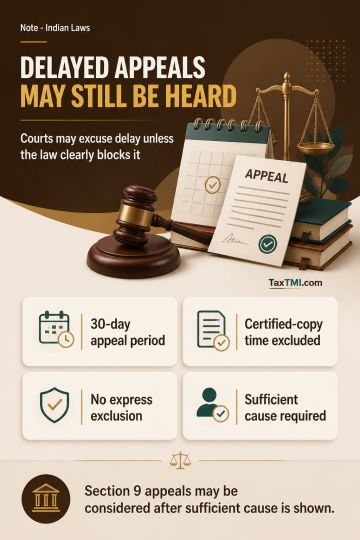
Condonation of delay under Section 5 remains available in special statutory appeals unless the governing scheme clearly excludes it.
Section 5 of the Limitation Act, 1963 applies to a special statutory appeal through Section 29(2) unless the governing enactment excludes it expressly or by necessary implication. A special limitation period alone is insufficient to exclude condonation. Restrictive language, a defined maximum condonable period, or a complete statutory limitation code may create a non-extendable outer limit. Section 9 of the Chhattisgarh Rajya Suraksha Adhiniyam contains a 30-day appeal period and excludes certified-copy time, but lacks an express bar or outer condonation ceiling; delay may therefore be considered upon proof of sufficient cause.
Case Laws Income Tax
Show AI Summary
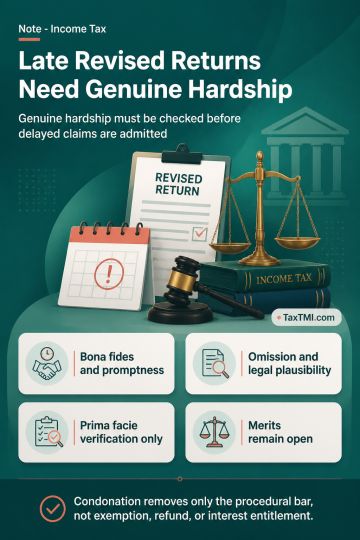
Genuine hardship in delayed revised-return claims requires prima facie verification without converting condonation into final tax adjudication.
Section 119(2)(b) may permit admission of a delayed revised-return claim where expiry of the Section 139(5) period causes genuine hardship. Condonation removes only the procedural bar and does not establish exemption, refund, or interest entitlement. Genuine hardship requires assessment of bona fides, the nature of the omission, promptness after discovery, legal plausibility, and the consequence of refusal. Circular No. 9/2015 permits prima facie verification and inquiry, but substantive taxability and refund entitlement remain for merits examination.
Case Laws Income Tax
Show AI Summary
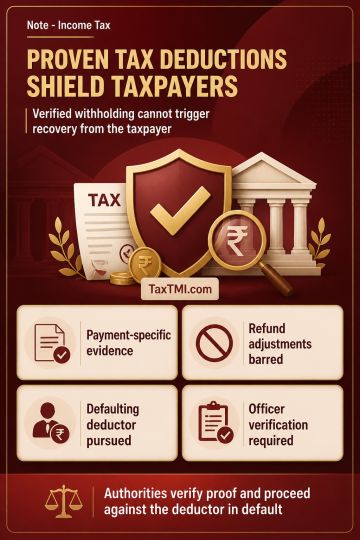
TDS credit after verified deduction protects taxpayers from demands and refund adjustments caused by deductor default.
TDS credit in domestic deductor-default cases depends on verified actual deduction from the taxpayer's income, not solely on deposit, TDS statements, Form 16 or Form 16A, or Form 26AS reflection. Section 205 bars direct or indirect recovery, including refund adjustment, to the extent tax was deducted. The taxpayer must provide reliable payment-specific evidence, and the Assessing Officer must verify the claim while the Department proceeds against the defaulting deductor.
Case Laws Indian Laws
Show AI Summary
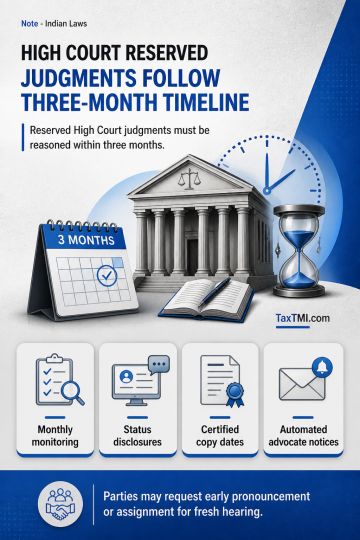
Timely reserved judgments: a three-month framework, transparency, and staged remedies protect liberty and require reasoned decisions.
Reserved High Court judgments are subject to a three-month framework for a reasoned pronouncement, supported by monthly monitoring, status disclosures, date-recorded certified copies, and automated notice to advocates. Urgent matters may receive an operative-part pronouncement, but reasons must be uploaded within seven days or, where practical difficulties exist, within fifteen days. Parties may seek early pronouncement after the specified period and, after further delay, request withdrawal and assignment for a fresh hearing.
Case Laws SEBI
Show AI Summary
Settlement-price depression allegations require cogent proof of manipulation, not merely short exposure, closing sales, or position-limit non-disclosure.
Settlement-price depression under the PFUTP framework requires cogent proof of a manipulative act, device, scheme or artifice, not merely a substantial short derivative position, closing-window sales, or an incentive to benefit from a lower settlement price. Position concentration and position-limit non-disclosure are distinct from PFUTP fraud. Sales below the last traded price require market-wide causal analysis of other trading activity, execution mechanics, benchmark methodology, commercial rationale, and actual price impact. A genuine hedge and agency-attributed exposure do not, without further proof, establish manipulation.
Case Laws Income Tax
Show AI Summary
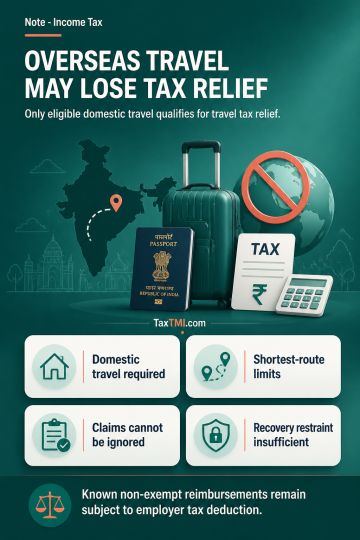
Foreign LTC tax exemption requires domestic travel; employers must deduct tax on known non-exempt travel reimbursements.
Foreign LTC/LFC payments for itineraries containing an overseas leg are outside the Section 10(5) exemption, which is confined to actual eligible domestic travel subject to Rule 2B shortest-route and fare conditions. Under Section 192, employers must include known non-exempt payments in estimated salary and deduct tax; they cannot disregard available claim records showing foreign or circuitous travel. A recovery restraint does not automatically suspend the deduction obligation. Section 201 recipient-compliance conditions, interest, and penalty based on reasonable cause require separate analysis.
Case Laws GST
Show AI Summary
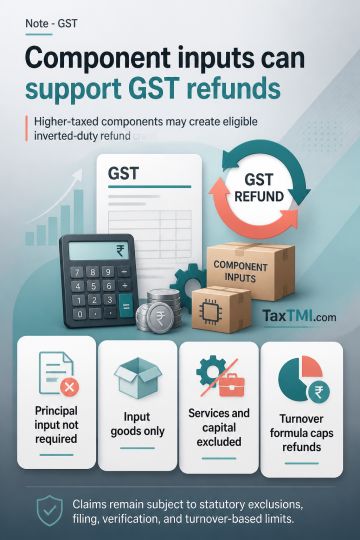
Inverted-duty GST refunds remain available where higher-taxed component inputs, rather than only principal inputs, cause accumulated eligible credit.
Refund of accumulated unutilised ITC under an inverted-duty structure depends on a causal link between higher-taxed input goods and lower-taxed output supplies. The test is not restricted to the principal raw material; higher-rated component inputs may support a claim despite parity between the principal input and output. Refund remains confined to credit on input goods, excluding input services and capital goods. Rule 89(5) separately determines the maximum refundable amount through its turnover-based formula, subject to statutory exclusions and prescribed filing and verification requirements.
Case Laws GST
Show AI Summary
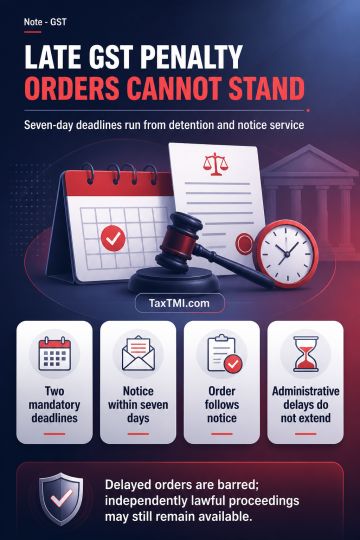
Mandatory goods-detention timelines bar delayed GST penalty orders despite administrative complications, while independently lawful proceedings may remain available.
Section 129(3) imposes two mandatory sequential deadlines: a penalty notice must be issued within seven days of detention or seizure, and the penalty order must follow within seven days of service of that notice. The service date, rather than reply, valuation or intervening events, controls the latter period. Administrative difficulty cannot extend either deadline. The framework also requires a hearing, while inspection reporting timelines and administrative forms remain distinct and cannot dilute the statutory time limits.
Case Laws GST
Show AI Summary
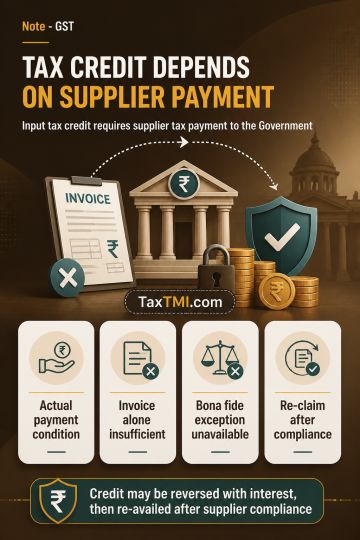
Input tax credit requires actual supplier tax payment, while reversal must rest on transaction-specific evidence and procedures.
Input tax credit under Section 16(2)(c) of the CGST Act is conditional upon actual payment of the tax charged on the supply to the Government. The condition is cumulative and is not replaced by the recipient's invoice, payment to the supplier, receipt of supply, return filing, or bona fides. Self-assessed credit is reversible with applicable interest where the supplier has not paid tax, but may be re-availed after subsequent supplier compliance. A bona fide-purchaser exception cannot be read into the actual-payment requirement, although any reversal or demand must rest on specific statutory facts, supporting material, and reasoned adjudication.
Case Laws GST
Show AI Summary
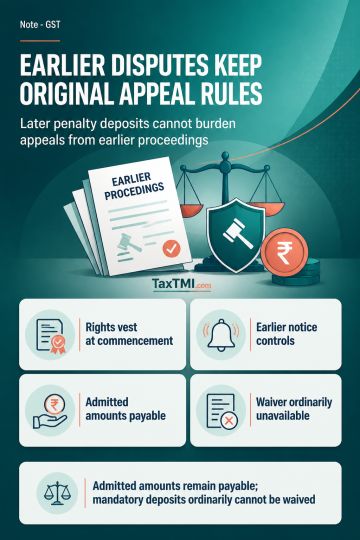
Vested appellate rights prevent later penalty-only pre-deposit conditions from burdening appeals arising from earlier commenced adjudication.
Substituted CGST pre-deposit requirement for penalty-only orders does not govern an appeal arising from a formal show-cause notice issued before 1 October 2025, absent express retrospective language or necessary implication. The right of appeal and its applicable conditions vest when the lis commences; a filing-stage deposit that bars institution is substantive, not merely procedural. Admitted amounts remain payable, while a mandatory applicable deposit cannot ordinarily be waived or reduced by the Appellate Authority.
Case Laws GST
Show AI Summary
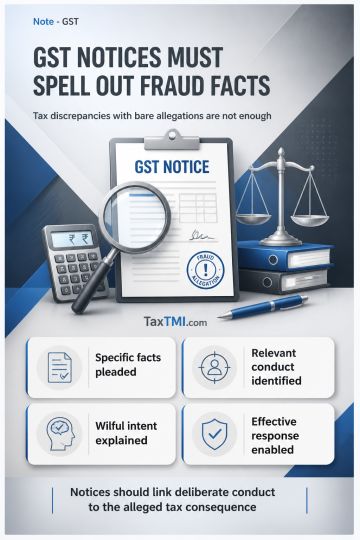
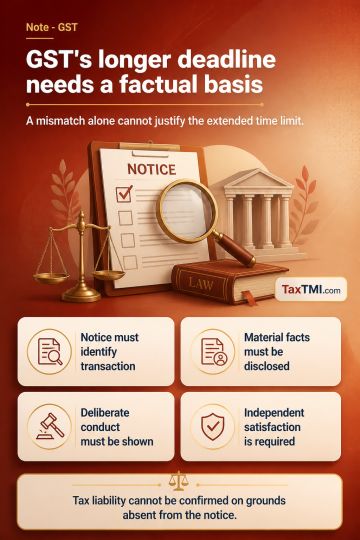
Extended GST limitation requires show cause notices to plead fraud, wilful misstatement, or suppression through specific factual allegations.
Section 74 requires the notice itself to state the material facts supporting the precise statutory limb invoked and the causal nexus between that conduct and the alleged tax consequence. The phrase "by reason of" requires a pleaded connection; a tax discrepancy coupled with a conclusory allegation of fraud or suppression is insufficient. The notice should identify the relevant act, omission, representation, non-disclosure or device, explain why it is deliberate or wilful, and enable an effective response.
Case Laws GST
Show AI Summary
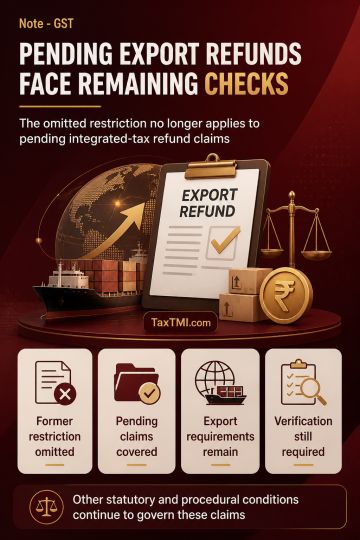
Omission of export-refund restriction requires pending integrated-tax refund claims to be assessed under surviving statutory and procedural conditions.
Omission of Rule 96(10), effective from 08 October 2024 without a saving clause, applies to integrated-tax export-refund proceedings pending on that date. Such claims are assessed without the former restriction concerning specified notification benefits because Section 6 of the General Clauses Act does not preserve an omitted subordinate rule. The omission does not remove independent requirements for zero-rated supplies, refund eligibility, export documentation, returns, limitation, verification, or the applicable Rule 96 and Rule 89 procedures.
Case Laws GST
Show AI Summary
Interim arrest protection cannot survive dismissal of anticipatory bail; GST arrest requires communicated authorisation, not merely a summons.
Interim protection from arrest is ancillary to a live anticipatory-bail proceeding and cannot subsist as a freestanding direction after an application is dismissed as not maintainable. Under the GST arrest framework, a summons does not by itself make the summoned person an accused or create a legally sustainable apprehension of arrest. Arrest depends upon the Commissioner's reasons to believe and an order authorising arrest. The Section 69 authorisation order must be communicated before arrest, enabling the affected person to pursue available remedies before personal liberty is curtailed.
Case Laws Income Tax
Show AI Summary
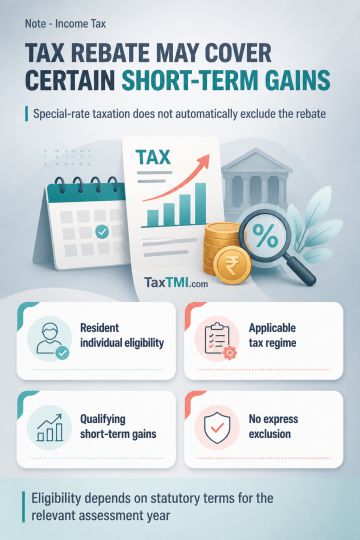
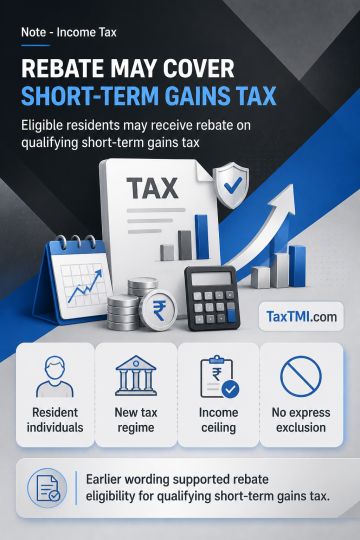
Section 87A rebate may apply after special-rate computation of qualifying short-term capital gains, absent an express statutory exclusion.
Section 111A requires qualifying short-term capital gains to be taxed at the prescribed special rate, while section 87A operates as a rebate from income-tax computed on total income for an eligible resident individual under the applicable section 115BAC(1A) regime. Special-rate taxation governs computation and does not itself imply exclusion from the rebate. Unlike section 112A(6), section 111A contains no express provision reducing the rebate base by tax on qualifying gains. Eligibility depends on the statutory terms applicable for the relevant assessment year.
Case Laws GST
Show AI Summary
Extended GST limitation requires pleaded foundational facts linking alleged fraud, wilful misstatement, or suppression to tax evasion.
Section 74 permits extended GST limitation only where tax short payment, erroneous refund, or wrongful input tax credit arose by reason of fraud, wilful misstatement, or suppression of facts to evade tax. A mismatch or discrepancy alone is insufficient. The show cause notice must disclose foundational facts identifying the transaction, withheld or misstated material, deliberate conduct alleged, and its factual link to tax evasion. Audit objections or approaching limitation cannot replace the proper officer's independent satisfaction. Liability cannot be confirmed on grounds beyond those specified in the notice.
Case Laws Income Tax
Show AI Summary
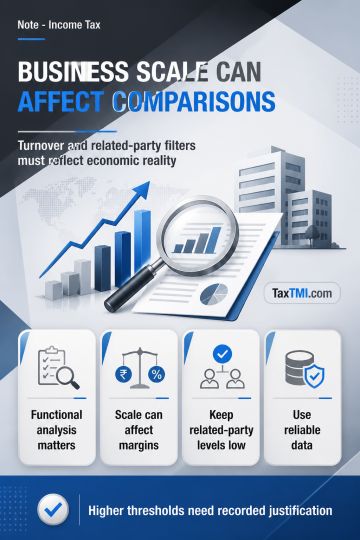
Transfer-pricing comparability requires turnover and related-party transaction filters to reflect functional, economic, and data-based reliability rather than fixed thresholds.
Transfer-pricing comparability under the transactional net margin method requires economically reliable uncontrolled comparables selected through functional, asset, risk, contractual and market analysis. Turnover is not a universal statutory threshold, but material scale differences may justify exclusion where they affect margins through brand value, intangibles, bargaining power or economies of scale. Related-party transaction tolerance should ordinarily be the lowest practicable level; a higher threshold requires a recorded finding that sufficient lower-related-party comparables are unavailable. Any re-determination and comparable selection must comply with statutory conditions, reliable data requirements and Rule 10B.
Case Laws Income Tax
Show AI Summary
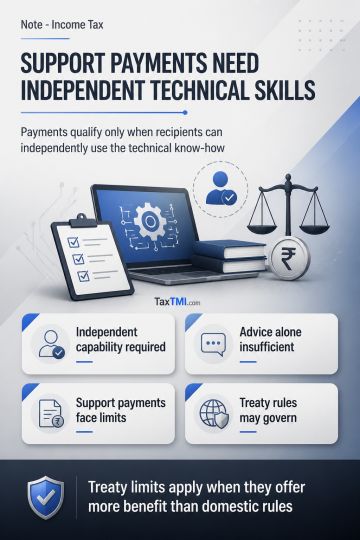
Make-available requirement limits treaty characterization of management and support payments as fees unless recipients gain independent technical capability.
Fees for technical services under Article 12(4) of the India-Singapore DTAA require more than managerial, technical or consultancy characterisation. The services must satisfy an additional treaty gateway, including making available technical knowledge, experience, skill, know-how or processes that enable the recipient to apply the technology independently. Advice, operational assistance, recurring support, training or business benefits do not alone establish transfer of technical capability. Where the DTAA is more beneficial than the broader domestic definition, the treaty limitation governs, subject to treaty-residence and documentation requirements.
Case Laws Income Tax
Show AI Summary
Income-tax rebate may extend to short-term capital gains tax when total-income conditions under the new regime are met.
Under the pre-restriction statutory formulation, a resident individual taxable under section 115BAC(1A) and within the prescribed total-income ceiling is analysed as eligible for section 87A rebate against income-tax on total income, including tax on qualifying short-term capital gains under section 111A. Section 111A fixes the special-rate computation but contains no express rebate exclusion. The explicit exclusion for specified long-term gains in section 112A(6) supports this distinction. Later limiting language in section 87A must be applied according to the statutory period concerned.
Case Laws Income Tax
Show AI Summary
Extended reassessment limitation permits reopening on qualifying book entries, independently of disputes over whether seized cash entries are assets.
Extended limitation under section 149(1)(b) may operate where books, documents or evidence reveal escaped income meeting the prescribed monetary threshold and represented as an asset, qualifying expenditure, or entries in books of account. These categories operate disjunctively; qualifying book entries may therefore provide an independent jurisdictional basis without resolving whether cash entries are assets. Handwritten and digital records may be treated as books where possession, control, corroboration, and attribution establish their nexus with the taxpayer.

TMI Notes

Back

All TMI Notes

Showing Results for :
Reset Filters
No Records Found

TMI Notes

Back

All TMI Notes

Taxation of Special Incomes in India "Profits and gains from Life Insurance Business" : Clause 194 of the Income Tax Bill, 2025 Vs. Section 115B of the Income-tax Act, 1961

1 May, 2025

Contents
Acts
Rules & Regulations
Summary
Note

Note

-

Bookmark

(New) -

Download

Print

Print

Clause 194 Tax on certain incomes.

Income Tax Bill, 2025

Introduction

Clause 194 of the Income Tax Bill, 2025 represents a significant evolution in the Indian income tax regime, specifically addressing the taxation of certain special categories of income. This provision not only consolidates and updates the taxation framework for winnings from lotteries, games, and gambling, but also incorporates contemporary income streams such as virtual digital assets (VDAs), carbon credits, and royalties from Indian-developed patents. Additionally, it addresses the taxation of profits and gains from life insurance business, a domain historically governed by Section 115B of the Income-tax Act, 1961. The move to introduce Clause 194 is reflective of the legislature's intent to modernize, streamline, and clarify the tax treatment of these special income categories, particularly in response to evolving business models and technological advancements. The inclusion of new income sources such as VDAs and carbon credits underlines the adaptive nature of tax policy to emerging economic realities. At the same time, the provision retains and refines the approach to long-standing income streams, ensuring continuity and stability in the tax system. This commentary undertakes a comprehensive analysis of Clause 194, examining its structure, purpose, and practical implications. It further provides a detailed comparative analysis with Section 115B, particularly focusing on the treatment of profits and gains from life insurance business, to highlight the continuities, departures, and policy considerations embedded in the legislative evolution.

Objective and Purpose

The legislative intent behind Clause 194 is multifold:

  • To provide a consolidated and updated framework for taxing specified incomes that merit special treatment, either due to their nature, volatility, or policy considerations.
  • To address gaps and ambiguities in the existing law, particularly with respect to new forms of income such as virtual digital assets and carbon credits.
  • To incentivize innovation and domestic research by offering concessional tax rates on royalties from patents developed and registered in India.
  • To ensure equitable and efficient taxation of windfall gains and speculative incomes, such as those from lotteries, gambling, and online games, which are generally considered non-recurring and not reflective of regular economic activity.
  • To maintain a consistent and predictable tax regime for profits and gains from life insurance business, a sector of systemic financial importance.

The historical background to these provisions lies in the recognition that certain income streams, due to their peculiar characteristics, require distinct tax treatment. For example, the high rate of tax on winnings from gambling and lotteries is designed both to discourage such activities and to ensure a fair share of revenue from windfall gains. The concessional rate on patent royalties aims to foster indigenous innovation.

Detailed Analysis of Clause 194 of the Income Tax Bill, 2025

Clause 194 is structured to apply "irrespective of anything contained in any other provision of this Act," thereby granting it overriding effect. The clause operates by reference to a comprehensive table, which sets out the categories of taxpayers, the specific income streams, the applicable tax rates, and any conditions or restrictions.

1. Winnings from Lotteries, Games, and Gambling (30%)

[*******]

2. Royalty from Indian Patents (10%)

[*******]

3. Income from Transfer of Carbon Credits (10%)

[*******]

4. Income from Transfer of Virtual Digital Assets (30%)

[*******]

5. Net Winnings from Online Games (30%)

[*******]

6. Profits and Gains from Life Insurance Business (12.5%)

Scope: Applies to any person with profits and gains from life insurance business.

Tax Rate: 12.5%, flat.

Conditions: None specified.

Interpretation: The provision continues the long-standing policy of taxing life insurance business profits at a concessional rate, recognizing the sector's systemic importance and unique business model.

Ambiguities/Potential Issues: The absence of detailed conditions may lead to interpretational issues regarding the computation of "profits and gains" from life insurance business.

Definitions and Explanations

Clause 194(2) provides detailed definitions for key terms such as "carbon credit," "computer resource," "developed," "patentee," "patent," "royalty," and "virtual digital asset." These definitions are largely aligned with existing statutes (such as the Patents Act and the Information Technology Act), ensuring coherence and minimizing interpretational disputes.

Practical Implications

Clause 194, by consolidating and updating the taxation of special income streams, has several practical implications:

  • Taxpayers: Individuals and entities earning income from the specified categories must be aware of the flat rates and the denial of deductions/set-offs. This may require adjustments in tax planning and compliance processes.
  • Businesses: Companies involved in patent development, carbon credits, or VDAs must ensure robust documentation and timely exercise of options to avail concessional rates where applicable.
  • Life Insurance Sector: The continuation of the 12.5% rate provides certainty, but any changes in the computation of profits and gains may require adjustments in reporting and tax calculation.
  • Regulators: The need for clear rules and guidance, especially for new income streams like VDAs and online games, will be critical to ensure consistent enforcement and minimize disputes.
  • Compliance: The denial of deductions and set-offs simplifies computation but may increase the effective tax burden for some taxpayers. The stringent penalty for non-compliance (e.g., in the patent royalty regime) underscores the importance of timely and accurate compliance.

Comparative Analysis with Section 115B of the Income-tax Act, 1961

Section 115B, as it stands, is a focused provision dealing exclusively with the taxation of profits and gains from life insurance business.

Key Features of Section 115B

  • Scope: Applies where the total income includes profits and gains from life insurance business.
  • Tax Rate: 12.5% on profits and gains from life insurance business.
  • Aggregate Computation: Tax is the sum of (i) tax at 12.5% on life insurance profits, and (ii) tax on the remainder of total income at normal rates.
  • Special Deposit Requirement (Historical): Sub-section (2) required, for certain years, a deposit of one-third of the tax computed into a social security fund, with a reduction if a deposit of at least 2.5% of profits was made. This was a temporary measure for assessment years 1989-90 and 1990-91.

Comparison with Clause 194 of the Income Tax Bill, 2025

  1. Scope and Breadth:
    • Section 115B is limited to life insurance business. Clause 194 is much broader, covering multiple categories of special income, including life insurance business.
  2. Tax Rate:
    • Both provisions prescribe the same concessional rate (12.5%) for life insurance business.
    • Clause 194, however, brings this within a consolidated framework for special incomes, rather than as a standalone section.
  3. Computational Method:
    • Both provisions use the "aggregate" method: tax at special rate on specified income, plus tax at normal rates on the remainder.
  4. Denial of Deductions:
    • Section 115B does not expressly deny deductions for expenses; such matters are governed by the general provisions of the Act.
    • Clause 194, for some categories (but not life insurance), expressly denies deductions. For life insurance business, no specific denial is mentioned, so general rules likely apply.
  5. Special Deposit Requirement:
    • Section 115B(2) had a requirement for contributions to a social security fund for certain years. Clause 194 contains no such requirement.
    • This reflects a policy shift, possibly due to the redundancy of the earlier requirement or the existence of alternative mechanisms for social security funding.
  6. Definitions:
    • Clause 194 provides comprehensive definitions for each special income, ensuring clarity.
    • Section 115B relies on general definitions and the computation methodology u/s 44 and the First Schedule for life insurance business.
  7. Legislative Approach:
    • Section 115B represents a piecemeal approach, with each special income category addressed in separate sections.
    • Clause 194 consolidates various special incomes under a single umbrella, reflecting a modern trend towards codification and simplification.
  8. Alignment with Contemporary Developments:
    • Clause 194 incorporates new income streams (digital assets, carbon credits, online games) absent in the 1961 Act, demonstrating adaptability to technological and economic change.

Comparison Table on Key Points:

Feature Section 115B of the Income-tax Act, 1961 Clause 194 of the Income Tax Bill, 2025 Analysis
Applicability Profits and gains from life insurance business Profits and gains from life insurance business (among other incomes) Clause 194 subsumes and continues the treatment of life insurance business, while expanding to other income streams.
Tax Rate 12.5% 12.5% No change; provides continuity and certainty for the sector.
Computation Tax on life insurance profits at 12.5% + tax on balance income as if life insurance profits excluded Same aggregation method for all specified incomes Clause 194 adopts the same computational mechanism, ensuring consistency.
Additional Requirements For AYs 1989-90 & 1990-91, deposit in social security fund No such requirement The social security fund deposit was a temporary measure, not continued in Clause 194.
Other Incomes Covered Only life insurance business Winnings, patent royalties, carbon credits, VDAs, online games, etc. Clause 194 is broader in scope, reflecting contemporary economic realities.
Conditions/Restrictions None specified (other than for social security fund) Specific conditions for other income streams; none for life insurance business Life insurance business remains subject to minimal conditions, maintaining simplicity.

Key Points of Evolution:

  • Clause 194 represents a structural consolidation, bringing together the taxation of various special income streams under one provision, whereas Section 115B was focused solely on life insurance business.
  • The tax rate and computation method for life insurance business remain unchanged, ensuring policy continuity.
  • The additional requirement of deposit in a social security fund, present in Section 115B for specific years, is not carried forward, indicating a move towards simplification.
  • The inclusion of new income streams (VDAs, carbon credits, online games) in Clause 194 reflects legislative responsiveness to new economic activities and technologies.

Conclusion

Clause 194 of the Income Tax Bill, 2025 marks a significant step towards a more comprehensive, transparent, and adaptive taxation regime for special categories of income in India. By consolidating the tax treatment of winnings, royalties, carbon credits, virtual digital assets, online games, and life insurance business, it provides clarity and certainty to taxpayers and administrators alike. The provision retains the established approach for life insurance business, as set out in Section 115B, while expanding the scope to address new and emerging income streams. The explicit denial of deductions and set-offs for certain categories, the requirement to exercise options for concessional regimes, and the detailed definitions provided are all indicative of a policy intent to ensure fair, efficient, and enforceable taxation. While the legislative framework is robust, its success will depend on effective implementation, clear rule-making (especially for new areas like VDAs and online games), and ongoing responsiveness to judicial interpretation and market developments. Potential areas for further refinement include clarifying definitions, simplifying compliance for small taxpayers, and ensuring that the regime remains competitive and equitable in a rapidly changing economic environment.


Full Text:

Clause 194 Tax on certain incomes.

Topics

Acts Income Tax