Loading...

⚠ ✕
❮ Top
☎ Help
☰
×

By creating an account you can:

Logo TaxTMI
Call Us / Help / Feedback✕

Contact Us At :

✉ E-mail: [email protected]

✆ To Call / Whatsapp, Check Contact Us

FAQs :

To know Frequently Asked Questions, Check FAQs

Most Asked Video Tutorials :

For more tutorials, Check Video Tutorials

Submit Feedback/Suggestion :

Email :
Please provide your email address so we can follow up on your feedback.
Category :
Description :
Min 15 characters 0/2000
Make Most of Text Search ✕
  1. Checkout this video tutorial: How to search effectively on TaxTMI.
  2. Put words in double quotes for exact word search, eg: "income tax"
  3. Avoid noise words such as : 'and, of, the, a'
  4. Sort by Relevance to get the most relevant document.
  5. Press Enter to add multiple terms/multiple phrases, and then click on Search to Search.
  6. Text Search
  7. The system will try to fetch results that contains ALL your words.
  8. Once you add keywords, you'll see a new 'Search In' filter that makes your results even more precise.
  9. Text Search
╳
Add to...
You have not created any category. Kindly create one to bookmark this item!
✕
Create New Category
Hide
Title :
Description :
❮❮ Hide
❮ Default View
Expand ❯❯
Close ✕
🔎 Filters / Advanced Search ❯
TEXT

Press 'Enter' to add multiple search terms. Rules for Better Search

Search In
Main Text + AI Text ❯
  • Main Text
  • Main Text + AI Text
  • AI Text
Law:
---- All Laws---- ❯
  • ---- All Laws----
  • Benami Property
  • Bill
  • Central Excise
  • Companies Law
  • Customs
  • DGFT
  • FEMA
  • GST
  • GST - States
  • IBC
  • Income Tax
  • Indian Laws
  • Money Laundering
  • SEBI
  • SEZ
  • Service Tax
  • VAT / Sales Tax
Types:
---- All Types ---- ❯
  • ---- All Types ----
  • Act Rules
  • Case Laws
  • Circulars
  • Manuals
  • News
  • Notifications
Sort By: ?
In Sort By 'Default', exact matches for text search are shown at the top, followed by the remaining results in their regular order.
Relevance Default Date
☰   Show Results ❯
    Project-Wise Anti-Profiteering Methodology in Real Estate under Section 171 of the Central Goods and...
    Case Laws Income Tax
    Retirement Leave Encashment Exemption under Section 10(10AA)(ii) and Retrospective Application of No...
    Transit-State Jurisdiction under GST: Limits on Detention and Penalty in External Inter-State Suppli...
    Post-Facto Shareholder Ratification of Diversion of Preferential Issue Proceeds under the PFUTP Regu...
    Case Laws Income Tax
    Section 195 Withholding on Payments to Non-Residents: Royalty, Fees for Technical Services and Busin...
    Penalty: Scope of "Any Person" under Section 122(1A) of the Central Goods and Services Tax Act, 2017
    Recovery of Corporate Debtor Premises and Proof of Tenancy, Lease or Licence Rights under the Insolv...
    Service of GST Notices through the Common Portal: Statutory Validity and Practical Accessibility
    Case Laws Income Tax
    TNMM Comparability: Operating Items, Search Matrix and Functional Analysis under Rule 10B
    Case Laws Customs
    Validity of Gold Seizure under Section 110 and the Conditional Reverse Burden under Section 123 of t...
    Case Laws Income Tax
    Deduction under Section 80GGC: Genuineness of Political Contributions and Evidentiary Burden
    Post-Death Determination of GST Liability and Estate-Limited Recovery from Legal Heirs
    Non-Confirmation of Seizure under Section 37A of FEMA and the Requirement of Recorded Reasons to Bel...
    Case Laws Companies Law
    Oppression and Mismanagement Proceedings under Sections 241 and 242: Corporate Authority During Pend...
    Case Laws Benami Property
    Benami Claims in Self-Acquired Property: Rejection of Plaint and the Limits of the Fiduciary-Capacit...
    Case Laws Income Tax
    Reopening of Assessment under Sections 147 and 148: Reason to Believe, Tangible Material and Change ...
    Case Laws Income Tax
    Penalty under Section 270A on Disallowance of Political Donation Deduction under Section 80GGC
    Case Laws Income Tax
    Conditional Registration under Section 12AB and the Limits of Commissioner's Statutory Powers
    Case Laws Customs
    Transaction Value, Rule 12 and Enhancement Based on Consent Letters in Customs Valuation: Limits of ...
    GST on Assignment of Leasehold Rights: Distinguishing Transfer of Immovable Property from Supply of ...
❮
❯
❯❯
Maximize Maximize Maximize
0 / 200
Expand Note
Add to Folder

No Folders have been created

+

Are you sure you want to delete "My most important" ?

NOTE:

Notes
Showing Results for :
Reset Filters
Results Found:
Show All Summaries Hide All Summaries
Case Laws GST
Show AI Summary
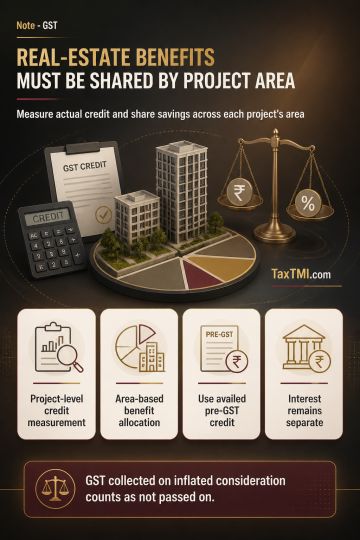
Project-wise anti-profiteering requires actual input tax credit measurement and area-based allocation of benefits to real-estate purchasers.
Real-estate anti-profiteering under Section 171 requires project-level identification of additional input tax credit and allocation of the saving across total project area on a per-square-foot basis. Purchase value may quantify credit attributable to project expenditure, but turnover or collections cannot serve as the allocation basis. The comparison must use pre-GST credit actually availed rather than merely available credit. GST collected on consideration inflated by an undistributed benefit forms part of the amount not passed on and remains distinct from statutory interest.
Case Laws Income Tax
Show AI Summary
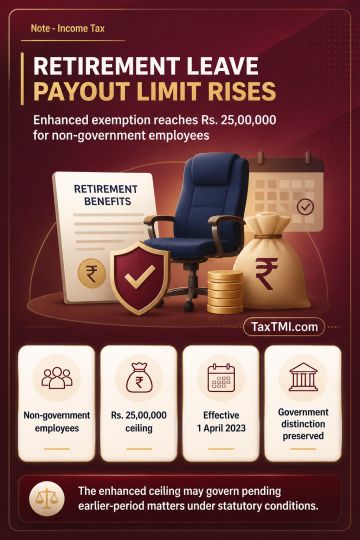
Retirement leave encashment exemption applies under the enhanced notified ceiling while preserving non-government employee classification and statutory conditions.
Section 10(10AA)(ii) governs retirement leave-encashment exemption for non-Government employees, subject to the ten-month earned-leave measure, average-salary computation, and the notified monetary ceiling. Notification No. 31/2023 specifies an enhanced ceiling of Rs. 25,00,000, is deemed effective from 1 April 2023, and certifies that retrospective effect causes no adverse effect. The enhanced ceiling is treated as a remedial rationalisation of an existing exemption and may govern pending earlier-period matters, while preserving the distinction between Government and non-Government employees.
Case Laws GST
Show AI Summary
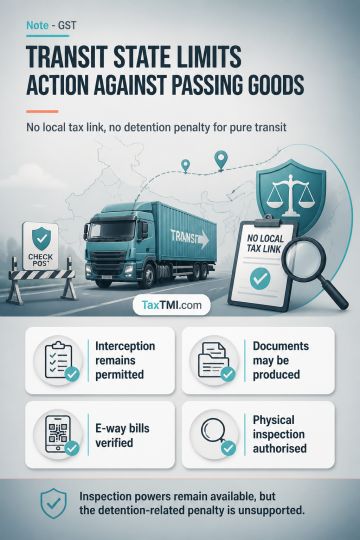
Transit GST jurisdiction limits detention penalties for documented inter-State supplies lacking a local taxable nexus.
Transit-State jurisdiction under GST permits interception, document production, e-way bill verification and authorised physical inspection of goods moving through an intermediate State. It does not, in a pure transit movement, support detention-related penalty for an external inter-State supply where origin and destination lie outside the intercepting State, no tax is payable there, and there is no evidence of diversion, local supply, fictitious or mismatched documents, or mismatch of goods. Cross-empowerment is administrative and does not create an independent territorial taxable nexus.
Case Laws SEBI
Show AI Summary
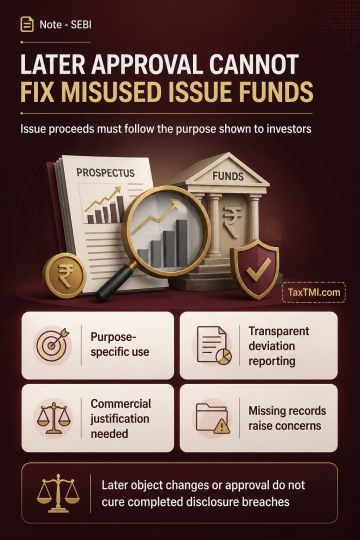
Shareholder ratification cannot cure preferential-issue fund diversion when disclosed objectives are abandoned, triggering securities-market fraud and disclosure concerns.
Post-facto shareholder approval cannot retrospectively validate diversion of preferential-issue proceeds contrary to issue-specific objects disclosed to shareholders and the market. A special resolution authorises the issue but does not permit unrestricted use of proceeds. Periodic deviation reporting, audit-committee review and utilisation disclosures promote transparency; they do not enable diversion followed by later regularisation. Immediate diversion, inadequate commercial justification and missing documentation may indicate that disclosed objects were not genuinely intended to be performed. Later amendment of corporate objects or shareholder ratification cannot cure a completed securities-market disclosure breach.
Case Laws Income Tax
Show AI Summary
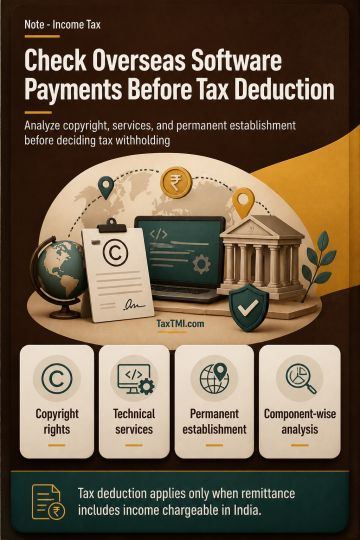
Cross-border software payments require copyright-right, technical-service, and permanent-establishment analysis before withholding obligations are determined under applicable treaties.
Section 195 requires withholding only from a remittance to a non-resident that includes income chargeable in India. For software, royalty depends on transfer of copyright rights, not merely the right to install, access, use, or distribute a copyrighted article under restrictive terms. Where a DTAA is more beneficial, its royalty and FTS definitions control; treaty FTS may require technology to be made available. Amounts that are neither royalty nor FTS require consideration as business profits, ordinarily taxable only where profits are attributable to a permanent establishment. Composite payments require component-wise allocation and analysis.
Case Laws GST
Show AI Summary
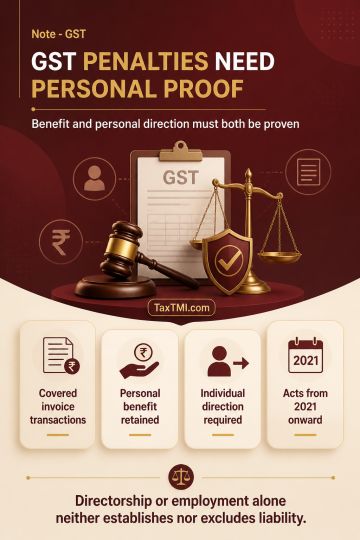
Personal GST penalty requires proof that the beneficiary retained benefit and directed a covered invoice or credit transaction.
Section 122(1A) may impose personal GST penalty on a registered or unregistered person only for a covered invoice or input tax credit transaction. Liability requires cumulative proof that the individual retained an identifiable personal benefit and that the transaction was conducted at that person's instance. Directorship, employment, registration, signature authority, or association with the taxable entity neither independently establishes nor excludes liability. Proceedings require transaction-specific and person-specific allegations and findings. The provision operates prospectively for underlying acts or transactions occurring on or after 01.01.2021.
Case Laws IBC
Show AI Summary
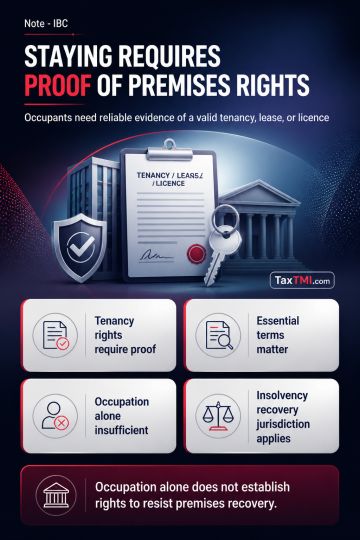
Proof of tenancy rights governs insolvency recovery of corporate-debtor premises from occupants lacking enforceable possessory interests.
Where premises form part of the corporate debtor's assets, Sections 18 and 25 of the Insolvency and Bankruptcy Code, 2016 require the resolution professional to take custody, control, preservation and protection measures. An occupant resisting recovery must prove a subsisting tenancy, leasehold interest or enforceable licence through reliable evidence of the parties' intended relationship and its essential terms. Permission to stock goods or conduct limited business activity, prolonged occupation, and business or utility records do not independently create rights in the premises. Section 60(5)(c) supports insolvency jurisdiction over asset-recovery measures connected with the insolvency estate.
Case Laws GST
Show AI Summary
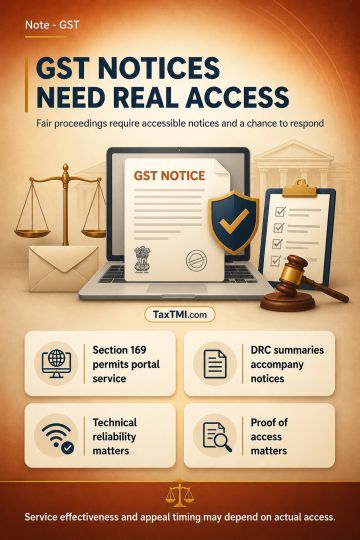
GST portal service requires statutory validity and practical accessibility before ex parte adjudication can fairly proceed.
GST portal service is a statutory method under Section 169, but its use in an ex parte demand proceeding depends on effective accessibility and a meaningful opportunity to reply and be heard. Rule 142 requires electronic DRC-01 and DRC-07 summaries to operate alongside the underlying show-cause notice and reasoned order. Portal placement, complete communication, e-mail transmission, technical reliability and proof of actual access may determine whether service is effective, whether waiver applies, and whether appellate limitation begins.
Case Laws Income Tax
Show AI Summary
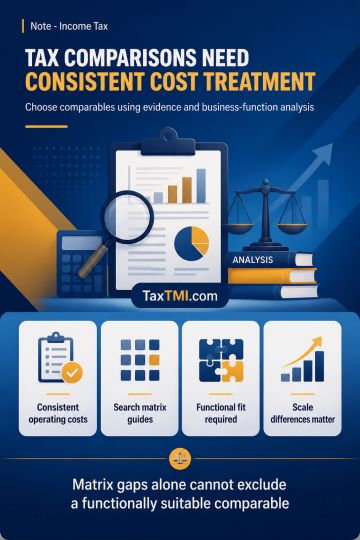
TNMM comparability requires consistent operating-cost treatment and FAR-based selection, while search matrices cannot replace evidence-led functional analysis.
TNMM requires consistent computation of operating profit and operating cost for the tested party and comparables. A provision for doubtful debts connected with sales and trade receivables may be an operating expense, as may routine business levies; income-tax on profits remains excluded. A search matrix is a disciplined evidentiary tool, not a statutory bar to an out-of-matrix comparable. Inclusion requires proof of functional fit, filter satisfaction and reasons for its absence, while rejection cannot rest solely on matrix absence. FAR analysis, segmental reliability and material scale differences govern comparability.
Case Laws Customs
Show AI Summary
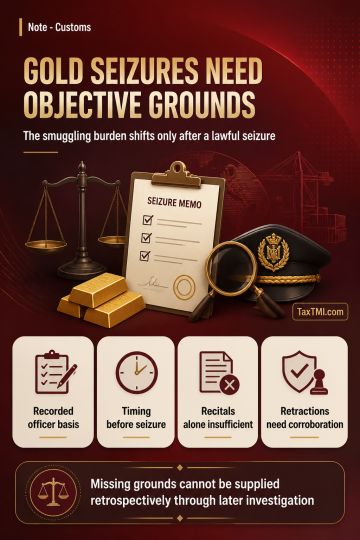
Reasonable belief in gold seizure requires recorded objective grounds before the reverse burden for smuggling can arise.
Gold seizure under Section 110 requires the proper officer to hold, before seizure, objectively supportable reasons to believe that goods are liable to confiscation. For gold, Section 123 shifts the burden of disproving smuggling only after a lawful seizure made in reasonable belief that the gold is smuggled. A general panchnama recital, foreign markings, high purity, or an uncorroborated retracted statement cannot alone establish that foundation. Reasons must exist contemporaneously and cannot be supplied retrospectively through later investigation.
Case Laws Income Tax
Show AI Summary
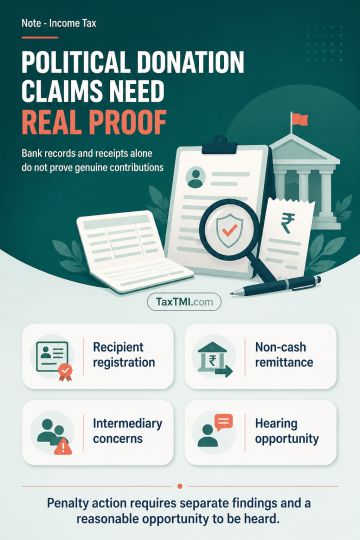
Political contribution deductions require proof that payments are genuine, not merely bank transfers, receipts, and recipient registration.
Registration of the recipient political party, non-cash remittance, banking records and donation receipts are necessary evidentiary facts for a political-contribution deduction, but do not conclusively prove a genuine contribution. Where credible material indicates an accommodation-entry arrangement involving return of funds through intermediaries, the claimant must substantiate the transaction and address taxpayer-specific circumstances. General allegations about a recipient cannot alone displace a claim without a sufficient nexus to the taxpayer's own payment. Penalty initiation requires separate determination of under-reporting or misreporting and a reasonable opportunity of hearing.
Case Laws GST
Show AI Summary
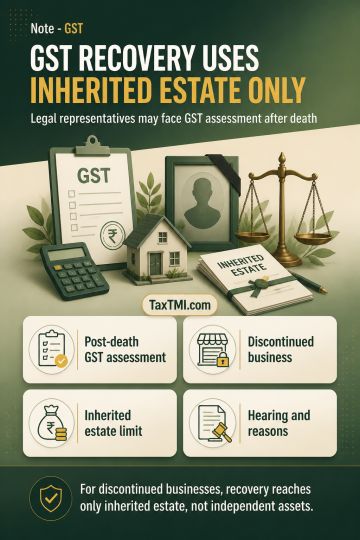
Estate-limited GST recovery permits post-death assessment of legal representatives while protecting heirs' independent assets after business discontinuance.
Section 93 permits post-death GST determination against a legal representative where a liable person dies. If the business is discontinued, tax, interest and penalty may be recovered only from the deceased's inherited estate and only within its capacity; the heir's independent assets remain outside that limit. Proceedings may be initiated without a pre-death notice, but must be addressed to the legal representative in that capacity, follow the applicable adjudication process, and provide hearing and a reasoned order.
Case Laws FEMA
Show AI Summary
Recorded reasons to believe govern foreign-asset seizure; non-confirmation requires appellate resolution before contradictory adjudication proceeds.
Section 37A permits seizure of equivalent domestic assets only where the authorised officer records written reasons to believe that foreign assets are held in contravention of FEMA. The competent authority must examine the material after hearing both sides and either confirm or set aside seizure. A reasoned non-confirmation based on an absent statutory threshold is substantive on seizure, though it does not finally decide the underlying contravention. Pending appeal, the adjudicating authority cannot displace that finding or adopt a contrary premise; Section 37A(4) applies only to confirmed seizure.
Case Laws Companies Law
Show AI Summary
Unstayed tribunal dismissal leaves former directors without corporate authority while banks follow valid company instructions amid management disputes.
Where an oppression and mismanagement petition has been dismissed, a pending appeal without an appellate stay does not itself restore a former director's authority or suspend the dismissal's operative effect. Sections 241 and 242 require statutory prejudice and prescribed Tribunal findings; procedural irregularities in director removal may be relevant but do not alone establish oppression. Banks should ordinarily follow formally authorised company instructions rather than decide unresolved management disputes, unless a binding judicial or statutory restraint applies.
Case Laws Benami Property
Show AI Summary
Benami property claims cannot be recast through wills or employment-based trust when pleadings assert beneficial ownership.
Benami-property claims based on a claimant's payment for property titled in another person's name may fall within the statutory definition when the property is alleged to be held for that claimant's benefit. A Will, succession claim, or other later instrument does not provide an independent basis of title where the pleaded foundation is restoration of beneficial ownership. The statutory scheme prohibits benami arrangements, bars enforcement of claimed beneficial ownership, and treats prohibited re-transfers as invalid; self-acquired title in the named holder's name does not displace the pleaded funding arrangement.
Case Laws Income Tax
Show AI Summary
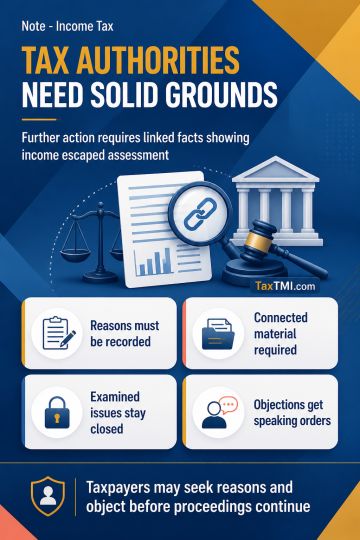
Reason to believe in reassessment requires tangible material, a live nexus, and recorded reasons; review of examined issues is barred.
Income-tax reassessment under Sections 147 and 148 is permissible only where recorded reasons, assessed at the time of notice, disclose a bona fide reason to believe that chargeable income escaped assessment. Final proof is unnecessary at that stage, but relevant tangible material must have a rational, live link to escapement. Reopening cannot be used to review an issue consciously examined and decided in the original scrutiny; nor can later or extraneous material supplement the recorded reasons. The taxpayer may seek the reasons, file focused objections, and receive a speaking order before reassessment continues.
Case Laws Income Tax
Show AI Summary
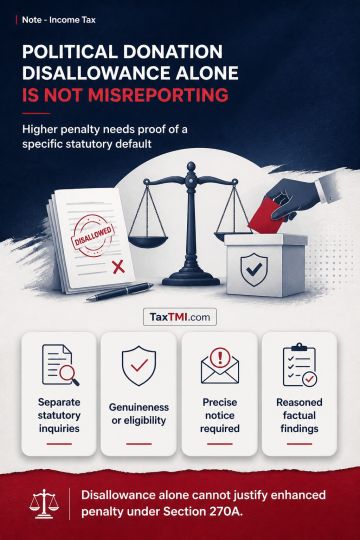
Political-donation deduction disallowance does not itself establish misreporting; enhanced penalty requires proof of a specific statutory default.
Disallowance of a political-contribution deduction under Section 80GGC and imposition of penalty under Section 270A are separate statutory inquiries. An adverse finding on genuineness or eligibility may raise assessed or reassessed income, but cannot alone establish misreporting. Enhanced penalty requires proof that the taxpayer's conduct falls within a specific Section 270A(9) category, supported by a precise notice and reasoned factual findings.
Case Laws Income Tax
Show AI Summary
Conditional charitable registration cannot suspend tax benefits pending litigation outside the statutory grant and cancellation framework.
Section 12AB permits the authority, after inquiry into objects, genuine activities and material legal compliance, to grant registration for the statutory period or reject the application. It does not create a contingent form of registration whose tax consequences await future litigation. Post-registration violations must be addressed through the separate cancellation process, requiring inquiry and hearing. Conditions in prescribed forms or administrative guidance may operationalise statutory duties but cannot create extra-statutory eligibility thresholds, future-conduct obligations or anticipatory cancellation consequences. Binding jurisdictional rulings remain applicable unless stayed, modified or reversed.
Case Laws Customs
Show AI Summary
Transaction value reassessment requires disclosed comparable evidence, while protest-qualified consent preserves appellate rights against enhanced customs valuation.
Transaction value under Section 14 and Rule 3 is the primary basis for valuing imported goods. Rule 12 permits rejection only where an objectively sustainable reasonable doubt persists after considering further information; on request, the grounds must be disclosed in writing and a hearing afforded. Redetermination must follow Rules 4 to 9 sequentially and rely on demonstrably comparable import data. Written acceptance of reassessment may dispense with a speaking order under Section 17(5), but protest-qualified or provisional-clearance correspondence may preserve the statutory right to appeal.
Case Laws GST
Show AI Summary
Leasehold rights assignment may fall outside GST when the lessee permanently transfers the entire proprietary estate.
GST treatment of assignment of leasehold rights turns on whether the lessee has made a complete transfer of its existing estate or continues to provide occupation or enjoyment. Where the assignor transfers the whole residual term, possession, building and associated rights, retains no reversionary or controlling interest, and the assignee succeeds directly to obligations towards the original lessor, the transaction may be characterised as transfer of benefits arising out of land rather than a supply of services. Labels such as premium, salami or transfer fee are not conclusive.

TMI Notes

Back

All TMI Notes

Showing Results for :
Reset Filters
No Records Found

TMI Notes

Back

All TMI Notes

Taxation of Special Incomes in India "Profits and gains from Life Insurance Business" : Clause 194 of the Income Tax Bill, 2025 Vs. Section 115B of the Income-tax Act, 1961

1 May, 2025

Contents
Acts
Rules & Regulations
Summary
Note

Note

-

Bookmark

(New) -

Download

Print

Print

Clause 194 Tax on certain incomes.

Income Tax Bill, 2025

Introduction

Clause 194 of the Income Tax Bill, 2025 represents a significant evolution in the Indian income tax regime, specifically addressing the taxation of certain special categories of income. This provision not only consolidates and updates the taxation framework for winnings from lotteries, games, and gambling, but also incorporates contemporary income streams such as virtual digital assets (VDAs), carbon credits, and royalties from Indian-developed patents. Additionally, it addresses the taxation of profits and gains from life insurance business, a domain historically governed by Section 115B of the Income-tax Act, 1961. The move to introduce Clause 194 is reflective of the legislature's intent to modernize, streamline, and clarify the tax treatment of these special income categories, particularly in response to evolving business models and technological advancements. The inclusion of new income sources such as VDAs and carbon credits underlines the adaptive nature of tax policy to emerging economic realities. At the same time, the provision retains and refines the approach to long-standing income streams, ensuring continuity and stability in the tax system. This commentary undertakes a comprehensive analysis of Clause 194, examining its structure, purpose, and practical implications. It further provides a detailed comparative analysis with Section 115B, particularly focusing on the treatment of profits and gains from life insurance business, to highlight the continuities, departures, and policy considerations embedded in the legislative evolution.

Objective and Purpose

The legislative intent behind Clause 194 is multifold:

  • To provide a consolidated and updated framework for taxing specified incomes that merit special treatment, either due to their nature, volatility, or policy considerations.
  • To address gaps and ambiguities in the existing law, particularly with respect to new forms of income such as virtual digital assets and carbon credits.
  • To incentivize innovation and domestic research by offering concessional tax rates on royalties from patents developed and registered in India.
  • To ensure equitable and efficient taxation of windfall gains and speculative incomes, such as those from lotteries, gambling, and online games, which are generally considered non-recurring and not reflective of regular economic activity.
  • To maintain a consistent and predictable tax regime for profits and gains from life insurance business, a sector of systemic financial importance.

The historical background to these provisions lies in the recognition that certain income streams, due to their peculiar characteristics, require distinct tax treatment. For example, the high rate of tax on winnings from gambling and lotteries is designed both to discourage such activities and to ensure a fair share of revenue from windfall gains. The concessional rate on patent royalties aims to foster indigenous innovation.

Detailed Analysis of Clause 194 of the Income Tax Bill, 2025

Clause 194 is structured to apply "irrespective of anything contained in any other provision of this Act," thereby granting it overriding effect. The clause operates by reference to a comprehensive table, which sets out the categories of taxpayers, the specific income streams, the applicable tax rates, and any conditions or restrictions.

1. Winnings from Lotteries, Games, and Gambling (30%)

[*******]

2. Royalty from Indian Patents (10%)

[*******]

3. Income from Transfer of Carbon Credits (10%)

[*******]

4. Income from Transfer of Virtual Digital Assets (30%)

[*******]

5. Net Winnings from Online Games (30%)

[*******]

6. Profits and Gains from Life Insurance Business (12.5%)

Scope: Applies to any person with profits and gains from life insurance business.

Tax Rate: 12.5%, flat.

Conditions: None specified.

Interpretation: The provision continues the long-standing policy of taxing life insurance business profits at a concessional rate, recognizing the sector's systemic importance and unique business model.

Ambiguities/Potential Issues: The absence of detailed conditions may lead to interpretational issues regarding the computation of "profits and gains" from life insurance business.

Definitions and Explanations

Clause 194(2) provides detailed definitions for key terms such as "carbon credit," "computer resource," "developed," "patentee," "patent," "royalty," and "virtual digital asset." These definitions are largely aligned with existing statutes (such as the Patents Act and the Information Technology Act), ensuring coherence and minimizing interpretational disputes.

Practical Implications

Clause 194, by consolidating and updating the taxation of special income streams, has several practical implications:

  • Taxpayers: Individuals and entities earning income from the specified categories must be aware of the flat rates and the denial of deductions/set-offs. This may require adjustments in tax planning and compliance processes.
  • Businesses: Companies involved in patent development, carbon credits, or VDAs must ensure robust documentation and timely exercise of options to avail concessional rates where applicable.
  • Life Insurance Sector: The continuation of the 12.5% rate provides certainty, but any changes in the computation of profits and gains may require adjustments in reporting and tax calculation.
  • Regulators: The need for clear rules and guidance, especially for new income streams like VDAs and online games, will be critical to ensure consistent enforcement and minimize disputes.
  • Compliance: The denial of deductions and set-offs simplifies computation but may increase the effective tax burden for some taxpayers. The stringent penalty for non-compliance (e.g., in the patent royalty regime) underscores the importance of timely and accurate compliance.

Comparative Analysis with Section 115B of the Income-tax Act, 1961

Section 115B, as it stands, is a focused provision dealing exclusively with the taxation of profits and gains from life insurance business.

Key Features of Section 115B

  • Scope: Applies where the total income includes profits and gains from life insurance business.
  • Tax Rate: 12.5% on profits and gains from life insurance business.
  • Aggregate Computation: Tax is the sum of (i) tax at 12.5% on life insurance profits, and (ii) tax on the remainder of total income at normal rates.
  • Special Deposit Requirement (Historical): Sub-section (2) required, for certain years, a deposit of one-third of the tax computed into a social security fund, with a reduction if a deposit of at least 2.5% of profits was made. This was a temporary measure for assessment years 1989-90 and 1990-91.

Comparison with Clause 194 of the Income Tax Bill, 2025

  1. Scope and Breadth:
    • Section 115B is limited to life insurance business. Clause 194 is much broader, covering multiple categories of special income, including life insurance business.
  2. Tax Rate:
    • Both provisions prescribe the same concessional rate (12.5%) for life insurance business.
    • Clause 194, however, brings this within a consolidated framework for special incomes, rather than as a standalone section.
  3. Computational Method:
    • Both provisions use the "aggregate" method: tax at special rate on specified income, plus tax at normal rates on the remainder.
  4. Denial of Deductions:
    • Section 115B does not expressly deny deductions for expenses; such matters are governed by the general provisions of the Act.
    • Clause 194, for some categories (but not life insurance), expressly denies deductions. For life insurance business, no specific denial is mentioned, so general rules likely apply.
  5. Special Deposit Requirement:
    • Section 115B(2) had a requirement for contributions to a social security fund for certain years. Clause 194 contains no such requirement.
    • This reflects a policy shift, possibly due to the redundancy of the earlier requirement or the existence of alternative mechanisms for social security funding.
  6. Definitions:
    • Clause 194 provides comprehensive definitions for each special income, ensuring clarity.
    • Section 115B relies on general definitions and the computation methodology u/s 44 and the First Schedule for life insurance business.
  7. Legislative Approach:
    • Section 115B represents a piecemeal approach, with each special income category addressed in separate sections.
    • Clause 194 consolidates various special incomes under a single umbrella, reflecting a modern trend towards codification and simplification.
  8. Alignment with Contemporary Developments:
    • Clause 194 incorporates new income streams (digital assets, carbon credits, online games) absent in the 1961 Act, demonstrating adaptability to technological and economic change.

Comparison Table on Key Points:

Feature Section 115B of the Income-tax Act, 1961 Clause 194 of the Income Tax Bill, 2025 Analysis
Applicability Profits and gains from life insurance business Profits and gains from life insurance business (among other incomes) Clause 194 subsumes and continues the treatment of life insurance business, while expanding to other income streams.
Tax Rate 12.5% 12.5% No change; provides continuity and certainty for the sector.
Computation Tax on life insurance profits at 12.5% + tax on balance income as if life insurance profits excluded Same aggregation method for all specified incomes Clause 194 adopts the same computational mechanism, ensuring consistency.
Additional Requirements For AYs 1989-90 & 1990-91, deposit in social security fund No such requirement The social security fund deposit was a temporary measure, not continued in Clause 194.
Other Incomes Covered Only life insurance business Winnings, patent royalties, carbon credits, VDAs, online games, etc. Clause 194 is broader in scope, reflecting contemporary economic realities.
Conditions/Restrictions None specified (other than for social security fund) Specific conditions for other income streams; none for life insurance business Life insurance business remains subject to minimal conditions, maintaining simplicity.

Key Points of Evolution:

  • Clause 194 represents a structural consolidation, bringing together the taxation of various special income streams under one provision, whereas Section 115B was focused solely on life insurance business.
  • The tax rate and computation method for life insurance business remain unchanged, ensuring policy continuity.
  • The additional requirement of deposit in a social security fund, present in Section 115B for specific years, is not carried forward, indicating a move towards simplification.
  • The inclusion of new income streams (VDAs, carbon credits, online games) in Clause 194 reflects legislative responsiveness to new economic activities and technologies.

Conclusion

Clause 194 of the Income Tax Bill, 2025 marks a significant step towards a more comprehensive, transparent, and adaptive taxation regime for special categories of income in India. By consolidating the tax treatment of winnings, royalties, carbon credits, virtual digital assets, online games, and life insurance business, it provides clarity and certainty to taxpayers and administrators alike. The provision retains the established approach for life insurance business, as set out in Section 115B, while expanding the scope to address new and emerging income streams. The explicit denial of deductions and set-offs for certain categories, the requirement to exercise options for concessional regimes, and the detailed definitions provided are all indicative of a policy intent to ensure fair, efficient, and enforceable taxation. While the legislative framework is robust, its success will depend on effective implementation, clear rule-making (especially for new areas like VDAs and online games), and ongoing responsiveness to judicial interpretation and market developments. Potential areas for further refinement include clarifying definitions, simplifying compliance for small taxpayers, and ensuring that the regime remains competitive and equitable in a rapidly changing economic environment.


Full Text:

Clause 194 Tax on certain incomes.

Topics

Acts Income Tax