

Loading...

⚠ ✕
❮ Top
☎ Help
☰
×

By creating an account you can:

Logo TaxTMI
Call Us / Help / Feedback✕

Contact Us At :

✉ E-mail: [email protected]

✆ Call / WhatsApp at: +91 99117 96707

For more information, Check Contact Us

FAQs :

To know Frequently Asked Questions, Check FAQs

Most Asked Video Tutorials :

For more tutorials, Check Video Tutorials

Submit Feedback/Suggestion :

Email :
Please provide your email address so we can follow up on your feedback.
Category :
Description :
Min 15 characters 0/2000
Make Most of Text Search ✕
  1. Checkout this video tutorial: How to search effectively on TaxTMI.
  2. Put words in double quotes for exact word search, eg: "income tax"
  3. Avoid noise words such as : 'and, of, the, a'
  4. Sort by Relevance to get the most relevant document.
  5. Press Enter to add multiple terms/multiple phrases, and then click on Search to Search.
  6. Text Search
  7. The system will try to fetch results that contains ALL your words.
  8. Once you add keywords, you'll see a new 'Search In' filter that makes your results even more precise.
  9. Text Search
╳
Add to...
You have not created any category. Kindly create one to bookmark this item!
✕
Create New Category
Hide
Title :
Description :
❮❮ Hide
❮ Default View
Expand ❯❯
Close ✕
🔎 Filters / Advanced Search ❯
TEXT

Press 'Enter' to add multiple search terms. Rules for Better Search

Search In
Main Text + AI Text ❯
  • Main Text
  • Main Text + AI Text
  • AI Text
Category: ?
Categorized by AI
---- All Categories ---- ❯
  • ---- All Categories ----
  • Income Tax
  • GST
  • Customs, DGFT & SEZ
  • FEMA & RBI
  • Corp. Laws, SEBI & IBC
  • PMLA, Black Money & ED
  • Budget
  • News and Press Release
  • PTI News
Month:
---- All Months ---- ❯
  • ---- All Months ----
  • January
  • February
  • March
  • April
  • May
  • June
  • July
  • August
  • September
  • October
  • November
  • December
Year:
---- All Years ---- ❯
  • ---- All Years ----
  • 2026
  • 2025
  • 2024
  • 2023
  • 2022
  • 2021
  • 2020
  • 2019
  • 2018
  • 2017
  • 2016
  • 2015
  • 2014
  • 2013
  • 2012
  • 2011
Sort By: ?
In Sort By 'Default', exact matches for text search are shown at the top, followed by the remaining results in their regular order.
Relevance Default Date
☰   Show Results ❯
    15th Meeting of ASEAN-India Trade in Goods Agreement (AITIGA) Joint Committee held during 6-9 October 2026
    Commerce Secretary Shri Rajesh Agrawal Highlights Need for Rigorous Legal Thinking at CTIL’s 9th Anniversary Celebration
    Release of Draft Guideline for Compilation Gross State Domestic Product (GSDP) Estimates by Expenditure Approach with Base Year 2022-23
    NLMC Invites Bids for Monetisation of 5.119-Acre Prime Freehold Land Parcel of HIL (India) Limited in New Delhi
    Union Finance Minister Smt. Nirmala Sitharaman on visit to Singapore for high-level meetings with Singapore Leadership and CEOs of business firms in S...
    Recommendations of the 57th Meeting of the GST Council
    India Began Building Bridges When the World Was Building Walls: Union Minister of Commerce and Industry Shri Piyush Goyal
    CCI approves acquisition of sole control over Omega-Meyer Ltd and Meyer Organics by BCPE Wellbeing Holdco Two Ltd. and Integral Investments Asia IV Lt...
    CCI approves proposed acquisition of 100% shareholding of Vishavari Tollway Ltd and nine SPVs operating road assets in India by Concessoc 41 SAS
    CCI approves acquisition of certain shareholding in Prestige Hospitality Ventures Limited by CPP Investment Board Pvt. Holdings (4) Inc.
    CCI approves proposed combination related to internal restructuring of the JSW Group
    NLMC Organises Mock E-Auction Training Ahead of RINL Land E-Auction
    Central Bureau of Narcotics (CBN) conducts Jan Samvad at Malana in Kullu District to create preventive drug awareness and to promote development
    Adopted Joint Statement after the India-UK Financial Markets Dialogue 2026, held in London
    Commerce Secretary Shri Rajesh Agrawal Calls for Greater Utilisation of India-EFTA TEPA Opportunities
    Commerce and Industry Minister Shri Piyush Goyal Holds Meetings with Leading U.S. Companies in New York to Strengthen India–U.S. Trade and Investmen...
    Monetary Policy Statement, 2026-27 Resolution of the Monetary Policy Committee October 5 to 7, 2026
    An Approach Paper on Expanding the scope and coverage for the Index of Services Production
    DRI cracks down on cross-border gold smuggling along Indo-Bangladesh border; seizes over 8.3 kg foreign-origin gold; 4 arrested
    Secretary, DFS, Shri Sanjay Lohiya chairs review meeting on progress of Financial Inclusion Schemes with senior executives of Public Sector and Privat...
❮
❯
❯❯
Maximize Maximize Maximize
0 / 200
Expand Note
Add to Folder

No Folders have been created

+

Are you sure you want to delete "My most important" ?

NOTE:

News
Showing Results for :
Reset Filters
Results Found:
Show All Summaries Hide All Summaries
October 9, 2026
Show AI Summary
AITIGA review negotiations face time-bound subcommittee deliverables to resolve policy issues and modernise trade arrangements.
The AITIGA Joint Committee directed its sub-committees to accelerate pending review chapters through firm, time-bound deliverables and close coordination. Work covers legal and institutional issues, national treatment and market access, and rules of origin. ASEAN and India reaffirmed their commitment to resolve outstanding policy issues, deepen economic integration, and modernise the Agreement into a balanced and mutually beneficial framework strengthening bilateral trade.
October 9, 2026
Show AI Summary
International investment law requires balance between investment protection and States' regulatory authority amid sustainability and digital trade challenges.
International trade and investment law are increasingly shaped by sustainability-linked trade measures and digital trade and require rigorous legal analysis. CTIL supports trade capacity through legal analysis for free trade agreement negotiations, WTO processes, dispute settlement and institutional knowledge-building. International investment law increasingly recognises States' regulatory authority alongside investment protection, with institutionalisation, legitimacy and the balance between investment and public power identified as central concerns. Research and capacity-building also address climate, sustainability, supply chains, artificial intelligence and other emerging trade-policy areas.
October 9, 2026
Show AI Summary
Expenditure-side GSDP compilation framework standardises regional estimates through common methods, local data sources, and allocation indicators.
Draft guidelines establish a uniform framework for compiling expenditure-side Gross State Domestic Product estimates using base year 2022-23. They cover data sources, estimation procedures and methodologies for private and government consumption, gross fixed capital formation, inventory changes, valuables and net exports. State-specific data and allocation indicators are preferred, while recommended allocation methods support consistent estimates where direct subnational data are unavailable. The approach is intended to harmonise estimation practices and strengthen subnational national accounts capacity.
October 9, 2026
Show AI Summary
Freehold land monetisation proceeds through a two-stage electronic sale requiring technical bids and an Earnest Money Deposit.
Monetisation of a 5.119-acre freehold industrial land parcel owned by HIL (India) Limited at Najafgarh Industrial Area, New Delhi, is facilitated through an E-Tender followed by E-Auction. Eligible bidders must complete registration, submit technical bids, and furnish the required Earnest Money Deposit or Bank Guarantee by the stipulated deadline. Sale is subject to "as is where is", "as is what is", "whatever there is" and no-recourse or no-complaint conditions. The exact land extent is to be determined through a joint survey with the successful bidder.
October 9, 2026
Show AI Summary
India-Singapore investment cooperation advances through investor engagement, financial connectivity, capital-market participation, and support for identified investment opportunities.
India-Singapore investment cooperation is to be strengthened through engagements with political leadership, business representatives and global institutional investors. Discussions cover trade and investment, digital financial connectivity, capital markets, taxation, advanced manufacturing, skilling and aviation. The National Investment and Infrastructure Fund and GIFT City are identified as channels for Singaporean capital participation through investment vehicles and funds. The Ministry of Finance will facilitate connections between investors, Indian companies, financial institutions and State Governments for identified investment opportunities.
October 8, 2026
Show AI Summary
GST process reforms propose automated registration, refunds and return corrections while easing enforcement, credit access and trade compliance.
GST process reforms propose automated registration, registration amendments and cancellation, return reconciliation, input tax credit correction, and phased system-based refund processing. Standardised demand notices and adjudication safeguards are proposed alongside lower penalties, capped penalty-only appeal pre-deposits, withdrawal of arrest powers and narrowed prosecution provisions. Input tax credit reforms would expand refunds and remove specified blocked-credit restrictions, while export measures would broaden zero-rated and export-of-services eligibility. Goods interception would be intelligence-based and authorised, with further compliance relief for small taxpayers and targeted classification, exemption and reverse-charge measures.
October 8, 2026
Show AI Summary
Free trade agreement utilisation enables MSME market access, rules-of-origin awareness, export participation, and foreign investment opportunities while protecting sensitive sectors.
Free Trade Agreements are positioned to preserve sensitive domestic interests, particularly agriculture, fisheries and MSMEs, while widening market access for agricultural, marine, engineering, precision and electronic products and facilitating foreign investment. Proposed FTA utilisation desks across State Councils would assist MSMEs in using preferential arrangements, understanding rules of origin and market-access opportunities, participating in delegations and exhibitions, and presenting products and technologies to overseas markets.
October 8, 2026
Show AI Summary
Sole-control acquisition of nutraceutical and pharmaceutical businesses receives competition approval for Bain Capital-managed investment funds.
Competition Commission of India approval permits BCPE Wellbeing Holdco Two Limited and Integral Investments Asia IV Limited, funds managed or advised by Bain Capital, to acquire sole control over Omega-Meyer Limited and Meyer Organics Private Limited. The target businesses provide nutraceuticals globally and in India, while Meyer Organics Private Limited also produces and supplies certain over-the-counter and prescription finished-dose pharmaceuticals in India.
October 8, 2026
Show AI Summary
Highway asset acquisition approval covers full ownership transfer of a tollway operator and road-project special purpose vehicles.
Competition Commission of India approval covers the acquisition by Concessoc 41 SAS of the entire shareholding in Vishavari Tollway Private Limited and nine special purpose vehicles. The target entities operate designated national-highway stretches in Andhra Pradesh, Odisha and Gujarat, while Vishavari Tollway Private Limited provides operation and maintenance and engineering, procurement and construction services for those highway assets.
October 8, 2026
Show AI Summary
Competition clearance for hospitality share acquisition permits investment in a company owning and developing hotel and serviced apartment assets.
Competition Commission of India approved the proposed combination involving CPP Investment Board Private Holdings (4) Inc.'s acquisition of certain shareholding in Prestige Hospitality Ventures Limited. The target is an Indian public limited company within the Prestige group and owns and develops hospitality assets, including hotels and serviced apartments. The acquirer is incorporated in Canada and is managed by Canada Pension Plan Investment Board.
October 8, 2026
Show AI Summary
Internal group restructuring receives merger-control approval for amalgamating an integrated steel producer into the group's steel manufacturer.
Merger-control approval covers the proposed internal JSW Group restructuring through amalgamation of BMM Ispat Limited into JSW Steel Limited. The amalgamation would convert the group's majority interest in BMM into full ownership and is intended to enhance operational, financial and organisational efficiencies through economies of scale, resource pooling and capital rationalisation. BMM is commercially integrated in the group's supply chain through intra-group sales and procurements.
October 7, 2026
Show AI Summary
Transparent land e-auction procedures support bidder preparedness through mock training, registration and earnest-money requirements for phased asset monetisation.
National Land Monetization Corporation is facilitating a two-phase e-tender-cum-e-auction of 459 encumbrance-free land parcels of Rashtriya Ispat Nigam Limited through the RailTel E-Nivida e-Procurement Platform. Participation requires registration, fulfilment of prescribed requirements and submission of earnest money deposit within the applicable deadlines. Physical and online mock e-auction training familiarises prospective bidders with the bidding interface and participation procedure. Investor outreach provides information on plot details, eligibility requirements, registration and bidding conditions.
October 7, 2026
Show AI Summary
Preventive narcotics outreach promotes drug awareness, community participation, and sustainable livelihood alternatives to discourage illicit cannabis cultivation.
Preventive outreach in Malana village promoted drug awareness, youth engagement, community participation and alternative development in an area associated with illicit cannabis cultivation. Residents were sensitised to the harmful effects of cannabis, charas and hashish oil consumption and encouraged to pursue sustainable alternatives, including apiculture, animal husbandry, dairy activities and tourism. Community discussions addressed livelihood barriers, ecological concerns, and commitments to refrain from drug consumption and discourage illicit cannabis cultivation.
October 7, 2026
Show AI Summary
Cross-border financial cooperation guides work on market access, sustainable finance, fintech safeguards, and payment interoperability.
India-UK financial-markets cooperation covers capital-market connectivity, cross-border listings, investor access and development of GIFT IFSC as an international financial centre. Engagement also addresses insurance, pensions, asset management, sustainable-finance disclosures and cross-border investment. Fintech cooperation includes digital public infrastructure, central bank digital currencies, data exchange, responsible artificial intelligence, fraud prevention, cyber security and operational resilience. Cross-border payments work prioritises reduced frictions, transparency, efficiency and interoperability of electronic payment infrastructures.
October 7, 2026
Show AI Summary
Investment commitments and tariff predictability under India-EFTA TEPA support market access, supply-chain planning, and long-term bilateral trade.
India-EFTA TEPA establishes reciprocal market-access commitments, with EFTA coverage extending to most Indian exports and full coverage for non-agricultural products. Tariff predictability is intended to support investment planning, supply-chain development and longer-term business partnerships. Agricultural opportunities may arise where duties have been reduced to zero. Article 7.1 includes an investment commitment under which the EFTA States are to aim to increase foreign direct investment into India and facilitate employment generation within specified implementation periods.
October 7, 2026
Show AI Summary
Foreign investment engagement focuses on expanded partnerships across financial services, manufacturing, insurance, and emerging technologies in India.
India-U.S. trade and investment engagement was pursued through discussions with leading United States companies on expanding investment, partnerships and commercial operations in India. Financial-sector discussions addressed private equity, asset and wealth management, insurance, and financial services, including prospective engagement aligned with the objective of insurance access for all by 2047.
October 7, 2026
Show AI Summary
Policy repo rate recalibration responds to inflationary pressures, adopting calibrated tightening while future actions depend on growth and inflation conditions.
Monetary policy is recalibrated through an increase in the policy repo rate under the liquidity adjustment facility by 25 basis points to 5.50 per cent. The monetary policy stance shifts to calibrated tightening, indicating that near-term rate reductions are excluded and that subsequent action may consist of a rate increase or a pause, depending on evolving conditions and the outlook. Further rate action depends on growth-inflation developments, underlying inflation, broadening price pressures, second-round effects and demand impulses.
October 7, 2026
Show AI Summary
Index of Services Production expansion proposes broader service-sector coverage through education, health, residential care, public administration and defence.
The Index of Services Production is proposed to expand beyond its initial formal-sector coverage, which relies on high-frequency administrative data and GST outward-supplies data. Education, Human Health and Residential Care, and Public Administration and Defence are proposed for inclusion. Their incorporation would increase coverage of services-sector Gross Value Added and support aggregation of sub-sectoral indices into a unified measure of short-term services-sector movements. Stakeholder views are invited on the proposed methodology.
October 7, 2026
Show AI Summary
Cross-border gold smuggling enforcement addresses concealed foreign-origin gold transport through customs seizure, arrest, and investigation of organised networks.
Intelligence-led customs enforcement targeted cross-border gold smuggling through surveillance and interception of four persons travelling from a border route. Personal searches recovered foreign-origin gold biscuits concealed in specially tailored cloth waist belts. Seventy-two gold biscuits were seized under relevant provisions of the Customs Act, 1962, and the four persons were arrested. Investigation continues into organised networks and wider syndicates involved in the movement and distribution of smuggled gold.
October 6, 2026
Show AI Summary
Financial inclusion drives digital lending, insurance claim awareness, portal enrolment, and banking access for marginalised sections.
Banks were urged to expand brick-and-mortar branches and banking correspondent coverage in unbanked villages, strengthen digital outreach, and implement end-to-end digital loan processing. Working-capital lending for micro-enterprises through UPI-linked credit lines and credit cards was highlighted. Banks were also directed to increase awareness of insurance claim eligibility, exercise care in claim-related grievance handling, and enrol new PMJJBY and PMSBY beneficiaries through the Jan Suraksha portal.

News

Back

All News

Showing Results for :
Reset Filters
No Records Found

News

Back

All News

GOVERNMENT'S PRUDENT MONETARY & TRADE POLICY SUPPORTED BY STRONG OUTPUT GROWTH REDUCES RETAIL INFLATION TO A FOUR-YEAR LOW OF 5.4% IN FY24

July 22, 2024

Contents
Plus +
Summary
Note

Note

-

Bookmark

Print

Print

CORE SERVICES INFLATION FALLS TO A NINE-YEAR LOW IN FY24

RBI EXPECTS 4.5% HEADLINE INFLATION IN FY25 & 4.1% IN FY26

ECONOMIC SURVEY RECOMMENDS REVISING CONSUMER PRICE INDEX WITH FRESH WEIGHTS AND ITEM BASKETS

ECONOMIC SURVEY ADVISES EXPANDING PULSES & OIL SEEDS CULTIVATION WHILE DEVELOPING MODERN STORAGE AND PROCESSING FACILITIES TO REDUCE INFLATIONARY PRESSURES

The Economic Survey 2023-24, that was tabled in Parliament today, lays special emphasis on controlling Prices and Inflation as 'Low and stable inflation is key to sustaining economic growth.' It states that Governments and Central Banks face the challenge of keeping inflation at a moderate level while ensuring financial stability. Achieving this delicate balance requires careful monitoring of economic indicators and taking appropriate and timely corrective actions. With the commitment of the Reserve Bank of India (RBI) to the goal of price stability and policy actions by the Central Government, India has successfully managed to keep retail inflation at 5.4 per cent in FY24, the lowest level in 4 years, since the Covid-19 pandemic period.

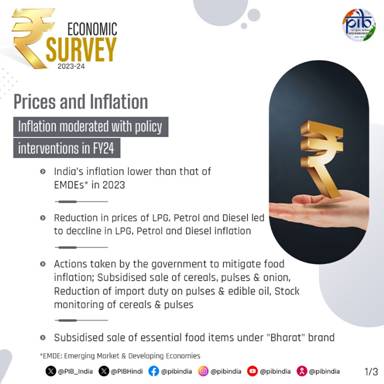
The Economic Survey highlights the fact that India's retail inflation is lower than the emerging markets & developing economies (EMDES) and world average in 2022 and 2023 as per IMF data. Survey states that factors such as established monetary policies, economic stability, well-developed and efficient markets that balance supply and demand conditions, and stable currencies contribute to the effective management of inflation. Historically, inflation in advanced economies has generally been lower than in EMDEs.
Inflation Management

With the goal of maintaining price stability, many countries have established their own inflation targets based on various factors that serve their economic objectives best. Lauding India's Inflation Management, the Economic Survey states that interestingly, India is performing better than various developed and emerging economies in relation to its inflation target. In 2023, India's inflation rate was within its target range of 2 to 6 per cent. Compared to advanced economies like the USA, Germany, and France, India had one of the lowest deviations from its inflation target in the triennial average inflation from 2021-2023. Despite the challenges posed by global demand- supply imbalances due to ongoing geopolitical tensions, India's inflation rate was 1.4 percentage points below the global average in 2023.

Since 2020, countries have been facing challenges in controlling inflation. India has been able to bring about a declining trend in Headline and Core Inflation through its prudent administrative measures and monetary policy. As per the Economic Survey, since May 2022, monetary policy broadly focused on absorbing excess liquidity in the system by increasing the policy repo rate by 250 basis points from 4 per cent in May 2022 to 6.5 per cent in February, 2023. Thereafter, the policy rate was kept unchanged by focusing on the gradual withdrawal of accommodation, aiming to align inflation with the target, while simultaneously fostering growth. Consequently, the persistent and sticky core inflation observed in FY23 declined to 3.1 per cent in June, 2024

The Survey further asserts that administrative measures such as price cuts for LPG, petrol, and diesel led to lower LPG and petroleum product inflation. LPG inflation rate has been in the deflationary zone since September 2023 while retail inflation in petrol and diesel moved to the deflationary zone in March 2024. Additionally, global commodity prices declined in 2023, reducing price pressure in energy, metals, minerals, and agricultural commodities through the imported inflation channel. Low fuel and core inflation ensured a downward trajectory for headline inflation, despite volatility in food prices in FY24. As per the recent data released by MoSPI, the retail inflation rate was 5.1 per cent in June 2024.

Core inflation, measured by excluding food and energy items from CPI headline inflation has witnessed a four year low in FY24. From the pandemic-driven highs, inflationary pressures in India eased in FY22, aided by softening food inflation. Inflationary pressures firmed up in FY23 yet again driven by the Russia-Ukraine war disrupting the recouping supply chains leading to a rise in food and fuel prices. In FY24, the price situation improved. CPI inflation moderated, driven by a decline in core inflation in both goods and services. Core services inflation eased to a nine-year low in FY24; at the same time, core goods inflation also declined to a four-year low.
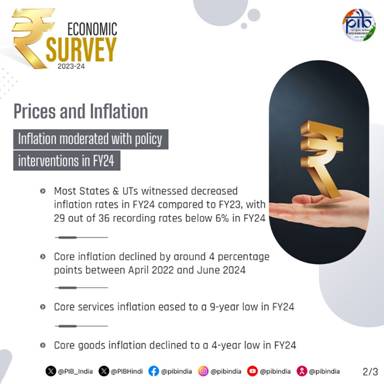
Trends in core inflation are important in determining the contours of monetary policy. Assessing the emerging patterns of price pressures, the RBI increased the repo rate gradually by 250 basis points since May 2022 to curtail inflationary pressures, leading to reduction of around 4 percentage points in core inflation between April 2022 and June 2024. This was aided by moderation in housing rental inflation, with a significant increase in the stock of new houses in 2023.

Consumer durables inflation increased progressively between FY20 and FY23 by more than 5 percentage points, mainly due to increase in gold prices in FY21 and clothing in FY22 and FY23. With the improvement in the supply of key raw materials, the inflation rate for consumer durables declined in FY24. However, record-high gold prices, driven by anticipated Fed rate cuts and escalating geopolitical uncertainty, have exerted upward pressure on overall durables inflation. Consumer non-durables (CND) inflation plunged in FY20, it started to inch up in FY21, reached an all-time in FY22, and declined sharply in FY23 and FY24.

Food Inflation has been a global phenomenon in the last two years. Research indicates the rising vulnerability of food prices to climate change. In FY23 and FY24, the agriculture sector was affected by extreme weather events, lower reservoir levels, and damaged crops that adversely affected farm output and food prices. So, food inflation based on the Consumer Food Price Index (CFPI) increased from 3.8 per cent in FY22 to 6.6 per cent in FY23 and further to 7.5 per cent in FY24. However, the government took prompt actions, including open market sales, retailing in specified outlets, and timely imports, to ensure an adequate supply of essential food items. Additionally, to ensure food security for the poor, the Pradhan Mantri Garib Kalyan Anna Yojana, which provides free food grains to more than 81 crore beneficiaries, was extended for a period of five years starting from January 2024.

Global Food Prices and Domestic Inflation

Global food prices also have an impact on domestic inflation. In India, the edible oil market is heavily depends on imports, with more than 50 per cent of the total edible oil requirement being imported, making it sensitive to global prices. The Government closely monitors global market trends to ensure the availability of edible oils for consumers at an affordable price. Efforts are also made to balance imports with domestic production to mitigate the risks associated with global price volatility. In this context, the National Mission on Edible Oils Oil Palm aims to increase domestic crude palm oil production to reduce the import burden. In the case of sugar, the Government announced restrictions on export in June 2022 to ensure sufficient local supplies and thereby manage sugar inflation. These export restrictions have indeed played a role in stabilising domestic sugar prices. As a result, even though the global sugar price index inflated and has been showing volatility since February 2023, domestic sugar prices have remained much less volatile.

Elaborating on the Interstate variations in Retail Inflation, the Economic Survey asserts that inflation rate was less than 6 per cent in 29 out of the 36 States and Union Territories. These Interstate variations in inflation are more pronounced in rural areas since rural consumption basket has a much higher weightage of food items (47.3%) than the urban (29.6%). Hence, in the last two years, States that witnessed elevated food prices also experienced higher rural inflation.

Future Inflation Projections

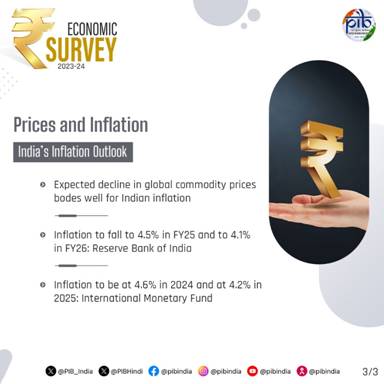
RBI and IMF have projected India's consumer price inflation will progressively align towards the inflation target in FY26. Assuming a normal monsoon and no further external or policy shocks, the RBI expects headline inflation to be 4.5 per cent in FY25 and 4.1 per cent in FY26. IMF has projected an inflation rate of 4.6 per cent in 2024 and 4.2 per cent in 2025 for India. The World Bank expects that the global supply of commodities will increase, and so will their demand due to improved industrial activity and trade growth. It projects a 3 per cent decline in the commodity price index in 2024 and a 4 per cent decrease in 2025, mainly driven by lower energy, food and fertiliser prices. The energy price index is expected to reduce due to significant declines in coal and natural gas prices this year. Fertiliser prices are likely to weaken but remain above 2015-2019 levels due to strong demand and export restrictions. Base metal prices are projected to rise, reflecting increased global industrial activity and clean energy production. In general, the current downward movement in the prices of commodities imported by India is a positive for the domestic inflation outlook.
The short-term inflation outlook for India is benign. However, from the angle of long-term price stability, the Economic Survey suggests exploring the following options as the way forward:

1. Reducing import dependence for edible oils by increasing domestic production of major oilseeds, Exploring potential of non-conventional oils such as rice bran oil and corn oil and expanding scope of National Mission on Edible Oils

2. Expand the area under pulses, particularly lentils, tur, and urad, in more districts and rice- fallow areas. Promoting the summer cultivation of urad and moong in areas with assured irrigation facilities.

3. Further improving and developing modern storage and processing facilities for vegetables, especially tomatoes and onions.

4. Improving swiftness and effectiveness of administrative action by the Government to deal with price flare-ups in specific items by collating high-frequency price monitoring data, from the farm gate to the final consumer, in a quantifiable manner. Expediting producer price index for goods and services for better grasp on episodes of cost-push inflation and

5. Revising the consumer price index with fresh weights and item baskets using Household Consumer Expenditure Survey, 2022-23.

Topics

Acts Income Tax