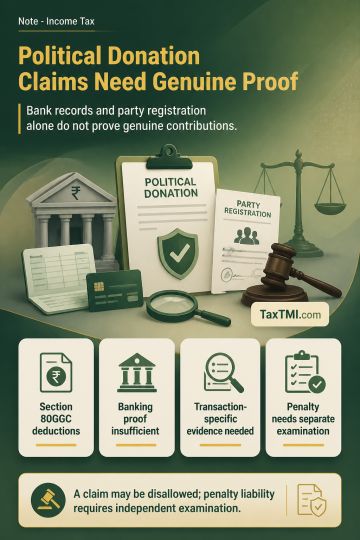
Political contribution deductions require genuine transactions; banking records and party registration alone cannot defeat evidence of accommodation e...
Post-death GST liability permits fresh proceedings against legal representatives, while discontinued-business recovery remains limited to the inherite...
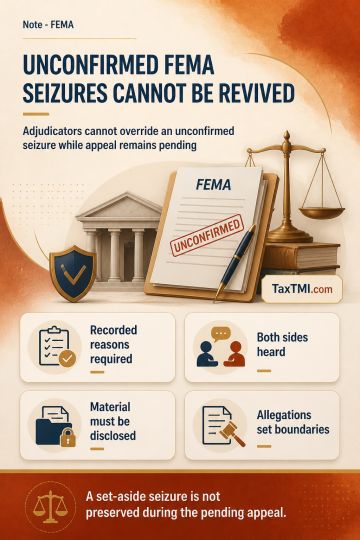
Non-confirmation of FEMA seizure prevents adjudicators from overriding pending appellate findings on recorded reasons and suspected foreign asset hold...
The assessee failed to file income tax returns and produce books of accounts. The Commissioner of Income Tax (Appeals) passed a detailed order computing income after obtaining inputs from the assessee, cross-verifying with suppliers, and verifying findings by the Assessing Officer. Although based on assumptions and estimates due to the assessee's lack of transparency, the computation cannot be faulted as the assessee conceded it before the CIT(Appeals). The Income Tax Appellate Tribunal held that the assessee cannot argue against the computation after conceding it, and decided against the assessee regarding the unexplained deposit u/s 69A. Regarding the estimation of net profit on cash deposits, the Tribunal dismissed the Revenue's appeal, upholding the CIT(Appeals)'s correct estimation of taxable net profit instead of considering the entire cash deposit as income.
The assessee failed to file income tax returns and produce books of accounts. The Commissioner of Income Tax (Appeals) passed a detailed order computing income after obtaining inputs from the assessee, cross-verifying with suppliers, and verifying findings by the Assessing Officer. Although based on assumptions and estimates due to the assessee's lack of transparency, the computation cannot be faulted as the assessee conceded it before the CIT(Appeals). The Income Tax Appellate Tribunal held that the assessee cannot argue against the computation after conceding it, and decided against the assessee regarding the unexplained deposit u/s 69A. Regarding the estimation of net profit on cash deposits, the Tribunal dismissed the Revenue's appeal, upholding the CIT(Appeals)'s correct estimation of taxable net profit instead of considering the entire cash deposit as income.
Note: It is a system-generated summary and is for quick reference only.
 TaxTMI
  TaxTMI