Governmental authority status supports construction-service exemption, while pre-cutoff contract and stamp-duty compliance requires verification on re...
Automated Free Sale and Commerce Certificates enable paperless processing while retaining risk-based manual verification for selected exporter applica...
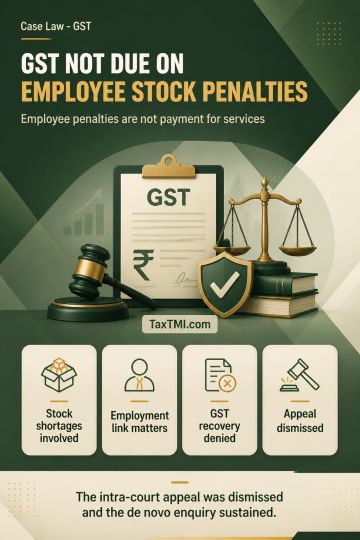
Employee stock-shortage penalties do not constitute consideration for services, preventing GST collection under Schedule II in employment relationship...
The ITAT considered the condonation of a 1100-day delay in filing an appeal, noting that the delay resulted from the income tax practitioner's mistaken belief that the order was not appealable. Citing the principle that "sufficient cause" should be liberally construed to advance justice, the ITAT referred to a Supreme Court case where a 1418-day delay was condoned due to unusual circumstances and misrepresentation by the advocate. The ITAT held that the ex-parte order by the PCIT violated natural justice as the assessee was not given a fair opportunity to present their case. Consequently, the order was set aside, and the matter was remitted back to the PCIT for fresh adjudication. The appeal was treated as allowed for statistical purposes.
The ITAT considered the condonation of a 1100-day delay in filing an appeal, noting that the delay resulted from the income tax practitioner's mistaken belief that the order was not appealable. Citing the principle that "sufficient cause" should be liberally construed to advance justice, the ITAT referred to a Supreme Court case where a 1418-day delay was condoned due to unusual circumstances and misrepresentation by the advocate. The ITAT held that the ex-parte order by the PCIT violated natural justice as the assessee was not given a fair opportunity to present their case. Consequently, the order was set aside, and the matter was remitted back to the PCIT for fresh adjudication. The appeal was treated as allowed for statistical purposes.
Note: It is a system-generated summary and is for quick reference only.
 TaxTMI
  TaxTMI
 of 4828












 Join Channel


