Political contribution deductions require genuine transactions; banking records and party registration alone cannot defeat evidence of accommodation e...
Post-death GST liability permits fresh proceedings against legal representatives, while discontinued-business recovery remains limited to the inherite...
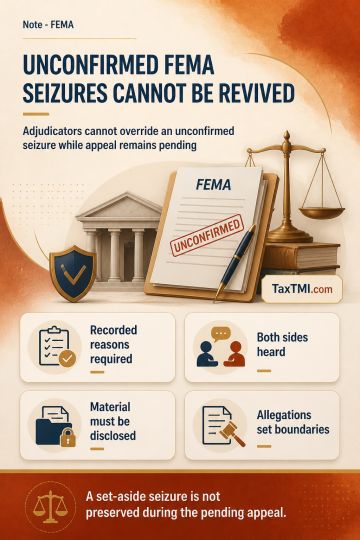
Non-confirmation of FEMA seizure prevents adjudicators from overriding pending appellate findings on recorded reasons and suspected foreign asset hold...
The ITAT considered the condonation of a 1100-day delay in filing an appeal, noting that the delay resulted from the income tax practitioner's mistaken belief that the order was not appealable. Citing the principle that "sufficient cause" should be liberally construed to advance justice, the ITAT referred to a Supreme Court case where a 1418-day delay was condoned due to unusual circumstances and misrepresentation by the advocate. The ITAT held that the ex-parte order by the PCIT violated natural justice as the assessee was not given a fair opportunity to present their case. Consequently, the order was set aside, and the matter was remitted back to the PCIT for fresh adjudication. The appeal was treated as allowed for statistical purposes.
The ITAT considered the condonation of a 1100-day delay in filing an appeal, noting that the delay resulted from the income tax practitioner's mistaken belief that the order was not appealable. Citing the principle that "sufficient cause" should be liberally construed to advance justice, the ITAT referred to a Supreme Court case where a 1418-day delay was condoned due to unusual circumstances and misrepresentation by the advocate. The ITAT held that the ex-parte order by the PCIT violated natural justice as the assessee was not given a fair opportunity to present their case. Consequently, the order was set aside, and the matter was remitted back to the PCIT for fresh adjudication. The appeal was treated as allowed for statistical purposes.
Note: It is a system-generated summary and is for quick reference only.
 TaxTMI
  TaxTMI