Just a moment...

Top
Help
×

By creating an account you can:

Logo TaxTMI
Call Us / Help / Feedback

Contact Us At :

E-mail: [email protected]

Call / WhatsApp at: +91 99117 96707

For more information, Check Contact Us

FAQs :

To know Frequently Asked Questions, Check FAQs

Most Asked Video Tutorials :

For more tutorials, Check Video Tutorials

Submit Feedback/Suggestion :

Email :
Please provide your email address so we can follow up on your feedback.
Category :
Description :
Min 15 characters0/2000
Add to...
You have not created any category. Kindly create one to bookmark this item!
Create New Category
Hide
Title :
Description :
+ Post a Query
Post a New Query
Title :
0/200 char
Description :
Max 0 char
Category :
Delete Reply

Are you sure you want to delete your reply beginning with '' ?

Delete Issue

Are you sure you want to delete your Issue titled: '' ?

Discussion Forum

Back

All Issues

WhatsAppJoin Channel
Advanced Search
Reset Filters
Search By:
Search by Text :
Press 'Enter' to add multiple search terms
Select Date:
FromTo
Category :
OR
Search by Issue ID:
NOTE: If you have inputs in both the fields, then results will be shown for issueId first.
Issue ID: 110747
Like 1Bookmark

Goods and GST Bill passed

Date 03 Aug 2016
Replies1401 Replies
Views 917142 Views
Goods and Services Tax consolidation creates a dual GST framework with GST Council oversight and a shared IT platform for compliance.
Goods and Services Tax establishes a destination based, dual tax framework subsuming central and state indirect levies, administered through a GST Council and implemented via a shared IT platform (GSTN). The model law sets out registration and return regimes, HSN/SAC classification by turnover bands, input tax credit carry forward, composition and reverse charge rules, refund and valuation procedures, compensation to states during transition, and institutional arrangements for cross empowerment, adjudication and dispute resolution. (AI Summary)

Dear All,

GST Bill is passed in Rajya Sabha on 03. 08.2016.

A panel under chief economic adviser Arvind Subramanian has recommended a revenue-neutral rate of 15-15.5%, with a standard rate of 17-18% be levied on most goods and all services.

But, there has been no agreement yet on rates of various goods and services, which remains a tricky issue. According to the Bill, passed in the Lok Sabha in May 2015, the rates were to be decided by a GST council headed by the central finance minister with state finance ministers as members.

Let us wait.

Thanks.

1401 answers
Sort by

Old Query - New Comments are closed.

Hide
Like 0
Replied on Sep 8, 2016
21.

GST Bill I.e. Constitutional Amendment Bill received assent from Hon'ble President Shri Pranab Mukherjee today. Thanks.

Like 0
Replied on Sep 9, 2016
22.

Sir, so many taxes are there in our country. One is not aware of all the taxes. So, many issues creep up because of ignorance of law. Hopefully most of the issues will be resolved with the implementation of GST.

The more important is training to the tax officers and the dealer as well as both have to work with each other. The training is needed in implementation level. Thanks.

Like 0
Replied on Sep 10, 2016
23.

The Bill received assent of the President, Now next GST Council to be set up and headed by Union Finance minister and the council shall comprise of State Finance ministers. Council will decide on the rate. Thanks.

Like 0
Replied on Sep 10, 2016
24.

The Central Board of Excise and Customs (CBEC) might be renamed the Central Board of Indirect Taxes (CBIT), as part of an organisational restructuring after national goods and services tax (GST) regime is rolled out. (Source: Business Standard).

Like 0
Replied on Sep 10, 2016
25.

To complete the cases of service tax and excise duty pending at various levels, a legacy division will be formed for a period of five years. Thanks.

Like 0
Replied on Sep 11, 2016
26.

According to the report of the finance ministry for 2015-16, as many as 27,451 cases of service tax and excise duty were pending as on December 2015. However, early this year, the department identified about 7,300 indirect tax cases for withdrawal, being under the revised threshold limits. “Some level of continuity will be required for some years at least to handle the pending cases. The legacy commissionerate will look into that,” said an official.

Source : Business Standard.

Like 0
Replied on Sep 12, 2016
27.

The Union Cabinet today approved the setting up of a GST Council, which will decide the rate of tax under the new Goods and Services Tax (GST) regime.

The GST Council will consist of Union Finance Minister, Minister of State in charge of Revenue Department and State Finance Minister. Thanks.

Like 0
Replied on Sep 12, 2016
28.

The CGST and IGST will be drafted on the basis of the model GST law. The states will draft their respective State GST (SGST) laws with minor variation incorporating state-based exemptions.

Like 0
Replied on Sep 13, 2016
29.

The first take of GST Council would be to decide the GST rate. The Chief Economic Advisor has suggested for 18%. But States insist for 20% and above. Thanks.

Like 0
Replied on Sep 14, 2016
30.

Sir, the discussion is going on and it appears that gov't will support 18% GST rate. Thanks.

Like 0
Replied on Sep 15, 2016
32.

The Government is making all its effort to implement GST w.e.f. 01.04.2017. The review of GST preparedness is being done by Prime Minister. Thanks.

The assessee need to gear up for GST. The time has come now. It was discussed that atleast 6months time would be required from the date of GST Act coming into effect and to the date of implementation. Let's hope for the good time to come. Thanks.

Like 0
Replied on Sep 16, 2016
33.

GST rollout must be ready 'before' April 1, PM emphasizes to top officials.

Like 0
Replied on Sep 16, 2016
34.

Taxpayers to get a feel of GST next month

Beginning next month, the Goods and Services Tax Network (GSTN) will start migrating over 80 lakh taxpayers onto its system. This will facilitate the smooth implementation of the GST regime. “The first part of our software will be ready by end October. Existing taxpayers of value added tax, service tax and central excise will be migrated to GSTN,” said Navin Kumar, Chairman, GSTN.

Like 0
Replied on Sep 16, 2016
35.

GST Council is fighting against time

The government plans to bring in GST from 1 April 2017 and supporting legislation in the winter session, leaving only around two months for the council to finalize all issues

Like 0
Replied on Sep 16, 2016
36.

India's Reincarnation As A Unified Marketplace Of 1.2 Billion Participants http://seekingalpha.com/article/4006469-indias-reincarnation-unified-marketplace-1_2-billion-participants

Earlier in August, as U.S. investors were preoccupied with domestic news on the elections and markets, an interesting development happened halfway around the globe. India's legislature, after a notoriously long process, approved one of the most ambitious tax reforms in history - the Goods and Services Tax (GST) bill.

Overall, GST is India's attempt to create the largest marketplace with standardized tax rates ever. It is also a reminder of the Modi government's serious push for reforms to make it easier to do business in India. Most of India's macro factors have improved recently, earnings of corporate India are steadily improving and the central government is gradually pushing positive policy changes.

So, let's take a look at what GST is and how it affects various sectors of the Indian economy.

What Is GST?

Broadly speaking, governments collect revenues/taxes in two categories:

  • Direct taxes or taxes paid by individuals (e.g., income tax, wealth tax, capital gains tax, etc.) or corporations (e.g., corporate tax).
  • Indirect taxes or taxes collected by intermediaries (e.g., retail stores) in lieu of goods or services purchased or sold, like a sales tax or value-added tax (VAT).

Typically, in developing countries, indirect taxes make up a greater portion of total taxes. In the U.S., taxes on goods and services are 5%1 of total tax collection, while in India they account for over 30%.2

India's GST is a bold attempt to streamline these indirect taxes and increase tax compliance. Taxes in India are split into an array of federal and state taxes. Not only does every state have its own rate, but each could also levy extra taxes depending on the category of sale (e.g., luxury taxes on high-end hotels, entertainment taxes on movies).

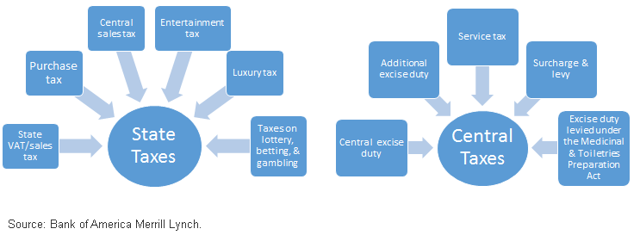
GST aims to subsume these taxes under two distinct categories of central and state tax, as shown in the chart below.

Taxes Subsumed by GST State and Central Taxes
Like 0
Replied on Sep 16, 2016
37.

Chasing the GST deadline: Early movers can capitalise on options and benefit most

Under the GST regime, the credit eligibility of a company will largely depend upon suppliers’ GST compliances. Therefore, companies would prefer to engage with suppliers having GST compliance as their top-most priority.

Like 0
Replied on Sep 16, 2016
38.

GST rollout a hell of a challenge, says Infosys CEO Vishal Sikka

Sikka admitted that the IT backbone of GST is an extremely complex and ambitious exercise as it involves banks, small businesses and states.

Like 0
Replied on Sep 16, 2016
39.

Proud to be part of GST, network project very complex, says Infosys CEO Vishal Sikka

Vishal Sikka, Infosys CEO, on Thursday said that the GST network project was very complex, but was proud to be part of it. Speaking to reporters after making a presentation to Finance Minister Arun Jaitley, Sikka said that there is some weakness in technology preparedness for GST network.

Like 0
Replied on Sep 16, 2016
40.

Congress on Wednesday said the "God and the Devil lies in the detail" of the GST and would not like to prejudice the decision of the Council, even as took a dig at the Centre for its "self-congratulatory patting" at beginning of GST journey as nine-tenth of its details are yet to come. "We have merely passed an empowering and enabling legislation. We have not passed an enforceable tax regime. So unless things are decided, there should not be any interface by me from this podium, by pre-empting the decision of that council by a political party."But certainly there should be no self-congratulatory patting the back by the central government when nine-tenths of the details are yet to come. As we all know, both God and the Devil lies in the details. Let the process start," Congress spokesperson Abhishek Singhvi told reporters. He said there has been a lot of self-congratulatory patting in the back by the Centre, which is failing to realise that "we are at the beginning of the GST journey, not at the end."
Mr Singhvi said almost everything is open and yet to be decided by the GST Council.
He said which article is to be exempted and which one to be taxed and what is the minimum rate and what is the maximum rate or are there three rates or one rate or is it uniform or differential, who will be the dispute resolution mechanism, are yet to be decided and hence refrained from commenting on the issue."Before all that is decided by the newly-constituted Council, no party should comment," he said. On September 12 the Union Cabinet approved setting up of the GST Council, which will decide on the rate of tax under the new Goods and Services Tax (GST) regime, likely to kick in from April 1, 2017.

The GST Council will consist of Union Finance Minister, Minister of State in charge of Revenue Department and state Finance ministers.

Old Query - New Comments are closed.

Hide
Recent Issues