Country of Origin Certificates and declared transaction value supported preferential customs exemption where authenticity and invoice prices remained ...
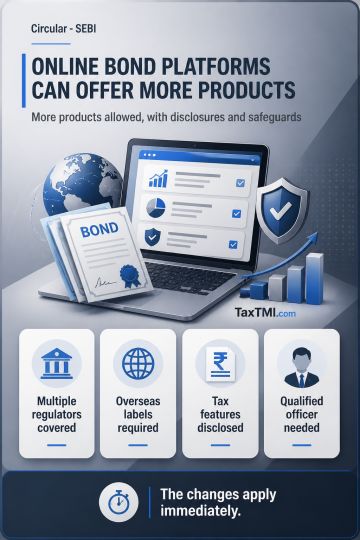
Online bond platforms may offer overseas-regulated products and tax-specific bonds subject to disclosures, compliance safeguards and revised complianc...
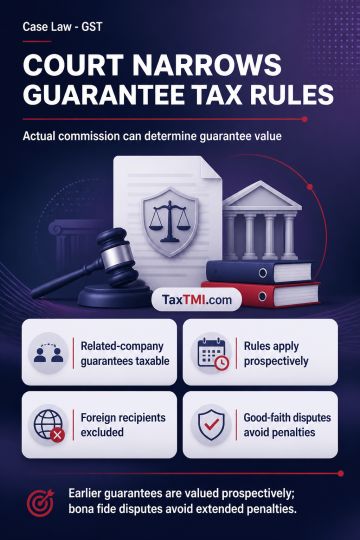
Corporate guarantee valuation permits actual ascertainable commission while barring retroactive application and extended-period penalties for bona fid...
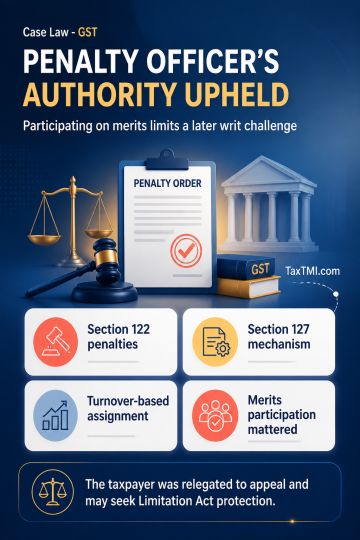
Proper-officer jurisdiction under UPGST penalty provisions upheld; participation on merits prevents bypassing the statutory appellate remedy through w...
Transitioned CENVAT credit may validly satisfy mandatory pre-deposit requirements for legacy service tax appeals through Electronic Credit Ledger debi...
Building-plan sanction charges require statutory authority; unauthorised fees and GST were quashed, while labour cess must follow prescribed collectio...
Pure-agent exclusion fails where hotel booking facilitators receive third-party services themselves, making entire customer consideration taxable as r...
Page of 4814
Press 'Enter' after typing page number.
381 to 400 of 96262 Results
❮
❯
❯❯
0 / 200
Expand Note
Add to Folder
No Folders have been created
+
Are you sure you want to delete "My most important" ?
FDI received as equity or preferential capital was treated as investment in securities, not borrowing in rupees, so the borrowing-and-lending regulations did not apply to the alleged use of funds. Adverse findings on downstream investment and the TISPRO regime were also unsustainable where the show cause notices did not set out the necessary factual basis and the alleged recipient was a society, not another Indian company. FDI-in-trust restrictions were inapplicable on the record, and Section 6(3)(e) did not cover the transactions. Once the company-level contravention failed, the vicarious penalty on the managing director under FEMA also fell away.
FDI received as equity or preferential capital was treated as investment in securities, not borrowing in rupees, so the borrowing-and-lending regulations did not apply to the alleged use of funds. Adverse findings on downstream investment and the TISPRO regime were also unsustainable where the show cause notices did not set out the necessary factual basis and the alleged recipient was a society, not another Indian company. FDI-in-trust restrictions were inapplicable on the record, and Section 6(3)(e) did not cover the transactions. Once the company-level contravention failed, the vicarious penalty on the managing director under FEMA also fell away.
Note: It is a system-generated summary and is for quick reference only.
 TaxTMI
  TaxTMI
 of 4814








 Join Channel